
Life, 1910-09-08 · page 16 of 40
Life — September 8, 1910 — page 16: what you’re looking at
What you’re looking at
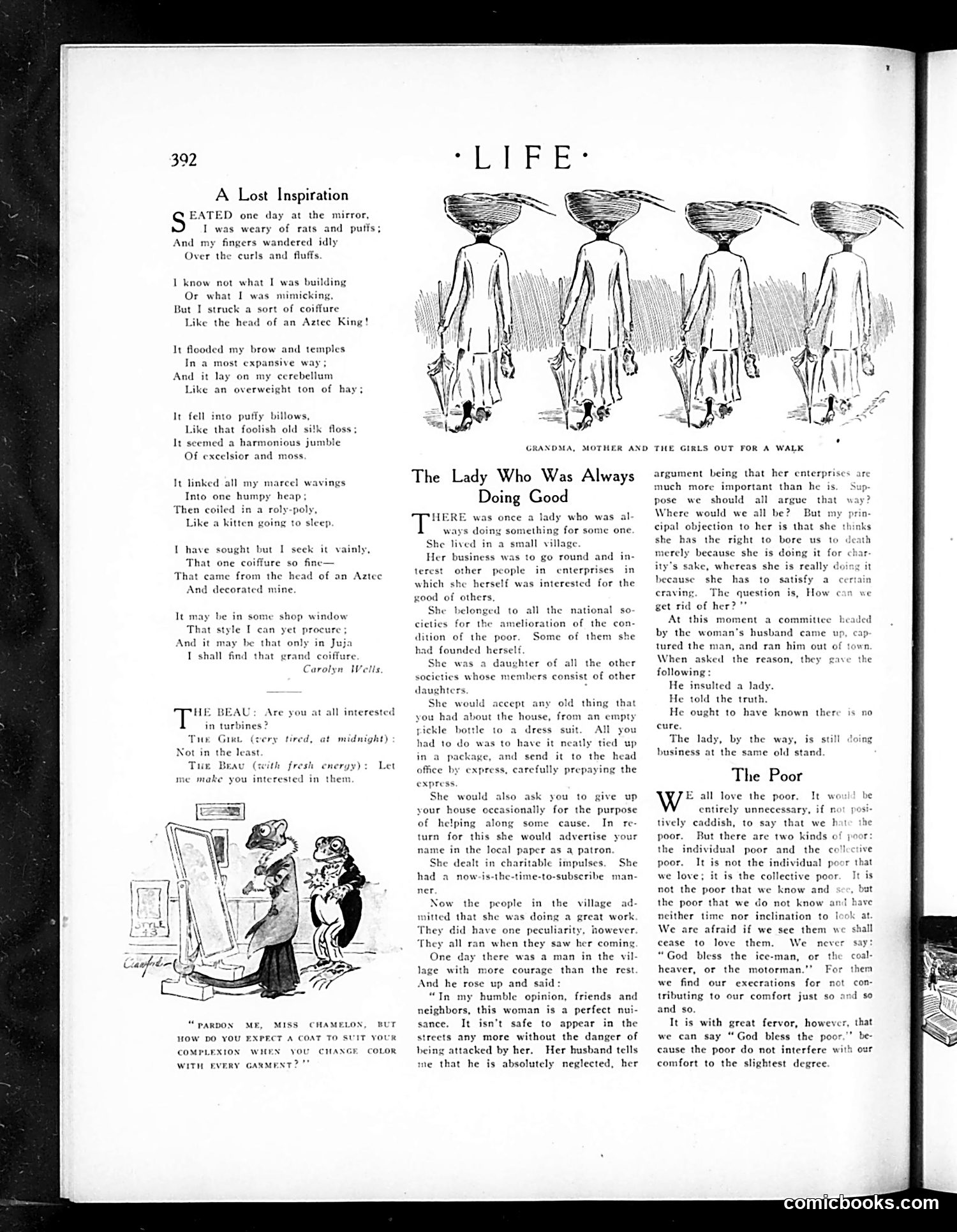
This *Life* magazine page contains three satirical pieces about women's behavior and charity work circa early 1900s. **"A Lost Inspiration"** mocks women's hairstyling fads, particularly elaborate updos resembling an "Aztec King's" head—satirizing the impracticality of fashionable coiffures. **"The Lady Who Was Always Doing Good"** targets self-righteous female charity workers. A village woman constantly organizes relief efforts and solicits donations, boring everyone relentlessly. When a man finally tells her she's a "perfect nuisance," the town defends her charitable work despite universally dreading her visits. The satire critiques performative charity—doing good primarily for social status rather than genuine compassion. **"The Poor"** argues people sentimentally love "the poor" collectively but actually despise poor individuals they encounter. It's a cynical commentary on class attitudes and selective compassion. The cartoon at bottom shows a dandy asking about wearing inappropriate colors—unrelated humor about fashion vanity. Overall, the page satirizes female vanity, self-satisfied charity work, and hypocritical social attitudes toward poverty.
📄 Transcribed text from this page (OCR, searchable)
Machine-transcribed from the original scan — historical spelling and the odd misread are preserved.
392 A Lost Inspiration S ATED one day at the mirror, I was weary of rats and pufis; And my fingers wandered idly Over the curls and fluffs. 1 know not what I was building Or what I was mimicking, But I struck a sort of coiffure Like the head of an Aztec King! It flooded my brow and temples In a most expansive way ; And it Like an overweight ton of hay; y on my cerebellum It fell into puffy billows, Like that foolish old sitk It seemed a harmonious jumble Of excelsior and moss GRANDMA, MOTHER AND THE GIRLS OUT FOR A WALK The Lady Who Was Always Doing Good argument being that her enterprises are much more important than he is. Su should argue that Where would we all be? But my cipal objection to her is that she thinks she has the right to bore us to death merely because she is doing it for ch ity’s sake, whereas she is really doing it It linked all my marcel wavings Into one humpy heap: Then coiled in a roly-poly, Like a kitten going to sl pose we HERE was once a lady who was I ways doing something for some one She lived in a small village Her t other I have sought but I seek it That one coiffure so fine— That came from the head of an Aztec And decorated mine. vainly, siness was to go round and people in enterprises in herself was interested for the terest which she xood of others, She belonged to all the cieties for the because she has to satisfy a certain The question is, How can we get rid of her?’ At this me by the wo: craving It may national so That style I can yet proc And it may be I shall fi be in some shop window nent a committee headed an’s husband came up, cap. tured the man, and ran him out of tow When asked following: amelioration of the con- Some of that only in Juja that grand coiffure dition of the poor them she had founded herself Teatls S| 1 daughter of all the other societies whose members consist of other was the reason, they gave the Carolyn HE BEAU; Are in turk Tue Not in the least Brau (sith fresh energy): Let ¢ you intere Tur “PARDON ME, HOW DO YOU EXPECT A COAT TO SUIT YOUR COMPLEXION WITH EVERY Grit. daughters. you at all interested ickle be (very tired, at midnight) office b: express. She $s would would also ask accept any old thing you had about the house, from an empty le to a dress suit. Al had to do was to have it neat in a package, express, carefully prepaying the nd send it to the head you to give up your house occasionally for the purpose of helping along some cause. In re- turn for this she would advertise your name in the local paper as a patron he dealt in cha had a now-is-th ner Now the She man- itable impulses. time-to-subsceribe people in the village ad- mitted that she was doing a great work They did have one peculiarity, however. ‘They all ran when they saw her comins One day there was a man in the vil lage with more courage than the rest And he ro: ec up and said: “In my humble opinion, friends and neighbors, this woman is a perfect nui- MISS CHAMELON, BUT sance. It wien GARMENT?" YOU CHANGE COLOR isn’t streets any more without the danger of ng attacked by her. that he is absolutely neglected, her safe to appear in the Her husband tells He insulted a lady. He told the truth. He ought to have known ther cure The lady, by the way, business at the same old stand The Poor E all love the poor. It we entirely unnecessary, if n tively caddish, to say that we } poor. But there are two kinds c the individual poor and the co!l poor, It is not the individual poor that we love; it is the collective poor. I not the poor that we know and but the poor that we do not know ant have neither time nor inclination to look at We are afraid if we see them we shall cease to love them. We never say? “God bless the ice-man, or the ¢ heaver, or the motorman.’’ For them we find our execrations for not con- tributing to our comfort just so and so and so, It is with great fervor, however, that we can say “God bless the poor.” be- cause the poor do not interfere with our comfort to the slightest degree. is no is still doing cComicbooks.com