
A complete issue · 40 pages · 1910
Life — July 14, 1910
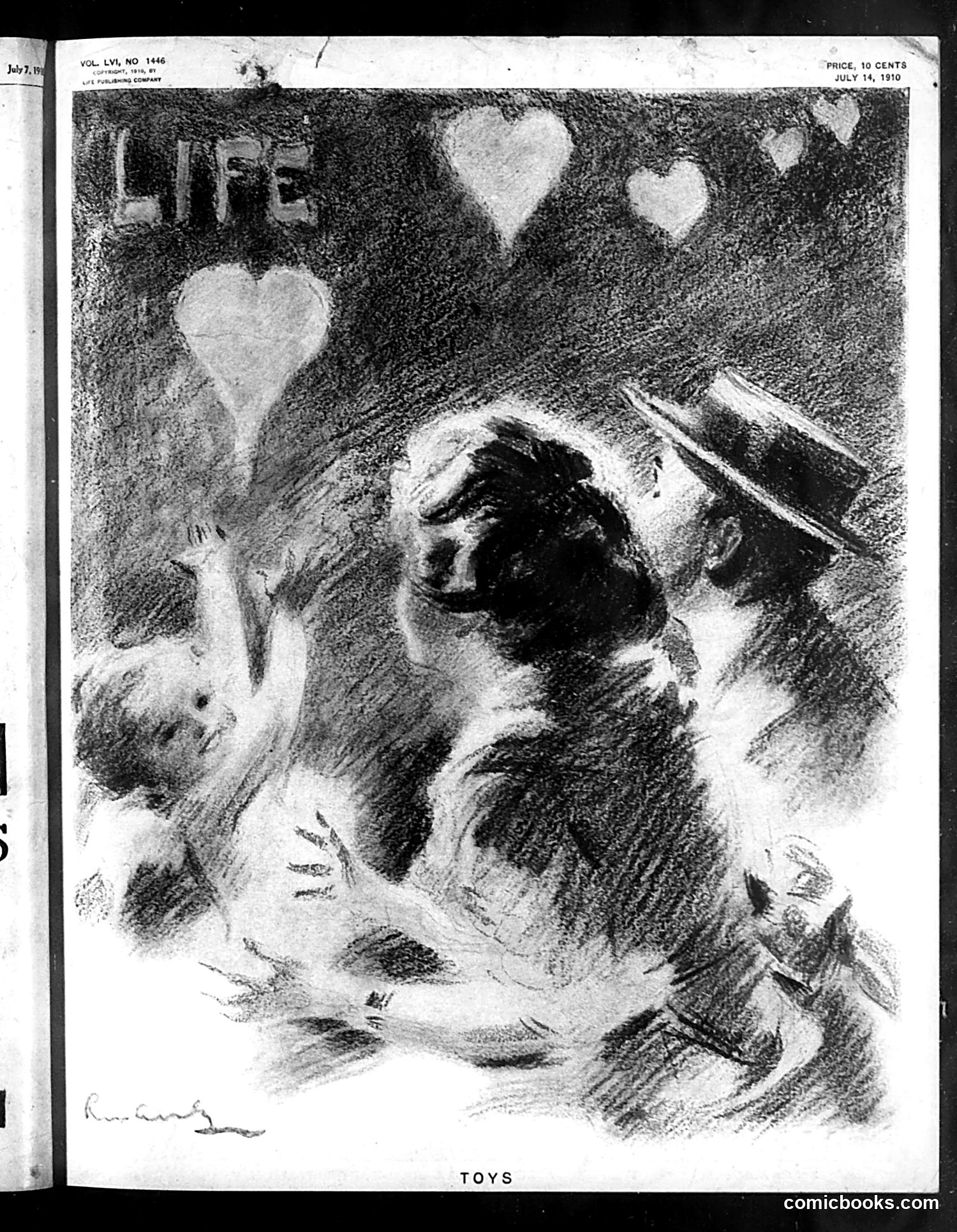
This page from *Life* magazine (July 14, 1910) is titled "TOYS" and appears to be a satirical illustration rather than a political cartoon. The sketch shows two figures—a man wearing a hat and a woman—gazing upward at floating hearts. The satire likely critiques romantic sentimentality or courtship rituals of the Edwardian era. The caption "TOYS" suggests the artist is mocking the triviality of romantic gestures or love itself, presenting hearts as playthings rather than genuine emotion. The dreamy, upward gazes of the figures imply naive romanticism. Without identifying the specific figures, the broader point appears to be social commentary on the superficiality of contemporary courtship customs among the middle or upper classes, treating romantic love as entertainment rather than something substantial.
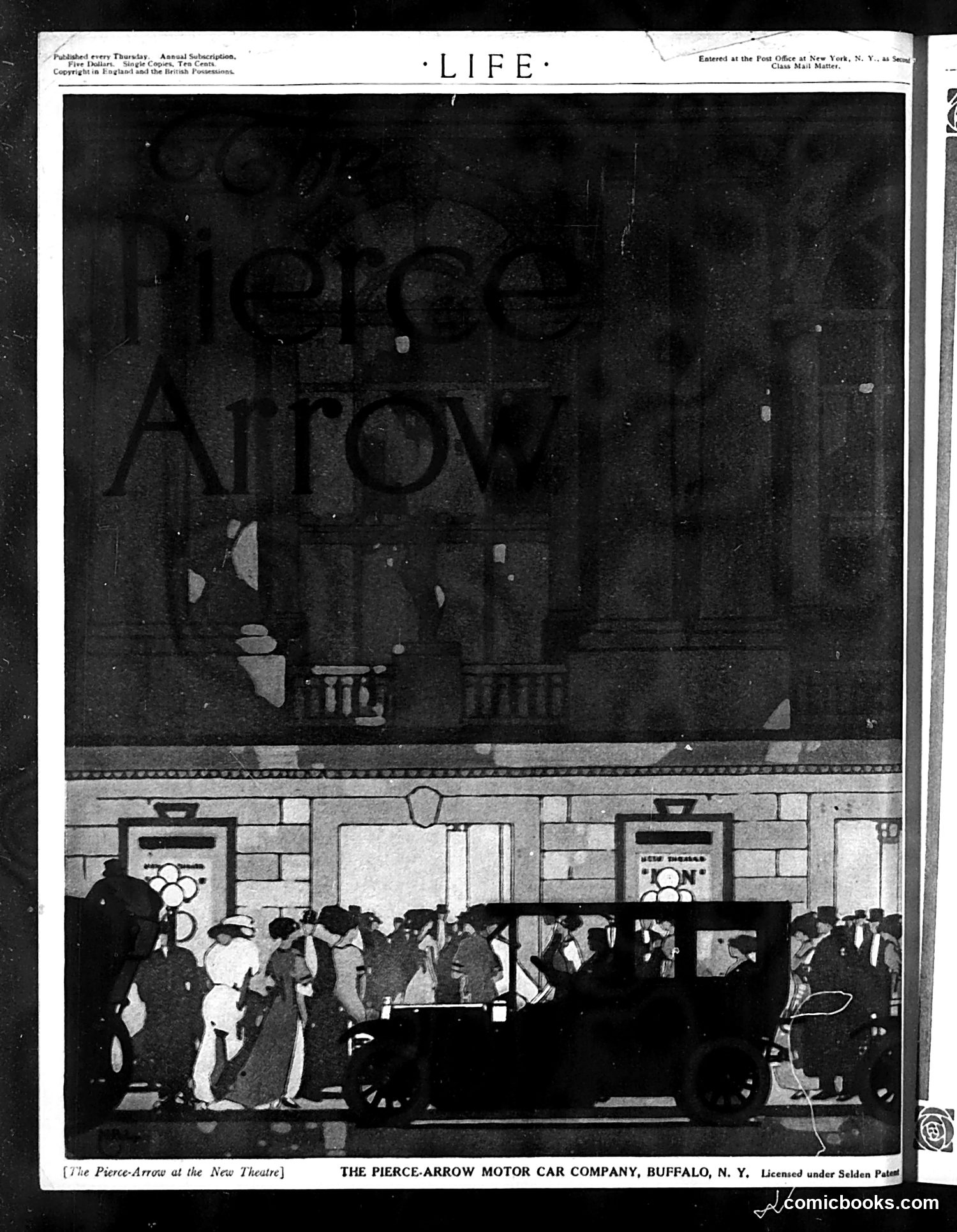
This page is primarily **advertising**, not political satire. The image shows a Pierce-Arrow motor car displayed at what appears to be the New Theatre in New York City, with well-dressed crowds gathered around it. The "Pierce-Arrow" text overlaid on the theater's upper facade represents the brand name prominently featured in the display. The caption credits "THE PIERCE-ARROW MOTOR CAR COMPANY, BUFFALO, N.Y." and notes it is "Licensed under Selden Patent." This is a product advertisement showcasing an automobile at a public venue, likely from the early 20th century when motorcar exhibitions were significant commercial and social events. The crowd's formal dress suggests this was a prestigious display targeting wealthy potential buyers.
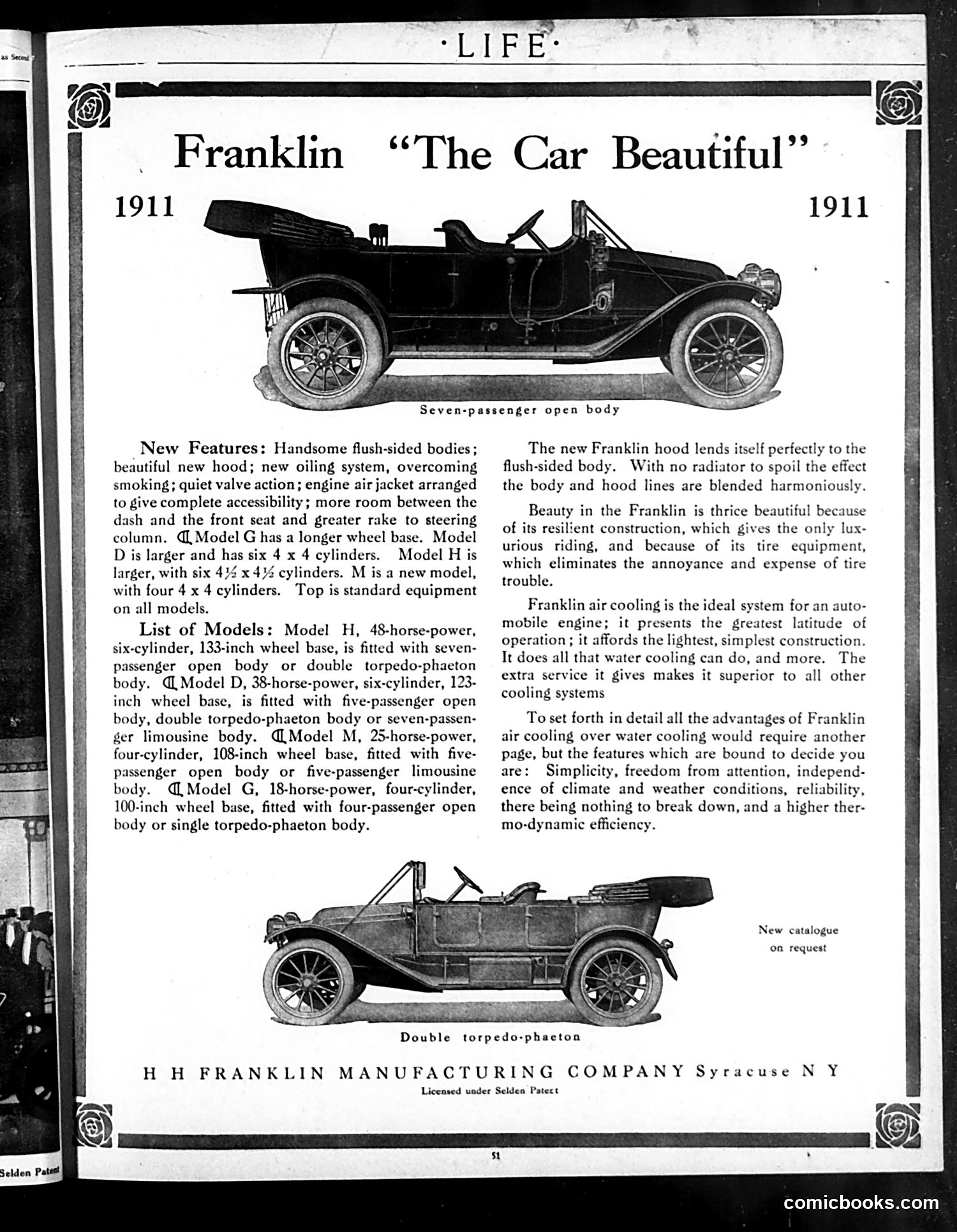
This is **not a cartoon or satire page**, but rather a **straightforward advertisement** for the Franklin automobile company of Syracuse, New York, published in 1911. The page showcases two vehicle models—a seven-passenger open body and a double torpedo-phaeton—with technical specifications emphasizing the Franklin's distinctive air-cooling system and construction quality. The marketing copy highlights features like flush-sided bodies, quiet valve action, and accessibility to engine components. This represents early automotive advertising before mass production made cars commonplace. The detailed mechanical descriptions and emphasis on engineering indicate the target audience was wealthy, technically-minded buyers who understood and valued automotive innovation. There is no political or social satire present on this page.
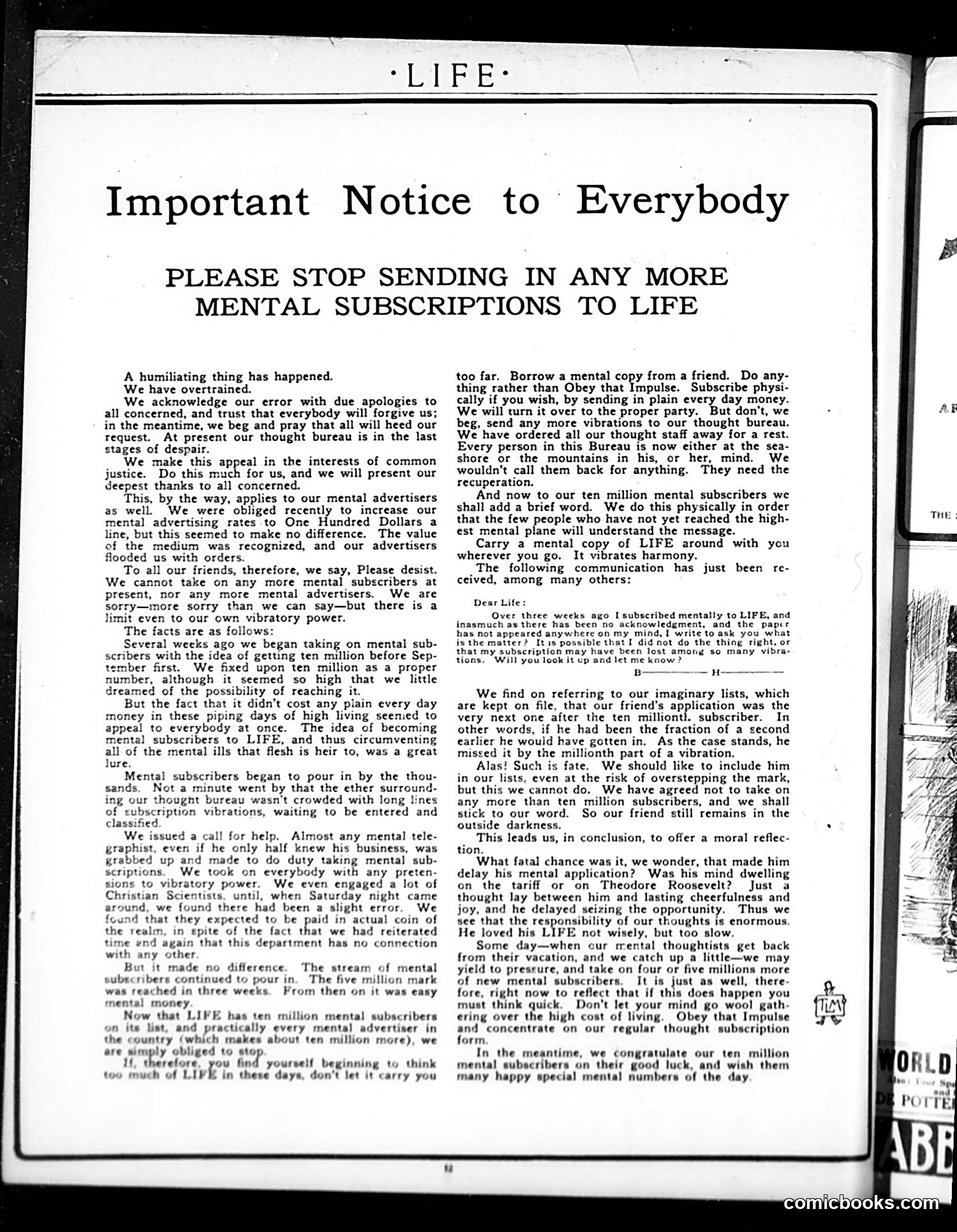
This page is primarily an editorial notice, not a cartoon. It's a humorous apology from *Life* magazine to its readers for a failed experiment with "mental subscriptions"—a concept where readers would mentally subscribe to the magazine rather than pay for physical copies. The notice explains that *Life* attempted to increase revenue by taking on mental subscribers, apparently believing this would work through some form of thought transmission or "vibratory power." The experiment failed dramatically, with five million mental subscribers allegedly materializing. The satire targets both the magazine's overconfidence in an absurd business scheme and, implicitly, the period's fascination with pseudoscientific concepts like mental telepathy. The tone mixes genuine apology with tongue-in-cheek self-mockery about the venture's obvious impossibility.
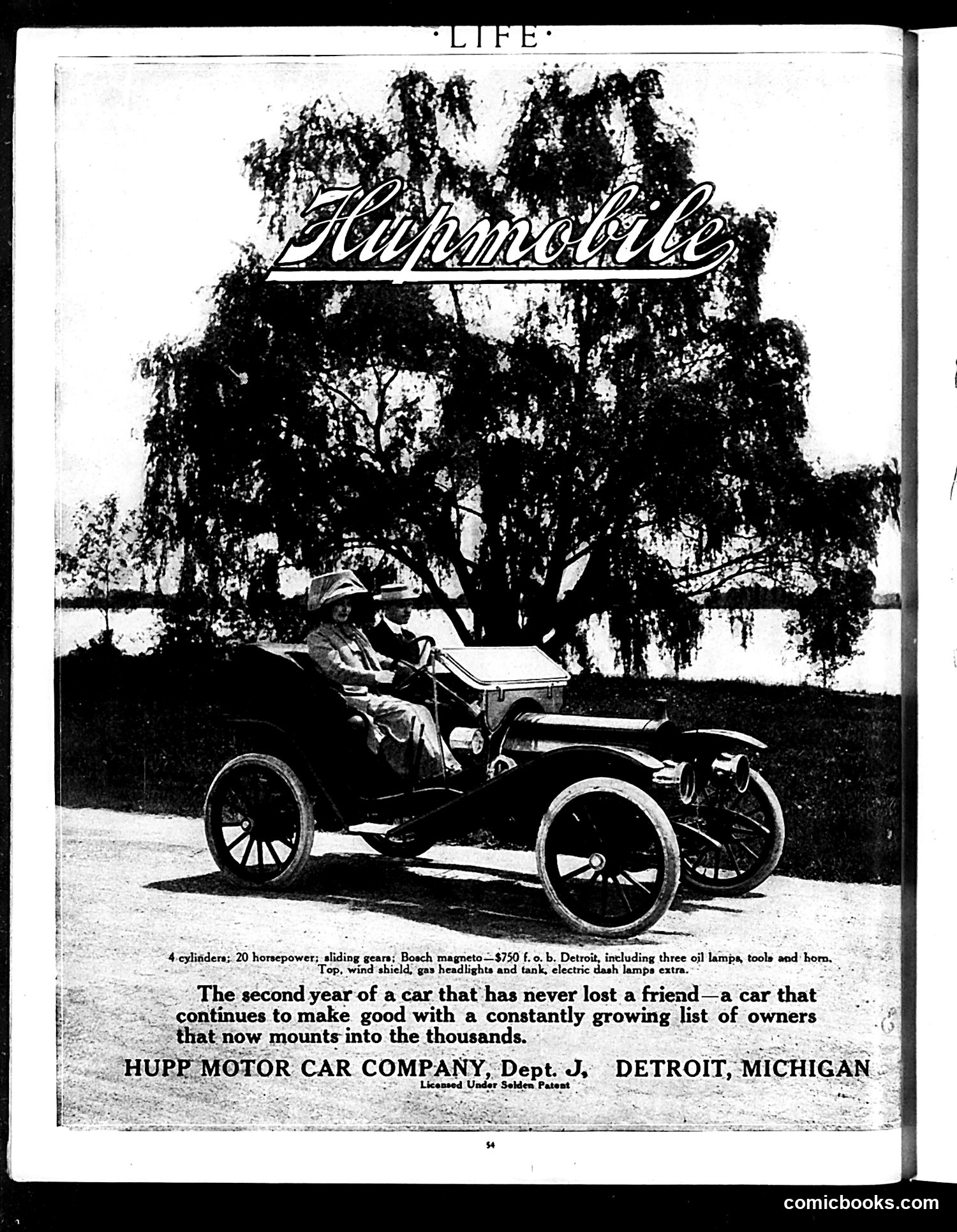
This is **not a cartoon or satire page** — it's a **straightforward advertisement** for the Hupp Motor Car Company of Detroit, Michigan. The image shows an early automobile (appears to be from the 1910s era) parked beneath a large willow tree near water, with a well-dressed driver. The ad emphasizes the car's reliability and durability, claiming it "has never lost a friend" and continues to perform well for a growing number of owners. The specifications listed (4 cylinders, 20 horsepower, Bosch magneto, priced at $750) reflect typical early automotive marketing. This represents vintage commercial advertising promoting automobile ownership during the early mass-production era, not political or social commentary.
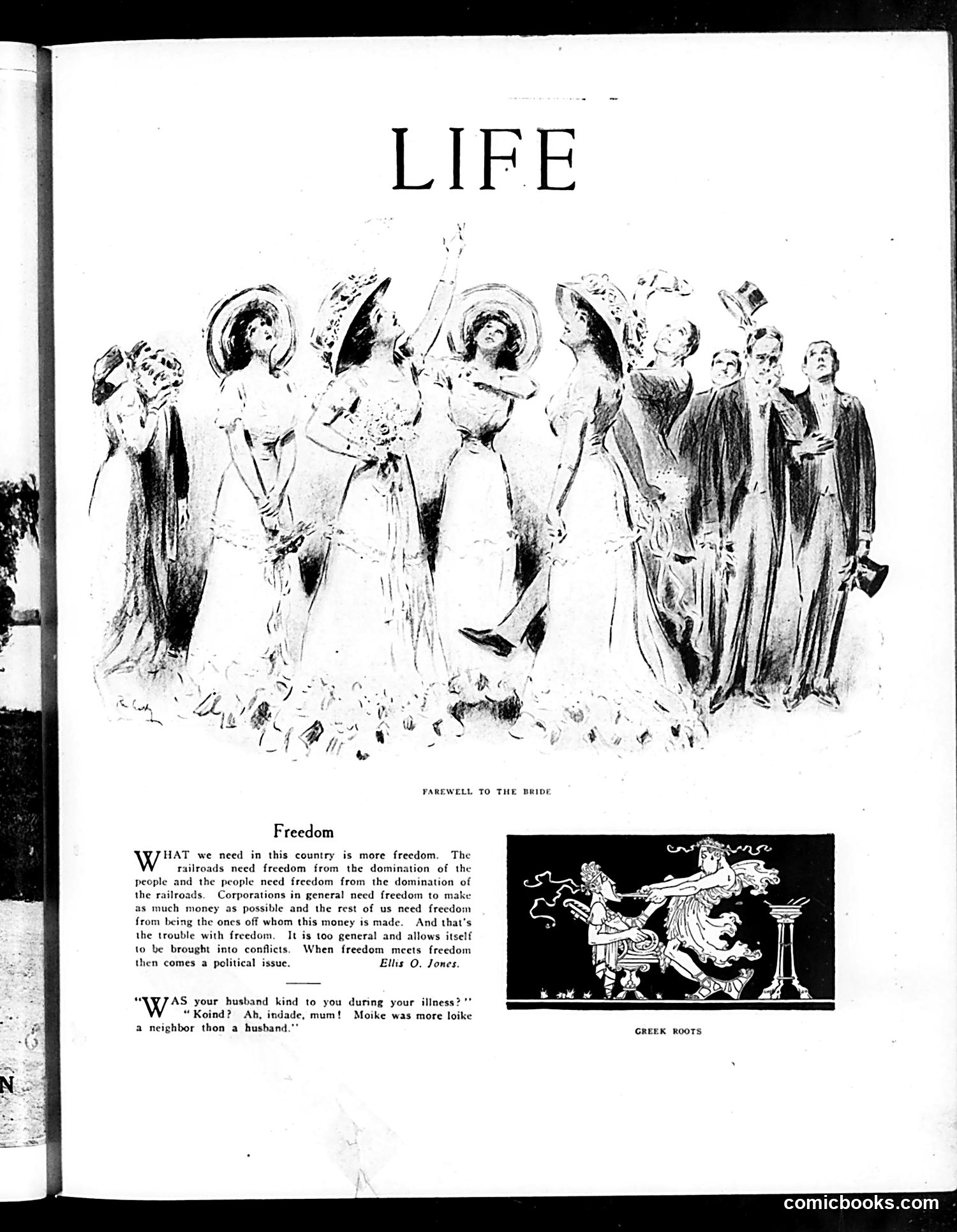
This page presents social commentary on early 20th-century American life. The main illustration titled "Farewell to the Bride" shows a wedding scene with figures in period dress. Below, an essay titled "Freedom" argues that America needs greater freedom from railroad and corporate domination. Author Elias O. Jones contends that corporations should have less power to influence how public money is spent. A separate joke exchanges dialogue about a husband's kindness during his wife's illness, with a punchline suggesting a neighbor ("Moike") was more attentive—implying either infidelity or the wife's preference for the neighbor's company. The "Greek Roots" illustration (bottom right) appears to be an unrelated classical or mythological vignette. The page mixes political editorial commentary with domestic humor typical of Life's satirical approach.
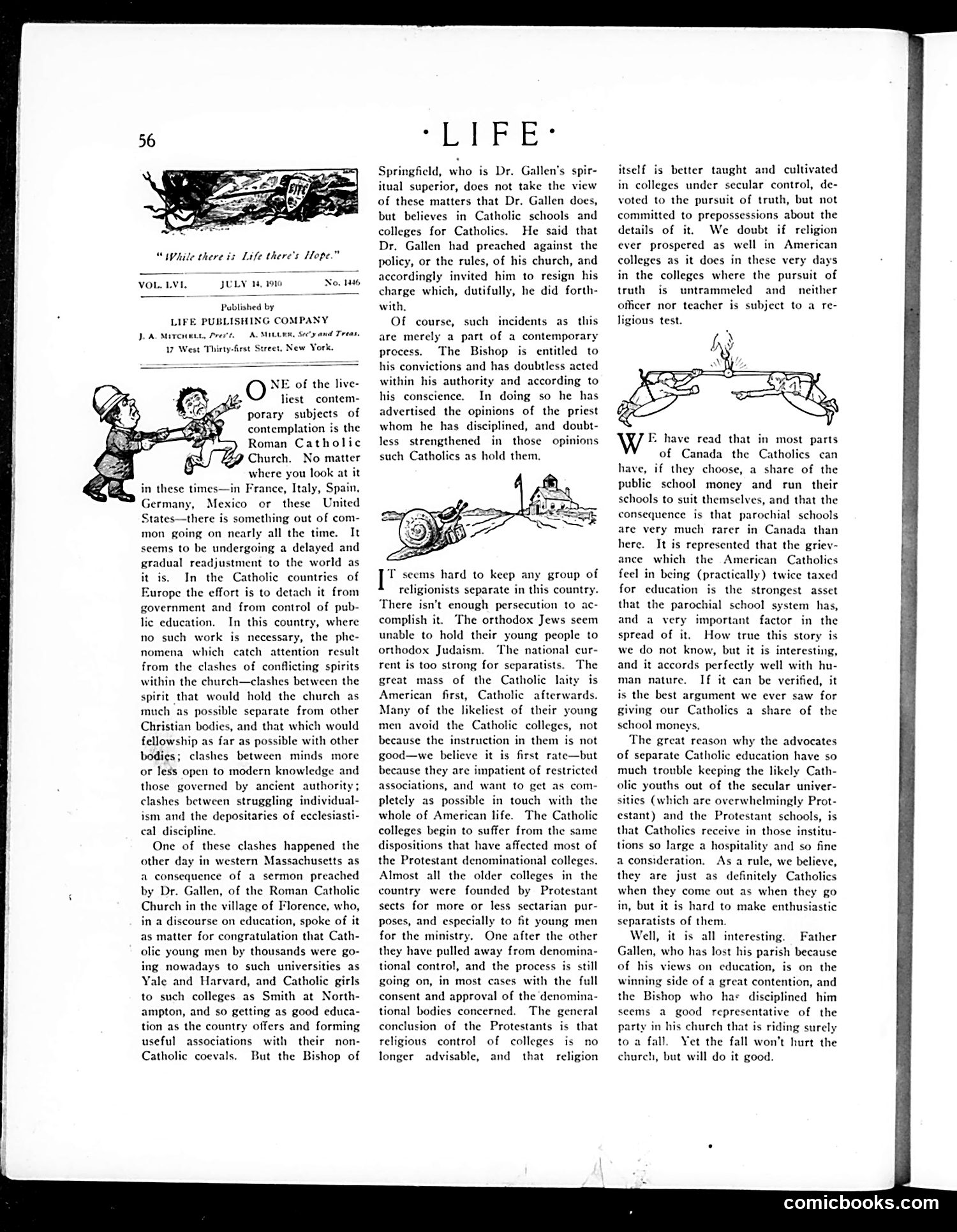
This page contains editorial text addressing Catholic education in America, accompanied by illustrative cartoons rather than political satire. The cartoons depict **children in various educational scenarios**—one shows youngsters near what appears to be a schoolhouse or institution. The imagery supports the article's discussion of Catholic versus public schooling debates in early 20th-century America. The text discusses **Bishop Gallen's conflict** over Catholic education policy and references broader tensions between Catholic and Protestant institutions. It debates whether Catholics should attend secular universities or separate Catholic colleges, and whether Catholic youth were being adequately separated from "American life." The satire is gentle—the primary point critiques both sides: Catholics worried about assimilation, and Protestants concerned about Catholic institutional control. The cartoon's simple depictions underscore the article's examination of these competing educational philosophies.
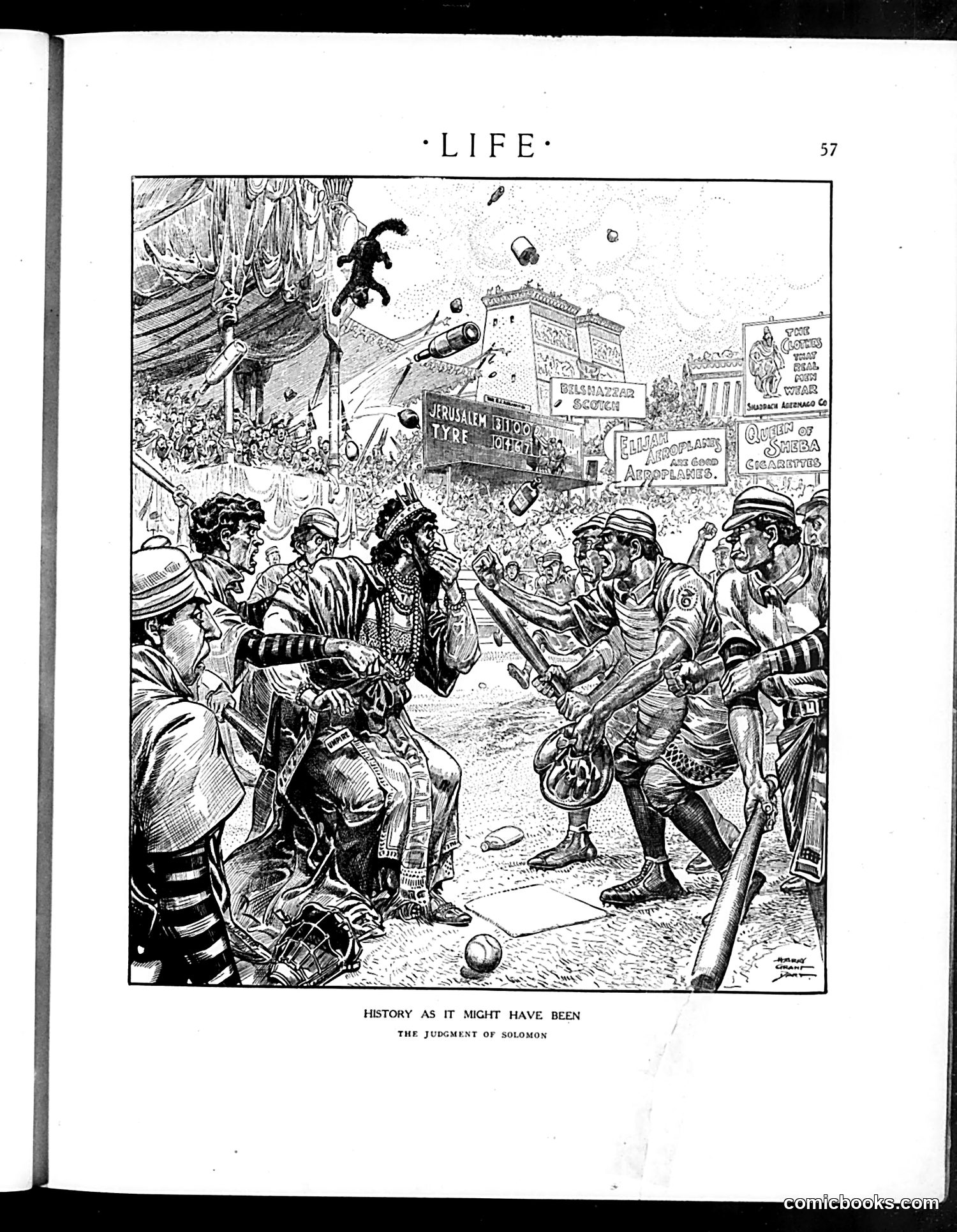
This satirical cartoon depicts a chaotic scene at what appears to be a public event or fair (visible signage includes "Jerusalem Ghee" and various advertisements). The title references Solomon, the biblical king famous for wise judgment. The cartoon presents a humorous "alternative history" scenario where Solomon's legendary wisdom is applied to a modern, carnival-like setting. A central figure in elaborate dress (likely representing Solomon) presides over what appears to be a dispute or conflict among working-class men in period attire. The satire likely mocks how ancient wisdom supposedly applies to contemporary social conflicts or labor disputes. The chaotic crowd and commercial backdrop suggest commentary on modern society's distance from genuine wisdom or justice.
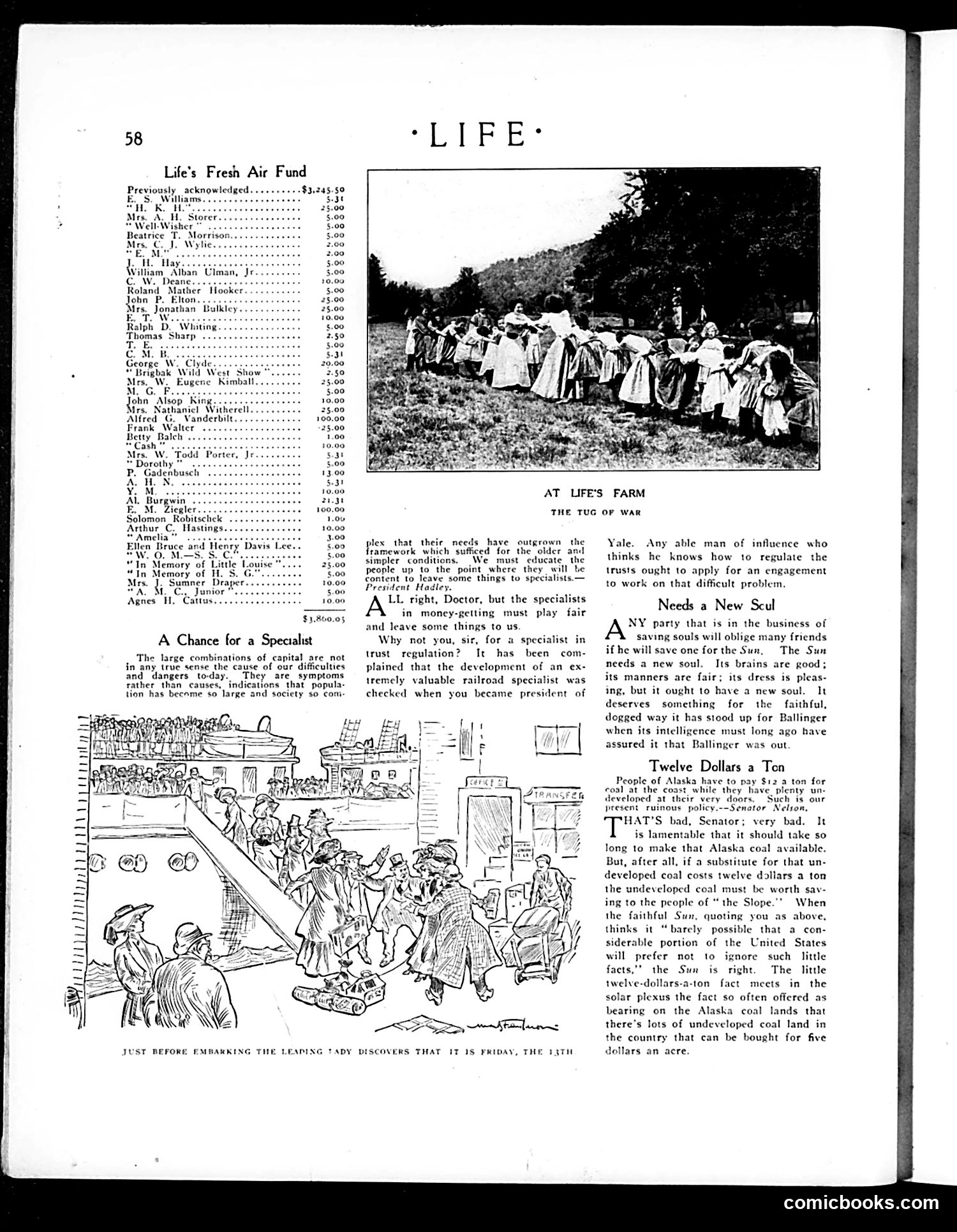
This page contains two distinct elements: **Top Section:** A photograph labeled "AT LIFE'S FARM - THE TUG OF WAR" shows a group of people in period dress engaged in a tug-of-war game outdoors, likely at a Life magazine-sponsored event or farm. **Bottom Section:** A satirical cartoon titled "JUST BEFORE EMBARKING THE LEADING 'LADY' DISCOVERS THAT IT IS FRIDAY, THE 13TH" depicts a crowded, chaotic scene of people in early 20th-century dress. The cartoon satirizes superstition about Friday the 13th—showing panicked reactions among what appears to be theatrical performers or travelers about to embark on a journey. The humor derives from mocking the widespread belief in this unlucky date as an actual cause for concern. The page also includes various short articles and donation lists for "Life's Fresh Air Fund."
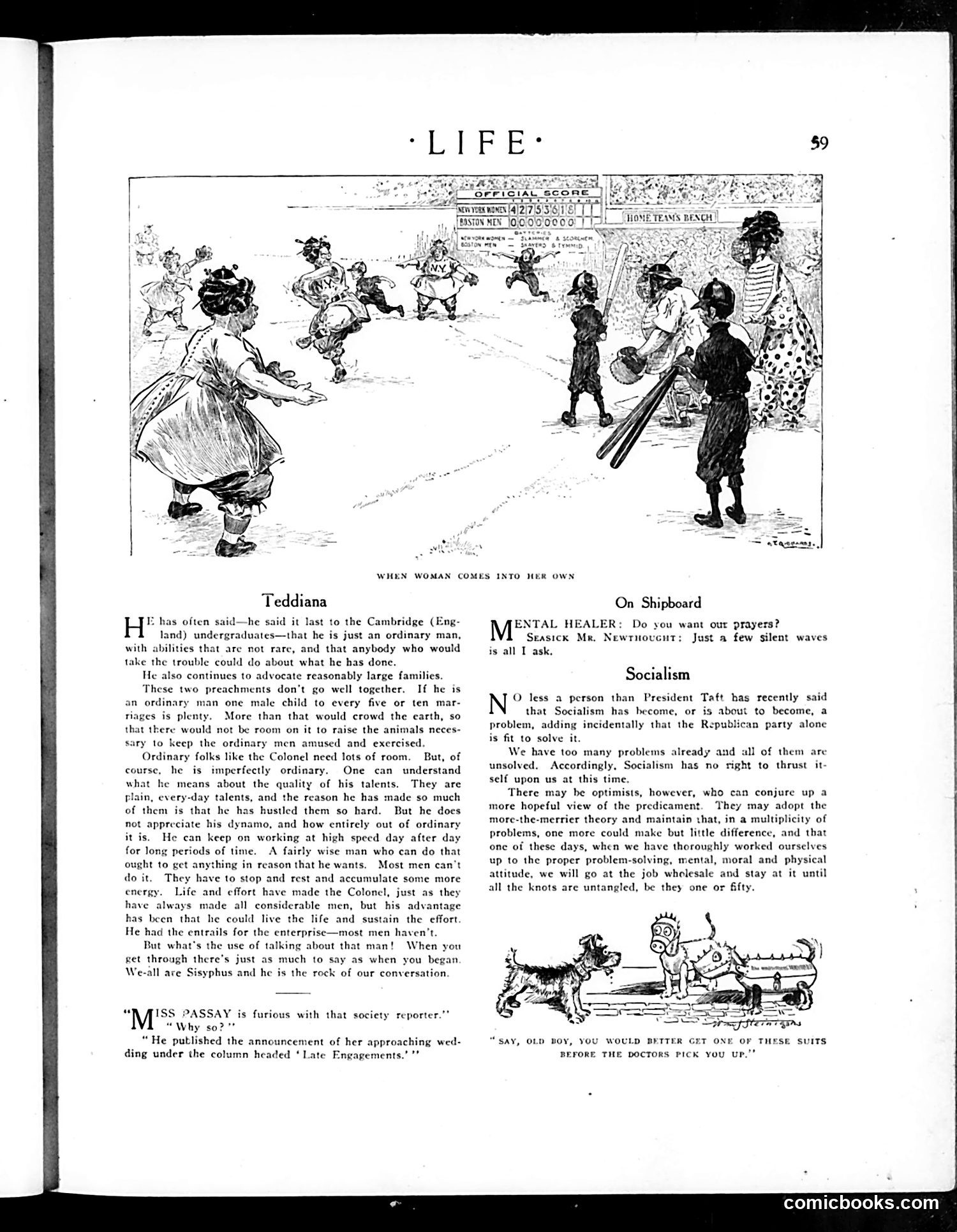
The page contains three distinct sections: **"Teddiana" (left column):** Discusses Theodore Roosevelt's advocacy for large families and the strain on ordinary men's finances and energy. It's satirical commentary on Roosevelt's public statements about population and masculinity. **"On Shipboard" (right column):** A brief dialogue joke about a mental healer offering prayers during rough seas. **"Socialism" (center-right):** Critiques the Socialist Party's recent electoral gains, arguing they've identified problems but lack solutions. It suggests the Republican Party should address issues proactively to prevent further Socialist gains. **Bottom illustration:** A cartoon showing dogs in suits, captioned about getting a suit "before the doctors pick you up"—likely satirizing hypochondria or medical pretension. The page reflects early 20th-century American political anxieties about Socialism and social reform.
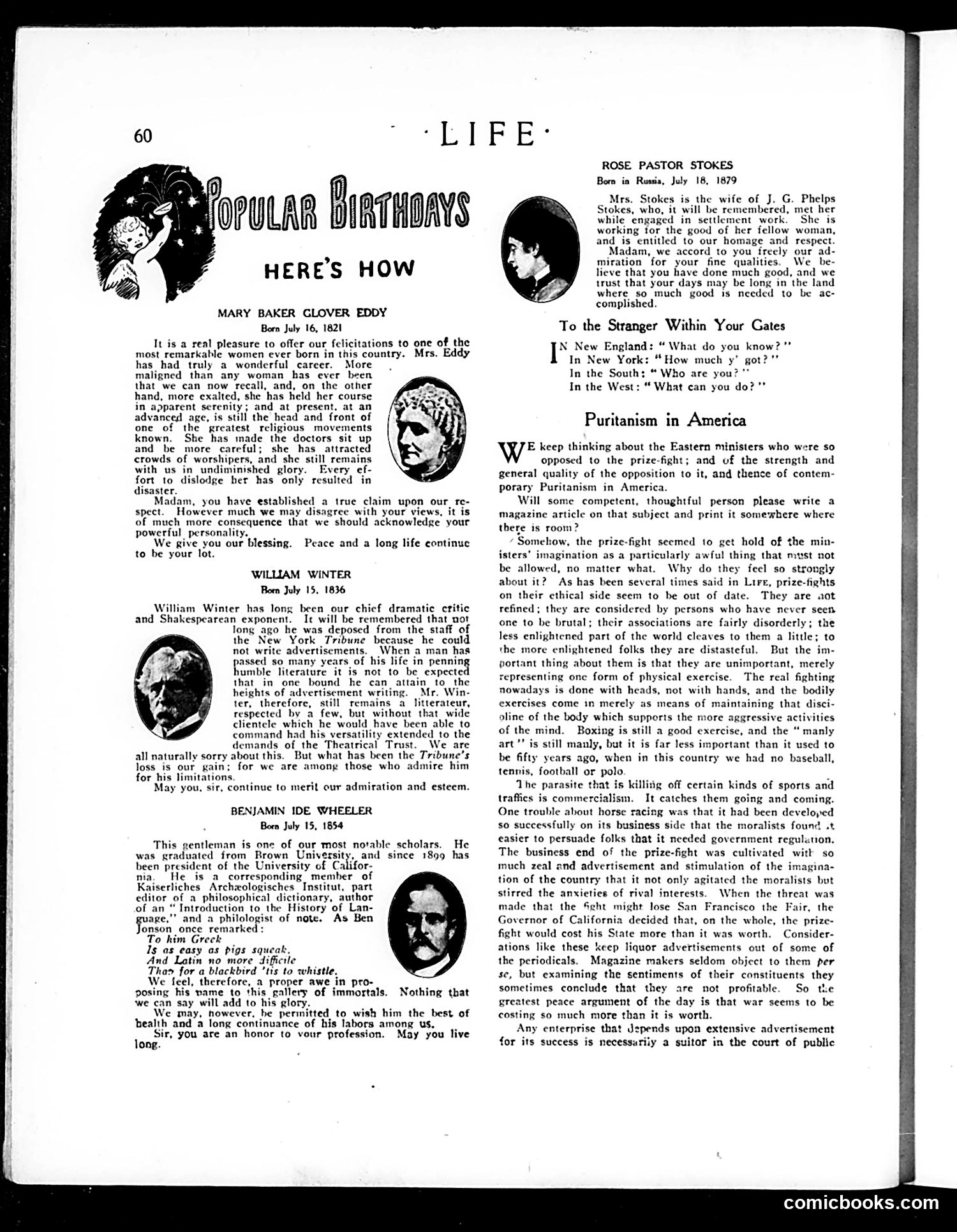
This page from *Life* magazine celebrates notable birthdays of public figures. The left column features portrait caricatures and biographical tributes to: - **Mary Baker Glover Eddy** (born 1821) — founder of Christian Science, praised for her religious movement and character - **William Winter** (born 1836) — a dramatic critic and Shakespeare expert, noted for his literary contributions - **Benjamin Ide Wheeler** (born 1854) — a prominent scholar and university leader The right side contains an essay titled "Puritanism in America" discussing Eastern ministers' opposition to prize-fighting and commercialized sports, particularly boxing. The author argues that boxing, despite its brutality, serves legitimate purposes and that commercialism—not the sport itself—is the real problem worth addressing. The page functions as celebratory biography combined with social commentary on American values.
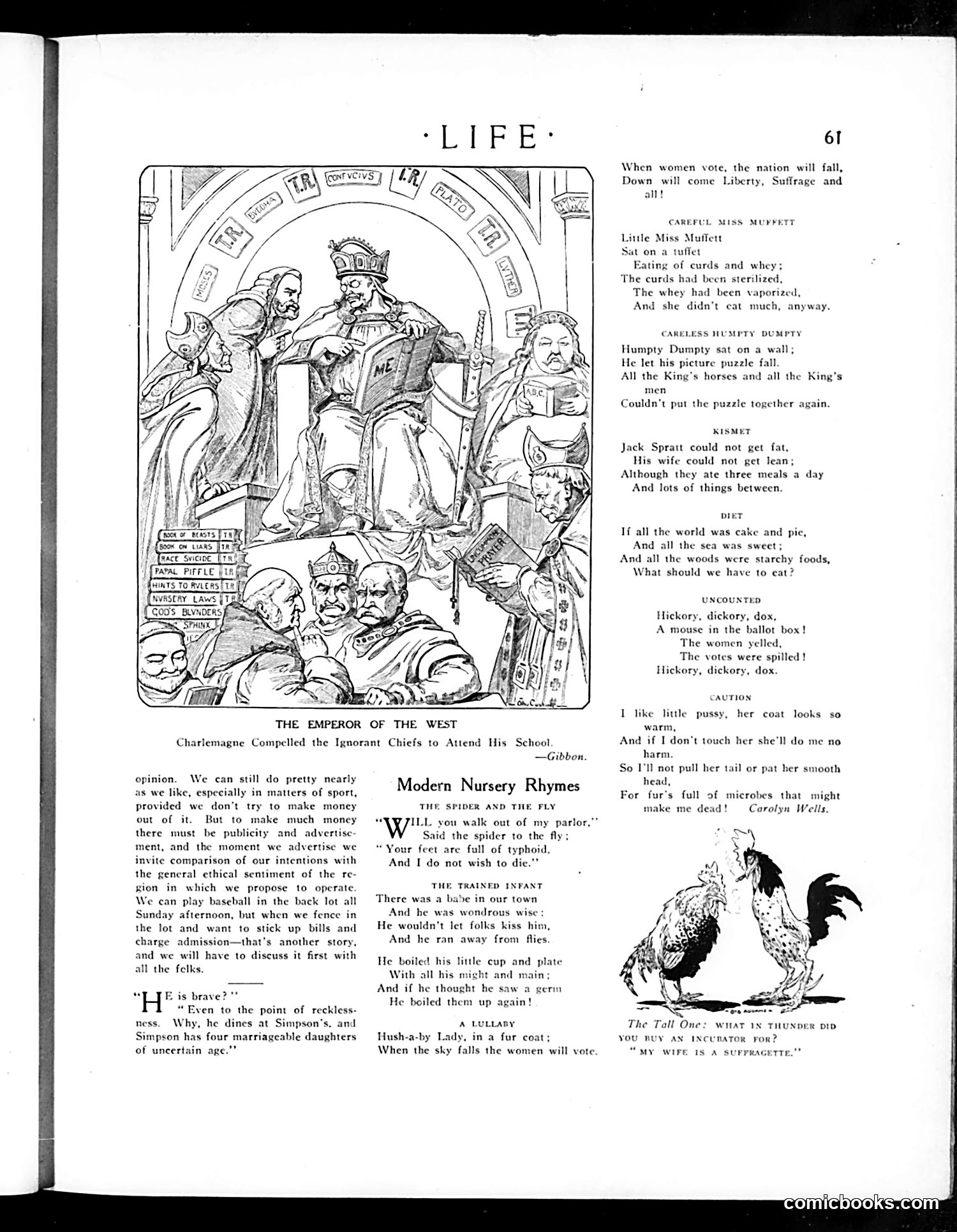
This cartoon satirizes **Charlemagne compelling ignorant chiefs to attend his school**, as noted by the Gibbon attribution. The central crowned figure appears to represent a powerful medieval ruler forcing subordinates into educational compliance. The satire likely critiques **contemporary authoritarian leadership or forced assimilation policies**, using historical analogy. The pile of books labeled "NURSERY LAWS," "FATAL PIFFLE," etc., suggests mockery of mandatory education laws or propaganda disguised as instruction. The bottom section contains unrelated nursery rhymes and light comic verses about everyday subjects (spiders, trained infants, diet). The page mixes serious political satire with frivolous humor—typical of *Life* magazine's format combining editorial commentary with entertainment content.
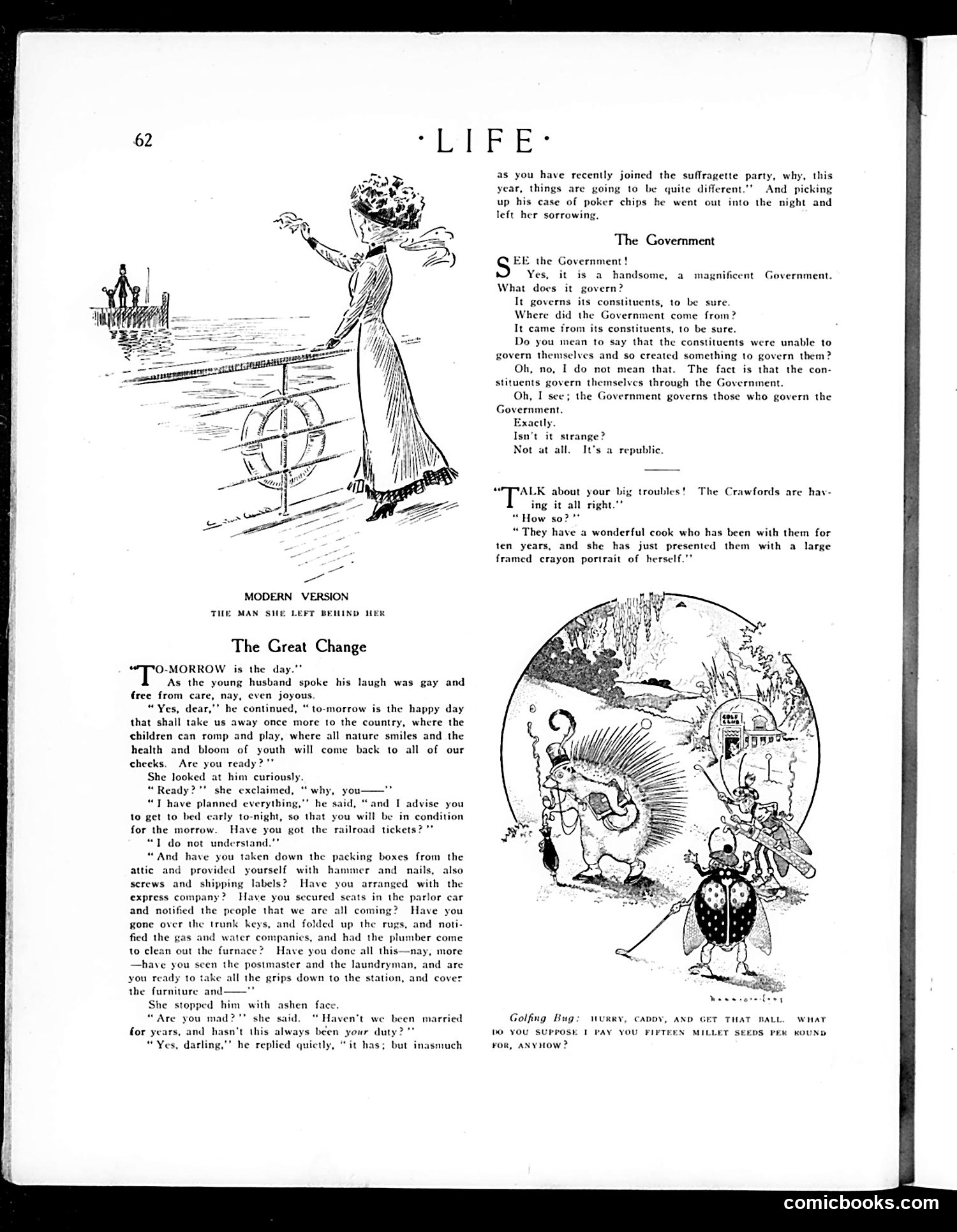
This page contains three satirical pieces: **"The Government"**: A philosophical dialogue mocking circular logic in democratic systems. It questions how constituents create government to govern them, yet constituents govern themselves *through* government—creating an absurd loop. The satire targets the paradox of representative democracy itself. **"The Great Change"**: A domestic comedy about a husband finally acknowledging his wife's unpaid labor. For years, she's handled all moving logistics (packing, arranging transport, notifying services). When he suddenly lists these tasks, she's shocked—he's finally recognizing her invisible work. The satire comments on how wives' domestic management goes unappreciated until explicitly enumerated. **"Golfing Bug"**: A brief joke about a golfer negotiating payment with his caddy using absurdly small currency (millet seeds), likely satirizing either stingy employers or the sport's class pretensions. The "Modern Version" subtitle for the second piece suggests Life is updating older domestic humor for contemporary (1910s-era) audiences, particularly referencing the suffragette movement mentioned in the opening text.
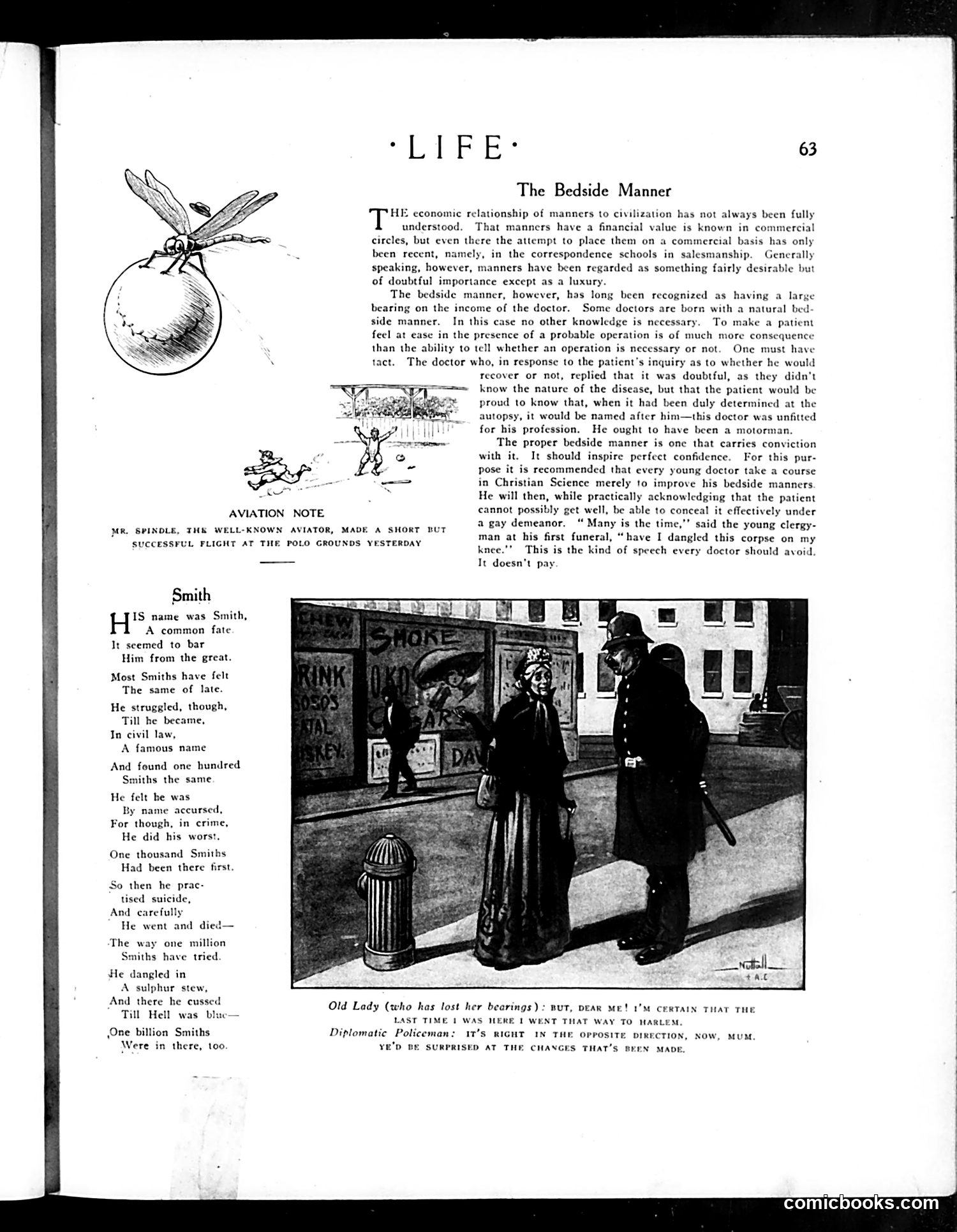
**"The Bedside Manner"** is a satirical essay mocking doctors who rely on charm rather than competence. It argues that a reassuring "bedside manner" can be more financially valuable to physicians than actual medical knowledge. The piece sarcastically suggests young doctors study Christian Science to learn how to comfort dying patients while concealing doubt about their survival—the ultimate con. The specific anecdote ridicules a doctor who tells a patient he'll be named after them at autopsy, suggesting such tactlessness disqualifies one from medicine. **"Smith"** is a humorous poem about a man cursed with the common surname Smith, struggling to achieve distinction before ultimately committing suicide—joining "one million Smiths" who've tried the same desperate act. It's dark comedy about anonymity and social aspiration. **The street scene photograph** shows an elderly woman confused about city directions, with a diplomatic policeman redirecting her—illustrating how urban change has disoriented longtime residents. The page satirizes professional pretense, common names as social handicap, and urban transformation.
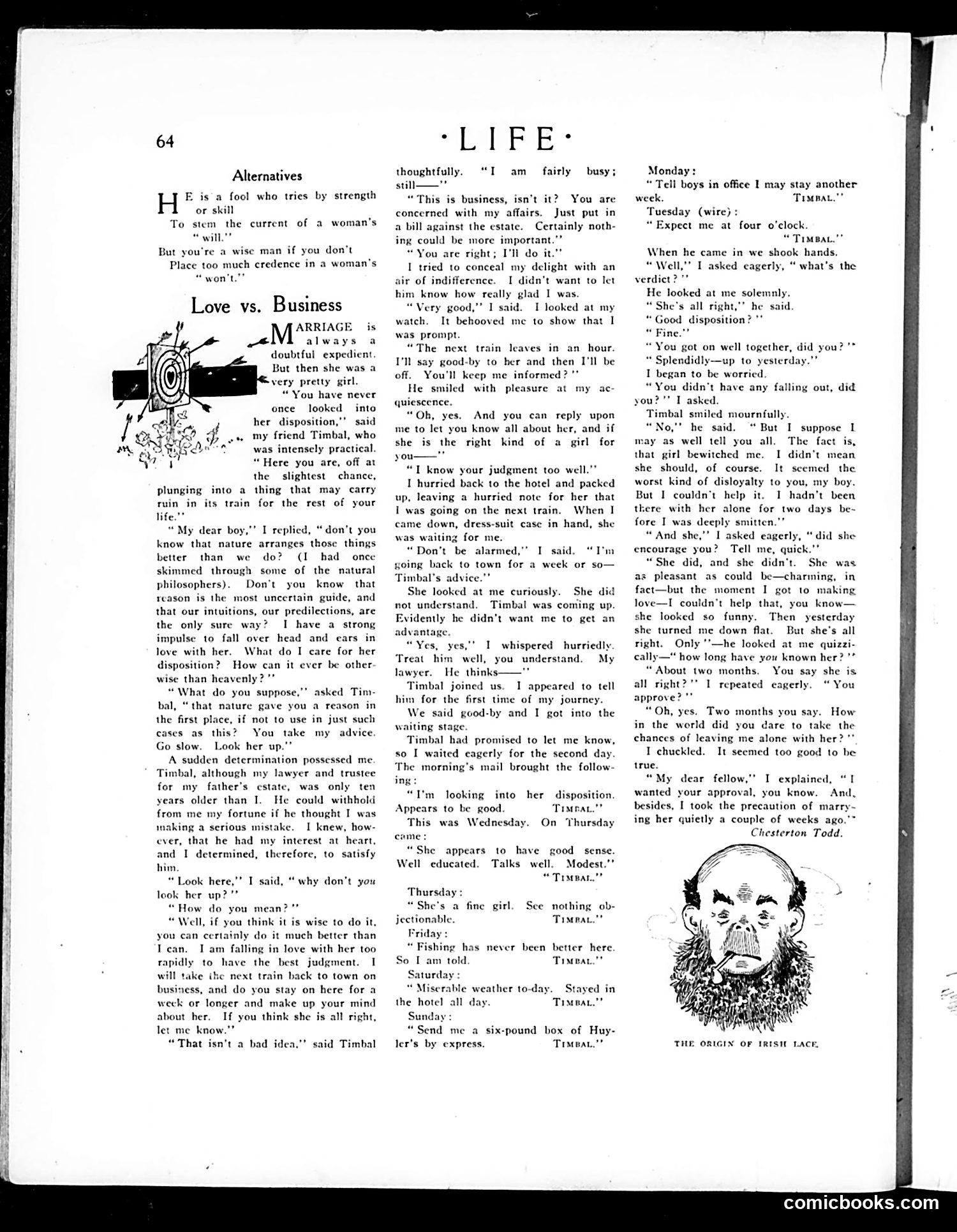
This page presents a short story mocking the tension between romantic impulse and practical business sense. The narrator falls in love with a pretty woman but his friend and trustee Timbal—a practical lawyer—insists on investigating her character before approving the match (apparently he has financial control over the narrator's inheritance). The narrator agrees, leaves town, and Timbal agrees to "look her up" by spending time with her. The story ends with Timbal reporting back via telegram throughout the week, offering increasingly positive but cautious assessments of the woman's disposition and character. **The satire's point**: The absurdity of treating romantic evaluation like a business transaction—using a lawyer to conduct due diligence on a potential wife, billing the investigation to an estate, and reducing human character to terse professional reports. It mocks both the prudishness of treating love as a financial matter and the era's tendency to subordinate emotion to legalistic practicality. The illustration titled "The Origin of Irish Lace" appears unrelated to the main text.
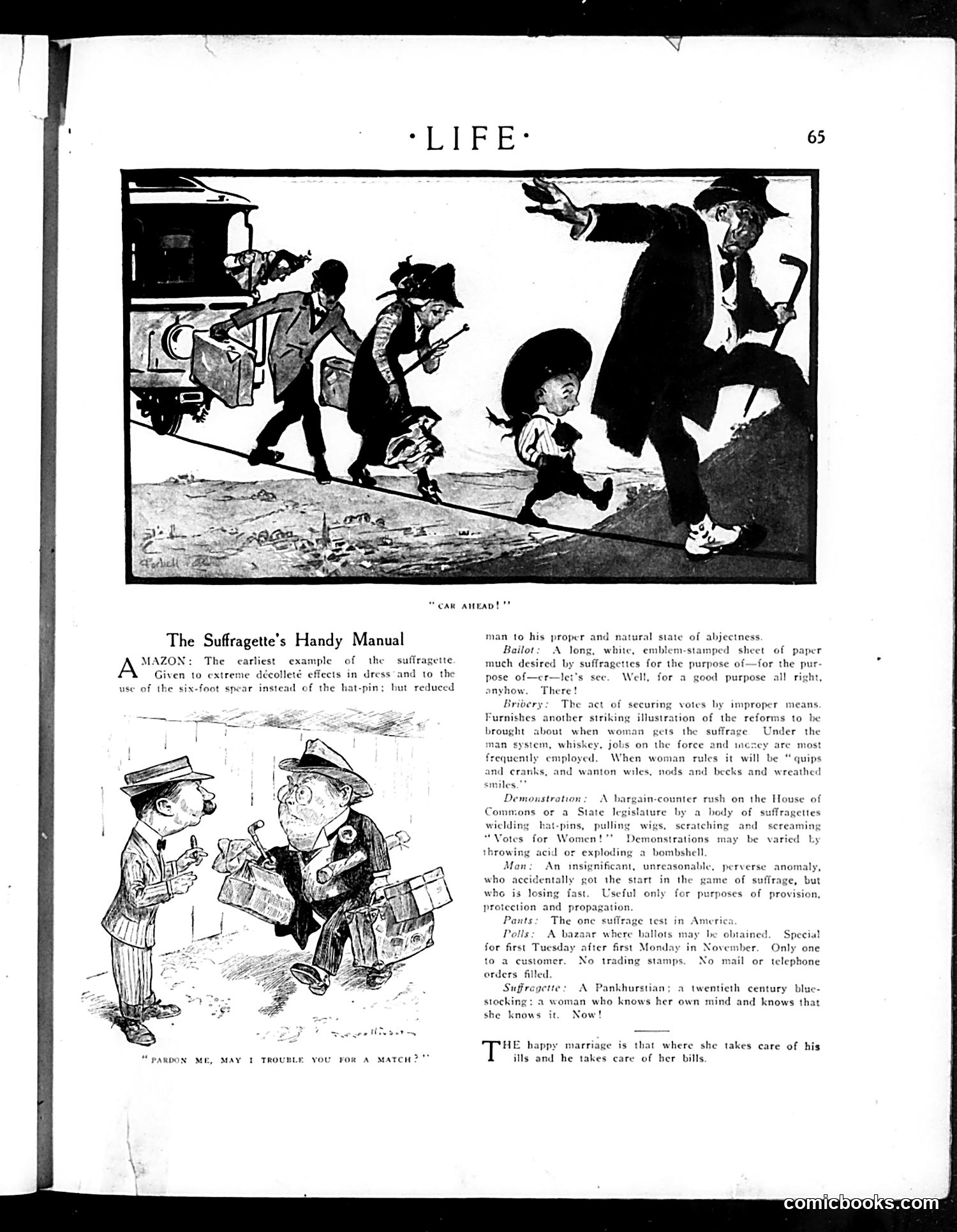
This page satirizes the women's suffrage movement through mock dictionary definitions and cartoons. The top illustration shows suffragettes as aggressive, chaotic figures disrupting public order—wielding hat-pins and causing mayhem while respectable citizens flee. The "manual" parodies suffragettes as extremists, defining their tactics as "bribery," "demonstration" (violent storming of legislatures), and "Pankhurstian" (referencing Emmeline Pankhurst, the militant British suffrage leader). The lower cartoon depicts two men discussing suffragettes, with one warning another to "trouble you for a match"—suggesting women's activism is an absurd nuisance. The closing definition mocks marriage equality, reducing women's rights to domestic arrangements. Overall, Life ridicules suffragettes as unreasonable, violent troublemakers rather than legitimate political reformers—a common anti-suffrage argument of the era.
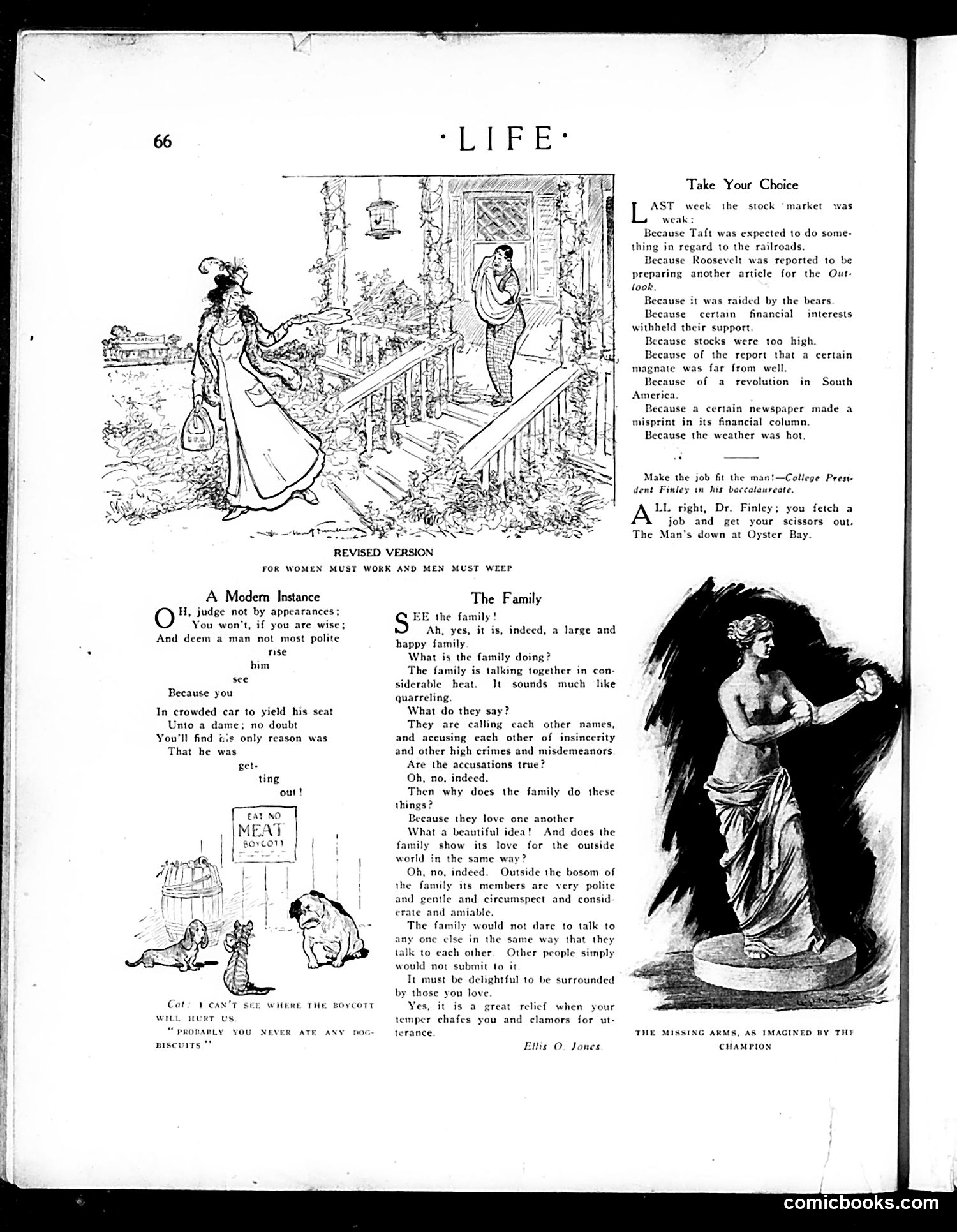
This page contains three satirical pieces from early 20th-century Life magazine: **"A Modern Instance"** mocks gentlemen's politeness in crowded streetcars—the joke being a man yields his seat not out of chivalry but because he's getting off anyway. **"Take Your Choice"** satirizes stock market volatility, listing absurd, contradictory reasons the market was "weak"—from Taft's railroad policies to Roosevelt's *Outlook* articles to simple hot weather. It mocks how financial commentators manufacture explanations for market movements. **"The Family"** presents a Q&A format contrasting family behavior with public conduct: families quarrel and insult each other "in considerable heat," yet claim to love one another, while treating outsiders with politeness. The satire critiques hypocrisy—the gap between private rudeness and public civility. The cartoons accompanying these pieces use visual humor to reinforce the textual satire about social pretense and contradictions in American life during the Progressive Era.
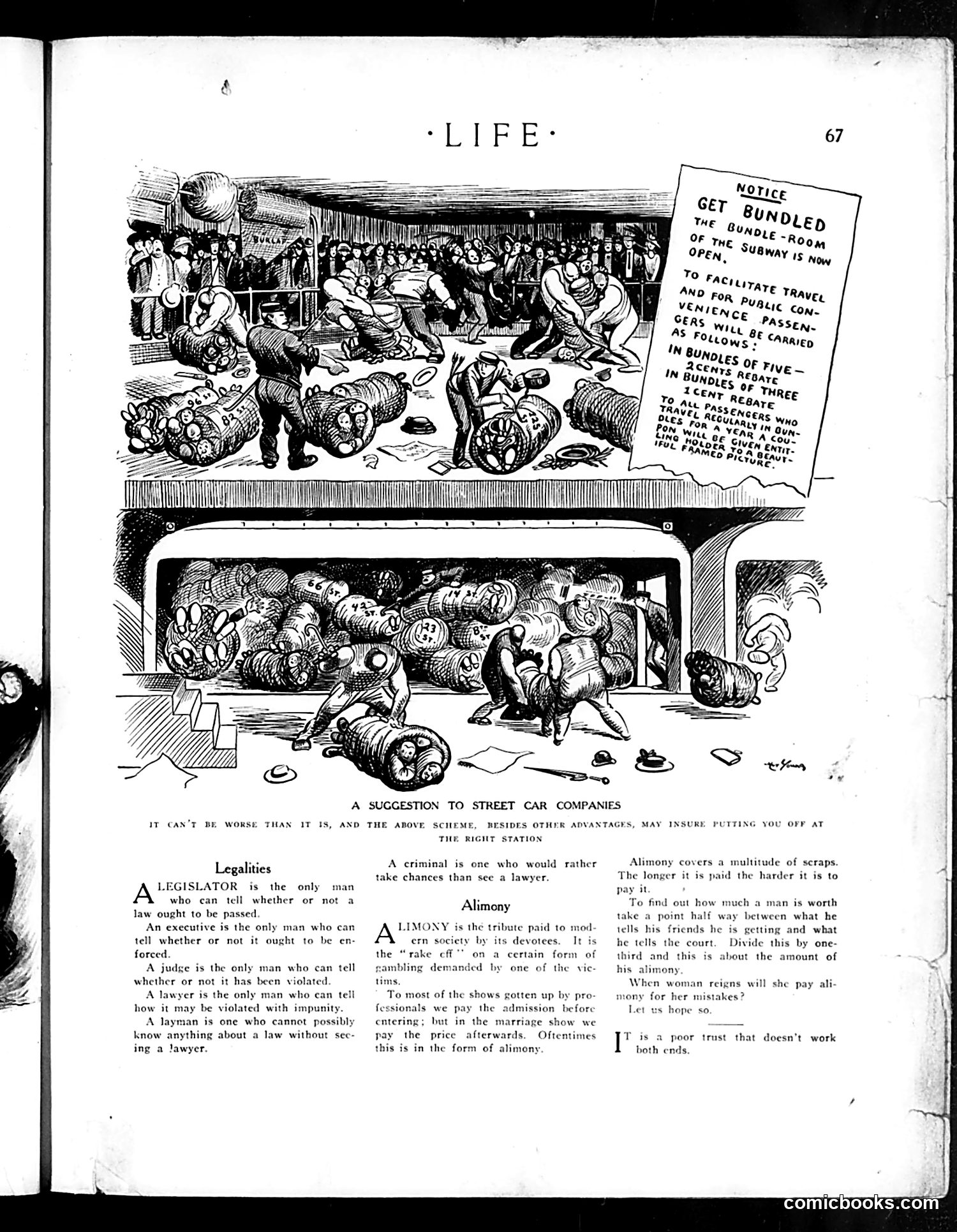
This page from *Life* magazine contains two distinct elements: **Top cartoon:** A satirical "suggestion to street car companies" depicting crowded subway conditions. The notice proposes bundling passengers like cargo—five passengers per bundle at discounted rates—to solve overcrowding. This is visual satire mocking both inadequate public transit infrastructure and the dehumanizing treatment of commuters packed into dangerous conditions during what appears to be early 20th-century urban transit crises. **Bottom section:** A series of humorous legal and social definitions. The "Legalities" section satirizes the legal profession by defining various figures (legislators, executives, judges, lawyers, laymen, criminals) in ways that mock their actual utility and ethics. The "Alimony" section uses bitter humor about divorce payments, suggesting alimony is tribute extracted from men, and cynically questioning whether women will ever pay for their own mistakes—reflecting period misogyny about marriage and divorce. The overall tone is cynical social commentary on urban conditions, legal absurdity, and gender relations.
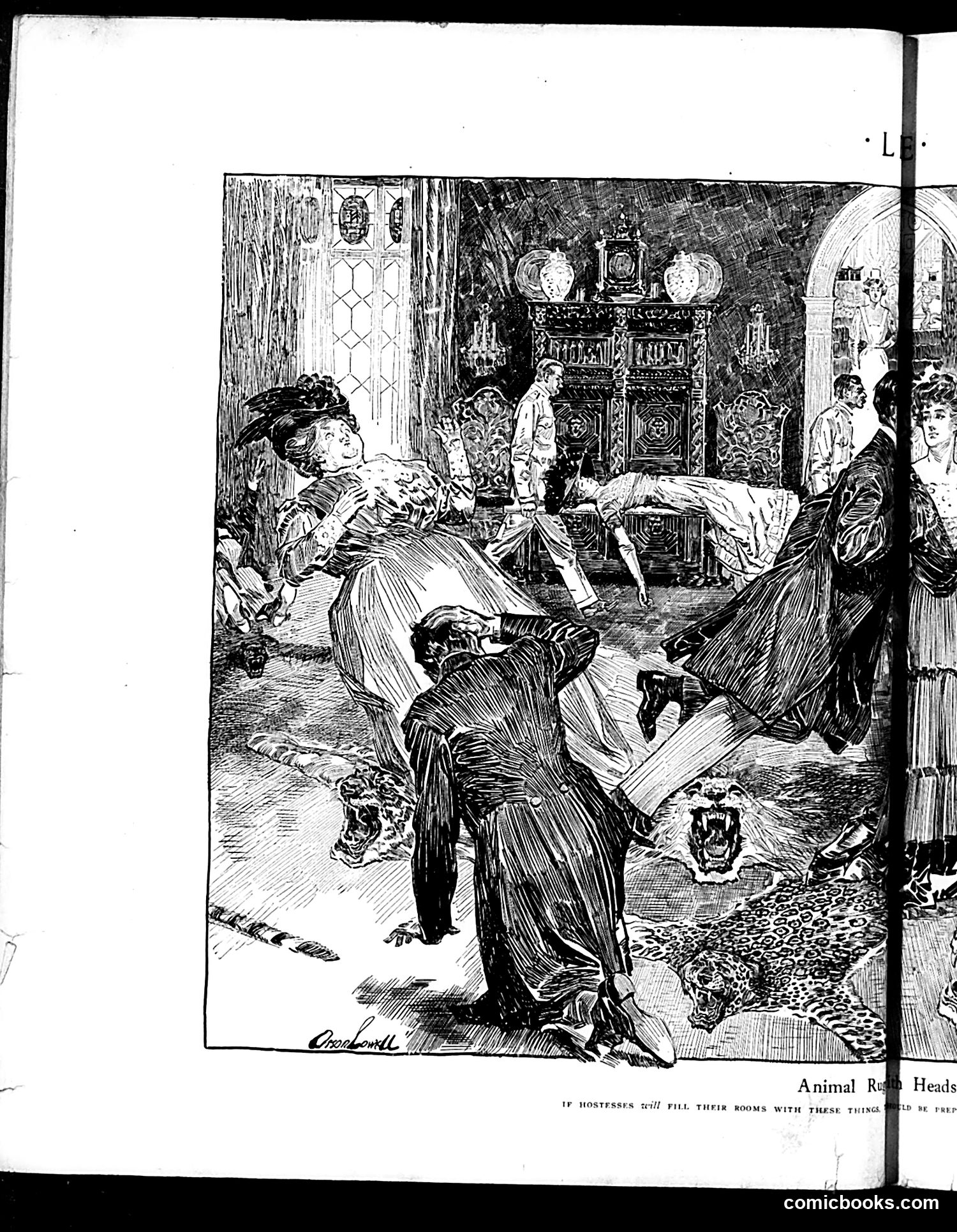
This ink illustration satirizes wealthy society hostesses and their decorating tastes. The caption reads: "If hostesses still fill their rooms with these things [it] would be prep[ared]" — though the OCR is incomplete. The cartoon depicts an elaborate, crowded salon filled with taxidermied animal heads mounted on walls and displayed prominently. A woman in the foreground recoils in shock or dismay at this aesthetic choice. Other fashionably-dressed guests populate the ornate room with its decorative furniture and chandelier. The satire targets the Victorian and Edwardian fashion for displaying hunting trophies and taxidermy as status symbols and room décor. The exaggerated, grotesque presentation of these specimens — and the woman's reaction — mocks this pretentious decorating trend as outdated or aesthetically offensive to refined taste.
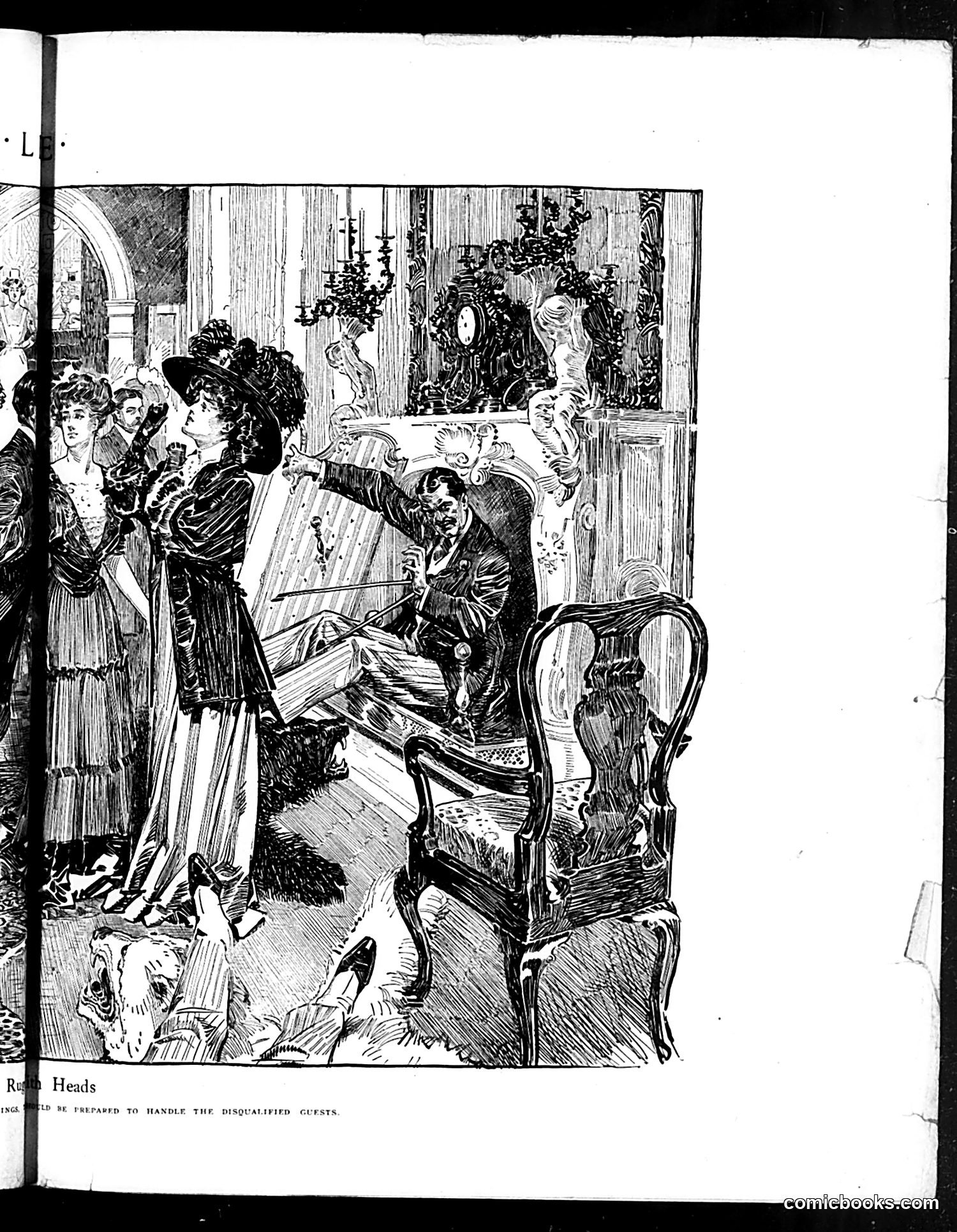
This is a satirical illustration titled "Rude Heads" with a caption reading "SHOULD BE PREPARED TO HANDLE THE DISQUALIFIED GUESTS." The image depicts an elegant social gathering—likely a formal reception or party—where well-dressed guests in period finery (appearing to be late 19th or early 20th century) are present. A man in dark formal attire appears to be gesturing dismissively or struggling with something, while fashionably-dressed women observe. A small dog is visible in the foreground. The satire appears to mock social pretension and etiquette—specifically the irony of "rude heads" (uncouth or ill-mannered people) attending refined social events. The humor suggests that hosts must be prepared to manage impolite or inappropriate guests despite the formal setting, poking fun at either the guests' behavior or the hosts' inability to maintain propriety. The exact social or political reference remains unclear without additional context.
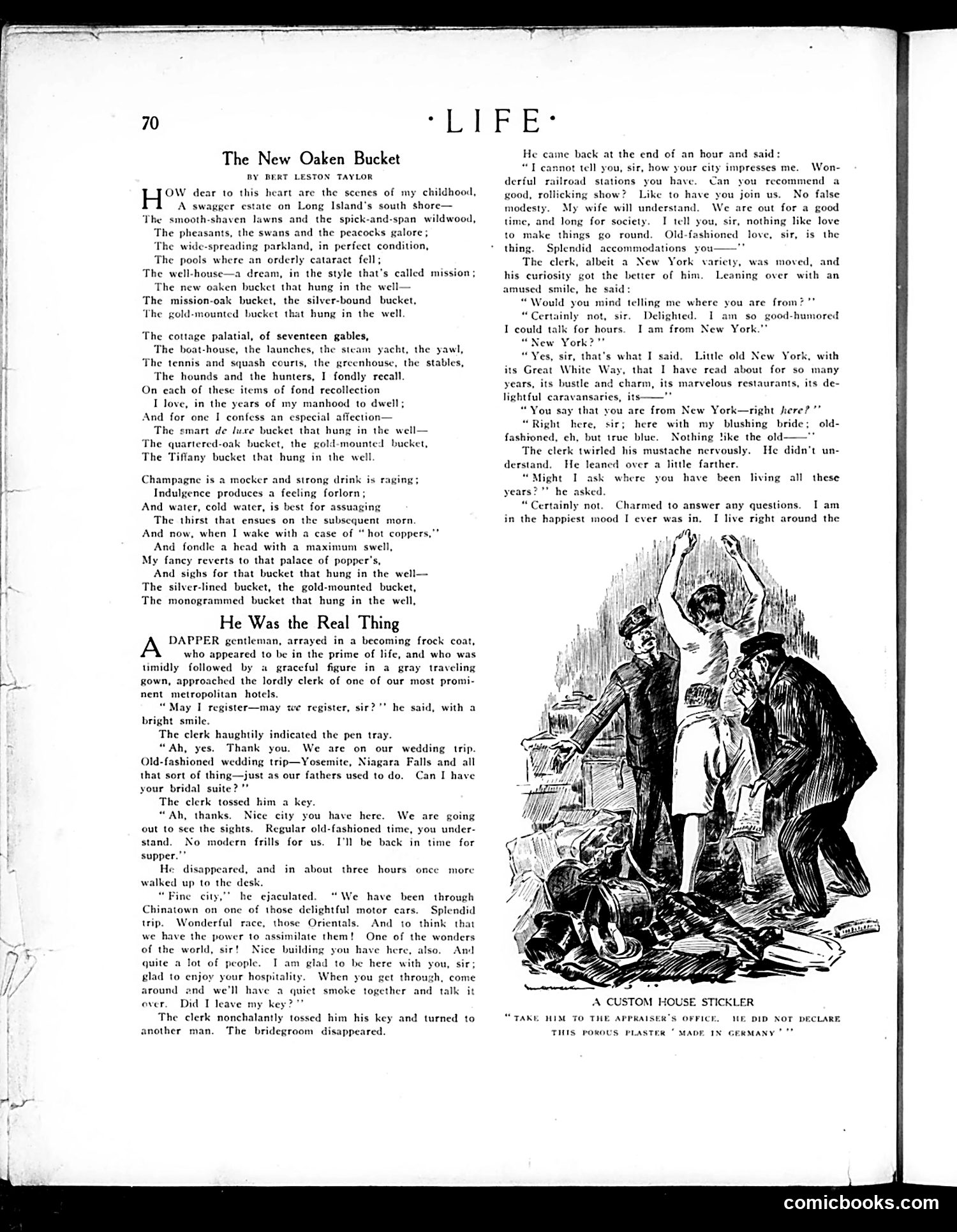
This page contains two distinct pieces of satire: **"The New Oaken Bucket"** (poem by Bert Leston Taylor) parodies the nostalgic ballad "The Old Oaken Bucket." It mocks wealthy Long Island estates by cataloging luxurious amenities—steam yachts, Tiffany buckets, seventeen-gable mansions—that contrast absurdly with the poem's supposed rural simplicity. The joke: modern rich people fetishize "old-fashioned" rusticity while surrounding themselves with ostentatious luxury goods. The repeated refrain about the "de luxe bucket" emphasizes the contradiction between humble nostalgia and extravagant reality. **"He Was the Real Thing"** (illustrated story) satirizes an overly earnest newlywed couple. The groom constantly praises everything—the city, Chinatown, the hotel—with excessive enthusiasm and offers friendship to the clerk. His performative "old-fashioned" wholesomeness and aggressive friendliness appear suspicious to the hotel clerk, who grows increasingly skeptical. The satire targets either affected sincerity or the couple's performative authenticity—they're *too* genuinely enthusiastic about everything. Both pieces mock artificial nostalgia and performative authenticity in early 20th-century wealthy society.
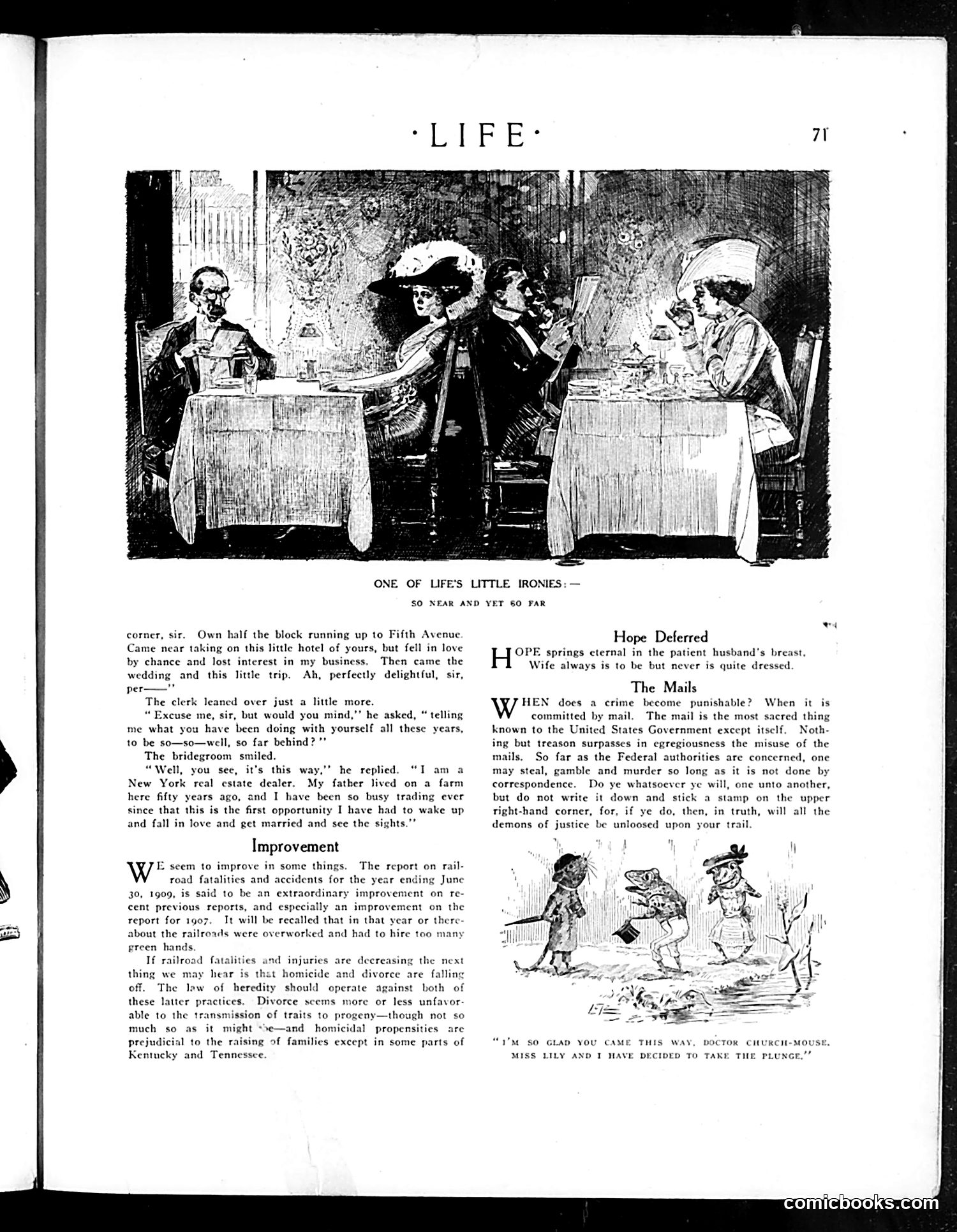
**"One of Life's Little Ironies"** depicts a bridegroom confessing to a hotel clerk that he's a New York real estate dealer who has been so consumed with business that he's neglected to experience life—falling in love and marrying only now. The irony: he could afford to buy the hotel but lost interest in the deal because of romantic distraction. This satirizes the American businessman's single-minded pursuit of wealth at the expense of human experience. The other brief satirical pieces mock contemporary social issues: railroad safety improvements, divorce and heredity, excessive federal reverence for mail security, and marital anxiety ("Hope Deferred"). The small cartoon shows a man announcing an engagement ("taking the plunge"), using outdated courtship language ("Doctor Church-Mouse"). These are light social commentaries typical of Life's satirical approach to American manners and institutions.
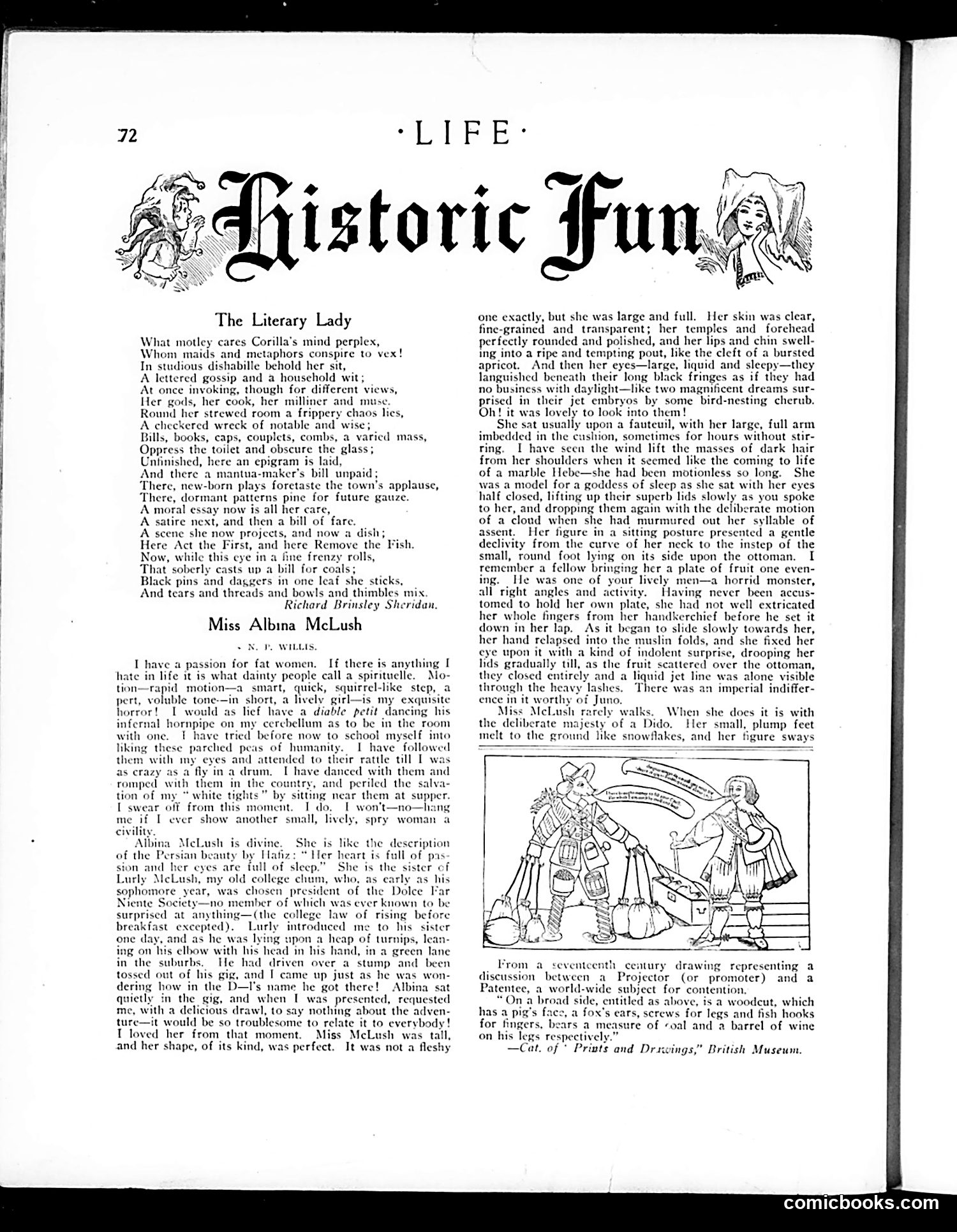
This page satirizes two contrasting female types. The opening poem, attributed to Sheridan, mocks "The Literary Lady"—a woman pretending to intellectual pursuits while remaining fundamentally domestic and scattered. "Corilla" juggles moral essays, satire, and dinner menus amid unpaid bills and fashion scraps, her mind "perplex[ed]" by the incompatibility of serious writing and household concerns. The satire targets women who dabble in literary pretension without genuine commitment. The second piece by N.P. Willis celebrates "Miss Albina McLush," the inverse type: a large, languid, physically beautiful woman of deliberate indolence. Willis expresses contempt for "fat women" ironically—praising McLush's immobility, her refusal to be "lively" or "spry." The accompanying illustration shows a seventeenth-century peasant costume scene. Together, these pieces reflect 19th-century gender anxieties: ridicule awaits women attempting intellectual ambition, while praise goes only to passive, ornamental beauty.
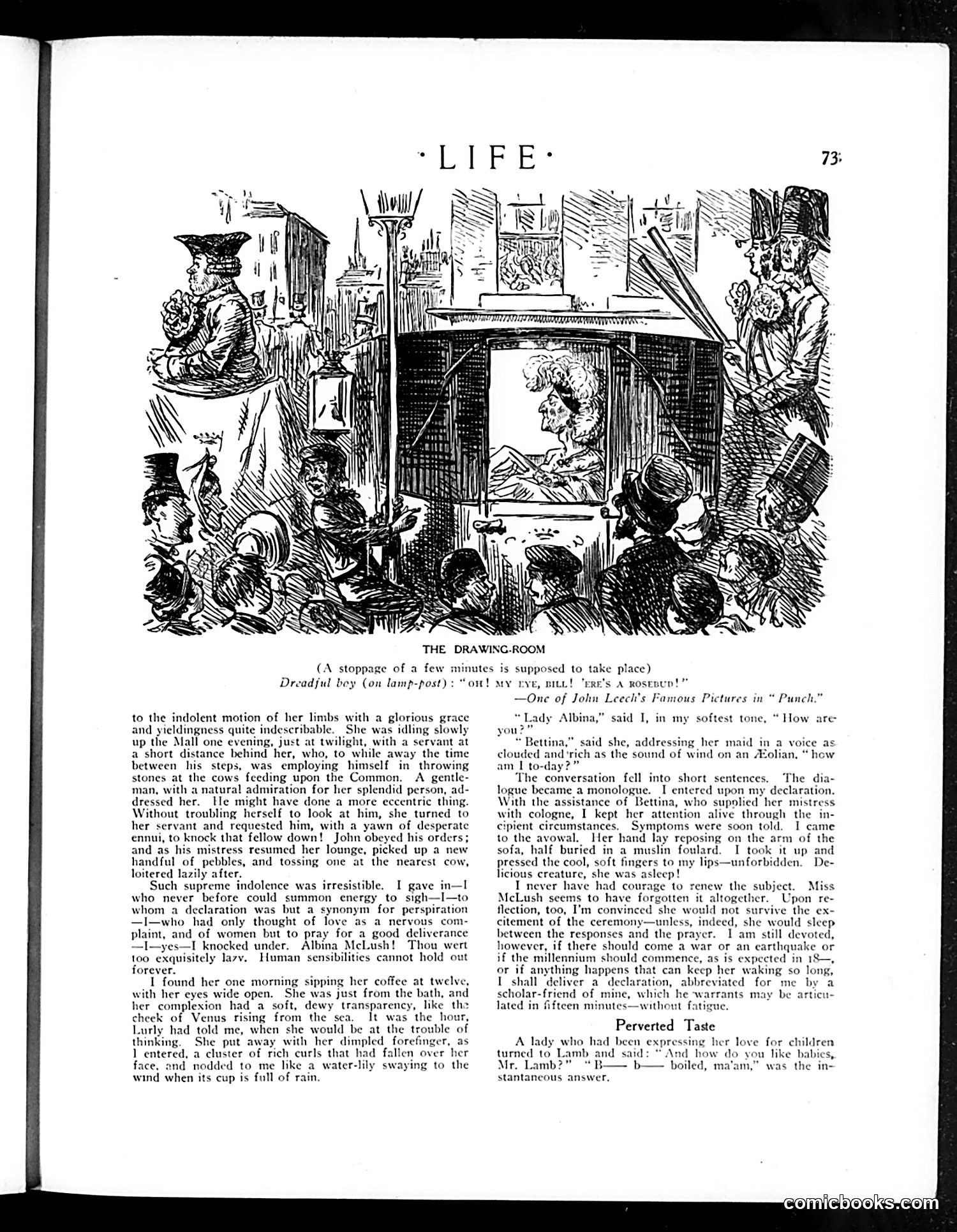
This page contains two separate satirical pieces from *Life* magazine: **"The Drawing-Room"** is a humorous narrative (accompanied by a John Leech illustration from *Punch*) mocking the affectation of extreme laziness in fashionable Victorian society. The narrator ridicules a woman named Albina McLush whose studied indolence is so complete she falls asleep during his marriage proposal. The satire targets the pretension of aristocratic idleness as a status symbol—being too refined to exert effort becomes absurd when she literally cannot stay conscious. **"Perverted Taste"** is a brief joke referencing Charles Lamb (the 18th-century essayist), playing on wordplay: when asked his opinion of babies, he responds "boiled"—a darkly humorous non-sequitur implying cannibalism or extreme misanthropy. The joke mocks both affected wit and cruel humor masquerading as clever conversation. Both pieces satirize Victorian social pretension and the sometimes cruel wit of upper-class discourse.
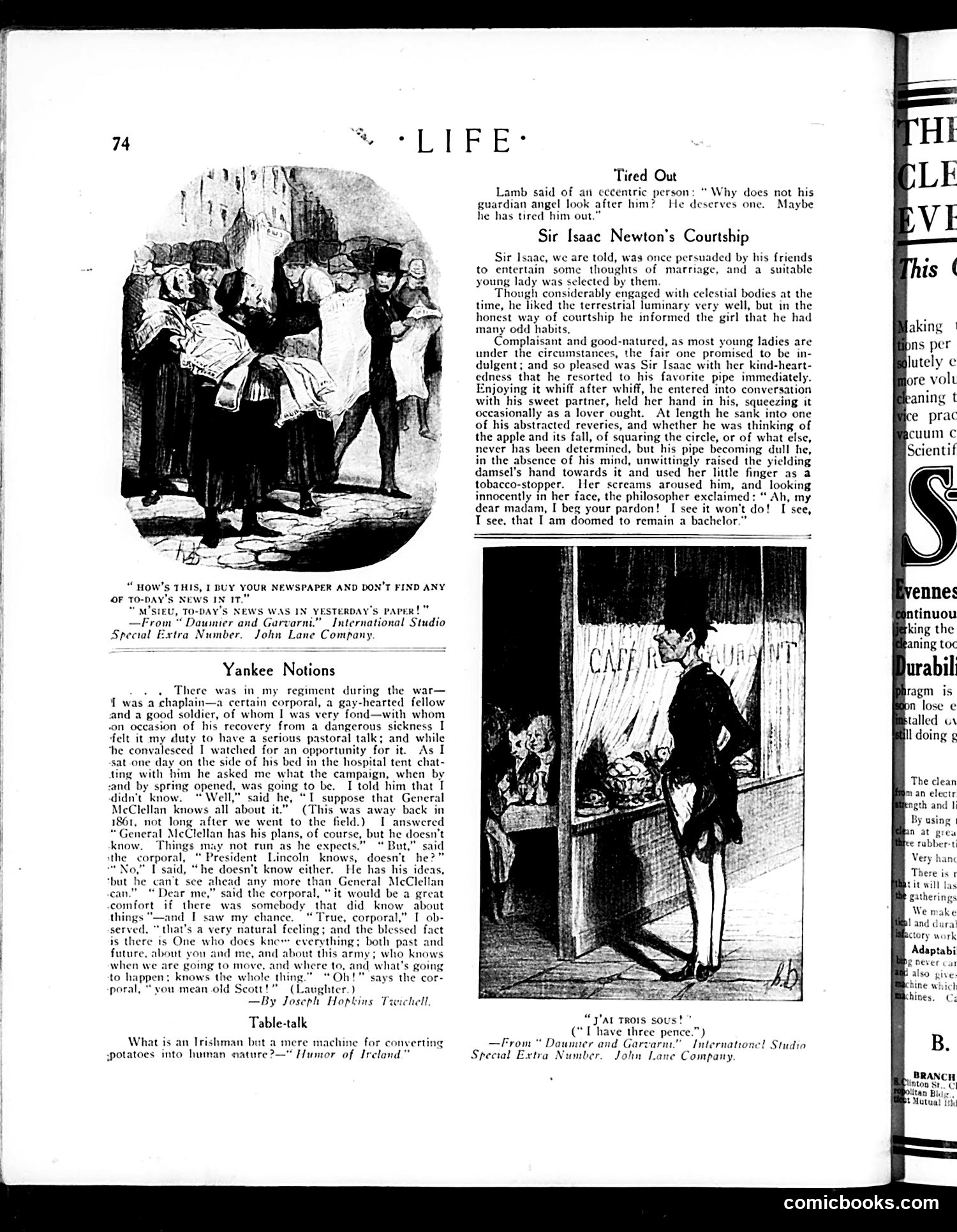
This page contains three distinct humor pieces: **"Sir Isaac Newton's Courtship"** presents an anecdote about the famous physicist's failed romance. The joke relies on Newton's absent-mindedness: so absorbed in abstract thought while courting a patient young woman, he absentmindedly uses her finger as a pipe-stopper. The satire targets both Newton's social incompetence and the era's expectations that women should tolerate male eccentricity. His conclusion—that he's "doomed to remain a bachelor"—frames bachelorhood as consequence of his own obliviousness rather than choice. **"Yankee Notions"** features a Civil War anecdote where a chaplain and corporal discuss whether General McClellan knows his campaign plans. The humor culminates when the corporal suggests "old Scott" (likely General Winfield Scott) must know everything—eliciting laughter at the implicit absurdity that *any* military leader has complete knowledge. **"Table-talk"** offers a brief ethnic joke about Irish people as "machines for converting potatoes into human nature." These pieces exemplify Life's satirical approach: poking fun at military incompetence, scientific absent-mindedness, and ethnic stereotypes.
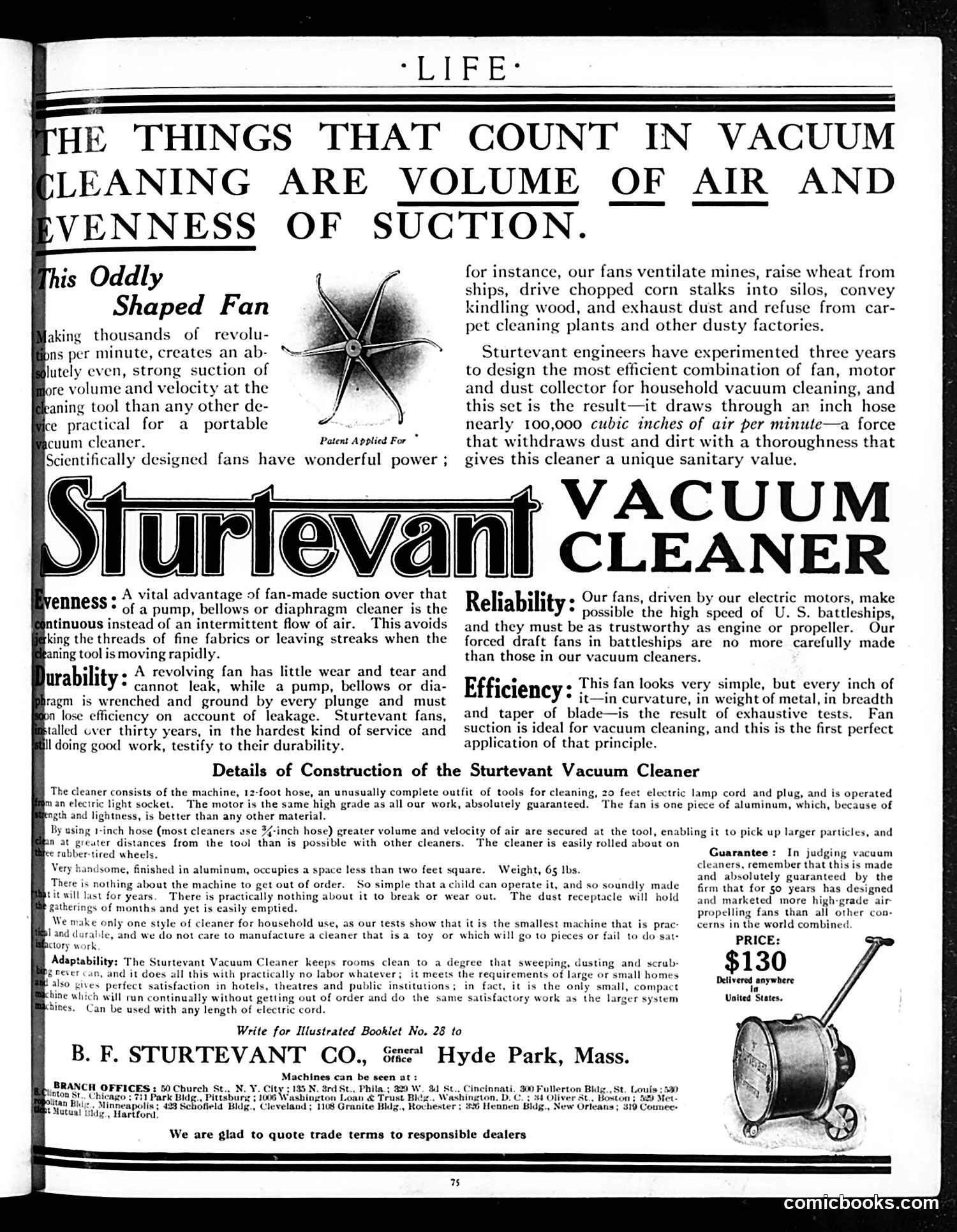
This page is primarily a **product advertisement**, not political satire. It promotes the Sturtevant brand vacuum cleaner, priced at $130. The "oddly shaped fan" illustration shows the patented fan design—the core innovation claimed to distinguish this cleaner. The advertisement emphasizes technical superiority: the fan creates "nearly 100,000 cubic inches of air per minute" through continuous suction, superior to pump-based competitors. The appeal to reliability is notably militaristic—comparing the fan motors to those in U.S. battleships, suggesting durability and precision engineering. This patriotic reference (likely from the WWI era) boosted consumer confidence by linking domestic products to military-grade quality. The marketing strategy stresses engineering credibility: "three years" of experimentation, aluminum construction, and a 50-year company reputation. The modest price and guarantee aim at middle-class households adopting this new cleaning technology.
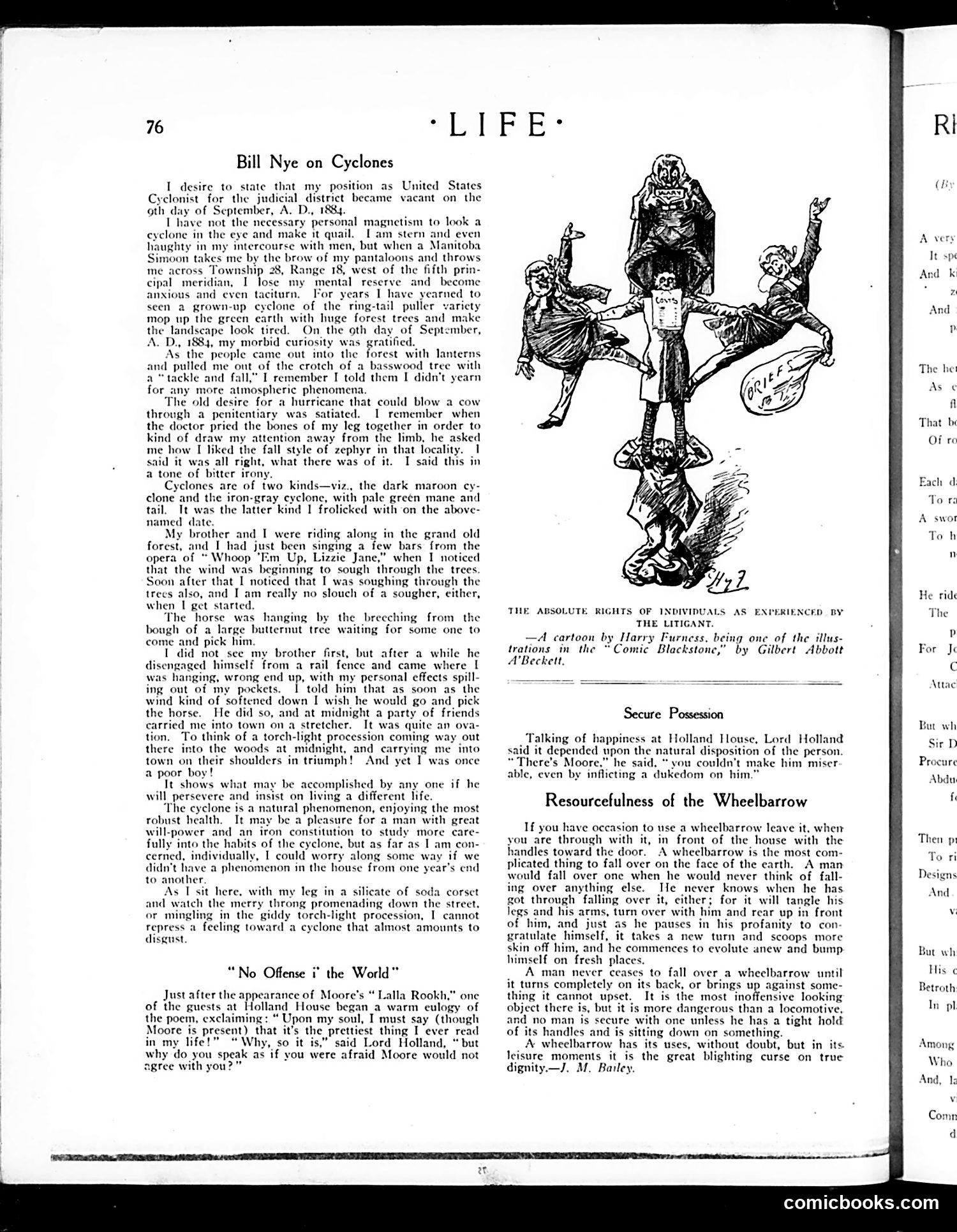
This page contains **humorous personal essays by Bill Nye**, a 19th-century American humorist, not political cartoons. The central cartoon illustrates Nye's tall tale about encountering a cyclone in 1884. **The Joke:** Nye adopts the persona of "United States Cyclonist"—a fictional government position—and recounts being violently caught in a tornado while riding with his brother. He describes being thrown through trees, his horse hanging from a branch, and ending up carried into town on a stretcher at midnight, which he mockingly compares to a triumphant "torch-light procession." **The Satire:** Nye satirizes both his own cowardice (claiming he lacks "personal magnetism" to intimidate cyclones) and bureaucratic absurdity (the invented "Cyclonist" position). The humor relies on exaggeration and deadpan delivery—he treats a disaster as if it were civic recognition. The page's other sections ("Secure Possession," "Resourcefulness of the Wheelbarrow") continue in similar humorous-essay format, typical of *Life* magazine's content during this era.
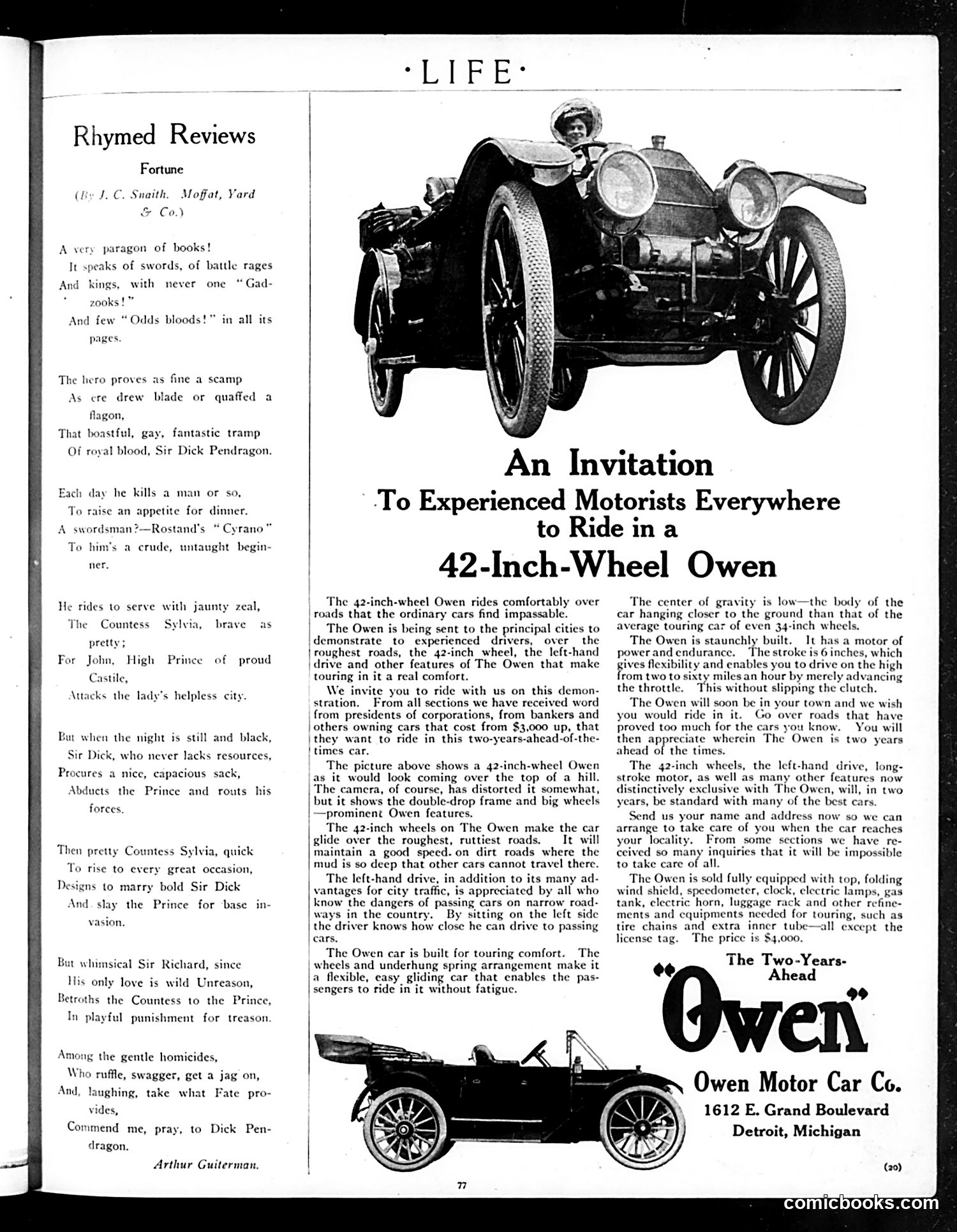
This page contains two separate items: **Left side:** A book review in verse of "Fortune" by J.C. Snaith, mocking a swashbuckling adventure novel. The satirist Arthur Guiterman ridicules the protagonist Sir Dick Pendragon as an over-the-top, cartoonish hero who casually kills men daily and performs absurd heroics. The satire targets melodramatic adventure fiction popular at the time—the exaggerated swordplay, noble bloodlines, and ridiculous plot twists are the joke. **Right side:** An Owen Motor Car advertisement showcasing the 42-inch wheels as revolutionary automotive innovation. The ad invites experienced drivers to test-drive the car, emphasizing its ability to traverse rough terrain that ordinary cars cannot handle. This represents early automobile marketing, positioning the Owen as superior through technical specifications (left-hand drive, suspension design, engine stroke). The page juxtaposes literary satire with consumer advertising—typical of Life magazine's mixed content.
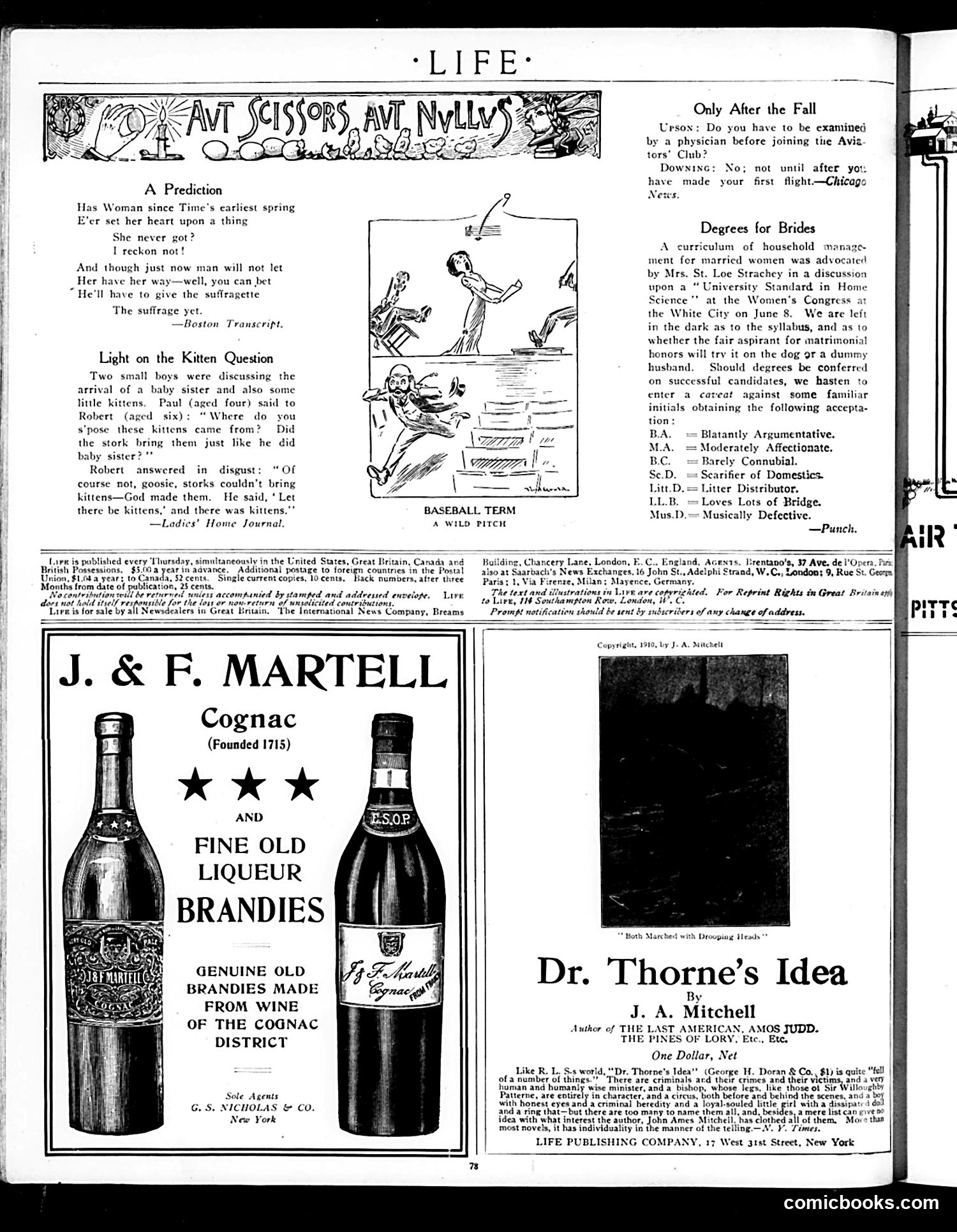
This page contains satirical humor pieces typical of Life magazine's editorial content. **"A Prediction"** addresses women's suffrage, predicting that despite men's current resistance, women will eventually win voting rights. This reflects the pre-1920 suffrage debate. **"Light on the Kitten Question"** is a children's humor piece contrasting two boys' explanations for where kittens come from—one invoking the stork myth, the other biblical creation—poking fun at childhood logic. **"Baseball Term: A Wild Pitch"** appears to be a cartoon about baseball, though details are unclear from the OCR. **"Degrees for Brides"** satirizes a proposal to create academic credentials in household management for married women, with humorous fake degree abbreviations mocking domestic stereotypes (e.g., "B.A. = Blatantly Argumentative"). The remaining content consists of advertisements for J. & F. Martell Cognac and a book review for "Dr. Thorne's Idea" by J.A. Mitchell.
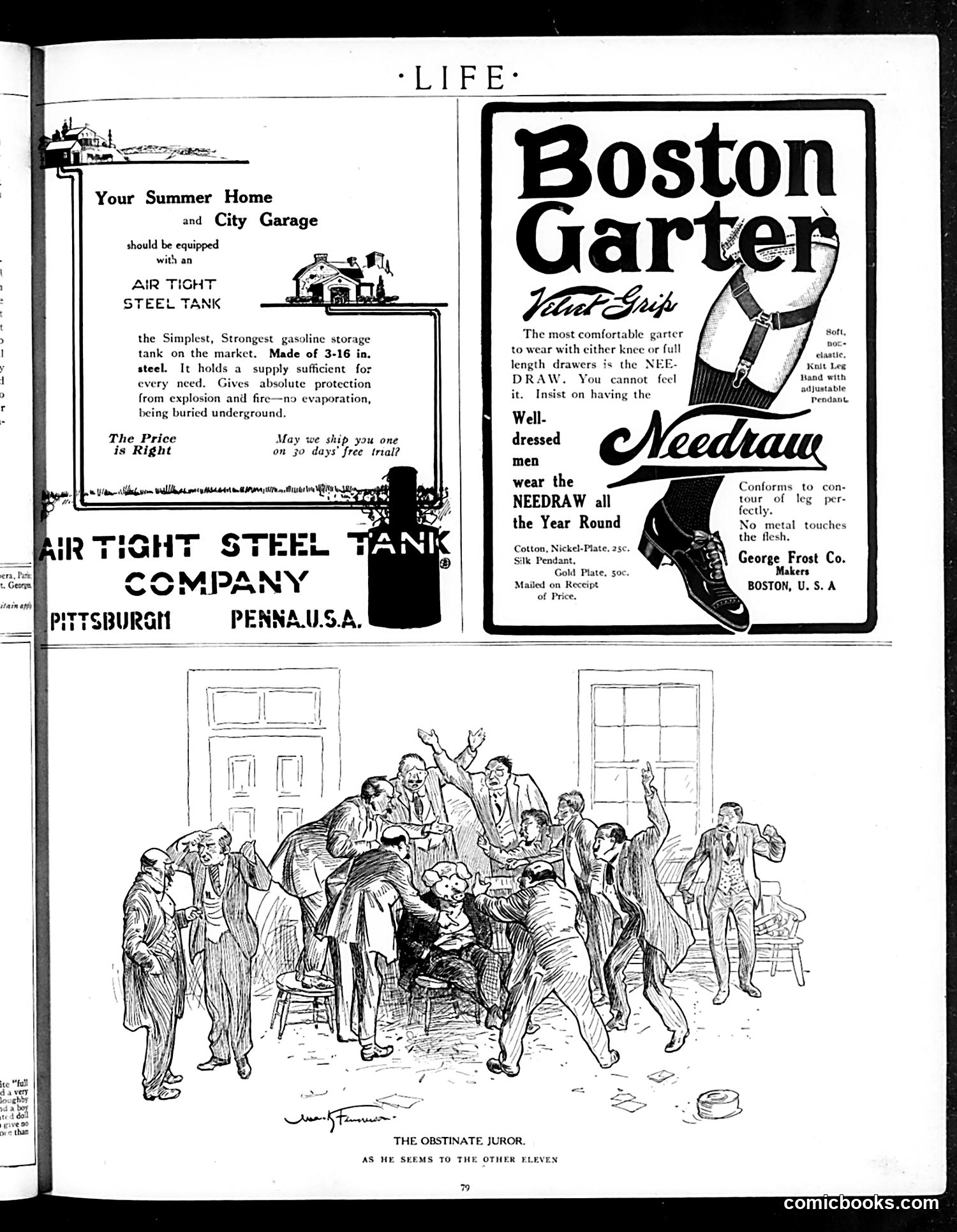
This page primarily features advertisements (Air Tight Steel Tank, Boston Garter, Needraw garter) with one cartoon at the bottom. **The Cartoon: "The Obstinate Juror"** The illustration depicts twelve men in suits in what appears to be a deliberation room—a jury chamber. One man (center, seated) is surrounded by the other eleven jurors who appear animated, gesturing, and arguing. The caption indicates the seated man is the "obstinate juror" as perceived by the other eleven. **The Point:** This satirizes jury deliberations where one juror holds out against the consensus of the other eleven, refusing to agree on a verdict. The cartoon captures the frustration of the majority facing a holdout—their exasperated body language contrasts with his apparent calm resolve. This reflects a common social frustration with how jury unanimity rules (then and now) allow single dissenters to deadlock cases, a recurring theme in early 20th-century legal commentary. The humor lies in showing the scene from the stubborn juror's imagined perspective of how others view him.
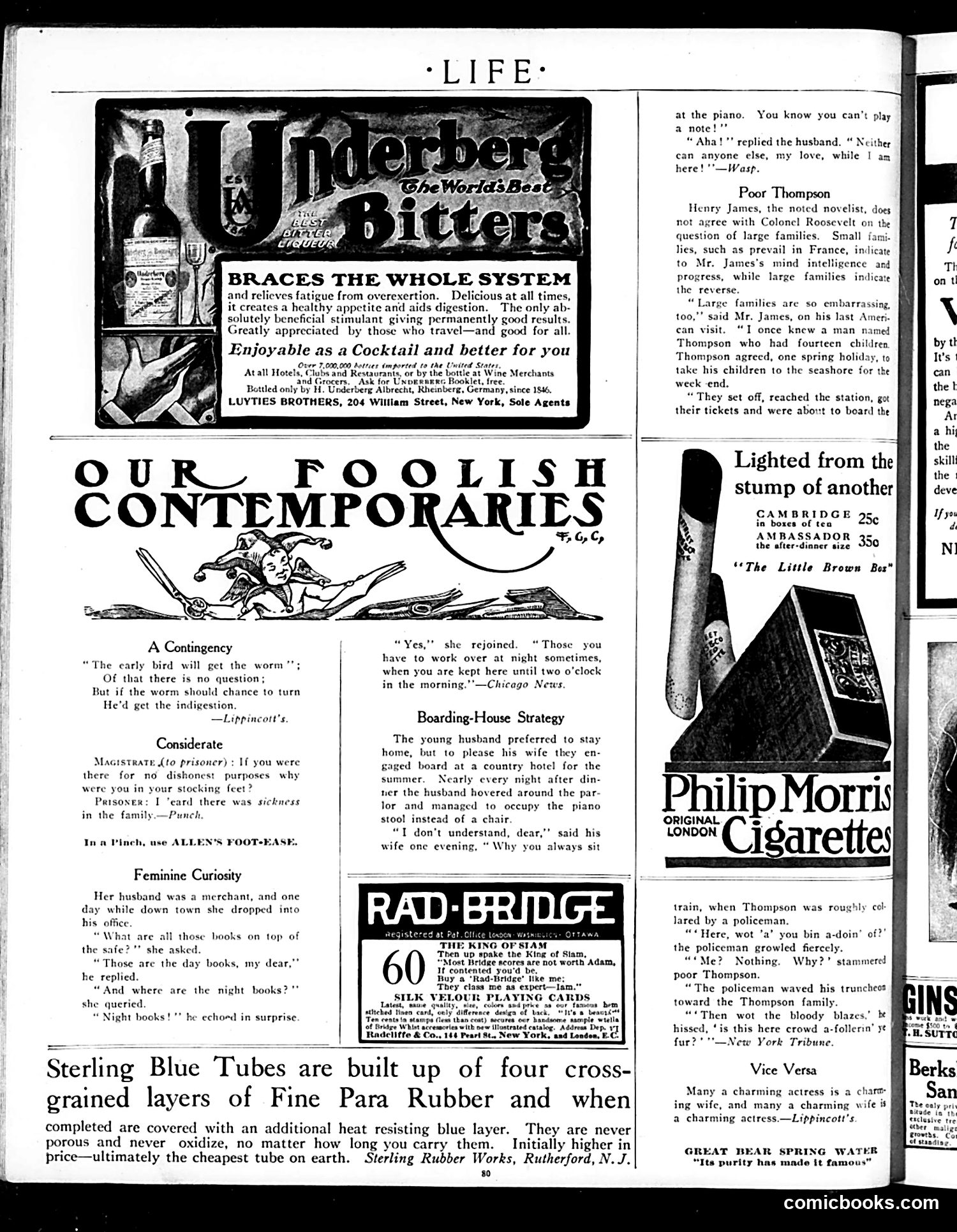
This page from *Life* magazine is primarily **advertising and light humor**, not political satire. The main content includes: 1. **"Our Foolish Contemporaries"** — a humor column with short jokes about everyday life (a bird getting indigestion, a prisoner in stocking feet, a wife asking about "night books" in her husband's office). These are gentle, domestic jokes typical of early 20th-century magazines. 2. **A longer anecdote about "Poor Thompson"** — apparently a reference to novelist Henry James's views on large families. The joke describes Thompson taking fourteen children to the seashore and the chaos that ensues at the train station (text cuts off). This satirizes anxieties about family size. 3. **"Boarding-House Strategy"** — a domestic joke about a husband preferring to sit at the piano rather than engage with his wife at a boarding house. The page is dominated by **product advertisements** for Underberg Bitters, Philip Morris cigarettes, Rad-Bridge playing cards, and Sterling rubber tubes—typical commercial content for the era.
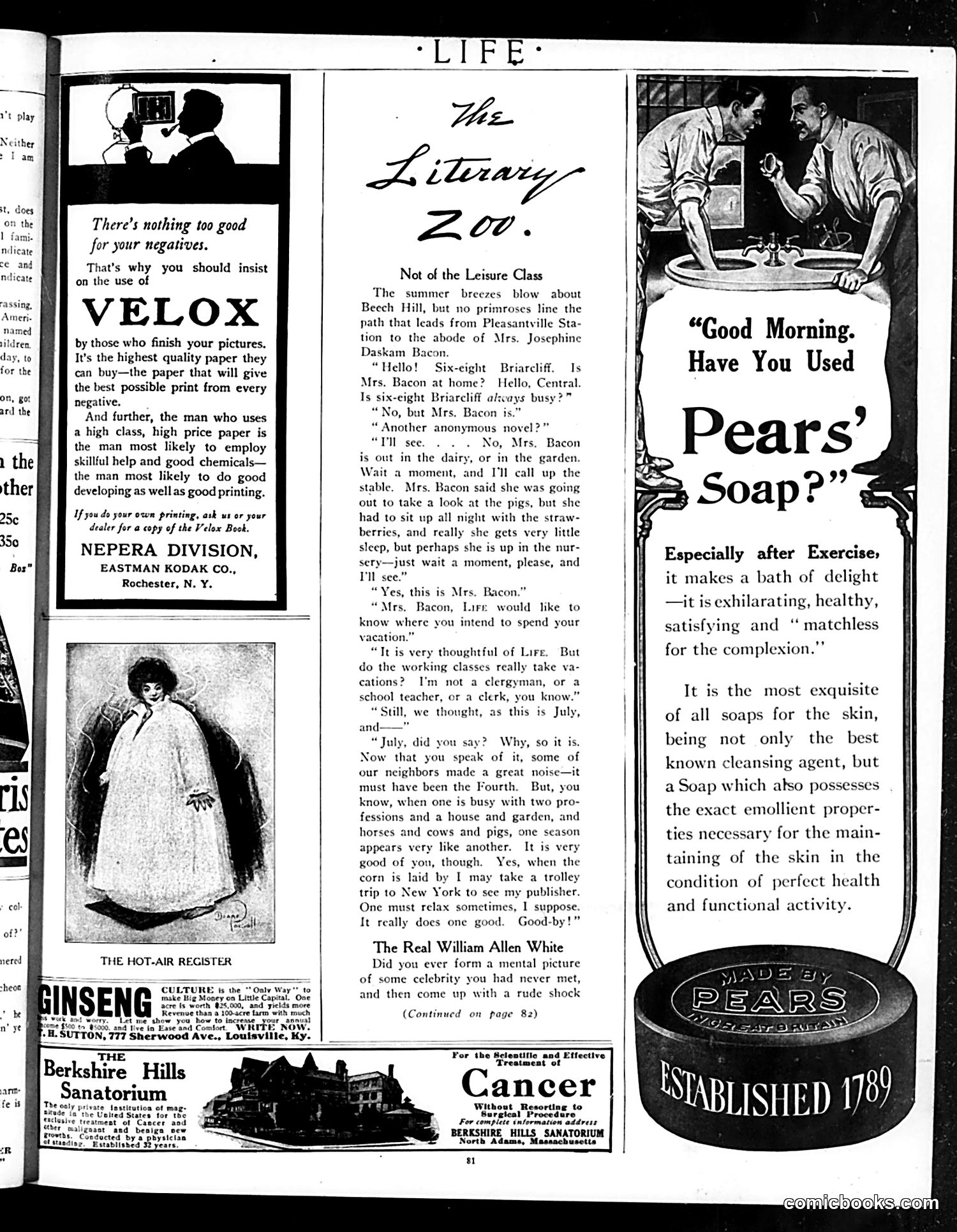
This page features a satirical article about **Mrs. Josephine Daskam Bacon**, a writer, presented as a humorous contrast to her public image. The joke centers on the irony of her claiming she doesn't take vacations because she's a "working class" person—yet the narrative reveals she's actually quite privileged, managing a country estate (dairy, garden, pigs, strawberries) while maintaining literary output. When Life's editor calls asking about her vacation plans, she defensively insists working people don't vacation, then casually mentions possibly taking a trolley trip to New York to see her *publisher*—revealing her actual leisure and status. The satire mocks both her pretense of being a laborer and the gap between her self-presentation and reality. The article's title, "The Literary Zoo," suggests she's being treated as a specimen for examination—a common Life magazine format for poking fun at celebrities' contradictions and pretenses. The surrounding advertisements (Velox paper, Pears' soap, various sanatoriums) are period commercial content, typical of early 20th-century magazines.
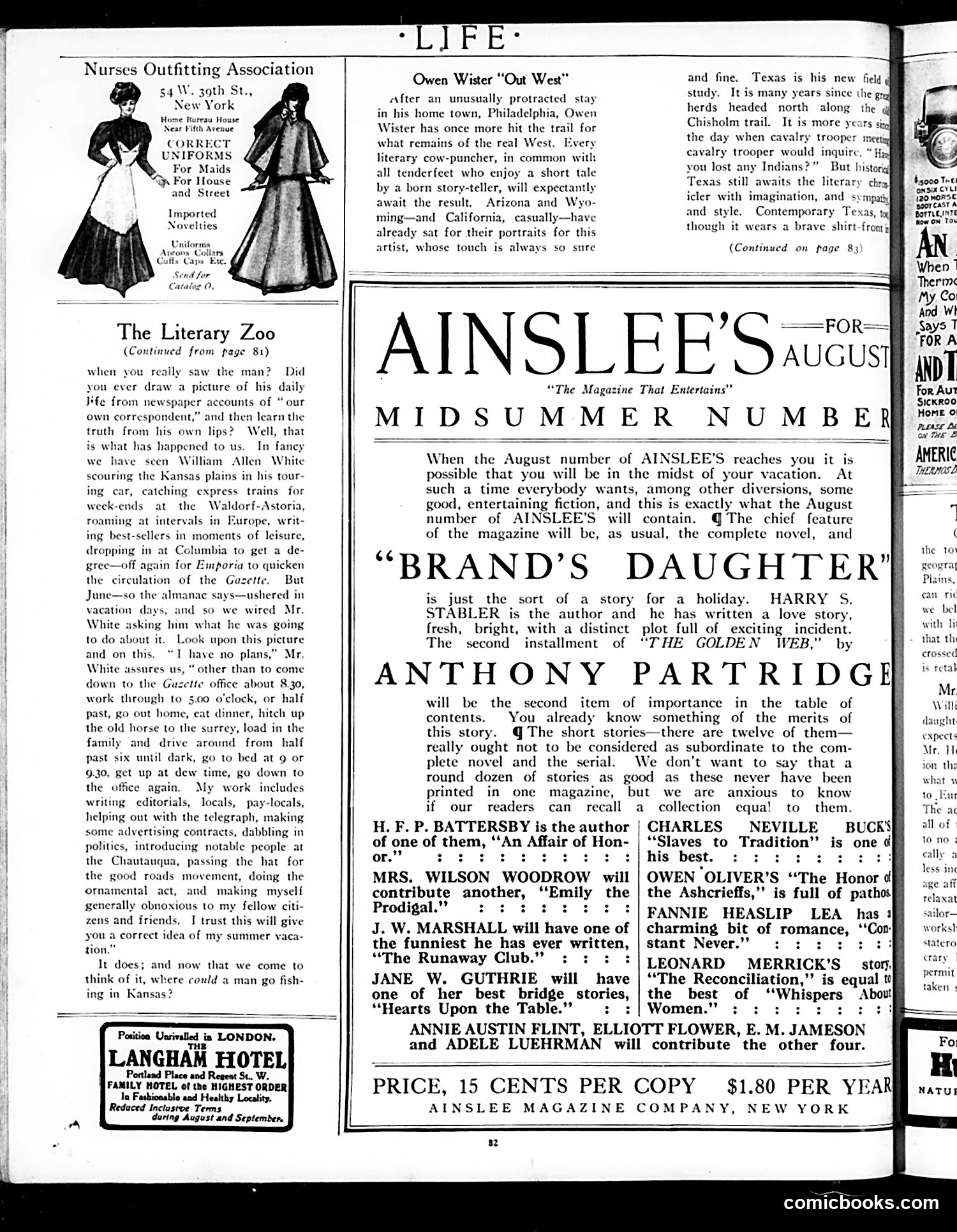
This page is primarily **advertising and editorial content** for Ainslee's Magazine's August midsummer issue, not a political cartoon. The substantive content includes: **"Owen Wister 'Out West'"**: A brief note about the author returning to the American West to research material, noting Texas awaits "literary chronicl[ing]" of its history—the cavalry and frontier era have largely passed. **"The Literary Zoo"**: A humorous account of interviewing William Allen White, the Kansas newspaper editor and writer. The piece describes White's mundane summer routine (working at his Gazette office, driving a surrey with family) contrasted with his celebrity status—he simultaneously writes bestsellers and manages a newspaper. The satire pokes fun at how writers balance serious literary work with everyday domestic life. The page otherwise consists of nursing uniforms advertising and promotion for Ainslee's serialized fiction featuring authors like Harry S. Stabler and Anthony Partridge. No political figures or events are referenced.
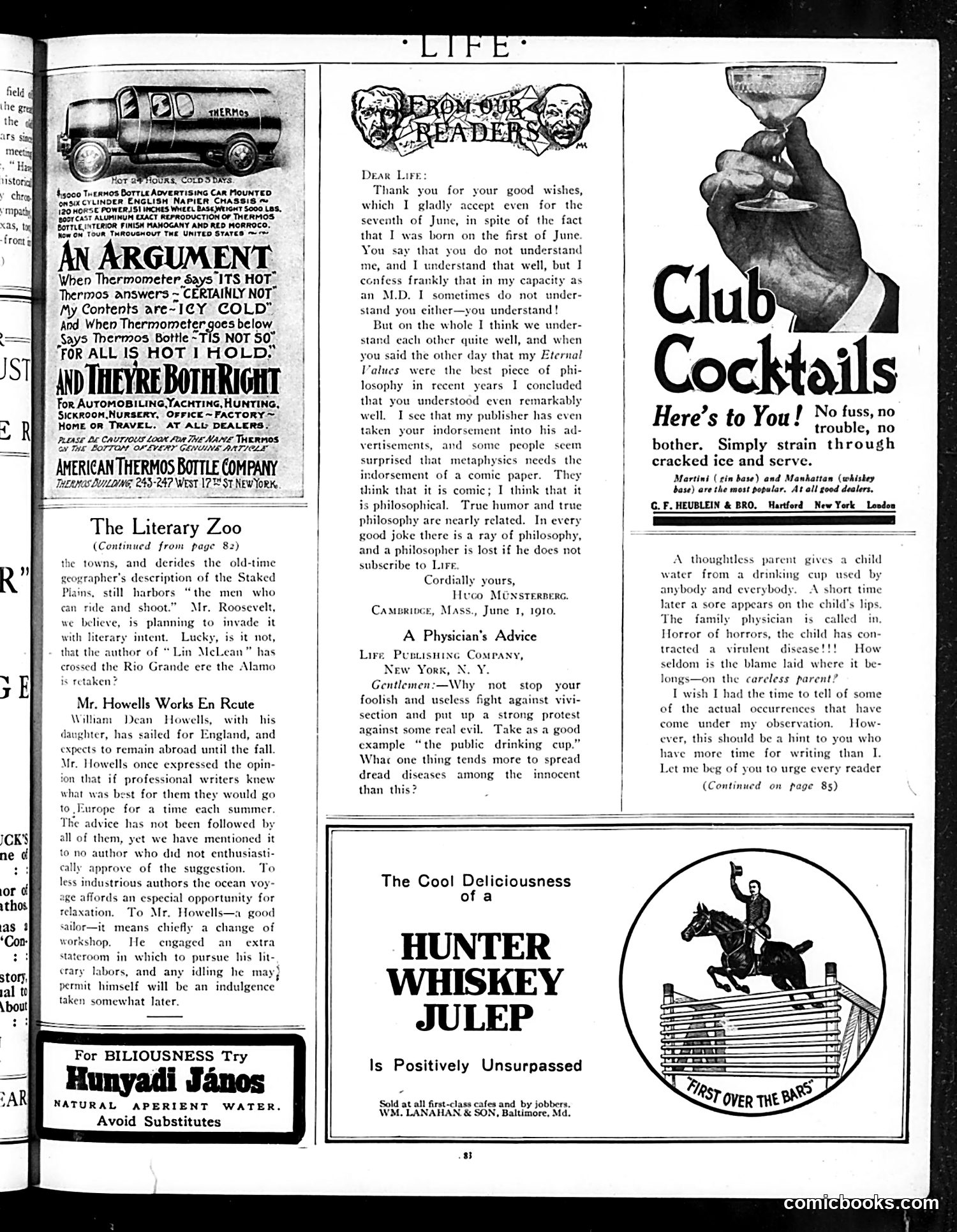
This page primarily contains **advertisements and reader correspondence**, not political cartoons. The main items are: 1. **Thermos bottle ad**: Argues the bottle keeps contents hot or cold regardless of outside temperature—a product endorsement using humorous logic. 2. **Literary gossip**: Brief notes on American writers, including Roosevelt's potential western invasion and William Dean Howells' European travel plans—typical celebrity-style coverage. 3. **Reader letter from Hugo Münsterberg** (a Harvard psychologist): Defends his philosophical work, joking that Life magazine's endorsement surprised people who thought philosophy incompatible with a comic publication. 4. **Public health letter**: A physician warns against shared drinking cups as disease vectors—reflecting early 20th-century sanitation awareness. 5. **Cocktail advertisement**: Hunter Whiskey Julep promotion. The page reflects Life's dual nature: satirical commentary mixed with consumer advertising. No significant political content is present. The tone is lighthearted, addressing contemporary concerns (hygiene, travel, literature) rather than partisan issues.
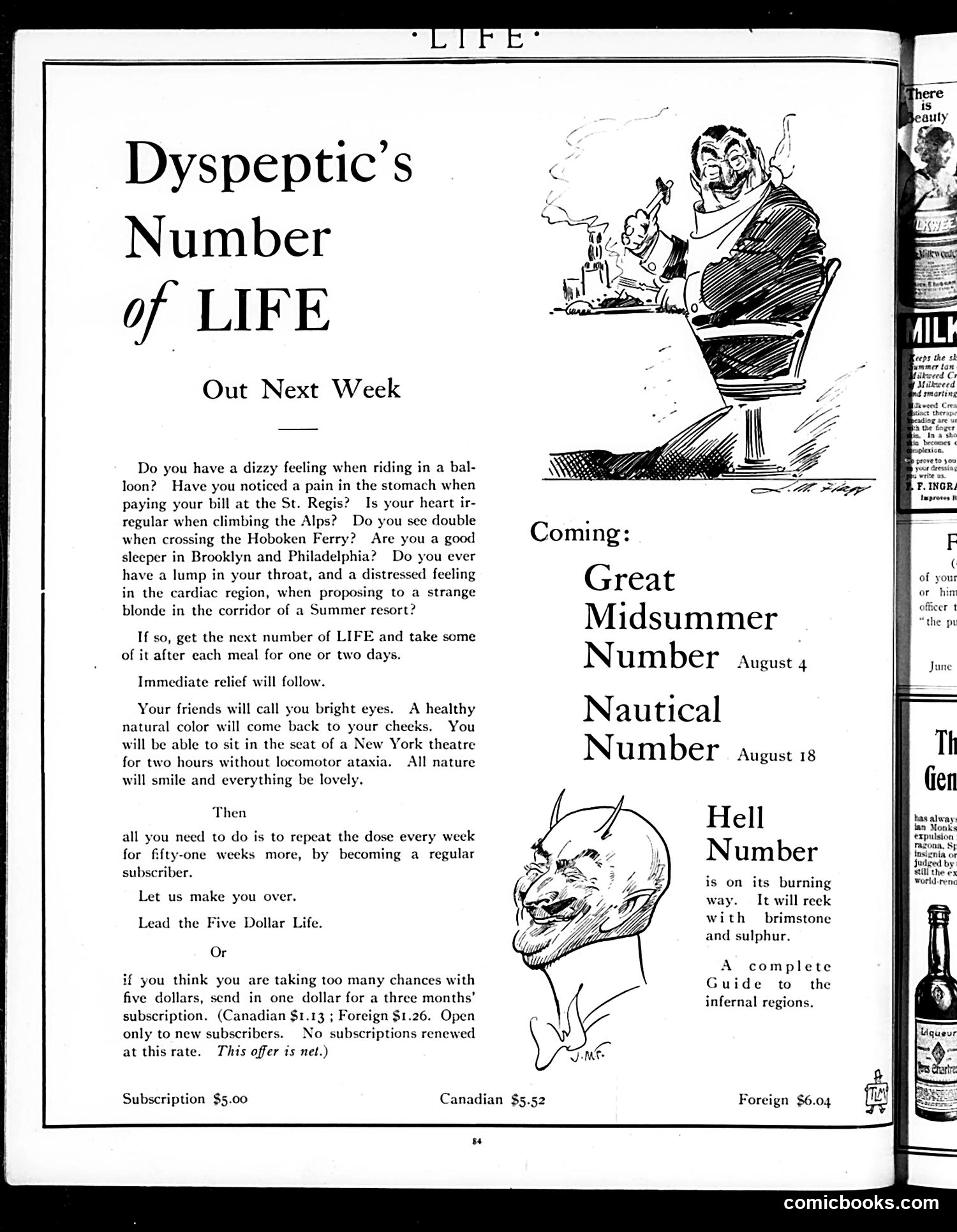
This is a self-promotional advertisement for *Life* magazine's upcoming "Dyspeptic's Number," satirizing both hypochondria and magazine subscription marketing. The left cartoon depicts a grotesque, scowling figure—representing the chronic worrier or "dyspeptic"—suffering vague ailments from everyday activities (balloon rides, paying bills, ferry crossings, romantic encounters). The satire mocks neurotic, upper-middle-class anxieties of the era. *Life* positions itself as medicine: read it weekly and your "bright eyes" return, your cheeks gain "healthy color," you'll sit through theater untroubled. The humor lies in treating a satirical magazine as literal cure-all. The right side advertises upcoming special issues ("Nautical Number," "Hell Number"), with the latter's grotesque demon face continuing the darkly comic tone. This is primarily **advertising disguised as humor**—a clever pitch designed to amuse potential subscribers into buying subscriptions ($5.00 yearly) by positioning *Life* as essential to modern life itself.
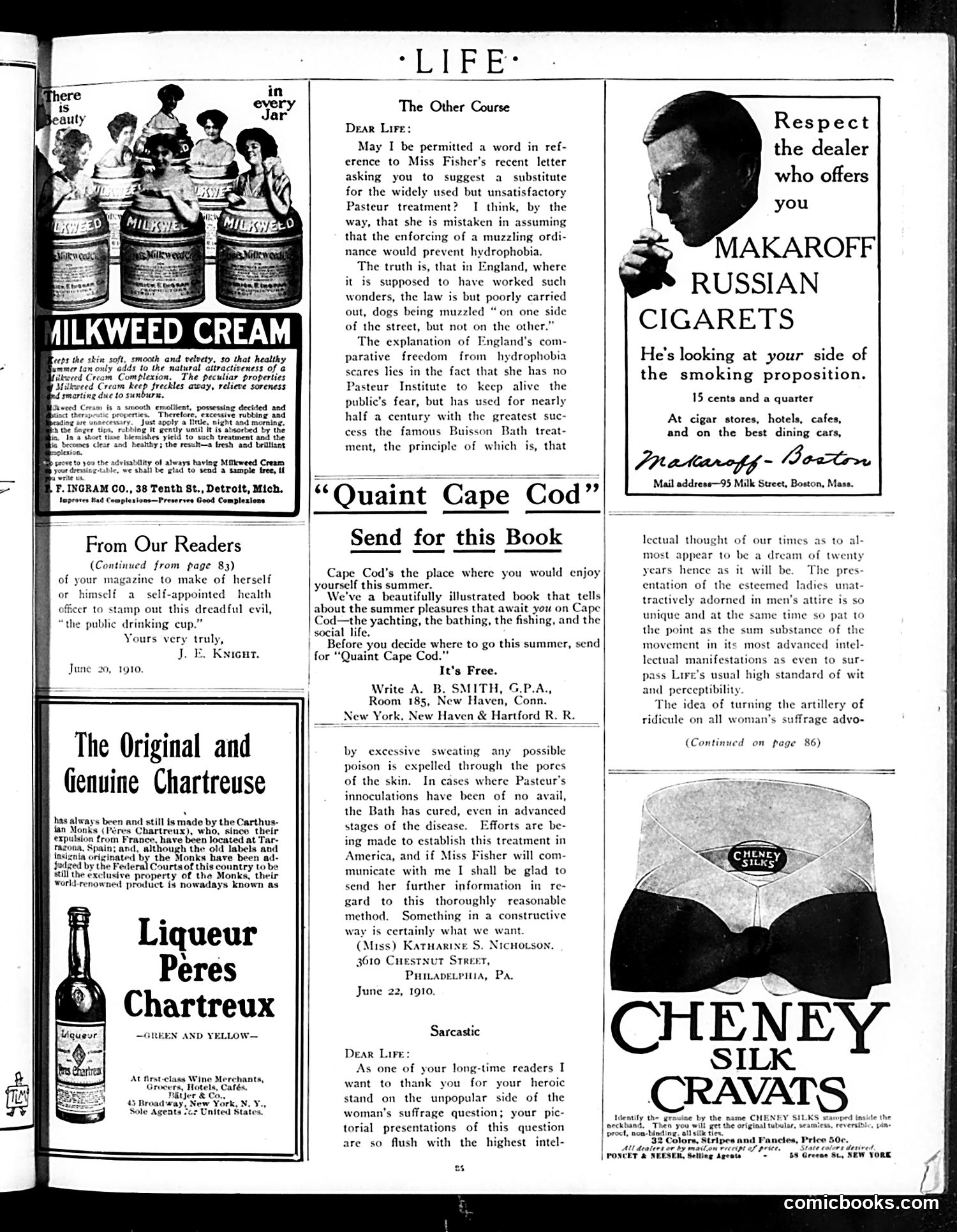
This page from *Life* magazine (June 1910) is primarily **advertisements and reader letters**, not political cartoons. The **advertisements** include: - **Milkweed Cream**: a complexion product marketed to women - **Makaroff Russian Cigarets**: positioned as a premium product for discerning smokers - **Cheney Silk Cravats**: neckwear for men - **Liqueur Peres Chartreux**: an alcoholic beverage - **Cape Cod tourism**: promoting summer travel The **"From Our Readers" section** contains letters debating public health issues—notably hydrophobia (rabies) treatment and **women's suffrage**. One sarcastic letter sardonically thanks *Life* for opposing women's voting rights, implying the magazine's editorial stance was unpopular with at least this reader. The page reflects 1910s consumer culture and emerging social debates rather than offering satire or political commentary itself. The advertisements target affluent readers with luxury goods.
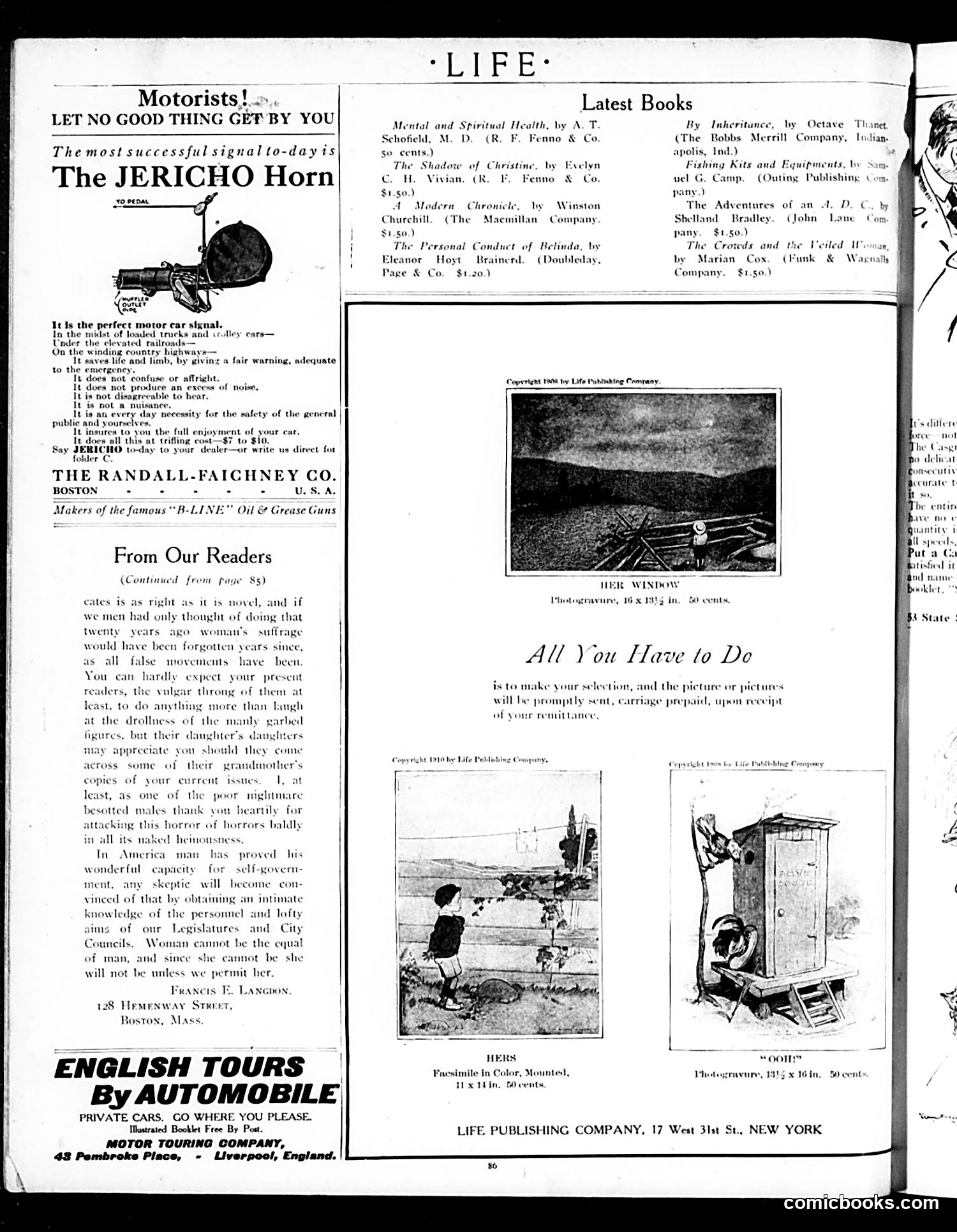
This page is primarily **advertising and book listings** rather than satirical content. The main elements are: **The Jericho Horn Advertisement** (top left): A motorist safety device marketed to early automobile owners. The pitch emphasizes it prevents accidents and gives drivers "full enjoyment" of their cars—reflecting early 1900s anxieties about this new technology and the need for audible warnings on roads. **"From Our Readers"** (center left): A letter praising Life's coverage of women's suffrage, written by Francis E. Langdon of Boston. The writer argues that opposing women's equality is illogical, though he expresses condescension ("their daughter's daughters may appreciate"). This reflects the suffrage debate contemporary to the magazine's publication. **Book listings and photographs**: Standard publishing advertisements for the era, including titles on health, fiction, and outdoor recreation. **Bottom section**: Instructions for ordering photographs from Life Publishing Company—a common revenue stream for magazines then. The page reflects early 20th-century concerns: automobile safety, women's rights debates, and consumer capitalism.
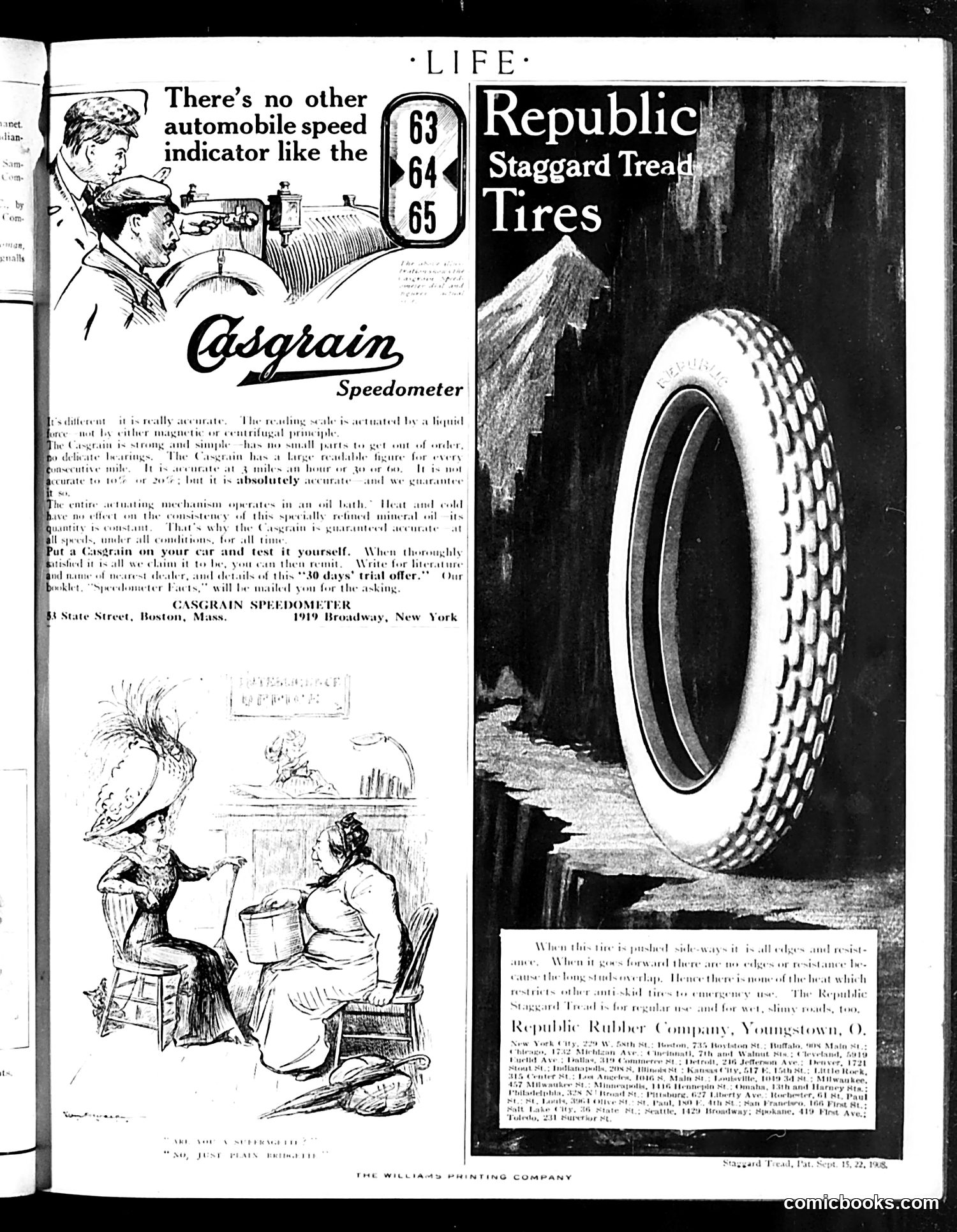
This page contains two unrelated advertisements typical of early 20th-century magazines. **Left side:** A Gasgrain Speedometer advertisement featuring two men examining an automobile speed indicator. The ad emphasizes the device's accuracy, claiming it registers speeds from 0-65+ mph with absolute precision. The copy promises a "30 days' trial offer" and lists Boston and New York addresses. **Right side:** A Republic Rubber Company advertisement for "Staggard Tread" tires. The large photograph shows a single tire displayed against a dark background. The ad's main selling point is the tire's tread design—when pushed sideways, the edges resist movement; when moving forward, the overlapping tread provides reduced resistance and less heat generation, making it suitable for regular use and wet roads. Neither content is satirical or political. This is straightforward product advertising aimed at automobile owners—a growing consumer market in the early automotive era.
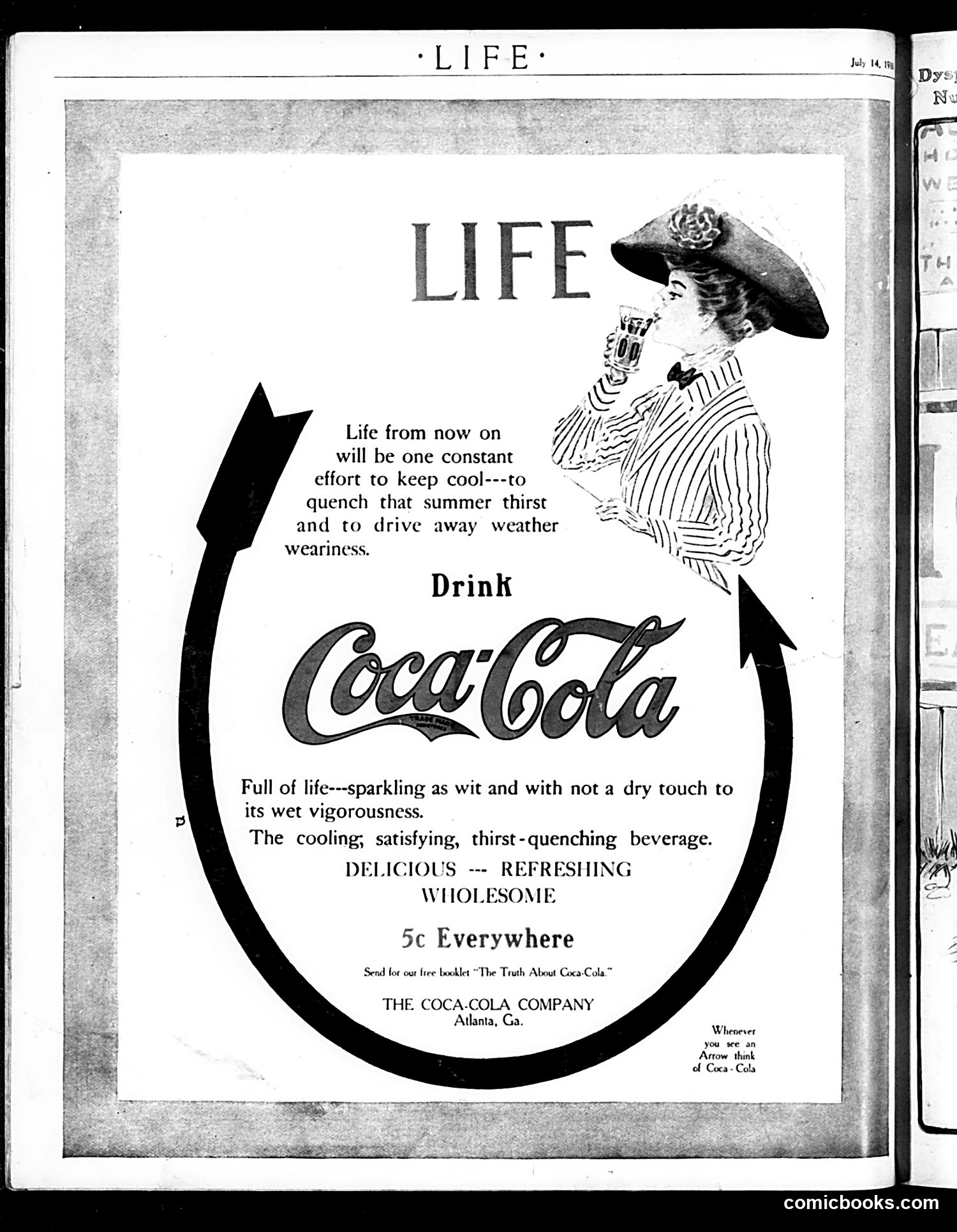
This is a **Coca-Cola advertisement**, not political satire. It appears in Life magazine (likely early 1900s based on style and 5¢ price point). The illustration shows a fashionably dressed woman in a large hat and striped jacket, depicted as elegant and refined. The ad uses her as a lifestyle aspirational figure—the implication being that sophisticated people drink Coca-Cola. The "joke" or appeal is purely commercial: the ad promises that summer life will be one long struggle against heat and fatigue, and Coca-Cola is positioned as the solution—"sparkling," "cooling," "satisfying," and "wholesome." The curved black design element frames the product name prominently. The arrow reference at bottom ("Whenever you see an Arrow think of Coca-Cola") suggests a contemporary advertising campaign using consistent branding across publications. This is straightforward product marketing, not political commentary or satire.