
Life, 1910-07-14 · page 16 of 40
Life — July 14, 1910 — page 16: what you’re looking at
What you’re looking at
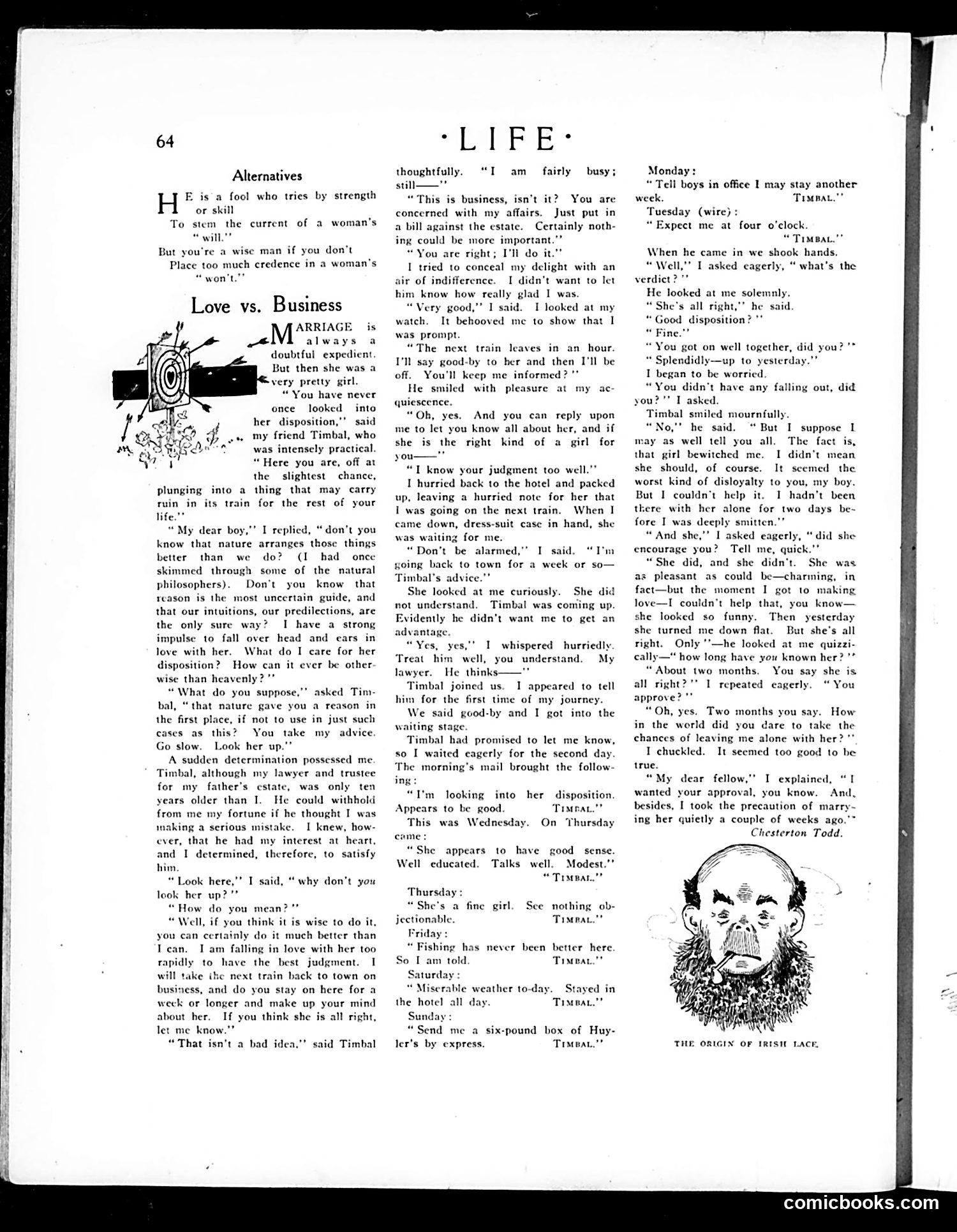
This page presents a short story mocking the tension between romantic impulse and practical business sense. The narrator falls in love with a pretty woman but his friend and trustee Timbal—a practical lawyer—insists on investigating her character before approving the match (apparently he has financial control over the narrator's inheritance). The narrator agrees, leaves town, and Timbal agrees to "look her up" by spending time with her. The story ends with Timbal reporting back via telegram throughout the week, offering increasingly positive but cautious assessments of the woman's disposition and character. **The satire's point**: The absurdity of treating romantic evaluation like a business transaction—using a lawyer to conduct due diligence on a potential wife, billing the investigation to an estate, and reducing human character to terse professional reports. It mocks both the prudishness of treating love as a financial matter and the era's tendency to subordinate emotion to legalistic practicality. The illustration titled "The Origin of Irish Lace" appears unrelated to the main text.
📄 Transcribed text from this page (OCR, searchable)
Machine-transcribed from the original scan — historical spelling and the odd misread are preserved.
Alternatives E is a fool who tries by strength or skill To stem the current of will” But you're a wise man if you don’t Place too much credence in a woman's “won't.” a woman's Love vs. Business MARRIAGE is er always a doubtful expedient. But then she was a very pretty girl. “You have never once looked into her disposition," said my friend Timbal, who was intensely practical. “Here you are, off at the slightest chance, plunging into a thing that may carry ruin in its train for the rest of your life."" “My dear boy,"’ I replied, “don’t you know that nature arranges those things better than we do? (I had once skimmed through some of the natural philosophers). Don’t you know that reason is the most uncertain guide, and that our intuitions, our predilections, are the only sure way? I have a strong impulse to fall over head and ears in love with her. What do I care for her disposition? How can it ever be other heavenly? "* “What do you suppose,’’ asked Tim- bal, “that nature gave you a reason in the first place, if not to use in just such cases as this? You take my advice Go slow. Look her up.”’ A sudden determination possessed me. Timbal, although my lawyer and trustee for my father’s estate, was only ten years older than I. He could withhold from me my fortune if he thought I was iaking a serious mistake. I knew, how- ever, that he had my interest at heart, and I determined, therefore, to satisfy him. “Look here,’ I said, “ why don't you look her up? “How do you mean?’ Well, if you think it is wise to do it, you can certainly do it much better than Ican. I am falling in love with her too rapidly to have the best judgment. I will ta e next train back to town on business, and do you stay on here for a week or longer and make up your mind about her. If you think she is all right, let me know."” “That isn’t a bad idea,” said Timbal “DFE thoughtfully, “Iam still. = fairly busy; This is business, isn’t it? You are concerned with my affairs. Just put in a bill against the estate. Certainly noth- ing could be more important.”’ “You are right; I'll do I tried to conceal my delight with an air of indifference. I didn't want to let him know how really glad I was. “Very good,” I said. I looked at my watch. It behooved me to show that 1 was prompt. “The next train leaves in an hour. I'l say good-by to ber and then I'll be off. You'll keep me informed?" He smiled with pleasure at my ac- quiescence. “Oh, yes. And you can reply upon me to let you know all about her, and if she is the right kind of a girl for you——"" “TL know your judgment too well.”’ I hurried back to the hotel and packed up, leaving a hurried note for her that 1 was going on the next train. When I came down, dress-suit case in hand, she was waiting for me. “Don't be alarmed,’ I said, “I'm going back to town for a week or so— Timbal’s advice."” She looked at me curiously. She did not understand. Timbal was coming up. Evidently he didn’t want me to get an advantage. Yes, yes," I whispered hurriedly. Treat him well, you understand. My lawyer. He thinks——" Timbal joined us. 1 appeared to tell him for the first time of my journey. We said good-by and I got into the waiting stage. Timbal had promised to let me know, so I waited eagerly for the second d The morning's mail brought the follow- ing: “I'm looking into her Appears to be good. This was Wednesday. came: “She Well disposition. Tratpat.”” On Thursday appears educated. to have good sense. Talks well. Modest."” “Trstmat.” Thursday : : ‘a fine girl, See jectionable. nothing ob- Timnat.”’ “Fishing has never been better here. So I am told Timeat.”” Mi Stayed in the hotel all day. Tinpat.”” Sunday : “Send me a six-pound box of Huy- ler's by express. Treat”? Monday: “ Tell boys in office I may stay another week. Timpar."* Tuesday (wire) : “Expect me at four o'clock “TimMBaL.”” When he came in we shook hands. “Well,"’ I asked eagerly, “ what’s the verdict ? He looked at me solemnly. “She's all right,” he said “Good disposition? ** “ Fine. “You got on well together, did “ Splendidly—up to yesterd, I began to be worried. “You didn’t have any falling out, did you?" I asked. Timbal smiled mournfully. “No,"’ he said. “But I suppose | may as well tell you all, The fact is, that girl bewitched me. I didn’t she should, of course. It scemed the worst kind of disloyalty to you, my boy. But I couldn't help it. 1 hadn't been there with her alone for two days be- fore I was deeply smitten.” “And she,’ I asked eagerly, “did she encourage you? Tell me, quick."’ “She did, and she didn't, She was as pleasant as could be—chariming, in fact—but the moment I got to making love—I couldn't help that, you know— she looked so funny. Then yesterday she turned me down flat. But she’s all right. Only ''—he looked at me quizzi- cally—“ how long have you known her? About two months. You say she is all right?'’ 1 repeated eagerly. “ You approve? "* “Oh, yes. Two months you say. How in the world did you dare to take the chances of leaving me alone with her?’ I chuckled. It seemed too good to be true. My dear fellow I explained, “I wanted your approval, you know. And. besides, I took the precaution of marry- ing her quietly a couple of weeks ago.’ Chesterton Todd. mean THE ORIGIN OF IRISIT LACK. comicbooks.com