
Life, 1910-07-14 · page 22 of 40
Life — July 14, 1910 — page 22: what you’re looking at
What you’re looking at
This page contains two distinct pieces of satire: **"The New Oaken Bucket"** (poem by Bert Leston Taylor) parodies the nostalgic ballad "The Old Oaken Bucket." It mocks wealthy Long Island estates by cataloging luxurious amenities—steam yachts, Tiffany buckets, seventeen-gable mansions—that contrast absurdly with the poem's supposed rural simplicity. The joke: modern rich people fetishize "old-fashioned" rusticity while surrounding themselves with ostentatious luxury goods. The repeated refrain about the "de luxe bucket" emphasizes the contradiction between humble nostalgia and extravagant reality. **"He Was the Real Thing"** (illustrated story) satirizes an overly earnest newlywed couple. The groom constantly praises everything—the city, Chinatown, the hotel—with excessive enthusiasm and offers friendship to the clerk. His performative "old-fashioned" wholesomeness and aggressive friendliness appear suspicious to the hotel clerk, who grows increasingly skeptical. The satire targets either affected sincerity or the couple's performative authenticity—they're *too* genuinely enthusiastic about everything. Both pieces mock artificial nostalgia and performative authenticity in early 20th-century wealthy society.
📄 Transcribed text from this page (OCR, searchable)
Machine-transcribed from the original scan — historical spelling and the odd misread are preserved.
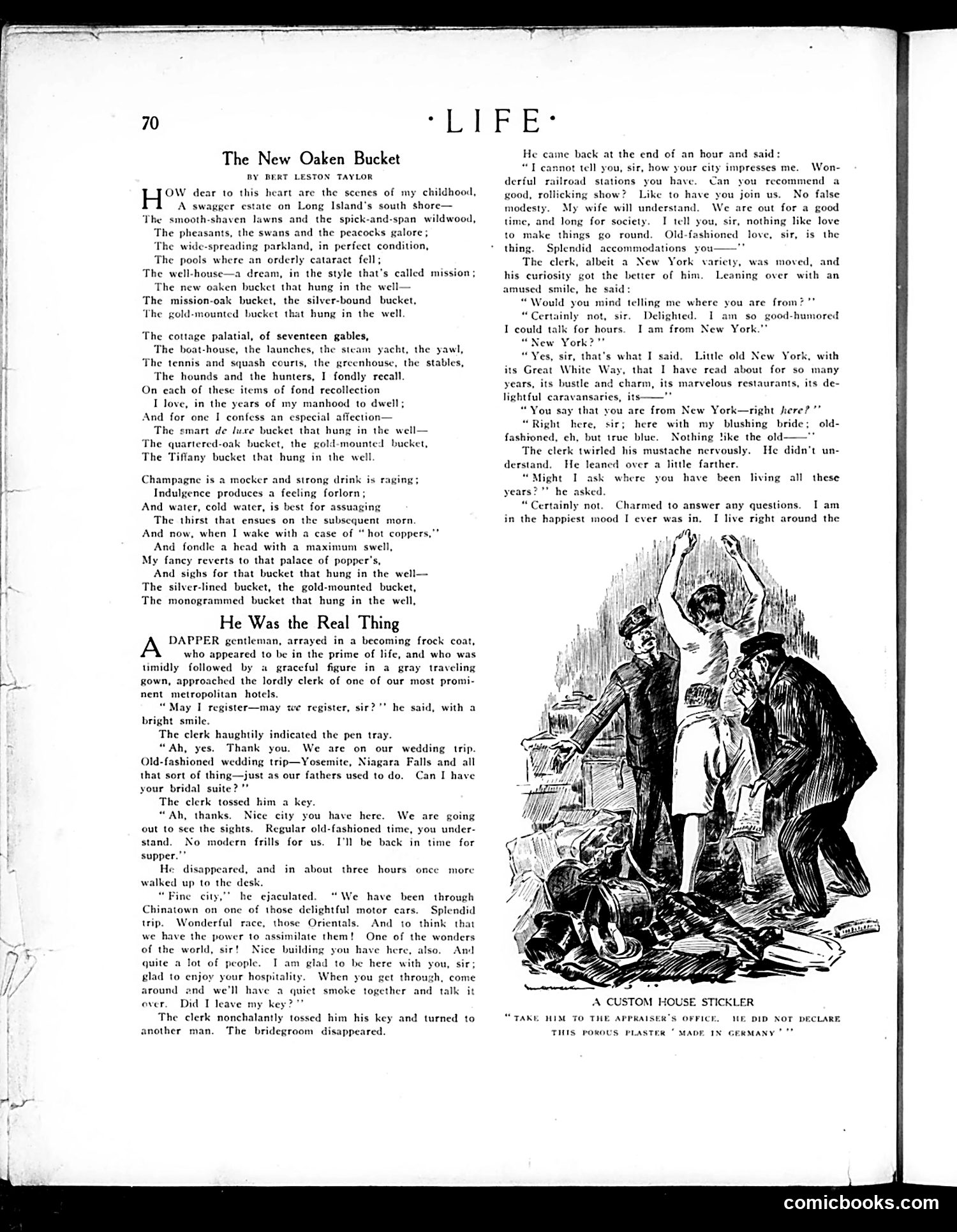
aa ) / iy 70 *LIFE: The New Oaken Bucket BY BERT LESTON TAYLOR OW dear to this heart are the scenes of my childhood, A swagger estate on Long Island's south shore— The smooth-shaven lawns and the spick-and-span wildwood, The pheasants, the swans and the peacocks galore ; The wide-spreading parkland, in perfect condition, The pools where an orderly cataract fell; The well-house—a dream, in the style that’s called mission; The new oaken bucket that hung in the well— The mission-oak bucket, the silver-bound bucket, ‘The gold-mounted bucket that hung in the well The cottage palatial, of seventeen gables, The boat-house, the launches, the steam yacht, the yawl, The tennis and squash courts, the greenhouse, the stables, The hounds and the hunters, I fondly recall On cach of these items of fond recollection I love, in the years of my manhood to dwell; And for one I confess an especial affection— The smart de luxe bucket that hung in the well— The quartered-oak bucket, the gold-mounted bucket, The Tiffany bucket that hung in the well Champagne is a mocker and strong drink is raging; Indulgence produces a feeling forlorn; And water, cold water, is best for assuaging The thirst that ensues on the subsequent morn. And now, when I wake with a case of “hot coppers,”” And fondle a head with a maximum swell, My fancy reverts to that palace of poppers, And sighs for that bucket that hung in the well— The silver-lined bucket, the gold-mounted bucket, The monogrammed bucket that hung in the well, He Was the Real Thing DAPPER gentleman, arrayed in a becoming frock coat, who appeared to be in the prime of life, and who was timidly followed by a graceful figure in a gray traveling gown, approached the lordly clerk of one of our most promi- nent metropolitan hotel “May I register—may bright smile. The clerk haughtily indicated the pen tray. “Ah, yes. Thank you. We are on our wedding trip. Old-fashioned wedding trip—Yosemite, Niagara Falls and all that sort of thing—just as our fathers used to do. Can I have your bridal suite?" The clerk tossed him a key. “Ah, thanks. Nice city you have here. We are going out to see the sights, Regular old-fashioned time, you under- stand. No modern frills for us. I'll be back in time for supper.” He disappeared, and in about three hours once more walked up to the desk. “Fine city,’ he ejaculated. “We have been through Chinatown on one of those delightful motor cars. Splendid trip. Wonderful race, those Orientals. And to think that we have the power to assimilate them! One of the wonders of the world, sir! Nice building you have here, also. And guite a lot of people. Tam glad to be here with you, sir; glad to enjoy your hospitality. When you get through, co’ around and we'll have a quict smoke together and talk it over. Did T leave my key?” The clerk nonchalantly tossed him his key and turned to another man. The bridegroom disappeared. ¢ register, sir?'’ he said, with a He came back at the end of an hour and said: “T cannot tell you, sir, how your city impresses me. Won- derful railroad stations you have. Can you recommend a good, rollicking show? Like to have you join us. No false modesty. My wife will understand. We are out for a good , and long for society. I tell you, sir, nothing like love ke things go round. Old-fashioned love, sir, is the Splendid accommodations you clerk, albeit a New York varie! his curiosity got the better of him. 1 amused smile, he said: “Would you mind telling me where you are from? “Certainly not, sir. Delighted. 1 am so good-humored I could talk for hours. Iam from New York.” “New York?” “Yes, sir, that's what I said. Little old New York, with its Great White Way, that I have read about for so many years, its bustle and charm, its marvelous restaurants, its de- lightful caravansaries, its——"* “You say that you are from New York—right fiere?”’ “Right here, sir; here with my blushing bride; old- fashioned, ch, but true bluc. Nothing tike the old—"* The clerk twirled his mustache nervously. He didn’t un- derstand. He leaned over a little farther. “Might I ask where you have been living all these years? "” he asked. “Certainly not. Charmed to answer any questions. I am in the happiest mood I ever was in, I live right around the tim y, was moved, and ning over with an <A CUSTOM HOUSE STICKLER “TAKE MIM TO THE APPRAISERS OFFICE. ME DID NOT DECLARE THIS POROUS PLASTER ‘MADE IN GERMANY‘ '* comicbooks.com