
Life, 1910-07-14 · page 28 of 40
Life — July 14, 1910 — page 28: what you’re looking at
What you’re looking at
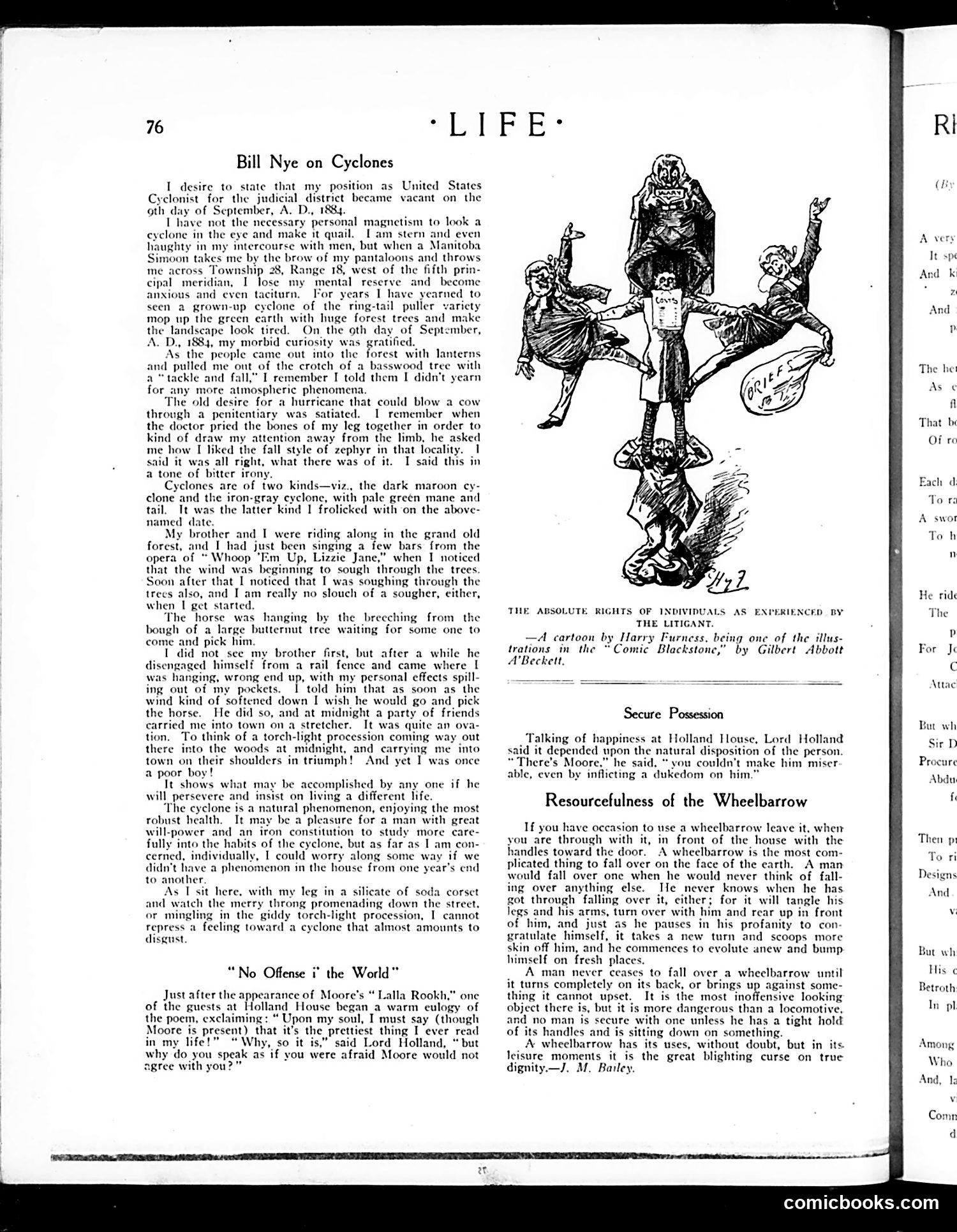
This page contains **humorous personal essays by Bill Nye**, a 19th-century American humorist, not political cartoons. The central cartoon illustrates Nye's tall tale about encountering a cyclone in 1884. **The Joke:** Nye adopts the persona of "United States Cyclonist"—a fictional government position—and recounts being violently caught in a tornado while riding with his brother. He describes being thrown through trees, his horse hanging from a branch, and ending up carried into town on a stretcher at midnight, which he mockingly compares to a triumphant "torch-light procession." **The Satire:** Nye satirizes both his own cowardice (claiming he lacks "personal magnetism" to intimidate cyclones) and bureaucratic absurdity (the invented "Cyclonist" position). The humor relies on exaggeration and deadpan delivery—he treats a disaster as if it were civic recognition. The page's other sections ("Secure Possession," "Resourcefulness of the Wheelbarrow") continue in similar humorous-essay format, typical of *Life* magazine's content during this era.
📄 Transcribed text from this page (OCR, searchable)
Machine-transcribed from the original scan — historical spelling and the odd misread are preserved.
%6 “IEE * Bill Nye on Cyclones I desire to state that my position as United States Cyclonist for the judicial district became vacant on the oth day of September, A. D., 1884. I have not the necessary personal magnetism to look a cyclone in the eye and make it quail. [am stern and even haughty in my intercourse with men, but when a Manitoba Simoon takes me by the brow of my pantaloons and throws. me across Township 28, Range 18, west of the fifth prin- cipal meridian, I lose my mental reserve and become anxious and even taciturn. For years I have yearned to seen a grown-up cyclone of the ring-tail puller variety mop up the green earth with huge forest trees and make the landscape look tired. On the oth day of September, A. D., 1884, my morbid curiosity was gratified. As the people came out into the forest with lanterns and pulled me out of the crotch of a basswood tree with a “tackle and fall,” I remember I told them I didn’t yearn for any more atmospheric phenomena. The old desire for a hurricane that could blow a cow through a penitentiary was satiated. I remember when the doctor pried the bones of my leg together in order to kind of draw my attention away from the limb, he asked me how I liked the fall style of zephyr in that locality. 1 said it was all right, what there was of I said this in a tone of bitter irony. Cyclones are of two kinds—viz., the dark maroon cy- clone and the iron-gray cyclone, with pale green mane and tail. It was the latter kind 1 frolicked with on the above named 1c. My brother and I were riding along in the grand old forest, and I had j been singing a few bars from the opera of “ Whoop "Em Up, Lizzie Jane,” when I noticed that the wind was beginning to sough through the trees. Soon after that I noticed that I was soughing through the trees also, and I am really no slouch of a sougher, either, when I get started. The horse was hanging by the breeching from the bough of a large butternut tree waiting for some one to come and pick him. I did not see my brother first, but after a while he disengaged himself from a rail fence and came where | ng, wrong end up, with my personal effects spill- ing out of my poc! 1 told him that as soon as the wind kind of softened down I wish he would go and_pick the horse. He did so, and at midnight a party of friends carried me into town on a stretcher. It was quite an ova- tion. To think of a torch-light procession coming way out there into the woods at midnight, and carrying me into town on their shoulders in triumph! And yet I was once a poor boy! It shows what may be accomplished by any one if he will persevere and insist on living a different life. The cyclone is a natural phenomenon, enjoying the most robust health. It may be a pleasure for a man with great will-power and an iron constitution to study more care fully into the habits of the cyclone, but as far as | am con- cerned, individually, | could worry along some way if we didn’t have a phenomenon in the house from one year's end to another. As I sit here, with my leg in a silicate of soda corset and ich the merry throng promenading down the street, or mingling in the giddy torch-light procession, I cannot repress a feeling toward a cyclone that almost amounts to disgust. “No Offense i’ the World” Just after the appearance of Moore's “ Lalla Rookh," one of the guests at Holland House began _a warm eulogy of the poem, exclaiming: “ Upon my soul, I must say (though Moore is present) that it’s the prettiest thing I ever read in my life!” “Why, so it is,” said Lord Holland, “ but why do you speak as if you were afraid Moore would not agree with you?” THE ABSOLUTE RIGHTS OF INDIVIDUALS AS EXPERIENCED BY THE LITIGANT. —A cartoon by Harry Furness, being one of the illus- trations in the “Comic Blackstone,” by Gilbert Abbott A'Beckett. Secure Possession alking of happiness at Holland House, Lord Holland id it depended upon the natural disposition of the person There's Moore,” he said, “you couldn't make him miser able, even by inflicting a dukedom on him.” Resourcefulness of the Wheelbarrow If you have occasion to use a wheelbarrow leave it, wher you are through with it, in front of the house with the handles toward the door. A wheelbarrow is the most com- plicated thing to fall over on the face of the earth. A man would fall over one when he would never think of fall- ing over anything else. He never knows when he has got through falling over it, either; for it will tangle his legs and his arms, turn over with him and rear up in front of him, and just he pauses in his profanity to con gratulate himself, it takes a new turn and scoops more skin off him, and he commences to evolute anew and bump himself on fresh places. A man never ceases to fall over a wheelbarrow until it turns completely on its back, or brings up against some- thing it cannot upset. It is the most inoffensive looking object there is, but it is more dangerous than a locomotive, no man is secure with one unless he has a tight hold its handles and is sitting down on something. wheelbarrow has its uses, without doubt, but in its leisure moments it is the great blighting curse on true dignity.—J. M. Bailey. CB: The het As ¢ A That be Of ro ich dd. Tor A swot Toh n But wh Sir D Procure Abdu fi Then pi To ri But wh His ¢ Betroth In pl Among Who And, Comn d comicbooks.com