
Life, 1910-07-14 · page 12 of 40
Life — July 14, 1910 — page 12: what you’re looking at
What you’re looking at
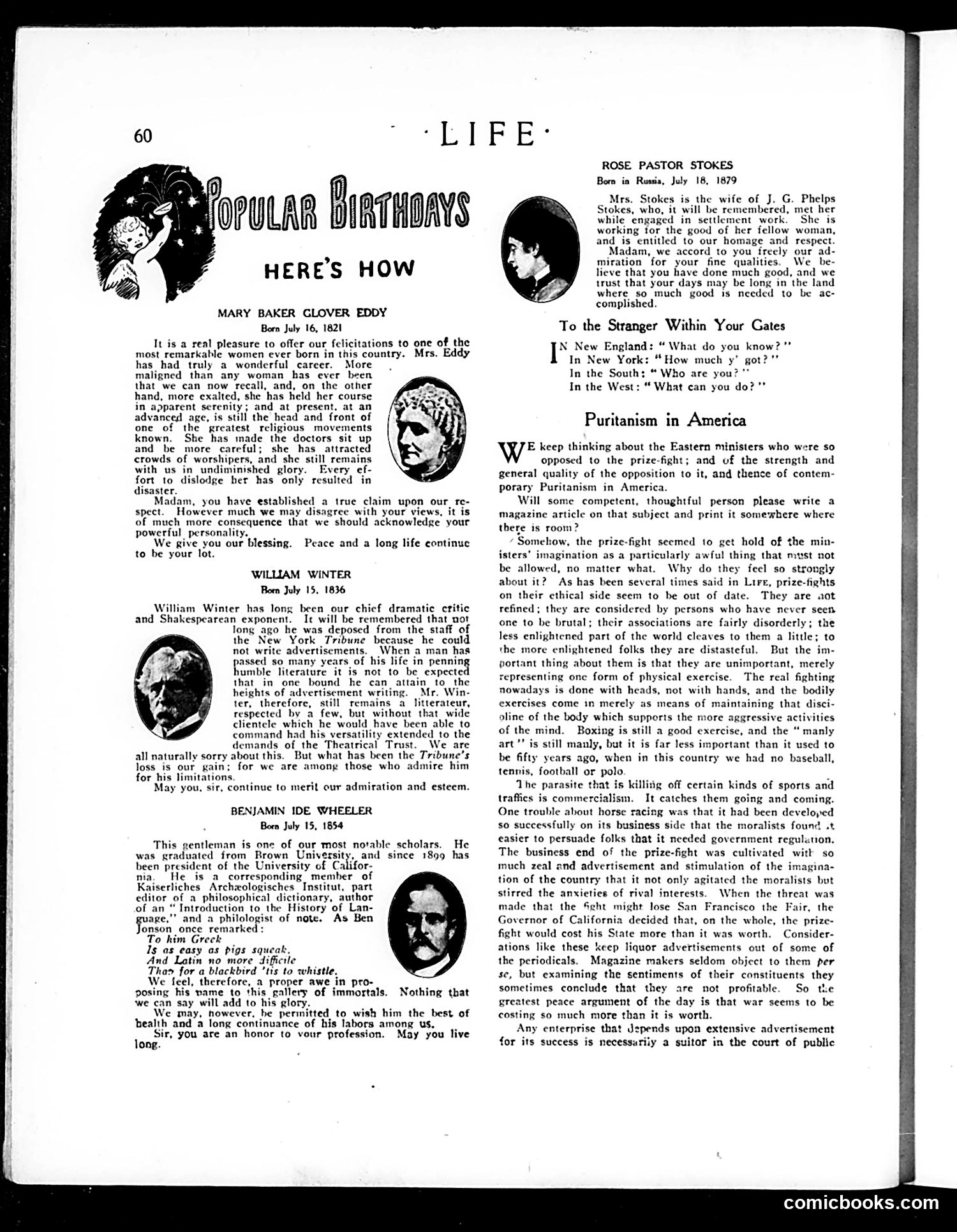
This page from *Life* magazine celebrates notable birthdays of public figures. The left column features portrait caricatures and biographical tributes to: - **Mary Baker Glover Eddy** (born 1821) — founder of Christian Science, praised for her religious movement and character - **William Winter** (born 1836) — a dramatic critic and Shakespeare expert, noted for his literary contributions - **Benjamin Ide Wheeler** (born 1854) — a prominent scholar and university leader The right side contains an essay titled "Puritanism in America" discussing Eastern ministers' opposition to prize-fighting and commercialized sports, particularly boxing. The author argues that boxing, despite its brutality, serves legitimate purposes and that commercialism—not the sport itself—is the real problem worth addressing. The page functions as celebratory biography combined with social commentary on American values.
📄 Transcribed text from this page (OCR, searchable)
Machine-transcribed from the original scan — historical spelling and the odd misread are preserved.
“LP E* "oPuLAR GIATHOAYS HERES HOW MARY BAKER GLOVER EDDY Born July 16, 1821 It is a real pleasure to offer our felicitations to one of the most remarkable women ever born in this country. Mrs. Eddy has had truly a wonderful career. More maligned than any woman has ever been that we can now recall, and, on the other hand, more exalted, she has held her course in apparent serenity; and at present, at an advanced age, is still the head and front of one of the greatest religious movements known. She has made the doctors sit up and be more careful; she has attracted crowds of worshipers, and she still remains with us in undiminished glory. Every ef- fort to dislodge her has only resulted in disaster. Madam, you have established a true claim upon our. re- spect. However much we may disagree with your views, it is of much more consequence that we should acknowledge your powerful personality. 7 We give you our blessing. Peace and a long life continue to be your lot. WILLIAM WINTER Born July 15, 1836 William Winter has long been our chief dramatic ctitic and Shakespearean exponent. It will be remembered that not long ago he was deposed from the staff of the New York Tribune because he could not write advertisements. When a man has pase so many years of his life in Denning humble literature it is not to be expectes that in one bound he can_ attain to the heights of advertisement writing. Mr. Win- ter, therefore, still remains a litterateur, respected by a few, but without that wide clientele which he would have been able to command had his versatility extended to the demands of the Theatrical Trust. We are all naturally sorry about this. But what has been the Tribune’s loss is our gain; for we are among those who admire him for his limitations. . oo. May you, sir, continue to merit our admiration and esteem. BENJAMIN IDE WHEELER Born July 15, 1854 This gentleman is one of our most notable scholars. He was graduated from Brown University, and since 1899 has been president of the University of Califor- n He is a corresponding member of Kaiserliches Archzologisches Institut, part editor of a philosophical dictionary, author of an “Introduction to the History of Lan- age,”” and a philologist of note. As Ben fonson once remarked : To him Greck Is as easy as pigs squeak, And Latin no more difficr Than for a blackbird ’tis to whistle, We feel, therefore, a proper awe in pro- posing his vame to this gallery of immortals. Nothing that we can say will add to his glory. We may, however, be permitted to wish him the best of health and a long continuance of his labors among us, 1 Sir, you are an honor to vour profession. May you live jong. ROSE PASTOR STOKES Born in Russia, July 18, 1879 Mrs. Stokes is the wife of J. G. Phelps Stokes, who, it will be remembered, met her while engaged in settlement work. She is working tor the good of her fellow woman, and is entitled to our homage and respect. Madam, we accord to you freely our ad- miration ‘for your fine qualities. We. be- lieve that you have done much good, and we trust that your days may be long in ‘the land where so much good is needed to be ac- complished. To the Stranger Within Your Gates N New England: “ What do you know?" In New York: “How much y’ got?’* In the South: “ Who are you? In the West: “ What can you do?’* Puritanism in America E keep thinking about the Eastern ministers who were so opposed to the prize-fight; and of the strength and general quality of the opposition to it, and thence of contem- porary Puritanism in America. Will some competent, thoughtful person please write a magazine article on that subject and print it somewhere where there is room? / Somehow, the prize-fight seemed to get hold of the min- isters’ imagination as a particularly awful thing that must not be allowed, no matter what. Why do they feel so strongly about it? As has been several times said in Lire, prize-fights on their cthical side seem to be out of date. They are aot refined; they are considered by persons who have never seen one to be brutal; their associations are fairly disorderly; the less enlightened part of the world cleaves to them a little; to the more enlightened folks they are distasteful. But the im- portant thing about them is that they are unimportant, merely representing one form of physical exercise. The real fighting nowadays is done with heads, not with hands, and the bodily exercises come in merely as means of maintaining that disci- oline of the body which supports the more aggressive activities of the mind. Boxing is still a good exercise, and the “ manly art’? is still manly, but it is far less important than it used to be fifty years ago, when in this country we had no baseball, tennis, football or polo ‘The parasite that is killiig off certain kinds of sports and traffics is commercialism. It catches them going and coming. One trouble about horse racing was that it had been developed so successfully on its business side that the moralists found .t easier to persuade folks that it needed government regulation. The business end of the prize-fight was cultivated with so much zeal and advertisement and stimulation of the imagina- tion of the country that it not only agitated the moralists but stirred the anxieties of rival interests. When the threat was made that the Seht might lose San Francisco the r, the Governor of California decided that, on the whole, the prize- fight would cost his State more than it was worth. Consider- ations like these keep liquor advertisements out of some of the periodicals. Magazine makers seldom object to them per se, but examining the sentiments of their constituents they sometimes conclude that they are not profitable. So the greatest peace argument of the day is that war seems to be costing so much more than it is worth. Any enterprise that depends upon extensive advertisement for its success is necessarily a suitor in the court of public comicbooks.com