
Life, 1910-07-14 · page 8 of 40
Life — July 14, 1910 — page 8: what you’re looking at
What you’re looking at
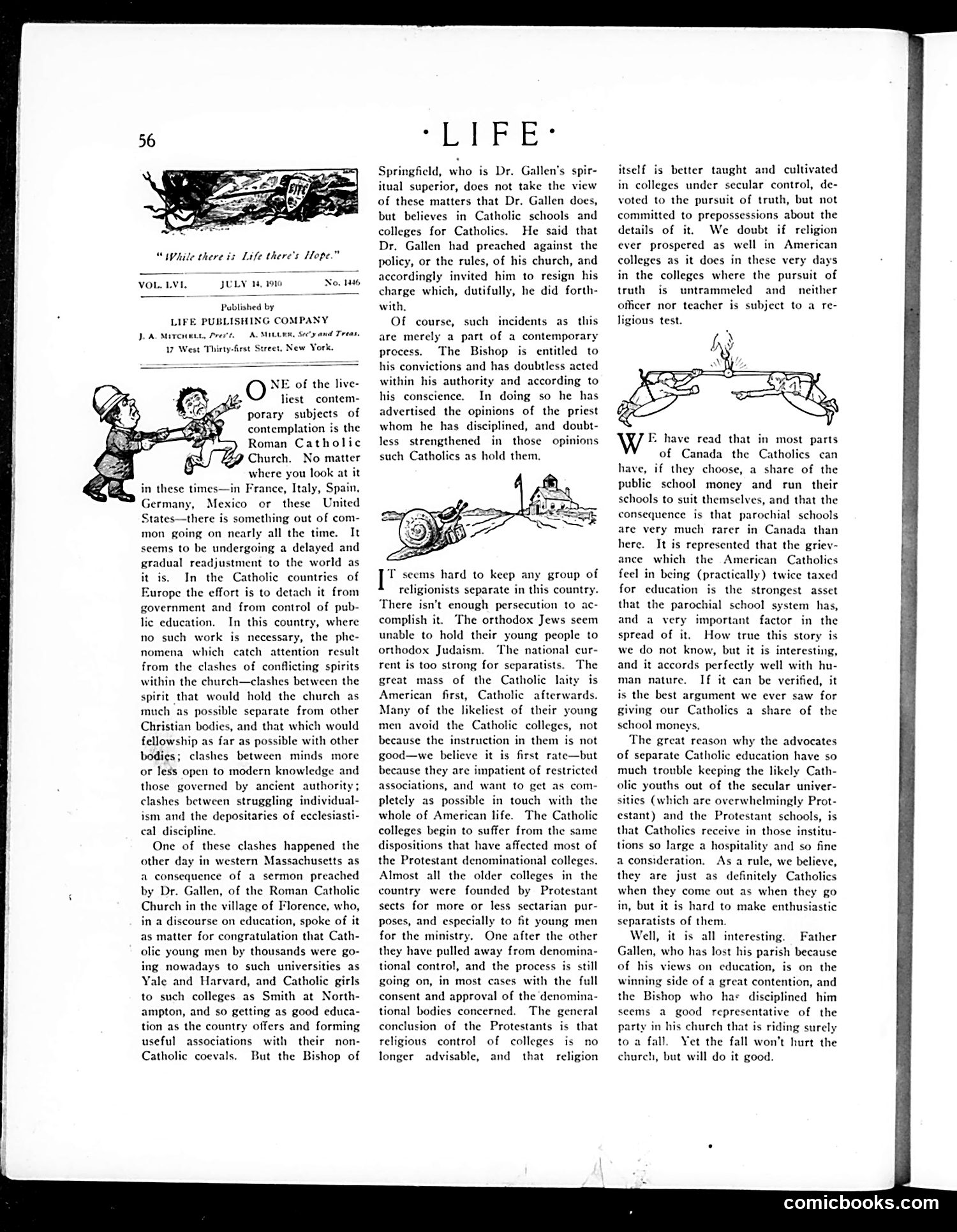
This page contains editorial text addressing Catholic education in America, accompanied by illustrative cartoons rather than political satire. The cartoons depict **children in various educational scenarios**—one shows youngsters near what appears to be a schoolhouse or institution. The imagery supports the article's discussion of Catholic versus public schooling debates in early 20th-century America. The text discusses **Bishop Gallen's conflict** over Catholic education policy and references broader tensions between Catholic and Protestant institutions. It debates whether Catholics should attend secular universities or separate Catholic colleges, and whether Catholic youth were being adequately separated from "American life." The satire is gentle—the primary point critiques both sides: Catholics worried about assimilation, and Protestants concerned about Catholic institutional control. The cartoon's simple depictions underscore the article's examination of these competing educational philosophies.
📄 Transcribed text from this page (OCR, searchable)
Machine-transcribed from the original scan — historical spelling and the odd misread are preserved.
“While there iz Life there's Hope.” VOL. LVI. JULY 14, 1910 Published by LIFE PUBLISHING COMPANY JA. Mor A. MILLER, Sec'y and Treas, 17 West Th eit, Pret, ty-first Street, New York. of the live- st contem- 3 porary subjects of contemplation is the Roman Catholic &D Church. No matter where you look at it in these times—in France, Italy, Spain, Germany, Mexico or these United States—there is something out of com- mon going on nearly all the time. It seems to be undergoing a delayed and gradual readjustment to the world as it is. In the Catholic countries of Europe the effort is to detach it from government and from control of pub- lic education. In this country, where no such work is necessary, the phe- nomena which catch attention result from the clashes of conflicting spirits within the church—clashes between the spirit that would hold the church as much ble separate from other Christian bodies, and that which would fellowship as far as possible with other bodies; clashes between minds more or less open to modern knowledge and those governed by ancient authority; clashes between struggling individual- ism and the depositaries of ecclesiasti- cal discipline. One of these clashes happened the other day in western Massachusetts as a consequence of a sermon preached by Dr. Gallen, of the Roman Catholic Church in the village of Florence, who, in a discourse on education, spoke of it as matter for congratulation that Cath- olic young men by thousands were go- ing nowadays to such universities as Yale and Harvard, and Catholic girls to such colleges as Smith at North- ampton, and so getting as good educa- tion as the country offers and forming useful associations with their non- Catholic coevals. But the Bishop of “E Springfield, who is Dr. Gallen’s spir- itual superior, does not take the view of these matters that Dr. Gallen does, but believes in Catholic schools and colleges for Catholics. He said that Dr. Gallen had preached against the policy, or the rules, of his church, and accordingly invited him to resign his charge which, dutifully, he did forth- with, Of course, such incidents as this are merely a part of a contemporary process. The Bishop is entitled to his convictions and has doubtless acted within his authority and according to his conscience. In doing so he has advertised the opinions of the priest whom he has disciplined, and doubt- less strengthened in those opinions such Catholics as hold them, T seems hard to keep any group of religionists separate in this country. There isn’t enough persecution to ac- complish it. The orthodox Jews seem unable to hold their young people to orthodox Judaism. ‘The national cur- rent is too strong for separati: The great mass of the Catholic laity is American first, Catholic afterwards. Many of the likeliest of their young men avoid the Catholic colleges, not because the instruction in them is not good—we believe it is first rate—but because they are impatient of restricted associations, and want to get as com- pletely as possible in touch with the whole of American life. The Catholic colleges begin to suffer from the same dispositions that have affected most of the Protestant denominational colleges. Almost all the older colleges in the country were founded by Protestant sects for more or less sectarian pur- poses, and especially to fit young men for the ministry. One after the other they have pulled away from denomina- tional control, and the process is still going on, in most cases with the full consent and approval of the denomina- tional bodies concerned. The general conclusion of the Protestants is that religious control of colleges is no longer advisable, and that religion itself is better taught and cultivated in colleges under secular control, de- voted to the pursuit of truth, but not committed to prepossessions about the details of it. We doubt if religion ever prospered as well in American colleges as it does in th very in the colleges where the pursuit of truth is untrammeled and neither officer nor teacher is subject to a re- ligious test. ¢ read that in most parts of Canada the Catholics can f they choose, a share of the public school money and run_ their schools to suit themselves, and that the consequence is that parochial schools are very much rarer in Canada than here. It is represented that the griev ance which the American Catholics feel in being (practically) twice taxed for education is the strongest asset that the parochial school system has, and a very important factor in the spread of it. How true this story is we do not know, but it is interesting, and it accords perfectly well with hu- man nature. If it can be verified, it is the best argument we ever saw for giving our Catholics a share of the school moneys, The great reason why the advocates of separate Catholic education have so much trouble keeping the likely Cath- olic youths out of the secular univer- sities (which are overwhelmingly Prot- estant) and the Protestant schools, is that Catholics receive in those institu- tions so large a hospitality and so fine a consideration. As a rule, we believe, they are just as definitely Catholics when they come out as when they go in, but it is hard to make enthusiastic separatists of them. Well, it is all interesting. Father Gallen, who has lost his parish because of his views on education, is on the winning side of a great contention, and the Bishop who has disciplined him seems a good representative of the party in his church that is riding surely to a fall. Yet the fall won't hurt the church, but will do it good. comicbooks.com