
A complete issue · 29 pages · 1909
Life — December 30, 1909
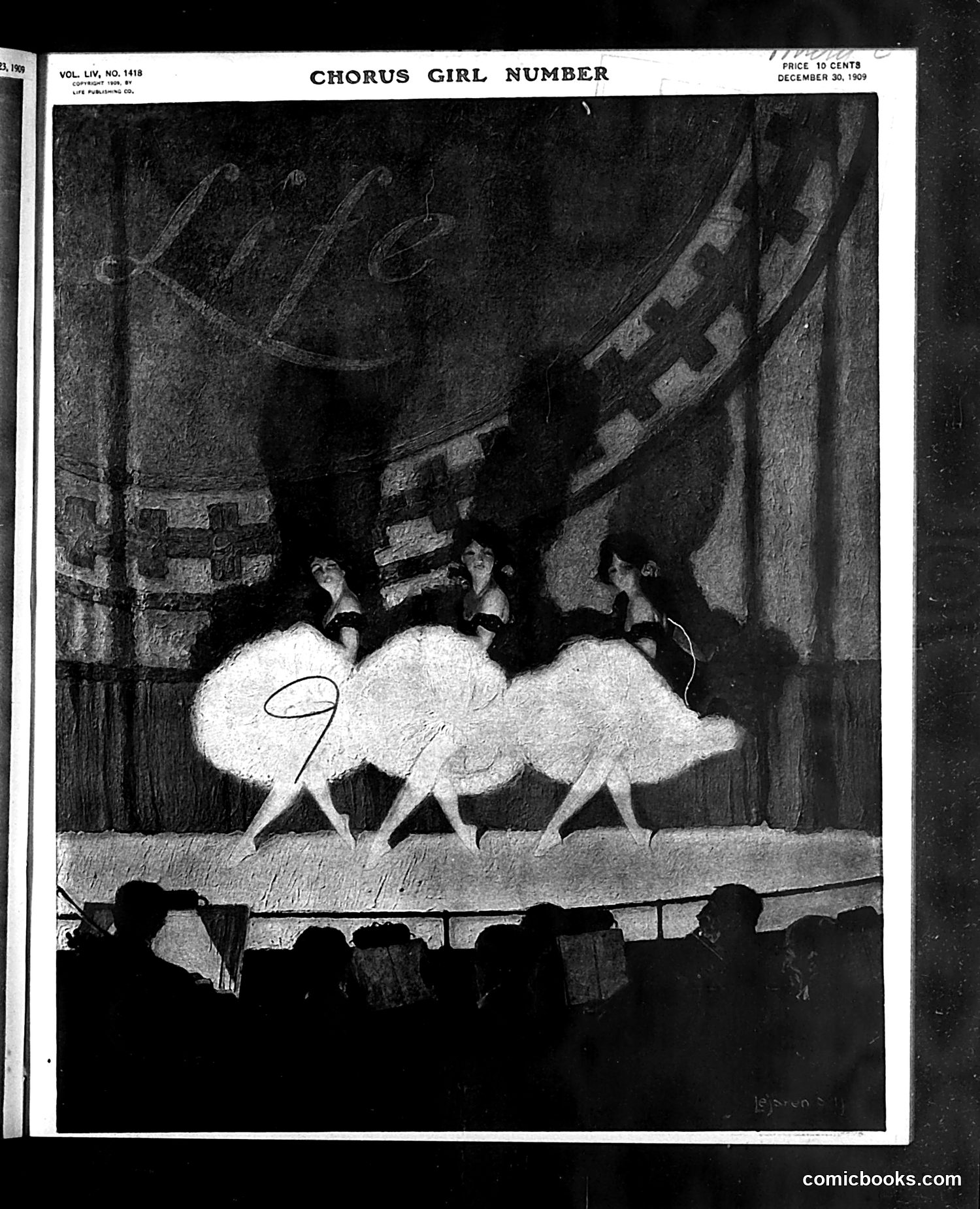
This is a theatrical satire depicting three chorus girls performing on stage, viewed from the audience. The "number 9" drawn on one dancer's back is the cartoon's joke: it labels her as interchangeable, suggesting chorus girls are essentially identical, replaceable performers rather than individuals with distinct talent or personality. The satire mocks both the theatrical industry's treatment of chorus girls as fungible commodities and contemporary attitudes toward chorus work. By literally numbering a performer, the artist ridicules how the entertainment establishment—and society generally—devalued chorus dancers as undifferentiated entertainment products rather than skilled artists. The silhouetted audience below emphasizes the performers' display and objectification.
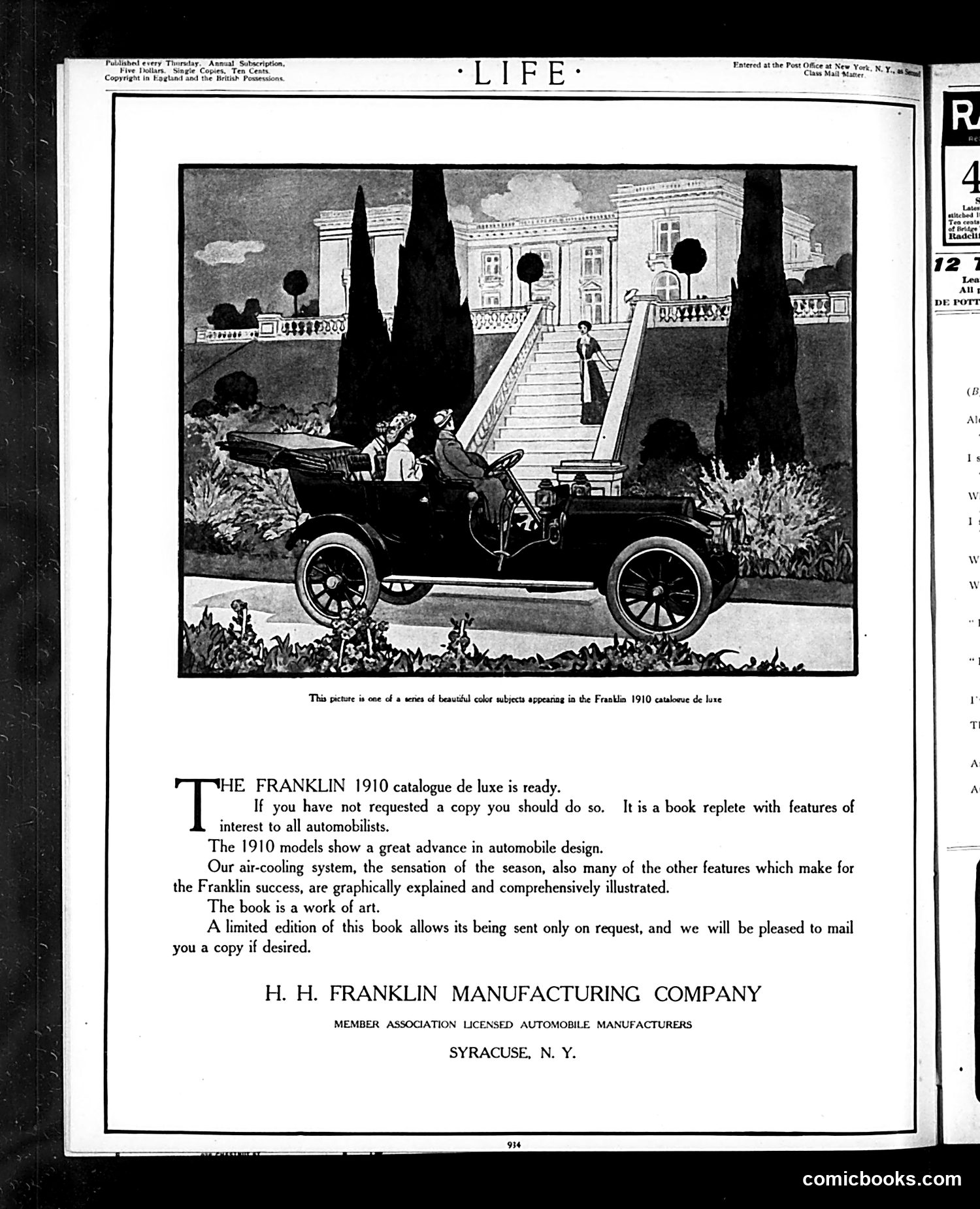
This is **advertising content**, not satire or political commentary. The page promotes the Franklin 1910 automobile catalogue through an illustration rather than containing cartoons. The image shows a stylized Franklin motorcar parked before an elegant mansion with cypress trees and formal gardens—a setting designed to convey luxury and sophistication. The composition suggests the automobile as a status symbol for wealthy Americans. The accompanying text emphasizes the 1910 models' "great advance in automobile design," specifically highlighting the air-cooling system as a distinctive feature. The advertisement describes the catalogue as "a work of art" and notes its limited edition, creating exclusivity appeal. This represents early automotive advertising targeting affluent consumers through aspirational imagery rather than technical specification alone.
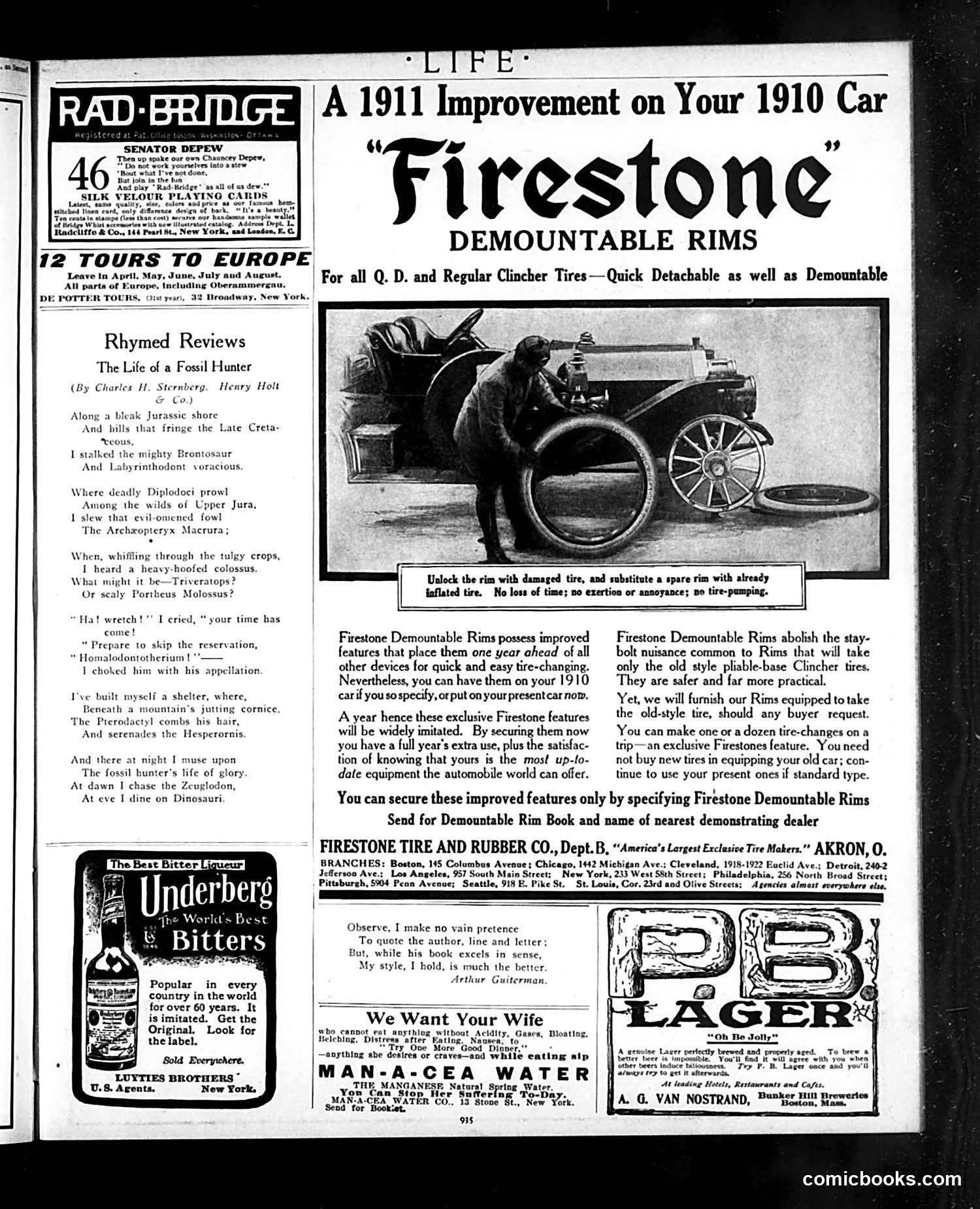
This page is **predominantly advertising** rather than satirical content. The main feature is a large Firestone Tire advertisement promoting "Demountable Rims" as a 1911 improvement for 1910 automobiles. The ad emphasizes quick tire changes without tools. The left column contains a poem titled "The Life of a Fossil Hunter" by Charles H. Stevenson, presenting humorous verse about paleontological discoveries (dinosaurs, fossils). Below are smaller ads for Underberg Bitters and Man-a-cea Water. The bottom right features a P.B. Lager beer advertisement. The page reflects early 1900s consumer culture: automobile innovation, patent-medicine marketing, and nostalgic natural-history humor. There is **no discernible political cartoon or satire** on this particular page.
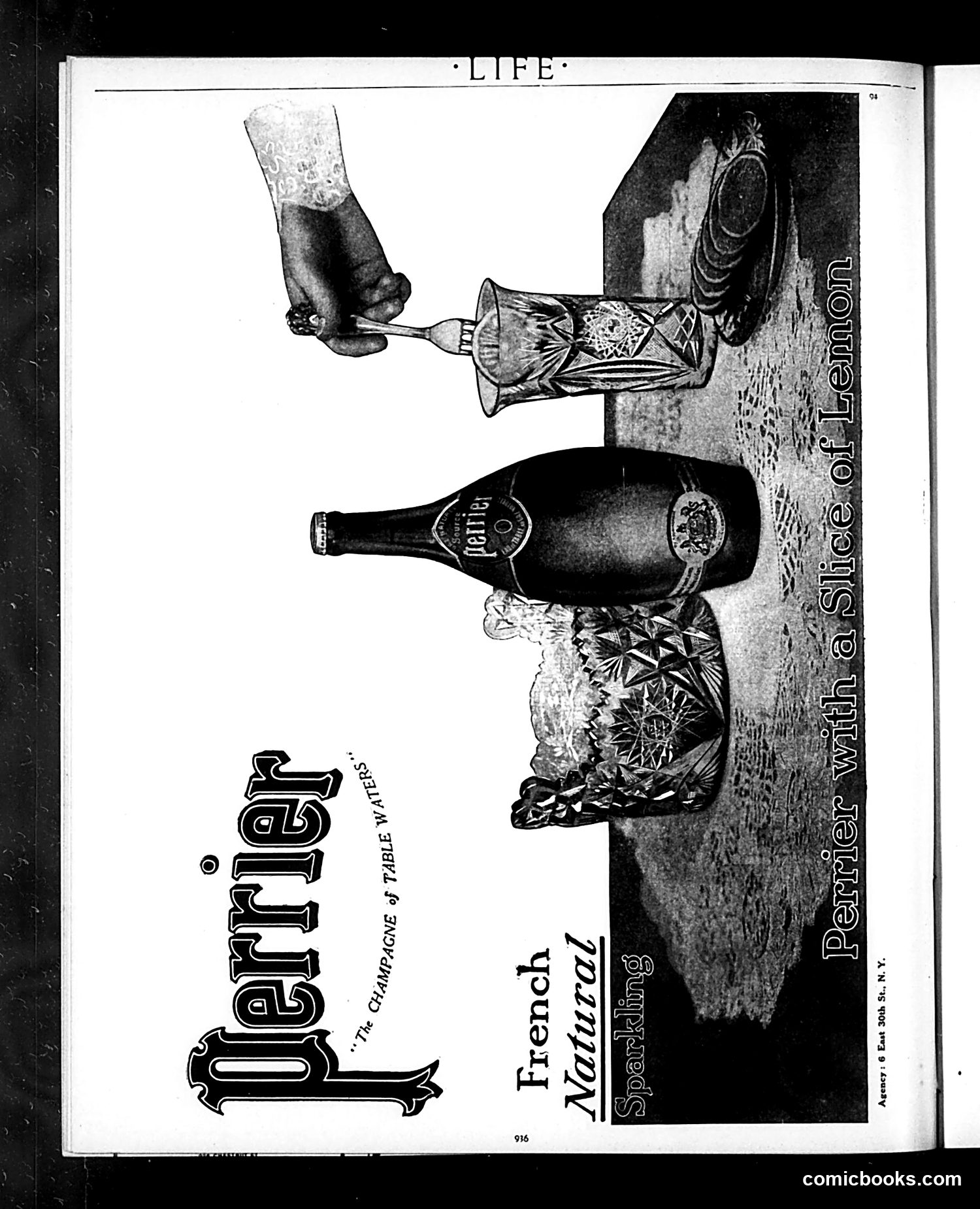
This is primarily a **Perrier sparkling water advertisement** from Life magazine, rotated 90 degrees on the page. The ad emphasizes Perrier as "The Champagne of Table Waters" and promotes it as a "Sparkling" beverage choice. The image shows an elegantly dressed woman in period clothing (appears early-to-mid 20th century) holding a Perrier bottle, paired with a champagne coupe glass. The advertisement's tagline suggests Perrier positioned itself as a sophisticated, luxurious alternative to ordinary water—appealing to affluent consumers who associated the product with French elegance and fine dining culture. This represents early celebrity/lifestyle advertising strategy, linking a utilitarian product to aspirational living standards.
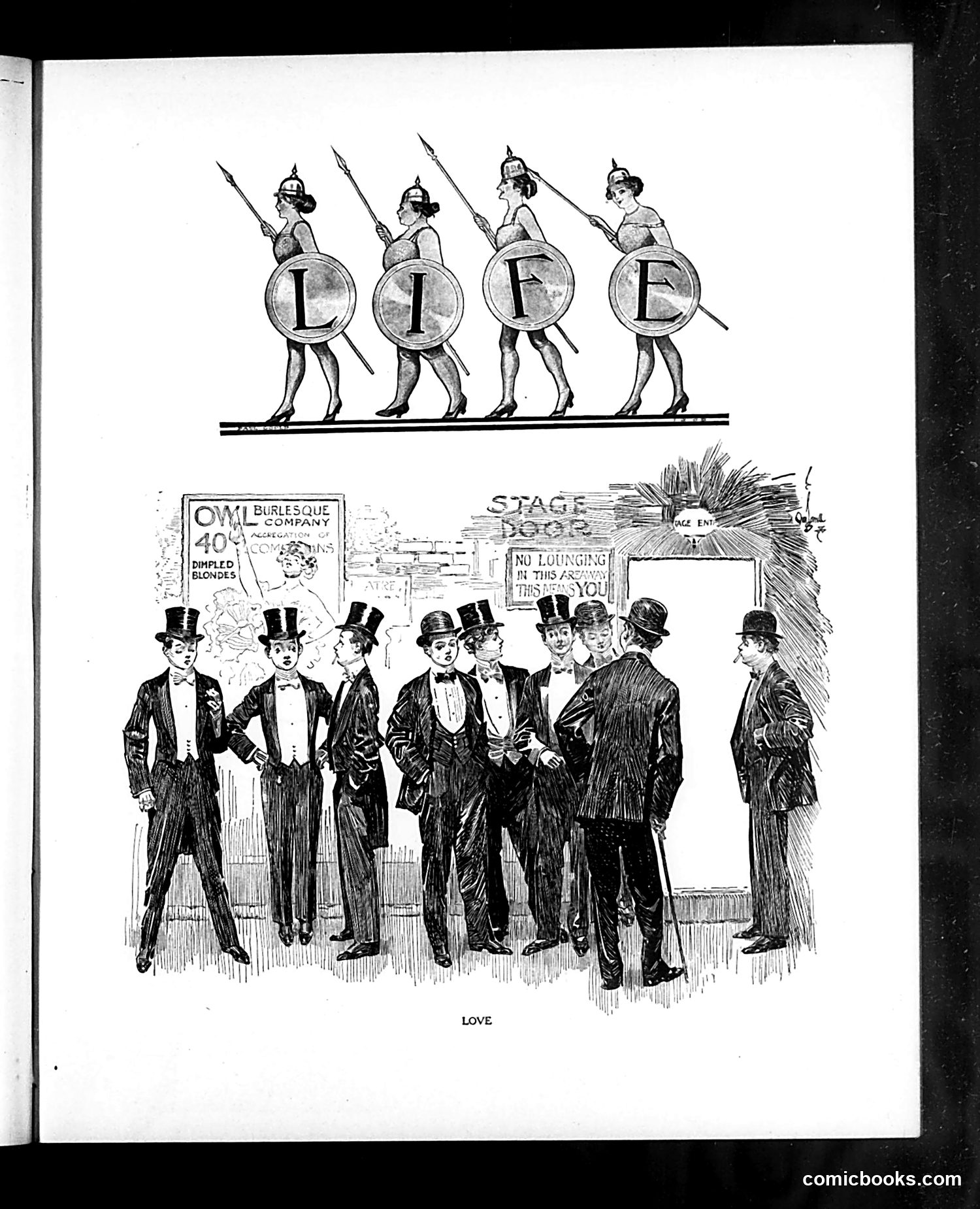
This page contains two distinct illustrations satirizing concepts of "LIFE" itself. **Top image**: Four armored soldiers bearing shields labeled "L," "I," "F," "E" spell out the word literally. This appears to be visual wordplay—depicting "life" as a military procession or march, suggesting life requires warrior-like fortitude or combat readiness. **Bottom image**: A theatrical scene outside a stage door labeled "OWL BURLESQUE COMPANY" shows well-dressed men in top hats gathered outside. One figure stands apart on the right. The caption reads simply "LOVE." This contrasts with the military imagery above, likely satirizing the contrast between life's serious struggles (top) and its lighter, entertainment-focused aspects (bottom). The burlesque theater reference adds bawdy humor to this juxtaposition.
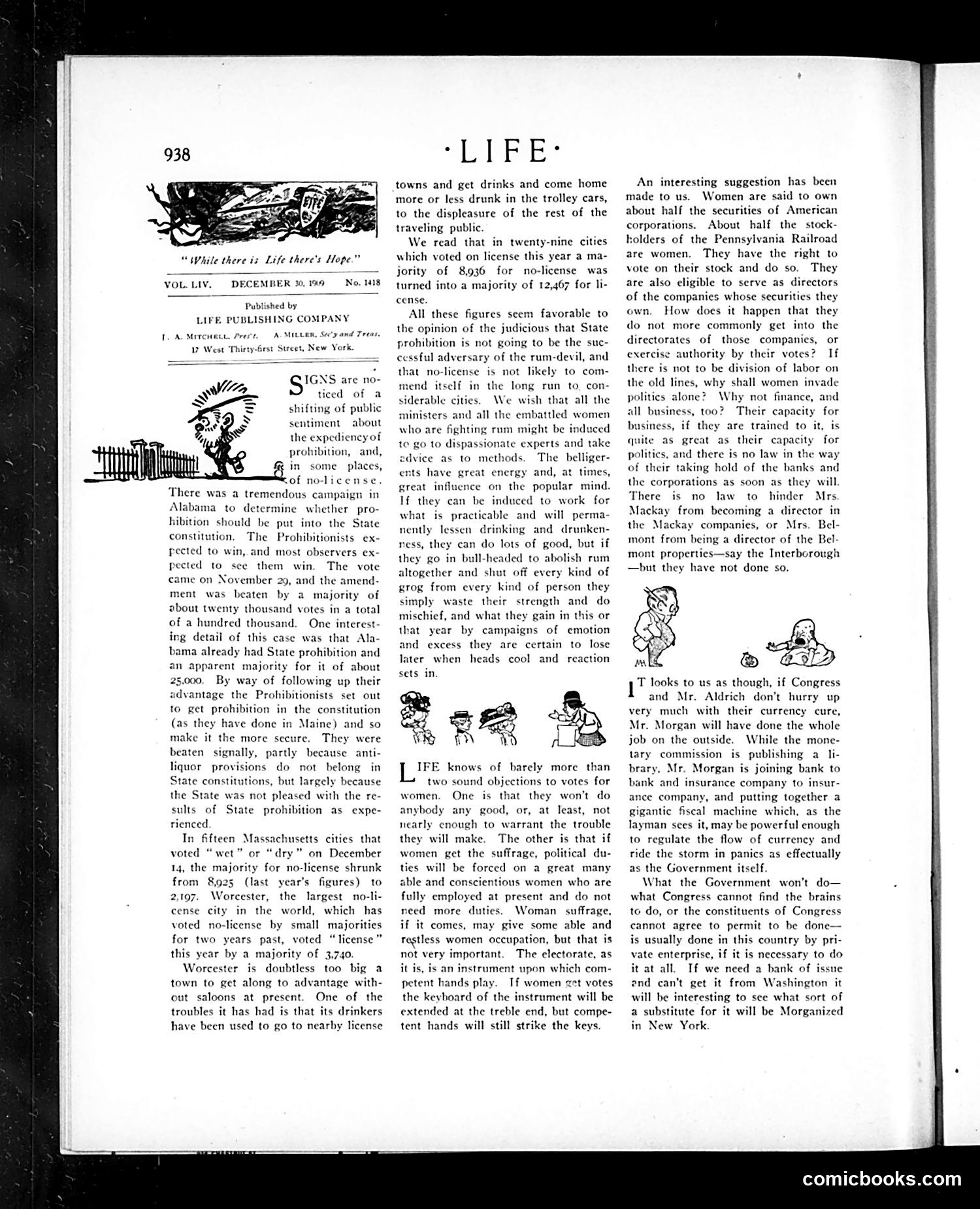
The page discusses prohibition politics and women's suffrage. The small cartoons illustrate social concerns about these movements. **Key figures/references:** - Alabama's prohibition referendum - Massachusetts cities voting on liquor licenses - Women gaining voting rights on financial matters **The satire:** The cartoons mock concerns that women voters might be unpredictable or easily swayed. One illustration shows a woman at a piano keyboard, suggesting women lack serious political judgment—a common anti-suffrage trope. **The political context:** The text debates whether prohibition and female suffrage would help or harm society. Life expresses skepticism about both movements, particularly fearing women's political participation might be influenced by emotion rather than reason—a prevalent anti-suffrage argument of the era. The page reflects early-1900s anxieties about expanding democratic participation.
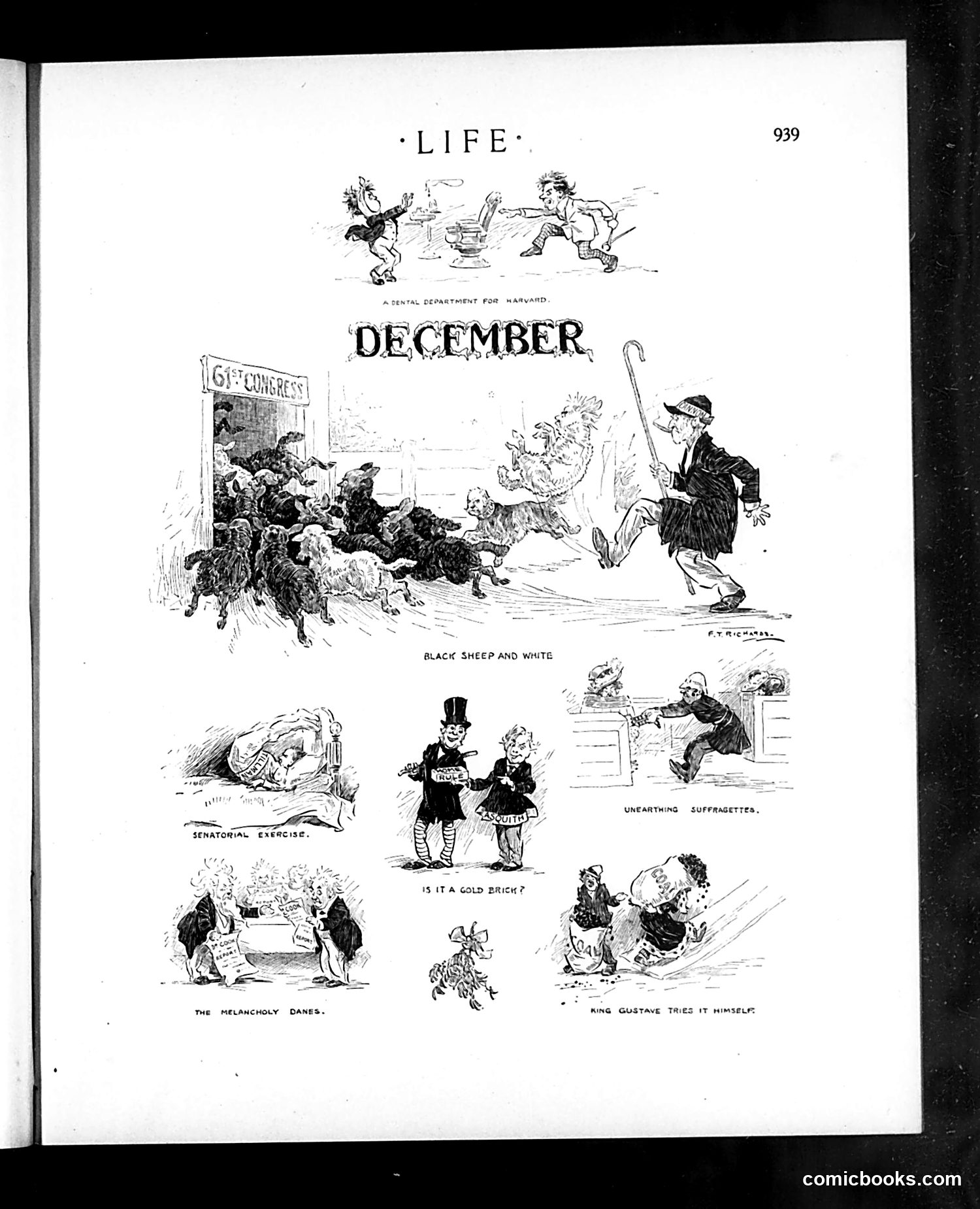
This satirical page features multiple political cartoons mocking December/holiday events and figures. "Black Sheep and White" depicts Congress as a chaotic flock of sheep being herded, suggesting congressional disorder. "Senatorial Exercise" shows senators in physical exertion, likely criticizing their legislative lethargy. "The Melancholy Danes" appears to reference Danish political or social matters. "Is It a Gold Brick?" depicts what appears to be a political figure with child, possibly mocking false promises or deception. "Unearthing Suffragettes" shows a woman activist emerging from ground, referencing the women's suffrage movement. "King Gustave Tried It Himself" depicts a Scandinavian monarch attempting something, likely a topical reference. The cartoons use visual exaggeration and metaphor to critique politicians, legislative ineffectiveness, and contemporary social movements with satirical humor.
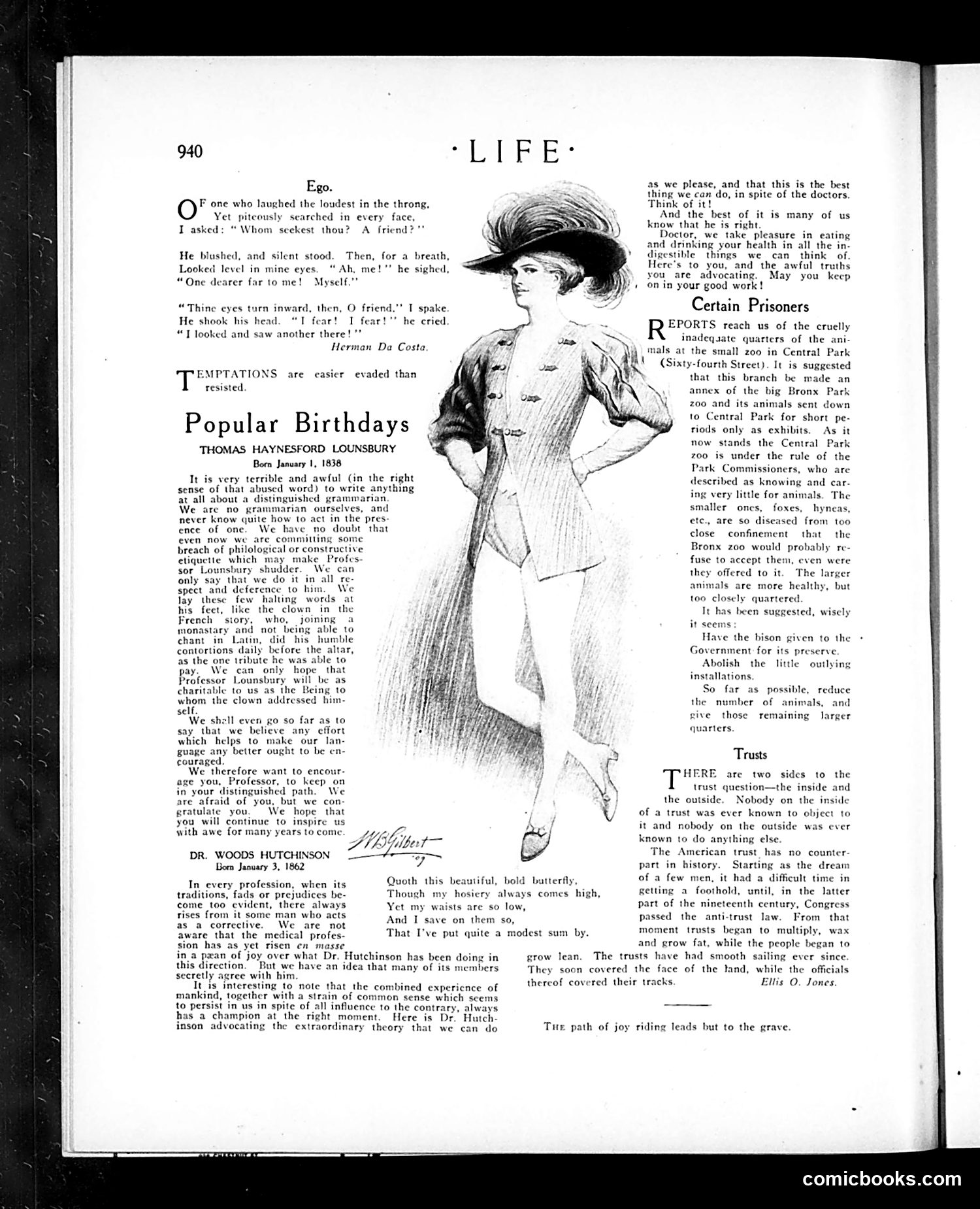
This page contains three distinct pieces: a poem titled "Ego" about vanity and self-deception; a "Popular Birthdays" section celebrating Thomas Haynesford Lounsbury (born January 1, 1838), a literary figure; and articles on "Certain Prisoners" (discussing inadequate zoo conditions in Central Park) and "Trusts" (examining American monopolies and their regulation). The illustrated figure shows a fashionably dressed woman in early 20th-century attire—a satirical representation of vanity or ego, complementing the poem's theme about self-deception and inward-turning eyes. The zoo and trusts pieces represent typical Progressive Era concerns: animal welfare and corporate monopoly reform. These reflect the social consciousness Life magazine championed during this period.
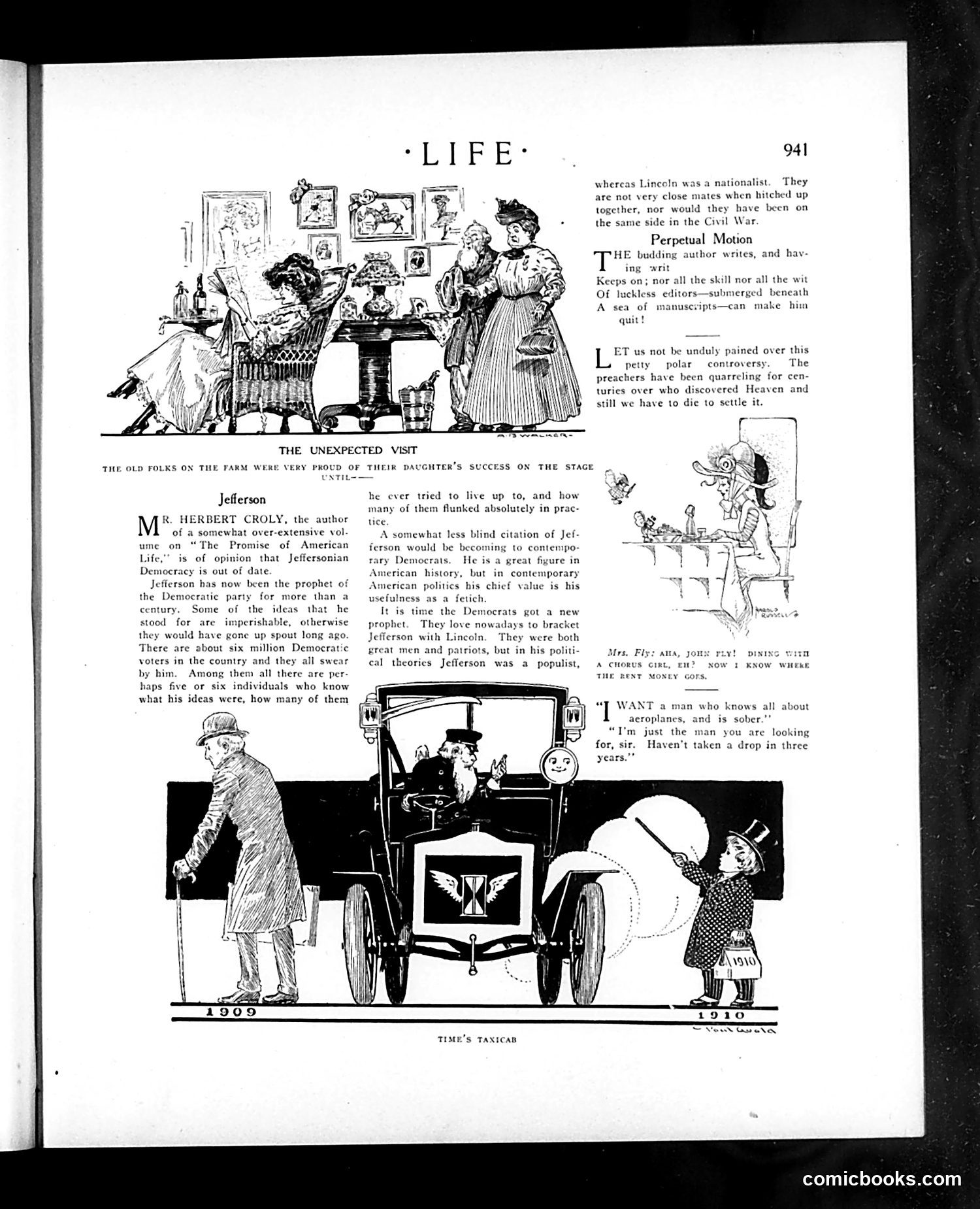
This page contains two satirical cartoons about American politics circa 1910: **Top cartoon** ("The Unexpected Visit"): Depicts rural farmers proudly displaying their daughter's theatrical success to visitors, suggesting tension between traditional rural values and urban entertainment culture. **Bottom cartoon** ("Time's Taxicab"): A timeline spanning 1909-1910 showing a motorcar labeled with a winged emblem. The dialogue humorously depicts someone seeking employment as an aeronautics expert, with another figure boasting about his aviation knowledge—satirizing the era's fascination with newly-invented aircraft as a status symbol. The accompanying article discusses Herbert Croly and Jefferson's relevance to contemporary Democrats, comparing historical and modern political figures. The page reflects early-20th-century anxieties about technological change, rural-urban divides, and political identity.
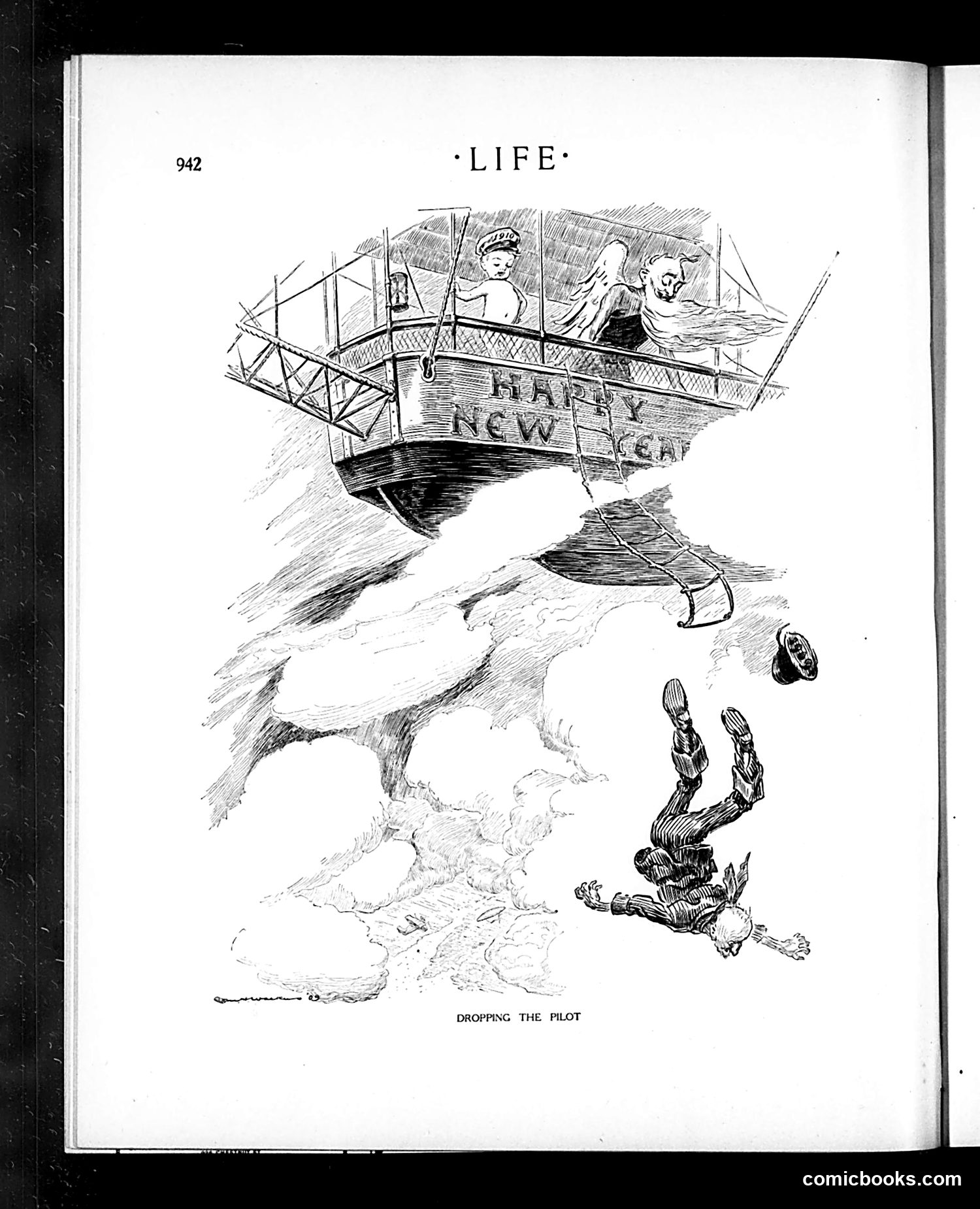
This satirical cartoon from *Life* magazine depicts a ship labeled "Happy New Year" with figures aboard dropping what appears to be a plot—literally shown as a person falling from the vessel into clouds below. The cartoon's title, "Dropping the Plot," is a pun: it references both abandoning a narrative storyline and physically dropping something overboard. The figures on deck appear to be discarding unwanted baggage as the new year begins. The satire likely comments on society's tendency to abandon resolutions, plans, or commitments shortly after making them at year's start. The ship represents the hopeful beginning of a new year, while the falling figure symbolizes the quick abandonment of ambitious goals—a timeless critique of human nature and New Year's promises.
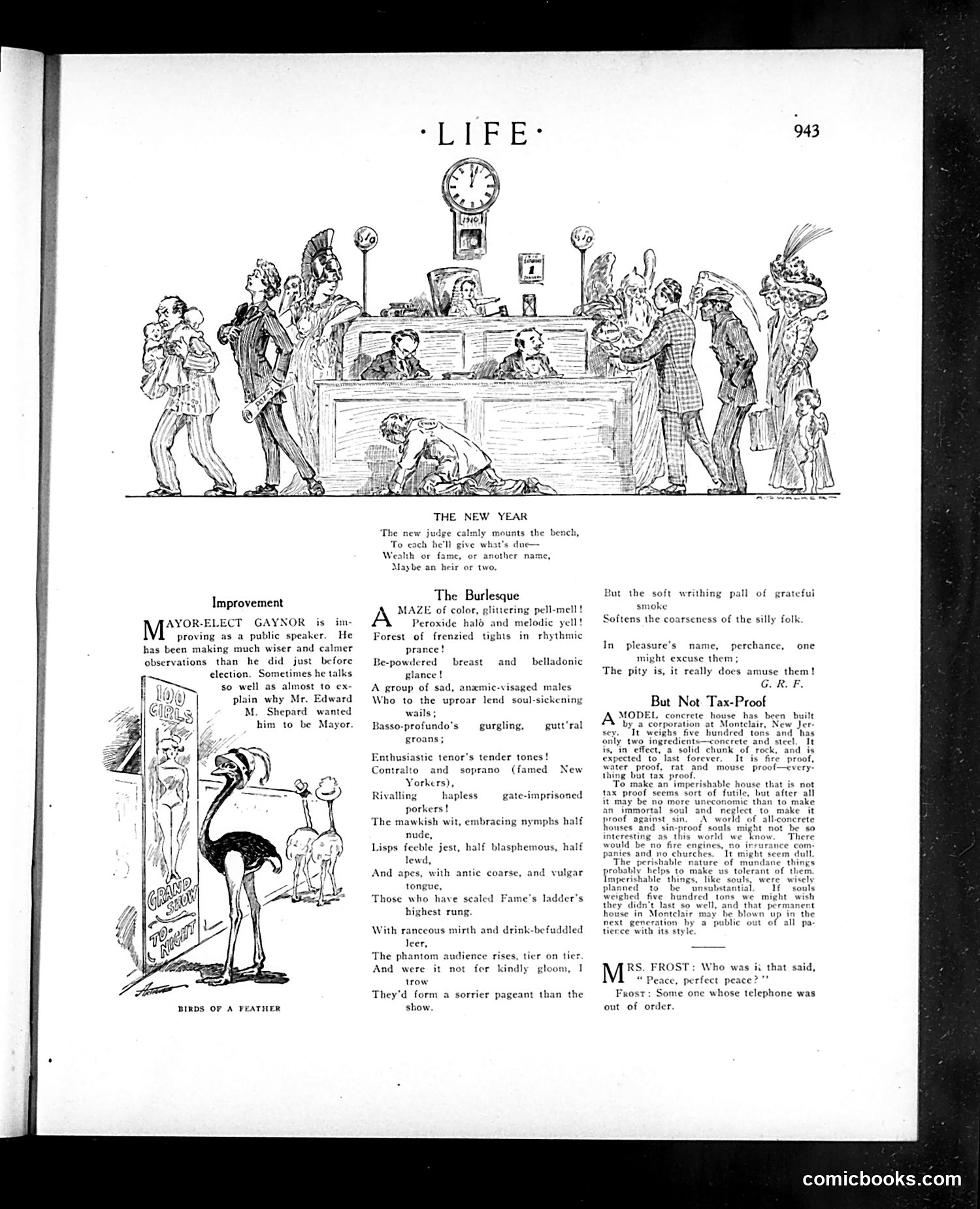
This page contains three distinct pieces of satirical content: **"The New Year"** (top): A courtroom scene where a judge presides over New Year's cases, depicting the annual ritual of making resolutions and seeking leniency for past misdeeds. **"Improvement"**: A brief political satire about Mayor-elect Gaynor, suggesting his promises to make the city "wiser and calmer" are questionable given Edward M. Shepard's prior warnings about him. **"The Burlesque"** (center): A lengthy poem satirizing theatrical performances, mocking everything from melodramatic acting to pretentious performers—likely critiquing contemporary Broadway productions and their overwrought style. **"Birds of a Feather"** (left margin): A cartoon illustration of an ostrich and other birds, accompanying unnamed social commentary. The page reflects early-20th-century urban politics and entertainment culture.
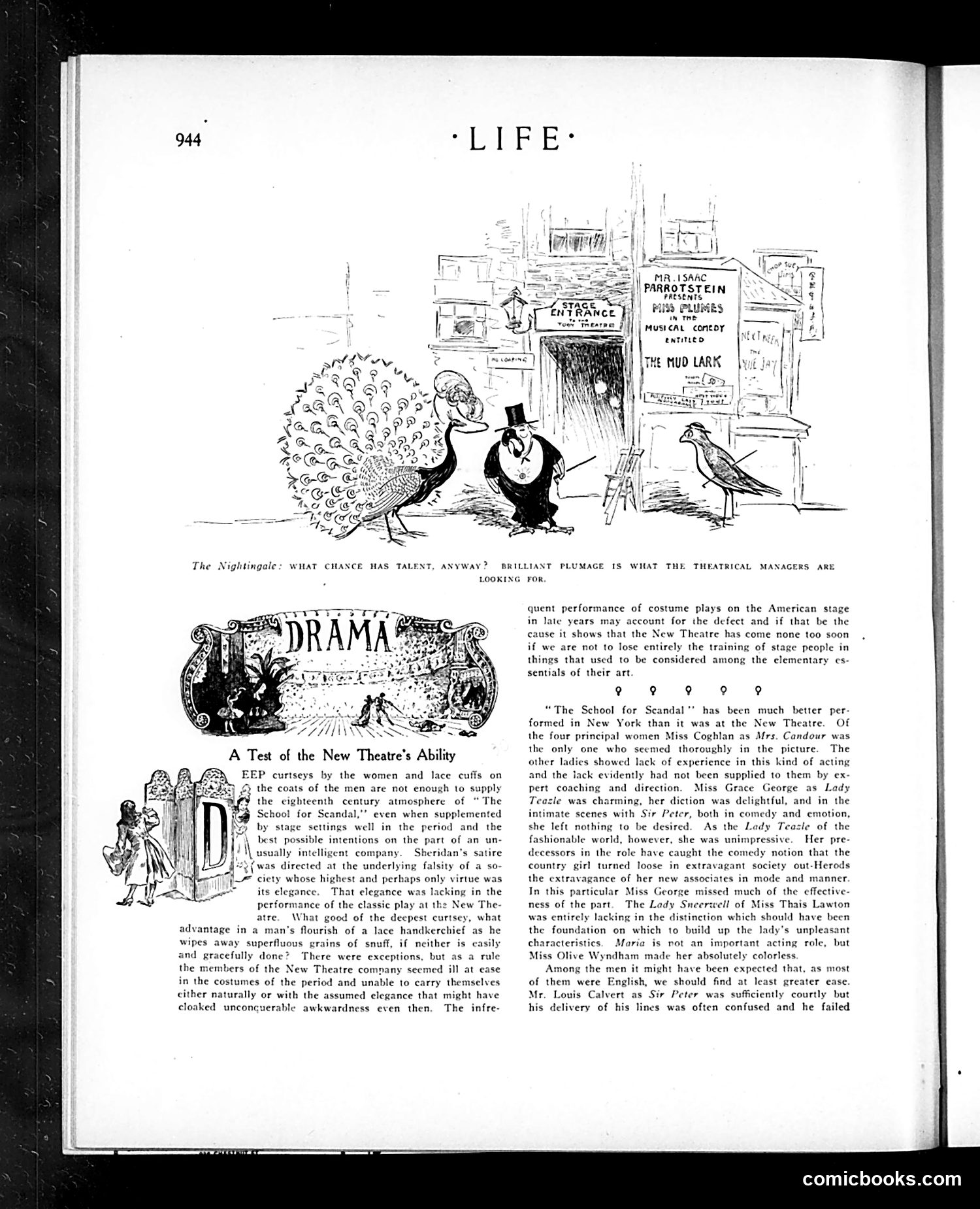
This page from *Life* magazine contains a theatrical drama critique titled "A Test of the New Theatre's Ability." The main cartoon depicts a peacock, a formally-dressed man in a top hat, and a bird, standing outside a theater entrance advertising "The Mud Lark" and other productions. The cartoon satirizes theatrical managers' obsession with "brilliant plumage"—elaborate costumes and visual spectacle—over actual talent. The peacock, with its showy feathers, represents this superficial aesthetic preference. The caption notes that theatrical talent has become less important than costume display in contemporary American productions. The accompanying text critiques "The School for Scandal" production at the New Theatre, faulting the performers for lacking adequate training and stage presence, despite their elaborate period costumes. The satire targets both theatrical management's priorities and performers' insufficient skill development.
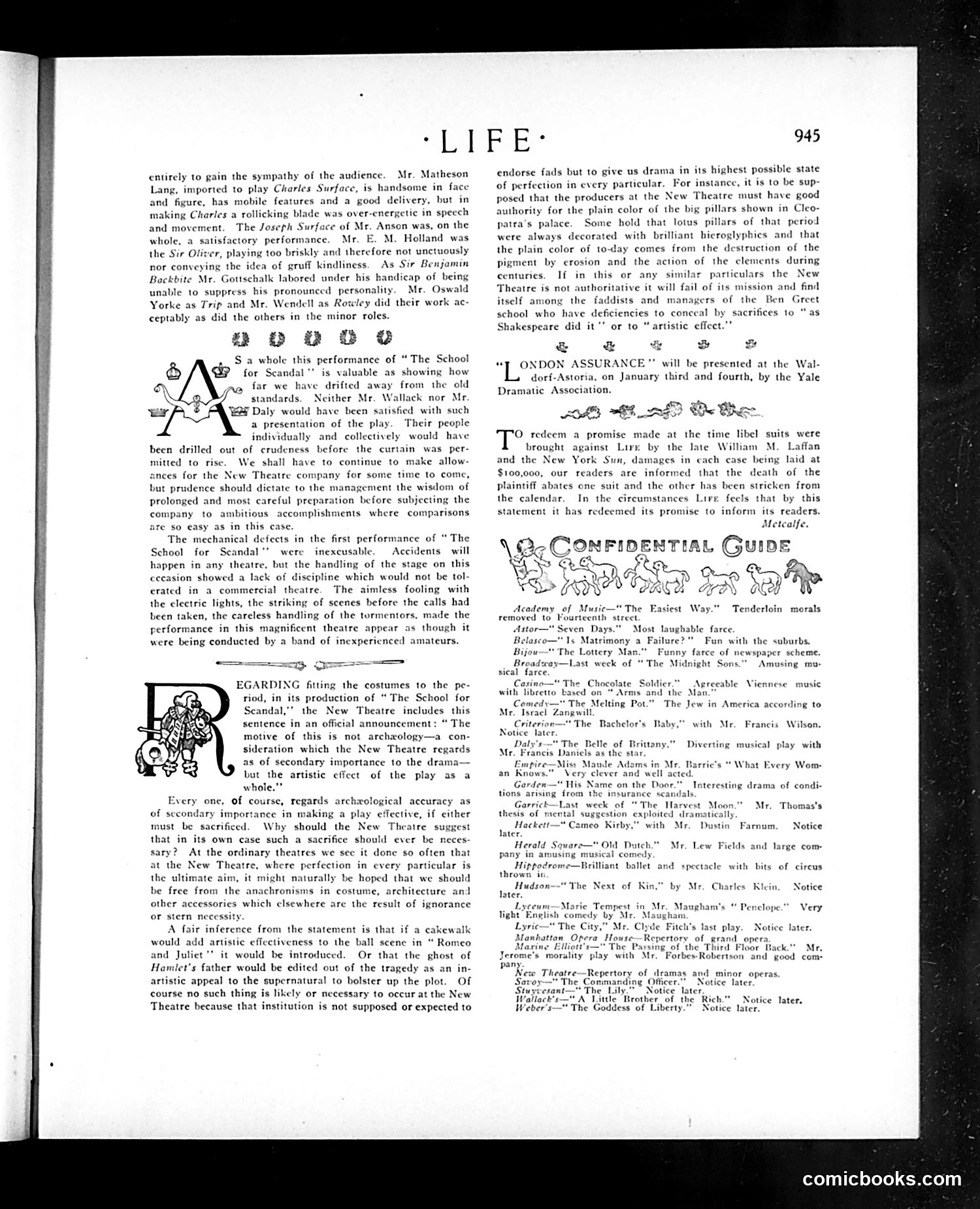
This page is primarily **theatrical criticism and advertising** rather than political satire. The main content discusses stage productions, including detailed critiques of "The School for Scandal" at the New Theatre. The visible **cartoon** (top left, ornate initial "A") appears to be a decorative element showing a figure in period costume, likely related to the theatrical discussion rather than political commentary. The "**Confidential Guide**" section lists current Broadway shows with brief reviews—plays like "The Lottery Man," "The Midnight Sons," and "The Melting Pot." The page's satire, if present, is **theatrical in nature**: critiquing productions' artistic choices, costume accuracy, and directorial decisions rather than addressing political or social issues. This reflects *Life's* role as both satirical commentary and cultural arbiter during this era.
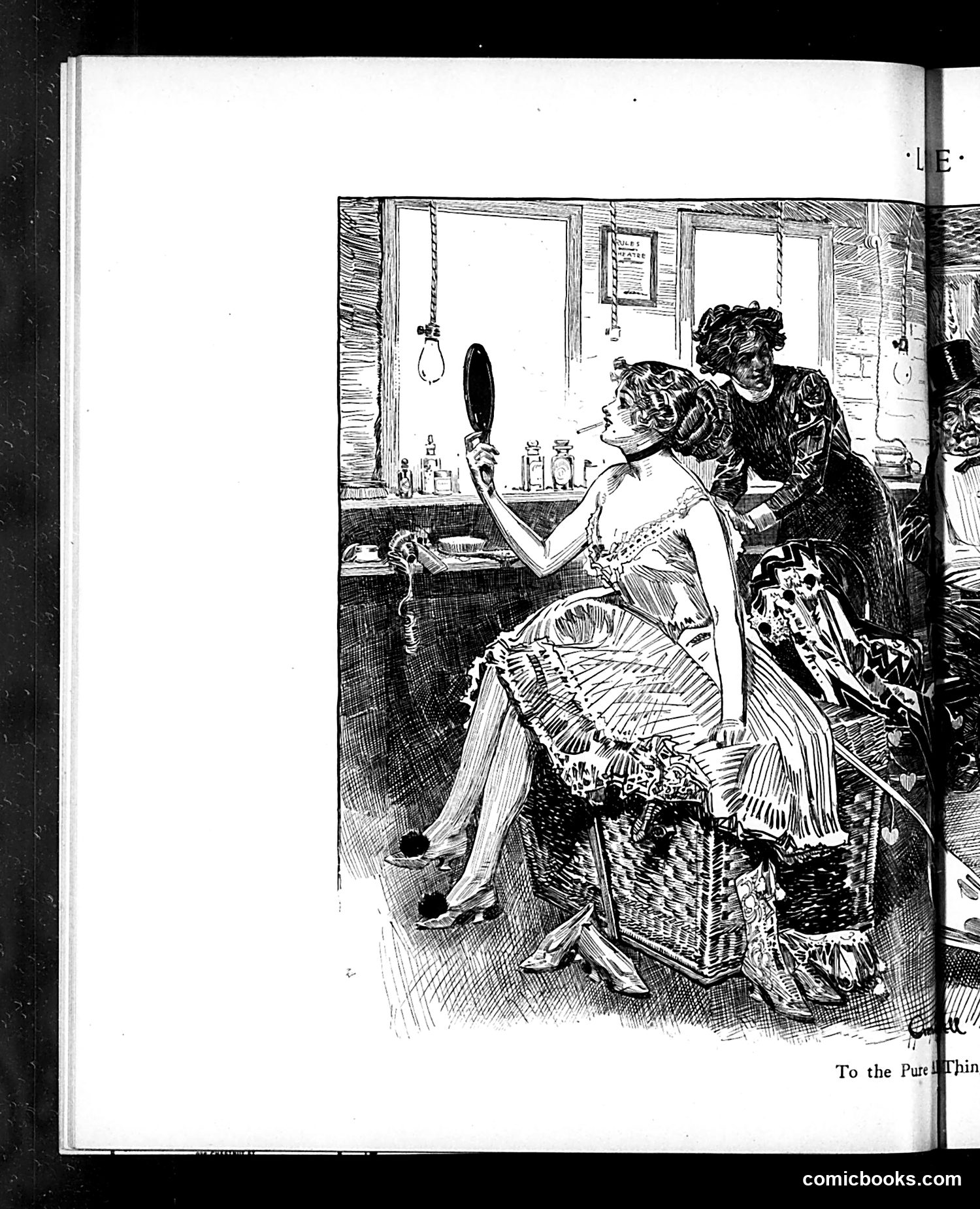
This is a black and white illustration showing a woman in an elegant, revealing dress seated at a vanity mirror while a maid or attendant helps her with her appearance. The woman holds a hand mirror and examines herself. The partial caption reads "To the Pure {Thin" (likely "To the Pure [all things are pure]"), suggesting a satirical commentary on vanity, morality, or hypocrisy—a common Life magazine theme. The satire appears to target the contrast between claims of moral purity and actual preoccupation with physical beauty and self-presentation. The elaborate dress, intimate boudoir setting, and focused attention on appearance may critique either women's vanity specifically or broader societal hypocrisy about virtue versus appearance. Without the complete caption and publication date, the specific target remains unclear, but the ironic tone is characteristic of early 20th-century American satirical illustration.
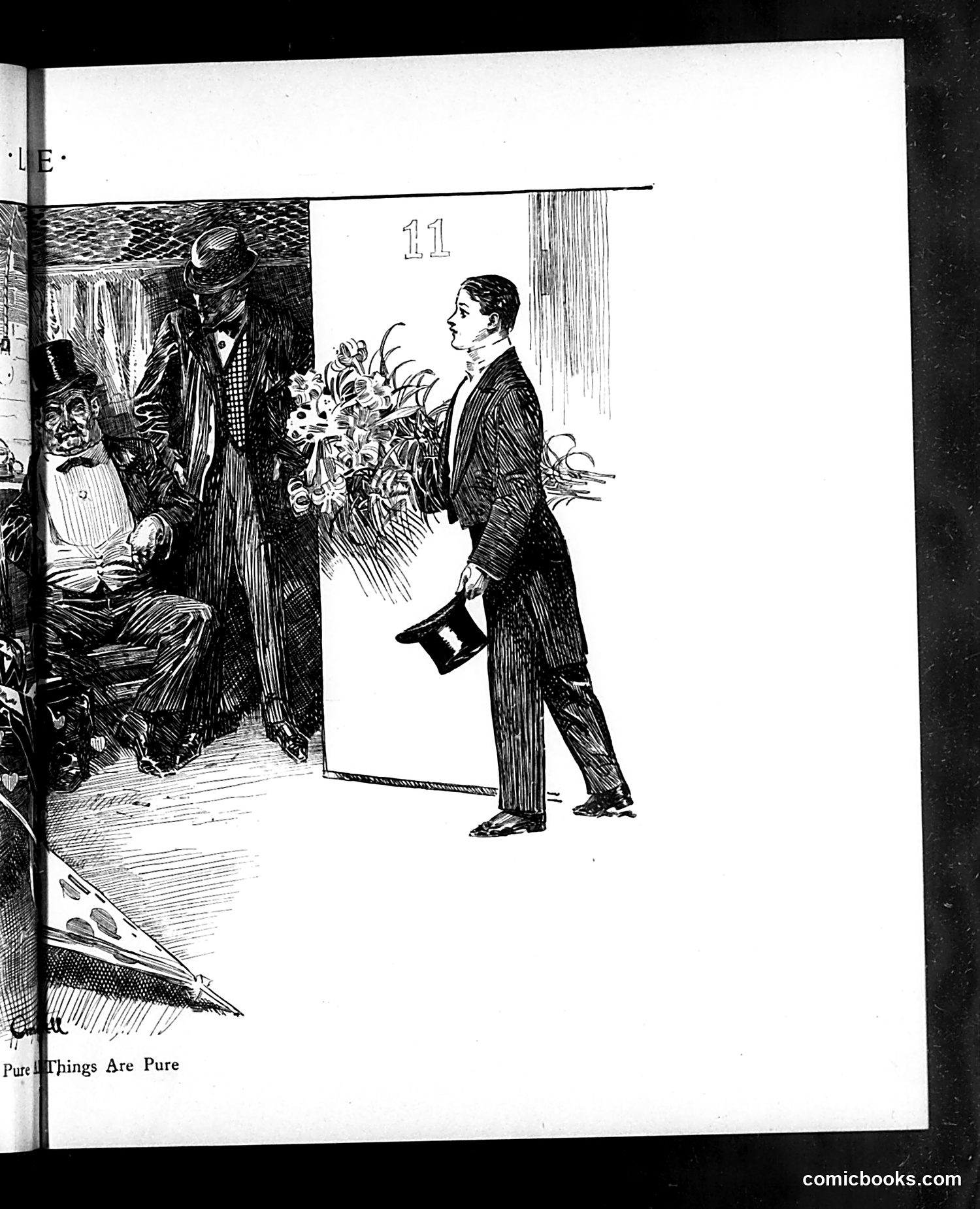
This is an illustration numbered 11 showing a well-dressed man in formal attire (suit and top hat) entering a room while holding flowers. Inside, we see three figures in dark clothing, appearing to be in conversation or greeting him. The caption "Pure Things Are Pure" suggests ironic social commentary. The scene appears to depict a formal social call or visit—likely a suitor presenting himself with flowers, a traditionally "pure" or respectable gesture. However, the knowing presentation and the caption's emphasis suggests satire about Victorian social conventions and the gap between outward propriety and actual intentions or character. The specific identities of the figures and the particular social situation being mocked remain unclear without additional context from the magazine's text.
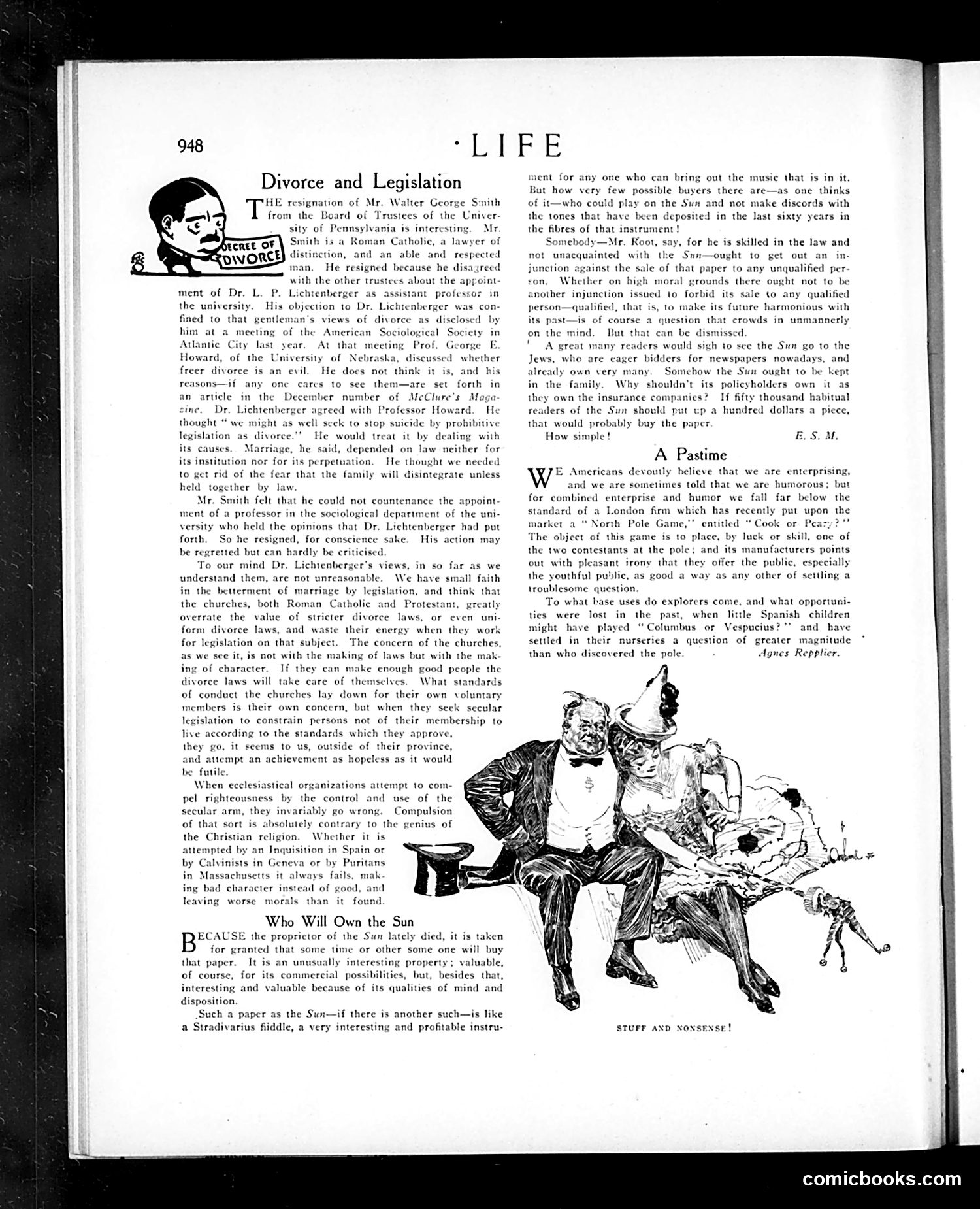
This page contains two distinct articles addressing early 20th-century religious and social debates. **"Divorce and Legislation"** discusses Walter George Smith's resignation from the University of Pennsylvania's board over the appointment of Dr. L.P. Lichtenberger, who advocated treating divorce like suicide—through addressing root causes rather than prohibition. Smith, a Roman Catholic, opposed Lichtenberger's liberal divorce views on moral grounds. The article sides with Lichtenberger, arguing churches waste energy on strict divorce laws instead of building character, and that using secular law to enforce religious standards (comparing this to the Spanish Inquisition and Puritan Massachusetts) inevitably fails. **"A Pastime"** briefly describes a parlor game called "North Pole Game" involving exploration and chance. **The cartoon** (captioned "STUFF AND NONSENSE!") appears to mock pompous debate—showing a rotund, self-satisfied figure gesturing dismissively, satirizing the earnest moral arguments in the divorce legislation debate above. The page reflects Progressive Era tensions between religious institutional authority and secular, rationalist approaches to social problems.
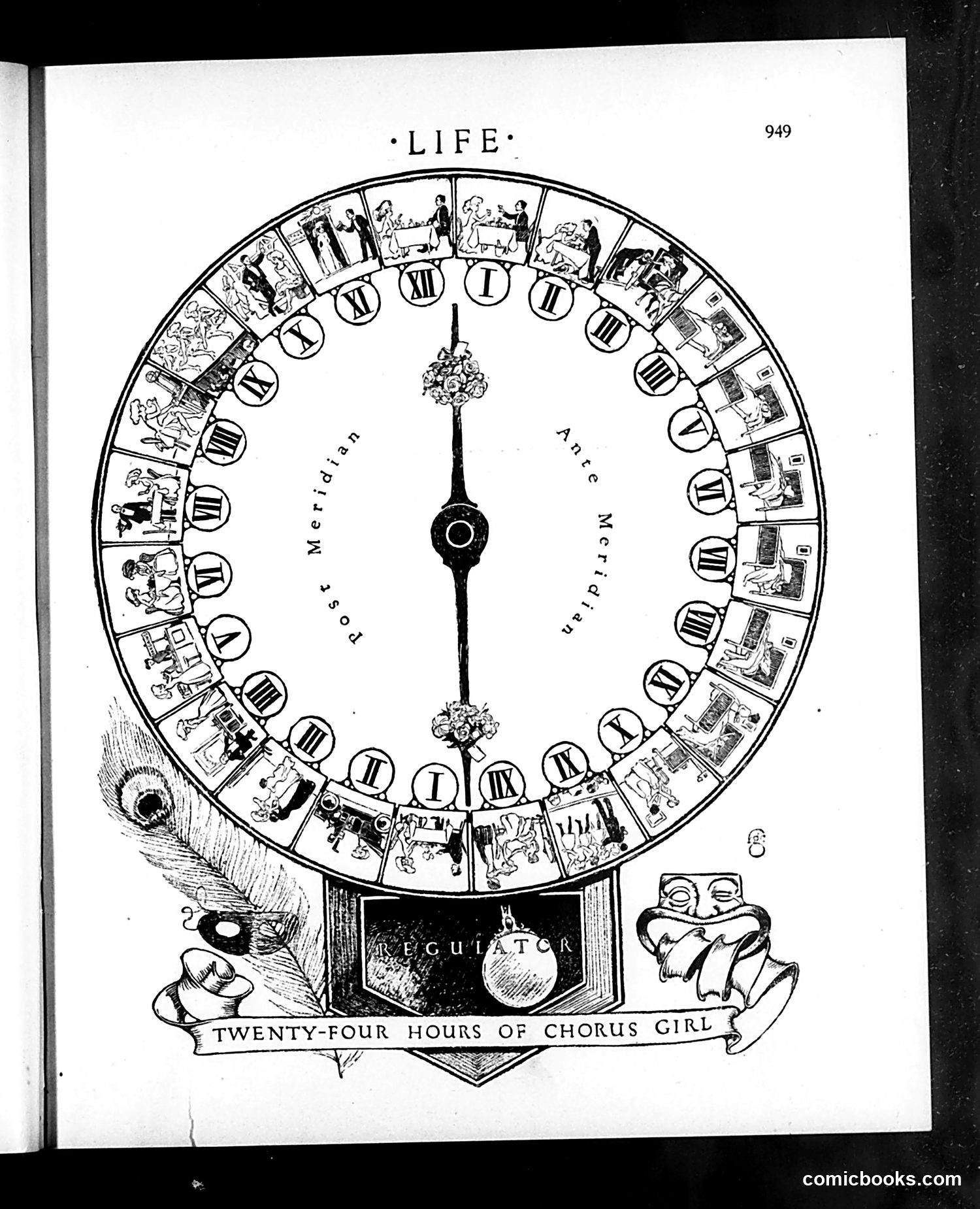
This Life magazine illustration is a satirical 24-hour clock depicting the daily activities of a chorus girl—a female dancer in theatrical productions, a common entertainment figure of the early 20th century. The clock face is divided into 24 numbered sections, each containing small illustrations showing different moments in her day: sleeping, dressing, rehearsing, socializing, dining, and performing. The satire appears to mock both the glamorous public perception and the mundane reality of this profession. The decorative base references "Meredith" and includes theatrical imagery (masks, a perfume bottle), emphasizing the artificial, performance-based nature of the role. The cartoon humorously suggests that a chorus girl's entire existence revolves around her work and appearance.
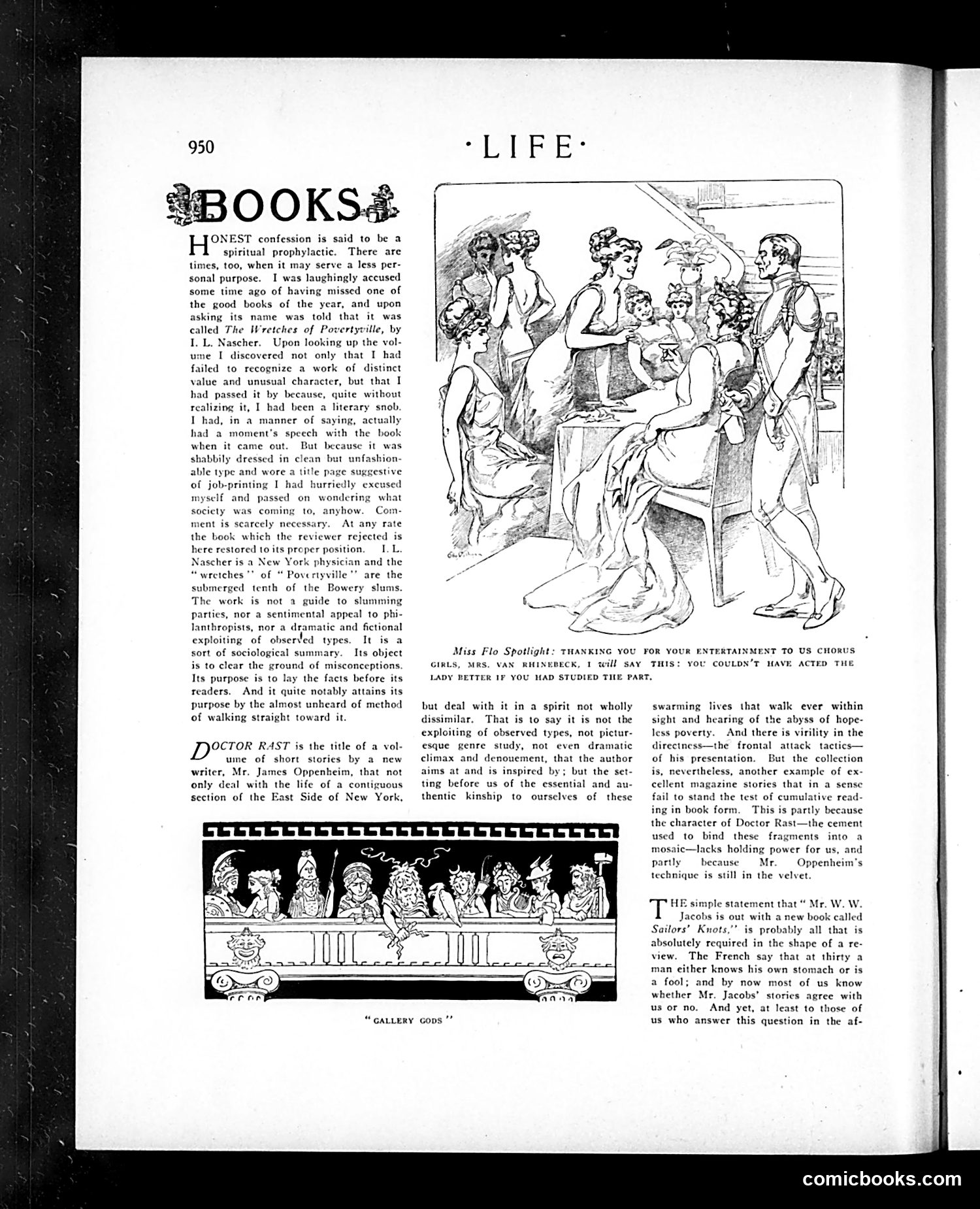
This page reviews three books for a literary audience. The main cartoon depicts **Miss Flo Spotlight** (a chorus girl) thanking society women for entertainment, with the caption sarcastically suggesting the wealthy patrons "couldn't have acted the lady better if you had studied the part"—mocking both the performers and the pretentious audience members. The text discusses books about working-class life: *The Wretches of Povertyville* by I.L. Nascher (a sociological study of Bowery slums), *Doctor Rast* by James Oppenheim (short stories about NYC's East Side poor), and *Sailors' Knots* by W.W. Jacobs. The reviews praise these works for authentically depicting poverty and working people without sentimentality or melodrama. The cartoon reinforces this theme—mocking wealthy people's shallow engagement with lower-class life, whether through slumming tourism or theater attendance. The satire suggests genuine understanding of working-class experience contrasts sharply with society's superficial interest.
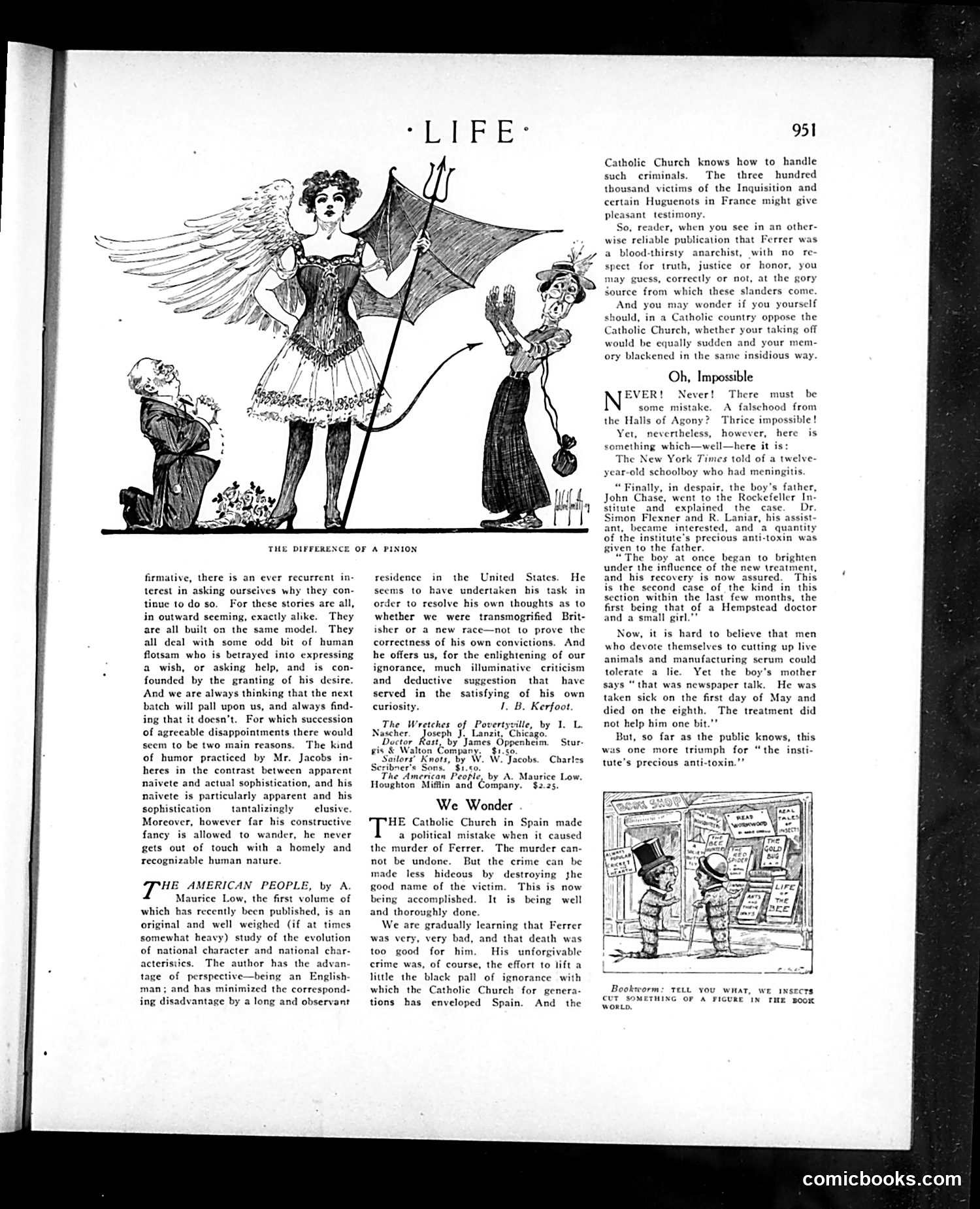
This page contains book reviews and social commentary typical of Life's satirical content. The main cartoon, titled "The Difference of a Pinion," depicts a winged female devil figure holding a trident, alongside a small human figure. The title appears to play on "pinion" (wing), suggesting the contrast between demonic ambition and human limitation. The accompanying text discusses W.W. Jacobs's short stories, praising their sophisticated humor about ordinary people betrayed by granted wishes—a darkly comic theme about human nature. More notably, Life's editorial commentary savagely critiques the Catholic Church's role in executing Spanish educator Francisco Ferrer (1909), accusing church authorities of then smearing his reputation to justify his death. The piece sardonically suggests that anyone opposing the Church in Catholic countries faces similar sudden elimination and character assassination—a direct attack on institutional religious power and its suppression of educational enlightenment.
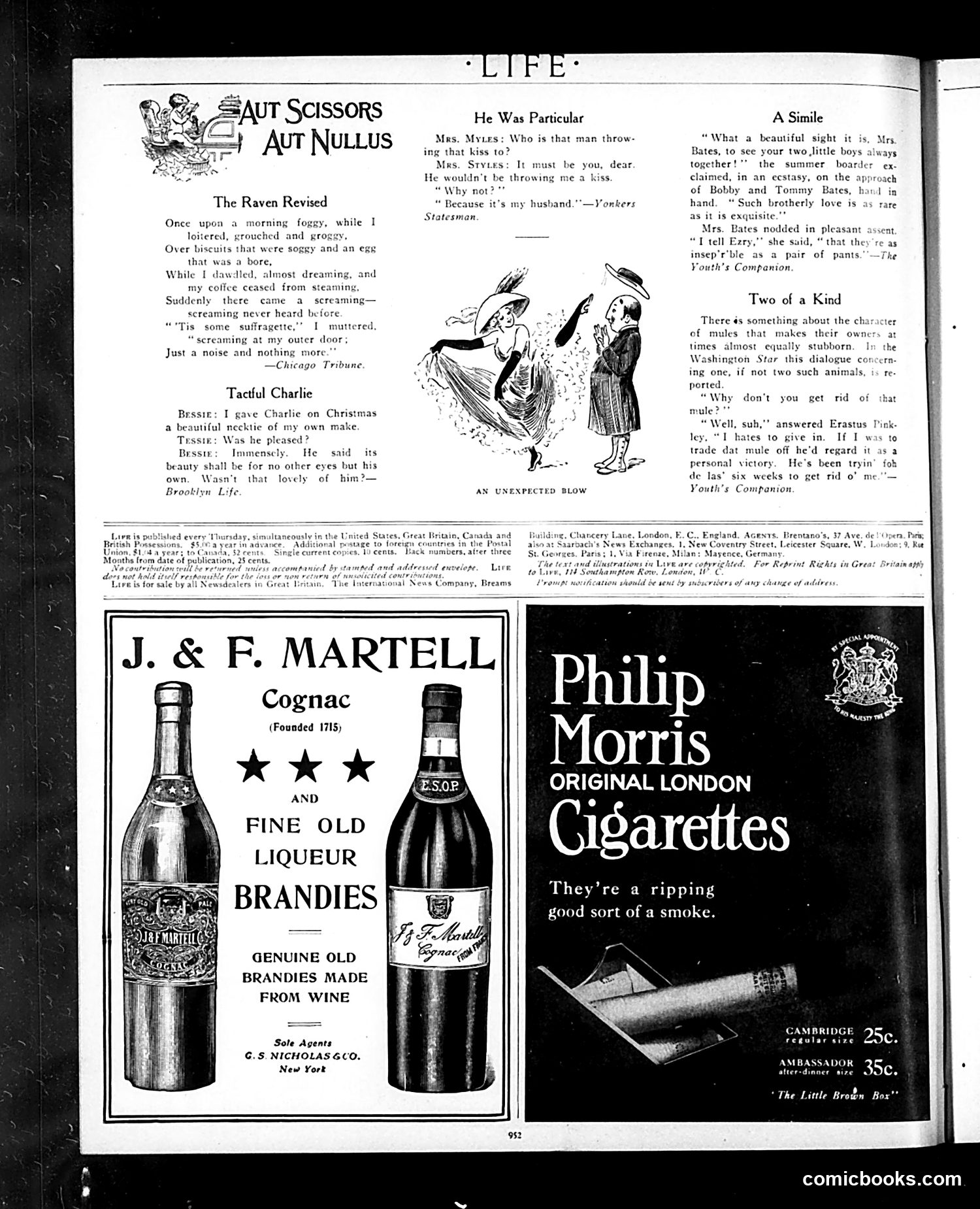
This page contains several short humor pieces typical of early 20th-century Life magazine, along with period advertisements. **The cartoons/jokes** are gentle domestic humor with no obvious political content. They depict: married couples and their interactions ("He Was Particular," "Two of a Kind"), a parody of Poe's "The Raven" about a screaming noise, and a brief anecdote about a tactful Christmas gift. The "Two of a Kind" piece appears to compare the stubbornness of a mule to a man's refusal to get rid of it—likely a commentary on male pride and stubbornness. **The central illustration** labeled "AN UNEXPECTED BLOW" shows a figure being knocked down, likely accompanying one of these humorous pieces. **The advertisements** promote J. & P. Martell Cognac and Philip Morris cigarettes—typical luxury goods marketing of the era. No specific political figures or events are referenced. This page represents mainstream, non-satirical humor content rather than the political commentary Life magazine was sometimes known for.
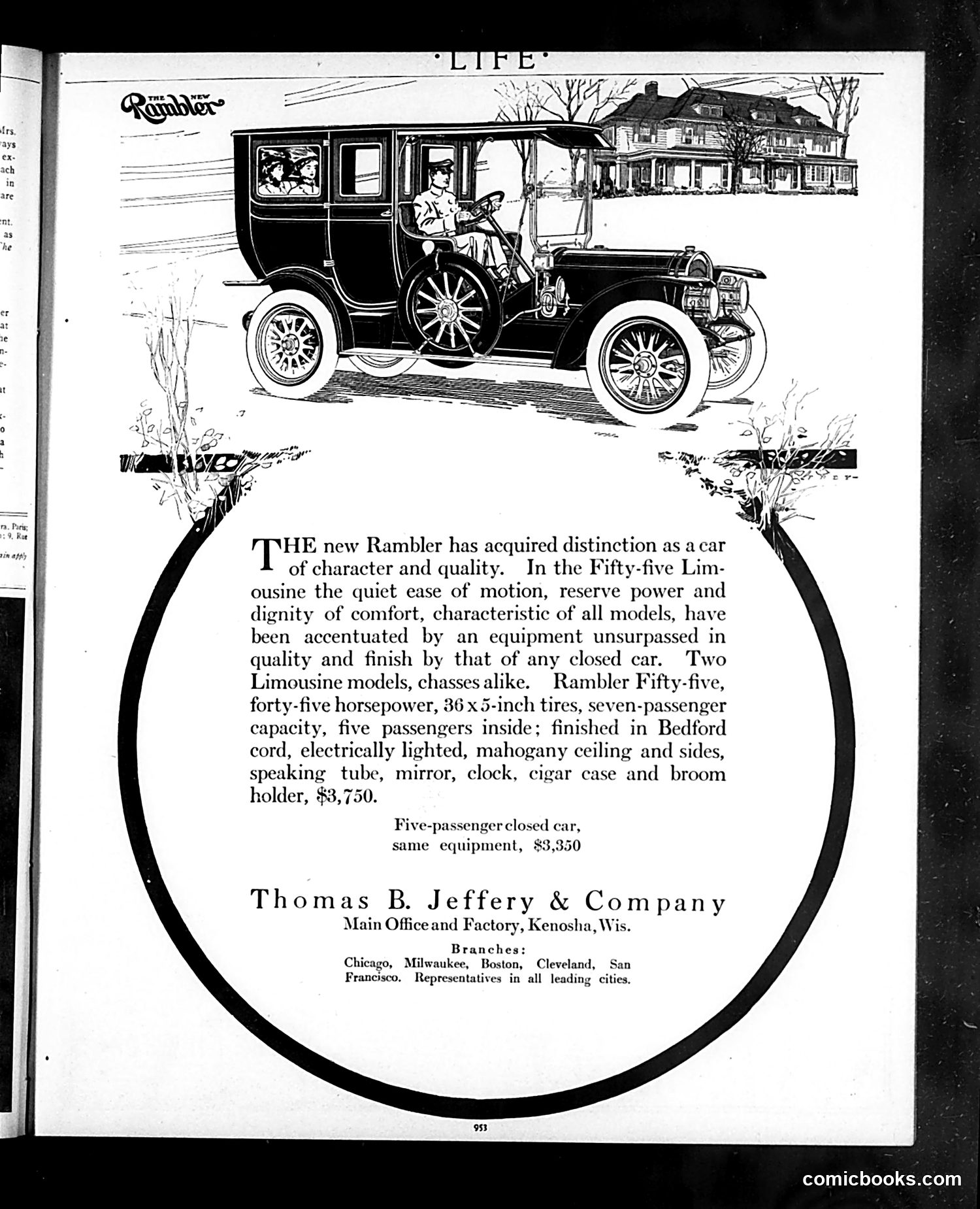
This is primarily an **advertisement**, not satirical content. It promotes the Rambler automobile, manufactured by Thomas B. Jeffery & Company in Kenosha, Wisconsin. The illustration shows a well-dressed man in a Rambler Fifty-five Limousine passing an elegant suburban mansion, emphasizing the car's association with wealth and sophistication. The ad copy emphasizes luxury features—mahogany interiors, electric lighting, speaking tubes, cigar cases—targeting affluent buyers. Prices ($3,750 and $3,350) indicate this was a premium vehicle for the era. The "Life" magazine masthead and decorative circular border frame suggest this is from the early automotive era (likely 1910s), when automobiles represented status symbols. There is no political satire present; this is straightforward luxury marketing designed to appeal to the affluent readership of Life magazine.
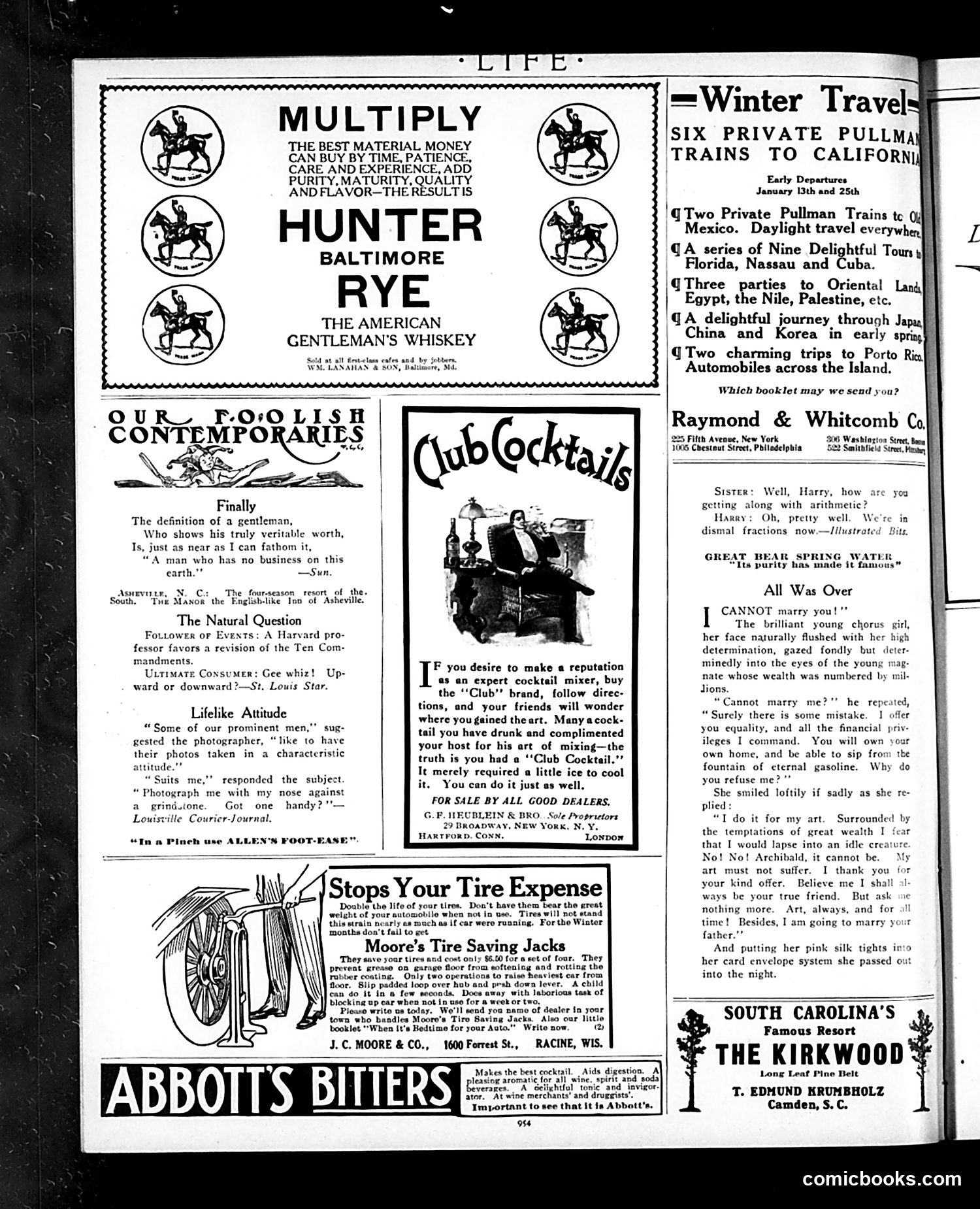
This is primarily an **advertising page** from Life magazine, circa early 1900s, featuring product advertisements and brief humorous anecdotes typical of the publication's format. The page includes advertisements for **Hunter Baltimore Rye whiskey**, **Club Cocktails**, **Moore's Tire Saving Jacks**, and **Abbott's Bitters**—all standard consumer products of the era. There's also a travel advertisement for **Raymond & Whitcomb Co.** offering luxury winter trips to California and exotic destinations. The humor sections ("Our Foolish Contemporaries," brief jokes about gentlemen, photographs, arithmetic) are mild social commentary—not political satire. They mock pretension, particularly around cocktail-mixing expertise and social affectation. The "All Was Over" serial story excerpt depicts a melodramatic romantic rejection based on class differences (wealthy magnate rejected by chorus girl). **No significant political or historical references** are present. This page reflects early-20th-century consumer culture and gentle magazine humor rather than satire or social commentary.
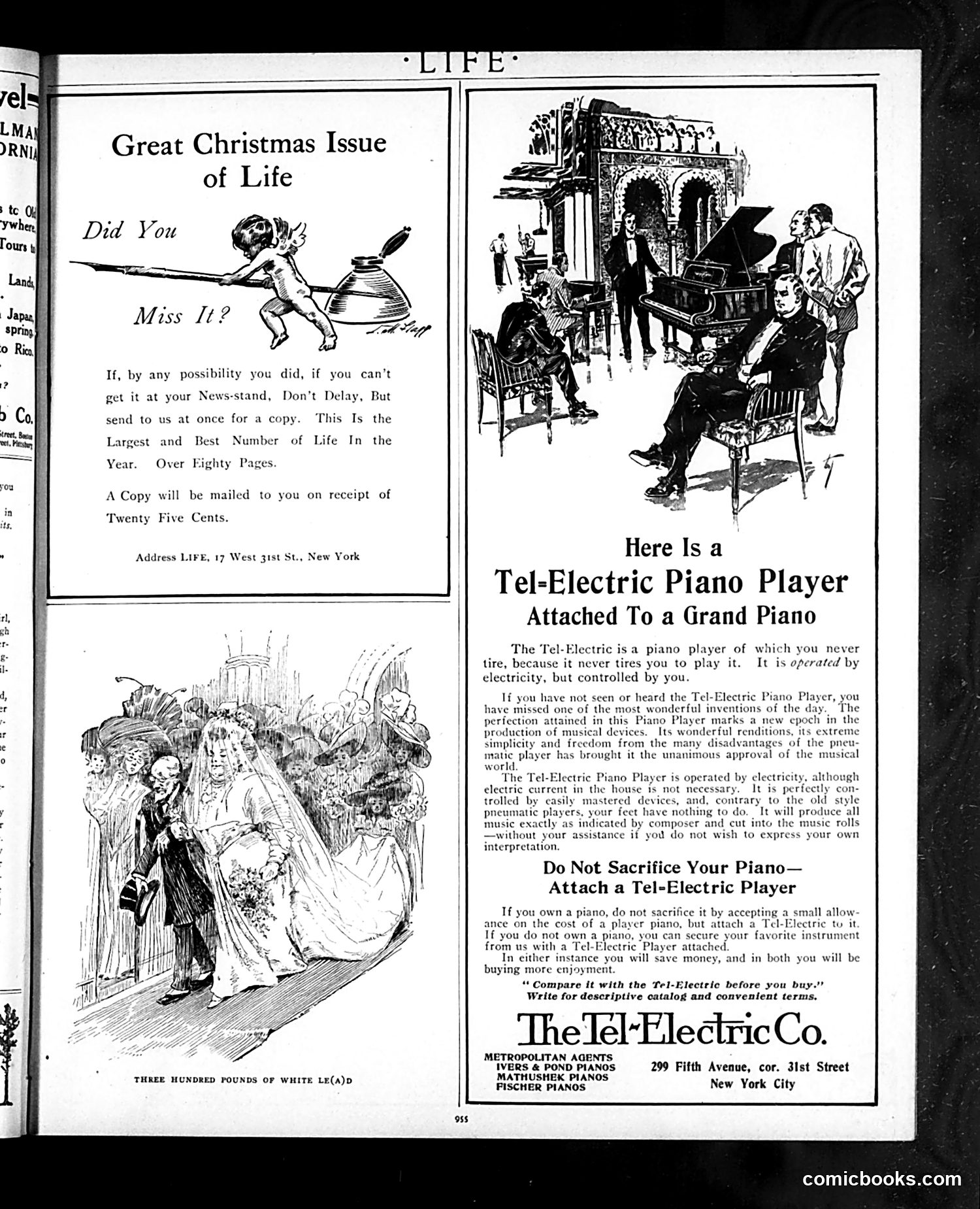
This page is primarily **advertising and promotional content**, not political satire. The left side advertises Life's "Great Christmas Issue," promoting it as the year's largest edition (80+ pages) available for 25 cents by mail. The right side features a full-page advertisement for the **Tel-Electric Piano Player**—a motorized device that attaches to grand pianos to play them automatically via electricity. The ad emphasizes it's controlled by the owner (unlike older pneumatic players requiring foot pedals), requires no house electricity, and allows owners to preserve their existing pianos rather than trading them for expensive player pianos. The illustration shows an elegant social scene of people enjoying the automatic piano performance at what appears to be a formal gathering, reflecting the product's appeal to wealthy households in the early 1900s. This reflects the era's enthusiasm for electrical automation and labor-saving devices marketed to affluent consumers.
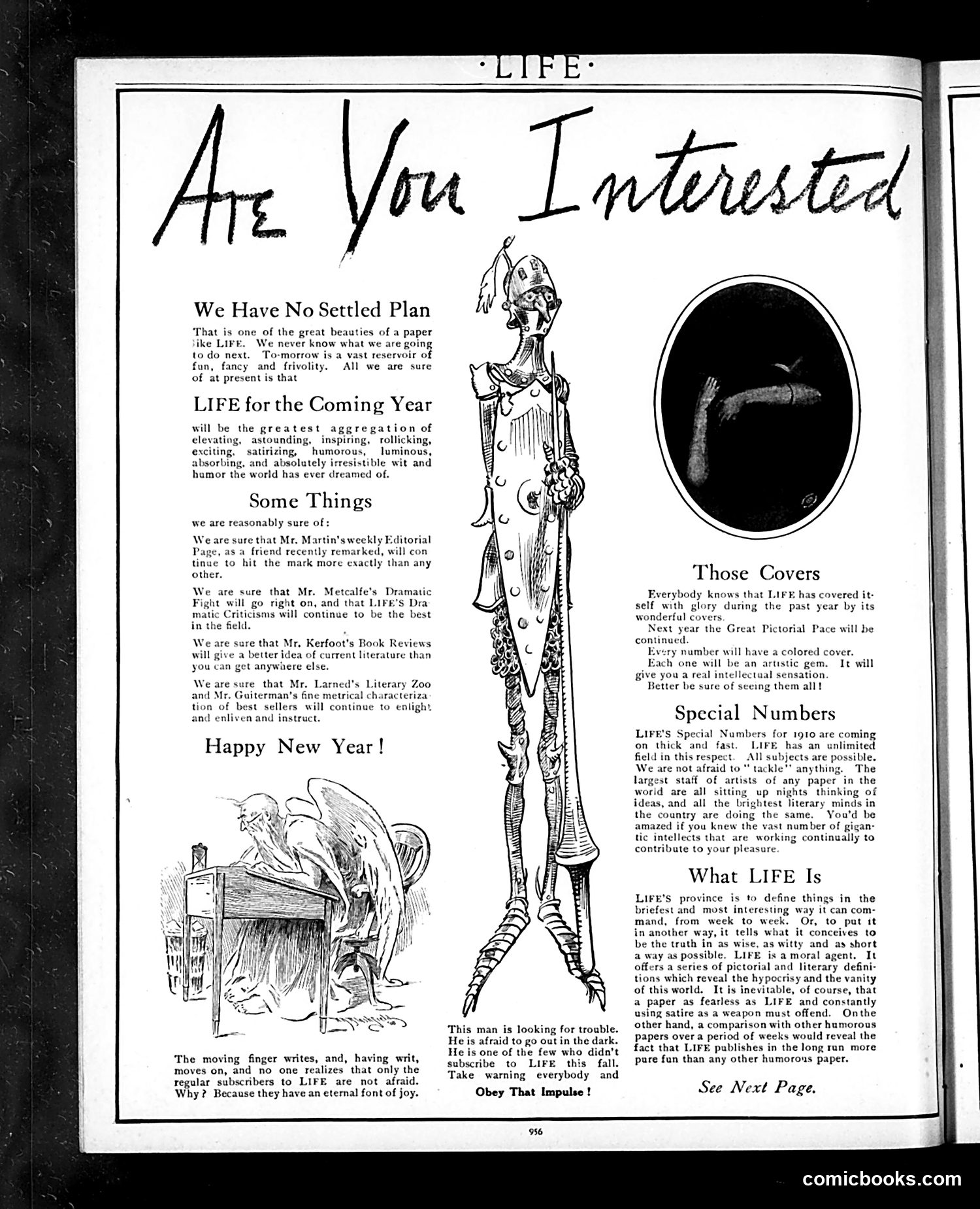
This is a New Year's promotional piece where *Life* magazine advertises itself to potential subscribers. Rather than specific political cartoons, the page contains: **Main content:** A self-promotional manifesto celebrating *Life*'s editorial staff and upcoming content. The text boasts of columnists like Martin (editorial), Metcalfe (drama criticism), Kerfoot (book reviews), and Larned (literary commentary)—figures prominent in *Life*'s circle but unknown today. **Visual elements:** An elongated, stylized female figure (representing *Life* or modern womanness) and a small sketch of a worried man—generic satire tropes of the era. **The pitch:** *Life* promises 1910 will bring unprecedented wit, humor, special numbered issues, and artistic covers. The magazine positions itself as fearlessly satirical, defining society's "hypocrisy and vanity" through humor. **For modern readers:** This reveals *Life*'s self-image as sophisticated, morally purposeful satire—not mere entertainment. The breathless promotional tone reflects pre-WWI American confidence and the magazine's cultural authority.
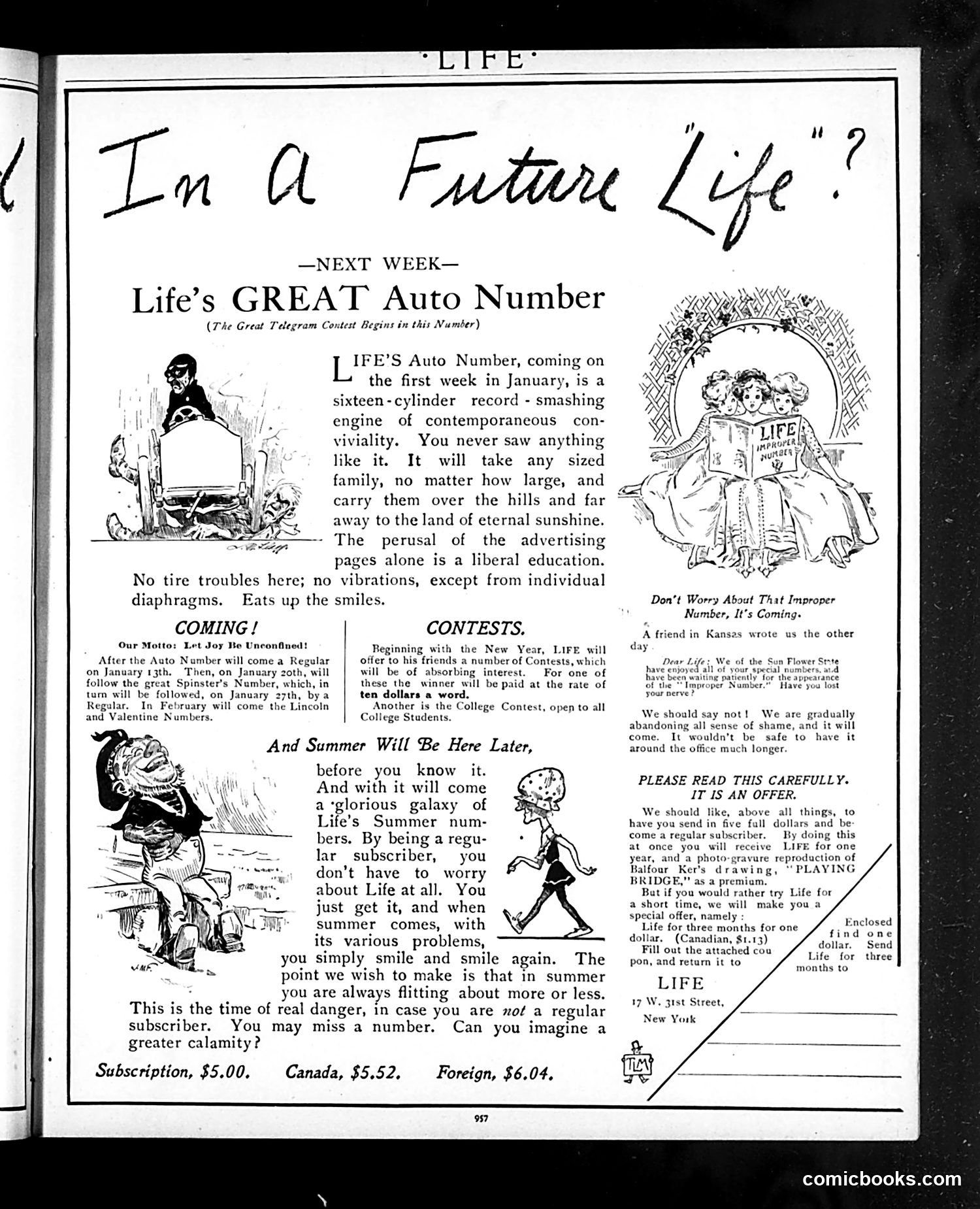
This is primarily a **subscription promotion page** for *Life* magazine, not a political cartoon. The page advertises upcoming special issues, particularly the "Auto Number" featuring a sixteen-cylinder automobile—a reference to luxury cars of the era (the 1920s-30s) that represented technological progress and aspirational American lifestyle. The cartoons are **self-promotional illustrations** showing families enjoying automobiles and reading *Life*. The satire is gentle: the magazine humorously warns subscribers not to miss issues while traveling in summer, suggesting that missing an edition would be a "calamity." There's a playful jab at a reader from Kansas who received an issue with an "improper number" (wrong issue in sequence), which *Life* dismissively acknowledges while promoting subscriptions. The overall tone is tongue-in-cheek advertising dressed as editorial content, typical of *Life*'s format blending humor with business promotion.
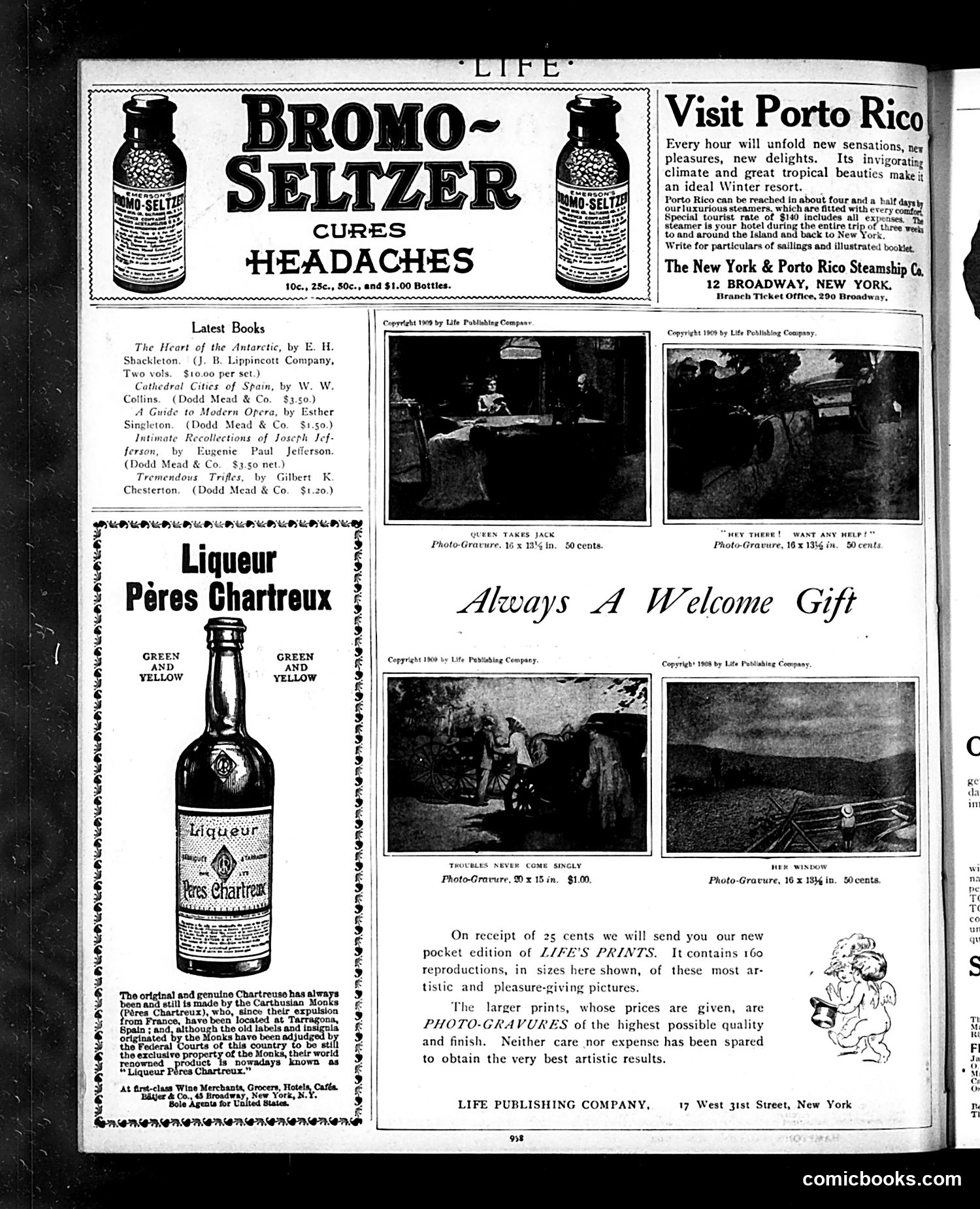
This page is primarily **advertising and product promotion** rather than political satire or editorial cartooning. The main advertisements feature: 1. **Bromo-Seltzer** (top) - a patent medicine claiming to cure headaches, sold in various bottle sizes 2. **Liqueur Pères Chartreux** (left) - a French liqueur marketed as "green and yellow" 3. **Porto Rico steamship tourism** (top right) - promoting winter vacation travel 4. **Life Publishing Company prints** (center/bottom) - selling reproduced artwork and photographs The four small photographic reproductions shown ("Queen Takes Jack," "Hey There! Want Any Help?," "Troubles Never Come Singly," and "His Window") appear to be genre scenes or humorous domestic situations typical of Life magazine's lighter content. The page reflects early 1900s American consumer culture, featuring popular patent medicines, luxury liqueurs, tourism promotion, and reproducible art for home decoration—all standard Life magazine advertising content of the era.
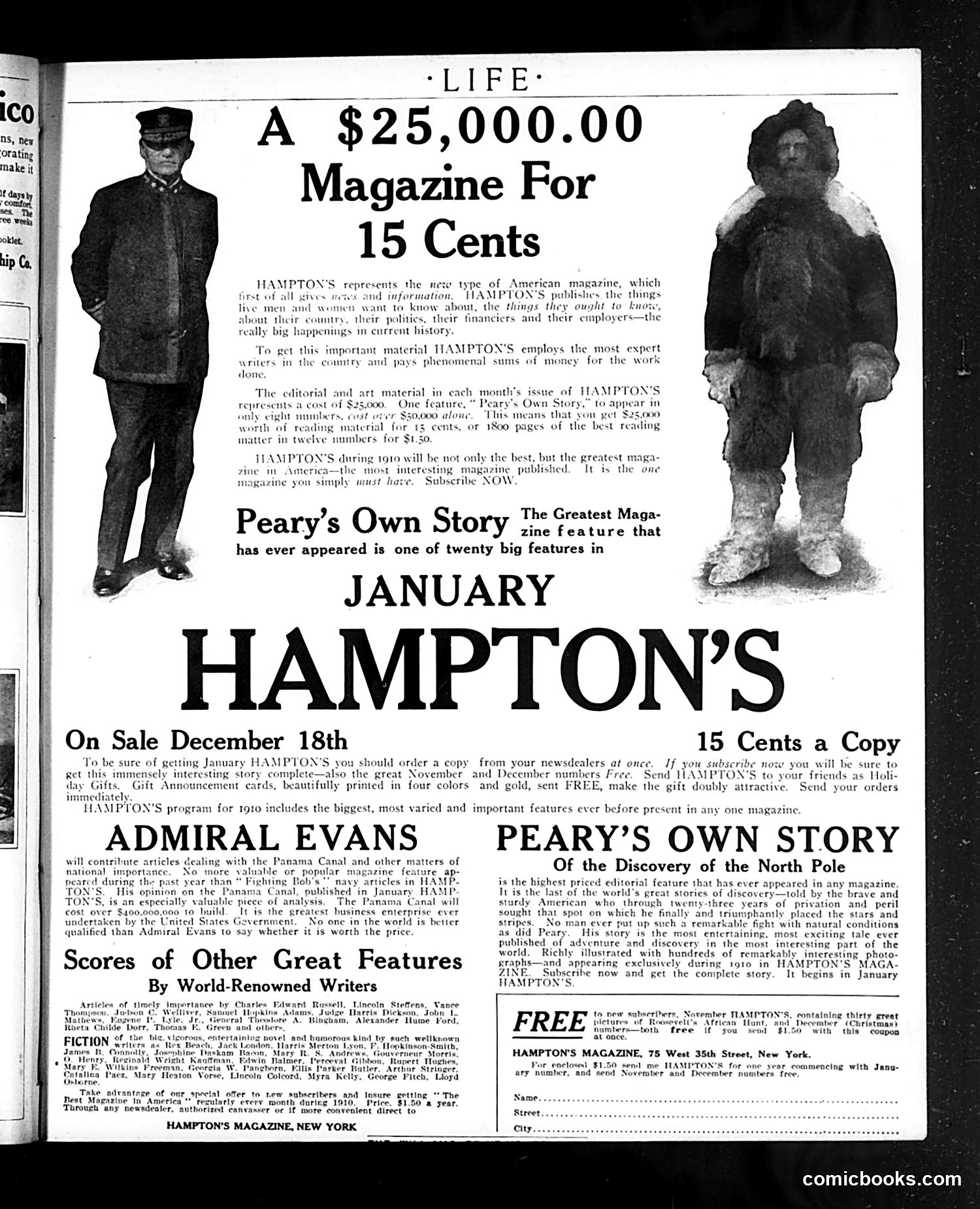
This is primarily a full-page advertisement for **Hampton's Magazine**, a muckraking publication promising $25,000 worth of content for 15 cents. The two photographs flanking the text appear to be **Admiral Robert Peary** (left, in naval uniform) and **Matthew Henson** or another Arctic explorer (right, in heavy fur clothing), promoting Peary's serialized account of discovering the North Pole—Hampton's major feature for January 1910. The advertisement emphasizes Hampton's as a new-style magazine publishing investigative journalism on politics, finance, and current events. It highlights other major contributors including **Admiral "Fighting Bob" Evans** (discussing the Panama Canal), plus fiction by established writers. The satire is implicit: the ad mocks mass-market magazines by claiming extraordinary editorial expenditure (the Peary series cost $25,000) while selling for mere pennies—positioning Hampton's as offering serious, expensive journalism to ordinary readers. This reflected Progressive Era confidence that exposé journalism could reach and reform the American public.
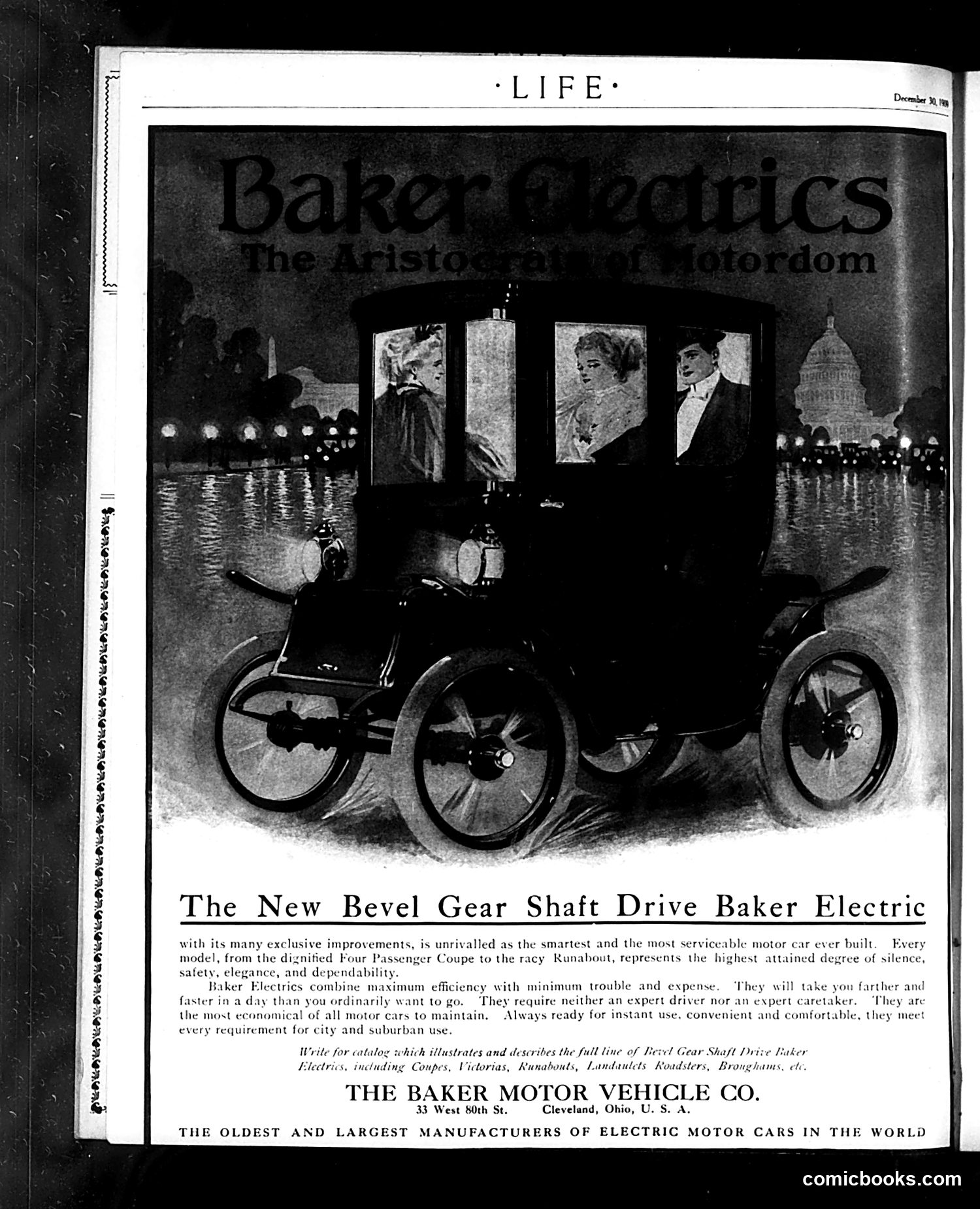
This is primarily a **Baker Electric automobile advertisement**, not a political cartoon. The page features an illustration of an early electric car with four elegantly dressed passengers visible through windows, set against a nighttime Washington D.C. backdrop (Capitol building visible). The ad emphasizes Baker Electrics as vehicles for the wealthy and refined—"the smartest and most serviceable motor car ever built." The passengers appear to be well-to-do socialites, suggesting the car's luxury market positioning. For modern readers: This reflects the early 1900s when **electric cars were prestigious luxury items** for affluent urban users. The advertisement's language ("dignified," "silence," "convenient") appeals to comfort-seeking elites who preferred electrics over noisy, difficult-to-operate gasoline engines. Baker was a real Cleveland manufacturer, then "the oldest and largest" electric car maker. Within a decade, gasoline cars would dominate; electrics largely disappeared until the 21st-century revival. This is period advertising, not satire.
I can see this is a mostly blank page from what appears to be a Life magazine issue, with only partial text visible at the edges. The OCR text is minimal and doesn't provide meaningful content. The page itself shows no discernible cartoon, illustration, or satirical content—it appears to be either a blank interior page, an advertisement page, or the reverse side of printed material. Without visible imagery or legible text to analyze, I cannot identify specific figures, political references, or satirical intent. This page would require viewing adjacent pages or a higher-quality image to provide historical context or interpretation.