
Life, 1909-12-30 · page 19 of 29
Life — December 30, 1909 — page 19: what you’re looking at
What you’re looking at
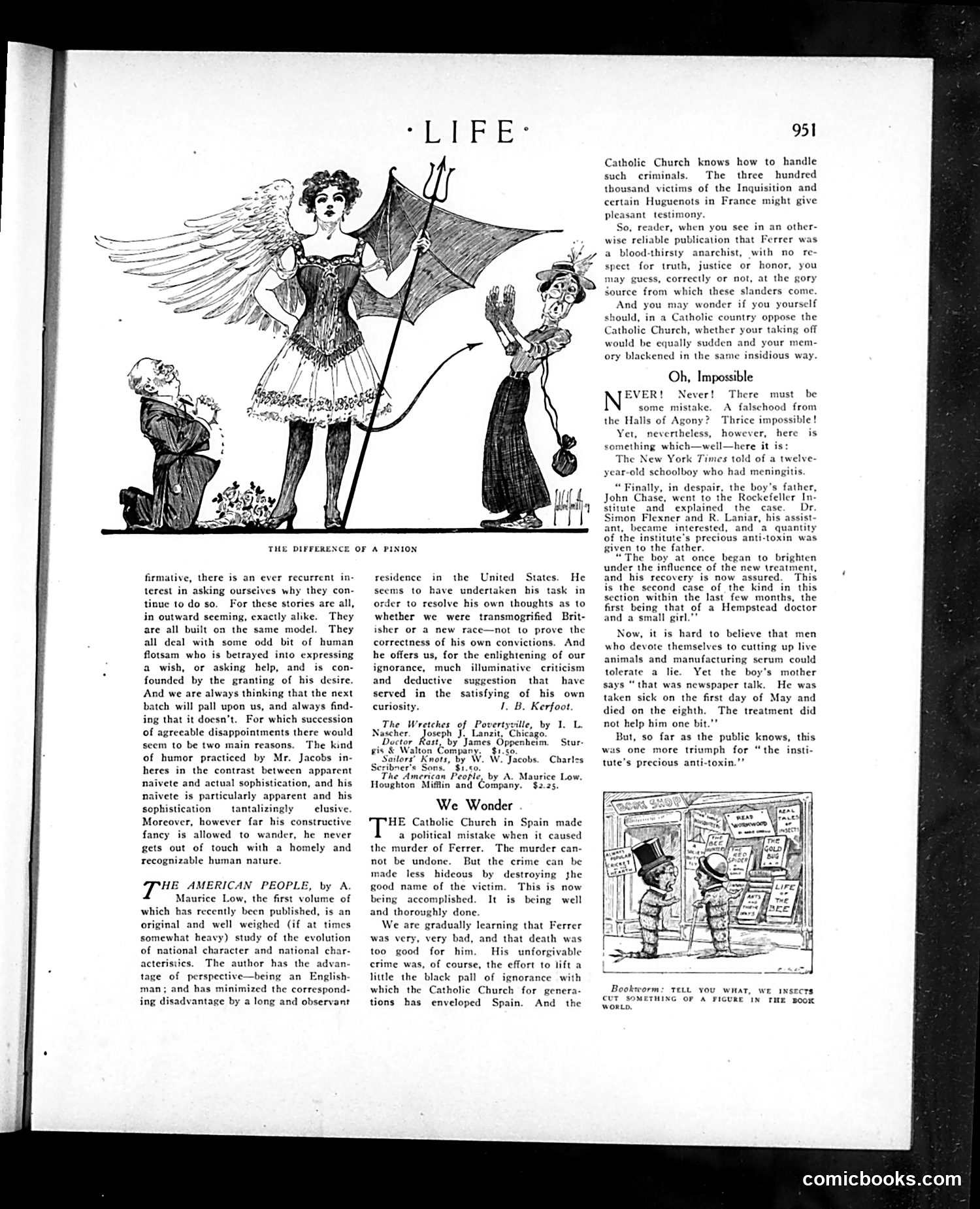
This page contains book reviews and social commentary typical of Life's satirical content. The main cartoon, titled "The Difference of a Pinion," depicts a winged female devil figure holding a trident, alongside a small human figure. The title appears to play on "pinion" (wing), suggesting the contrast between demonic ambition and human limitation. The accompanying text discusses W.W. Jacobs's short stories, praising their sophisticated humor about ordinary people betrayed by granted wishes—a darkly comic theme about human nature. More notably, Life's editorial commentary savagely critiques the Catholic Church's role in executing Spanish educator Francisco Ferrer (1909), accusing church authorities of then smearing his reputation to justify his death. The piece sardonically suggests that anyone opposing the Church in Catholic countries faces similar sudden elimination and character assassination—a direct attack on institutional religious power and its suppression of educational enlightenment.
📄 Transcribed text from this page (OCR, searchable)
Machine-transcribed from the original scan — historical spelling and the odd misread are preserved.
TME DIFFERENCE OF firmative, there is an ever recurrent in- terest in asking ourseives why they con- tinue to do so. For these stories are all, in outward seeming, exactly alike. They are all built on the same model. They all deal with some odd bit of human flotsam who is betrayed into expressing a wish, or asking help, and is con- founded by the granting of his desire. And we are always thinking that the next batch will pall upon us, and always find- ing that it doesn’t. For which succession of agreeable disappointments there would seem to be two main reasons. The kind of humor practiced by Mr. Jacobs in- heres in the contrast between apparent naivete and actual sophistication, and his naivete is particularly apparent and his sophistication _tantalizingly elusive. Moreover, however far his constructive fancy is allowed to wander, he never gets out of touch with a homely and recognizable human nature HE AMERICAN PEOPLE, by A. Maurice Low, the first volume of which has recently been published, is an original and well weighed (if at times somewhat heavy) study of the evolution of national character and national char- acteristics. The author has the advan- tage of perspective—being an English- man; and has minimized the correspond- ing disadvantage by a long and observant A PINION residence in the United States. He seems to have undertaken his task in ler to resolve his own thoughts as to whether we were transmogrified Brit- isher or a new race—not to prove the correctness of his own convictions. And he offers us, for the enlightening of our ignorance, much illuminative criticism and deductive suggestion that have served in the satisfying of his own curiosity. 1. B. Kerfoot. The Wretches of Povertyville, by 1. L. Nascher, Joseph J, Lanzit, Chicigo Doctor Rast, by James Oppenheim. Stur- Char! $1.50. The American People, by A. Maurice Low. Houghton Mifflin and Company. $2.25. We Wonder HE Catholic Church in Spain made a political mistake when it caused the murder of Ferrer. The murder can- not be undone. But the crime can be made less hideous by destroying she good name of the victim. This is now being accomplished. It is being well and thoroughly done We are gradually learning that Ferrer was very, very bad, and that death was too good for him. His unforgivable crime was, of course, the effort to lift a little the black pall of ignorance with which the Catholic Church for genera- tions has enveloped Spain. And the $1.50. gis & Walton Company, $1.5 seailers, Knots, by W. W. Jacobs Se: ’s Sons, 951 Catholic Church knows how to handle such criminals. The three hundred thousand victims of the Inquisition and certain Huguenots in France might give pleasant. testimony. So, reader, when you see in an other- wise reliable publication that Ferrer was a blood-thirsty anarchist, with no re- spect for truth, justice or honor, you may guess, correctly or not, at the gory Source from which these slanders come. And you may wonder if you yourself ld, in a Catholic country oppose the Catholic Church, whether your taking off would be equally sudden and your mem- ory blackened in the same insidious way. Oh, Impossible There must be A falschood from the Halls of Agony? Thrice impossible! Yet, nevertheless, however, something which—well—here it is: The New York Times told of a twelve- year-old schoolboy who had meningitis. EVER! Never! some mistake. here is “ Finally, in despair, the boy's father, John Chase, went to the Rockefeller In- Stitute and explained the case. Dr imon Flexner and R. Laniar, his assist- ant, became interested, and a quantity of the institute's precious anti-toxin was given to the father. The boy at once began to brighten under the influence of the new treatment, and his recovery is now assured. This is the second case of the kind in this section within the last few months, the first being that of a Hempstead doctor and a small girl.’” Now, it is hard to believe that men who devote themselves to cutting up live animals and manufacturing serum could tolerate a lie. Yet the boy's mother says “that was newspaper talk. He was taken sick on the first day of May and died on the eighth. The treatment did not help him one bit.’” But, so far as the public knows, thi wus one more triumph for “the insti- rm: TELL YOU WHAT, WE INSECTS CUT SOMETHING OF A FIGURE IN THE BOOK worto, comicbooks.com