
Life, 1909-12-30 · page 6 of 29
Life — December 30, 1909 — page 6: what you’re looking at
What you’re looking at
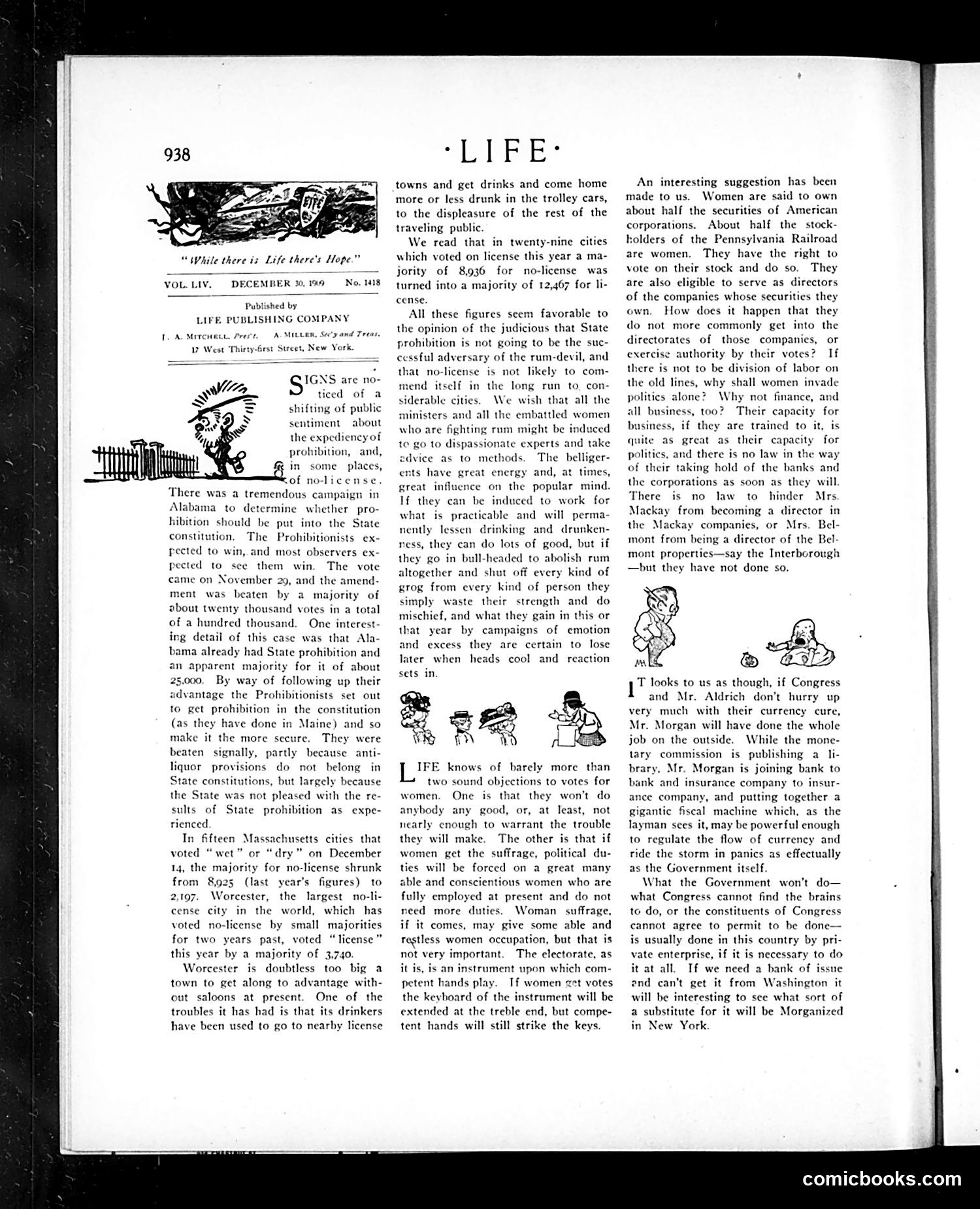
The page discusses prohibition politics and women's suffrage. The small cartoons illustrate social concerns about these movements. **Key figures/references:** - Alabama's prohibition referendum - Massachusetts cities voting on liquor licenses - Women gaining voting rights on financial matters **The satire:** The cartoons mock concerns that women voters might be unpredictable or easily swayed. One illustration shows a woman at a piano keyboard, suggesting women lack serious political judgment—a common anti-suffrage trope. **The political context:** The text debates whether prohibition and female suffrage would help or harm society. Life expresses skepticism about both movements, particularly fearing women's political participation might be influenced by emotion rather than reason—a prevalent anti-suffrage argument of the era. The page reflects early-1900s anxieties about expanding democratic participation.
📄 Transcribed text from this page (OCR, searchable)
Machine-transcribed from the original scan — historical spelling and the odd misread are preserved.
“ While there iz Life there's Hope.” VOL. LIV, DECEMBER 30,199 No. Published by LIFE PUBLISHING COMPANY 1. A. Mere V7 West Thirty-first Stree L Pret. A MILLER, Sec'y and Treas, New York. Sis are no- ticed of a shifting of public sentiment about the expediency of prohibition, and, in some places, of no-license There was a tremendous campaign in Alabama to determine whether pro- hibition should be put into the State constitution, The Prohibitionists ex- pected to win, and most observers ex- pected to see them win. The vote came on November 29, and the amend- ment was beaten by a majority of about twenty thousand votes in a total of a hundred thousand. One interest- ing detail of this case was that Ala- bama already had State prohibition and an apparent majority for it of about 5.000. By way of following up their advantage the Prohibitionists set out to get prohibition in the constitution (as they have done in Maine) and so make it the more secure. They were beaten. signally, partly because anti- liquor provisions do not belong in State constitutions, but largely because the State was not pleased with the re- sults of State prohibition as expe- rienced. In fifteen Massachusetts cities that voted “wet” or “dry” on December 14, the majority for no-license shrunk from 80 25 (last year’s figures) to 2,197, Worcester, the largest no-li- cense city in the world, which has voted no-license by small majorities for two years past, voted “license” this year by a majority of 3,740. Worcester is doubtless too big a town to get along to advantage with- out saloons at present. One of the troubles it has had is that its drinkers have been used to go to nearby license LEE? towns and get drinks and come home more or less drunk in the trolley cars, to the displeasure of the rest of the traveling public. We read that in twenty-nine cities which voted on license this year a ma- jority of 8,936 for no-license was turned into a majority of 12,467 for li- cense. All these figures seem favorable to the opinion of the judicious that State prohibition is not going to be the suc- cessful adversary of the rum-devil, and that no-license is not likely to com- mend itself in the long run to, con- siderable cities. We wish that all the ministers and all the embattled women who are fighting rum might be induced te go to dispassionate experts and take zdvice as to methods, The belliger- ents have great energy and, at times, great influence on the popular mind. If they can be induced to work for what is practicable and will perma- nently lessen drinking and drunken- ness, they can do lots of good, but if they go in bull-headed to abolish rum altogether and shut off every kind of grog from every kind of person they simply waste their strength and do mischief, and what they gain in this or that year by campaigns of emotion and excess they are certain to lose later when heads cool and reaction sets in. IFE knows of barely more than two sound objections to votes for women. One is that they won't do anybody any good, or, at least, not nearly enough to warrant the trouble they will make. The other is that women get the suffrage, political du- ties will be forced on a great many able and conscientious women who are fully employed at present and do not need more duties. Woman suffrage, if it comes, may give some able and restless women occupation, but that is not very important. The electorate, as it is, is an instrument upon which com- petent hands play. If women get votes the keyhoard of the instrument will be extended at the treble end, but compe- tent hands will still strike the keys. An interesting suggestion has been made to us. Women are said to own about half the securities of American corporations. About half the stock- holders of the Pennsylvania Railroad are women, They have the right to vote on their stock and do so. They are also eligible to serve as directors of the companies whose securities they own. How does it happen that they do not more commonly get into the directorates of those companies, or exercise authority by their votes? If there is not to be division of labor on the old lines, why shall women invade politics alone? Why not finance, and all business, too? Their capacity for business, if they are trained to it, is quite as great as their capacity for politics, and there is no law in the way of their taking hold of the banks and the corporations as soon as they will There is no law to hinder Mrs. Mackay from becoming a director in the Mackay companies, or Mrs. Bel- mont from being a director of the Bel- mont properties—say the Interborough —but they have not done so. looks to us as though, if Congress and Mr. Aldrich don’t hurry up very much with their currency cure, Mr. Morgan will have done the whole job on the outside. While the mone- tary commission is publishing a li- brary, Mr. Morgan is joining bank to bank and insurance company to insur- ance company, and putting together a gigantic fiscal machine which, as the layman sees it, may be powerful enough to regulate the flow of currency and ride the storm in panics as effectually as the Government itself What the Government won't do— what Congress cannot find the brains to do, or the constituents of Congress cannot agree to permit to be done— is usually done in this country by pri- vate enterprise, if it is necessary to do it at all. If we need a bank of issue end can't get it from Washington it will be interesting to see what sort of a substitute for it will be Morganized in New York. comicbooks.com