
Life, 1909-12-30 · page 18 of 29
Life — December 30, 1909 — page 18: what you’re looking at
What you’re looking at
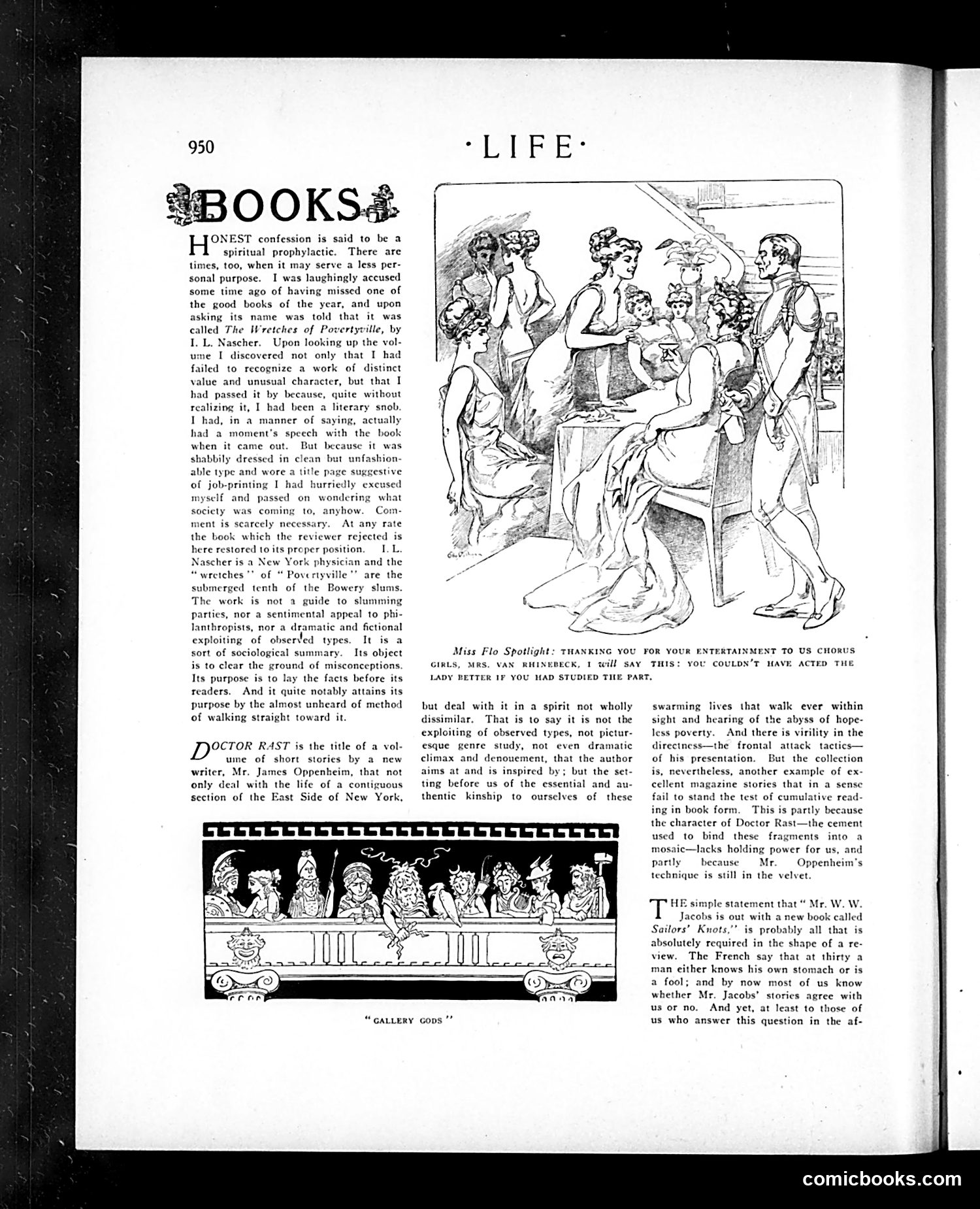
This page reviews three books for a literary audience. The main cartoon depicts **Miss Flo Spotlight** (a chorus girl) thanking society women for entertainment, with the caption sarcastically suggesting the wealthy patrons "couldn't have acted the lady better if you had studied the part"—mocking both the performers and the pretentious audience members. The text discusses books about working-class life: *The Wretches of Povertyville* by I.L. Nascher (a sociological study of Bowery slums), *Doctor Rast* by James Oppenheim (short stories about NYC's East Side poor), and *Sailors' Knots* by W.W. Jacobs. The reviews praise these works for authentically depicting poverty and working people without sentimentality or melodrama. The cartoon reinforces this theme—mocking wealthy people's shallow engagement with lower-class life, whether through slumming tourism or theater attendance. The satire suggests genuine understanding of working-class experience contrasts sharply with society's superficial interest.
📄 Transcribed text from this page (OCR, searchable)
Machine-transcribed from the original scan — historical spelling and the odd misread are preserved.
as ONEST confession is said to be a spiritual prophylactic. There are times, too, when it may serve a less per- sonal purpose. I was laughingly accused some time ago of having missed one of the good books of the year, and upon asking its name was told that it was called The Wretches of Povertyville, by I. L. Nascher. Upon looking up the vol- ume I discovered not only that I had failed to recognize a work of distinct value and unusual character, but that I had passed it by because, quite without realizing it, I had been a literary snob. I had, in a manner of saying, actually had a moment's speech with the book when it came out. But because it was shabbily dressed in clean but unfashion- able type and wore a title page suggestive of job-printing I had hurriedly excused myself and passed on wonder ment is scarcely necessary. At any rate the book which the reviewer rejected is here restored to its proper position. 1. L. Nascher is a New York physician and the “ wretches" of “ Povertyville’’ are the submerged tenth of the Bowery slums. The work a guide to slumming parties, nor a sentimental appeal to phi- lanthropists, nor a dramatic and fictional exploiting of observed types. It is a sort of sociological summary. Its object is to clear the ground of misconceptions. Its purpose is to lay the facts before its readers. And it quite notably attains its purpose by the almost unheard of method of walking straight toward it. society was coming to, anyhow. is not OCTOR RAST is the title of a vol- ume of short stories by a new writer, Mr. James Oppenheim, that not only deal with the life of a contiguous section of the East Side of New York, Miss Flo Spotlight: tax GIRLS, MRS, VAN RHINEDECK, 1 LADY BETTER IF YOU will say but deal with it in a spirit not wholly dissimilar, That is to say it is not the exploiting of observed types, not pictur- esque genre study, not even dramatic climax and denouement, that the author aims at and is inspired by; but the set- ting before us of the essential and au- thentic kinship to ourselves of these “GALLERY Gops"” ING YOU FOR YOUR ENTERTAI ENT TO US CHORUS THIS: YOU COULDN’T MAVE ACTED THE MAD STUDIED TIE PART. swarming lives that walk ever within sight and hearing of the abyss of hope- less poverty. And there is virility in the directness—the frontal attack tactics— of his presentation. But the collection is, nevertheless, another example of ex- cellent magazine stories that in a sense fail to stand the test of cumulative read- ing in book form. This is partly because the character of Doctor Rast—the cement used to bind these fragments into a mosaic—lacks holding power for us, and partly because Mr. Oppenheim’s technique is still in the velvet. HE simple statement that “ Mr. W. W. Jacobs is out with a new book called Sailors’ Knots,” is probably all that is absolutely required in the shape of a re- view. The French say that at thirty a man either knows his own stomach or is a fool; and by now most of us know whether Mr. Jacobs’ stories agree with us or no. And yet, at least to those of us who answer this question in the af- comicbooks.com