
Life, 1909-12-30 · page 13 of 29
Life — December 30, 1909 — page 13: what you’re looking at
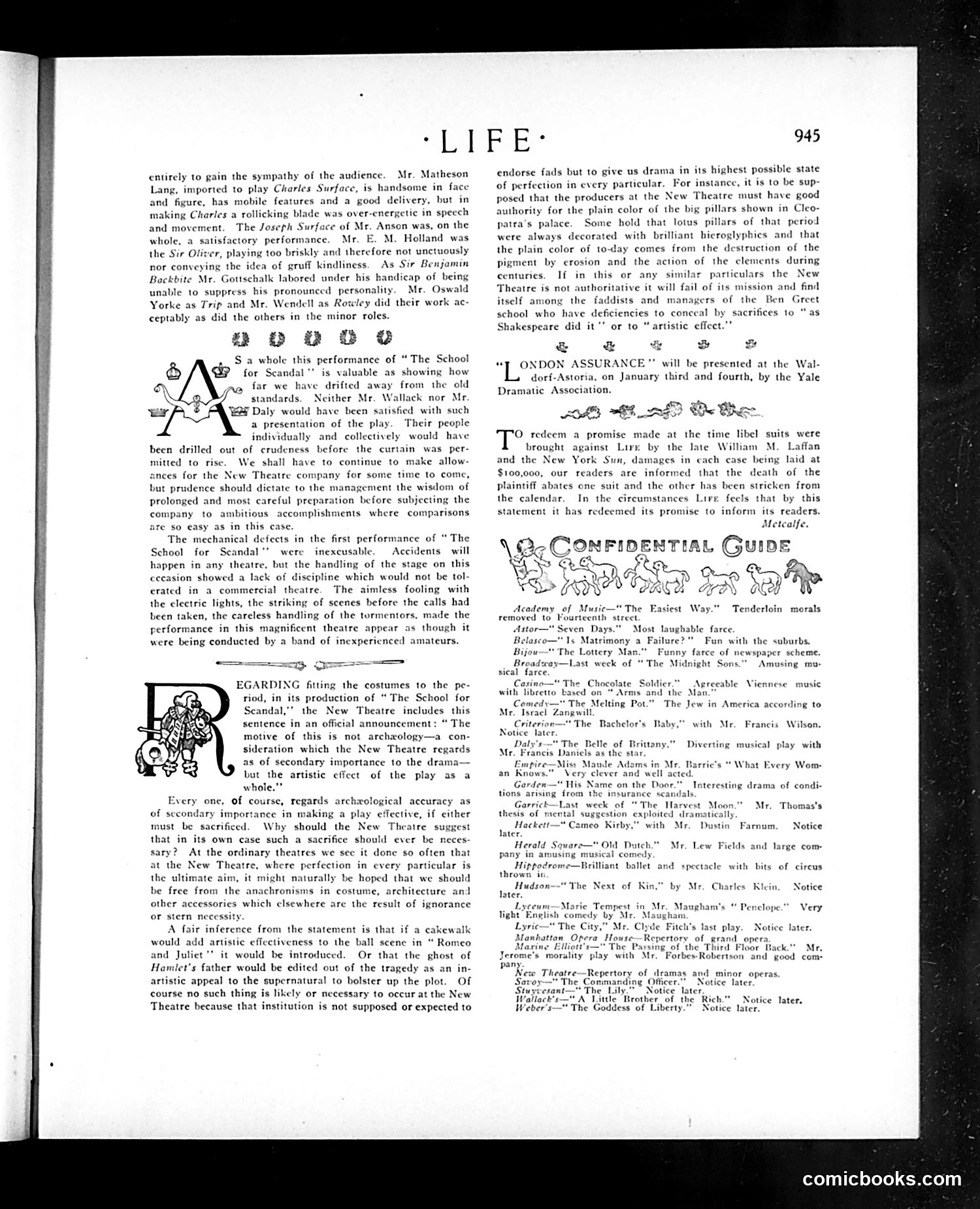
What you’re looking at
This page is primarily **theatrical criticism and advertising** rather than political satire. The main content discusses stage productions, including detailed critiques of "The School for Scandal" at the New Theatre. The visible **cartoon** (top left, ornate initial "A") appears to be a decorative element showing a figure in period costume, likely related to the theatrical discussion rather than political commentary. The "**Confidential Guide**" section lists current Broadway shows with brief reviews—plays like "The Lottery Man," "The Midnight Sons," and "The Melting Pot." The page's satire, if present, is **theatrical in nature**: critiquing productions' artistic choices, costume accuracy, and directorial decisions rather than addressing political or social issues. This reflects *Life's* role as both satirical commentary and cultural arbiter during this era.
📄 Transcribed text from this page (OCR, searchable)
Machine-transcribed from the original scan — historical spelling and the odd misread are preserved.
bee aid entirely to gain the sympathy of the audience. Mr. Matheson Lang, imported to play Charles Surface, is handsome in face and figure, has mobile features and a good delivery, but in making Charles a rollicking blade was over-energetic in speech and movement. The Joseph Surface of Mr. Anson was, on the whole, a satisfactory performance. Mr. E. M. Holland was the Sir Oliver, playing too briskly and therefore not unctuously nor conveying the idea of gruff kindliness, As Sir Benjamin Backbite Mr. Gottschalk labored under his handicap of being unable to suppress his pronounced personality, Mr. Oswald Yorke as Trip and Mr. Wendell as Rowley did their work ac- ceptably as did the others in the minor roles. eo 8 8 S a whole this performance of “The School \e/ for Scandal’ is valuable as showing how Aa far we have drifted away from the old ~ standards. Neither Mr. Wallack nor Mr. WF Daly would have been satisfied with such a presentation of the play. Their people individually and collectively would have been drilled out of crudeness before the curtain was per- mitted to rise. We shall have to continue to make allow- ances for the New Theatre company for some time to come, but prudence should dictate to the management the wisdom of prolonged and most careful preparation before subjecting the company to ambitious accomplishments where comparisons so easy as in this case. The mechanical defects in the first performance of “ The School for Scandal’? were inexcusable, Accidents will happen in any theatre, but the handling of the stage on this eccasion showed a lack of discipline which would not be tol- erated in a commercial theatre. The aimless fooling with the electric lights, the striking of scenes before the calls had been taken, the careless handling of the tormentors, made the performance in this magnificent theatre appear as though it were being conducted by a band of inexperienced amateurs. EGARDING fitting the costumes to the pe- riod, in its production of “ The School for Scandal,’ the New Theatre includes this sentence in an official announcement: “ The motive of this is not archxology—a con- sideration which the New Theatre regards as of secondary importance to the drama— but the artistic effect of the play as a whole.” Every one, of course, regards archwological accuracy as of secondary importance in making a play effective, if either must be sacrificed. Why should the New Theatre suggest that in its own case such a sacrifice should ever be neces sary? At the ordinary theatres we sec it done so often that at the New Theatre, where perfection in every particular is the ultimate aim, it might naturally be hoped that we should be free from the anachronisms in costume, architecture an: other accessories which elsewhere are the result of ignorance or stern necessity. A fair inference from the statement is that if a cakewalk would add artistic effectiveness to the ball scene in “ Romeo and Juliet '’ it would be introduced. Or that the ghost of Homict’s father would be edited out of the tragedy as an in- artistic appeal to the supernatural to bolster up the plot. Of course no such thing is likely or necessary to occur at the New Theatre because that institution is not supposed or expected to endorse fads but to give us drama in its highest possible state of perfection in every particular. For instance, it is to be sup- d that the producers at the New Theatre must have good ty for the plain color of the big pillars shown in Cleo- Some hold that lotus pillars of that period s and that patra's palace were always decorated with brilliant hicroglyp the plain color of to-day comes from the destruction of the pigment by erosion and the a of the elements during centuries. If in this or any similar particulars the New Theatre is not authoritative it will fail of its mission and find itself among the faddists and managers of the Ben Greet as school who have deficiencies to conceal by sacrifices to Shakespeare did it’? or to “artistic effect.” & «€ es f will be presented at the Wal- dorf-Astoria, on January third and fourth, by the Yale Dramatic Association. ee ft ok BI AED Be the 'O redeem a promise made at the time libel suits were brought against Lire by the late William M. Laffan and the New York Sun, damages in cach case being laid at $100,000, our readers are informed that the death of the plaintiff abates one suit and the other has been stricken from the calendar. In the circumstances Lire fecls that by this statement it has redeemed its promise to inform its readers. Metcalfe. Be CONFIDENTIAL UIDE Wee dee onto a> HWM B85) ER SQ PREG BB K6eG fen Music— The Easiest Way.” Tenderloin morals removed to Fourteenth street Astor—" Seven Days.” Most laughable farce. Belasco—" Is Matrimony a F an with the suburbs, Bijou" The Lottery Man.” © scheme. Broadway—Last week of using mu: sical farce. Casino—" The Choc: with libretto based on Arms and the Man Comedy—* The Melting Pot.” The Jew in America according to Mr. Israel Zangwill id Criterion—" The Bachelor's Baby," with Mr. Francis Wilson. Notice ater. ° Da “The Belle of Brittany.” Dive Mr. Francis Daniels as the sta Empire—Miss Ma: Ad n Mr. Barrie’s “ What Every Wom- an Knows.” Very clever and acted eee Garden—“ His Name on the Door. tions arising from the insurance scandals: Garrick—Last week of “The Harvest Moon.” Mr. thesis of mental suggestion exploited drama y Hackett—“ Cameo Kirby,” with Mr. Dustin Farnum. Herald Square—" Old Dutch.” Mr, Lew Fields and large com- pai a g musical comedy ‘ Hippodrome—Brilli: ballet thrown i Viennese music musical play with Interesting drama of cond Thomas's Notice spectacle with bits of circus “The Next of Kin,” by Mr, Charles Klein, Notice ie Tempest in Mr. Maugh: nglish comedy by Mr. Maugham Mr. Clyde Fitch's last play. Notice later. ra House—Repertory of grand opera. , r The Passing of the Third Floor Back.” Mr. Jerome's morality play with Mr. Forbes-Robertson and good coi pany 's Penclope.” Very Repertory of dramas and m “The Conmanding Officer.”” esant—" The Lily.” Notice later Wallack’s—“A Little Brother of the Rich Weber's—" The Goddess of Liberty.” F operas. ice later. ‘i Notice later. Notice later. comicbooks.com