
Life, 1909-12-30 · page 12 of 29
Life — December 30, 1909 — page 12: what you’re looking at
What you’re looking at
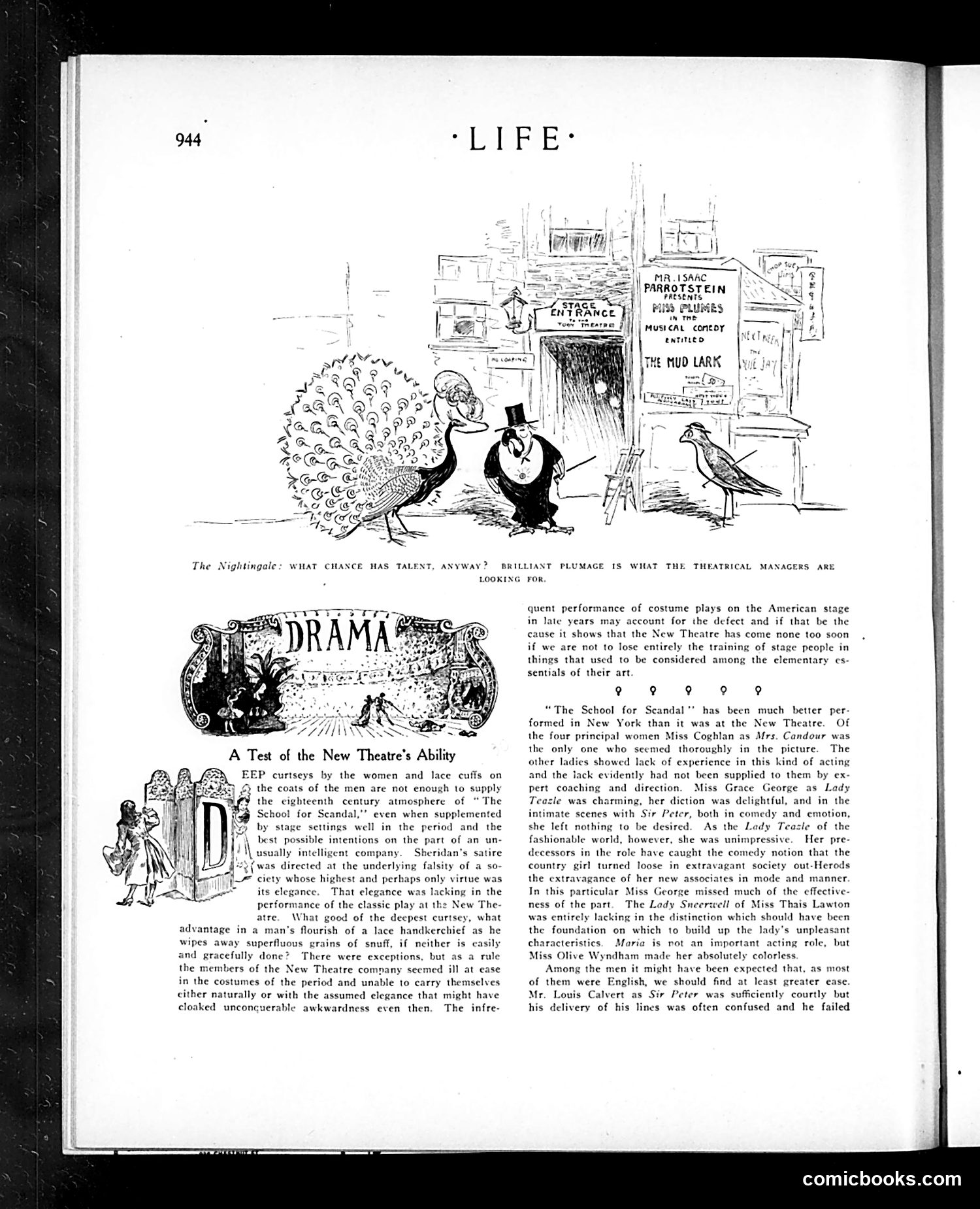
This page from *Life* magazine contains a theatrical drama critique titled "A Test of the New Theatre's Ability." The main cartoon depicts a peacock, a formally-dressed man in a top hat, and a bird, standing outside a theater entrance advertising "The Mud Lark" and other productions. The cartoon satirizes theatrical managers' obsession with "brilliant plumage"—elaborate costumes and visual spectacle—over actual talent. The peacock, with its showy feathers, represents this superficial aesthetic preference. The caption notes that theatrical talent has become less important than costume display in contemporary American productions. The accompanying text critiques "The School for Scandal" production at the New Theatre, faulting the performers for lacking adequate training and stage presence, despite their elaborate period costumes. The satire targets both theatrical management's priorities and performers' insufficient skill development.
📄 Transcribed text from this page (OCR, searchable)
Machine-transcribed from the original scan — historical spelling and the odd misread are preserved.
The Nightingale: wuat CHANCE MAS TALENT, ANYWAY? LOOKING Theatre's Ability EEP curtseys by the women and lace cuffs on G} the coats of the men are not enough to s: f¥ the cighteenth century atmosphere of “The fem School for Scandal,"’ even when supplemented > by stage settings well in the period and the \ best possible intentions on the part of an un- usually intelligent company § (was directed at the underlying falsity of a so- i al ciety whose highest and perhaps only virtue was “its elegance. That elegance was lacking in the performance of the classic play at the New The atre. What good of the deepest curtsey, what advantage in a man’s flourish of a lace handkerchief as he wipes away superfluous grains of snuff, if neither is casily and gracefully done? There were exceptions, but as a rule the members of the New Theatre company secmed ill at ease in the costumes of the period and unable to carry themselves cither naturally or with the assumed elegance that might have cloaked unconguerable awkwardness even then. The infre- Sheridan's satire i eo 4 = {| RARE < Ged) || pass tubes BIL est eee Hl] | musreat contor MR .1SAAC PARROTSTEIN nTime BRILLIANT PLUMAGE IS WHAT THE THEATRICAL MANAGERS ARE FOR quent performance of costume plays on the American stage in late years may account for the defect and if that be the cause it shows that the New Theatre has come none too soon if we are not to lose entirely the training of stage people in things that used to be considered among the elementary es- sentials of their art g g 9 9 9 “The School for Scandal’? has been much better per- formed in New York than it was at the New Theatre. Of the four principal women Miss Coghlan as Mrs. Candour was the only one who seemed thoroughly in the picture. The other ladies showed lack of experience in this kind of acting and the lack evidently had not been supplied to them by ex- ert coaching and direction. Miss Grace George as Lady e was charming, her diction was delightful, and in the timate scenes with Sir Peter, both in comedy and emotion, she left nothing to be desired. As the Lady Teazle of the fashionable world, however, she was unimpressive. Her pre- decessors in the role have caught the comedy notion that the country girl turned loose in extravagant society out-Herods the extravagance of her new associates in mode and manner. In this particular Miss George missed much of the effective- ness of the part. The Lady Sneerwell of Miss Thais Lawton was entirely lacking in the distinction which should have been the foundation on which to build up the lady's unpleasant characteristics. Maria is pot an important acting role, but Miss Olive Wyndham made her absolutely colorless. Among the men it might have been expected that of them were English, we should find at least greater ease. Mr. Louis Calvert as Sir Peter was sufficiently courtly but his delivery of his lines was often confused and he failed s most comicbooks.com