
Life, 1909-12-30 · page 16 of 29
Life — December 30, 1909 — page 16: what you’re looking at
What you’re looking at
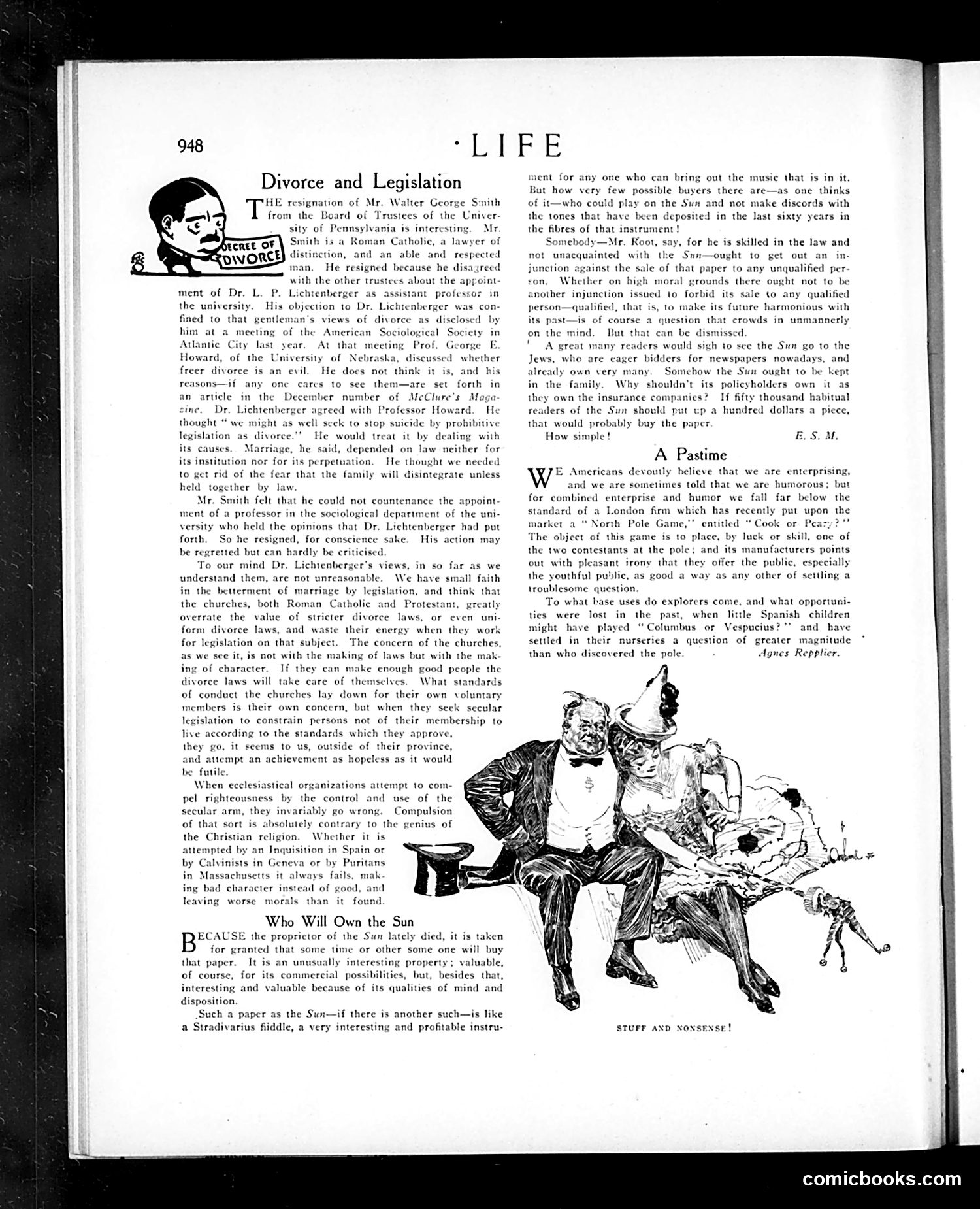
This page contains two distinct articles addressing early 20th-century religious and social debates. **"Divorce and Legislation"** discusses Walter George Smith's resignation from the University of Pennsylvania's board over the appointment of Dr. L.P. Lichtenberger, who advocated treating divorce like suicide—through addressing root causes rather than prohibition. Smith, a Roman Catholic, opposed Lichtenberger's liberal divorce views on moral grounds. The article sides with Lichtenberger, arguing churches waste energy on strict divorce laws instead of building character, and that using secular law to enforce religious standards (comparing this to the Spanish Inquisition and Puritan Massachusetts) inevitably fails. **"A Pastime"** briefly describes a parlor game called "North Pole Game" involving exploration and chance. **The cartoon** (captioned "STUFF AND NONSENSE!") appears to mock pompous debate—showing a rotund, self-satisfied figure gesturing dismissively, satirizing the earnest moral arguments in the divorce legislation debate above. The page reflects Progressive Era tensions between religious institutional authority and secular, rationalist approaches to social problems.
📄 Transcribed text from this page (OCR, searchable)
Machine-transcribed from the original scan — historical spelling and the odd misread are preserved.
“LYRE Divorce and Legislation HE resignation of Mr. Walter George Smith from the Board of T sity of Pennsylvania is interesting. Mr. Smith is a Roman Catholic, a lawyer of € OF nat . y < SWORCE distinction, and an able and respected man, He resigned because he disagreed ees of the Univer- with the other trustees about the appoint- ment of Dr. L. P. Lichtenberger as assistant professor in the university. His objection to Dr. Lichtenberger was con- fined to that ge him at a meeting of the American Sociologi leman’s views of divorce as disclosed by Society in Atlantic City last year. At that meeting Prof. George E. Howard, of the University of Nebraska, discussed whether freer divorce is an evil. He docs not think it is, and his reasons—if any one carcs to see them—are set forth in an article in the December number of McClure’s Mage ne. Dr. Lichtenberger agreed with Professor Howard. He thought “ we might as well scck to stop suicide by prohibitive He would treat it by dealing with Marriage, he said, depended on law neither for legislation as divorce." its causes. its institution nor for its perpetuation. He thought we necded to get rid of the fear that the family will disintegrate unless held together by law Mr. Smith felt that he could not countenance the appoint- the uni- versity who held the opinions that Dr. Lichtenberger had put forth. So he resigned, for conscience sake. His action may be regretted but can hardly be criticised. ment of a professor in the sociological departme ‘0 our mind Dr. Lichtenberger’s views, in so far as we understand them, are not unreasonable, We have small faith in the betterment of marriage by legislation, and think that the churches, both Roman Catholic and Protestant, greatly overrate the value of stricter divorce laws, or even uni- form divorce laws, and waste their energy when they work for legislation on that subject. The concern of the churches, as we sce it, is not with the making of laws but with the mak ing of character. If they can make enough good people divorce laws will take care of themselves. What st of conduct the churches lay down for their own voluntary nembers is their own concern, but when they seek secular legislation to constrain persons not of their membership to live according to the standards which they approve, they go, it seems to us, outside of their province, and attempt an achievement as hopeless as it would he futile When ecclesiastical organizations attempt to com- pel righteousness by the control and use of the secular arm, they invariably go wrong. Compulsion of that sort is absolutely contrary to the genius of the Christian religion. Whether it is attempted by an Inquisition in Spain or by Calvinists in Geneva or by Puritans in Massachusetts it always fails, mak ing bad character instead of good, ar leaving worse morals than it found Who Will Own the Sun CAUSE the proprietor of the Sun lately died, it is taken for granted that some time or other some one will buy that paper. It is an unusually interesting property; valuable, of course, for its commercial possibilities, but, besides that, interesting and valuable because of its qualities of mind and disposition. Such a paper as the Sun—if there is another such—is like a Stradivarius fiddle, a very interesting and profitable instru- nent for any one who can bring out the music that is in it, But how very few possible buyers there are—as one thinks of it—who could play on the Sun and not make discords with the tones that have been deposited in the last sixty years in the fibres of that instrument! Somebody—Mr. Koot, say, for he is skilled in the law and not unacquainted with tke Sun—ought to get out an junction against the sale of that paper to any unqualified per- son, Whether on high moral grounds there ought not to be another injunction issued to forbid its sale to any qualified person—qualified, that is, to make its future harmonious with its past—is of course a question that crowds in unmannerly on the mind. But that can be dismissed A great many readers would sigh to see the Sun go to the ager bidders for newspapers nowadays, and how the Sun ought to be kept in the family. Why shouldn't its policyholders own it as Jews, who are already own very many. Se they own the insurance companies? If fifty thousand habitual readers of the Sun should put cp a hundred dollars a piece, that would probably buy the paper. E.S. M. How simple A Pastime WWE Americans devoutly believe that we are enterprising, and we are sometimes told that we are humorous; but for combined enterprise and humor we fall far below the standard of a London firm which has recently put upon the rket a“ North Pole Game," entitled “Cook or Peary?" The object of this game is to place, by luck oF skill, one of the two contestants at the pole : out with pleasant irony that they offer the public, especially and its manufacturers points the youthful public, as good a way as any other of settling a troublesome question. To what base uses do explorers come, and what opportuni- ties were lost in the p: when little Spanish children might have played “Columbus or Vespucius?"’ and have settled in their nurseries a question of greater magnitude than who discovered the pole. Agnes Repplier. comicbooks.com