
A complete issue · 32 pages · 1909
Life — September 16, 1909
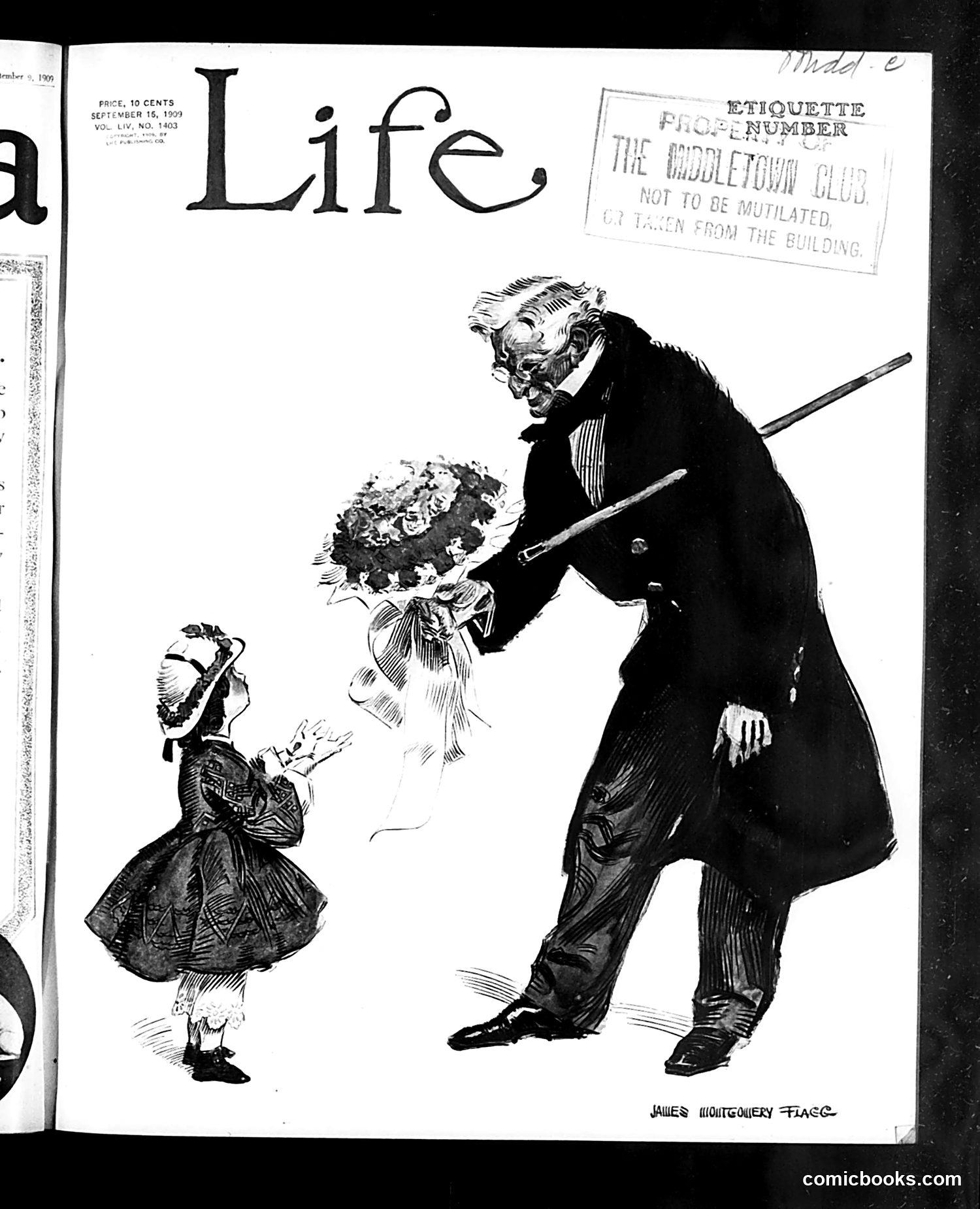
This is the September 15, 1909 cover of *Life* magazine (price 10 cents), featuring artwork by James Montgomery Flagg. The cartoon depicts an elderly man with exaggerated features offering flowers to a young girl. The satire appears to comment on an age-gap romance or courtship—a common subject of social ridicule in early 20th-century humor. The contrast between the wizened, scheming older gentleman and the innocent child suggests mockery of inappropriate relationships or "May-December" romances that were occasionally subjects of public scandal. The specific figures remain unclear without additional historical context, though Flagg's caricature style emphasizes physical distortion for comedic effect. The overall message critiques such relationships through visual exaggeration typical of the era's satirical journalism.
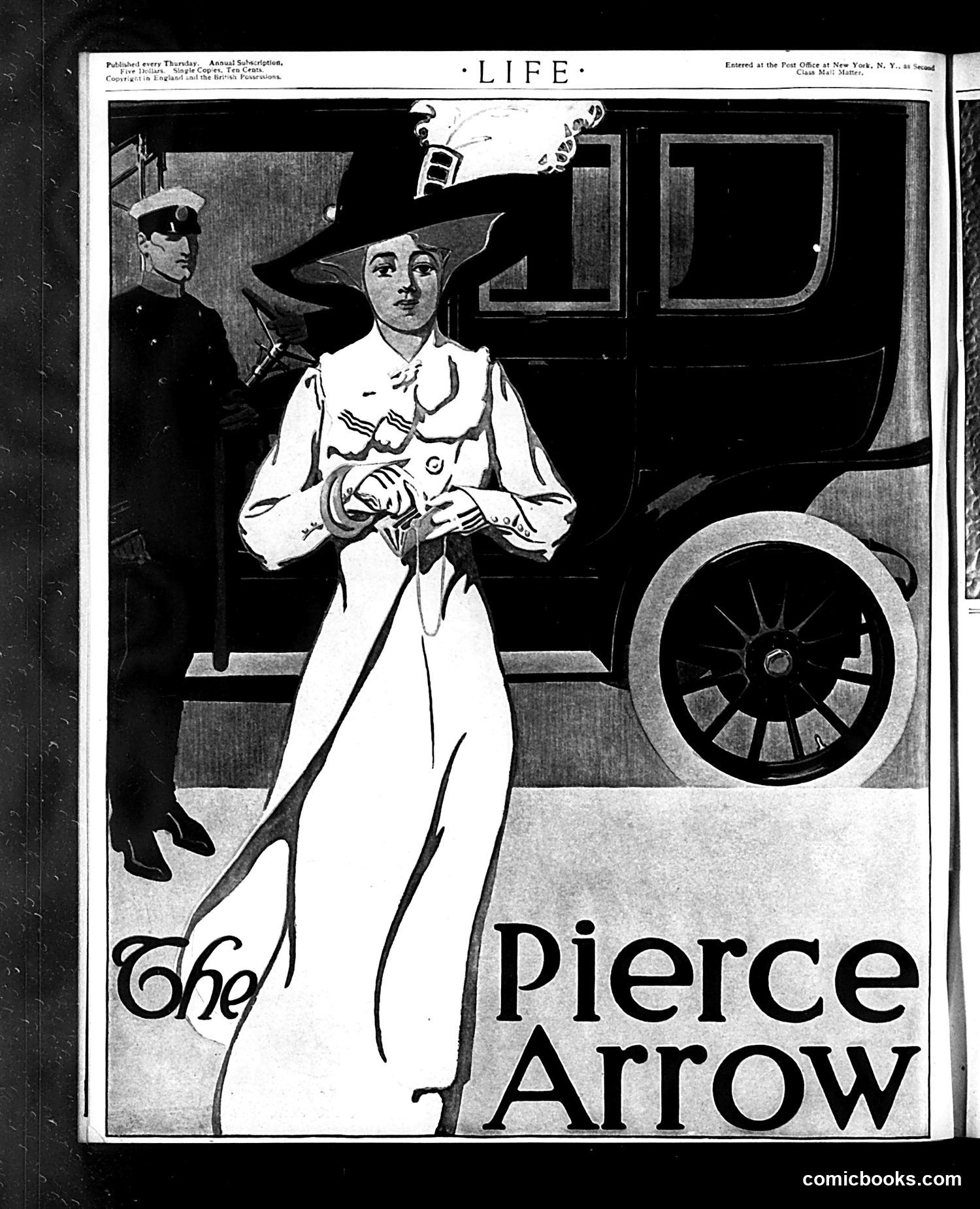
This is a **car advertisement**, not political satire. The page promotes "The Pierce Arrow," an early automobile brand, appearing in *Life* magazine's pages. The illustration depicts an elegantly dressed woman in a wide-brimmed hat and long white coat, standing before a Pierce Arrow vehicle with a uniformed chauffeur visible in the background. A military or police officer stands to the left. The advertisement uses aspirational imagery common to the era—associating the automobile with luxury, refinement, and social status. The woman's fashionable attire and the formal attendants suggest wealth and prestige. This represents early 20th-century automotive marketing, targeting affluent consumers by linking car ownership to elegance and elevated social position.
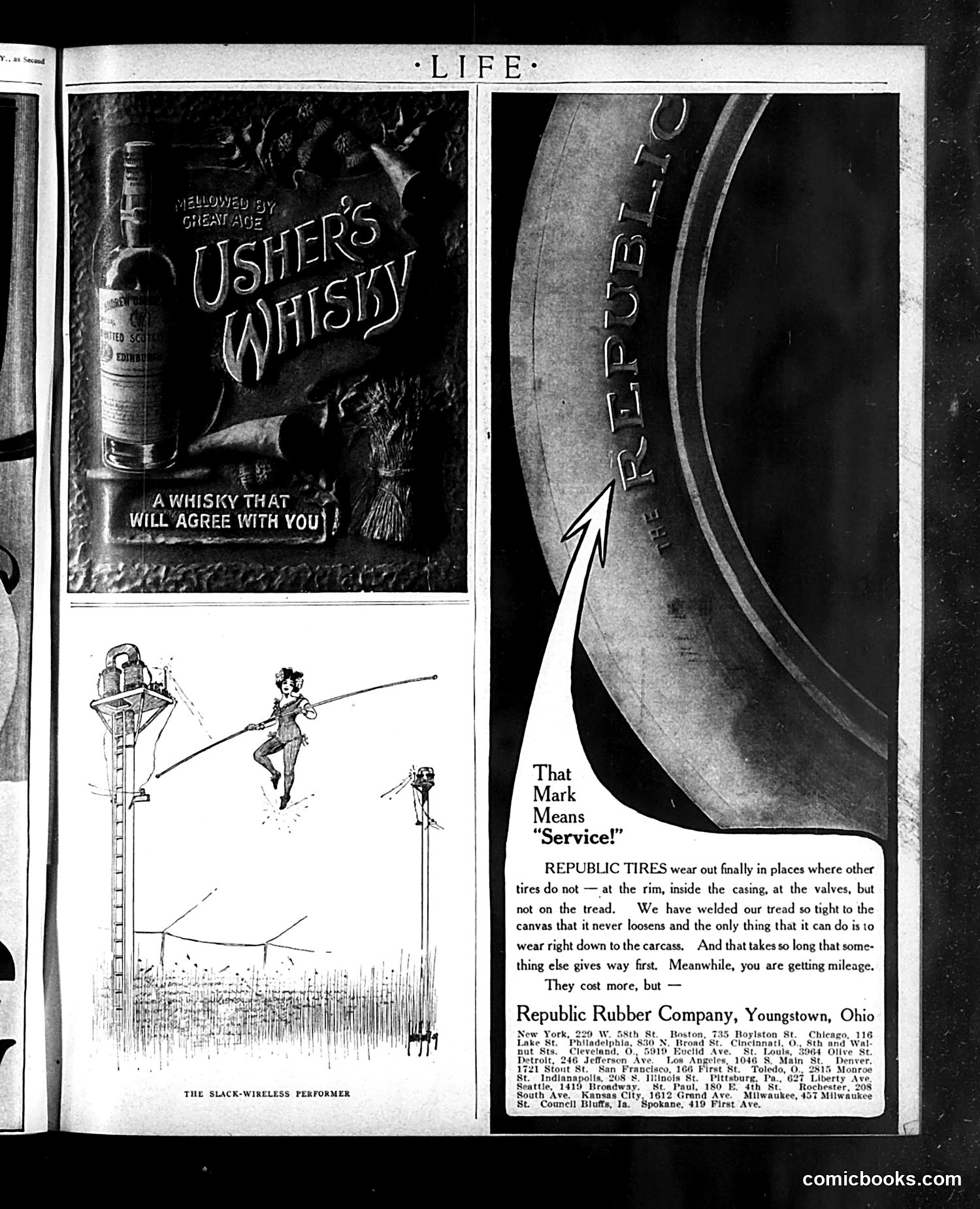
This page contains two distinct elements: **Left side:** An advertisement for Usher's Whisky showing a bottle with text "A Whisky That Will Agree With You," accompanied by an illustration titled "The Slack-Wireless Performer." The cartoon depicts acrobats on a tightrope, likely satirizing circus performers or entertainers of the era. The "slack-wireless" title appears to reference wireless technology and possibly the precarious nature of performing without safety equipment. **Right side:** An advertisement for Republic Tires from Youngstown, Ohio. The "R-Public" mark shown refers to their branding. The copy emphasizes durability, claiming Republic tires wear out in unexpected places rather than the tread—a selling point suggesting superior longevity compared to competitors, despite higher cost. Both advertisements reflect early 20th-century marketing tactics and product claims typical of *Life* magazine's commercial content.
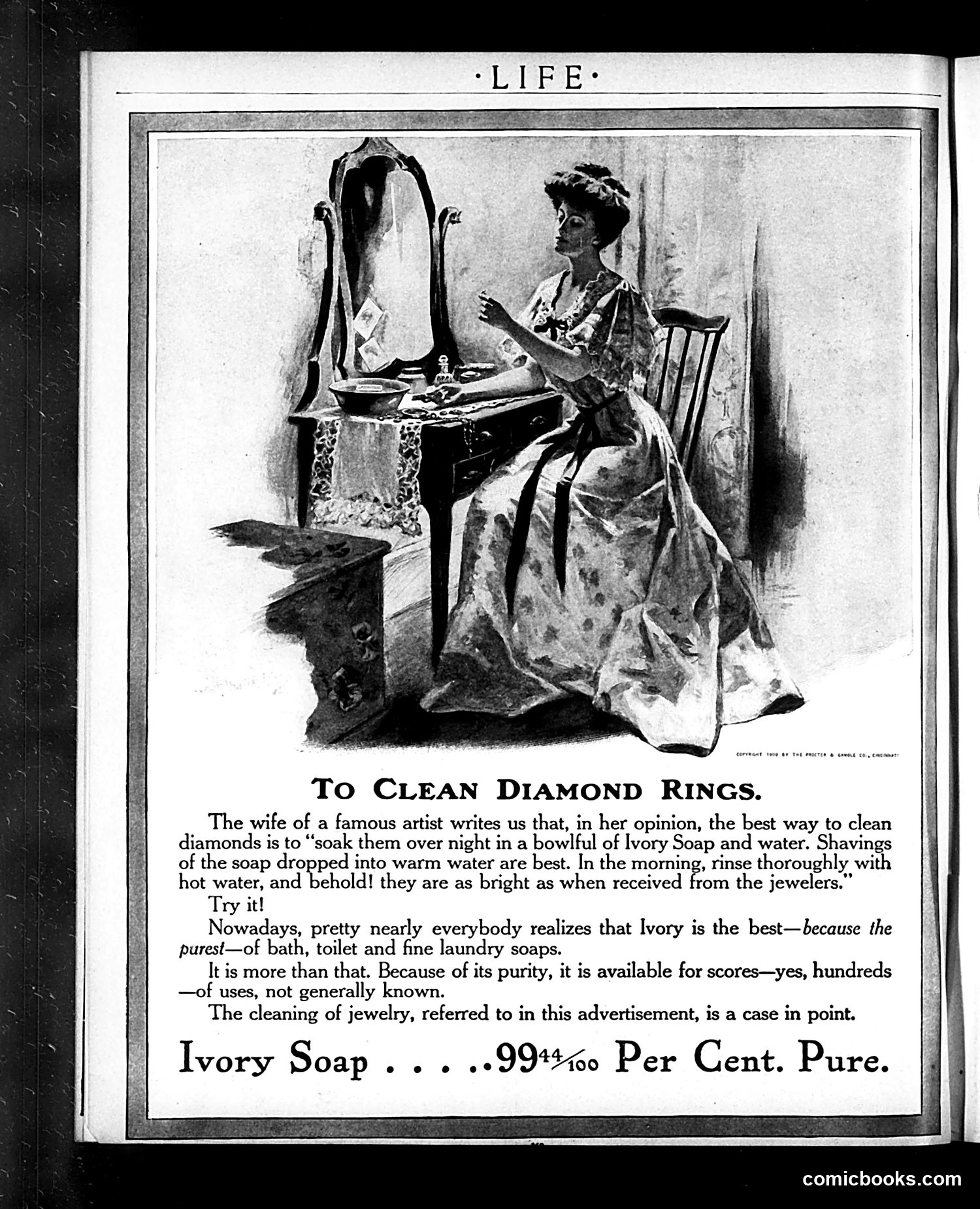
This page is primarily **advertising, not satire**. It features an Ivory Soap advertisement for cleaning diamond rings. The image shows a well-dressed woman seated at a vanity mirror, examining her jewelry. The ad credits "the wife of a famous artist" as the source of cleaning advice: soak diamonds overnight in Ivory Soap and water, then rinse with hot water. The text emphasizes Ivory Soap's purity (99 44/100% pure) and claims it has "hundreds of uses, not generally known." The jewelry-cleaning tip serves as a testimonial to establish the soap's gentleness and effectiveness beyond typical bathing uses. There is **no political commentary or satire present**—this is straightforward early 20th-century product marketing using a domestic scenario and celebrity endorsement to promote consumer goods.
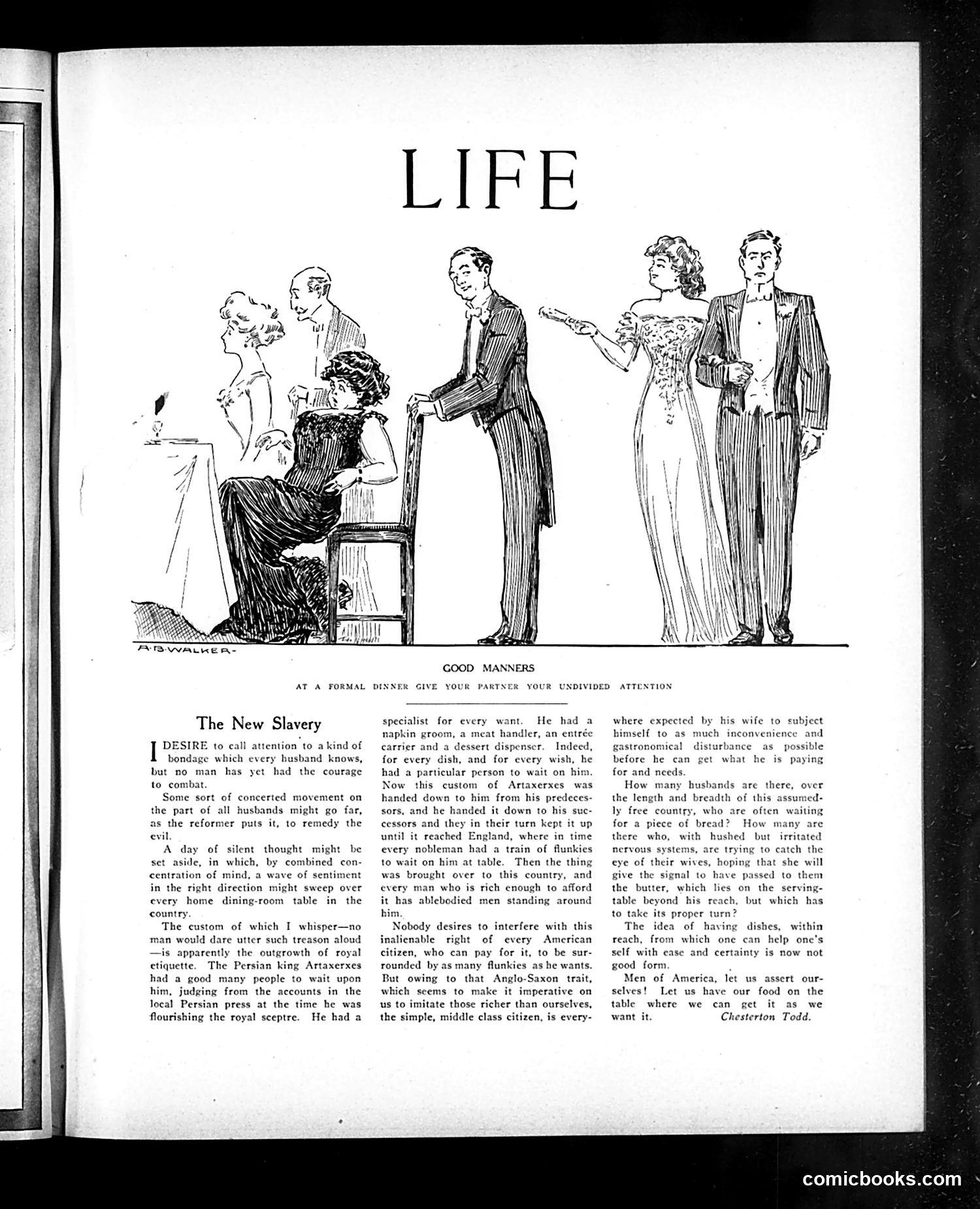
**Cartoon Title:** "Good Manners - At a Formal Dinner Give Your Partner Your Undivided Attention" The illustration shows formal dinner etiquette, depicting well-dressed figures at a social gathering. The accompanying article, "The New Slavery," critiques the elaborate servant system imported from Persian royal courts (Artaxerxes). The satire contrasts American egalitarianism with wealthy Americans mimicking European aristocratic customs—specifically the practice of employing numerous servants for specialized tasks (napkin groom, meat handler, etc.). The author argues this "new slavery" contradicts American values and suggests middle-class citizens should reject such pretentious imitation. The cartoon humorously illustrates proper formal dinner conduct, while the article mocks the unnecessary servant hierarchy that accompanies such occasions.
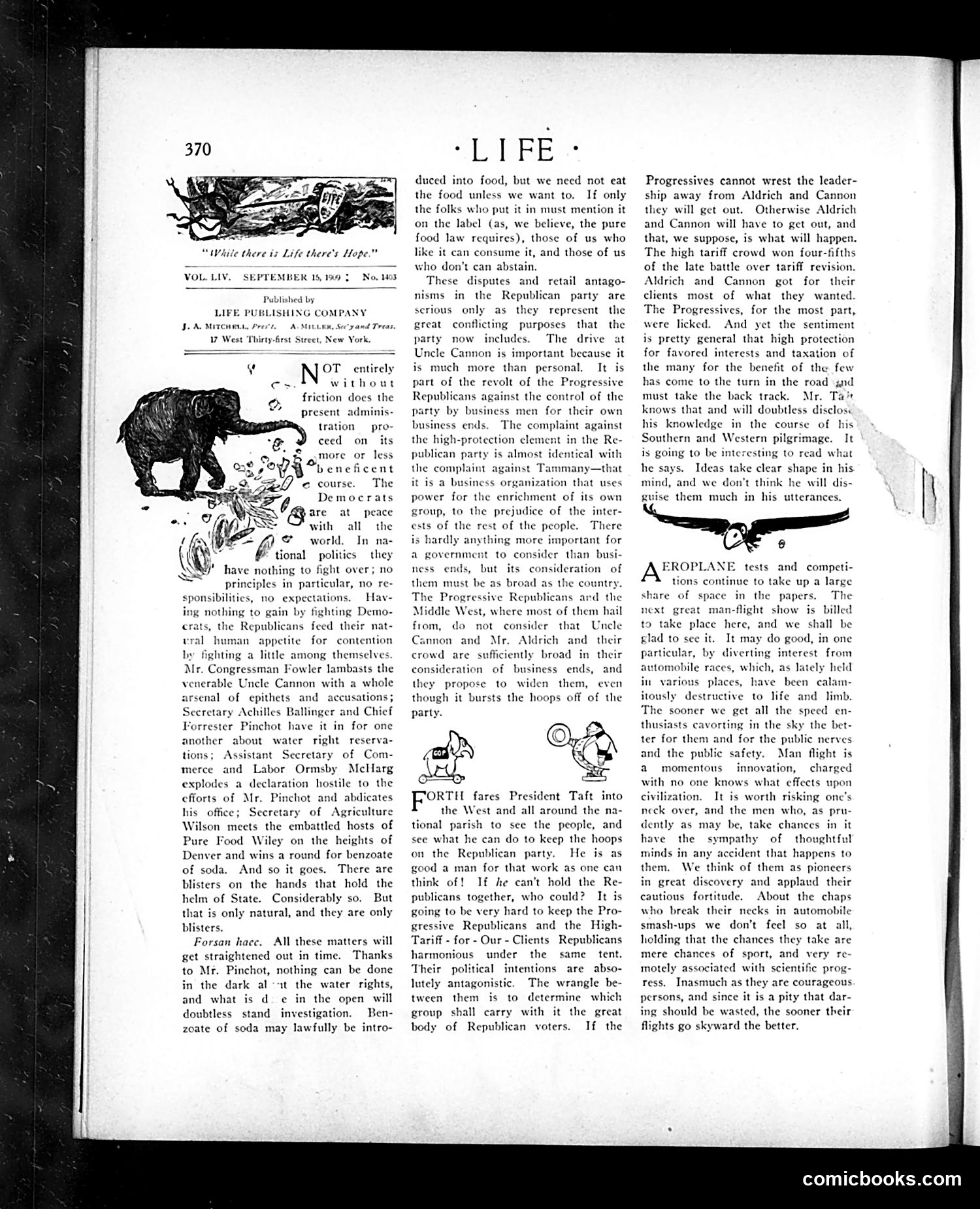
This page critiques internal Republican Party conflict. The text discusses disputes between conservative Republicans (Aldrich and Cannon) and Progressive Republicans over tariff policy and party leadership. The cartoons illustrate this friction—one shows figures in conflict, representing the party's division. The satire targets the Republican establishment's attempt to control the party apparatus for "business ends" rather than the public interest. The author argues Progressives rightly challenge this control, comparing it unfavorably to the party's broader claims of serving all Americans. The piece also mentions President Taft's efforts to maintain party unity while addressing tariff disputes—suggesting ongoing tension between conservative and reform wings of the Republican Party during this period.
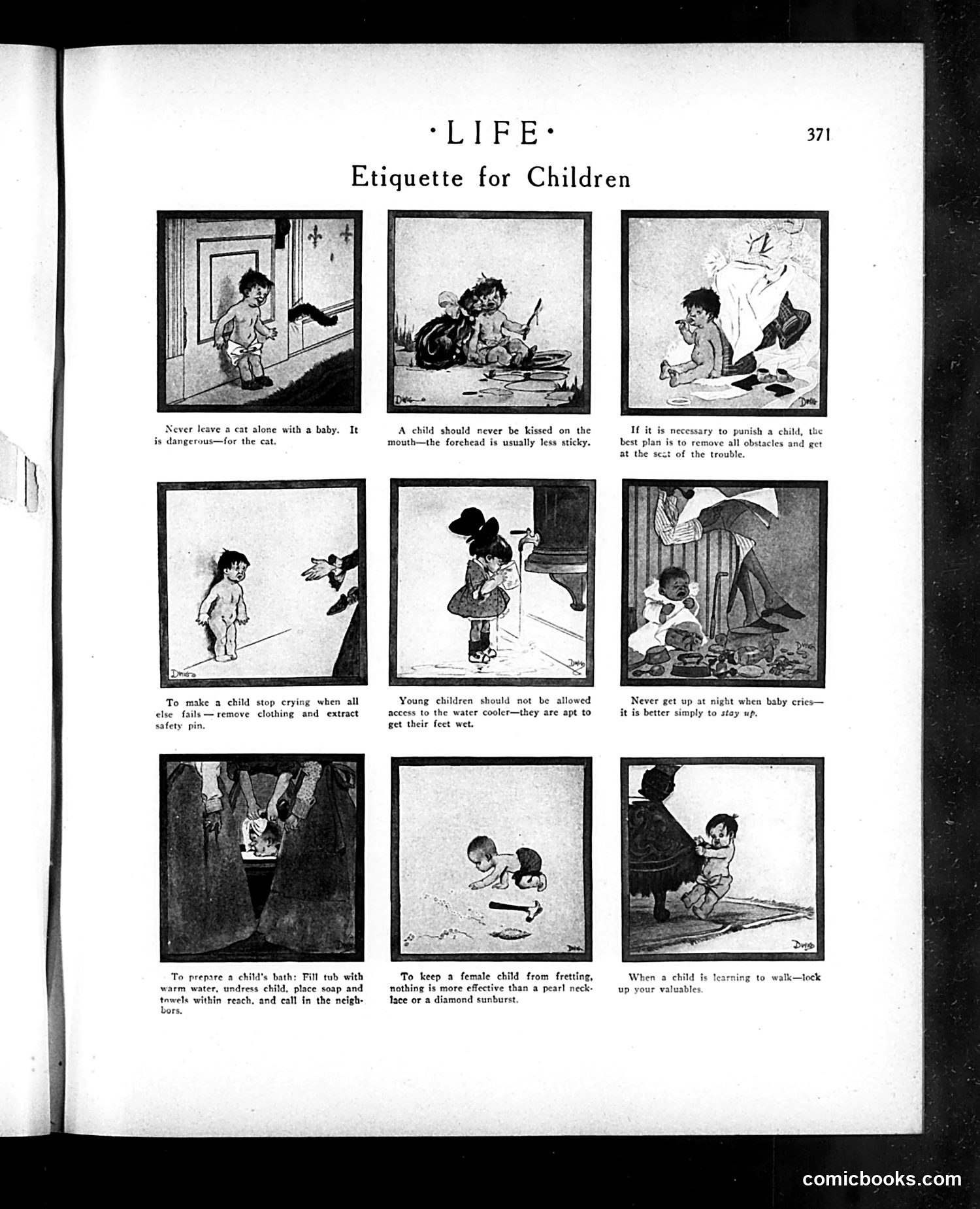
This is a humorous instructional page offering satirical advice on child-rearing practices. Rather than depicting actual political figures or events, it presents nine illustrated vignettes with tongue-in-cheek etiquette tips: The captions cover practical (if sometimes questionable) parenting scenarios: never leaving cats alone with babies, avoiding kissing children on the mouth, punishment techniques, preventing water accidents, bathing procedures, and protecting valuables from curious toddlers. The satire lies in the deadpan delivery of common-sense (and period-specific) parenting wisdom through formal "etiquette" framing—treating child management as a matter of social propriety rather than genuine safety or child development. The cartoons mock both overprotective parenting and the era's somewhat cavalier attitudes toward childhood dangers.
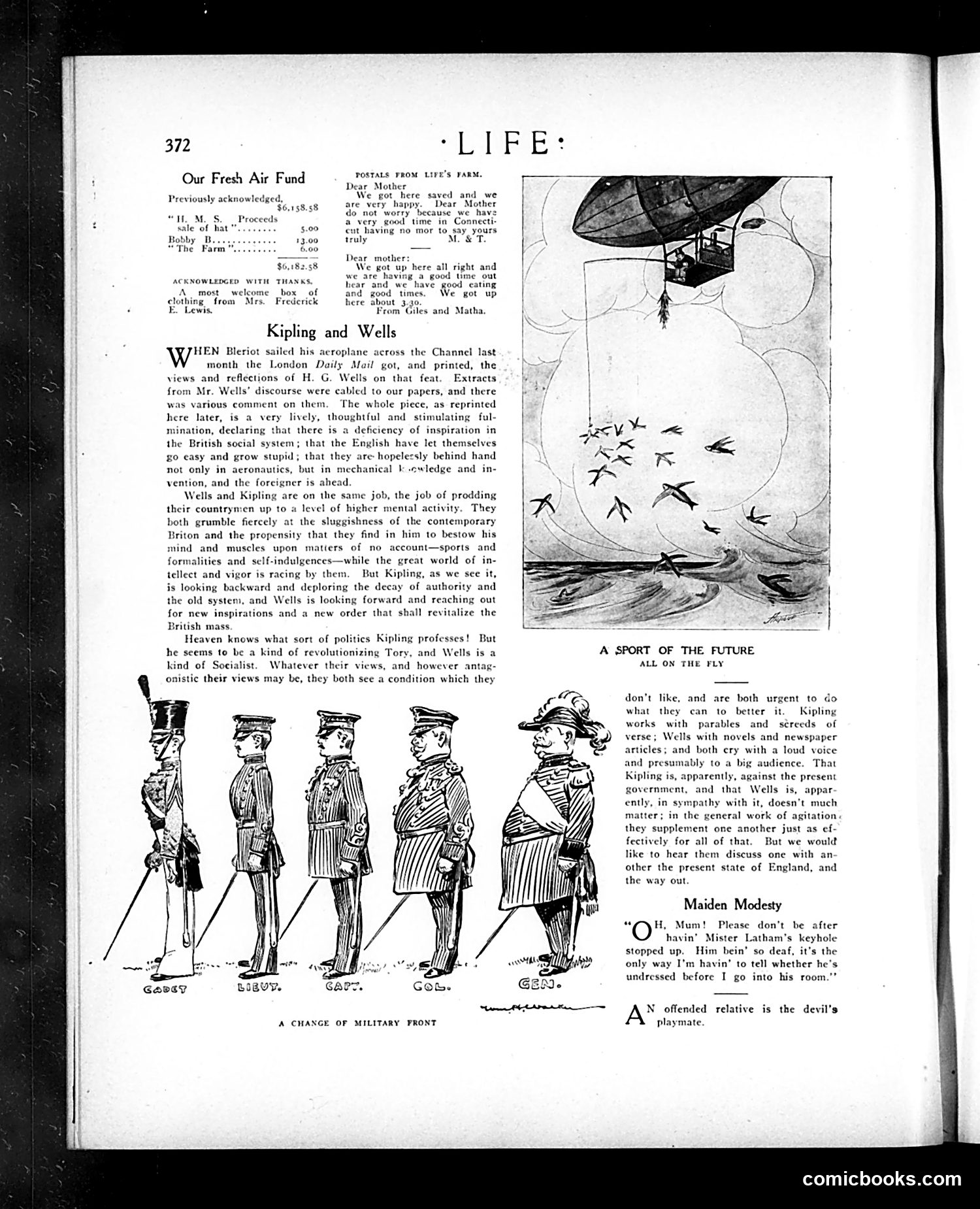
This cartoon satirizes shifting political positions, likely during World War I era. The five uniformed figures appear to represent military or political leaders changing their stance or allegiance—literally turning around to face the opposite direction. The labels beneath are partially illegible in this reproduction, but the visual joke is clear: these officials are "about-facing" (reversing course), suggesting they've abandoned previous commitments or adopted contradictory positions. The accompanying article "Kipling and Wells" discusses how writers Rudyard Kipling and H.G. Wells hold opposing political views—one appearing conservative, the other progressive—yet both influence public opinion. The cartoon likely comments on similar inconsistency or opportunism among political/military figures of the period.
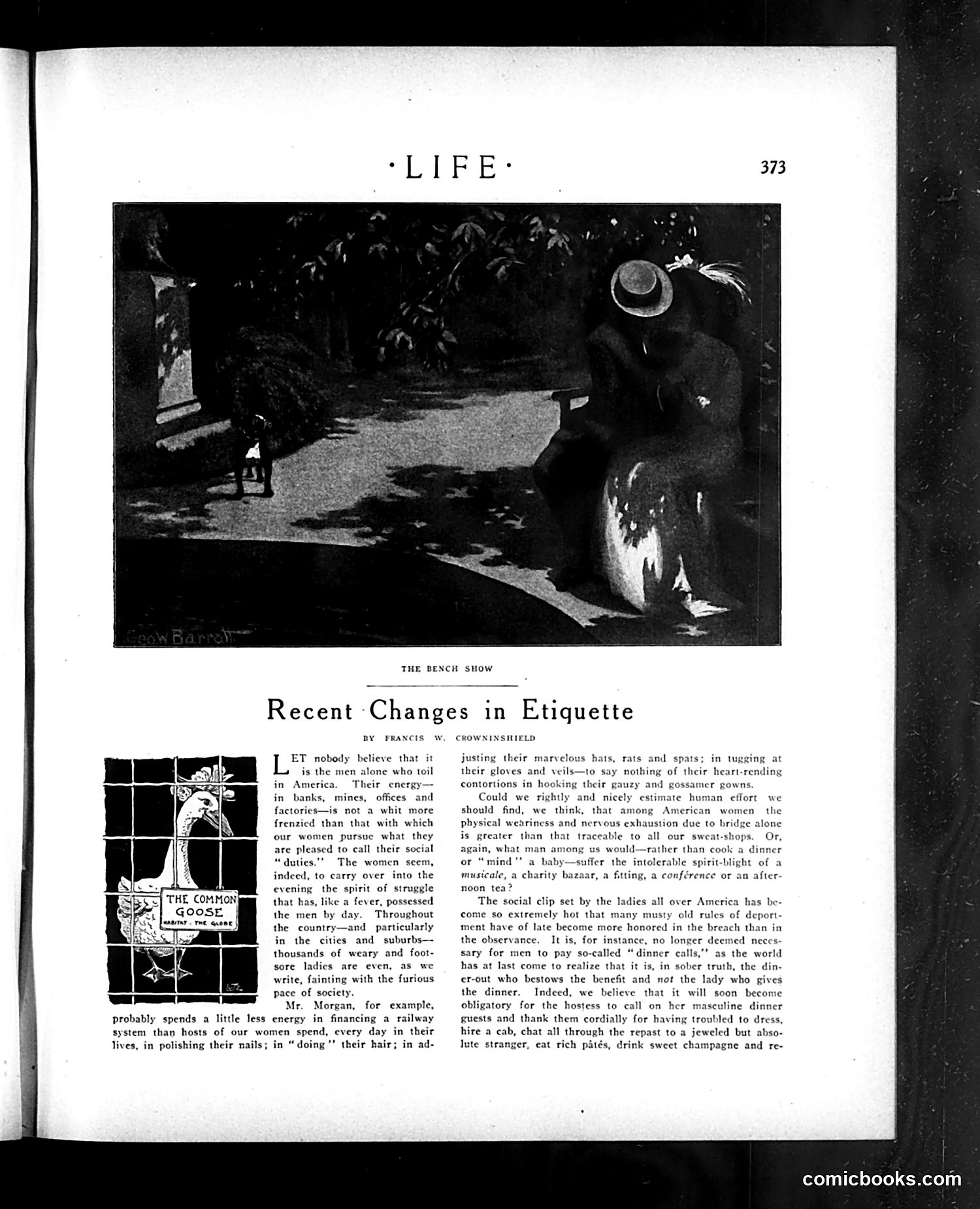
This page from *Life* magazine satirizes modern American social behavior, particularly among the wealthy and leisure classes. The photo titled "The Bench Show" depicts a woman in fashionable dress and hat sitting outdoors, likely making social commentary on public behavior. The accompanying article by Francis W. Crowninshield critiques how American women have adopted more relaxed, energetic lifestyles—engaging in activities like sports and public socializing—rather than maintaining strict Victorian propriety. The text ironically suggests that women now spend less energy on domestic duties and social formalities, instead participating in "dinner calls" and social events. The sidebar illustration labeled "The Common Goose" appears to be a humorous counterpoint to these changing social norms, though its exact meaning is unclear from the visible portion.
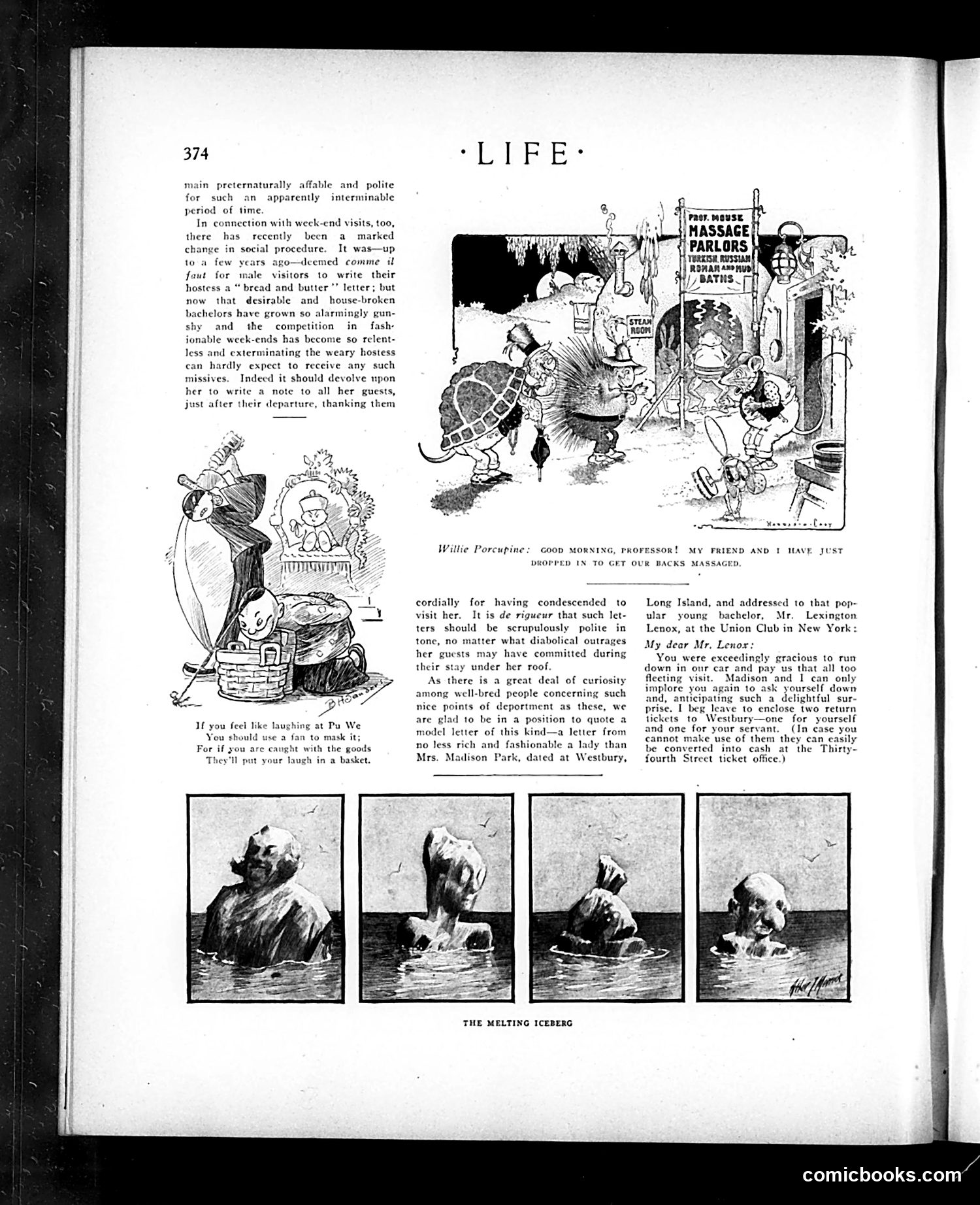
This page satirizes **wealthy women's social etiquette and weekend visiting customs**. The text mocks the elaborate politeness required when hostesses receive guests, noting that bachelor visitors now face exhausting competition and should thank their hosts with written notes. The main cartoon depicts a woman with a baby carriage greeting visitors at a massage parlor, humorously suggesting that wealthy women's leisure activities have become more vigorous and health-focused. The bottom series titled **"The Melting Iceberg"** appears to be an unrelated photographic sequence showing someone in water, possibly documenting an actual iceberg melting or a stunt. The page primarily targets the **affectations and rituals of wealthy socialites**, poking fun at their increasingly demanding social expectations and modern health trends.
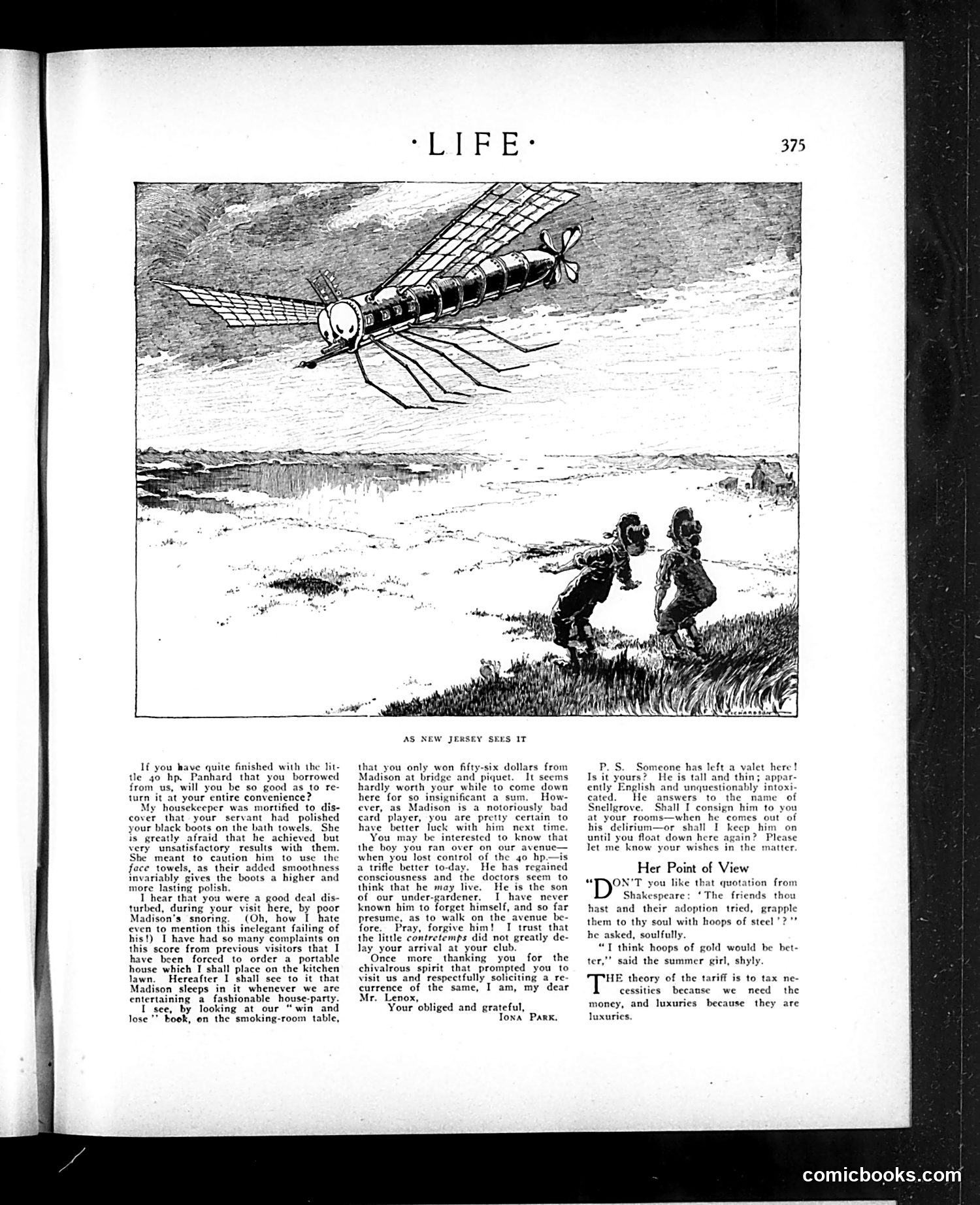
The illustrated cartoon at top depicts a giant mechanical mosquito-like device hovering over a landscape, labeled "AS NEW JERSEY SEES IT." Two figures below react with apparent alarm or concern. This appears to be satirizing New Jersey's perspective on some contemporary threat or problem—likely disease-carrying insects or a public health concern. The mechanical/technological rendering suggests either industrial pollution affecting insects, or possibly anxieties about new technology or weaponry. The text below includes personal letters addressing topics like borrowed money, servants, and social etiquette. One section titled "Her Point of View" references Shakespeare and discusses luxury goods becoming necessities. Without additional context about the specific date and contemporary events, the precise target of satire remains unclear, though it likely comments on New Jersey-specific concerns or attitudes of its era.
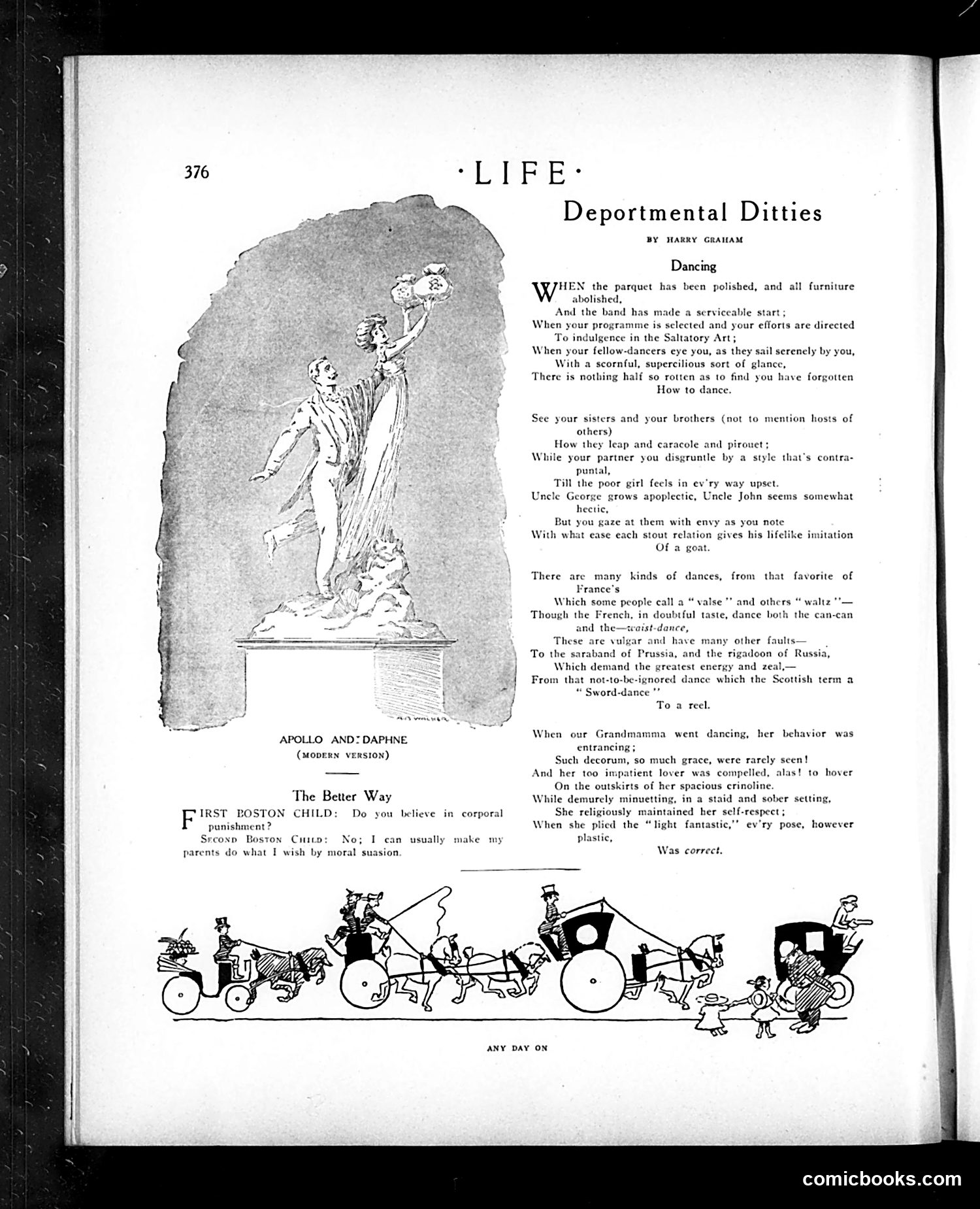
This page from *Life* magazine contains satirical poetry by Harry Graham about proper ballroom dancing etiquette. The classical illustration of "Apollo and Daphne" at top references idealized grace, which contrasts with Graham's satirical verses mocking actual dancers' behavior. The poem ridicules dancers who lack grace—mentioning family members watching with judgment ("your cousins and your brothers"), poorly-matched couples where partners "discredit by a style that's contrapuntal," and relatives who grow "apoplectic" observing the dancing. The satire targets the gap between aspirational refinement and actual clumsy, undignified performance at social dances. The bottom cartoon showing chaotic traffic appears unrelated or illustrative of general social chaos. The piece is social satire mocking middle-class pretensions about proper dancing.
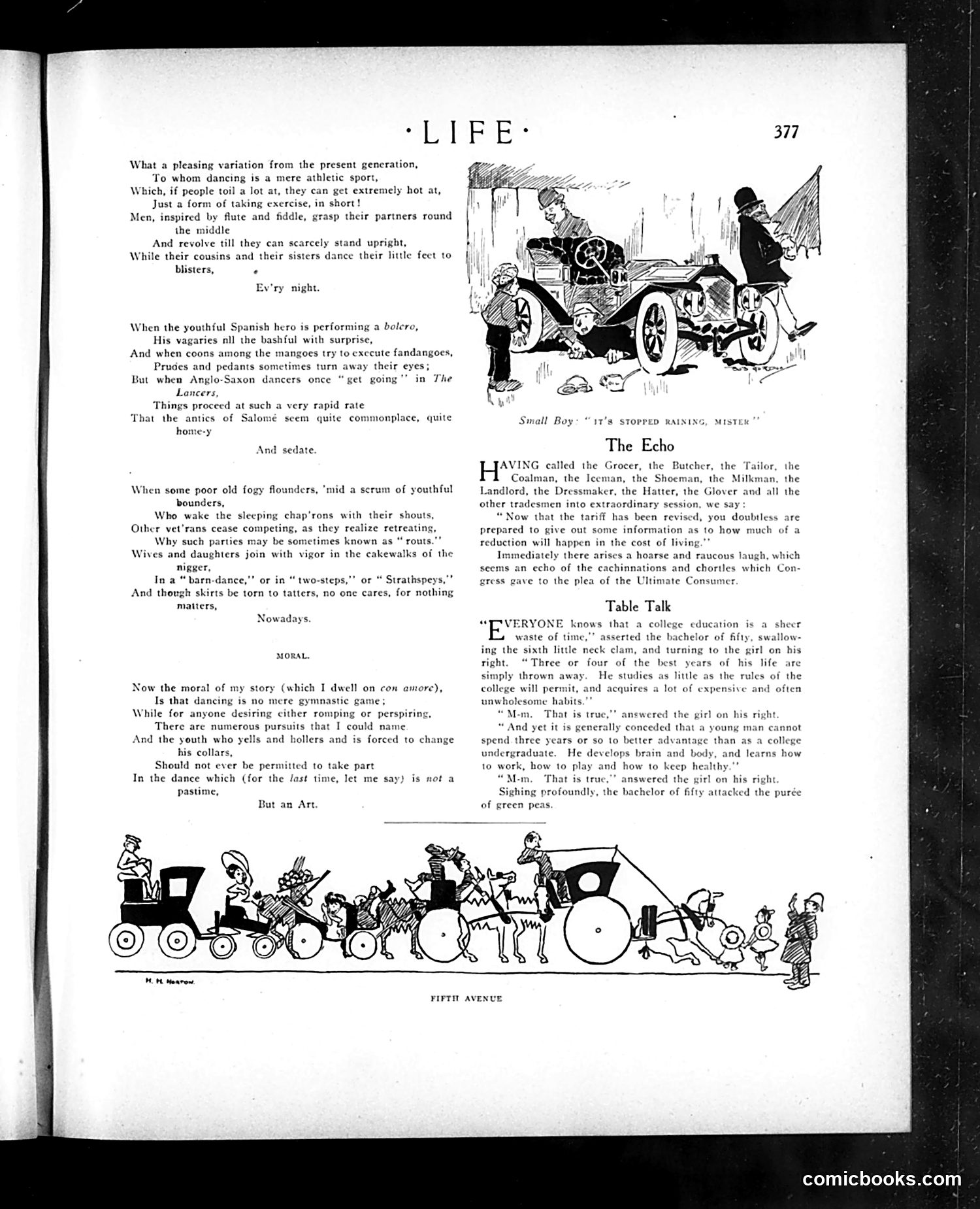
This page contains satirical poetry and illustrations mocking early 20th-century social customs. The main cartoon "Small Boy—'It's stopped raining, Mister'" depicts a car accident or breakdown, with the humor apparently coming from a child's innocent interruption of adult activity during poor weather. The text discusses dancing as "athletic sport" rather than art, mocking how people debate its propriety. References to "Spanish hero" performing a *bolero* and "Anglo-Saxon dancers" suggest cultural commentary on dance forms. The "Table Talk" section discusses college education's limited value for young men, presenting a satirical bachelor's perspective on why three years of study won't improve prospects—a critique of contemporary educational assumptions and gender relations. The bottom illustration, captioned "Fifth Avenue," appears to be a humorous parade or procession.
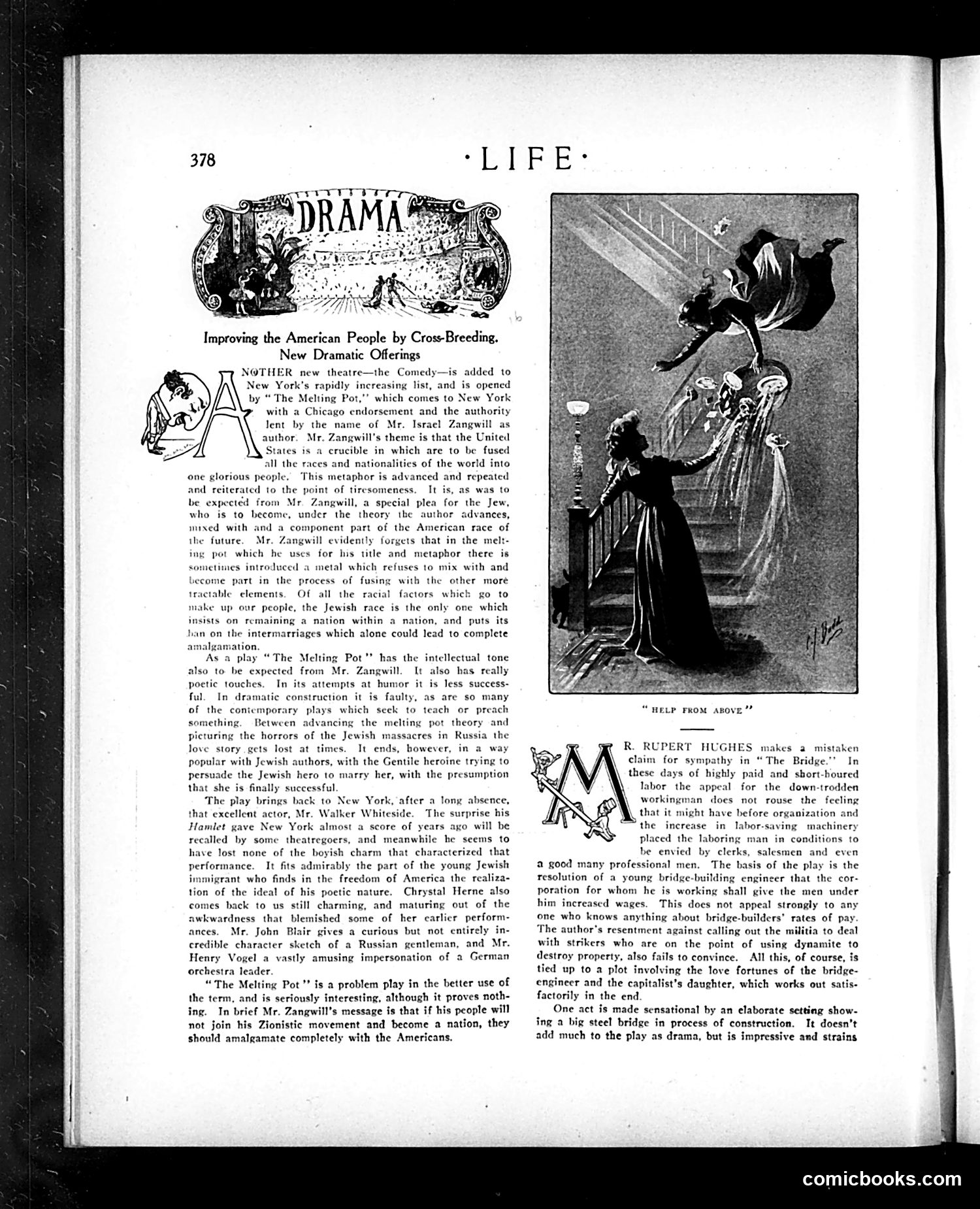
This *Life* magazine page reviews Israel Zangwill's play "The Melting Pot," which promoted the idea that America would fuse all races and nationalities into one unified people. The review's satire is hostile and revealing of period prejudices. While praising the play's theatrical qualities, the critic attacks Zangwill's central premise by claiming the Jewish people uniquely resist assimilation—describing them as "a metal which refuses to mix" in the melting pot. The critic objects that Jews insist on remaining "a nation within a nation," implying they cannot or will not truly become American. The review concludes with backhanded advice: Zangwill's message is that Jews must either join the Zionist movement *or* "amalgamate completely with the Americans"—framing Jewish identity itself as incompatible with American belonging. This reflects early-20th-century anti-Semitic assumptions about Jewish loyalty and assimilation.
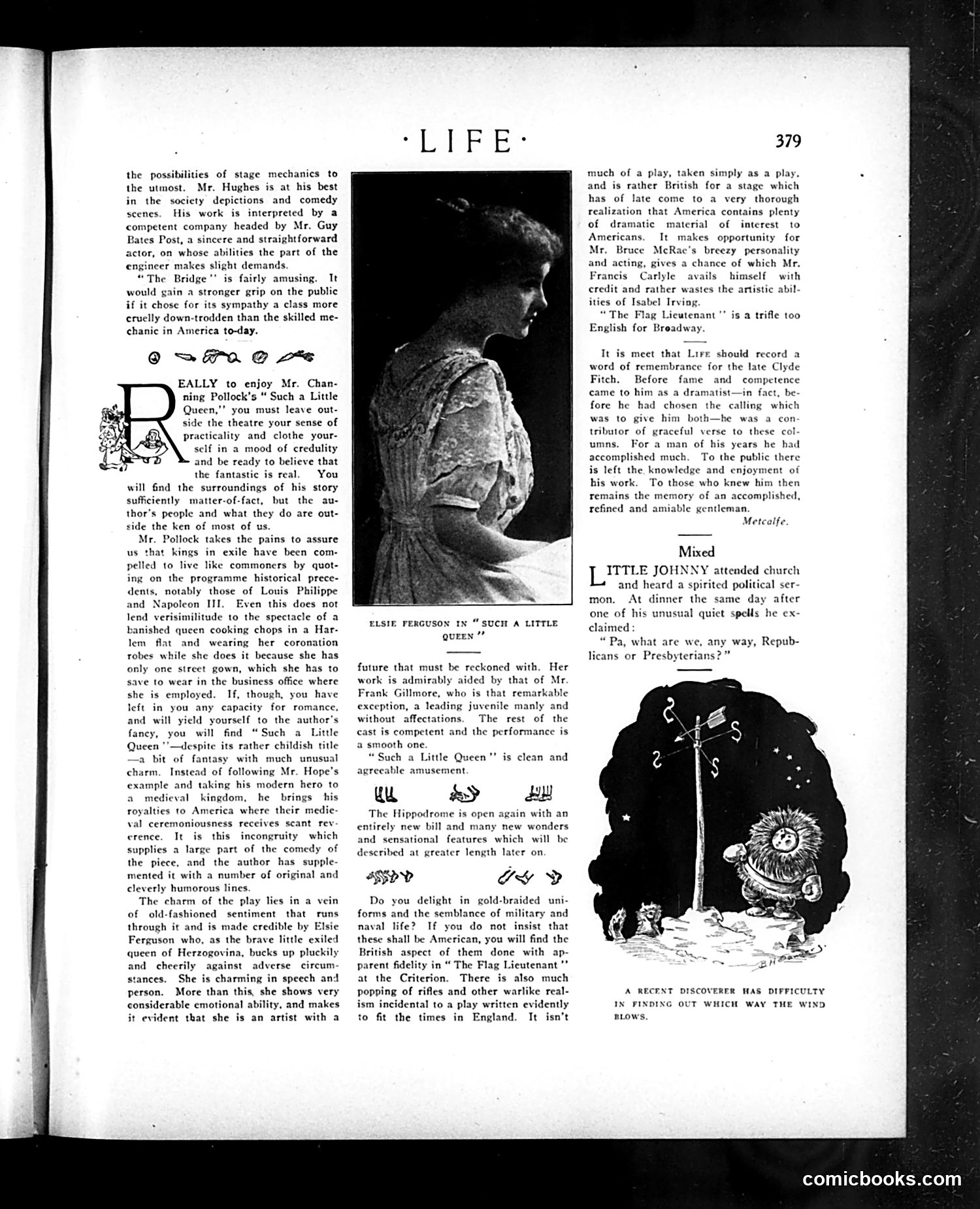
This page reviews Broadway plays, focusing on *"Such a Little Queen,"* starring actress Elsie Ferguson (shown in the photograph). The play's central satire involves a displaced European royal—specifically a queen from "Herzogovina" (likely fictional)—reduced to poverty and forced to work as a servant in a Harlem apartment while retaining her coronation robes for appearances at her office job. The humor derives from incongruity: Old World royalty facing American democratic reality, stripped of reverence and forced into mundane domesticity. The reviewer praises Ferguson's emotional performance and charm, though notes the plot's inherent implausibility requires the audience to suspend practical judgment. The page also briefly reviews other plays, including *"The Flag Lieutenant,"* criticized as overly British in sensibility for American audiences who increasingly demand homegrown dramatic material.
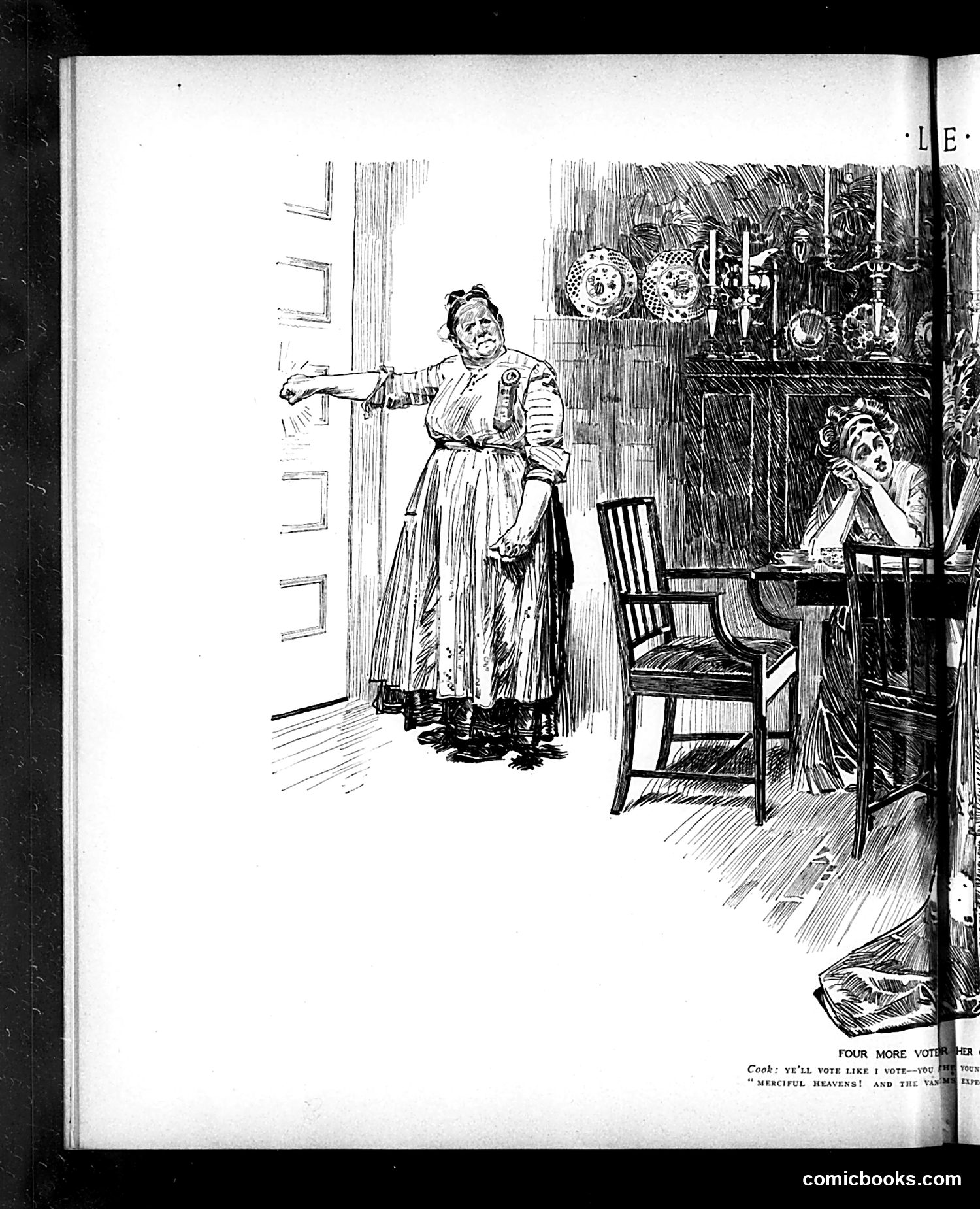
This appears to be a suffrage-era cartoon from Life magazine titled "Four More Votes Per Cook." The image shows a domestic worker (labeled as "Cook") standing at a doorway, gesturing emphatically while speaking to her employer. The partially visible text references voting and mentions "merciful heavens" and "the vandals." The satire targets middle-class anxieties about women's suffrage. The "cook" represents working-class women gaining voting power, which the cartoon presents as a threat to household order and social hierarchy. The employer's shocked reaction satirizes elite concerns that expanding the franchise to domestic workers—who greatly outnumbered other women in the workforce—would destabilize traditional power structures. The humor relies on class prejudice and anti-suffrage sentiment common in early 20th-century America.
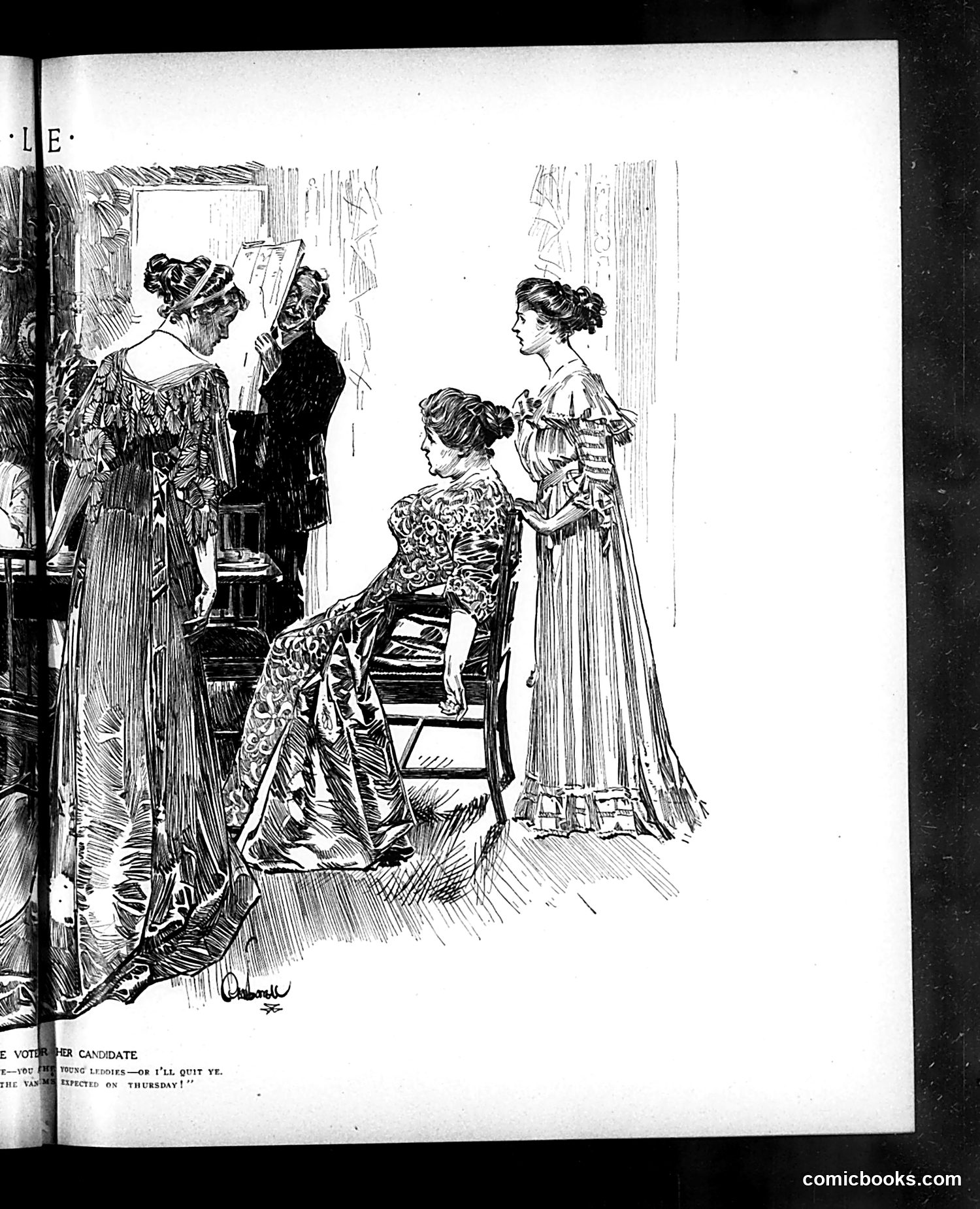
This is a sketch depicting four elegantly dressed women in an early 20th-century interior. Based on the partial OCR text mentioning "voter" and "candidate," this appears to be political satire related to women's suffrage. The cartoon likely comments on women seeking voting rights or political participation. The women's elaborate, ornate clothing and fashionable hairstyles suggest upper-class society women. The composition—with some standing and one seated—implies a social gathering or political discussion. The satire probably mocks either: (1) society women's newfound political ambitions, or (2) the perceived disconnect between refined domesticity and political engagement. Without the complete caption, the specific point remains unclear, but the drawing style and subject matter align with Life magazine's frequent commentary on the women's suffrage movement.
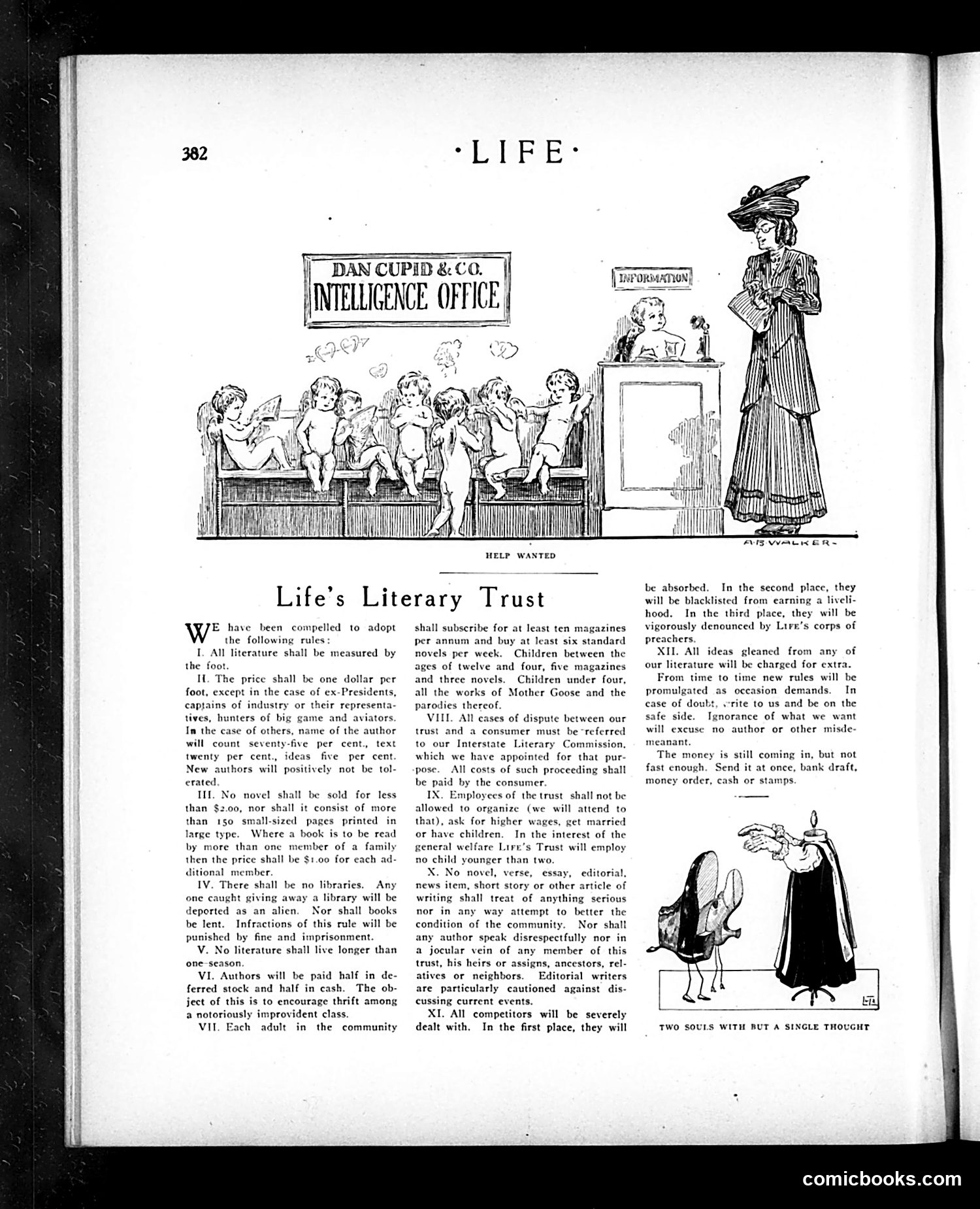
This is a satirical attack on monopolistic corporate control of publishing and media. The "Dan Cupid & Co. Intelligence Office" illustration depicts cherubs (representing literature/creativity) being managed by a businesswoman, symbolizing the industrialization and commercialization of art. The "Literary Trust" rules parody actual monopolistic practices of the era—likely referencing real trusts that dominated American industries. The satire targets: - **Commodification of literature**: measuring books by the foot, pricing by author prestige - **Labor exploitation**: underpaying authors with deferred stock, preventing unionization - **Consumer manipulation**: mandatory subscriptions and purchases - **Content control**: prohibiting serious writing or criticism of the trust - **Anti-competition tactics**: absorbing or blacklisting rivals The cartoon criticizes how corporate consolidation stifles artistic freedom and treats literature as a profit commodity rather than cultural expression. This reflects Progressive Era anxieties about trusts controlling American commerce and culture.
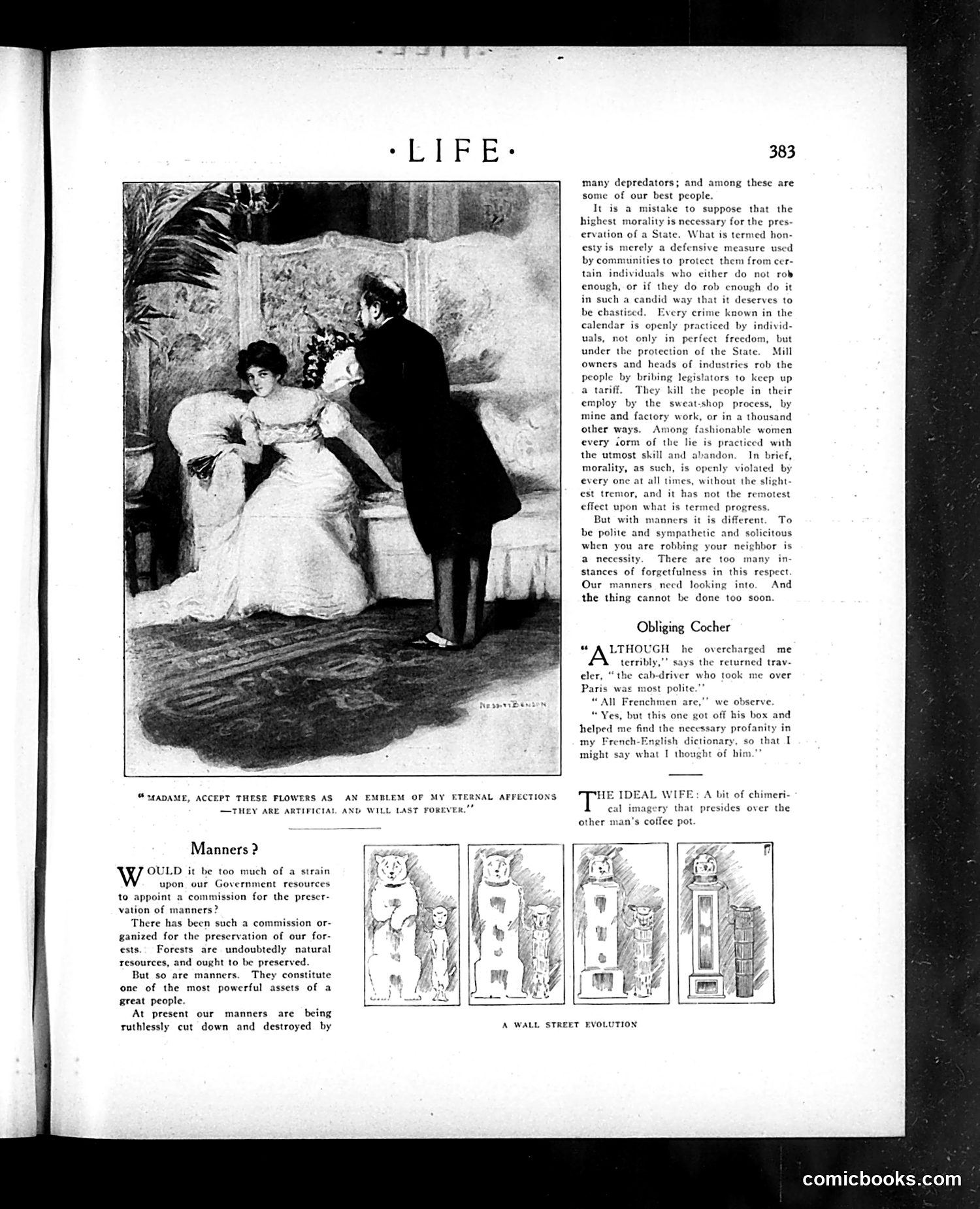
This page satirizes American social hypocrisy through multiple pieces: **"Manners?" (main essay)**: The author argues that the U.S. government should establish a commission to preserve "manners" just as it preserves forests. The satire is biting: he notes that morality is routinely violated by the wealthy and powerful (factory owners bribing legislators, exploiting workers), yet society tolerates this. However, *politeness while committing these crimes* is essential for social stability. The joke exposes how Americans prioritize superficial civility over actual ethical behavior—manners matter more than morality. **"Obliging Cocher"**: A brief anecdote mocking French politeness. A cab driver overcharges a tourist but remains courteous, even helpfully assisting the passenger in finding insulting words in a French-English dictionary to express his anger. It reinforces the theme: politeness persists regardless of actual wrongdoing. **"Wall Street Evolution"** (comic strip): Appears to show the evolution of buildings/structures, likely satirizing capitalist development. All content reinforces Life's critique of societal values prioritizing appearance over substance.
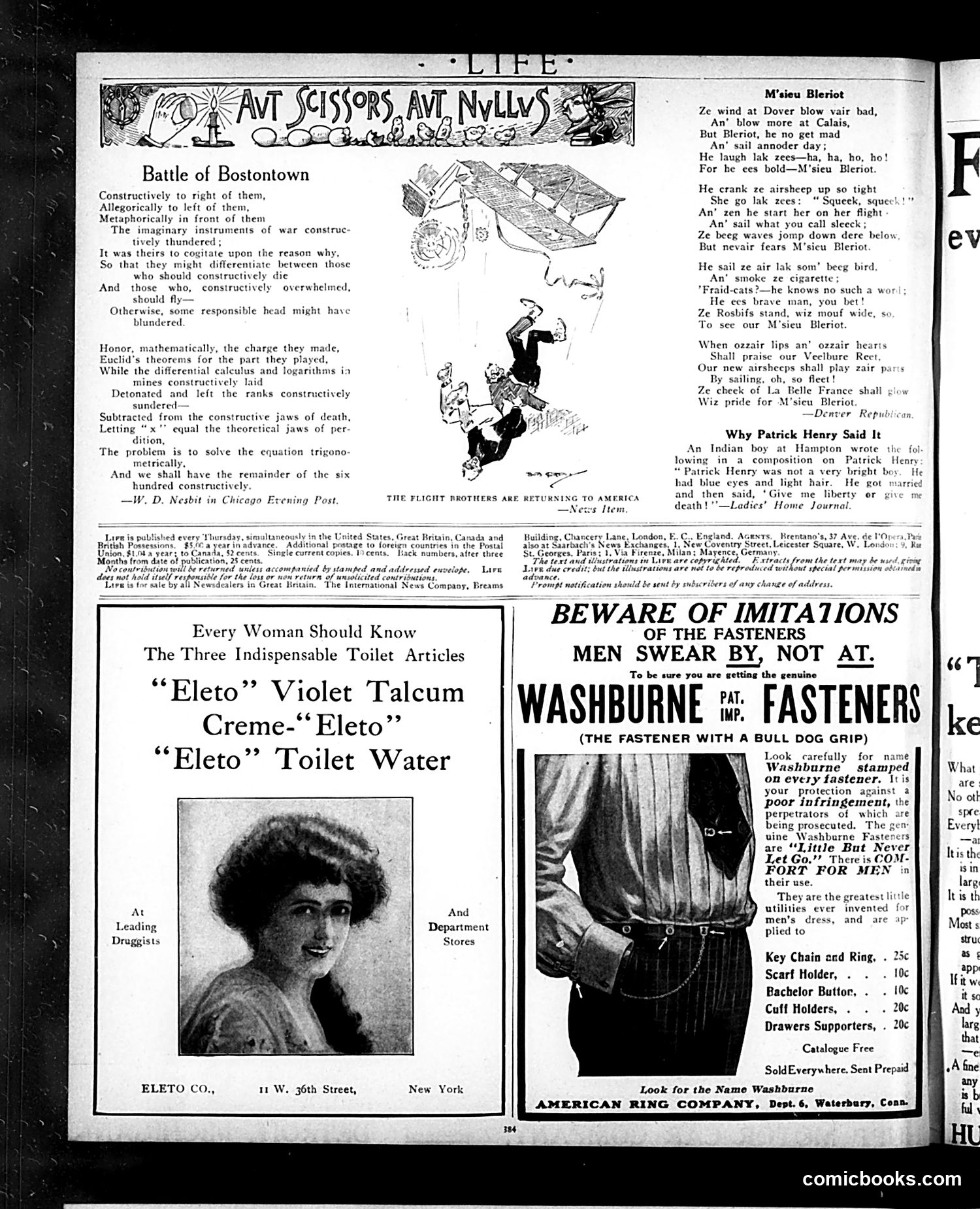
This page contains two main satirical pieces: ## "Battle of Bostontown" A poem mocking overwrought military language and academic jargon. The text parodies how battles are described using obtuse mathematical and philosophical terminology—"constructively thundered," solving equations "trigonometrically"—rather than plain language. It's satire of pompous war reporting and intellectualized descriptions of violence. The accompanying cartoon shows chaotic figures in combat, emphasizing the absurdity gap between flowery language and messy reality. ## "M'sieu Bleriot" A poem celebrating aviator Louis Blériot (who famously crossed the English Channel by airplane in 1909). Written in exaggerated French-accented English, it humorously portrays Bleriot as fearless and confident despite bad weather. The poem mocks both French theatrical pride and British anxiety ("Rosbifs") about this aviation achievement. The page also contains period advertisements for toiletries and fasteners—standard magazine filler of the era, not satirical content.
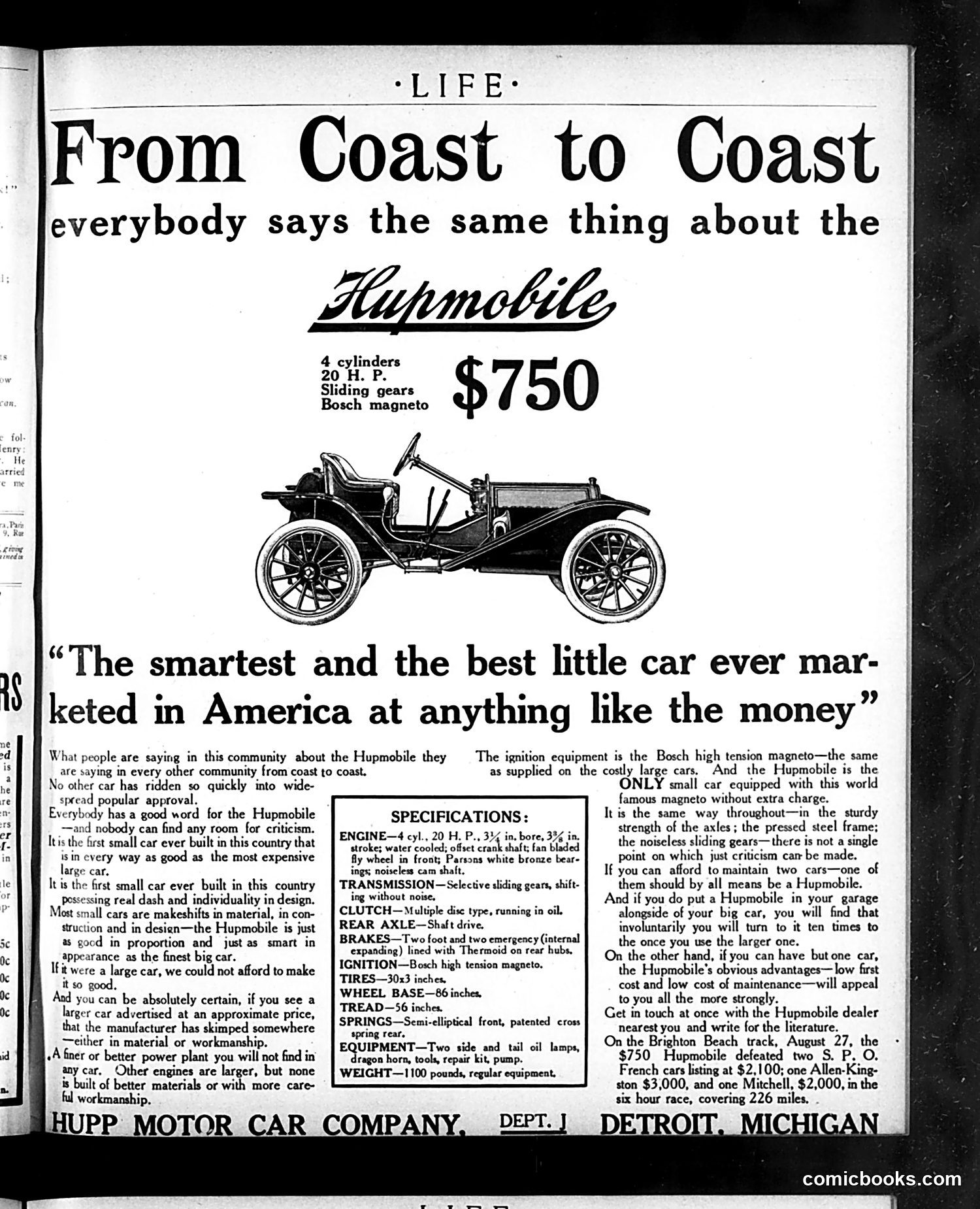
This is **not a cartoon or satire**—it's a straightforward automobile advertisement for the Hupmobile, priced at $750. The page uses the tagline "From Coast to Coast everybody says the same thing" to claim widespread approval for this affordable car. The ad emphasizes that despite its low price, the Hupmobile matches expensive vehicles in quality components (Bosch magneto ignition, pressed steel frame, etc.). The "Life" masthead indicates this appeared in *Life* magazine, which was primarily a humor and satire publication at this era, but this particular page is commercial advertising rather than editorial content. The ad includes technical specifications and competitive racing credentials (mentioning a victory over more expensive French and American cars at Brighton Beach) to establish legitimacy. For modern readers: this represents early 1900s automobile marketing, targeting middle-class buyers with appeals to value and quality assurance—a novel concept when cars were still luxury items for most Americans.
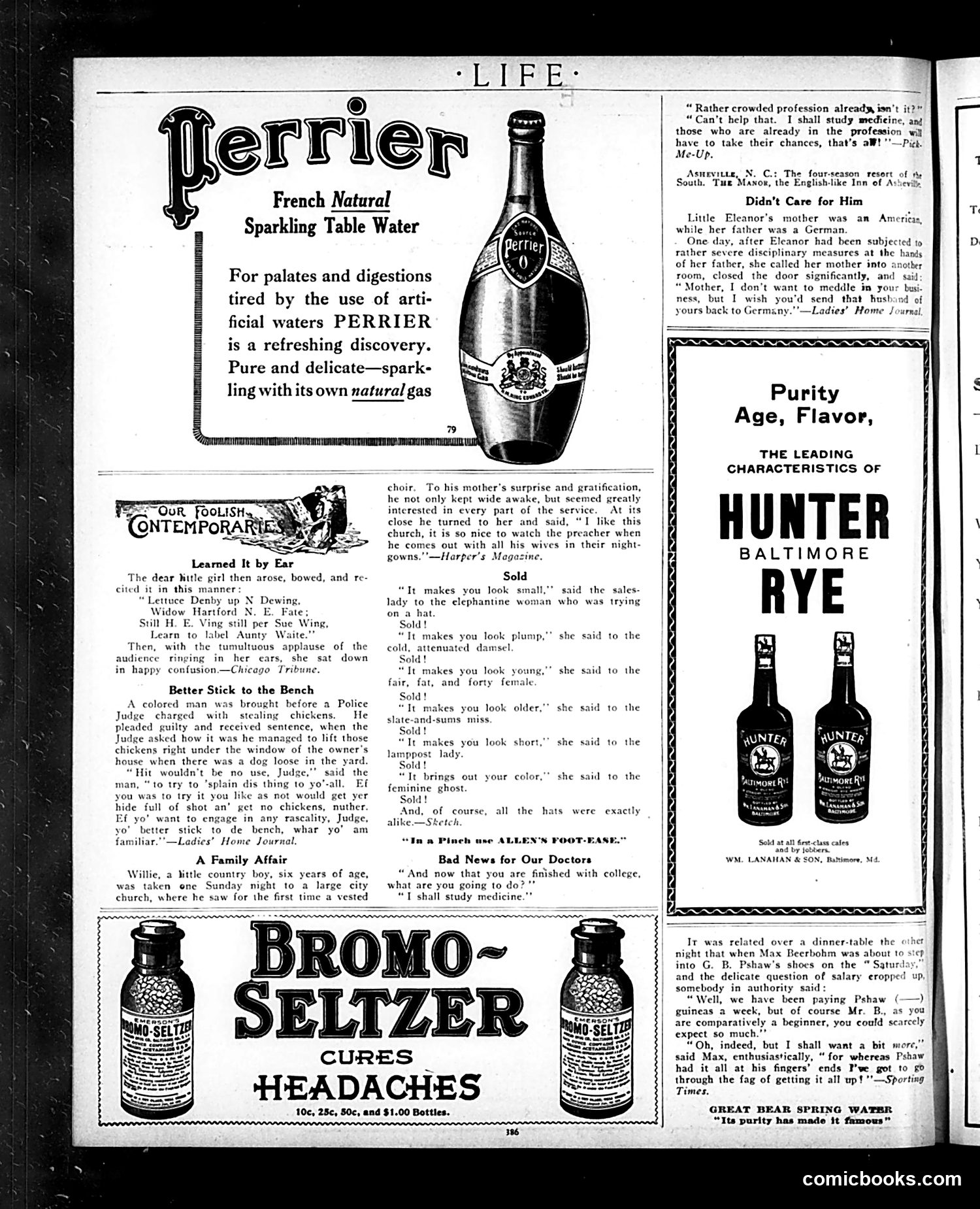
This page is primarily **advertisements interspersed with humorous anecdotes**, typical of early 20th-century Life magazine format. The cartoons/jokes mock social pretenses and professional crowding: 1. **"Learned It by Ear"**: A child mishears hymn lyrics as nonsense ("Lettuce Denby up N Dewin"), satirizing rote religious instruction. 2. **"Better Stick to the Bench"**: A Black defendant advises a judge that theft requires criminal skill the judge lacks—subtle commentary on judicial hypocrisy. 3. **"A Family Affair"**: A child mistakes robed choir members for the preacher's polygamist wives, mocking religious formality. 4. **"Sold"**: A saleswoman sells identical hats to different women by flattering each with contradictory claims—satirizing consumerism and dishonest marketing. 5. **"Bad News for Our Doctors"**: A college graduate entering medicine dismisses overcrowding, suggesting professional saturation. The advertisements (Perrier, Hunter Rye, Bromo-Seltzer) occupy equal space, reflecting the magazine's revenue model.
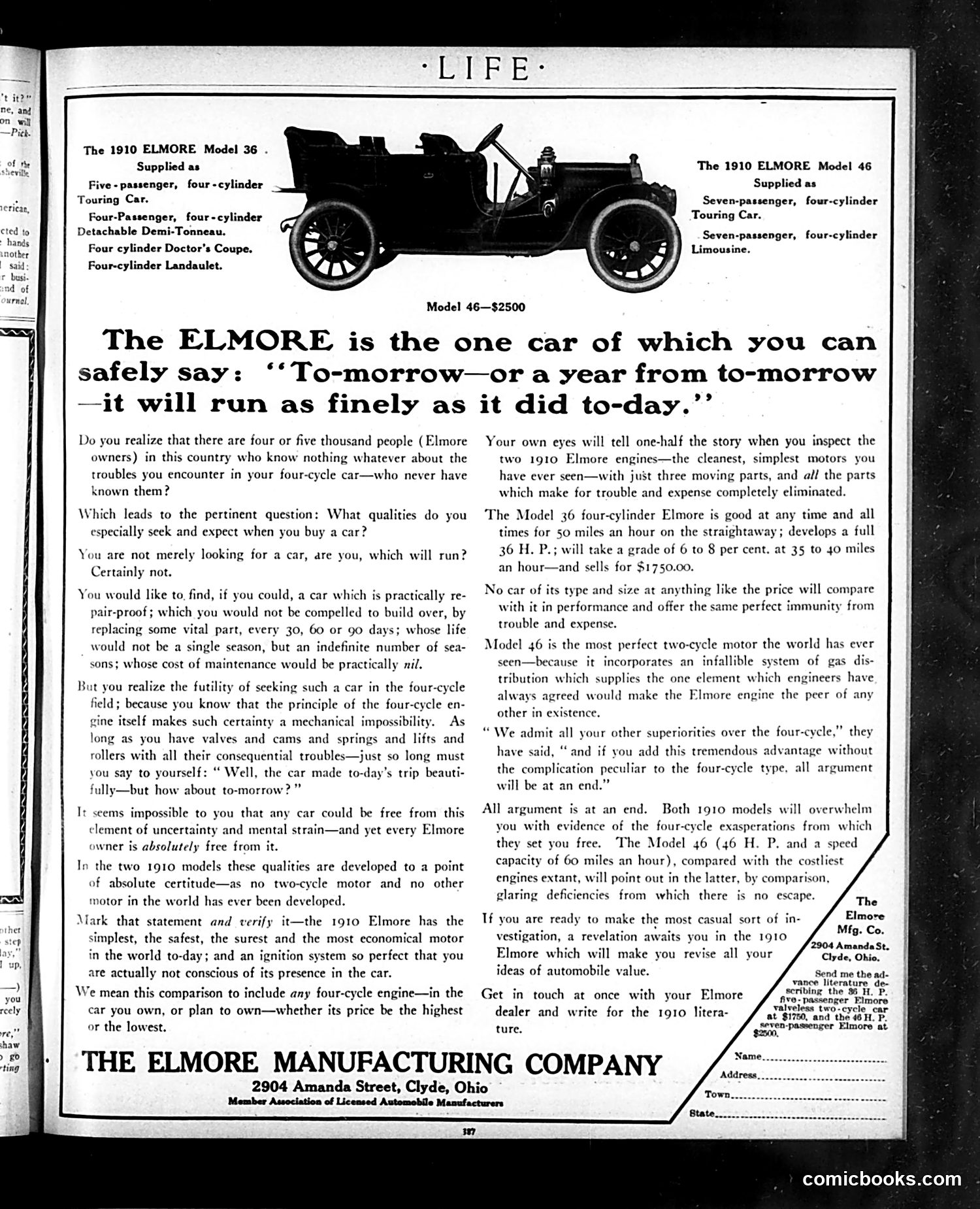
This is a **full-page automobile advertisement**, not satire or political commentary. It promotes the 1910 Elmore automobile manufactured in Clyde, Ohio. The ad makes claims typical of early auto marketing: that the Elmore's two-cycle engine is simpler, more reliable, and cheaper to maintain than competing four-cycle engines. Key selling points include only three moving parts, 50 mph capability, and prices of $1,750-$2,500. The rhetorical strategy compares the Elmore favorably to four-cycle cars by emphasizing their mechanical complexity and frequent repairs. The ad acknowledges that buyers want reliability and low maintenance—concerns that suggest automobiles were still novel, temperamental machines requiring constant upkeep. For modern readers: this reflects an era when car engines were radically experimental, with competing technologies competing for dominance. The ad's emphasis on simplicity as a virtue shows how unreliable early automobiles were.
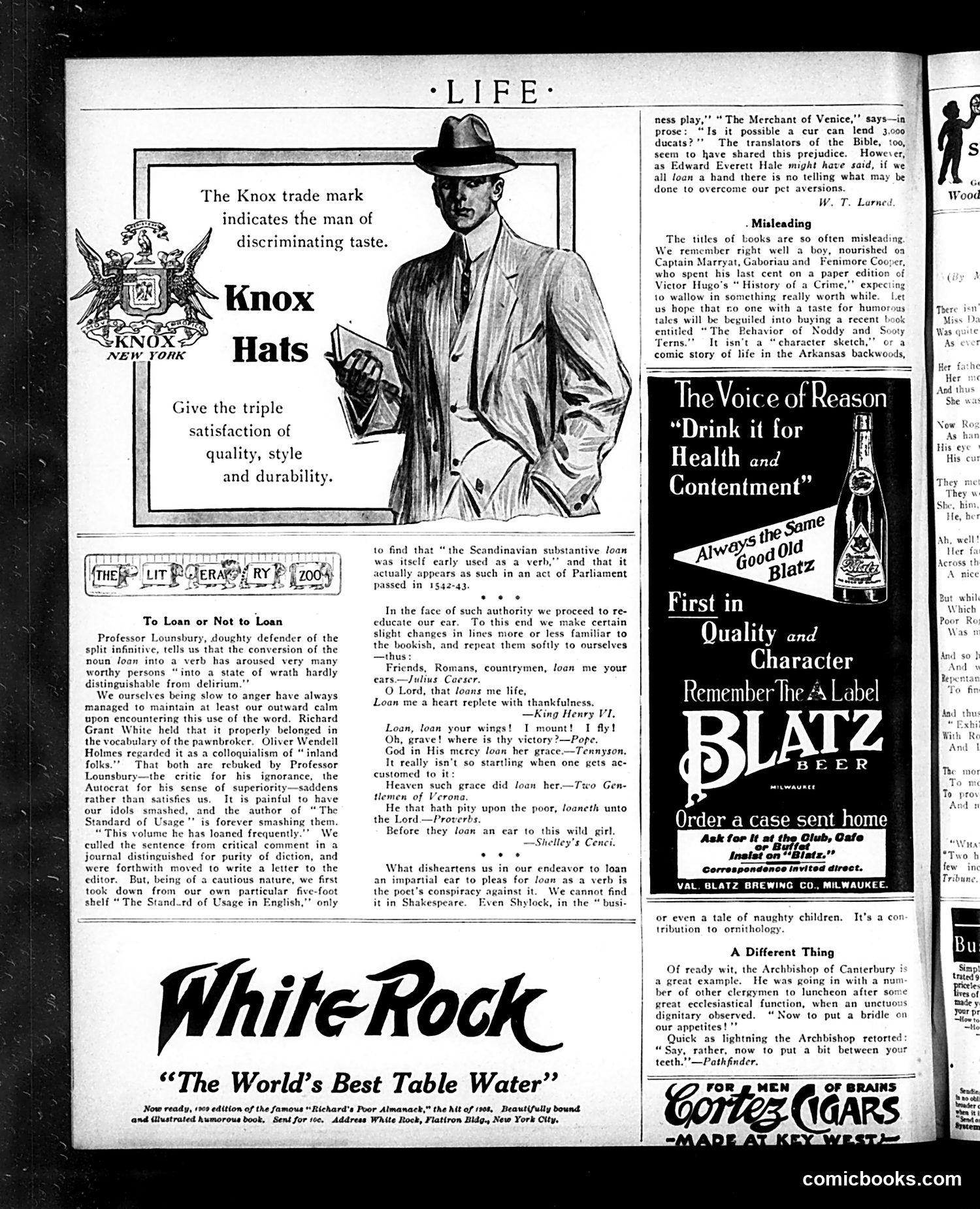
This page consists primarily of **advertisements and a linguistic humor column**—not political cartoons. The main content is "To Loan or Not to Loan," a *cultural satire* about grammar debates. Professor Lounsbury defended the verb "to loan" (converting the noun into a verb), which outraged language purists including prominent figures like Richard Grant White and Oliver Wendell Holmes. Life humorsly endorses the change by re-writing famous literary passages ("Friends, Romans, countrymen, **loan** me your cars..."). The **satire's point**: Language guardians are needlessly rigid. Shakespeare and the Bible avoided "loan" as a verb, yet Professor Lounsbury proved it's historically legitimate. Life mocks pretentious language-policing by suggesting everyone "loan a hand" embracing the controversial usage. The page also includes sidebars on misleading book titles and advertisements for Knox Hats, Blatz Beer, and White Rock water—representative of the magazine's mixed editorial-advertising format.
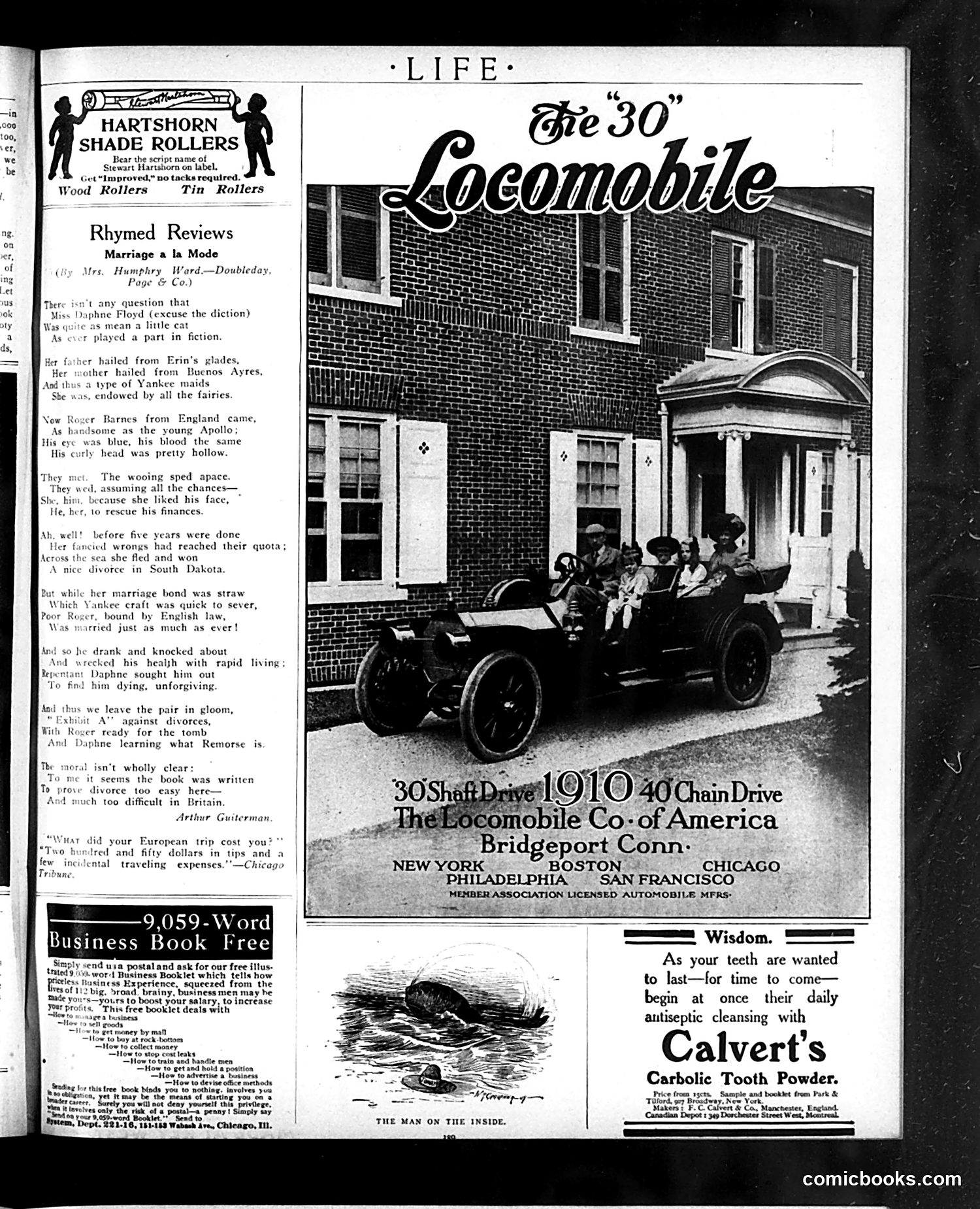
This page contains a satirical poem reviewing Mrs. Humphry Ward's novel, which critiques easy American divorce laws. The plot follows a mismatched marriage: Roger Barnes, a handsome but financially troubled Englishman, marries Daphne Floyd for her money. After five years of unhappiness, Daphne divorces him in South Dakota (known for lenient divorce laws) and leaves America. Roger descends into alcoholism and dies unforgiving. The satire's point, explained by critic Arthur Guiterman: the novel argues that American divorce is *too easy* compared to Britain's stricter laws. The moral critique suggests that easy divorce enables selfish behavior—Daphne escapes her marital obligations, while Roger suffers. This reflects early 20th-century debates about divorce reform, with conservatives warning that accessible divorce undermined marriage's stability and moral seriousness. The page is otherwise filled with advertisements for shade rollers, automobiles, and tooth powder.
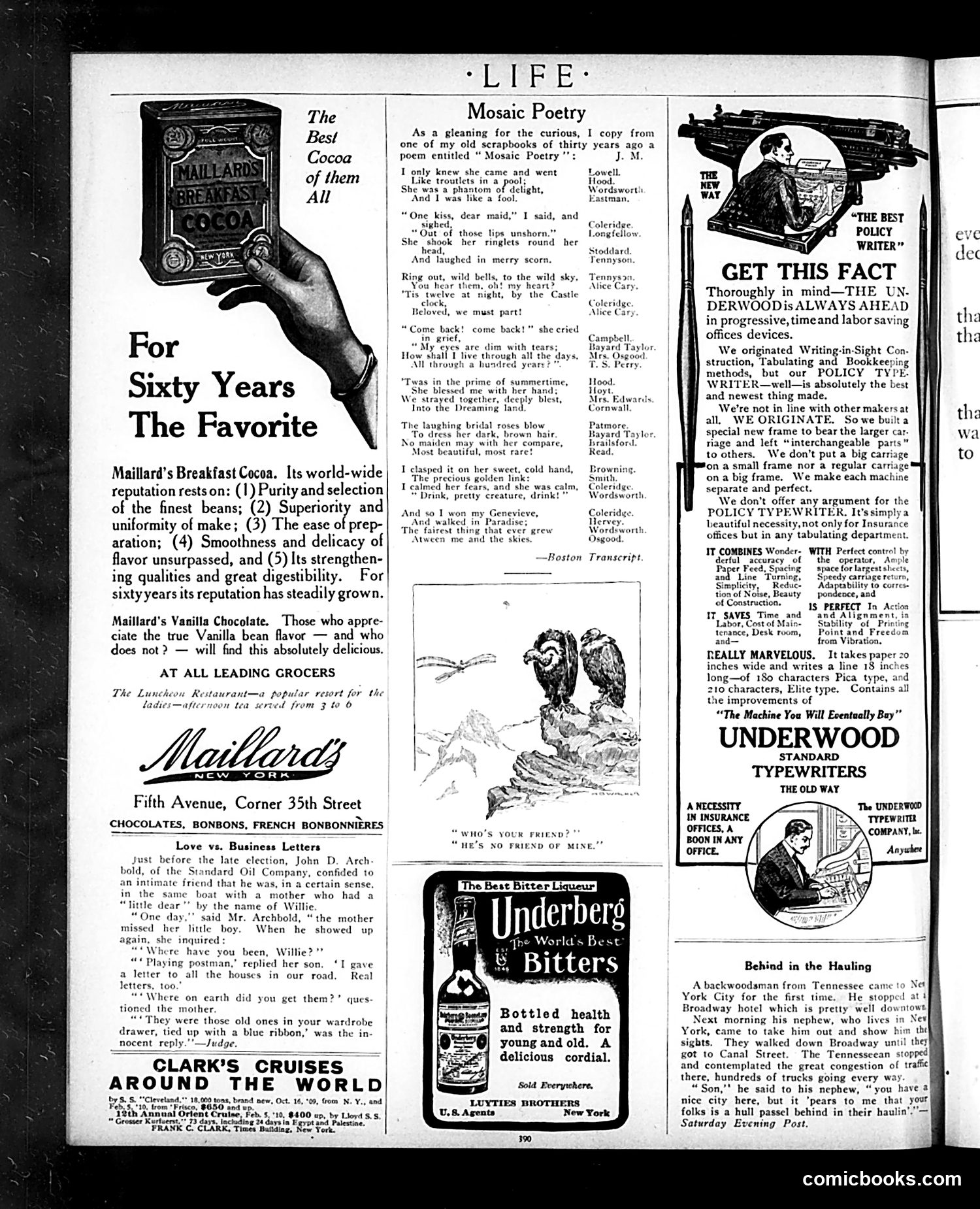
This page is primarily **advertising**, with two notable features: **Main Advertisements:** - Maillard's Breakfast Cocoa and Chocolate (luxury goods) - Clark's Cruises Around the World - Underwood Typewriters - Underbergé Bitters **Humorous Content:** 1. **"Love vs. Business Letters"** — A brief anecdote about John D. Archbold (Standard Oil magnate) involves a child playing postman with old love letters from his mother's wardrobe. The joke satirizes Archbold's business reputation by juxtaposing his corporate ruthlessness with domestic sentimentality. 2. **"Mosaic Poetry"** — A clever literary parody composed entirely of lines from famous poets (Lowell, Longfellow, Tennyson, etc.), reassembled to create a coherent romantic narrative. This celebrates literary culture while gently mocking how familiar poetic phrases can be recombined. The page reflects early-20th-century *Life* magazine's mix of sophisticated advertising targeting wealthy readers and light literary humor.
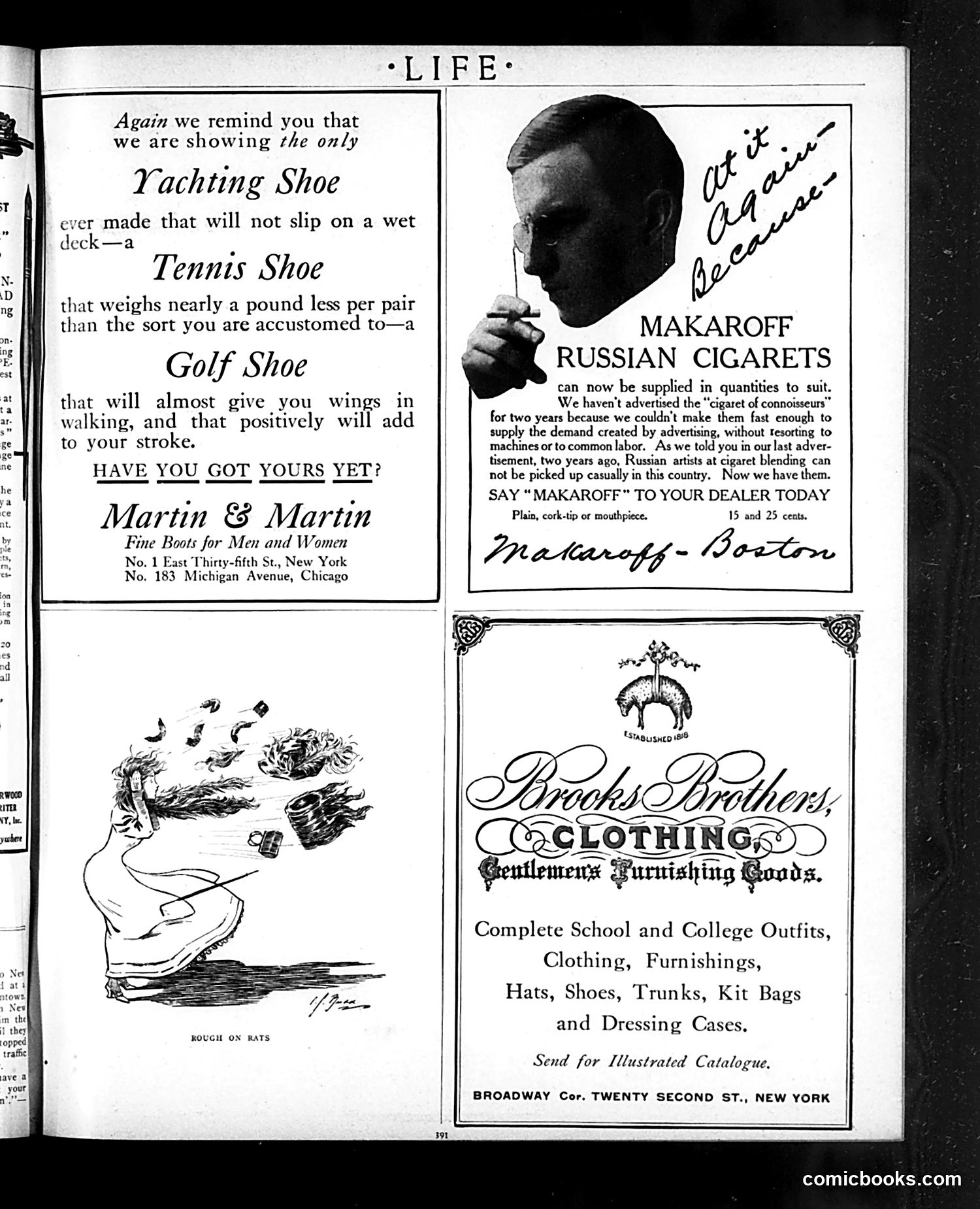
This is primarily an **advertising page** from Life magazine, not a satirical cartoon. It contains four advertisements for consumer goods. The page features: 1. **Martin & Martin shoes** — promoting specialized footwear (yachting, tennis, golf shoes) with the slogan "Have you got yours yet?" 2. **Makaroff Russian Cigarets** — a luxury cigarette brand claiming two-year production delays due to high demand and reliance on skilled Russian artisans for hand-blending. The ad emphasizes exclusivity and craftsmanship, suggesting supply shortages made the product more desirable. 3. **"Rough on Rats"** — a small cartoon showing someone dealing with rat infestation (likely a pest control product). 4. **Brooks Brothers** — advertising complete school/college outfits and gentlemen's furnishings. The ads reflect early 20th-century consumer culture targeting affluent readers, emphasizing quality, specialization, and status goods. There is no significant political satire visible on this page.
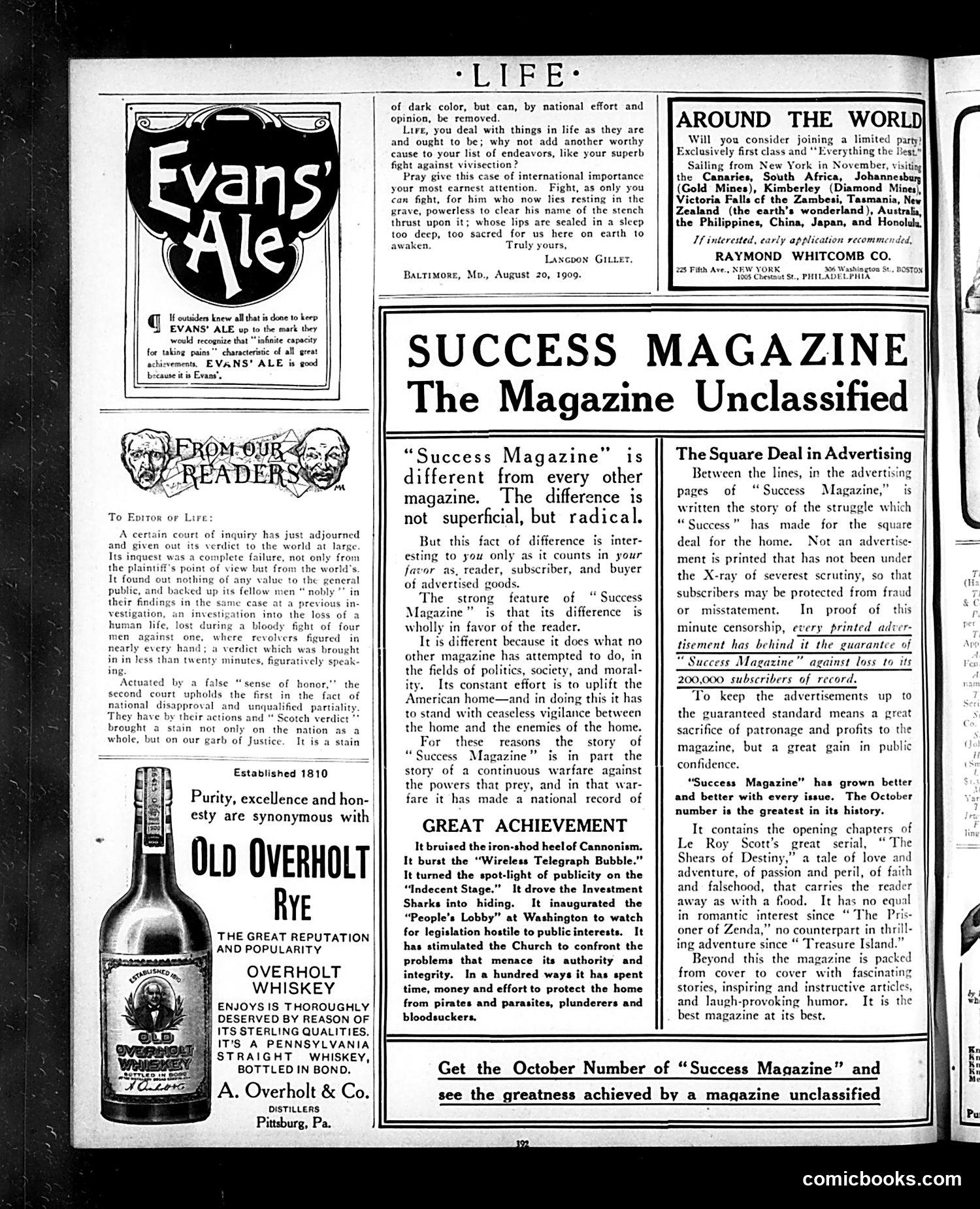
This page is primarily **advertising and promotional content**, not a political cartoon. The main editorial content is a reader's letter criticizing court proceedings—apparently referencing a violent incident involving "four men" and "revolvers" where courts failed to investigate properly, calling the verdict a "Scotch verdict" (a legal term for inconclusive findings). The writer urges *Life* magazine to champion this cause as it did with anti-vivisection efforts. The page otherwise contains advertisements for **Evans' Ale**, **Old Overholt Whiskey**, and promotional material for **Success Magazine** (which emphasized consumer protection and exposing fraud—"bruised the iron-shod heel of Cannonism," attacked investment scams). There's also a travel advertisement for around-the-world voyages. **No identifiable political figures or satirical cartoons appear here.** This is a standard magazine page mixing reader correspondence with commercial advertising typical of 1909 publication practices.
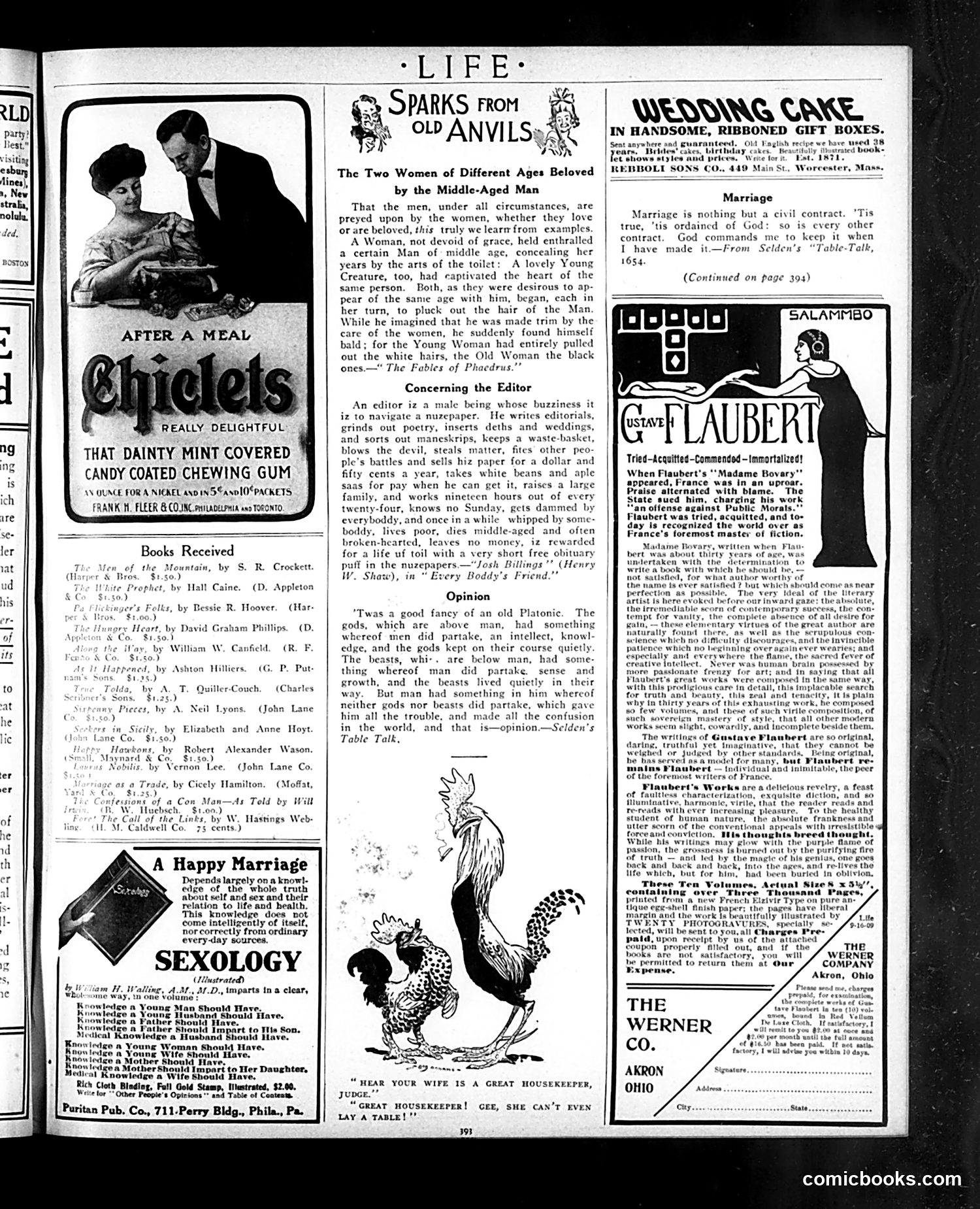
This page from Life magazine contains satirical pieces and advertisements typical of early 20th-century American humor journalism. **Main Cartoon:** The bottom illustration depicts a rooster and hen with the caption about a "great housekeeper" who "can't even lay a table." This is a crude sexual double-entendre joke playing on the dual meaning of "lay"—the domestic task versus animal reproduction—to mock a wife's housekeeping incompetence. **"Fables of Phaedrus" Section:** A classical fable about a middle-aged man loved by both an older and younger woman, each plucking out his hair (white and black respectively) until he goes bald. The satire critiques how women manipulate men through vanity and deception. **"Concerning the Editor":** A humorous definition mocking newspaper editors as overworked, underpaid, constantly criticized figures who labor thanklessly for meager compensation and brief obituaries. The page reflects period attitudes toward gender relations, marital dynamics, and professional frustrations through satire and classical literary references.
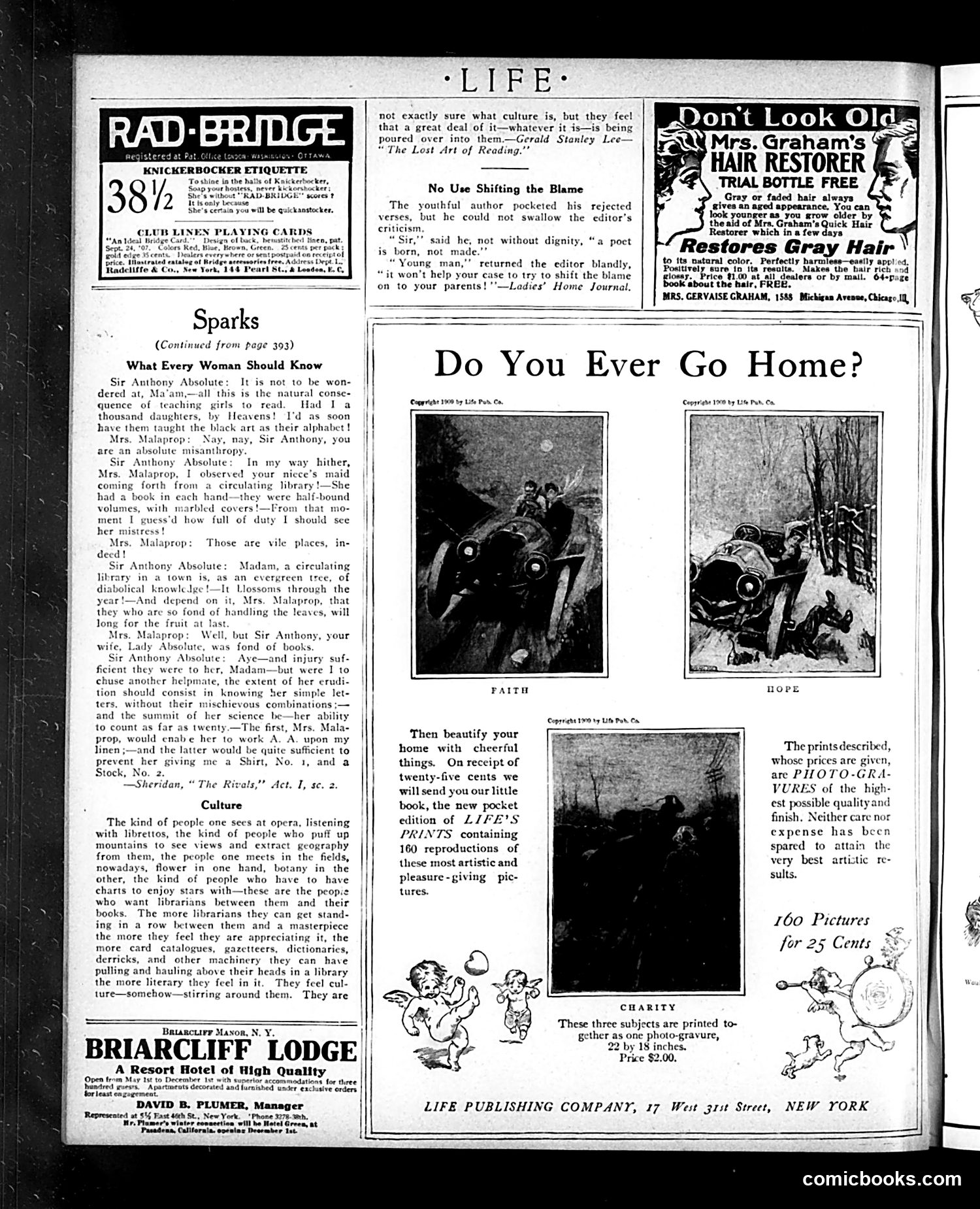
This page combines literary satire with advertisements. The main feature is a humorous excerpt from Sheridan's 18th-century play *The Rivals*, featuring characters Sir Anthony Absolute and Mrs. Malaprop debating whether women should be educated. Sir Anthony absurdly argues that teaching women to read is dangerous—libraries are "diabolical" and reading makes women restless. He contends wives should only know enough to count to twenty and mark his shirts. The satire targets anti-intellectual attitudes and resistance to women's education prevalent in Sheridan's era (and apparently still relevant to Life's contemporary readers). The accompanying "Culture" essay extends the critique, mocking people who consume culture superficially—attending opera with librettos, carrying botany books while picking flowers—rather than genuinely engaging with art and literature. The advertisements for Mrs. Graham's Hair Restorer and Briarcliff Lodge resort complete the page's commercial content.
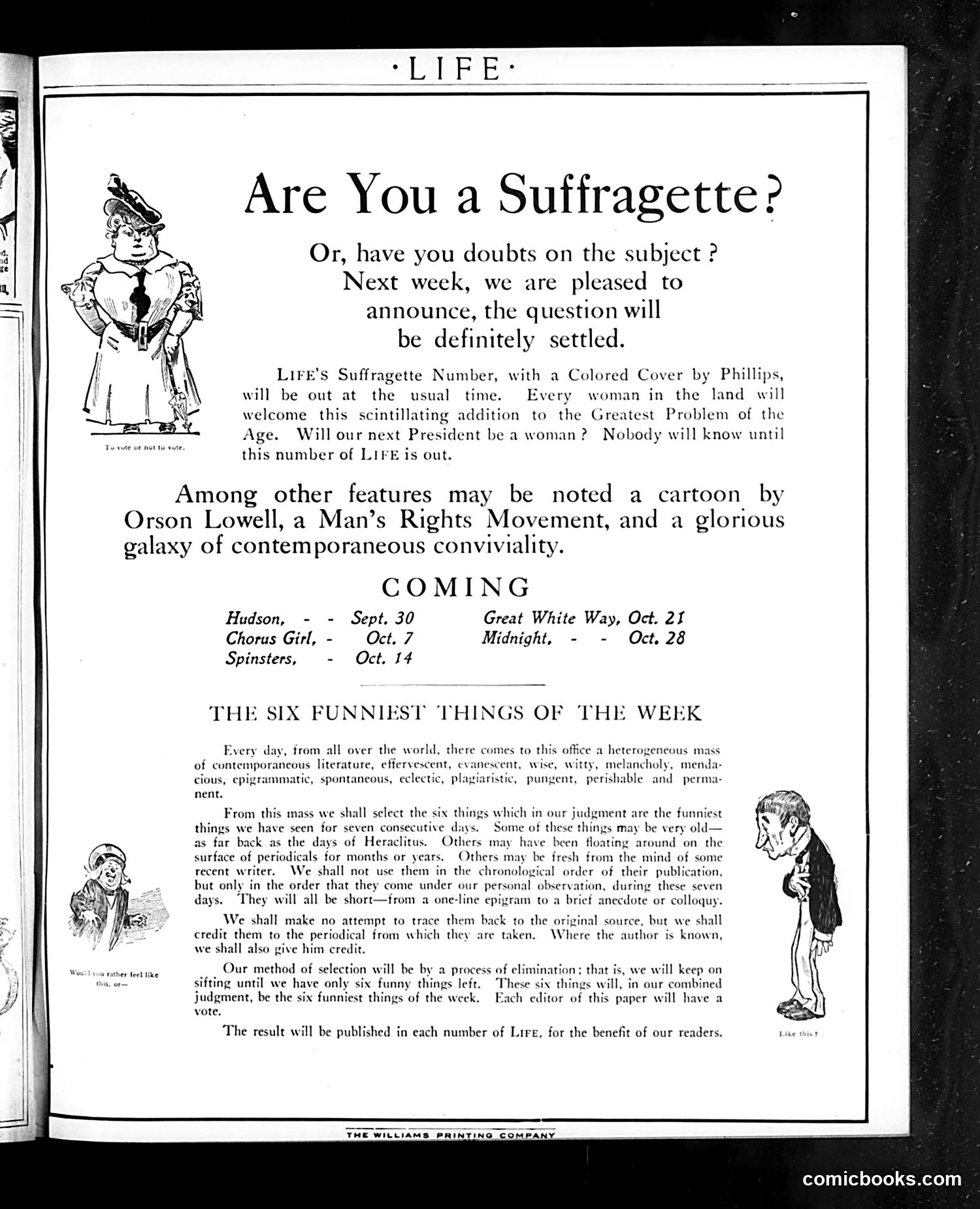
This page announces Life's upcoming "Suffragette Number," mocking the women's suffrage movement through exaggerated enthusiasm. The illustration shows a caricatured suffragette in period dress—likely representing the stereotype of suffrage activists as overly militant or unfeminine. The satire works through ironic hyperbole: Life claims this special issue will "definitely settle" whether women should vote and whether a woman could become President, presenting the suffrage question as absurdly momentous ("Greatest Problem of the Age"). The promise to feature a "Man's Rights Movement" cartoon suggests counter-mockery of anti-suffrage arguments. The page also announces a new recurring feature: "The Six Funniest Things of the Week," where editors will select humorous content from contemporary publications through democratic voting. This reflects early 1900s opposition to women's suffrage, which wasn't granted federally until 1920.
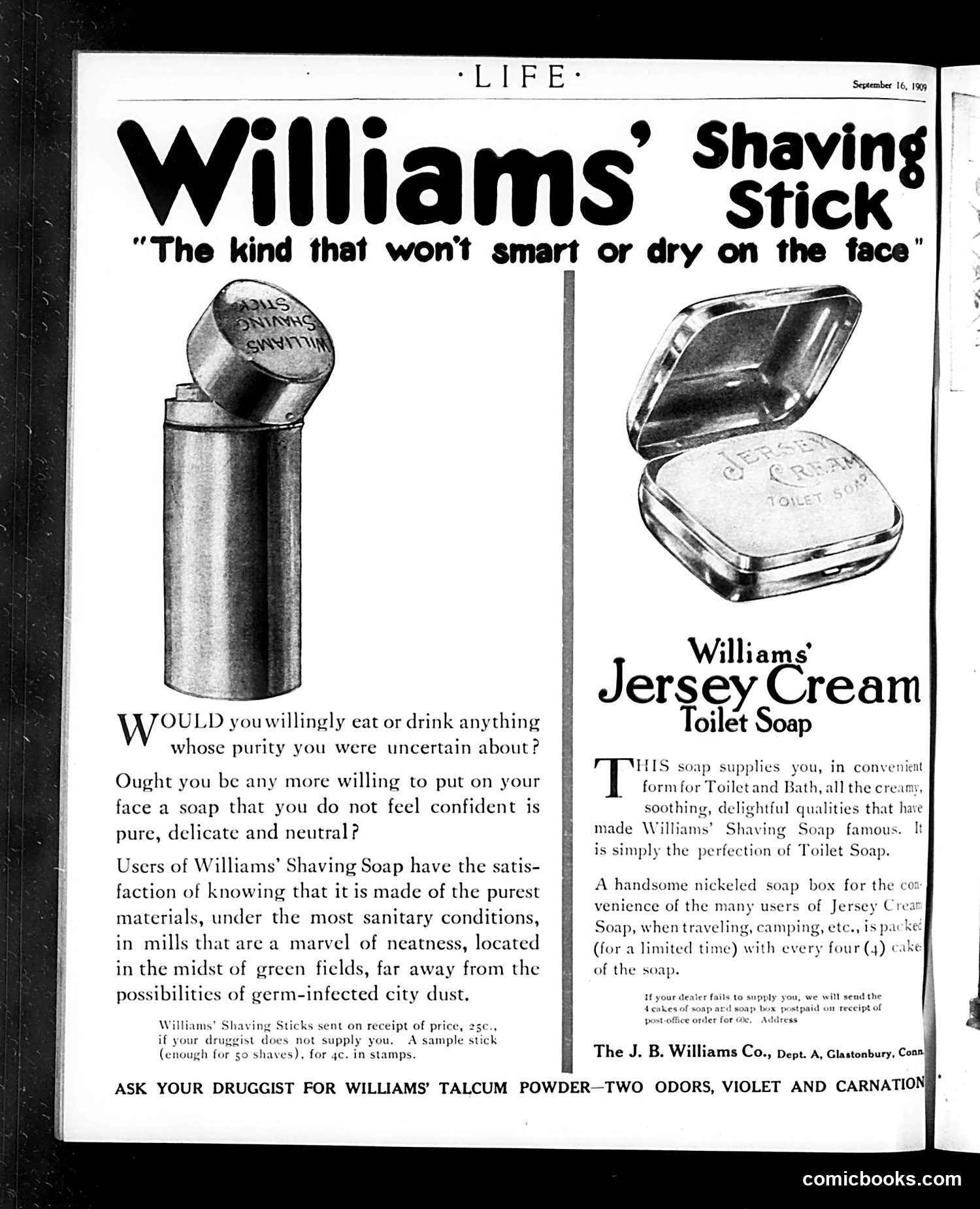
This page contains **advertising, not satire or political commentary**. It promotes two Williams' grooming products through early 1900s marketing rhetoric. The **Shaving Stick** ad uses the rhetorical device of questioning consumer confidence: "Would you eat something of uncertain purity?" to argue that facial products deserve equal scrutiny. It emphasizes purity by claiming manufacture in rural mills away from "germ-infected city dust"—reflecting early 20th-century anxieties about urban contamination and germ theory. The **Jersey Cream Toilet Soap** ad highlights convenience features (nickel soap box for travelers) and product quality. Both ads appeal to middle-class consumers concerned with hygiene and gentility. The language is instructional rather than satirical. The products are made by **J.B. Williams Co. in Glastonbury, Connecticut**, and cost 25 cents—typical pricing for premium grooming goods of the era. No political content or cartoon caricatures appear on this page.