
Life, 1909-09-16 · page 14 of 32
Life — September 16, 1909 — page 14: what you’re looking at
What you’re looking at
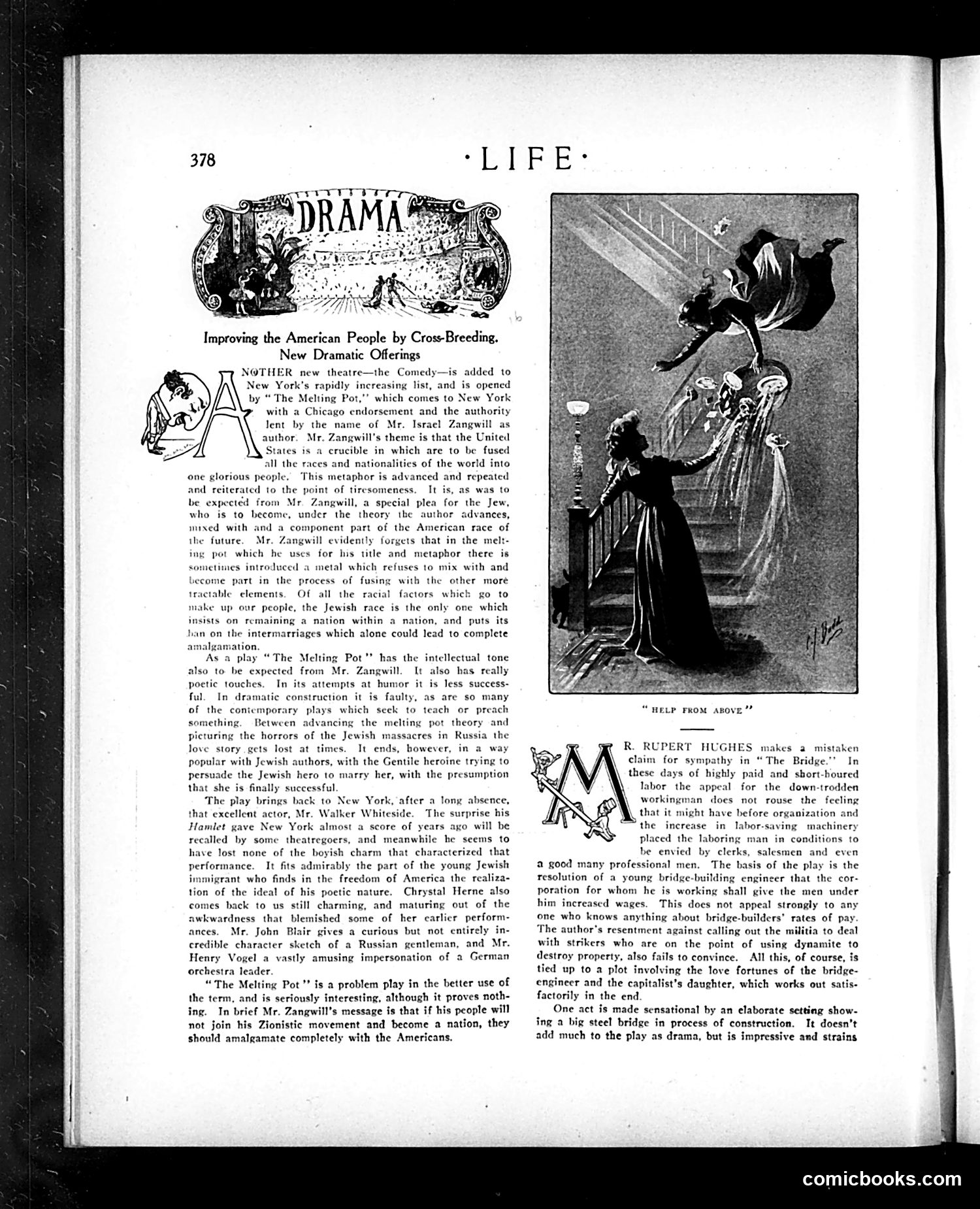
This *Life* magazine page reviews Israel Zangwill's play "The Melting Pot," which promoted the idea that America would fuse all races and nationalities into one unified people. The review's satire is hostile and revealing of period prejudices. While praising the play's theatrical qualities, the critic attacks Zangwill's central premise by claiming the Jewish people uniquely resist assimilation—describing them as "a metal which refuses to mix" in the melting pot. The critic objects that Jews insist on remaining "a nation within a nation," implying they cannot or will not truly become American. The review concludes with backhanded advice: Zangwill's message is that Jews must either join the Zionist movement *or* "amalgamate completely with the Americans"—framing Jewish identity itself as incompatible with American belonging. This reflects early-20th-century anti-Semitic assumptions about Jewish loyalty and assimilation.
📄 Transcribed text from this page (OCR, searchable)
Machine-transcribed from the original scan — historical spelling and the odd misread are preserved.
Improving the American People by CrossBreeding. New Dramatic Offerings NOTHER new theatre—the Comedy—is added to New York's rapidly increasing list, and is opened by “The Melting Pot," which comes to New York with a Chicago endorsement and the authority lent by the name of Mr. Israel Zangwill as author. Mr. Zangwill's theme is that the United States is a crucible in which are to be fused all the races and nationalities of the world into one glorious people. ‘This metaphor is advanced and repeated and reiterated to the point of tiresomeness. It is, as was to be expected from Mr. Zangwill, a special plea for the Jew, who is to become, under the theory the author advances, mixed with and a component part of the American race of the future. Mr. Zangwill evidently forgets that in the mel ing pot which he uses for his title and metaphor there is troduced a metal which refuses to mix with and ‘come part in the process of fusing with the er more ble elements. Of all the racial factors which go to ake up our people, the Jewish race is the only one which insists on remaining a nation within a nation, and puts its han on the intermarriages which alone could lead to complete amation. As a play “The Melting Pot’? has the intellectual tone also to be expected from Mr. Zangwill. It also has really poetic touches. In its attempts at humor it is less success- ful. In dramatic construction it is faulty, as are so many of the contemporary plays which seek to teach or preach something. Between advancing the melting pot theory and picturing the horrors of the Jewish massacres in Russia the love story gets lost at times. It ends, bowever, in a way popular with Jewish authors, with the Gentile heroine trying to persuade the Jewish hero to marry her, with the presumption that she is finally successful ‘The play brings back to fter a long absence, that excellent actor, Mr. Walker Whiteside. The surprise his Hamlet gave New York almost a score of years ago will be recalled by some theatregoers, and meanwhile he seems to have lost none of the boyish charm that characterized that performance. It fits admirably the part of the young Jewish migrant who finds in the freedom of America the realiza- tion of the ideal of his poetic nature. Chrystal Herne also comes back to us still charming, and maturing out of the awkwardness that blemished some of her earlier perform- ances. Mr. John Blair gives a curious but not entirely in- credible character sketch of a Russian gentleman, and Mr. Henry Vogel a vastly amusing impersonation of a German orchestra leader. “The Melting Pot’? is a problem play in the better use of the term, and is seriously interesting, although it proves noth- ing. In brief Mr. Zangwill’s message is that if his people will not join his Zionistic movement and become a nation, they should amalgamate completely with the Americans. times “HELP FROM ABOVE’? RUPERT HUGHES makes a mistaken claim for sympathy in “The Bridge.” In these days of highly paid and short-boured labor the appeal for the down-trodden n does not rouse the feeling ht have before organization and se in labor-saving machinery placed the laboring man in conditions to be envied by clerks, salesmen and even a good many professional men. The basis of the play is the resolution of a young bridge-building engineer that the cor- poration for whom he is working shall give the men under him increased wages. This docs not appeal strongly to any one who knows anything about bridge-builders’ rates of pa The author's resentment against calling out the militia to deal with strikers who are on the point of using dynamite to destroy property, also fails to convince. All this, of course, is tied up to a plot involving the love fortunes of the bridge- engineer and the capitalist’s daughter, which works out satis- factorily in the end One act is made sensational by an elaborate setting show- ing a big steel bridge in process of construction. It doesn’t add much to the play as drama, but is impressive and strains comicbooks.com