
Life, 1909-09-16 · page 5 of 32
Life — September 16, 1909 — page 5: what you’re looking at
What you’re looking at
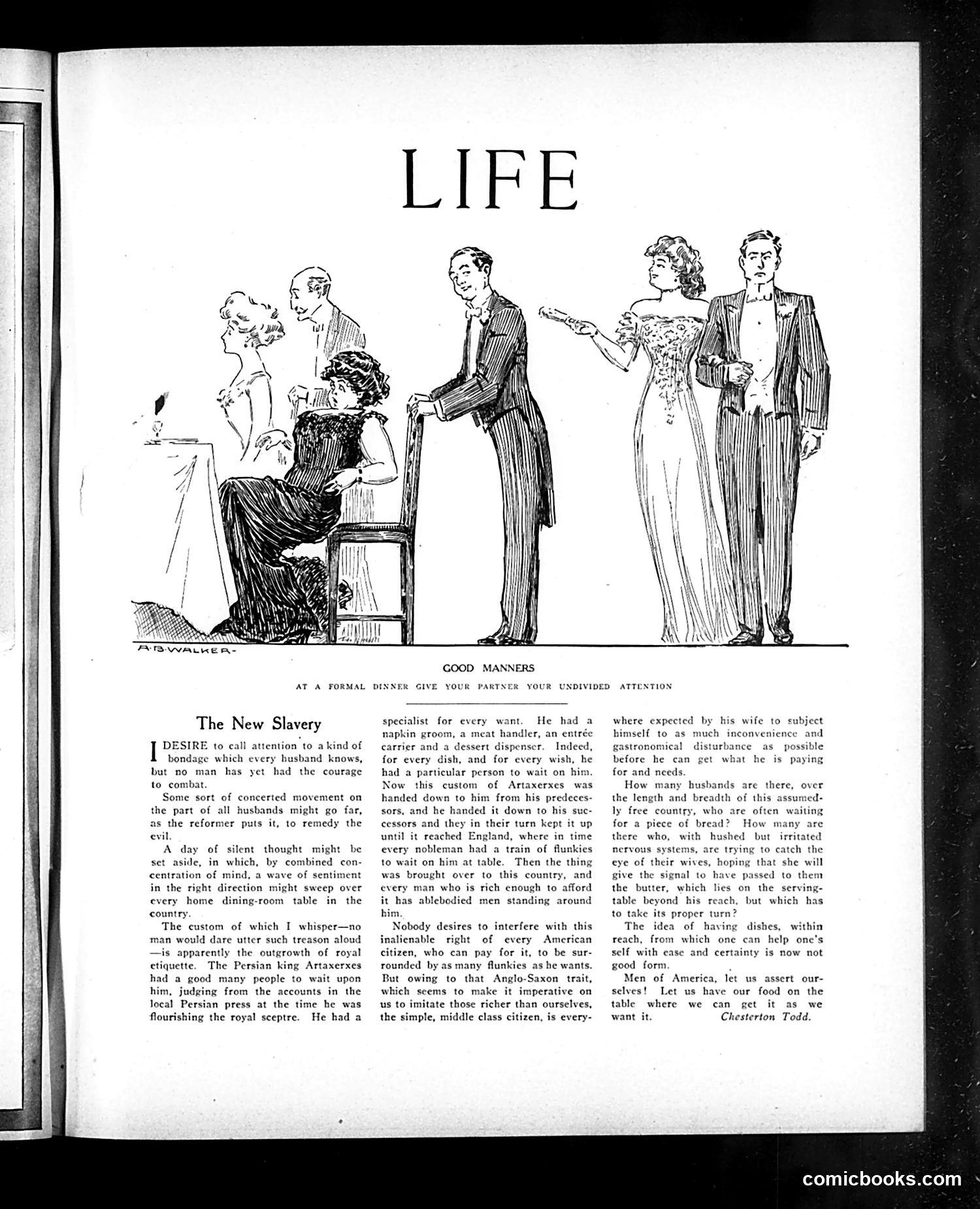
**Cartoon Title:** "Good Manners - At a Formal Dinner Give Your Partner Your Undivided Attention" The illustration shows formal dinner etiquette, depicting well-dressed figures at a social gathering. The accompanying article, "The New Slavery," critiques the elaborate servant system imported from Persian royal courts (Artaxerxes). The satire contrasts American egalitarianism with wealthy Americans mimicking European aristocratic customs—specifically the practice of employing numerous servants for specialized tasks (napkin groom, meat handler, etc.). The author argues this "new slavery" contradicts American values and suggests middle-class citizens should reject such pretentious imitation. The cartoon humorously illustrates proper formal dinner conduct, while the article mocks the unnecessary servant hierarchy that accompanies such occasions.
📄 Transcribed text from this page (OCR, searchable)
Machine-transcribed from the original scan — historical spelling and the odd misread are preserved.
PTS WALKER- AT A FORMAL The New Slavery DESIRE to call attention to akind of bondage which every husband knows, but no man has yet had the courage to combat Some sort of concerted movement on the part of all husbands might go far, as the reformer puts it, to remedy the evil A day of silent thought might be set aside, in which, by combined con- centration of mind, a wave of sentiment in the right direction might sweep over every home dining-room table in the country The custom of which I whisper—no man would dare utter such treason aloud —is apparently the outgrowth of royal etiquette. The Persian king Artaxerxes had a good many people to wait upon him, judging from the accounts in the local Persian press at the time he was flourishing the royal sceptre. He had a GOOD MANNERS DINNER GIVE YOUR PARTNER YOUR UNDIVIDED ATTENTION specialist for every want. He had a napkin groom, a meat handler, an entré carrier and a dessert dispenser. Indeed, for every dish, and for every wish, had a particular person to wait on hi Now this custom of Artaxerxes was handed down to him from his predeces- sors, and he handed it down to his suc- cessors and they in their turn kept it up until it reached England, where in time every nobleman had a train of flunkies to wait on him at table. Then the thing was brought over to this country, and every man who is rich enough to afford it has ablebodied men standing around him Nobody desires to interfere with this inalienable right of every American citizen, who can pay for it, to be sur- rounded by as many flunkies as he wants. But owing to that Anglo-Saxon trait, which seems to make it imperative on us to imitate those richer than ourselv the simple, middle class citizen, is every- where expected by his wife to sv himself to as much inconvenience gastronomical disturbance as before he can get what he for and needs. How many husbands are there, over the length and breadth of this assum: ly free country, who are often waitin for a piece of bread? How many are there who, with hushed but irritated nervous systems, are trying to catch the eye of their wives, hoping that she will give the signal to have passed to th the butter, which lies on the serving- table beyond his reach, but which has to take its proper turn? The idea of having dishes, within reach, from which one help one's self with ease and certainty is now not good form. . Men of America, let us assert our- selves! Let us have our food on the table where we can get it as we want it. Chesterton Todd. comicbooks.com