
Life, 1909-09-16 · page 24 of 32
Life — September 16, 1909 — page 24: what you’re looking at
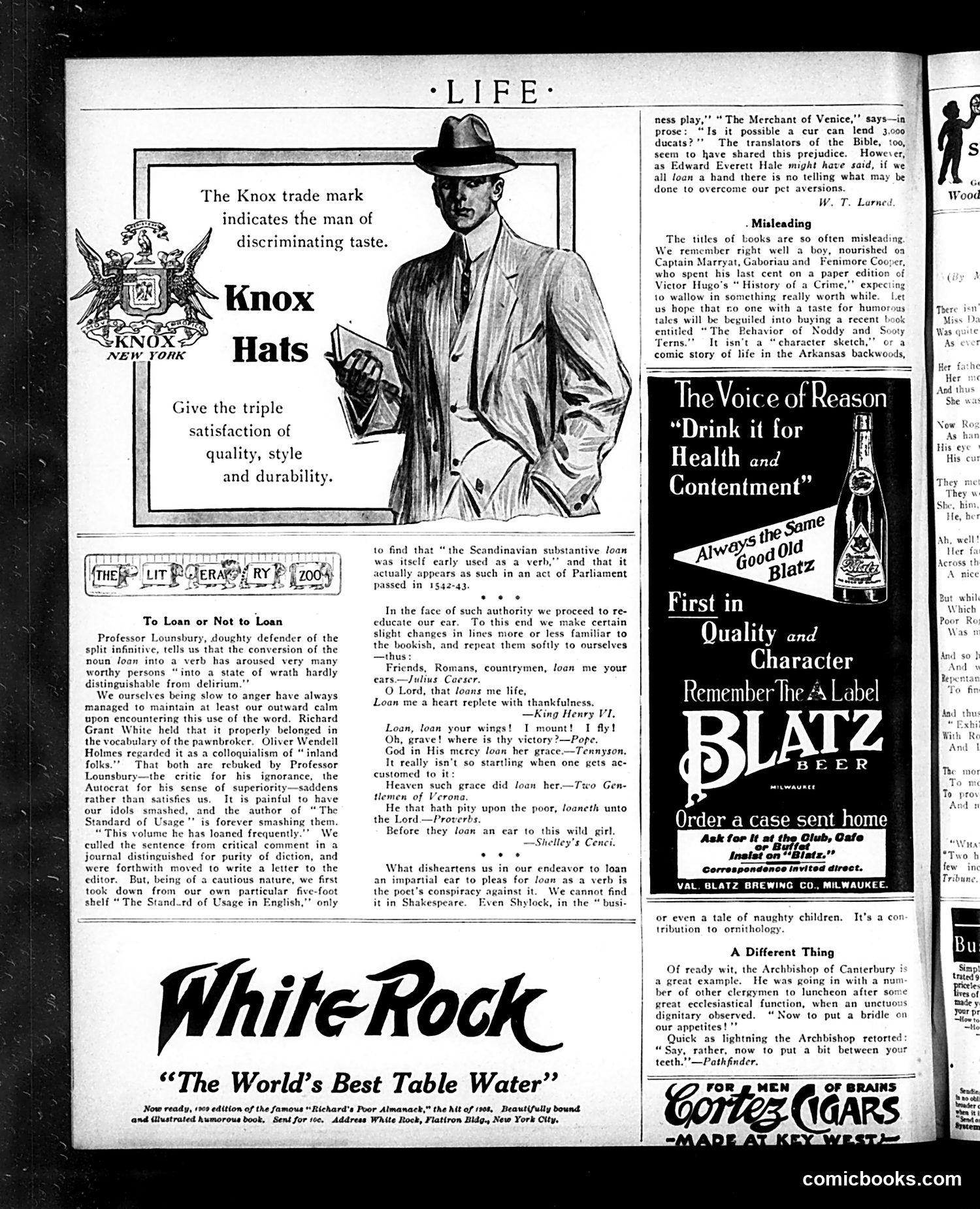
What you’re looking at
This page consists primarily of **advertisements and a linguistic humor column**—not political cartoons. The main content is "To Loan or Not to Loan," a *cultural satire* about grammar debates. Professor Lounsbury defended the verb "to loan" (converting the noun into a verb), which outraged language purists including prominent figures like Richard Grant White and Oliver Wendell Holmes. Life humorsly endorses the change by re-writing famous literary passages ("Friends, Romans, countrymen, **loan** me your cars..."). The **satire's point**: Language guardians are needlessly rigid. Shakespeare and the Bible avoided "loan" as a verb, yet Professor Lounsbury proved it's historically legitimate. Life mocks pretentious language-policing by suggesting everyone "loan a hand" embracing the controversial usage. The page also includes sidebars on misleading book titles and advertisements for Knox Hats, Blatz Beer, and White Rock water—representative of the magazine's mixed editorial-advertising format.
📄 Transcribed text from this page (OCR, searchable)
Machine-transcribed from the original scan — historical spelling and the odd misread are preserved.
The Knox trade mark indicates the man of discriminating taste. Give the triple satisfaction of quality, style and durability. (rej urge To Loan or Not to Loan Professor Lounsbury, doughty defender of the split infinitive, tells us that the conversion of the noun Joan into a verb has aroused very many worthy persons “into a state of wrath hardly distinguishable from delirium.”” We ourselves being slow to anger have always managed to maintain at least our outward calm upon encountering this use of the word. Richard Grant White held that it properly belonged in the vocabulary of the pawnbroker. Oliver Wendell Holmes regarded it as a colloquialism of “ inland folks. That both are rebuked by Professor Lounsbury—the critic for his ignorance, the Autocrat for his sense of superiority—saddens rather than satisfies us. It is painful to our idols smash nd the author of ndard of Usage’ is forever smashing them. This volume he has loaned frequently." We culled the sentence from critical comment in a journal distinguished for purity of diction, and were forthwith moved to write a letter to the editor. But, being of a cautious nature, we first took down from our own particular five-foot shelf “ The Stand.rd of Usage in English,”” only to find that “the Scandinavian substantive loan itself early used as a verb,’ and that it actually appears as such in an act of Parliament passed in 1542-43. In the face of such authority we proceed to re- educate our ear. To this end we make certain slight changes in lines more or less familiar to the bookish, and repeat them softly to ourselves —thus: Friends, Romans, countrymen, loan me your cars—Julius Coeser. O Lord, that loans me life, Loan me a heart replete with thankfulness, —King Henry VI. Loan, loan your wings! I mount! I fly! Oh, grave! where is thy victory ?—Pope. God in His mercy loan her grace.—Tennyson. It really isn’t so startling when one gets ac- customed to it: Heaven such grace did loan her—Two Gen- tlemen of Verona He that hath pity upon the poor, loaneth unto the Lord —Proverbs. Before they loan an ear to this wild girl. —Shelley’s Cenci. What disheartens us in our endeavor to loan an impartial ear to pleas for loan as a verb is the poet's conspiracy against it. We cannot find it in Shakespeare en Shylock, in the “ busi- ness play,” “The Merchant of Venice,’” says—in prose: “Is it possible a cur can lend 3,000 ducats?"" The translators of the Bible, 100, seem to have shared this prejudice. However, as Edward Everett Hale might have said, if we all loan a hand there is no telling what may be done to overcome our pet aversions. W. T. Larned . Misleading c titles of books are so often misleading mber right well a boy, nourished oa Captain Marryat, Gaboriau and Fenimore Cooper, who spent his last cent on a paper edition of Victor Hugo's “ History of a Crime,’” expecting to wallow in something really worth while. Let us hope that co one with a taste for humorous tales will be beguiled into buying a recent book entitled “The Behavior of Noddy and Sooty Terns.” It isn’t a “character sketch,” or a comic story of life in the Arkansas backwoods, Wood The Voice of Reasor “Drink it for ia Health and | Contentment” First in - Wien Quality and Character “Two h few inc Tribune VAL. BLATZ BREWING CO., MILWAUKEE. ’ While Rock. “The World’s Best Table Water’’ Now ready, 110 edition of the famous “Richard's Poor Almanack,” the hit of 1908, Beautifully bound and (ilustrated humorous book, Sent for ice, Address White Rock, Flatiron Bldg. New York City. or even a tale of naughty children, It’s a con. tribution to ornithology. A Different Thing Of ready wit, the Archbishop of Canterbury i a great example. He was going in with a num ber of other clergymen to luncheon after some great ecclesiastical function, when an unctuous dignitary observed. “Now to put a bridle on our appetites!” Quick as lightning the Archbishop retorted: y, rather, now to put a bit between yo "Pathfinder. comicbooks.com