
Life, 1909-09-16 · page 8 of 32
Life — September 16, 1909 — page 8: what you’re looking at
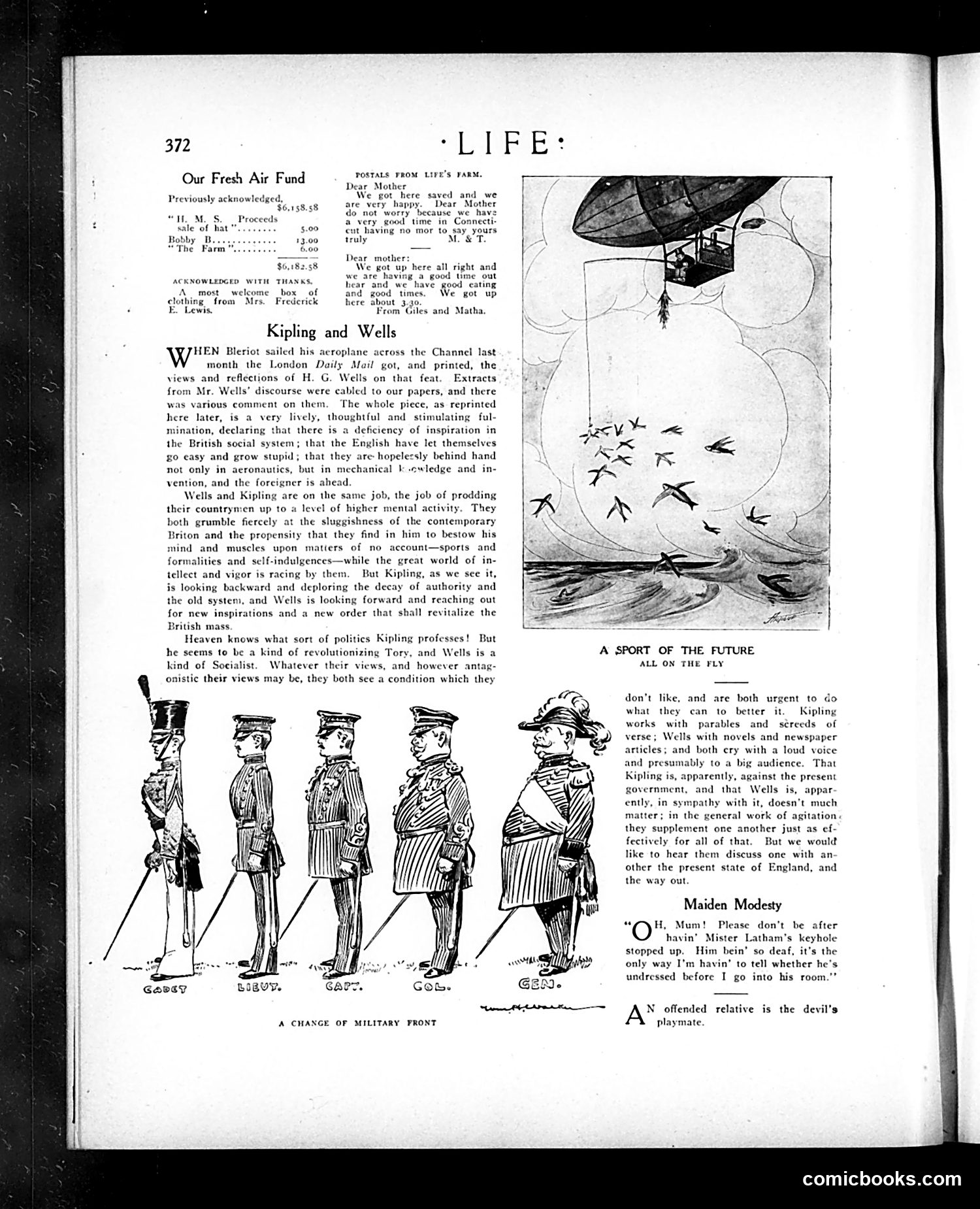
What you’re looking at
This cartoon satirizes shifting political positions, likely during World War I era. The five uniformed figures appear to represent military or political leaders changing their stance or allegiance—literally turning around to face the opposite direction. The labels beneath are partially illegible in this reproduction, but the visual joke is clear: these officials are "about-facing" (reversing course), suggesting they've abandoned previous commitments or adopted contradictory positions. The accompanying article "Kipling and Wells" discusses how writers Rudyard Kipling and H.G. Wells hold opposing political views—one appearing conservative, the other progressive—yet both influence public opinion. The cartoon likely comments on similar inconsistency or opportunism among political/military figures of the period.
📄 Transcribed text from this page (OCR, searchable)
Machine-transcribed from the original scan — historical spelling and the odd misread are preserved.
372 Our Fresh Air Fund Previously acknowledged, $6,158.58 “TL M.S. Proceeds sale of hat"........ §.00 13.00 $6,182.5 ACKNOWLEDGED WITH THANKS A most welcome box of hing from Mrs. Frederick Lewis, “L DRSES POSTALS FROM LIPE’S FARM. Dear Mother We got here saved and we are very happy. Dear Mother t worry because we hay. nod time in Connecti- no mor to say yours M &T. all right and bod time out ave good cating and good times. We got up here about 3.30. From Giles and Matha. Kipling and Wells HEN Bleriot sailed his acroplane across the Channel last month the London Daily Mail got, and printed, the views and reflections of H. G. Wells on that feat. Extracts from Mr. Wells’ discourse were cabled to our papers, and there was various comment on them. The whole piece, as reprinted here later, is a very lively, thoughtful and stimulating ful- mination, declaring that there is a deficiency of inspiration in the British social system; that the English have let themselves go easy and grow stupid; that they are hopelessly behind hand not only in aeronautics, but in mechanical k .ewledge and in- vention, and the foreigner is ahead. Wells and Kipling are on the same job, the job of prodding their countrymen up to a level of higher mental activity. They both grumble fiercely at the sluggishness of the contemporary Briton and the propensity that they find in him to bestow his mind and muscles upon matiers of no account—sports and formalities and sclf-indulgences—while the great world of in- tellect and vigor is racing by them, But Kipling, as we see it, is looking backward and deploring the decay of authority and the old system, and Wells is looking forward and reaching out for new inspirations and a new order that shall revitalize the British mass. Heaven knows what sort of politics Kipling professes! But he seems to be a kind of revolutionizing Tory, and Wells is a kind of Socialist. Whatever their views, and however antag- onistic their views may be, they both see a condition which they A CHANGE OF MILITARY PRONT A SPORT OF THE FUTURE ALL ON THE FLY don't like, and are both urgent to do what they can to better it. Kipling works with parables and séreeds of verse; Wells with novels and newspaper articles; and both cry with a loud voice and presumably to a big audience. Kipling is, apparently, against the present government, and that Wells is, appar ently, in sympathy with it, doesn’t much matter; in the general work of agitation they supplement one another just as ef- fectively for all of that. But we would like to hear them discuss one with an. other the present state of England, and the way out. Maiden Modesty “Op Mum! Please don’t, be after havin’ Mister Latham’s keyhole stopped up. Him bein’ so deaf, it's the only way I’m havin’ to tell whether he’s undressed before I go into his room.’ N offended relative is the devil’s playmate. comicbooks.com