
Life, 1909-09-16 · page 15 of 32
Life — September 16, 1909 — page 15: what you’re looking at
What you’re looking at
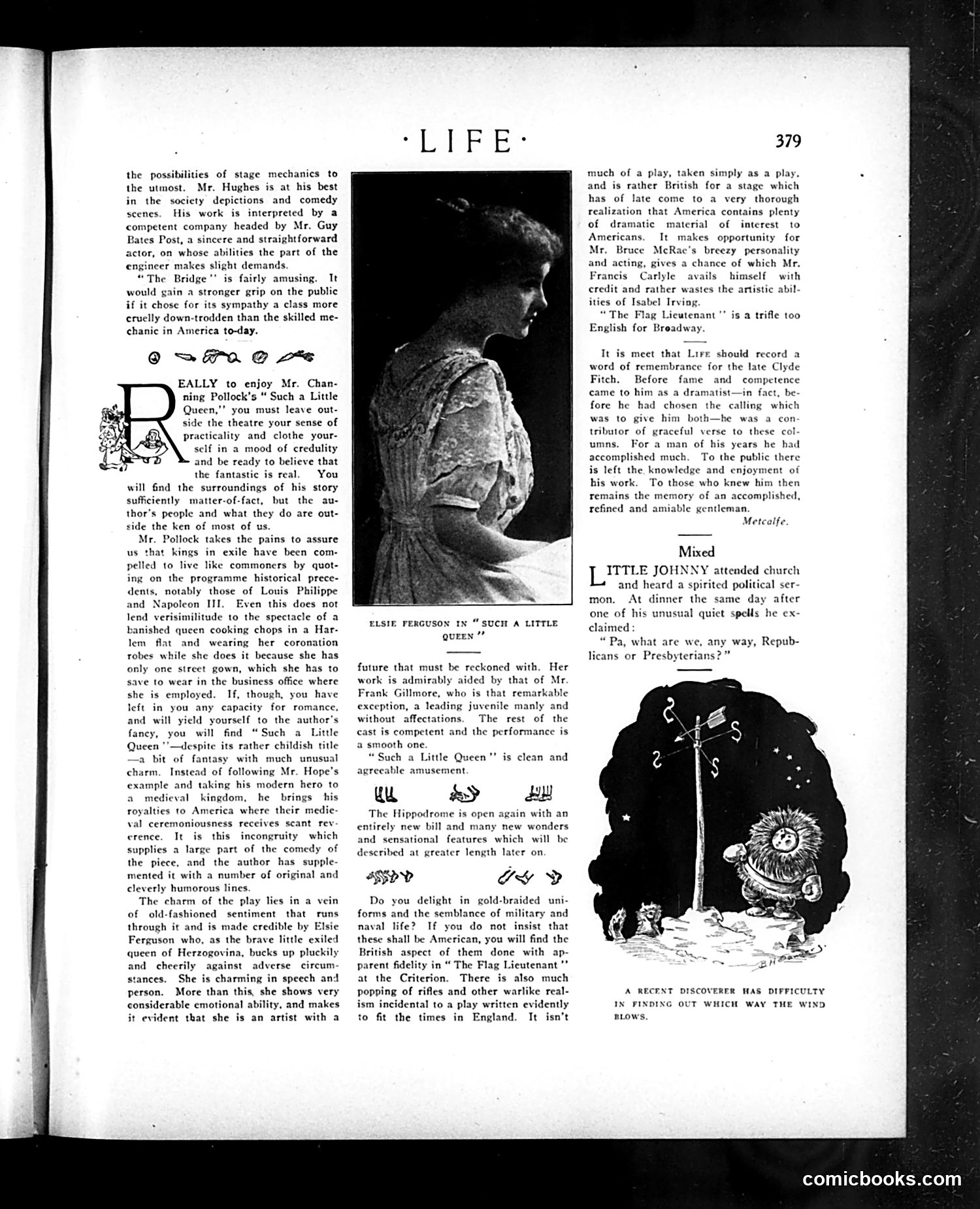
This page reviews Broadway plays, focusing on *"Such a Little Queen,"* starring actress Elsie Ferguson (shown in the photograph). The play's central satire involves a displaced European royal—specifically a queen from "Herzogovina" (likely fictional)—reduced to poverty and forced to work as a servant in a Harlem apartment while retaining her coronation robes for appearances at her office job. The humor derives from incongruity: Old World royalty facing American democratic reality, stripped of reverence and forced into mundane domesticity. The reviewer praises Ferguson's emotional performance and charm, though notes the plot's inherent implausibility requires the audience to suspend practical judgment. The page also briefly reviews other plays, including *"The Flag Lieutenant,"* criticized as overly British in sensibility for American audiences who increasingly demand homegrown dramatic material.
📄 Transcribed text from this page (OCR, searchable)
Machine-transcribed from the original scan — historical spelling and the odd misread are preserved.
the possibilities of stage mechanics to the utmost. Mr, Hughes is at his best in the society depictions and comedy scenes. His work is interpreted by a competent company headed by Mr. Guy Bates Post, a sincere and straightforward actor, on whose abilities the part of the engineer makes slight demands “The Bridge” is fairly amusing. Tt would gain a stronger grip on the public if it chose for its sympathy a class more cruelly down-trodden than the skilled me- chanic in America to-day. 0 > &O @ a<**e EALLY to enjoy Mr. Chan- ning Pollock's “ Such a Little Queen,’” you must leave out- side the theatre your sense of practicality and clothe your- self in a mood of credulity and be ready to believe that the fantastic is real. You will Gnd the surroundings of his story sufficiently matter-of-fact, but the au- thor's people and what they do are out- side the ken of most of us. Mr. Pollock takes the pains to assure us that kings in exile have been com- pelled to live like commoners by quot- ing on the programme historical prece- dents, notably those of Louis Philippe and Napoleon III. Even this does not lend verisimilitude to the spectacle of a banished queen cooking chops in a Har- lem flat and wearing her coronation robes while she does it because she has only one street gown, which she has to save to wear in the business office where she is employed. If, though, you have left in you any capacity for romance, and will yield yourself to the author's fancy, you will find “Such a Little Queen "’—despite its rather childish title —a bit of fantasy with much unusual charm. Instead of following Mr. Hope's example and taking his modern hero to a medieval kingdom, he brings his royalties to America where their medic val ceremoniousness receives scant rev erence. It is this incongruity which supplies a large part of the comedy of the piece, and the author has supple- mented it with a number of original and cleverly humorous lines. The charm of the play lies in a vein of old-fashioned sentiment that runs through it and is made credible by Elsie Ferguson who, as the brave little exiled queen of Herzogovina, bucks up pluckily and cheerily against adverse circum- stances. She is charming in speech an: person. More than this, she shows very considerable emotional ability, and makes it evident that she is an artist with a ELSIE PERGUSON IN “SUCH A LITTLE Quer: future that must be reckoned with. Her work is admirably aided by that of Mr Frank Gillmore, who is that remar! exception, a leading juvenile manly and without affectations. The rest of the cast is competent and the performance is a smooth one. “Such a Little Queen”? agreeable amusement Ly ay oy The Hippodrome is open again with an entirely new bill and many new wonders al features which will be described at greater length later on 29 oy > Do you delight in gold-braided uni- forms and the semblance of military and naval life? If you do not insist that these shall be American, you will find the British aspect of them done with ap- parent fidelity in “ The Flag Lieutenant "* at the Criterion. There is also much popping of rifles and other warlike real- ism incidental to a play written evidently to fit the times in England. It isn’t is clean and and sensatio: 379 much of a play, taken simply as a play. and is rather British for a stage which has of late come to a very thorough realization that America contains plenty of dramatic material of interest 10 Americans. It makes opportunity for Mr. Bruce McRac’s breezy personality and acting, gives a chance of which Mr. Francis Carlyle ils himself with credit and rather wastes the artistic abil- ities of Isabel Irving “The Flag Lieutenant" English for Broadwa It is meet that Lire should record a word of remembrance for the late Clyde Fitch, Before fame and competence came to him as a dramatist—in fact, be- fore he had chosen the calling which was to give him both—he was is a trifle too a con tributor of graceful verse to these col- umns, For a man of his years he had accomplished much. To the public there is left the, knowledge and enjoyment of his work. To those who knew him then remains the memory of an accomplished, refined and amiable gentleman. Mete Mixed ITTLE JOHNNY attended church and heard a spirited political ser- mon. At dinner the same day after one of his unusual quiet spells he ex- claimed : “Pa, what are we, any way, Repub- licans or Presbyterians?” A RECENT DISCOVERER HAS DIFFICULTY, IN FINDING OUT WHICH WAY THE WIND BLows, comicbooks.com