
A complete issue · 44 pages · 1909
Life — July 1, 1909
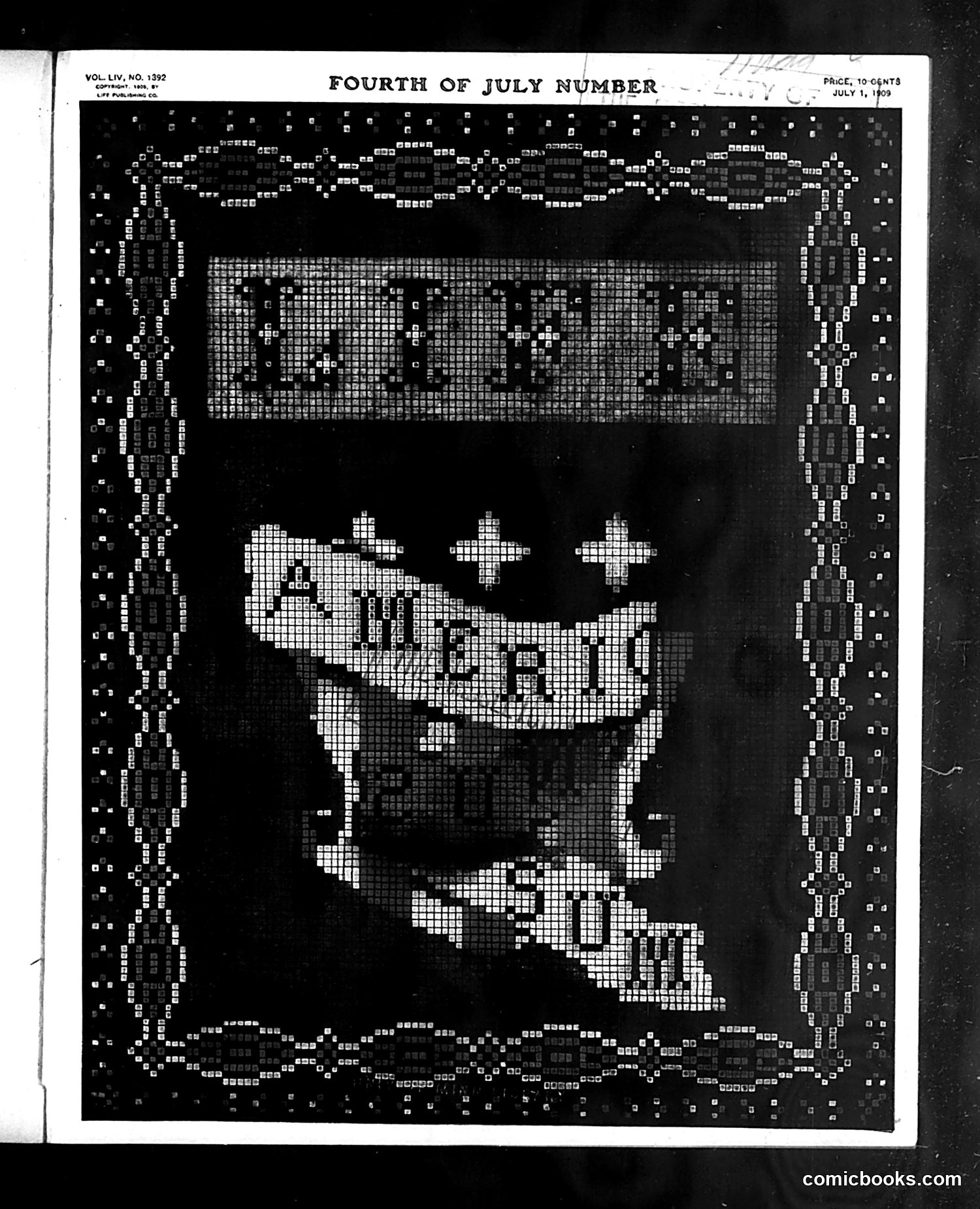
This appears to be a Fourth of July-themed page from *Life* magazine (dated July 1, 1909, based on the header). The image is a patriotic pixel-art or mosaic-style illustration of the United States map filled with stars and crosses, with "AMERICA" text visible overlaid on the central portion. The decorative border features geometric patterns typical of Art Nouveau design popular in that era. The illustration seems celebratory rather than satirical—a straightforward patriotic visualization for Independence Day, emphasizing American symbols (stars, crosses) and territorial identity. Without clearer OCR text or visible captions, the specific satirical intent remains unclear, though the artistic style reflects early 20th-century design aesthetics.
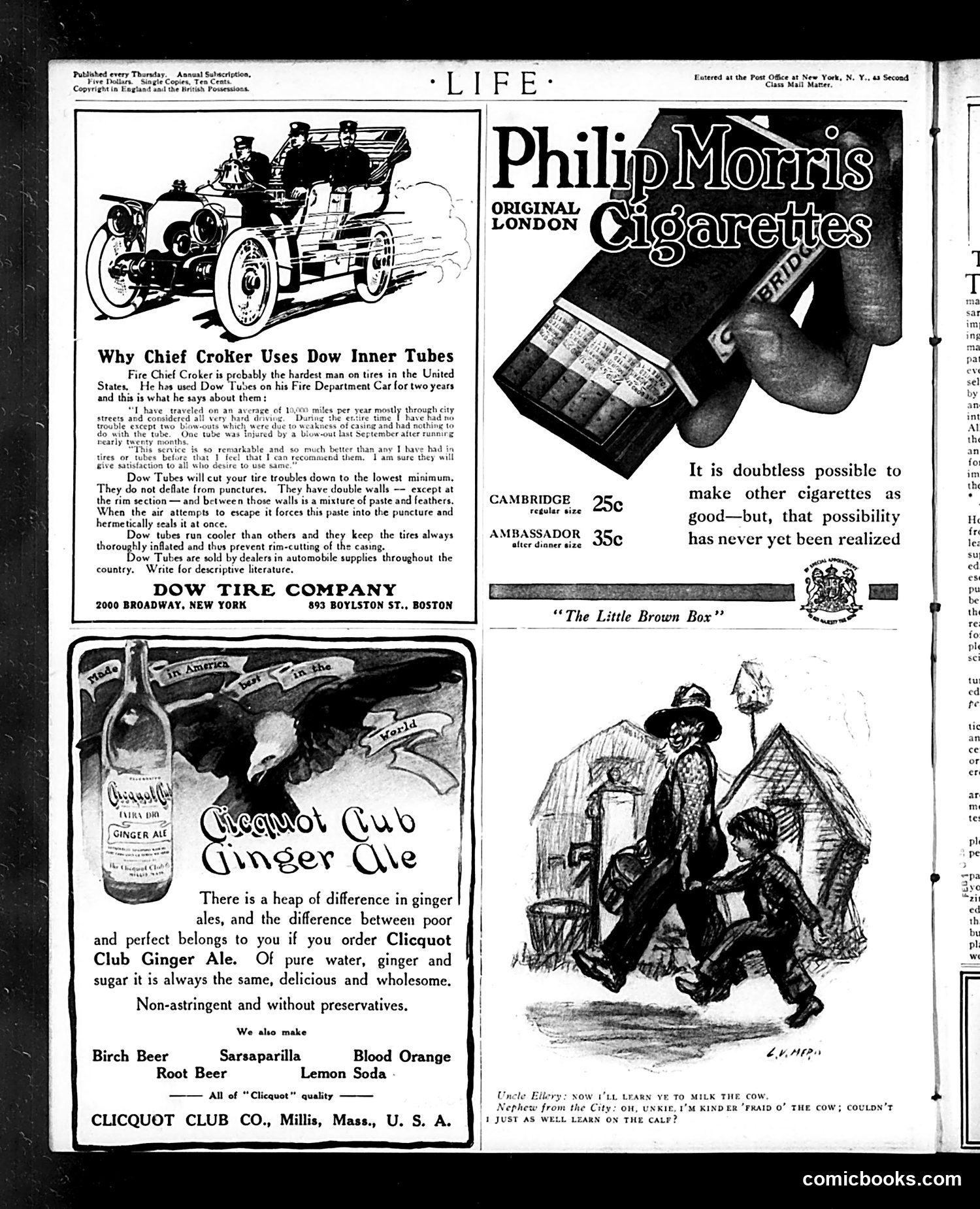
This page is primarily **advertising content** rather than political satire or comics. It contains three product advertisements: 1. **Dow Tire Company** (top): Features an early automobile with testimonial from a Fire Chief praising Dow Inner Tubes' durability and reliability. 2. **Philip Morris Cigarettes** (center-right): Ad claiming superior quality with pricing for Cambridge (25¢) and Ambassador (35¢) sizes. 3. **Clicquot Club Ginger Ale** (bottom-left): Promotes their ginger ale as pure and preservative-free, listing other beverages they manufacture. The single **cartoon** (bottom-right) shows an uncle teaching a city boy to milk a cow—a rural/urban comedy rather than political satire. The humor relies on the child's inexperience with farm life. This is a typical early 20th-century magazine page mixing advertising with light humor.
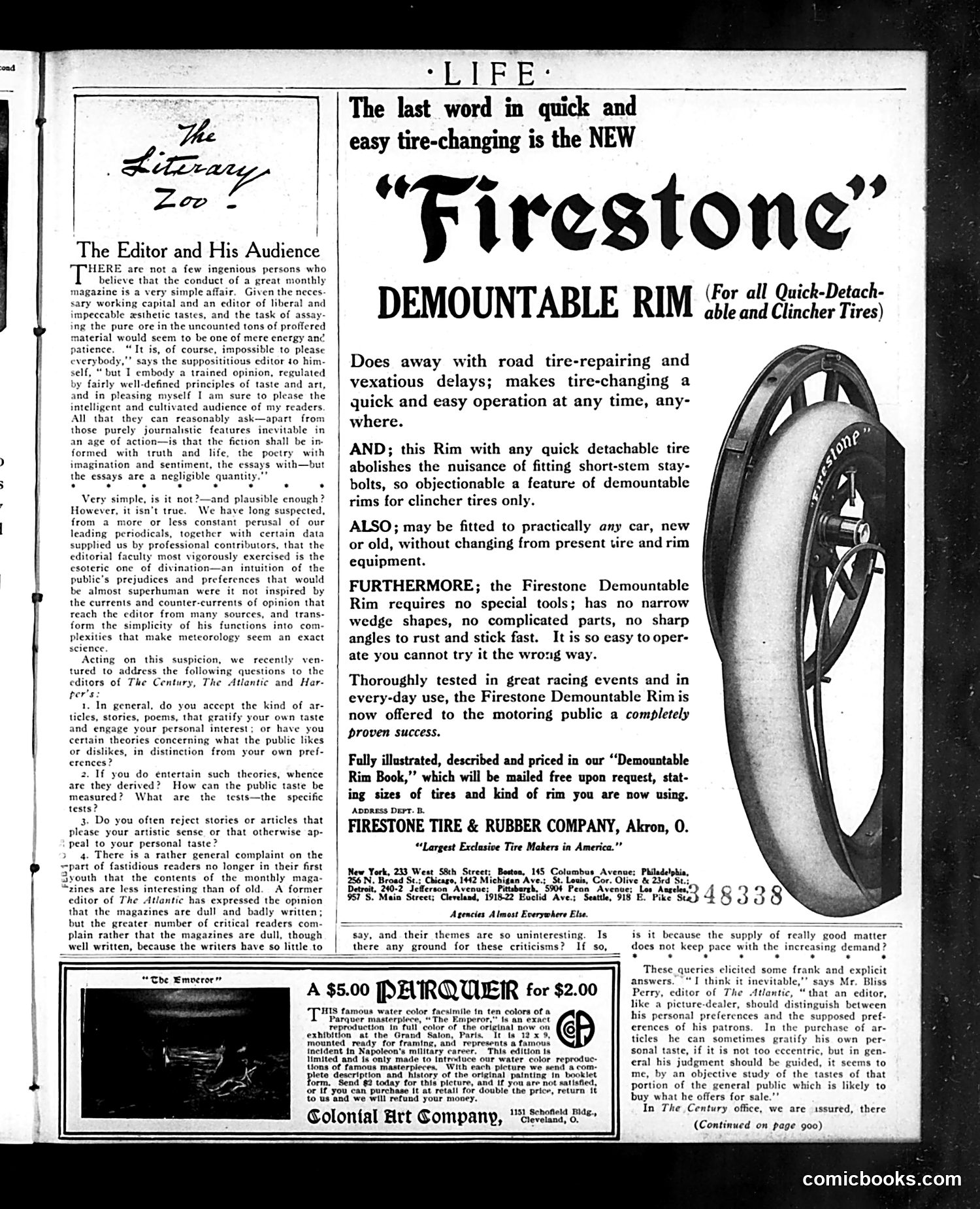
This column addresses criticism of *Life* magazine's editorial practices. The editor responds to readers' complaints about the magazine's content, defending his choices and explaining his philosophy. The editor argues he aims to please intelligent readers while acknowledging he cannot satisfy everyone's tastes. He responds to specific accusations: that *Life* accepts too many mediocre submissions, that editors impose personal preferences on content, and that the magazine publishes insufficiently serious material. Rather than a political cartoon, this is essentially the editor's column—a meta-commentary defending editorial judgment itself. It's notable mainly for showing early 20th-century magazine culture and debates over what constitutes worthy literary content for a satirical publication's audience.
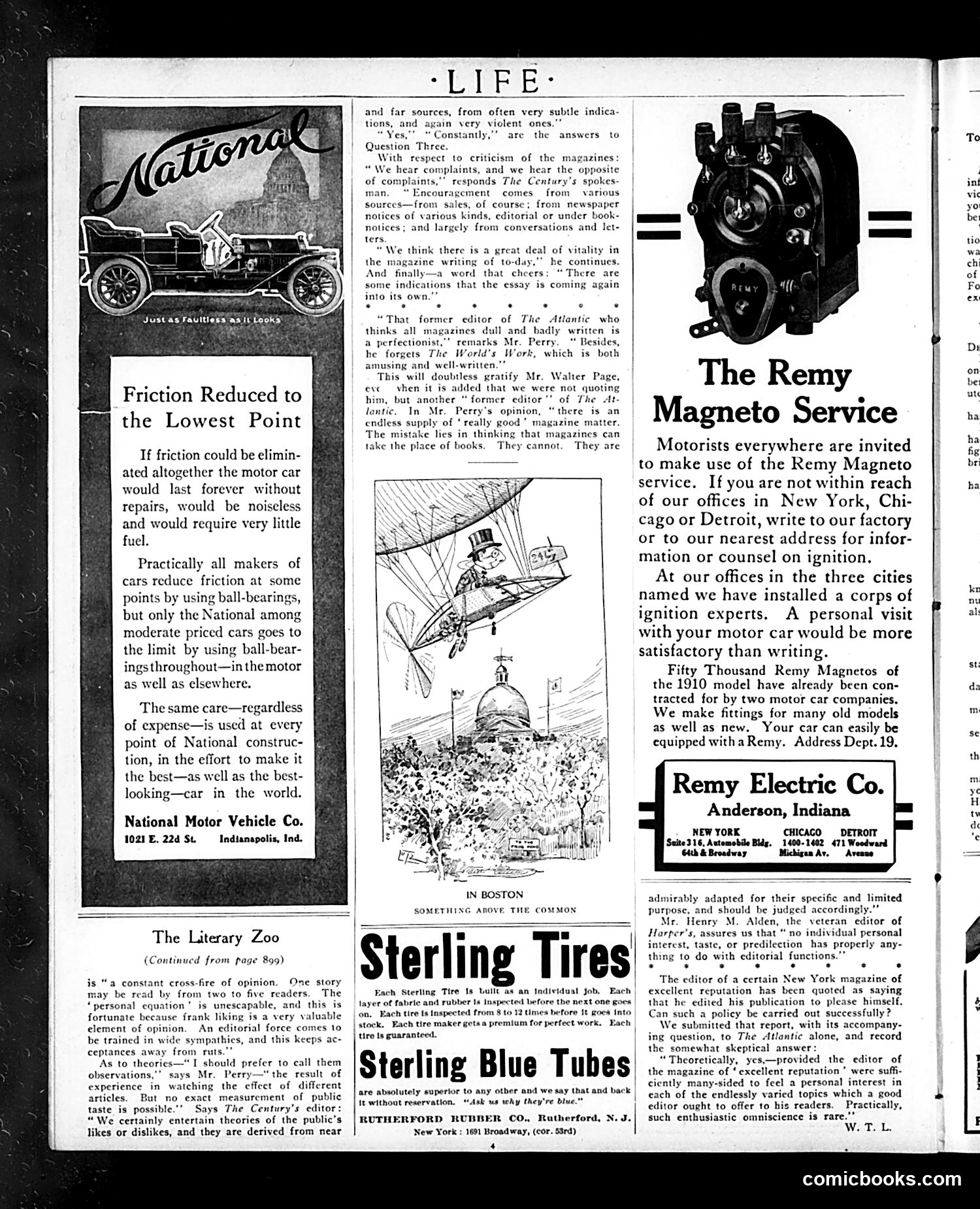
This page is primarily **advertising** for automobiles and automotive parts (National Motor Vehicle Co., Remy Magneto Service, Sterling Tires). The "Literary Zoo" section continues editorial content critiquing magazine writing and editors. The text discusses complaints about magazine quality, referencing former editors of *The Atlantic* and *The World's Work*. It appears to be a meta-commentary on journalism standards—debating whether magazines can rival books as serious literature. The cartoon showing a figure with an umbrella among clouds likely illustrates this abstract debate about editorial quality and magazine credibility, though its specific meaning is **unclear without fuller context** from the preceding page. The overall content reflects early 20th-century tensions between mass-market magazines and literary establishments.
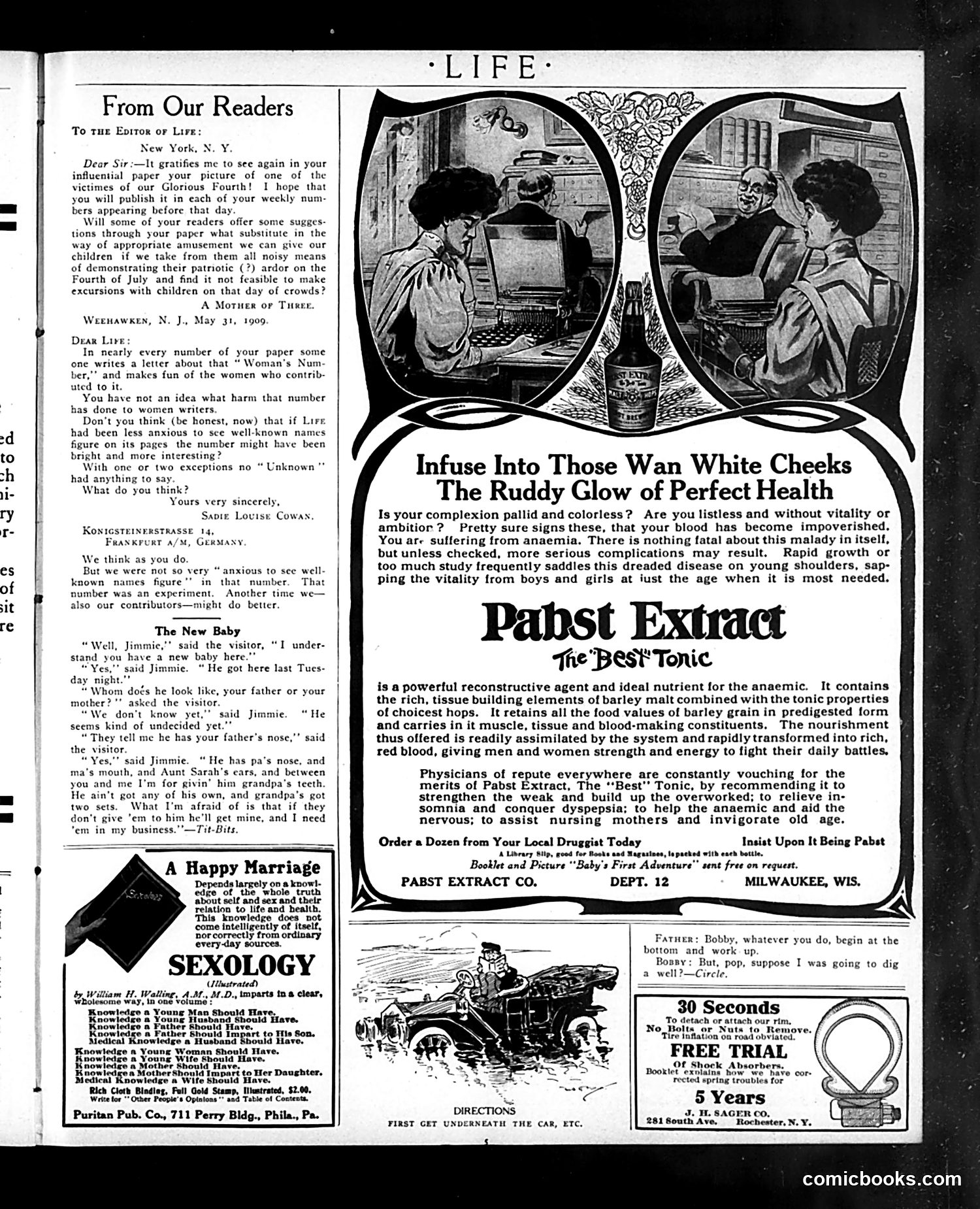
This page is primarily **advertising rather than satire or political cartoon**. The dominant content is a full-page advertisement for **Pabst Extract**, a medicinal tonic claiming to cure anemia and restore health, particularly targeting young women with "pallid and colorless" complexions. The illustrations show women in domestic settings, reflecting early 1900s gender roles. The ad employs period medical pseudoscience, promoting the product as containing "barley malt" and "chicories hops" to build blood and vitality. Supporting content includes reader letters, a brief story titled "The New Baby," and smaller ads including one for a "Sexology" book. The magazine's tone reflects common early 20th-century attitudes toward women's health and domestic life, with patent medicines presented as legitimate remedies.
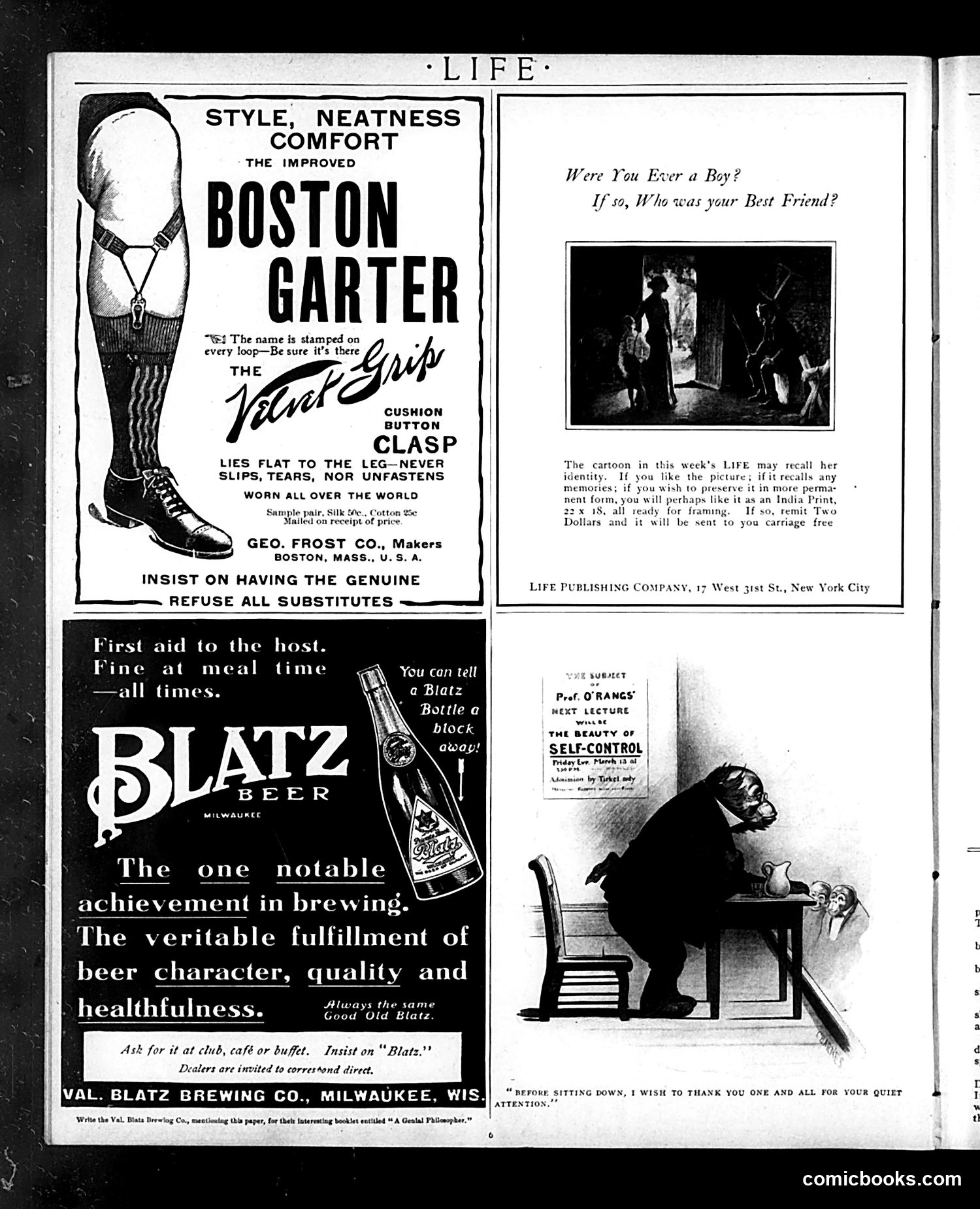
This page is primarily **advertising** rather than political satire. The left side features two ads: one for Boston Garters (hosiery with "Velvet Grip" cushion buttons) and one for Blatz Beer from Milwaukee, emphasizing quality and "healthfulness." The right side contains a cartoon titled "Were You Ever a Boy? If so, Who was your Best Friend?" showing what appears to be a nostalgic scene of childhood friendship. Below it is a separate cartoon of a man at a desk, captioned "Before sitting down, I wish to thank you one and all for your quiet attention." These cartoons reflect early-20th-century American humor about boyhood reminiscence and public speaking etiquette—gentle, non-political humor typical of Life magazine's satirical approach during this era.
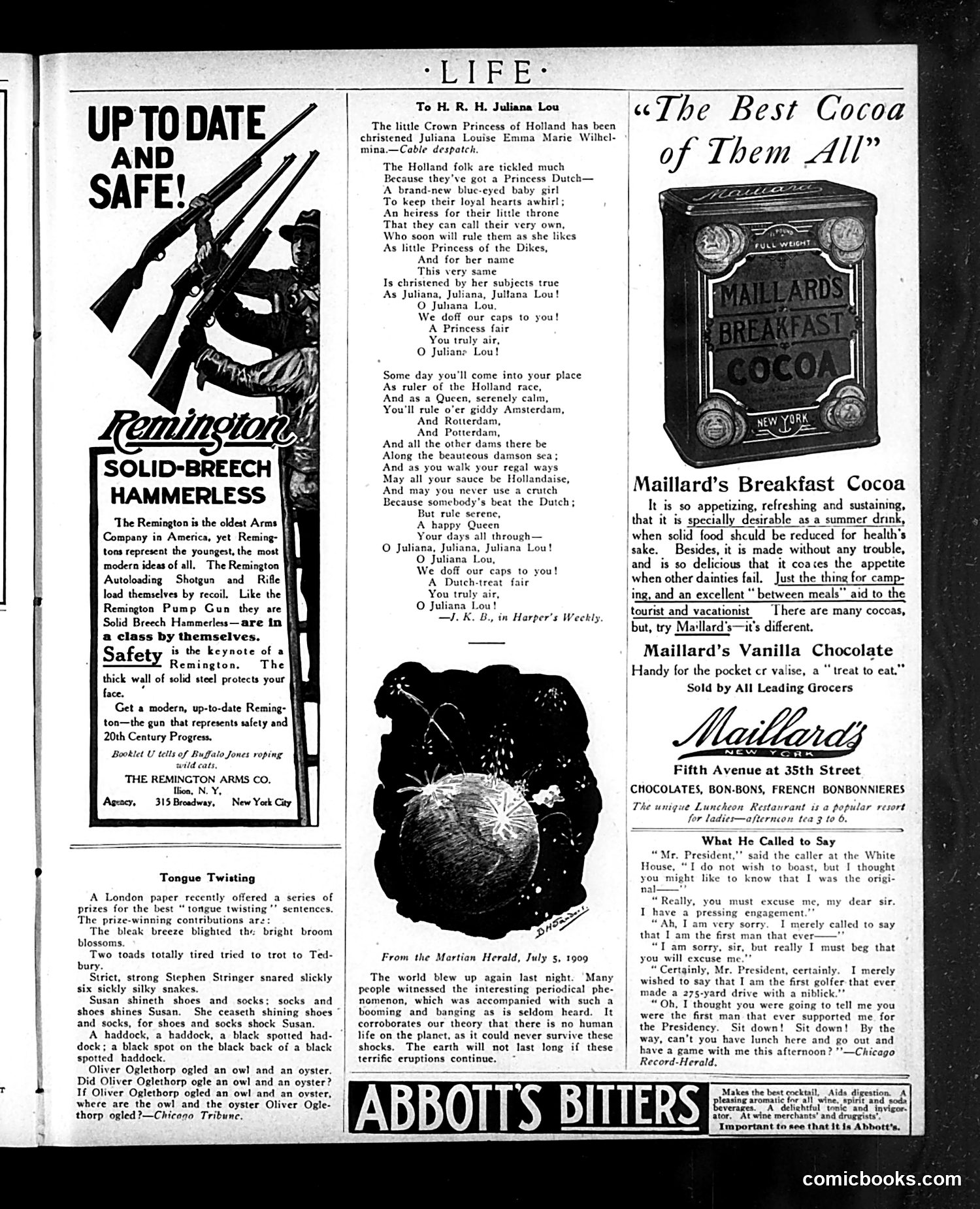
This page is primarily **advertising and light satirical content**, not political commentary. The left side features a **Remington firearms ad** emphasizing "Safety" and modernity—playing on early-20th-century anxieties about gun technology. The tagline "Up to Date and Safe!" suggests competition in the arms market. The center contains a **humorous poem** celebrating the birth of Princess Juliana of Holland, written in playful, congratulatory verse. This is straightforward celebratory journalism, not satire. The right side advertises **Maillard's chocolate and cocoa products**, with testimonial-style copy. Below is a brief **humorous anecdote** titled "Tongue Twisting" about wordplay and a vicar—light comedy filler. The **martian Herald illustration** appears unrelated to surrounding text. Overall, this is a typical early-1900s magazine page mixing ads, society news, and mild humor rather than sharp political satire.
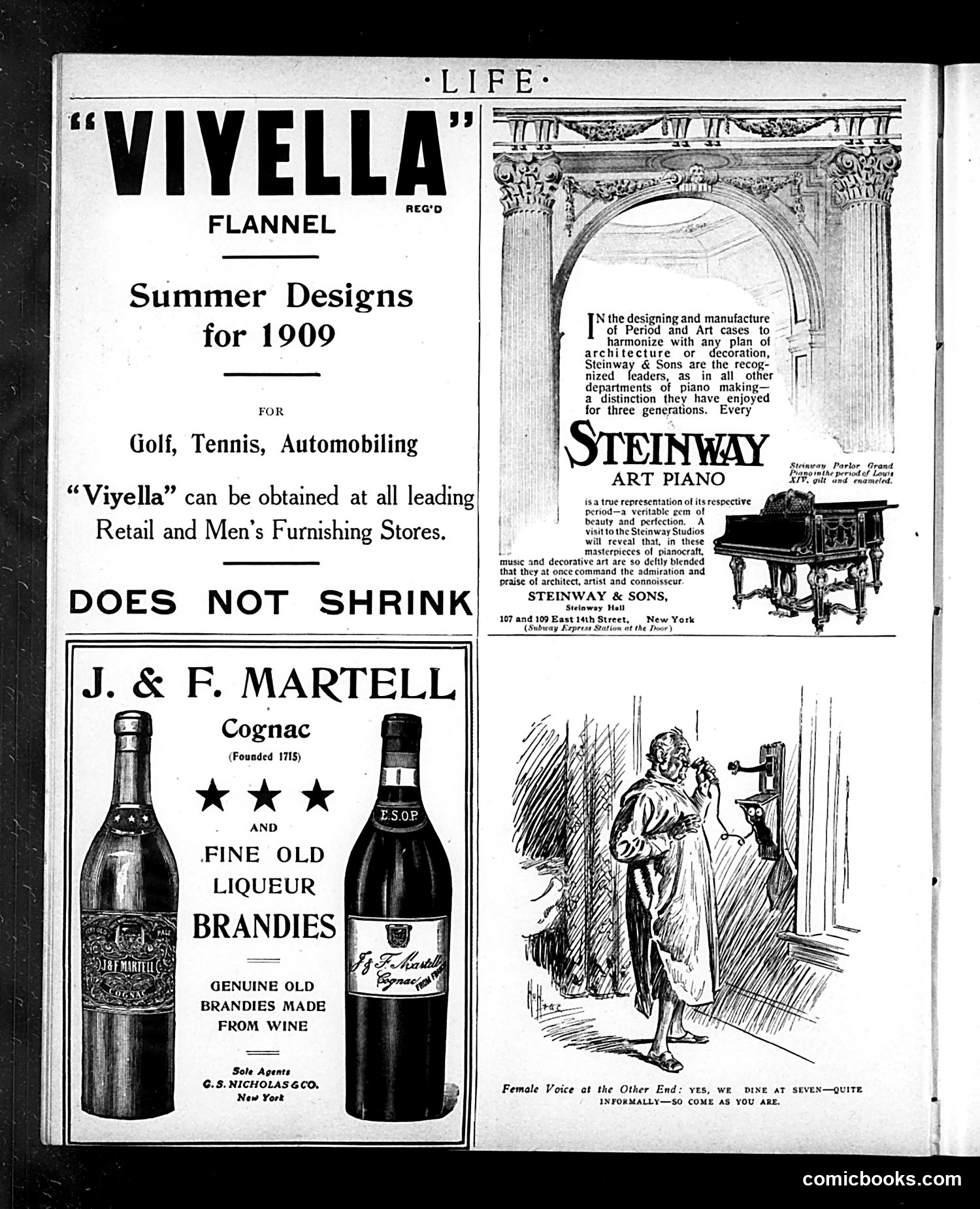
This page is primarily **advertising content** from Life magazine, circa 1909. The left side features ads for Vivella flannel (marketed for summer activities like golf and tennis, emphasizing it "does not shrink") and J. & F. Martell Cognac brandy. The right side contains a **Steinway piano advertisement** and a small illustration labeled "Female Voice at the Other End" depicting a woman at what appears to be a telephone, with dialogue mentioning "seven—quite informally—do come as you are." This final illustration appears to be **social satire about telephone etiquette**—likely mocking informal or improper phone interactions among the era's social classes. The page itself contains **no political cartoons**, just period advertisements and light social humor.
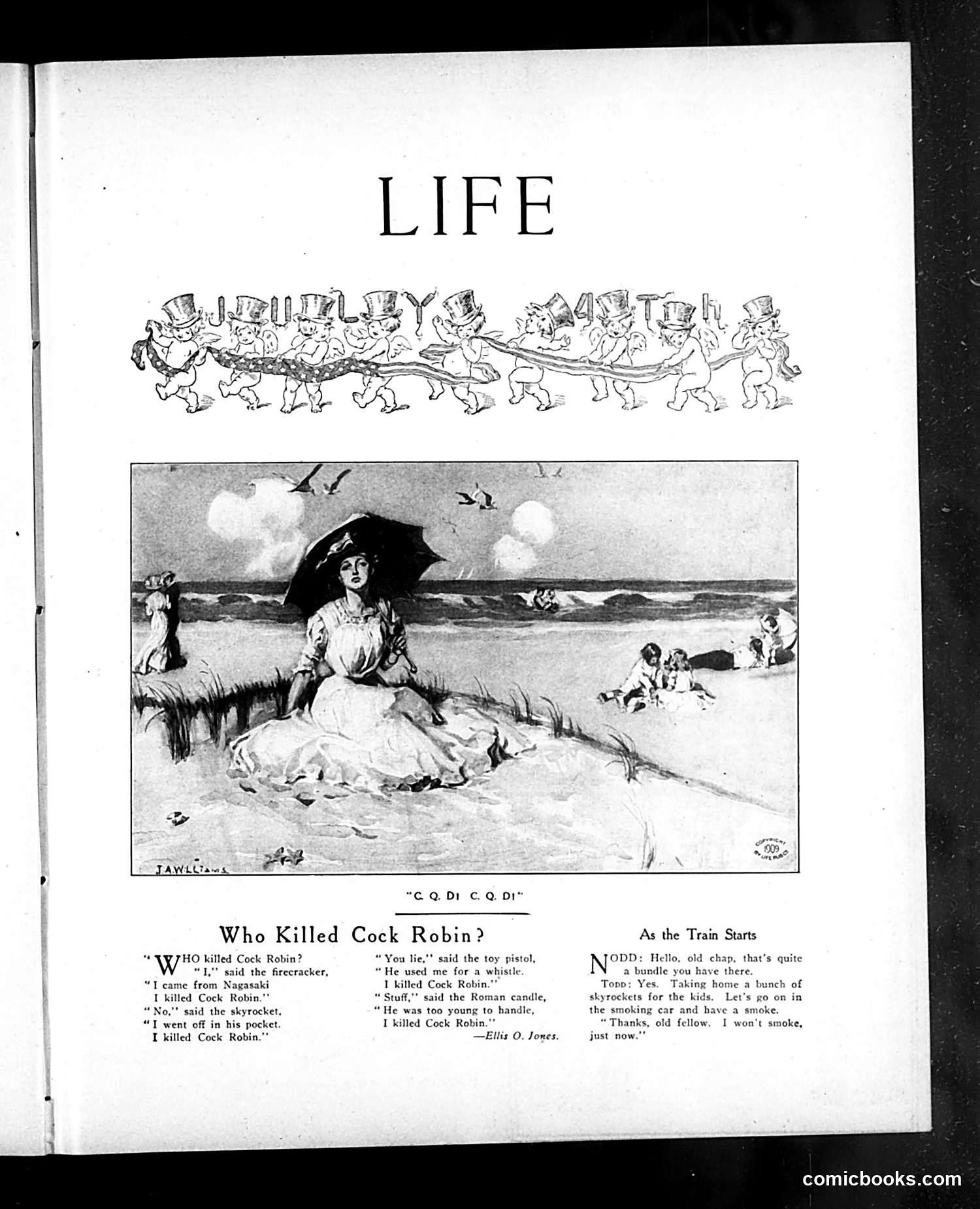
This page features a beach scene illustration with three literary pieces about "Who Killed Cock Robin?" — the traditional nursery rhyme. The content is straightforward satirical humor rather than political commentary. The illustration shows a woman with a parasol on a beach, surrounded by children and beachgoers. The three text versions — credited to different authors including Elia O. Jones — humorously reinterpret the nursery rhyme by having different characters confess to the robin's death (a toy pistol, Roman candle, and skyrocker all claim responsibility). The joke targets Victorian-era literary pretension by treating a simple children's verse as material worthy of elaborate poetic reimagining. It's gentle satire of how serious writers might over-intellectualize nursery rhymes. The beach setting provides light summer context for what is essentially wordplay and parody.
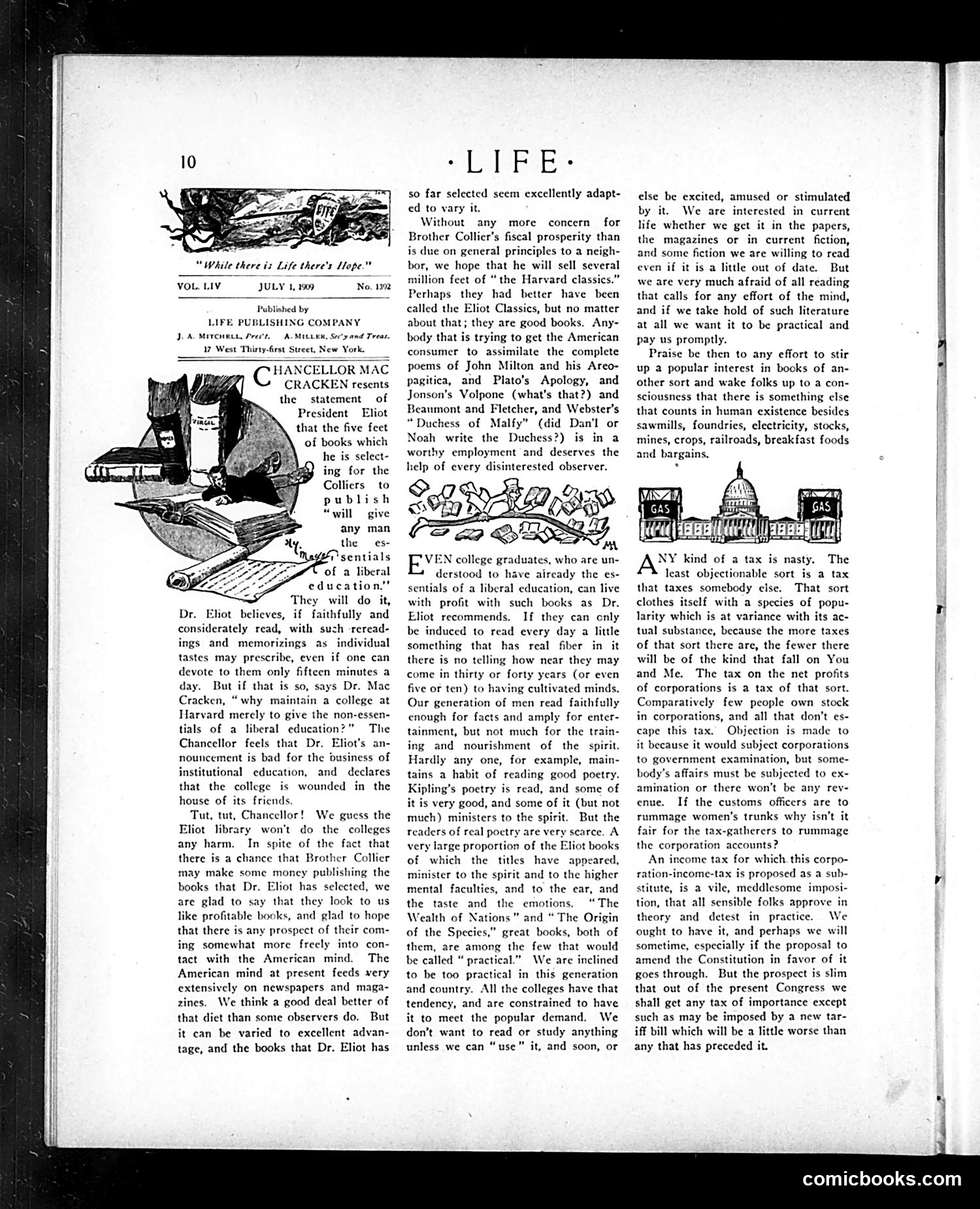
This page from *Life* (July 1, 1909) contains an editorial essay on college education rather than a political cartoon. The main illustration shows a figure labeled "Chancellor Mac Crackken" at a desk surrounded by books, satirizing his effort to select "the essentials of a liberal education" for Princeton University. The text criticizes the practicality obsession in American education, arguing that colleges prioritize "useful" knowledge over genuine intellectual nourishment. The author defends reading literature like Milton and Plato, warning against reducing education to mere vocational training. The piece advocates for preserving classical humanities against pressure to make curriculum narrowly "practical"—a tension between liberal arts and utilitarian education that remains relevant today.
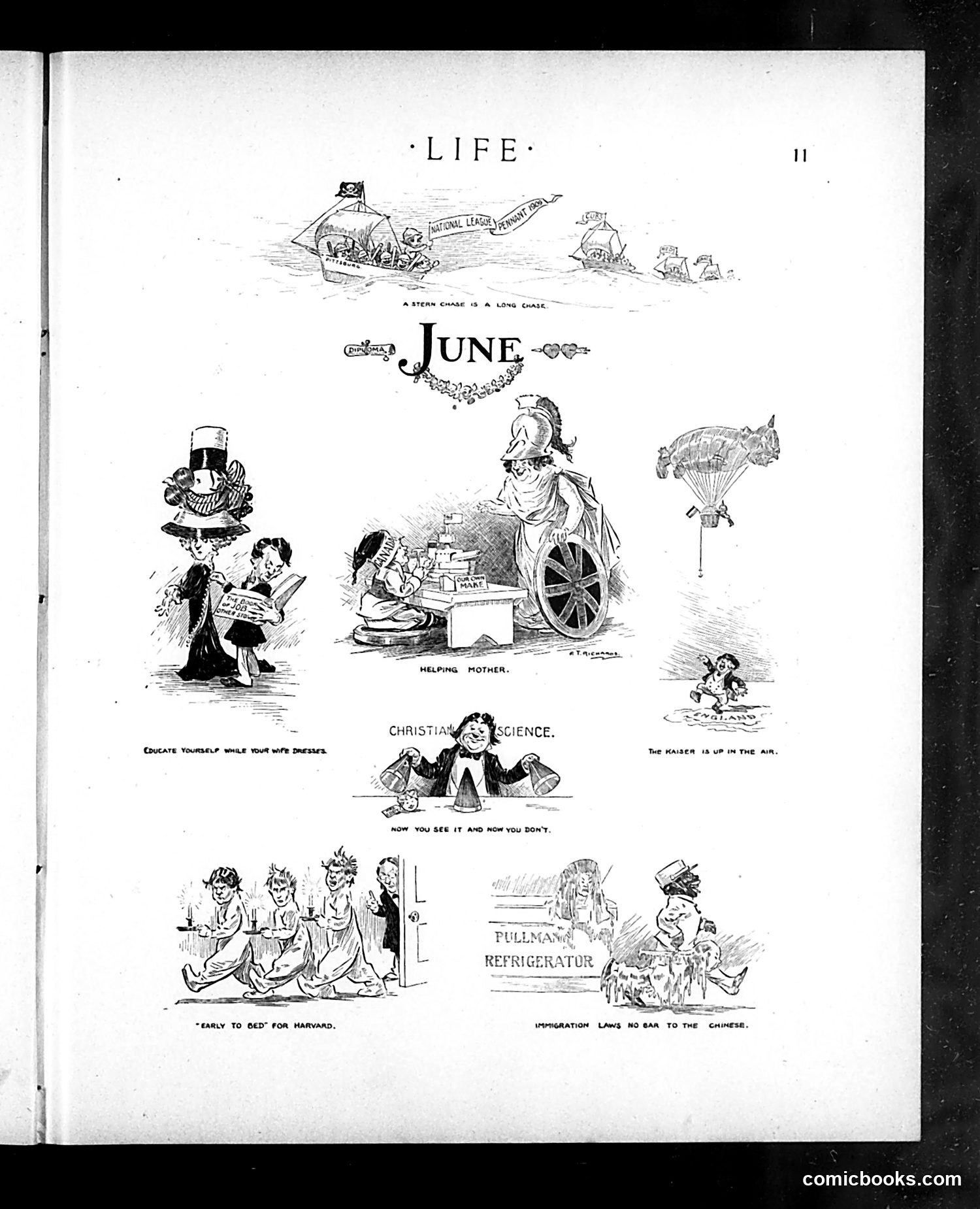
This page from *Life* magazine's June issue contains multiple satirical cartoons mocking contemporary American institutions and social issues: **"A Stern Chase is a Long Chase"** (top): Naval vessels, likely satirizing military spending or naval policy. **"Helping Mother"**: A figure at a spinning wheel, possibly critiquing women's domestic labor. **"Christian Science"** (center): A character saying "Now you see it and now you don't," mocking Christian Science's healing claims. **"Early to Bed for Harvard"**: Students in beds, satirizing Harvard's strict dormitory rules or academic culture. **"Immigration Laws No Bar to the Chinese"** and **"The Kaiser is Up in the Air"**: References to immigration policy and likely World War I-era politics, though specifics remain unclear without fuller context. The overall page uses visual satire to critique politics, social institutions, and contemporary controversies.
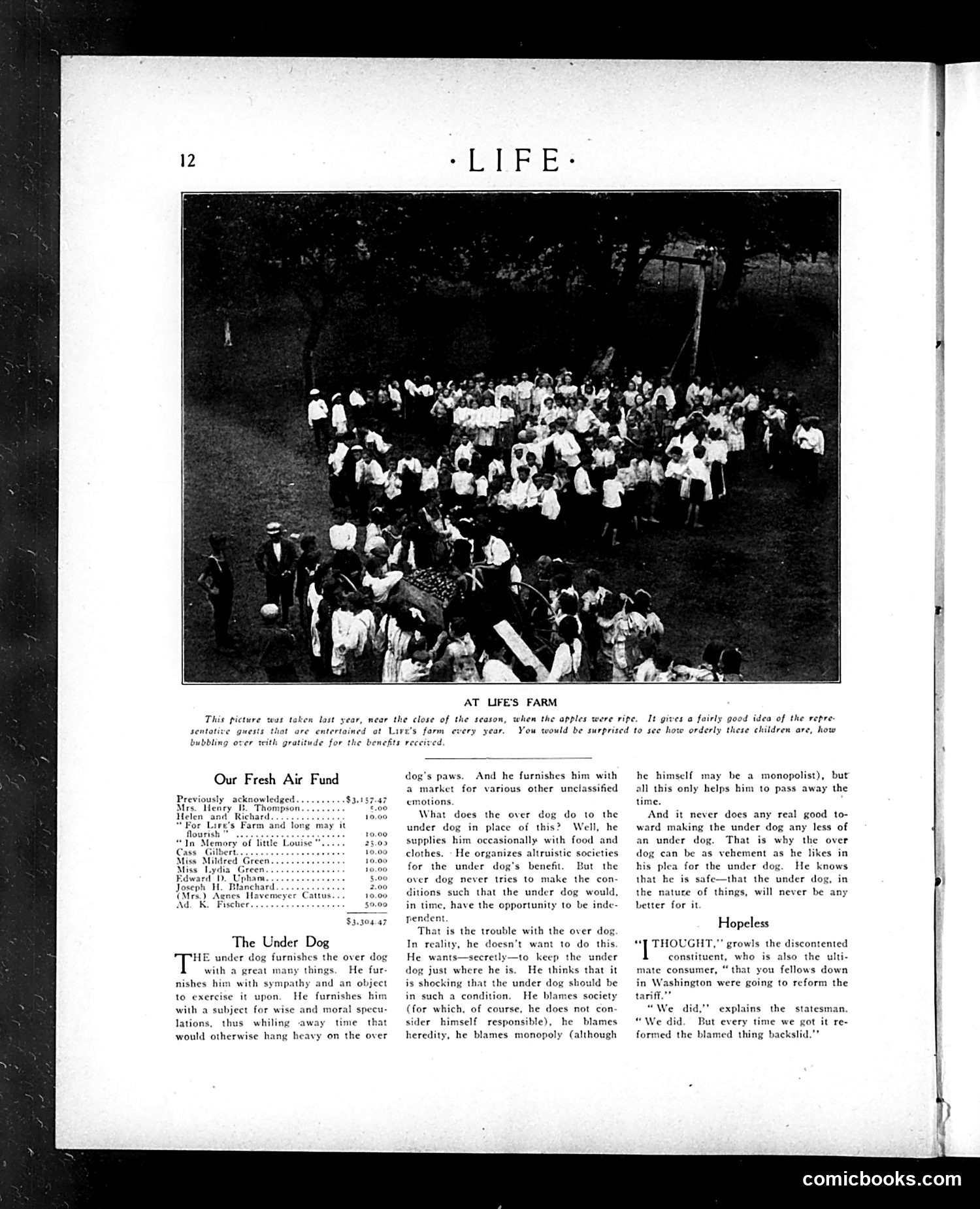
This page contains a photograph labeled "At Life's Farm" showing a large outdoor gathering of people seated at tables, apparently at an entertainment event. The caption notes this was taken "near the close of the season, when the apples were ripe." The accompanying articles discuss "Our Fresh Air Fund" (acknowledging donations for children's outings) and "The Under Dog," a satirical piece about social hierarchy and inequality. The "Under Dog" section critiques how privileged people patronize those of lower social status, treating them as objects of charity rather than equals—a commentary on class consciousness and the limitations of philanthropic gestures that preserve rather than challenge social hierarchies. The piece appears to mock self-satisfied paternalism common in Gilded Age America.
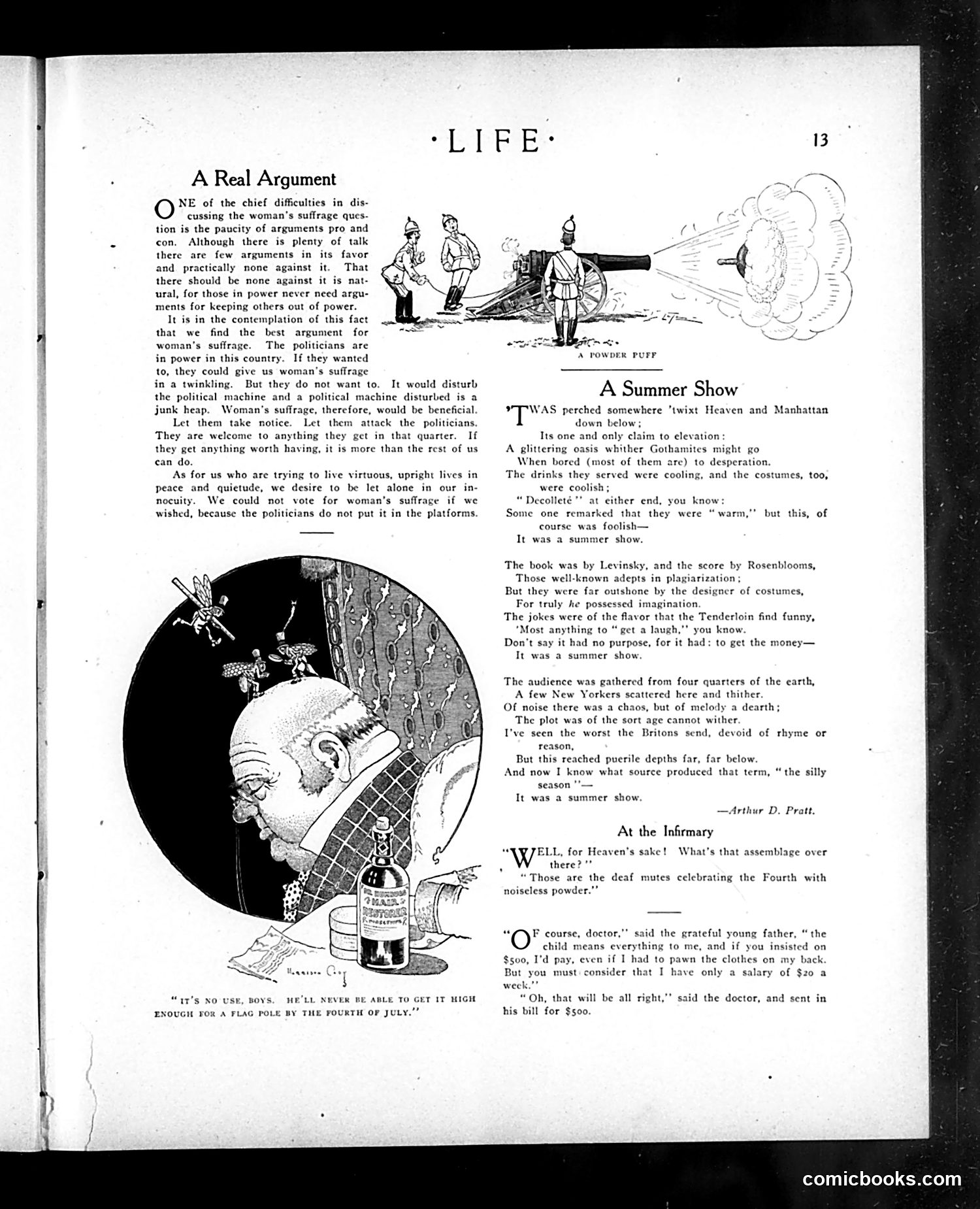
**"A Real Argument"** (top left): This editorial attacks politicians' inaction on women's suffrage. The text argues that if politicians truly opposed women's voting rights, they should openly debate it rather than use parliamentary delay tactics. The piece criticizes the political establishment for avoiding the issue. **"A Powder Puff"** (top right): An illustration mocking a military display, with the caption suggesting the demonstration is ineffectual—"it's no use, boys. he'll never be able to get it high enough for a flag pole by the fourth of july." This appears to satirize failed military preparedness or inadequate weaponry. **"A Summer Show"** and **"At the Infirmary"**: These are separate humorous pieces with no direct political content visible on this page.
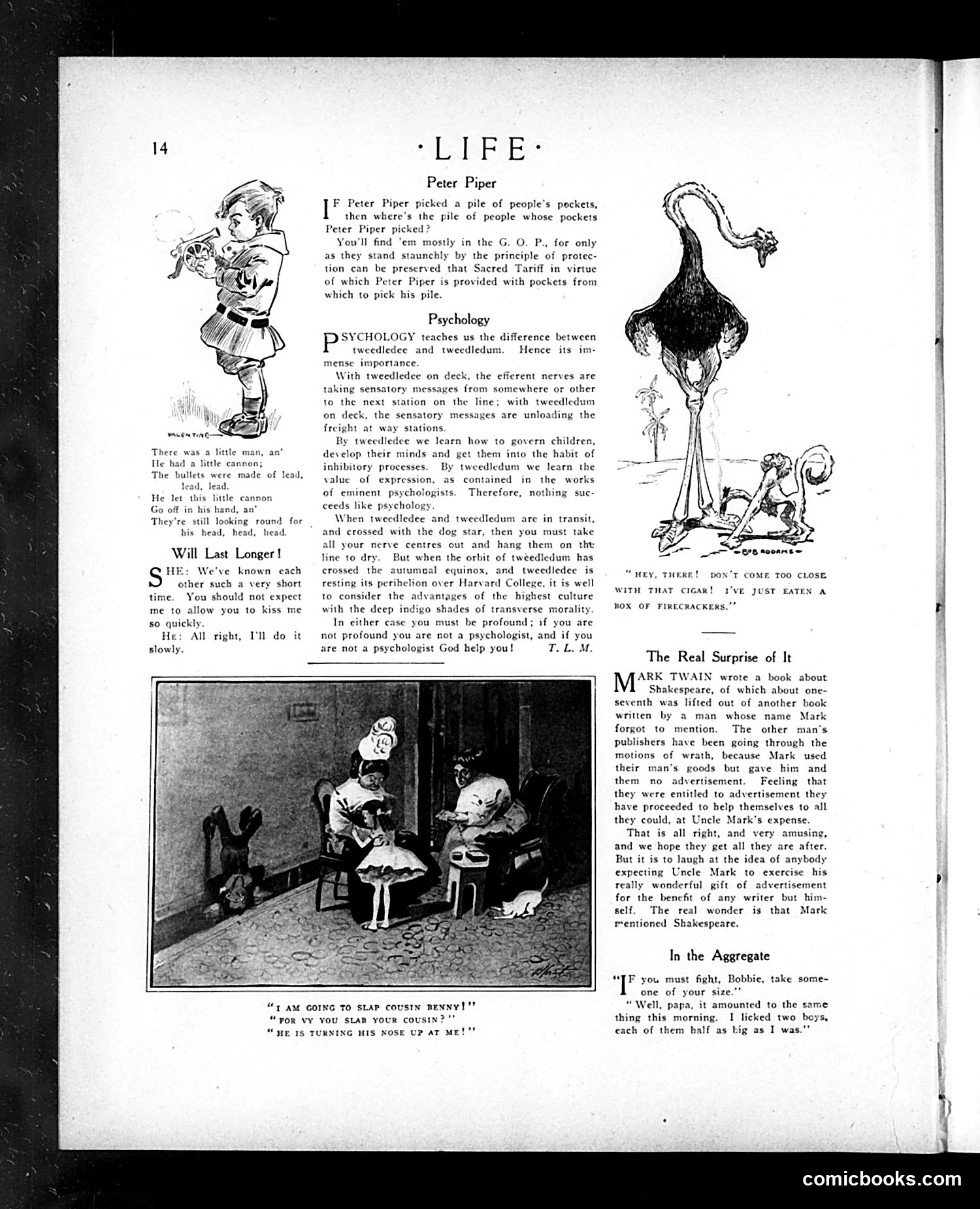
This page contains several satirical pieces typical of early 20th-century Life magazine humor: **"Peter Piper"** mocks Republican protectionist tariff policy by rewriting the nursery rhyme. It suggests GOP politicians pick ordinary citizens' pockets while claiming to protect them through tariffs—the "Sacred Tariff" supposedly fills their pockets, which they then pick from. **"Psychology"** is nonsensical satire of pseudo-intellectual psychology jargon. Terms like "tweedledee," "tweedledum," and references to "the dog star" and "autumeal equinox" parody how psychology was being presented as profound science when it was often incomprehensible nonsense. **"The Real Surprise of It"** criticizes Mark Twain for plagiarizing from another author's Shakespeare book without credit, then ironically noting that Twain's fame actually benefited the original author through free publicity—the opposite of what one might expect. The cartoon and shorter jokes are light domestic humor unrelated to political commentary.
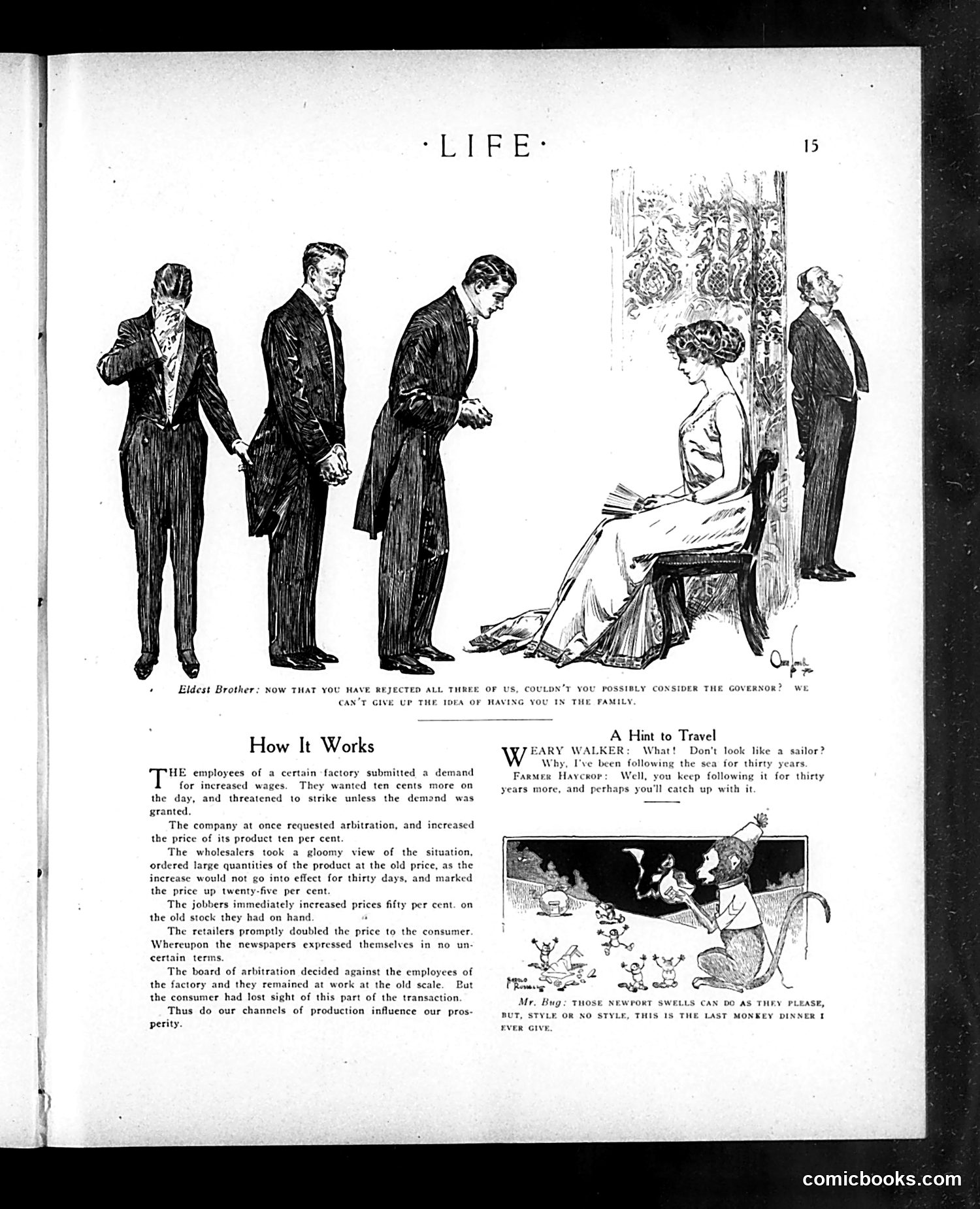
**Top Cartoon:** Three men (labeled "Eldest Brother") present themselves as suitors to a seated woman, then suggest "the Governor" as an alternative. This appears to be political satire about marriage proposals and political candidates—the joke suggests that after rejecting three suitors, she should consider a governor, implying politicians are as disposable or interchangeable as rejected romantic prospects. **"How It Works" Article:** This is economic satire tracing how a factory wage dispute cascades through supply chains. Workers demand a ten-cent daily raise; instead of granting it, management raises product prices 10%, which wholesalers exploit by buying at old prices and marking up 25%, jobbers increase 50%, retailers double prices to consumers. The irony: arbitration denies workers their raise, but consumers unknowingly bear the cost anyway. The piece satirizes how middlemen profit from labor disputes while actual workers gain nothing. **"A Hint to Travel" Cartoon:** A weary sailor and farmer joke about the sailor "following the sea for thirty years"—with the farmer suggesting he'll catch up with it in thirty more. A gentle pun on slow progress.
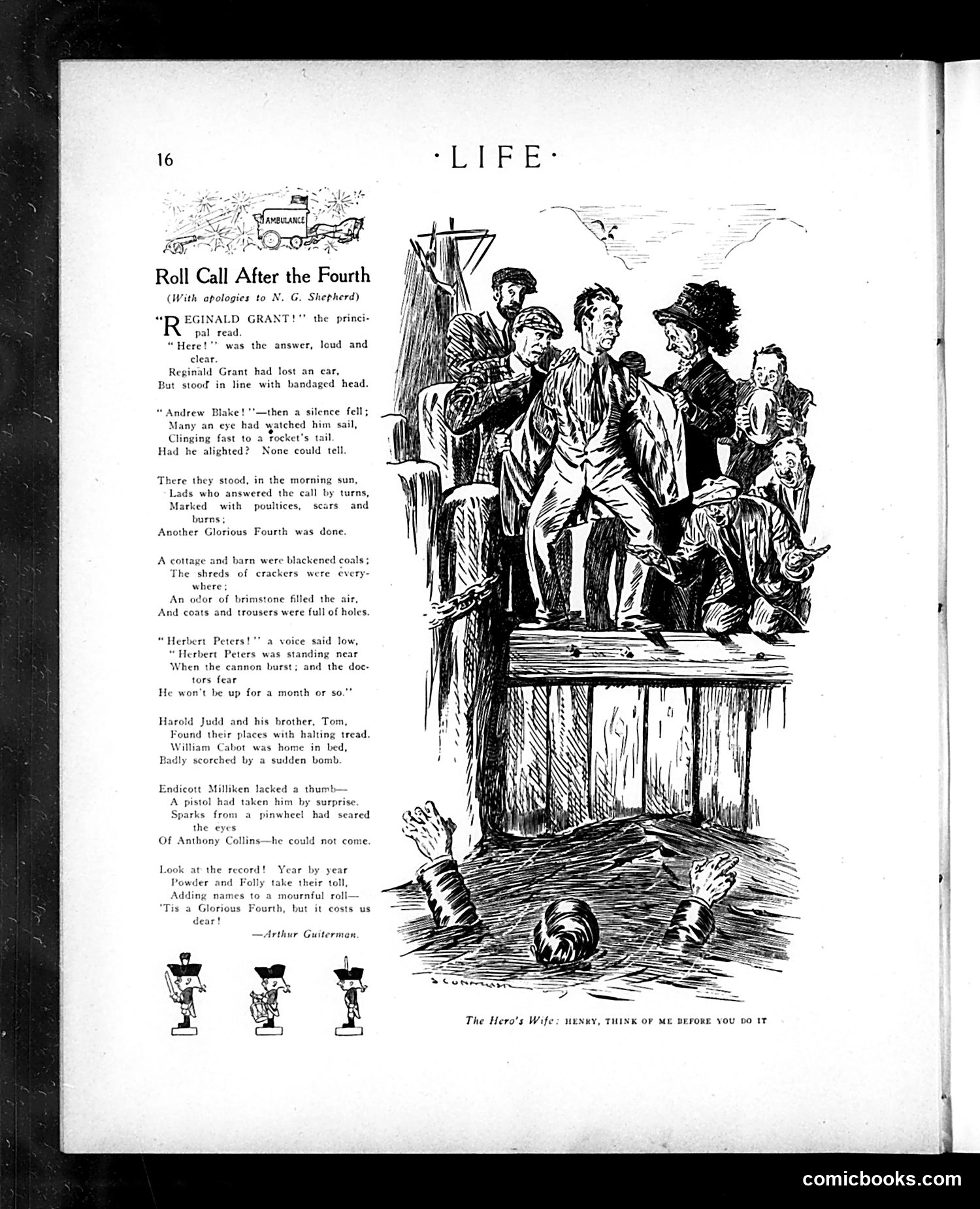
This poem and illustration satirize Fourth of July fireworks injuries. Set in a schoolroom roll call, each student's name is answered with descriptions of Independence Day accidents: lost ears, near-fatal rocket rides, burns, blindness, missing thumbs, and cannon injuries. The illustration shows a schoolmaster reading names while injured boys stand before him, some visibly bandaged. The satire critiques the American celebration's human cost—"Powder and Folly take their toll" annually. By treating horrific injuries as routine Fourth of July consequences, the piece mocks both the public's casual acceptance of these preventable accidents and the glorification of reckless patriotic celebration. The caption "The Hero's Wife" suggests ironic commentary on masculine risk-taking. Attributed to poet Arthur Guiterman, this appears designed to promote fireworks safety through dark humor.
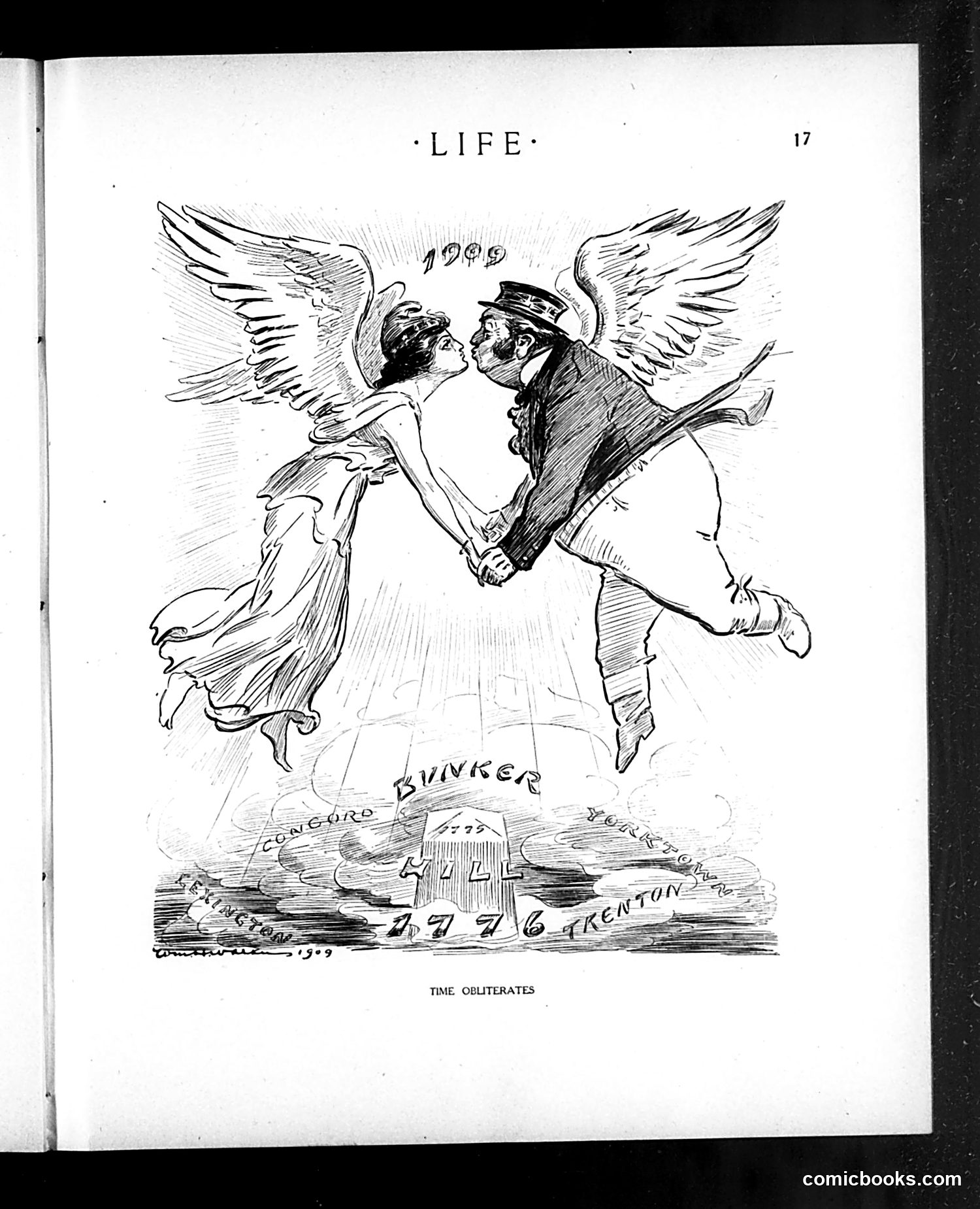
This satirical cartoon depicts two winged figures (appearing to represent angels or allegorical concepts) dancing above a grave. The inscription reads "Concord Bunker Hill 1776 Trenton," referencing American Revolutionary War battles. The year "1899" appears in the image. The title "Time Obliterates" suggests the cartoon's theme: that historical memory fades. The two figures seem to represent competing narratives or interpretations of American history, celebrating over a grave marked with Revolutionary War sites. This likely critiques how time and distance allow people to forget or reinterpret historical events, or how different parties claim ownership of patriotic legacy. The 1899 date places this during a period of American imperial expansion and historical revisionism.
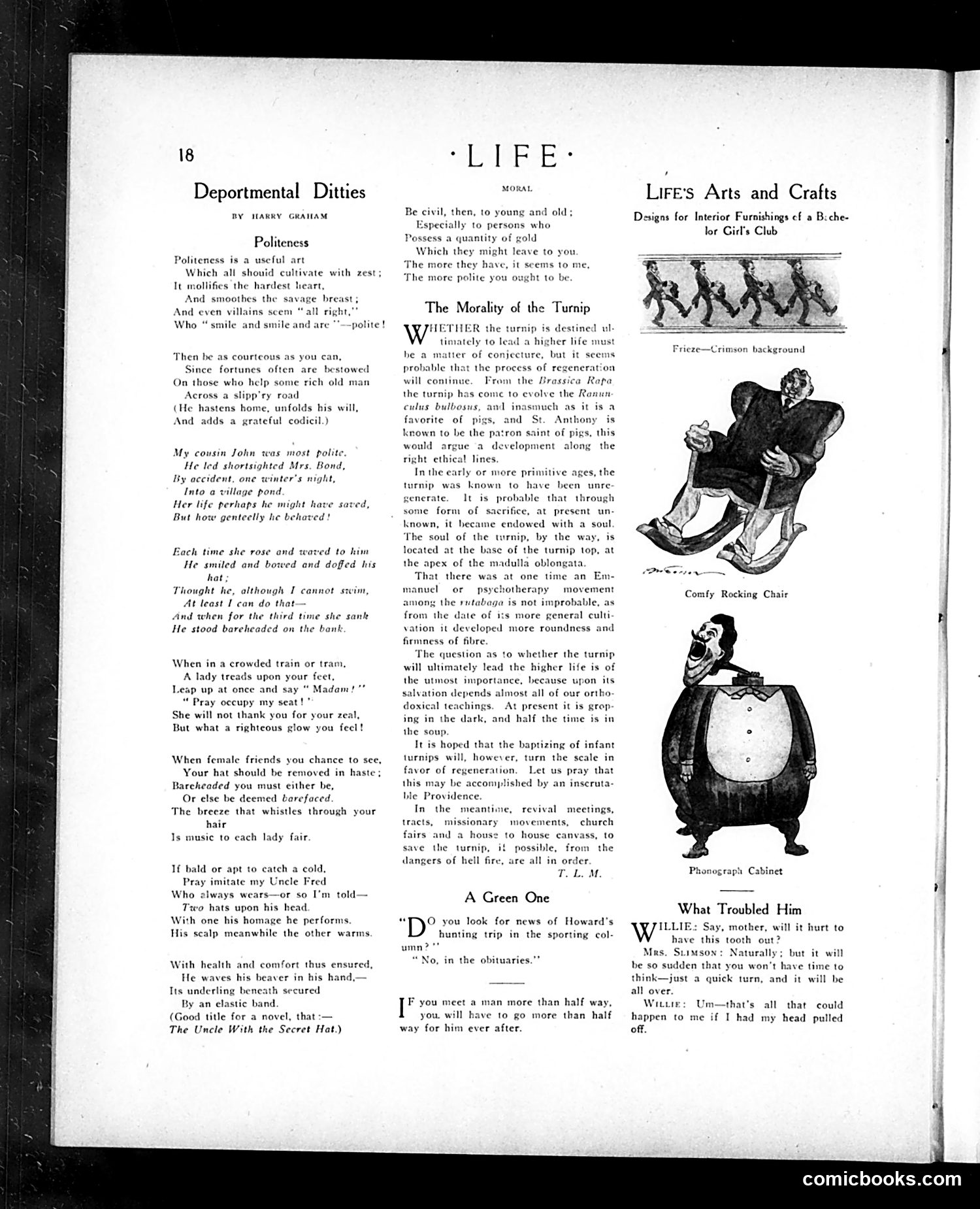
This page from *Life* magazine contains humorous poetry and illustrations satirizing Victorian social conventions. **"Politeness"** by Harry Graham mocks excessive politeness as a tool for social climbing. The central joke: a man named John so obsessively polite he allows a woman (Mrs. Bond) to drown in a pond rather than break decorum—he merely tips his hat as she sinks. The satire targets how rigid etiquette rules can override basic human compassion. The advice about removing hats repeatedly, even wearing two hats simultaneously, exaggerates the absurdity of pointless social rituals. **"The Morality of the Turnip"** is pseudo-philosophical nonsense that pretends to analyze whether turnips possess souls and can achieve spiritual salvation. This parodies overwrought moral philosophy and religious earnestness applied to trivial subjects. **The cartoon illustrations** include a "Comfy Rocking Chair" and "Phonograph Cabinet"—appearing to be design examples for *Life's* Arts and Crafts section. The tone throughout is satirical—mocking Victorian politeness, social pretension, and excessive formality through exaggeration and absurdist humor.
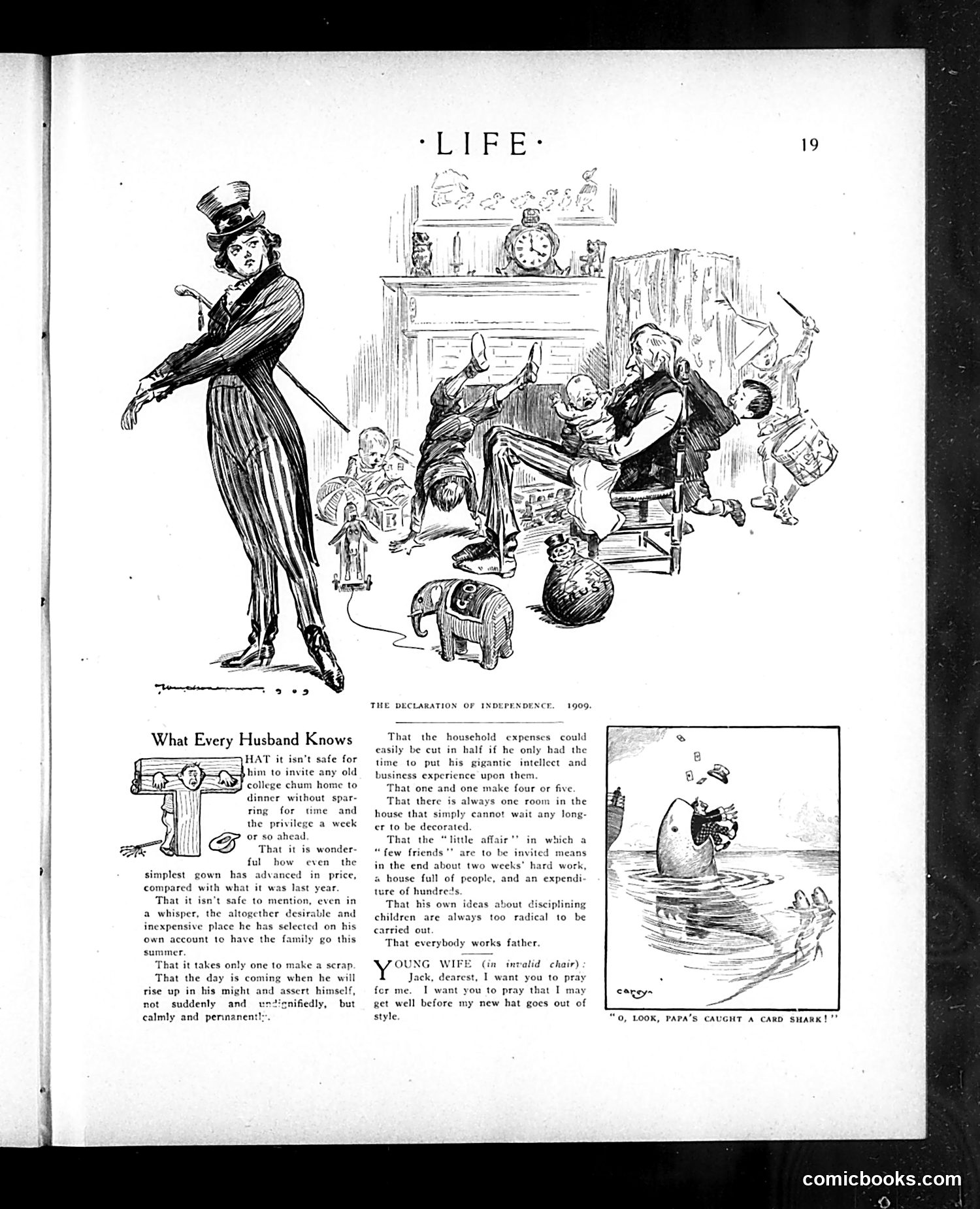
This page satirizes married life and gender dynamics in early 1900s America through husband-wife conflict humor. **Main cartoon** ("The Declaration of Independence"): A domineering wife controls the household while her henpecked husband stands aside with a whip, illustrating the ironic "declaration" that wives rule domestic life despite legal male authority. **Text section**: Lists humorous "truths" husbands must accept—wives' spending habits, surprise dinner guests requiring advance notice, home decoration needs, and modest expenses ballooning unexpectedly. The recurring joke: husbands surrender rational control to wives. **Bottom cartoon**: A bedridden wife asks her husband to pray she recovers before her new hat goes out of fashion—mocking women's vanity and fashion obsession as more important than health. The satire targets both wives' material consumption and husbands' emasculation, reflecting contemporary anxieties about female spending power and shifting domestic authority in the Progressive Era.
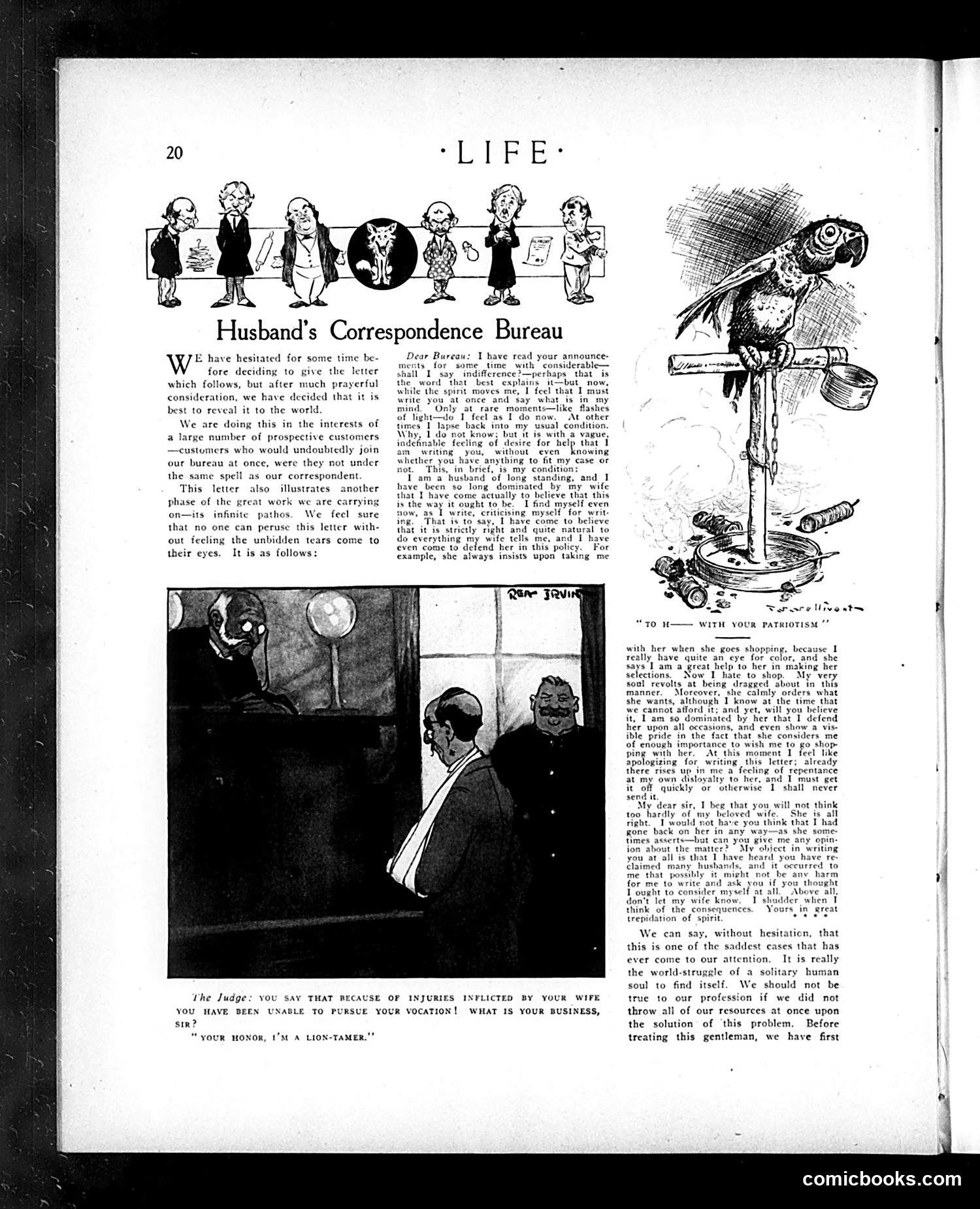
This page satirizes a fictional advice bureau addressing marital discord. The setup presents a letter from a husband completely dominated by his wife—he accompanies her shopping against his will, defends her wasteful spending, and cannot assert himself despite recognizing the problem. The accompanying cartoon shows a judge and lion-tamer, captioned: the judge questions why marital injuries prevented the man from pursuing his vocation (lion-taming), and the husband replies he's a "lion-tamer"—suggesting his wife is the "lion" he cannot control. The satire targets emasculated husbands of the era, mocking both the man's complete subjugation to his wife and the idea of an "advice bureau" solving such domestic tyranny. The parody highlights the paradox: a man who tames dangerous lions cannot manage his own household, suggesting wives wielded surprising domestic power while husbands remained publicly dominant but privately powerless. The tone is comedic but also critiques rigid gender dynamics of the period.
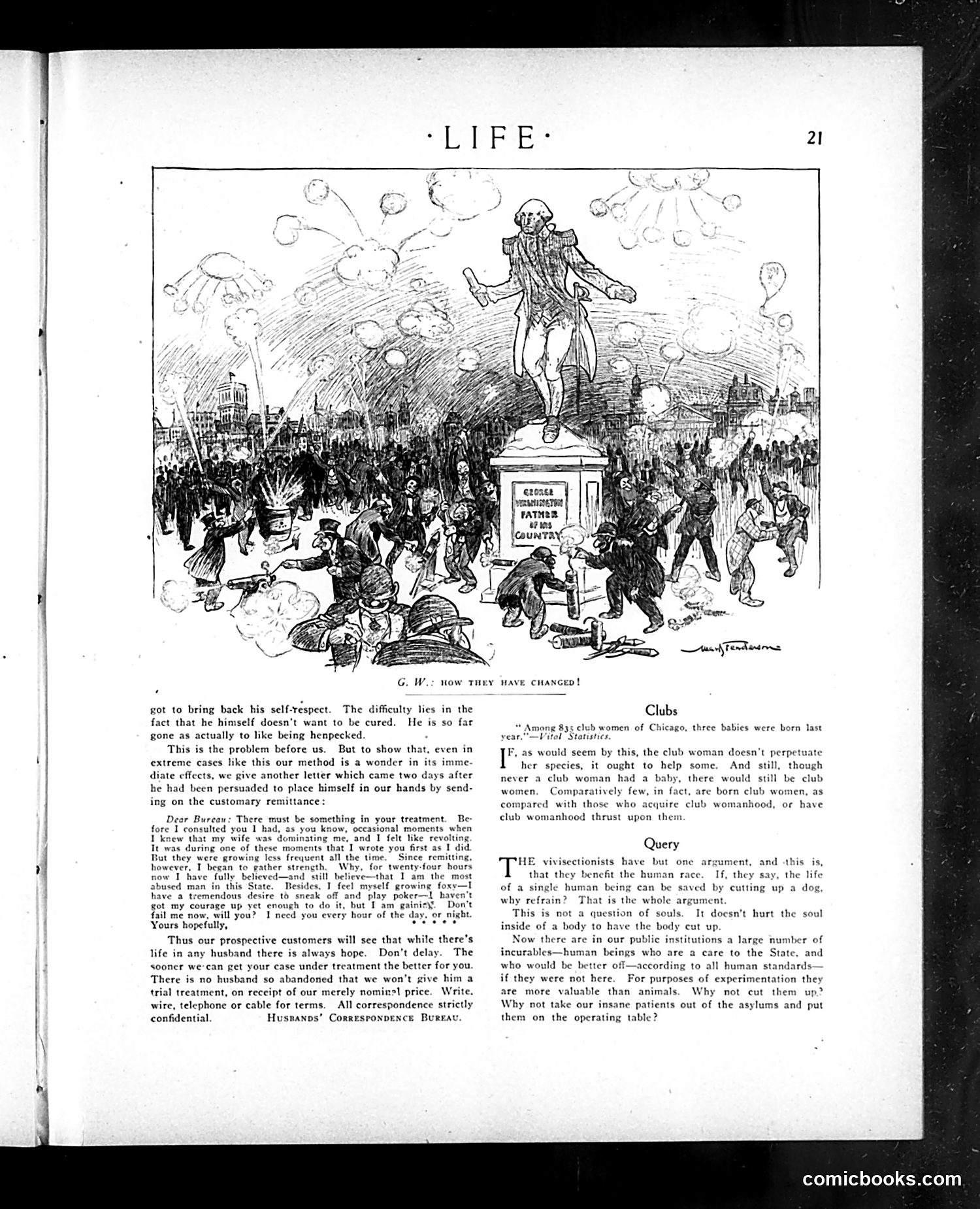
## Main Cartoon: "G.W.: How They Have Changed!" The illustration depicts a giant statue of George Washington being celebrated by a massive crowd below. The satirical point appears to be about changing American character or values—the caption suggests that modern Americans (the crowd) represent a departure from Washington's ideals or virtues. ## Letter Features The page includes two humorous mock-advice letters: 1. **"Husbands' Correspondence Bureau"**: A fake advice column satirizing henpecked husbands seeking help through dubious treatments. It mocks both weak men and manipulative marriage dynamics of the era. 2. **Subsequent columns** ("Clubs," "Query") critique: - **Club women**: Sarcastically noting that Chicago club women rarely have children, questioning whether such organizations truly benefit society - **Vivisection debate**: A pointed moral argument questioning why animal testing is acceptable if human experimentation on institutionalized patients isn't—exposing the hypocrisy of contemporary ethical standards The page uses satire to critique social institutions, gender dynamics, and scientific ethics of early 20th-century America.
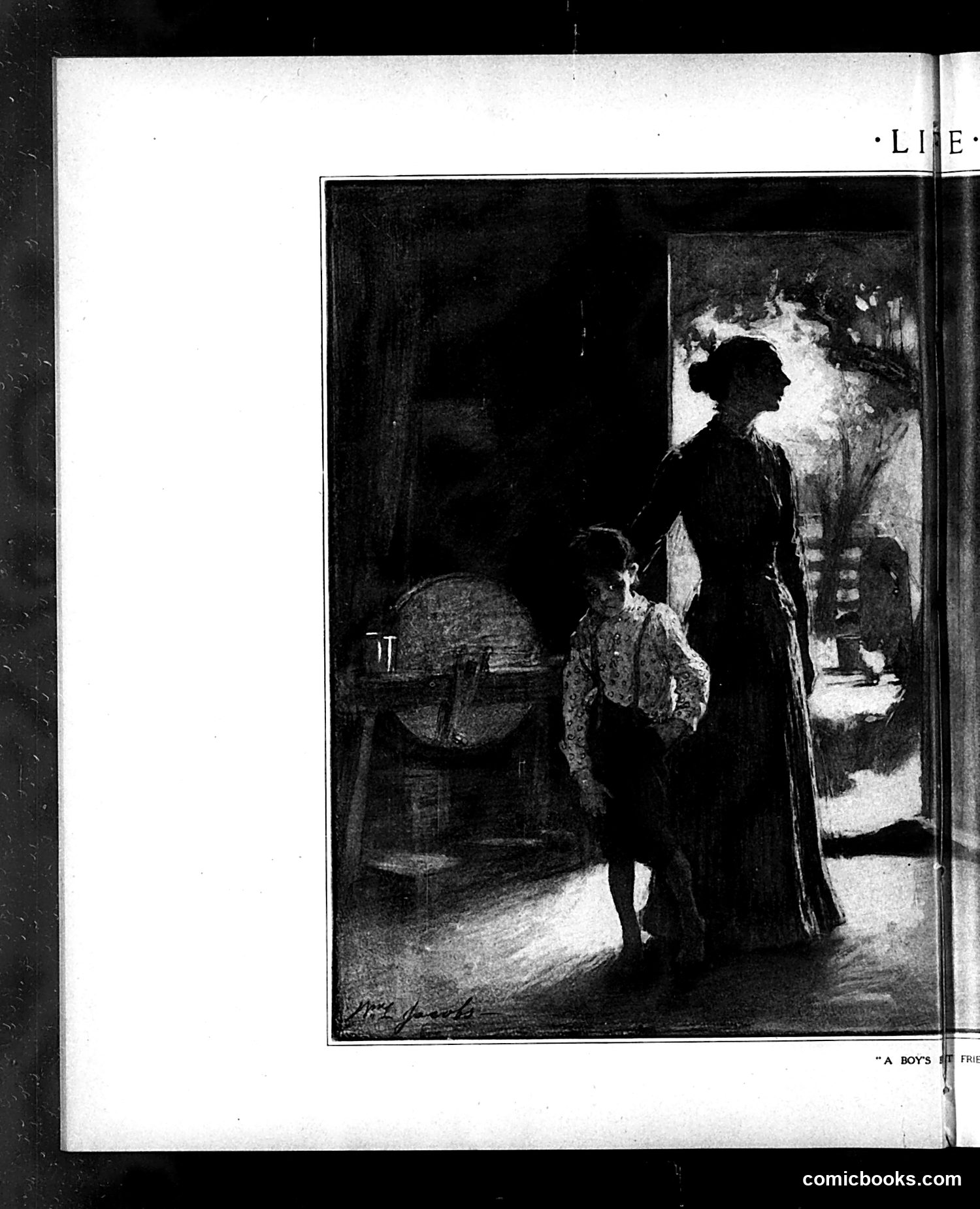
This appears to be a page from *Life* magazine featuring a dramatic illustration titled "A Boy's..." (title cut off). The image shows a silhouetted woman and child in a darkened interior, looking toward a bright doorway or window where figures are visible outside. The composition emphasizes chiaroscuro—stark contrasts between light and shadow. Without the complete title and caption text, the specific satirical or political meaning is unclear. The scene could reference social commentary about poverty, displacement, immigration, or family hardship common to early-20th-century *Life* magazine's satirical content. The artistic style and domestic interior setting suggest a social critique, but I cannot determine the precise target of satire or historical context from the visible image alone.
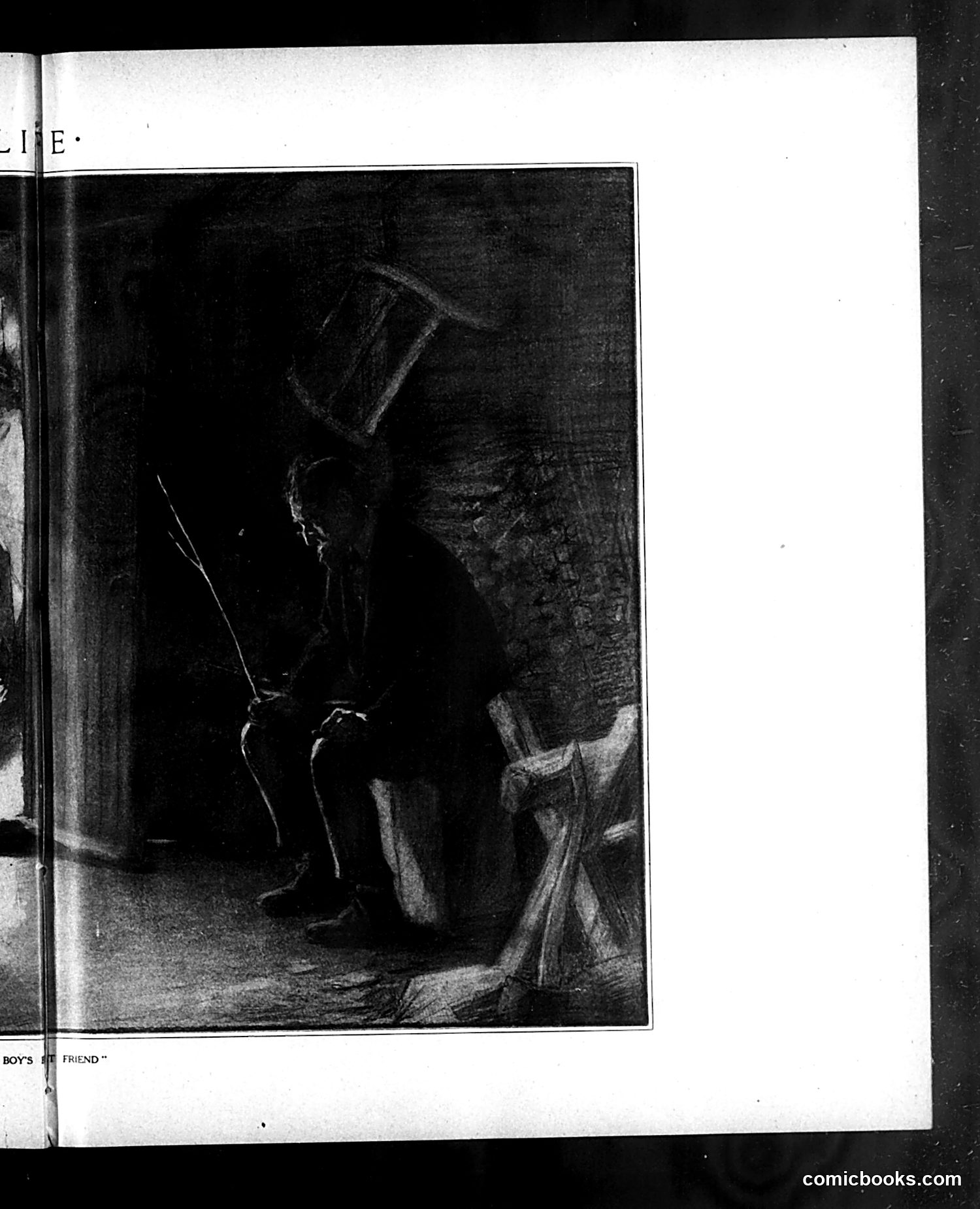
This page appears to be from *Life* magazine and shows a dark, dramatic illustration labeled "BOY'S BEST FRIEND" (visible at bottom). The image depicts a figure in a top hat standing over what appears to be a dog or animal in shadow. The caption "BOY'S BEST FRIEND" is the famous phrase traditionally referring to dogs' loyalty to humans. However, the ominous tone and shadowy composition suggest this is satirical commentary—possibly critiquing how boys/young men treat animals, or using the dog metaphor to comment on betrayal, abuse of trust, or exploitation of the vulnerable by those in power (suggested by the top hat, a symbol of authority or the wealthy). Without additional context or visible text explaining the specific reference, the exact satirical target remains unclear.
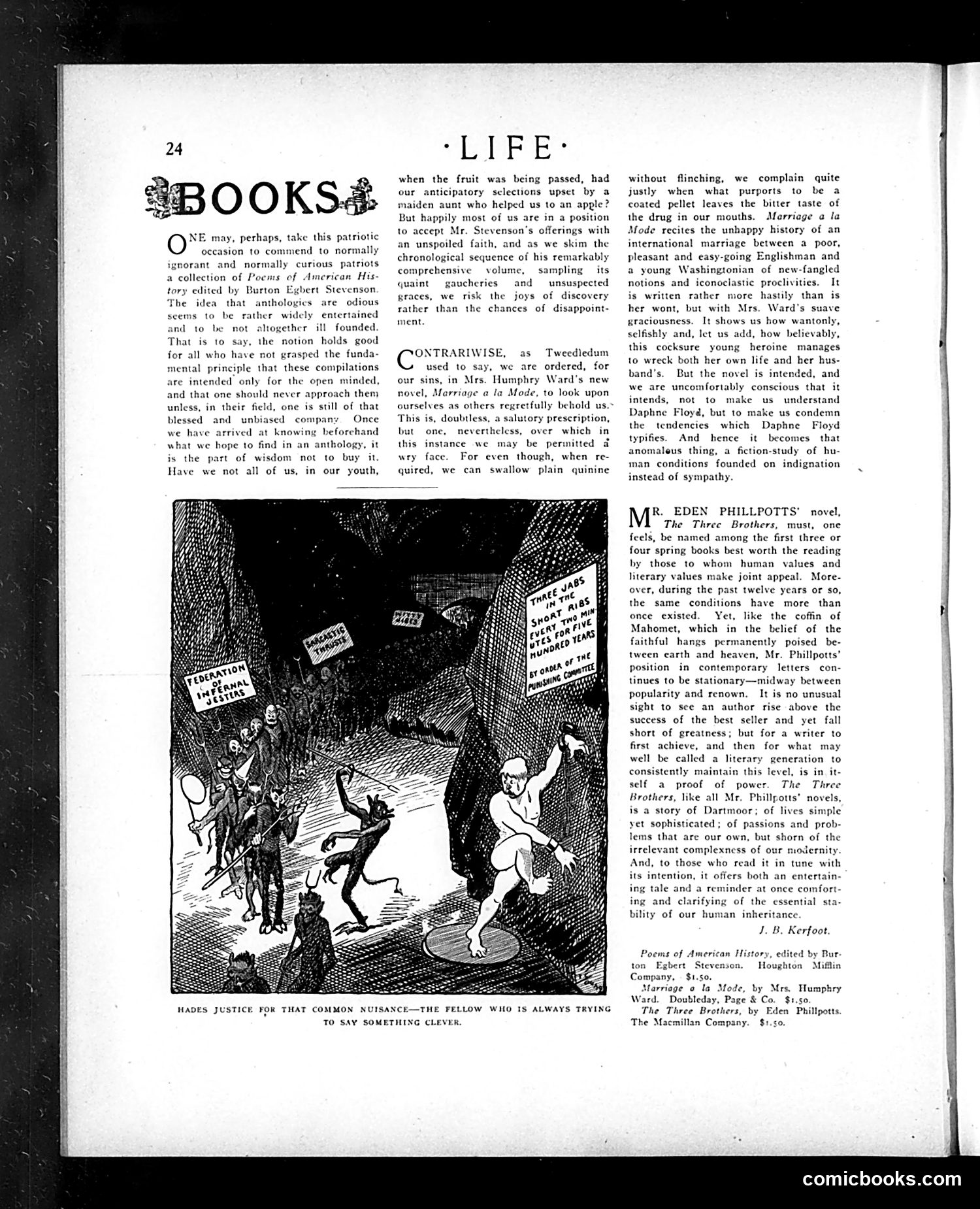
This page contains a **book review section** rather than political cartoons. The central illustration depicts Hades (Greek underworld) administering justice to "the fellow who is always trying to say something clever"—a social satire about people who make constant quips or witty remarks. The reviews discuss three literary works: a poetry anthology edited by Burton Egbert Stevenson; *Marriage à la Mode* by Mrs. Humphry Ward (criticized for being hastily written and condemning its young female protagonist rather than understanding her); and *The Three Brothers* by Eden Phillpotts (praised as worthy literature, though noting Phillpotts maintains a frustratingly middling position between bestseller success and literary greatness). The underlying point seems to be about literary merit versus popular appeal—a common concern in early 20th-century literary criticism. The Hades cartoon serves as light commentary on social pretension, a typical satirical magazine element.
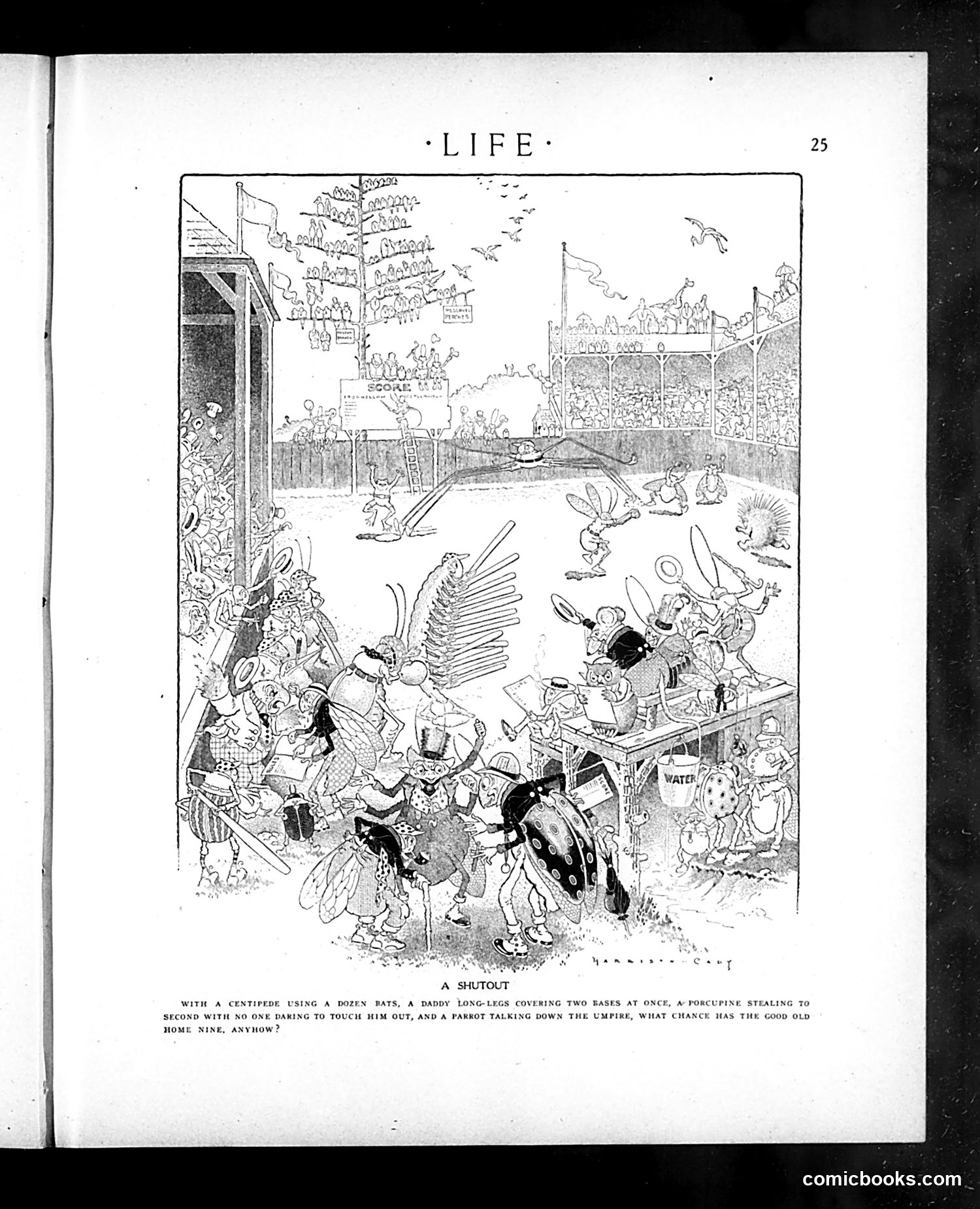
This is a humorous baseball illustration satirizing an absurd game where insects and animals have replaced human players. The joke imagines an impossible matchup: the "good old home nine" (traditional human baseball team) faces off against a team of creatures with natural advantages—a centipede wielding multiple bats, a daddy longlegs covering bases simultaneously with its long legs, a porcupine stealing bases untouchably, and a parrot manipulating the umpire. The satire mocks the impossibility of fair competition and likely critiques either unfair advantage in sports or, more broadly, the futility of competing against overwhelming odds. The illustration's chaotic stadium scene emphasizes the comedic pandemonium.
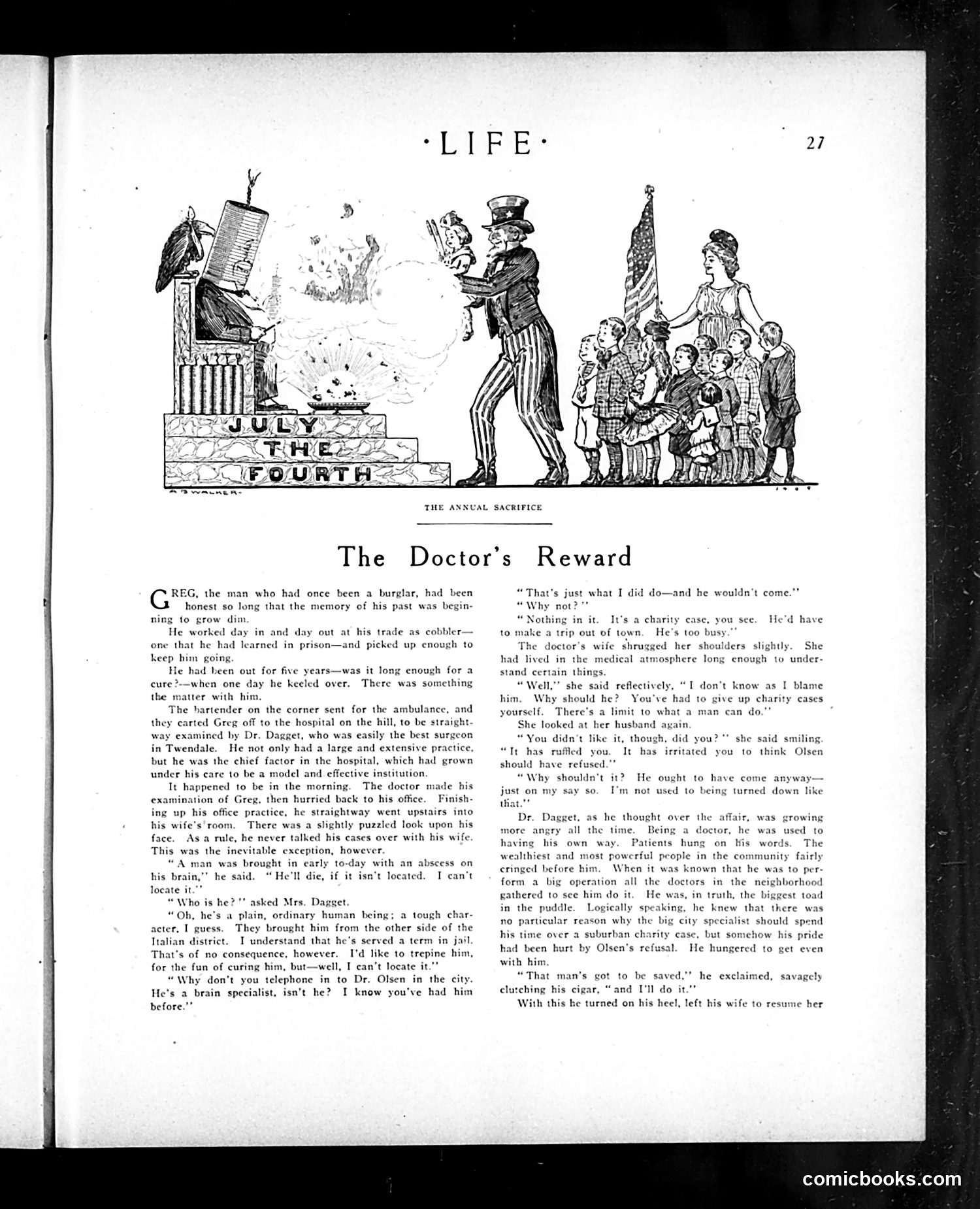
This story-cartoon satirizes professional vanity and class prejudice. Dr. Dagget, a prominent surgeon, examines Greg, a reformed ex-convict and cobbler from the poor Italian district who has a brain abscess. Rather than help this charity case, Dagget calls in a city specialist (Dr. Olsen), who refuses because there's "nothing in it"—no money. Dagget's pride is wounded by Olsen's rejection. Though he knows logically that specialists needn't take charity work, he's infuriated because he's accustomed to deference from patients and colleagues. His wife shrewdly observes he's upset not from compassion for Greg, but from being "turned down"—his ego bruised. The satire targets medical elitism: doctors' assumed superiority and their expectation of control over others, while simultaneously dismissing poor patients as unworthy of effort. The July Fourth imagery above suggests irony about American democratic ideals versus actual class divisions in healthcare.
This page presents a narrative story with embedded satire about medical professional ethics and social class. The headline "DR. OLSEN ROBBED" refers not to literal theft, but to a con: Dr. Dagget, a country doctor, tricks the renowned specialist Dr. Olsen into treating a poor burglar (Greg) for a reduced fee by claiming it's a private case requiring seventy-five dollars instead of his usual hundred. The satire targets: 1. **Professional pride**: Olsen refuses to admit he's been duped, paying the check rather than acknowledging he was outwitted 2. **Class pretension**: Dagget humbles the "eminent specialist" using a vagrant as an instrument 3. **Medical ethics**: Despite the deception, Olsen performs excellently—suggesting integrity ultimately prevails The irony is that Dagget's trick succeeds in getting quality care for someone who "deserves" it medically, though socially disposable. The women's gossip network spreading news of the scheme emphasizes gender and power dynamics of the era.
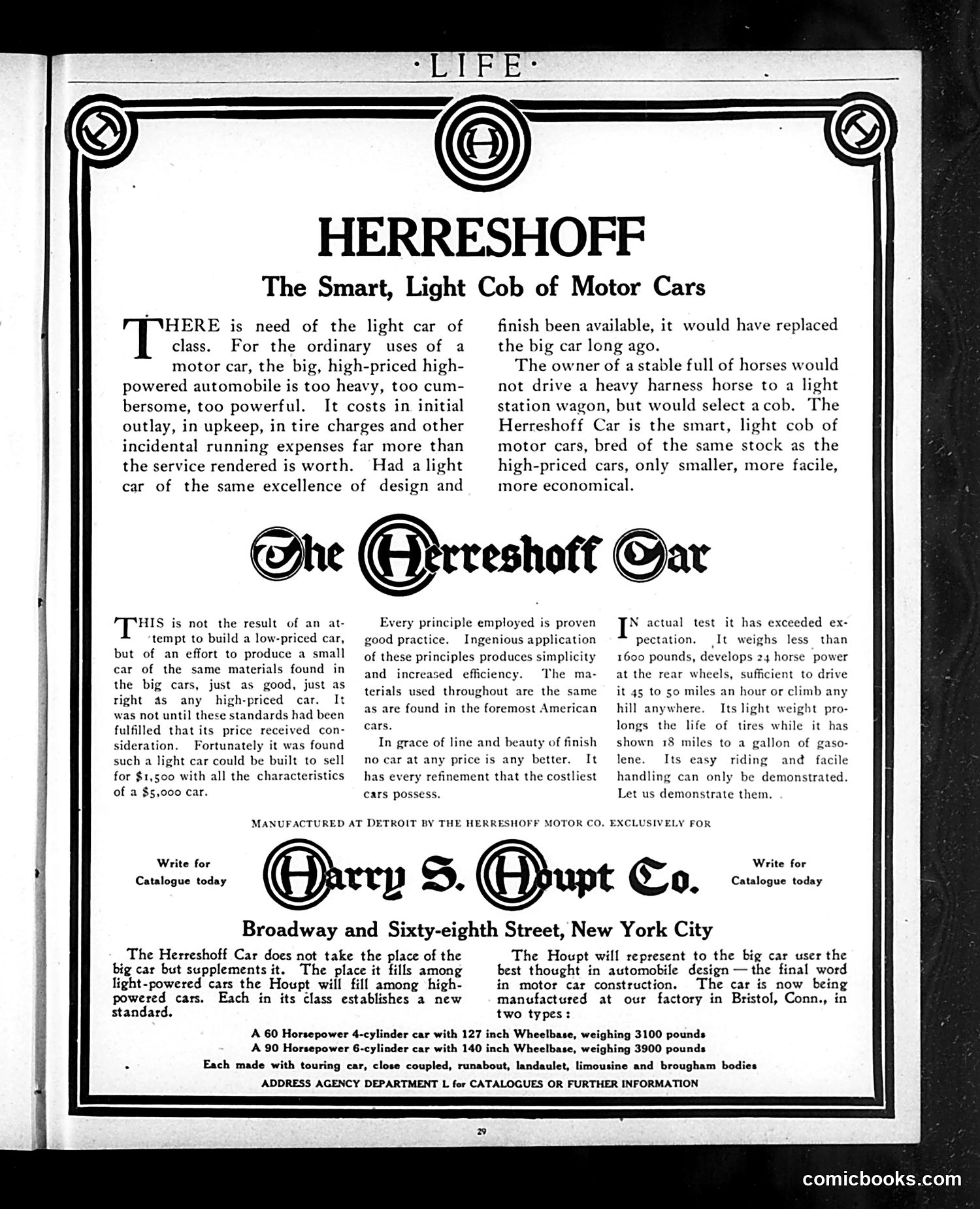
This is **not a cartoon or satire**, but a full-page automobile advertisement from Life magazine. It promotes the Herreshoff car, a lightweight vehicle manufactured in Detroit. The ad argues for a market niche: smaller, affordable cars ($1,500) designed with quality materials and engineering comparable to expensive vehicles ($5,000). The metaphor comparing the car to "the smart, light cob of motor cars" (a cob being a sturdy, smaller horse breed) suggests practicality over power—positioning it as economical transportation for ordinary users rather than the "big, high-priced" automobiles then dominating the market. The advertisement also mentions the "Houpt" car (distributed by Harry S. Houpt Co. in New York), presented as complementary: Houpt for high-powered cars, Herreshoff for light-powered ones. This reflects early-20th-century automotive segmentation, when the industry was still determining what consumers actually needed versus what manufacturers preferred selling.
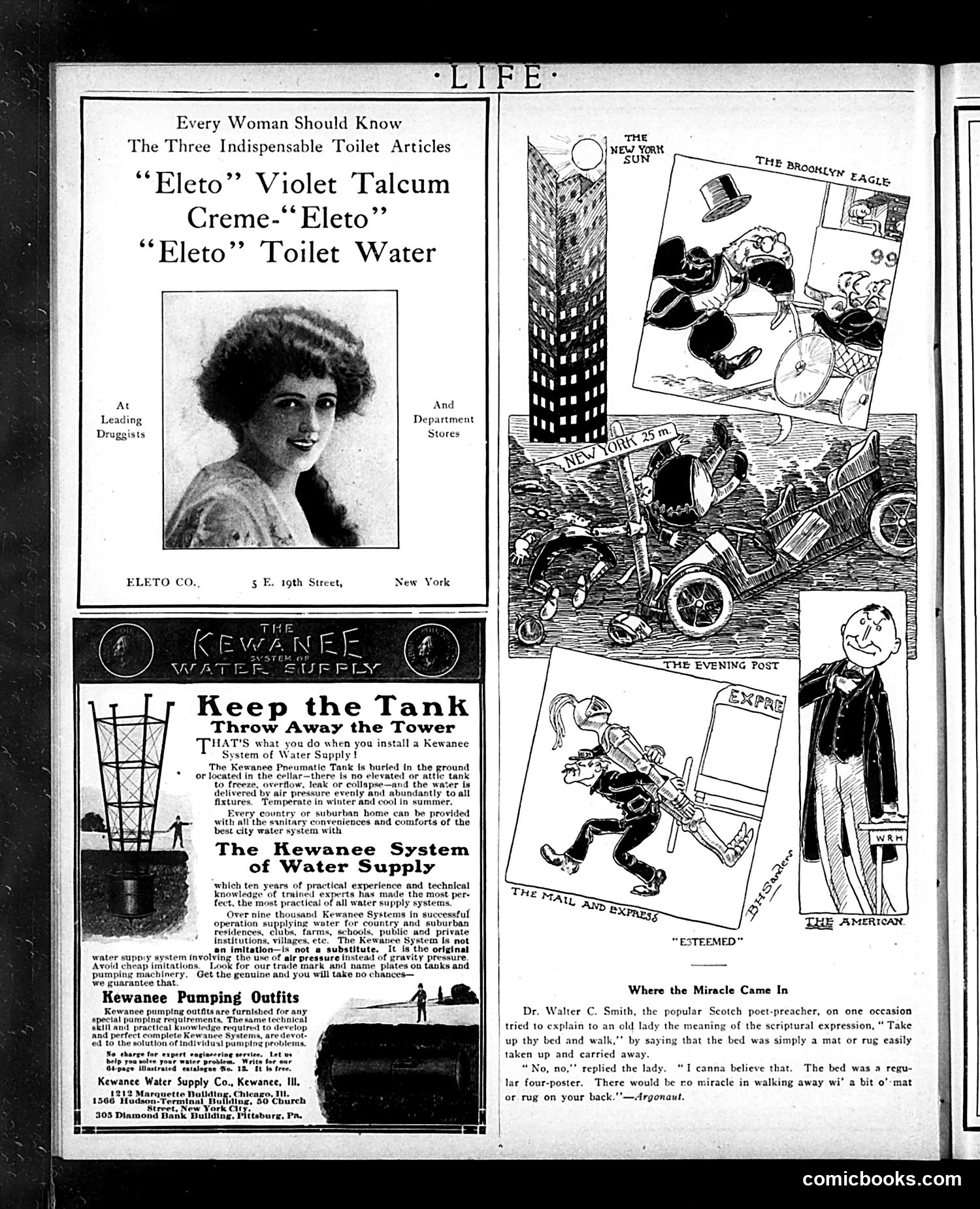
This page mixes advertisements with satirical cartoons. The left side features product ads for "Eleto" toiletries and Kewanee water-supply systems—typical commercial content of the era. The right side shows humorous cartoon vignettes labeled "ESTEEMED," depicting various newspaper delivery scenarios (New York Sun, Brooklyn Eagle, Evening Post, Mail and Express, The American). These appear to satirize the competitive newspaper industry and the rough-and-tumble nature of newspaper distribution in early 20th-century New York City. Below is a short humor piece titled "Where the Miracle Came In," featuring a Scottish preacher and an elderly woman debating biblical interpretation. The joke turns on the woman's literal-minded skepticism: she cannot believe someone could physically carry away a large four-poster bed while walking, thus finding "the miracle" in the scripture's feasibility rather than its spiritual meaning. The satire mocks both religious pedantry and working-class common sense.
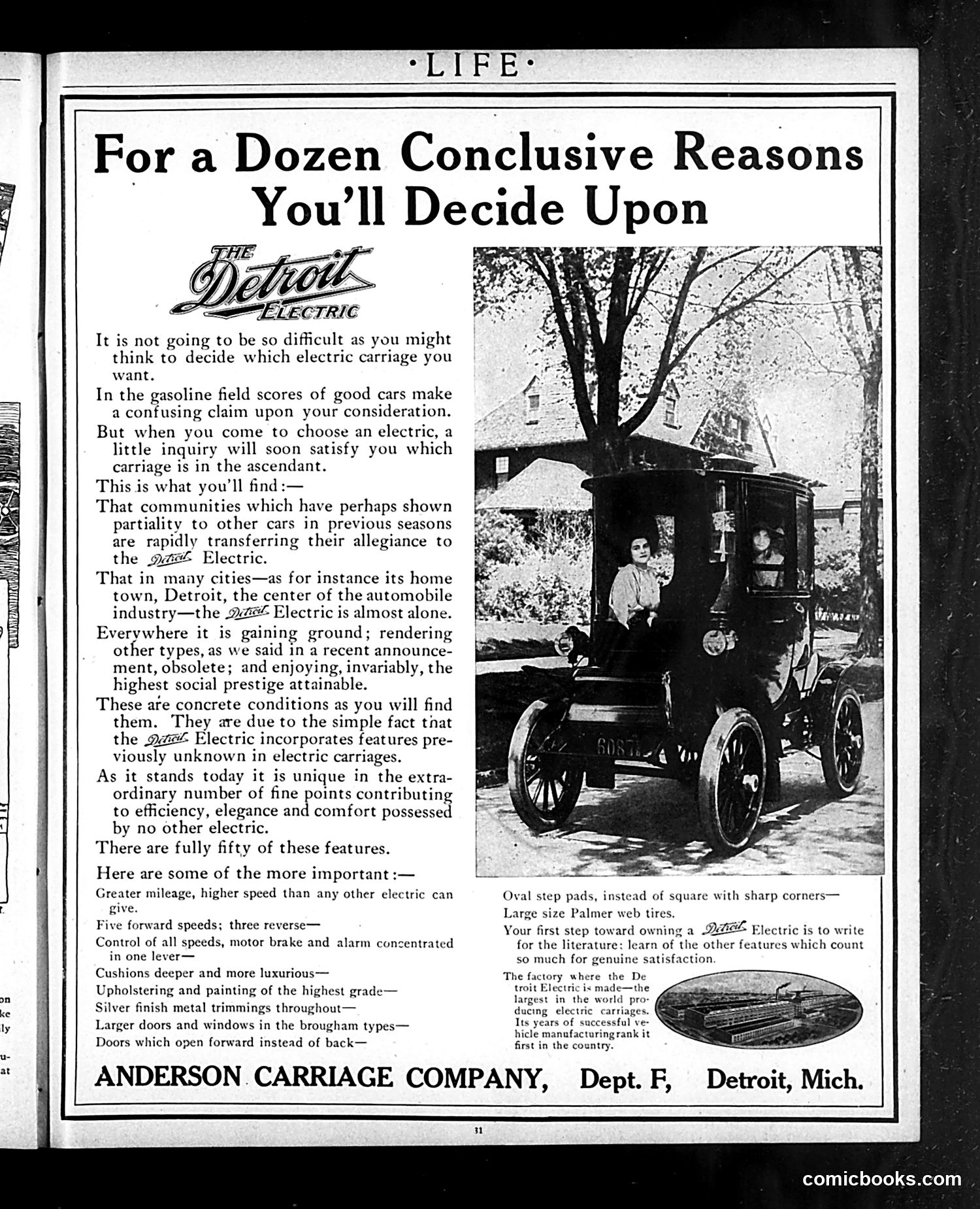
This is not satire or cartoon—it's a straightforward **advertisement for the Detroit Electric automobile**, published in *Life* magazine when electric cars were a viable competing technology to gasoline vehicles (early 1900s). The ad promotes the Detroit Electric's superiority over both gasoline cars and competitor electric vehicles. Key selling points include: five forward speeds, greater range and speed than other electrics, luxurious upholstering, and forward-opening doors—then considered innovative features. The photograph shows the vehicle with well-dressed passengers, emphasizing its association with "highest social prestige." The text claims Detroit is "almost alone" in preference for this model, suggesting market dominance. This reflects a historical moment when electric vehicles were actually competitive before gasoline engines ultimately prevailed. The ad's tone—confident, detailed, emphasizing technological advancement—was typical of automotive advertising during this transitional period in transportation history.
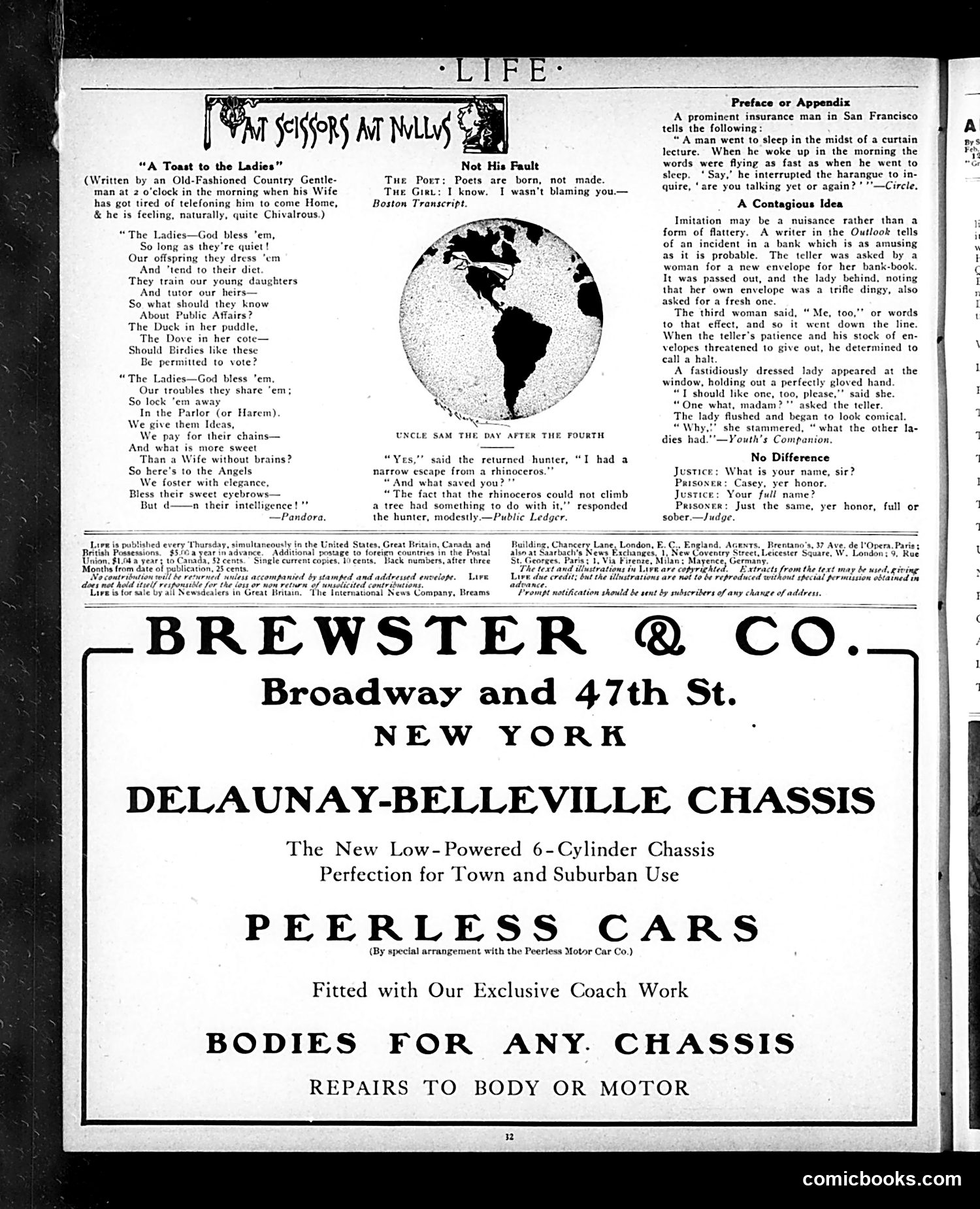
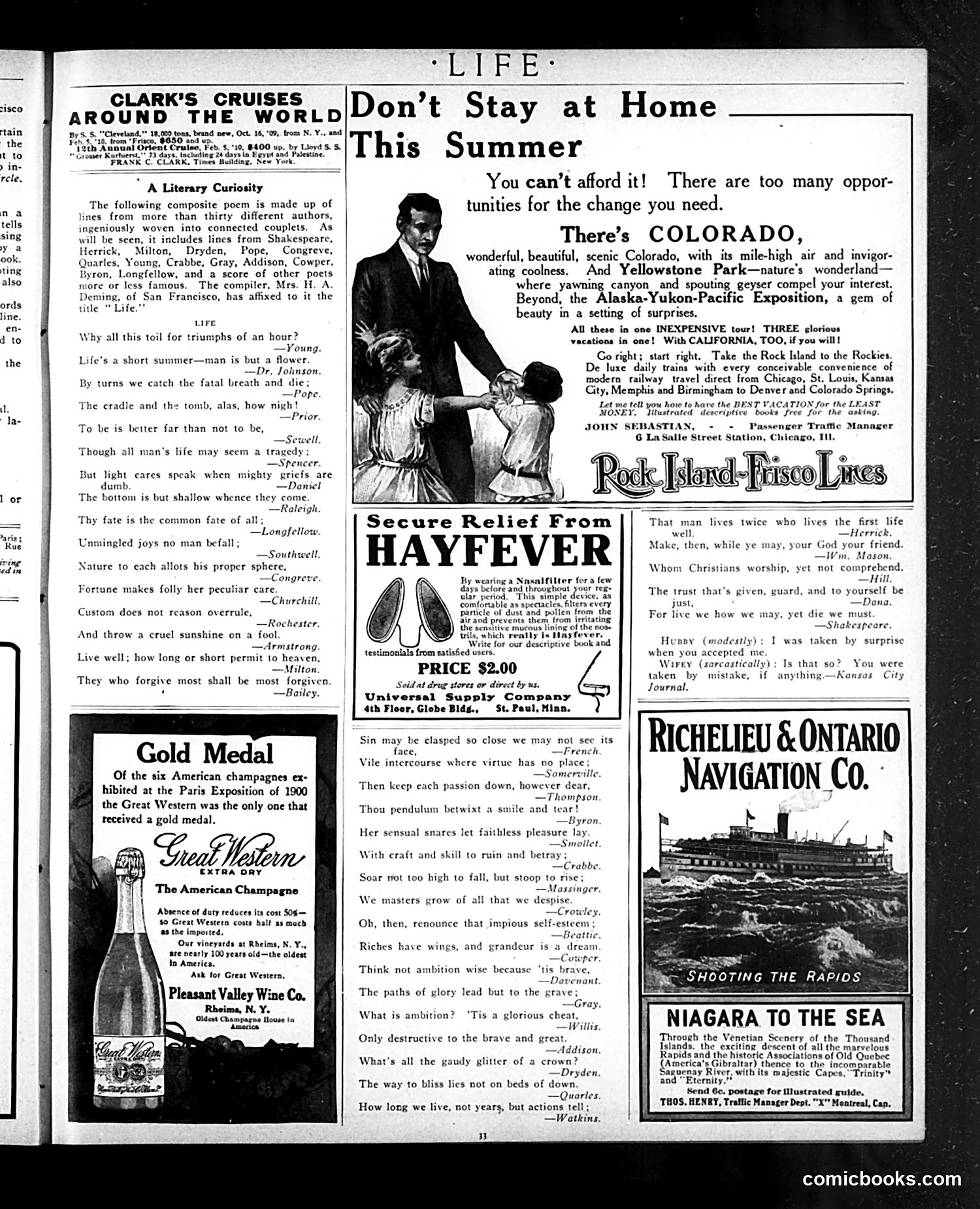
This page is primarily **advertising and light literary content** rather than political satire. The main elements are: **"A Literary Curiosity"** — a composite poem assembled from 30+ classic authors (Shakespeare, Milton, Byron, etc.), stitched together to create connected couplets about life's brevity and virtue. This is a clever parlor trick popular in the era, showcasing erudition. **Travel Advertisements** dominate the page, promoting summer vacations to Colorado, Yellowstone, and the Alaska-Yukon-Pacific Exposition via the Rock Island Line railroad. The "Don't Stay at Home" headline appeals to middle-class leisure aspirations. **Commercial ads** for champagne (Great Western), hay fever relief (Nasalfilter device), and cruise lines fill remaining space. The overall tone is aspirational rather than satirical — encouraging readers to spend money on travel and consumer products. There is no clear political cartoon or social satire visible on this page.
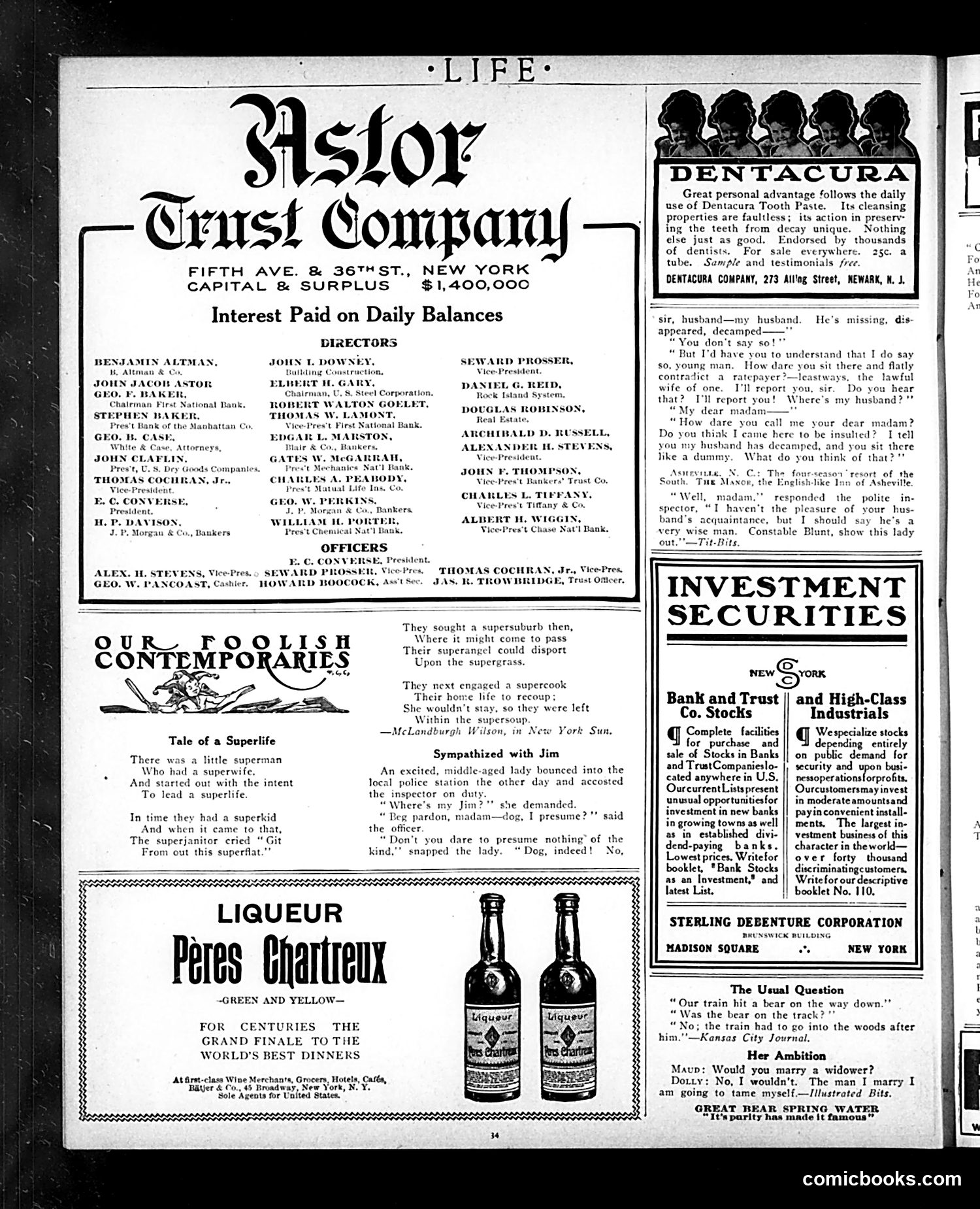
This page is primarily **advertising and filler content**, typical of early 20th-century Life magazine. Key elements: **Main Advertisement**: Astor Trust Company (financial institution) lists its board of directors and officers. **Cartoons/Humor**: - "Our Foolish Contemporaries" presents a satirical poem about a couple seeking the "supersuburb" with a "superangel" and "supercook"—mocking the era's obsession with suburban living and modern conveniences. The joke: their cook leaves anyway, leaving them with "supersoup." - "Sympathized with Jim" depicts a domestic dispute where a woman's missing husband is mistaken for a dog by a police inspector—the humor relies on the wife's indignation at being questioned by authority. - "The Usual Question" is a brief joke about a train hitting a bear. **Other Ads**: Dentacura toothpaste, Peres Chartreux liqueur, and Sterling Debenture Corporation (investment securities). The page reflects period-appropriate satire of suburban aspirations and domestic mishaps, alongside financial/consumer advertising.
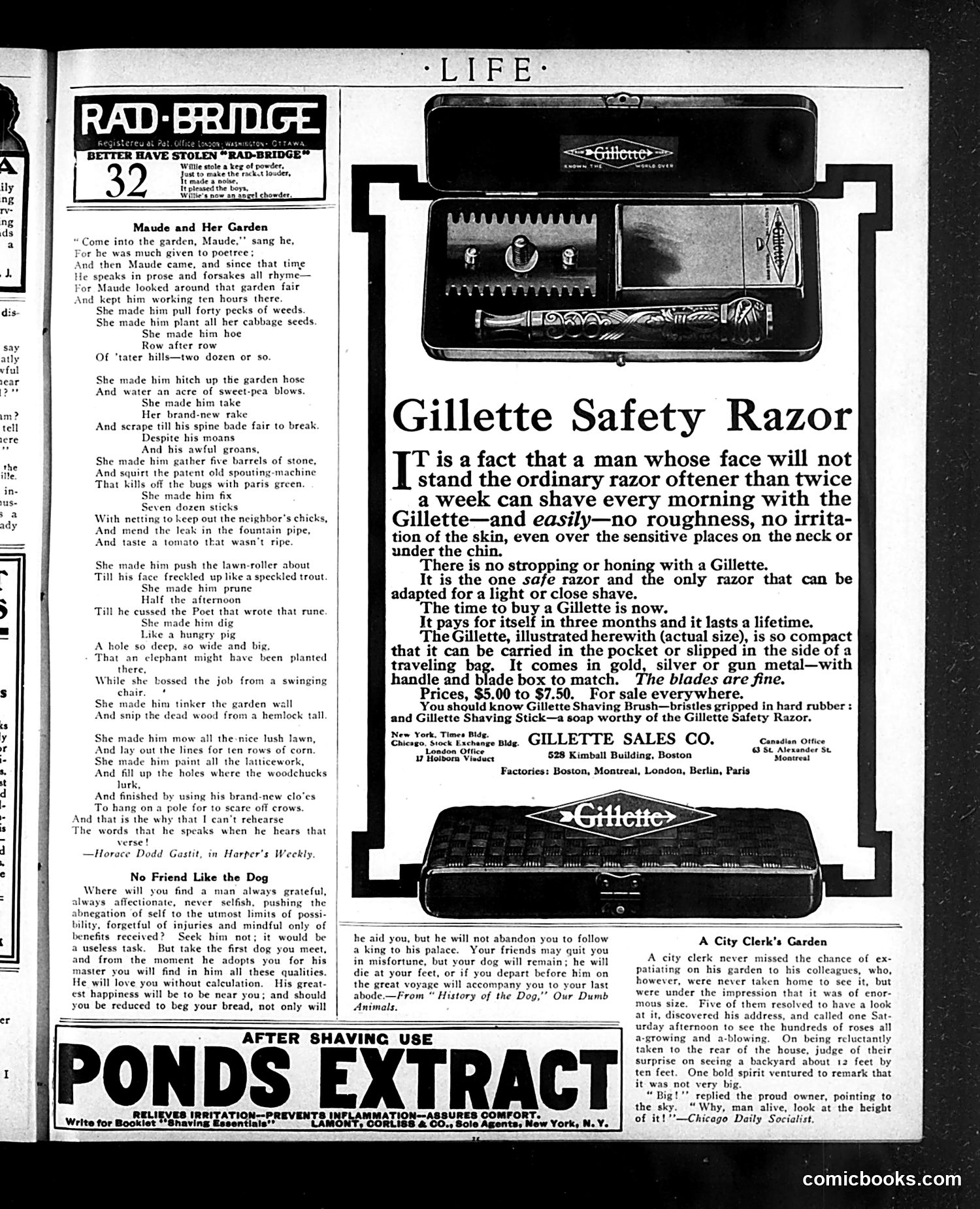
This humorous poem mocks the romantic ideal of courtship through physical labor. A suitor recites poetry to woo "Maude" in her garden, but she immediately puts him to work—pulling weeds, planting vegetables, fixing fences, and performing grueling manual tasks for hours. The poem's joke is that the poet's romantic declarations ("Come into the garden, Maude") are replaced by backbreaking work, transforming him from lover to laborer. The satire targets Victorian courtship conventions, suggesting that romantic gestures mask exploitation. By the poem's end, the man is so exhausted and frustrated he abandons poetry for angry cursing—his idealism destroyed by Maude's relentless demands. The page also features period advertisements (Gillette razors, Pond's Extract), reflecting early 20th-century *Life* magazine's mix of satire and commercial content.
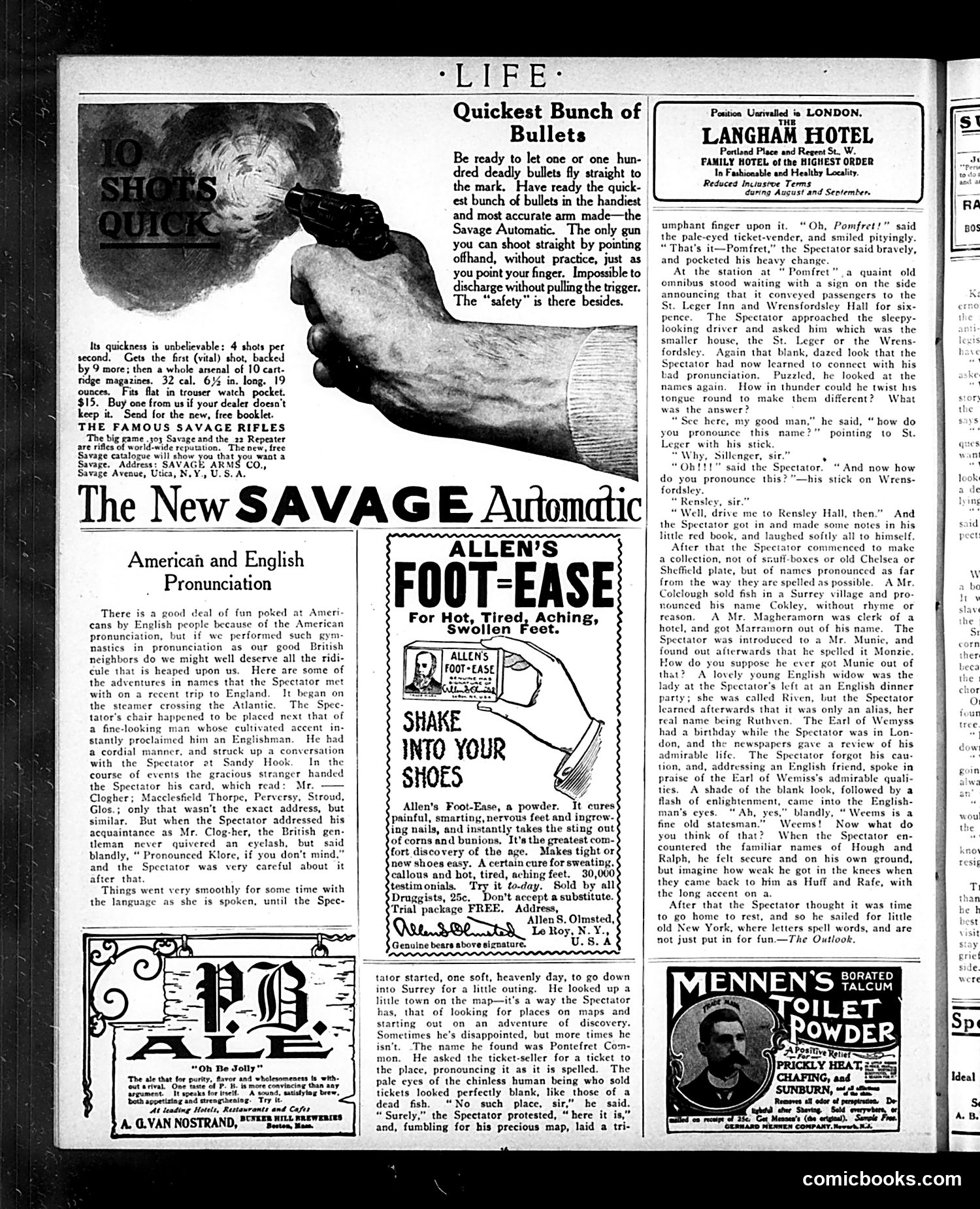
This page is primarily **advertising and humorous articles**, not political commentary. The main content includes: **The Savage Automatic advertisement** dominates the left side—a firearms ad emphasizing rapid fire capability (4 shots per second) for civilian purchase, typical of early 20th-century gun marketing. **"American and English Pronunciation"** is a comedic article (center/right) describing a traveler's ("the Spectator") mishaps with British place names. The humor relies on how English place names are pronounced counterintuitively to American ears—examples include "Clogher" (pronounced "Klore") and "Pomfret." The joke targets American unfamiliarity with English conventions and the bewilderment of trying to navigate English geography. **Supporting advertisements** include Allen's Foot-Ease (a foot powder remedy) and the Langham Hotel in London. The page reflects early 1900s consumer culture and the transatlantic cultural/linguistic divide as entertainment for American readers.
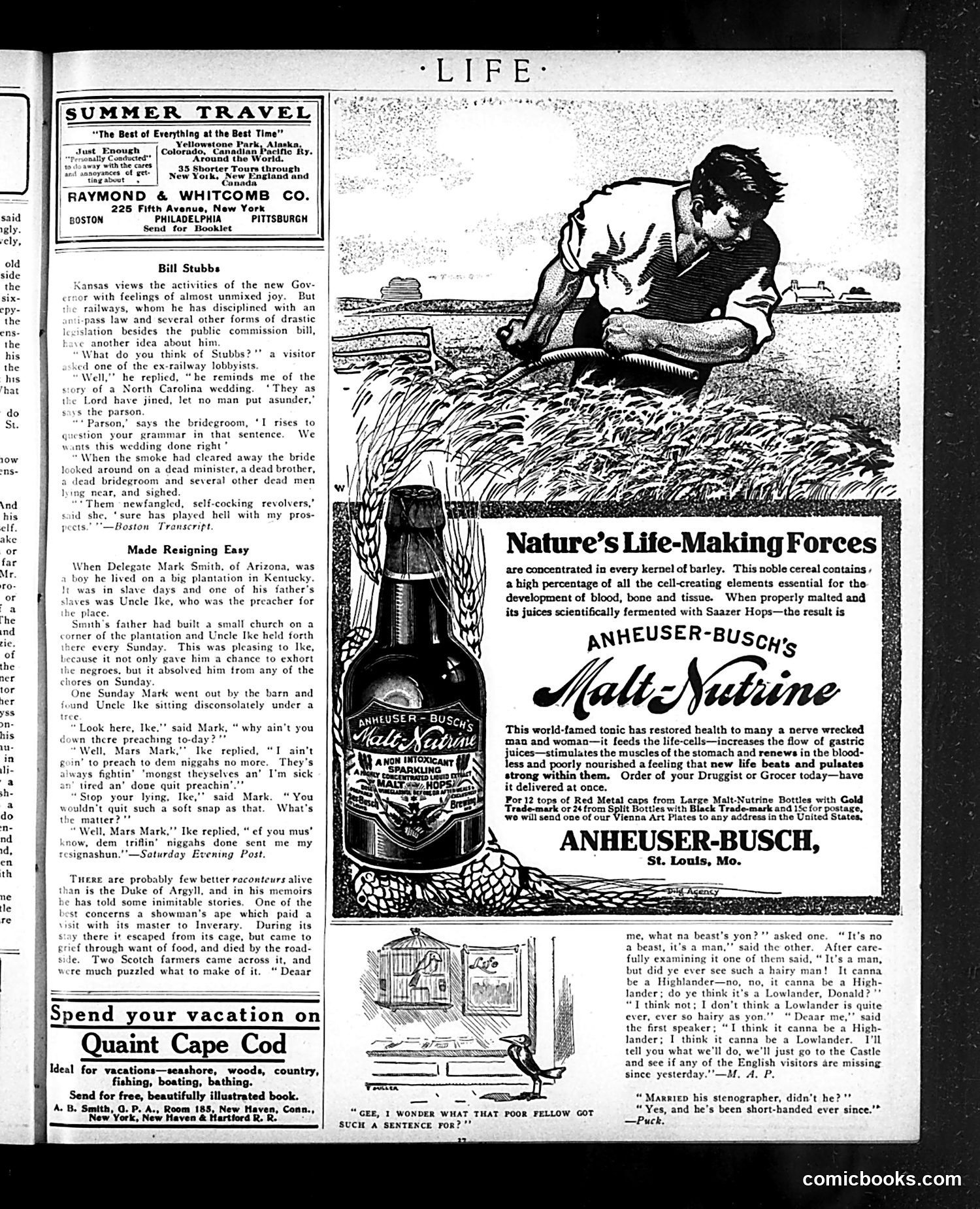
This page contains primarily **advertising and humorous anecdotes** rather than political satire. The main content includes three jokes: "Bill Stubbs" mocks a Kansas governor through a violent wedding story; "Made Resigning Easy" uses a pre-Civil War plantation narrative where an enslaved preacher "resigns" (the humor relies on period racial stereotypes); and a brief anecdote about Scottish farmers discovering a dead ape. The dominant visual is a large **Anheuser-Busch Malt-Nutrine advertisement** featuring barley imagery and health claims typical of early 20th-century patent medicine marketing. The ad claims the product restores health to "nerve wrecked" individuals and strengthens the body—common exaggerated claims of the era before modern FDA regulations. The page also includes **travel advertisements** for Raymond & Whitcomb tours and Cape Cod vacations, reflecting Life magazine's dual nature as both satirical publication and vehicle for commercial advertising. The humor style and language reflect early 1900s sensibilities that modern readers would find dated or offensive.
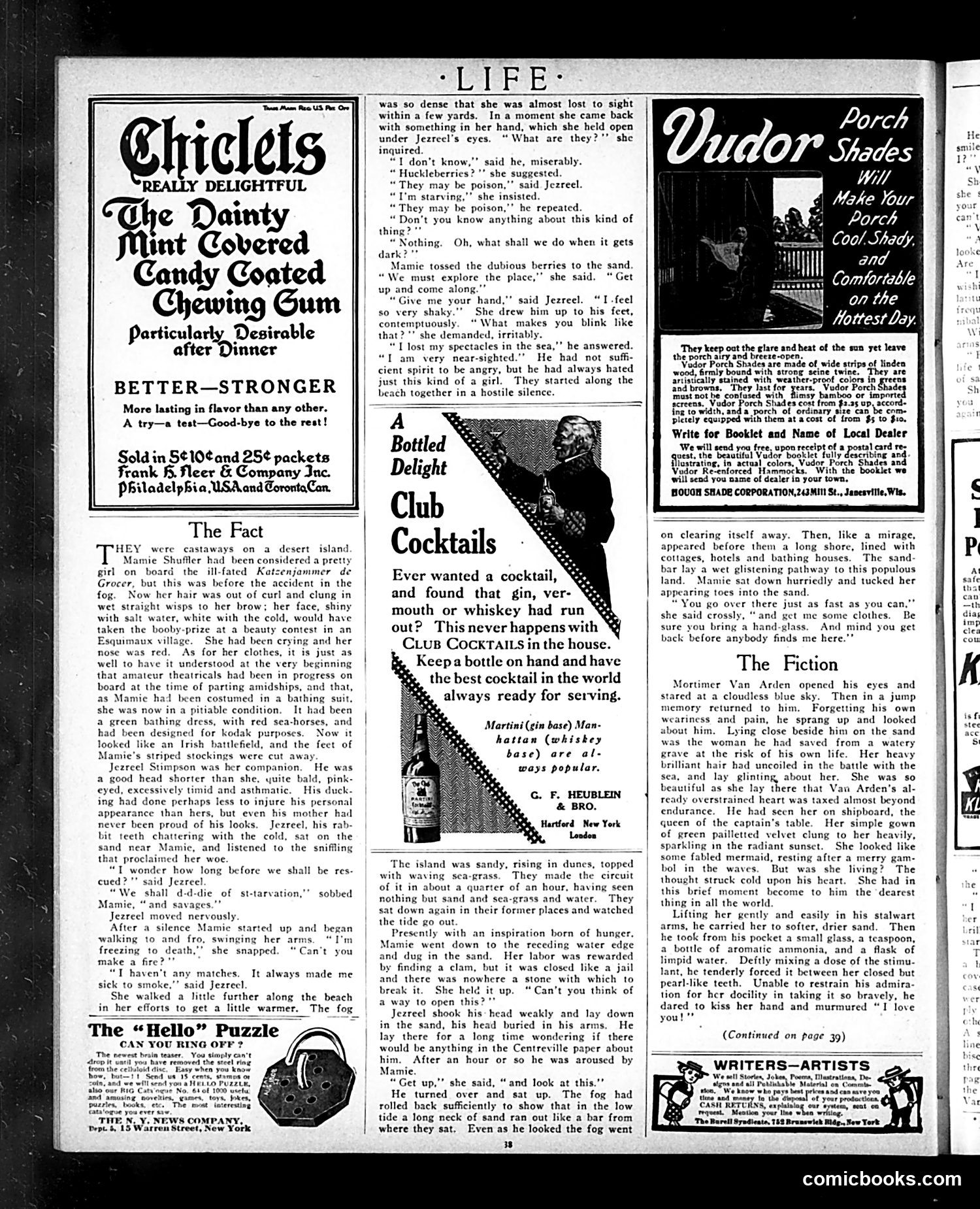
This page is primarily **advertising and serialized fiction**, not political satire. The main content is "The Fact," a serialized short story about two shipwreck survivors: Mamie Shuffler (a vain woman reduced to a pathetic state) and Jezreel Simpson (a timid, bald, near-sighted man). The narrative mocks both characters—she's helpless and irritable despite her former vanity; he's physically unattractive and emotionally weak. Their "hostile silence" suggests the story satirizes the incompatibility of certain character types forced together. The page is dominated by **product advertisements**: Chiclets chewing gum, Club Cocktails, Vudor Porch Shades, and a puzzle game. These represent typical early-20th-century Life magazine revenue. No identifiable political figures or contemporary events appear. The satire is purely **social comedy** about personality types and human nature, not political commentary.
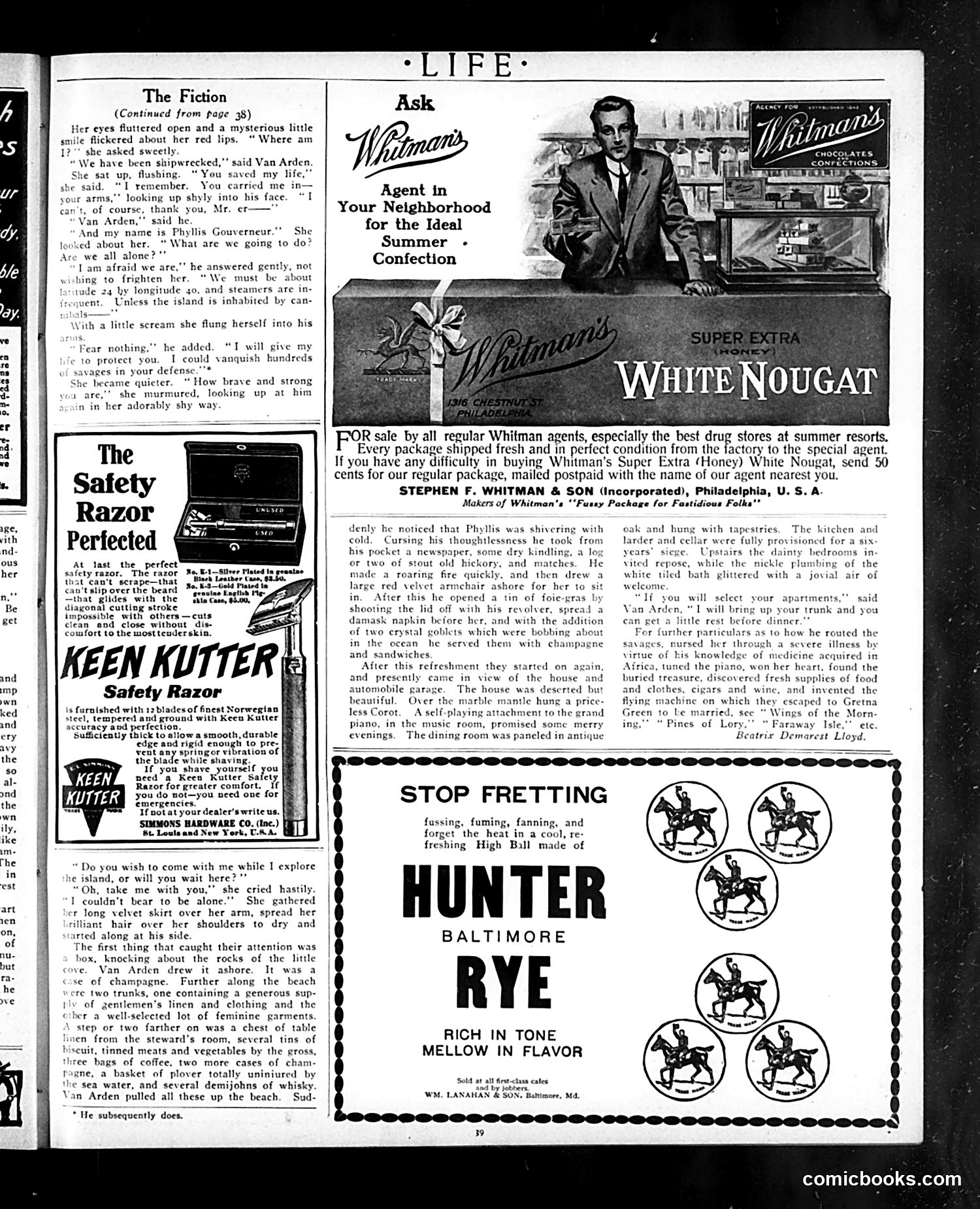
This page combines fiction, advertising, and humor typical of early 20th-century Life magazine. **The Fiction** (continued narrative): A shipwrecked romance between Van Arden and Phyllis Gouverneur. The satire mocks overwrought romantic fiction—after being stranded, they conveniently discover an abandoned mansion fully stocked with champagne, foie-gras, crystal goblets, a piano, and modern plumbing. The narrative absurdly escalates, with Van Arden performing impossibly heroic feats (defeating savages, nursing her through illness, finding buried treasure). This parodies the melodramatic adventure-romance genre popular at the time. **Advertisements**: Whitman's chocolates, Keen Kutter safety razors, and Hunter Baltimore Rye whiskey occupy the remaining space—typical period advertising positioned alongside editorial content. The humor lies in Life's exaggeration of romance-fiction tropes: the convenient island paradise, the perfectly provisioned estate, and the protagonist's cartoonish competence at everything from medicine to piano-tuning.
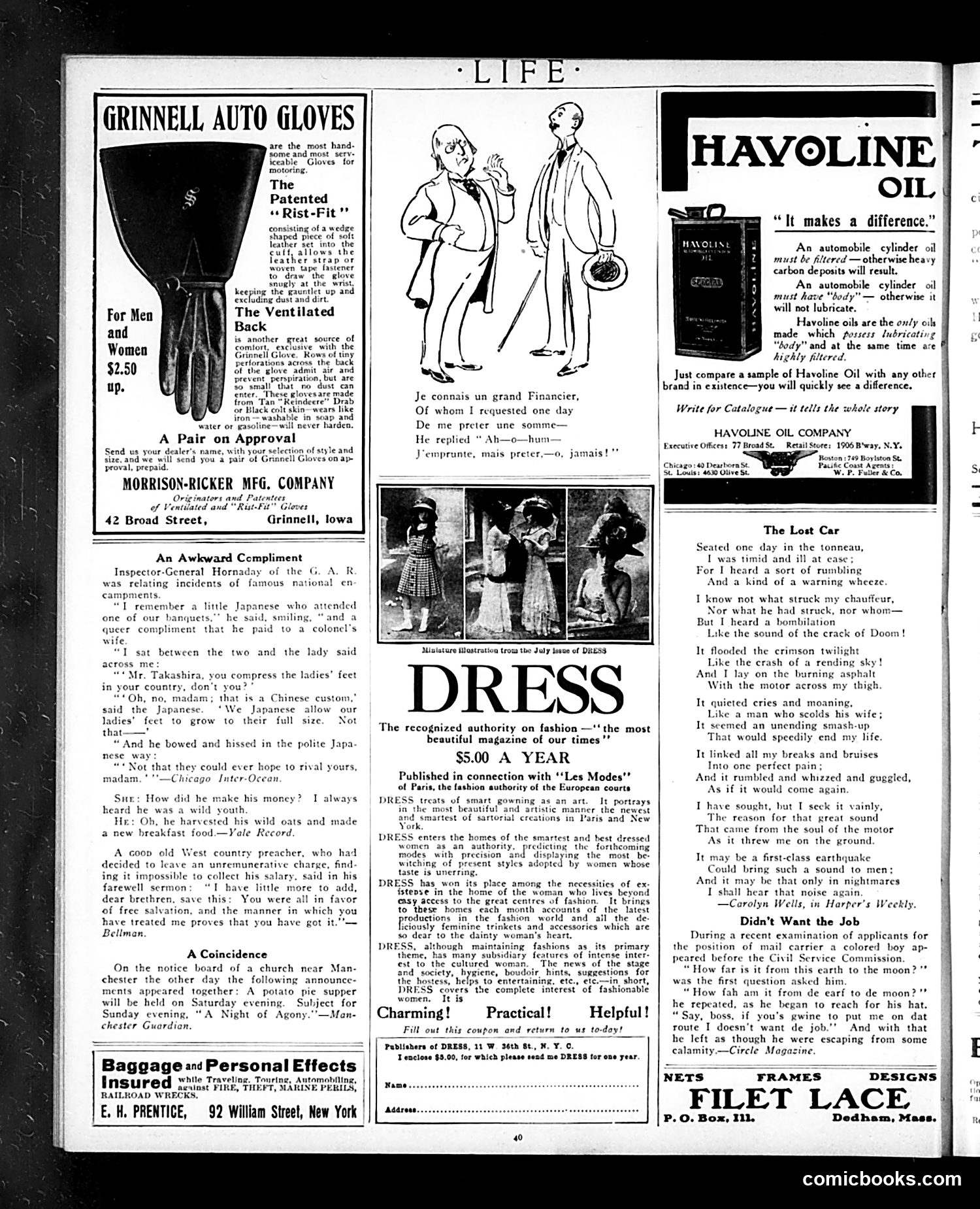
This page is primarily **advertisements and humor pieces** rather than political cartoons. The main content includes: **Advertisements:** Grinnell Auto Gloves, Havoline Oil, and Dress magazine dominate the layout—typical early 20th-century product promotions. **Humor Pieces:** Several short anecdotes appear, including: - "An Awkward Compliment" about a Japanese official's backhanded praise of American women - A joke about a minister who harvested "wild oats" - A preacher's bitter farewell about "free salvation" **The Satire:** The humor relies on period-specific references—foot-binding practices in Asia, "wild youth" as a come-up story, and small-town church politics. The Japanese official's comment plays on Western stereotypes and cross-cultural misunderstandings common to this era. **Context:** Life magazine mixed commerce with social commentary. The ads reflect early automotive culture, while the jokes target middle-class concerns and international relations attitudes of the 1910s.
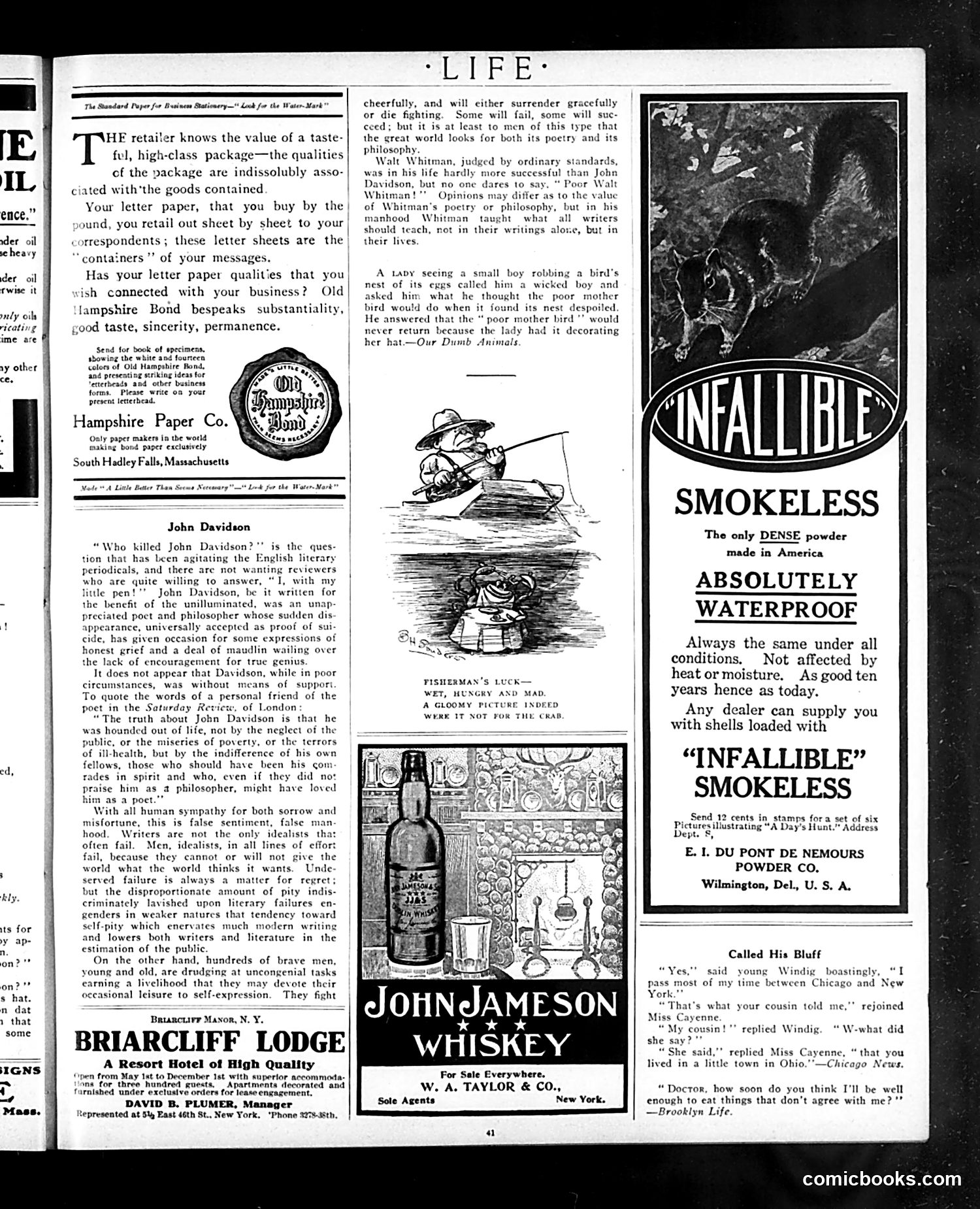
This page mixes editorial commentary with advertisements. The main article discusses poet **John Davidson**, whose recent disappearance (implied suicide) sparked literary debate about whether critics and society bear responsibility for artists' failures. The piece argues against "false sentiment"—the romanticization of struggling artists. It contends that many ordinary workers also pursue creative ideals while earning livelihood, yet don't receive similar pity. The author uses **Walt Whitman** as a counterexample: though commercially unsuccessful like Davidson, Whitman commanded respect through personal integrity and philosophy demonstrated "in their lives," not just writings. The satire targets Victorian literary circles' tendency toward maudlin sympathy for failed poets, suggesting this self-pitying culture actually weakens modern literature. The piece advocates for stoicism and productive effort over romantic despair. The remainder consists of period advertisements for Hampshire Bond paper, whiskey, and a resort hotel—typical Life magazine commercial content.
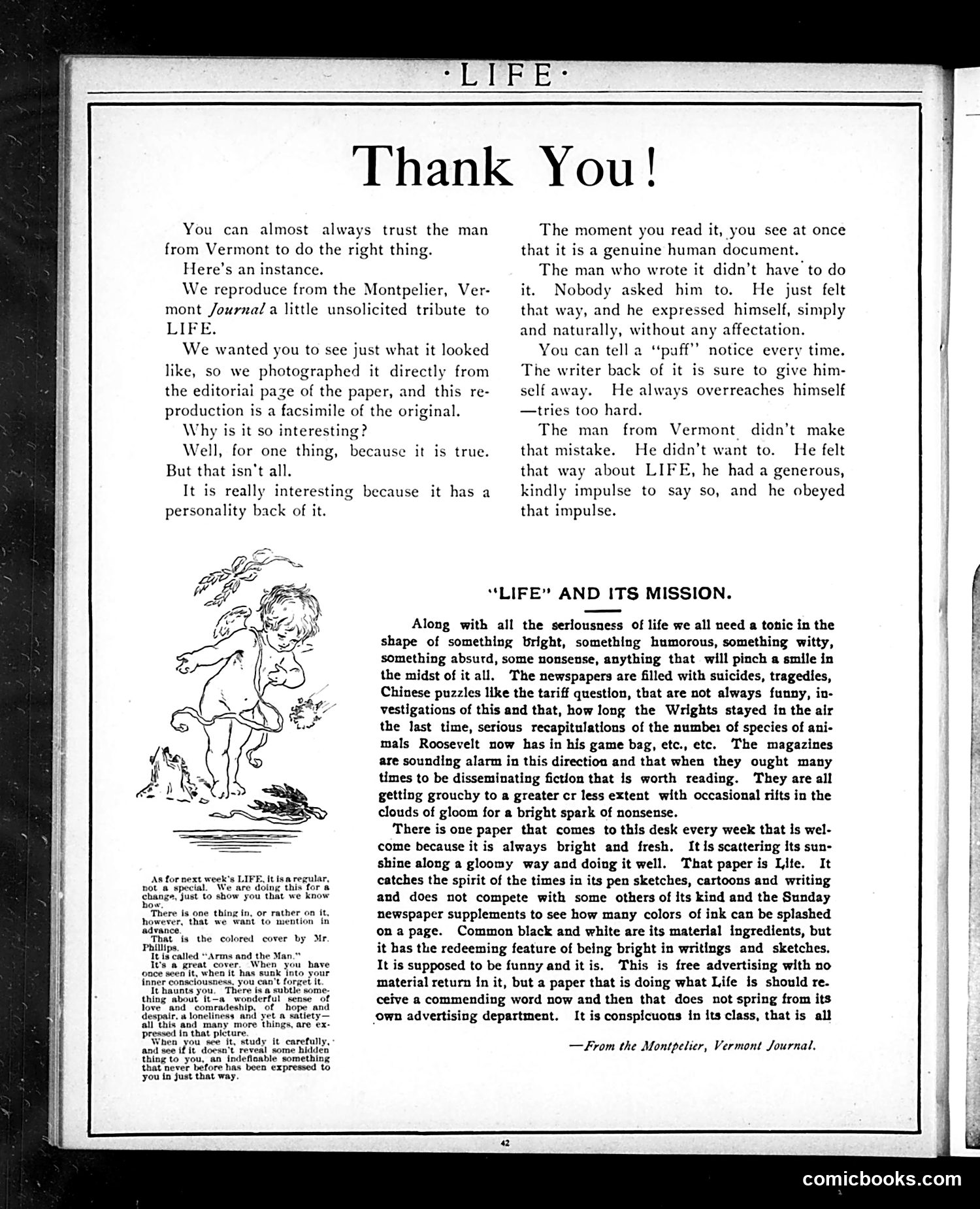
This page reproduces an unsolicited favorable review of *Life* magazine from the *Montpelier, Vermont Journal*. The editors use it to demonstrate authentic praise versus insincere "puffs." The Vermont editor praises *Life* for providing humor and satire as a necessary counterbalance to serious newspaper content—suicides, tragedies, tariff debates, and Roosevelt's hunting exploits. *Life* is commended for using simple black-and-white illustration and witty writing to brighten gloomy times, without competing with Sunday supplements' color splash. The accompanying cupid illustration is decorative. The editors emphasize the Vermont piece's genuineness: the writer felt compelled to praise *Life* unprompted, expressed himself naturally, and avoided the self-aggrandizing overreach typical of paid endorsements. Essentially, this is *Life* magazine celebrating its own role as satirical relief in early-20th-century American journalism.
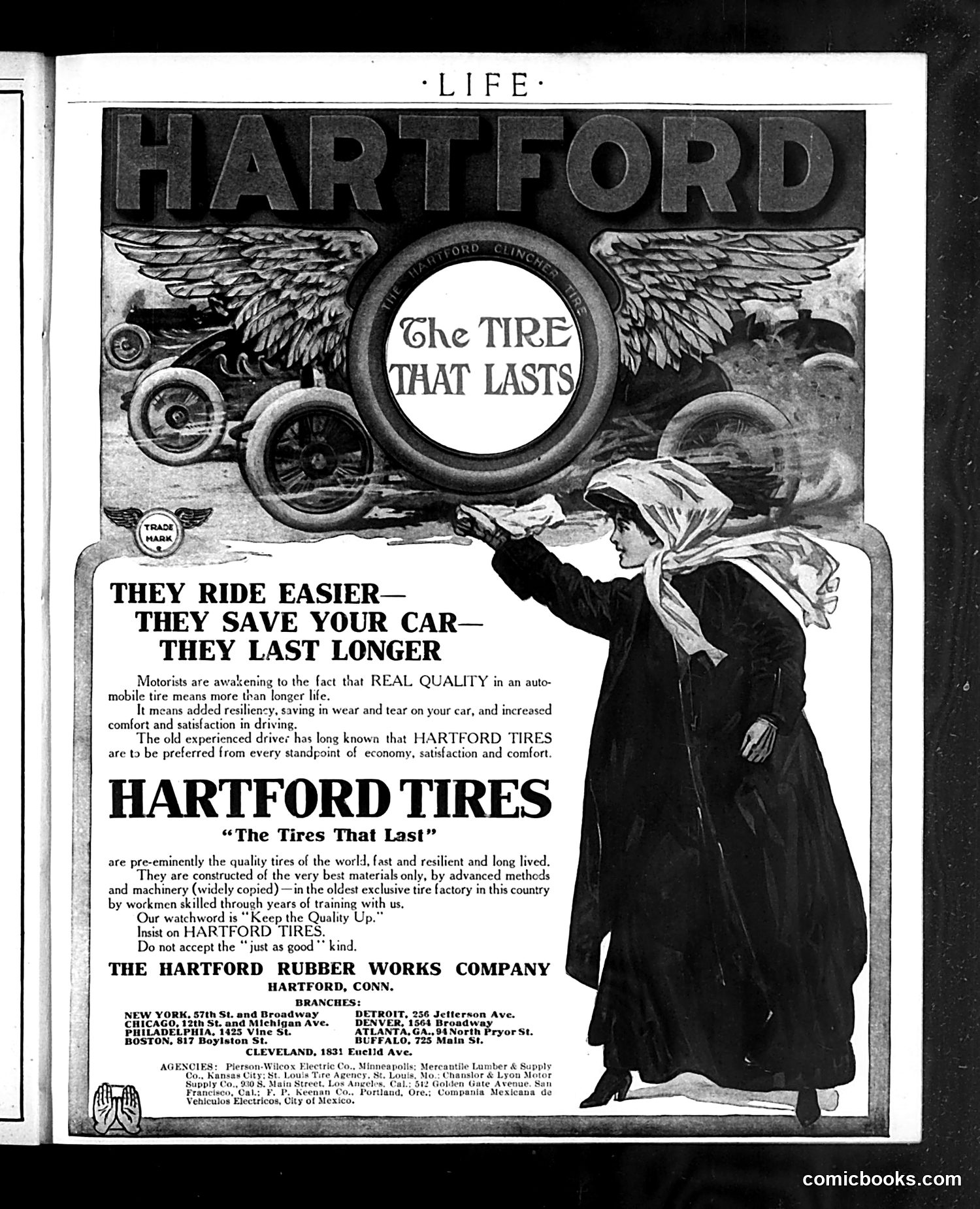
This is a **full-page advertisement**, not a political cartoon. It promotes Hartford brand automobile tires to early 20th-century motorists. The ad features a woman in period clothing pointing at a large tire, with vintage racing cars illustrated behind her. The marketing message emphasizes three selling points: easier riding, car protection, and longevity—positioning Hartford as superior quality versus cheaper competitors ("Do not accept the 'just as good' kind"). The ad appeals to both **practical concerns** (economy, durability, comfort) and **male anxieties** about automobile maintenance. The woman figure appears designed to make tire-buying seem accessible to all motorists, not just experienced drivers. The Hartford Rubber Works Company lists branches across major American cities, indicating this was a national brand during the automobile's early mass-adoption era. There is no satire present—this is straightforward period advertising emphasizing product quality and brand reputation.
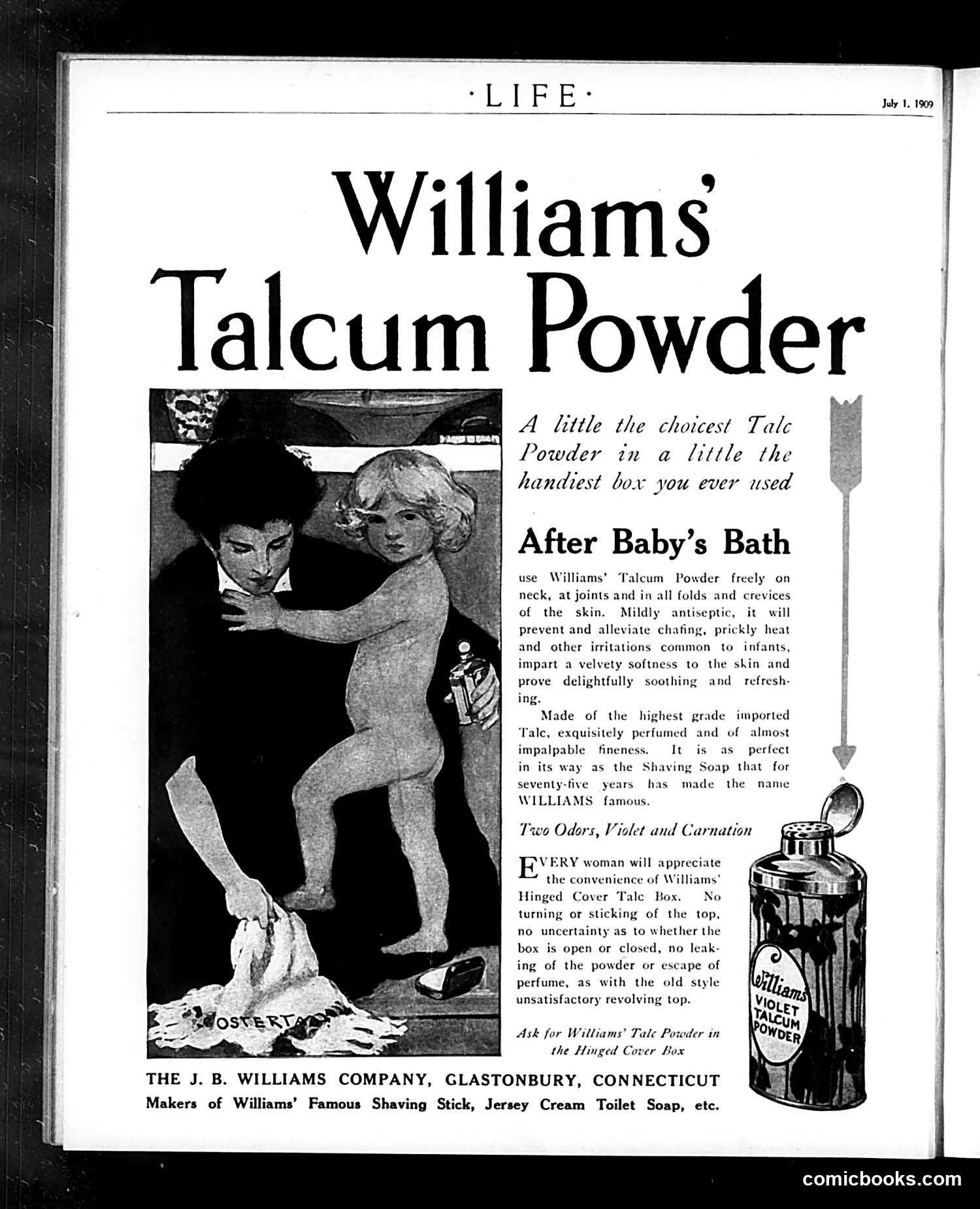
This is a commercial advertisement, not satire or political commentary. The page promotes Williams' talcum powder for use on babies after bathing, emphasizing its antiseptic properties and softness. The illustration shows a woman applying powder to a naked baby—a straightforward domestic scene typical of early 1900s advertising. The image conveys maternal care and cleanliness, values the ad copy reinforces by highlighting the product's ability to prevent chafing and irritation in infants. The advertisement mentions the product comes in two scents (Violet and Carnation) and features a "Hinged Cover" box design, positioned as modern convenience compared to older "revolving top" containers. This reflects the era's marketing of hygiene and personal care products to middle-class families, with talcum powder being standard baby care.