
Life, 1909-07-01 · page 10 of 44
Life — July 1, 1909 — page 10: what you’re looking at
What you’re looking at
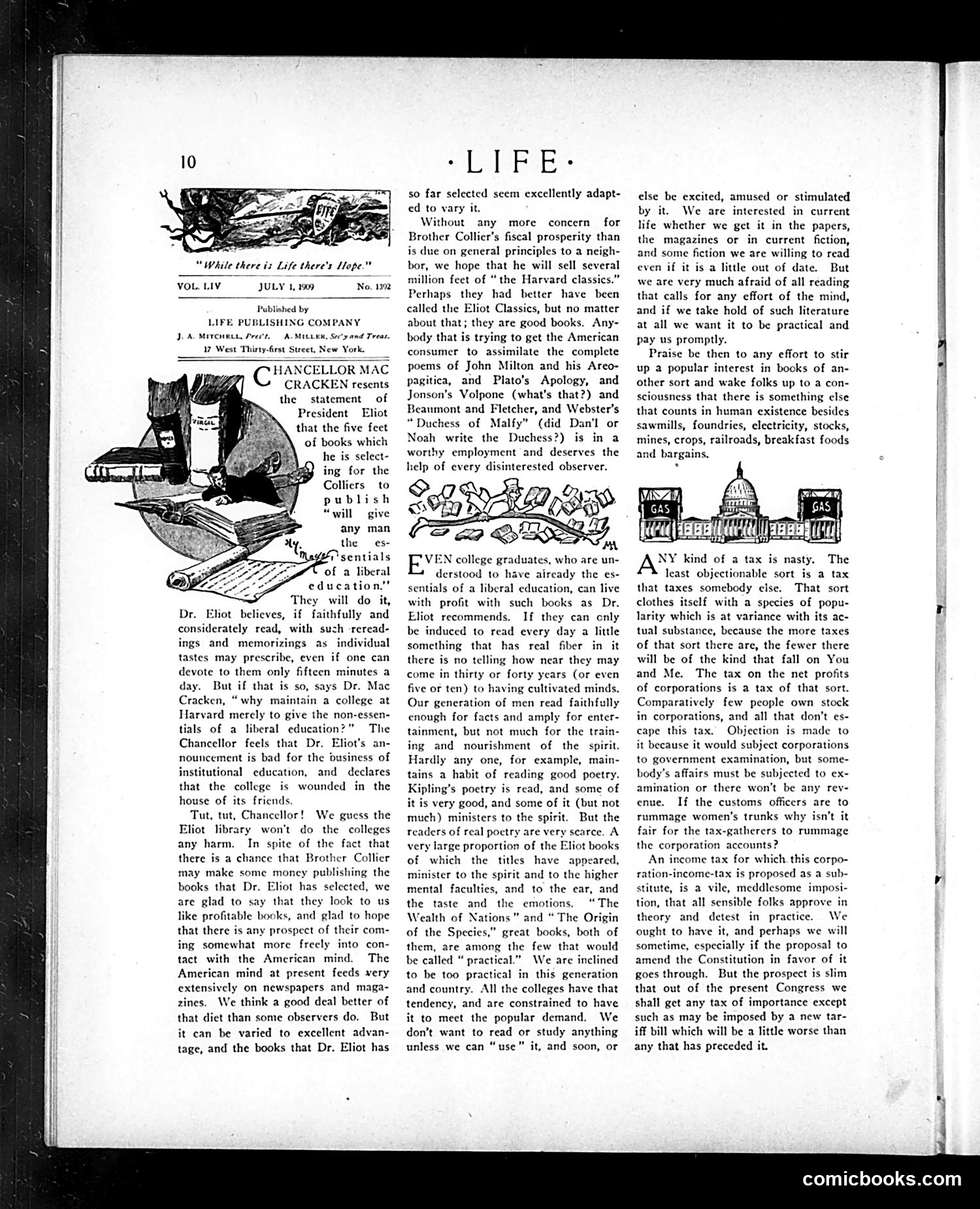
This page from *Life* (July 1, 1909) contains an editorial essay on college education rather than a political cartoon. The main illustration shows a figure labeled "Chancellor Mac Crackken" at a desk surrounded by books, satirizing his effort to select "the essentials of a liberal education" for Princeton University. The text criticizes the practicality obsession in American education, arguing that colleges prioritize "useful" knowledge over genuine intellectual nourishment. The author defends reading literature like Milton and Plato, warning against reducing education to mere vocational training. The piece advocates for preserving classical humanities against pressure to make curriculum narrowly "practical"—a tension between liberal arts and utilitarian education that remains relevant today.
📄 Transcribed text from this page (OCR, searchable)
Machine-transcribed from the original scan — historical spelling and the odd misread are preserved.
“While there iz Life there's Hope.” VOL. LIV JULY 1,199 Published by LIFE PUBLISHING COMPANY JA MITCHELL, Prost, A MILLER, Sec'y and Treat, 17 West Thirty-first Street, New York. HANCELLOR MAC CRACKEN resents the statement of President Eliot that the five feet of books which he is select- ing for the Colliers to publish “will give any man the — es- wsentials of a liberal education.” They will do it, Dr. Eliot believes, if faithfully and considerately read, with such -reread- ings and memorizings as individual tastes may prescribe, even if one can devote to them only fifteen minutes a day. But if that is so, says Dr. Mac Cracken, “why maintain a college at Harvard merely to give the non-essen- tials of a liberal education The Chancellor feels that Dr. Eliot’s an- nouncement is bad for the business of institutional education, and declares that the college is wounded in the house of its friends. Tut, tut, Chancellor! We guess the Eliot library won't do the colleges any harm. In spite of the fact that there is a chance that Brother Collier may make some money publishing the books that Dr. Eliot has selected, we are glad to say that they look to us like profitable books, and glad to hope that there is any prospect of their com- ing somewhat more freely into con- tact with the American mind. The American mind at present feeds very extensively on newspapers and maga- zines. We think a good deal better of that diet than some observers do. But it can be varied to excellent advan- tage, and the books that Dr. Eliot has No. 13972 = LaEsE= so far selected seem excellently adapt- ed to vary it. Without any more concern for Brother Collier’s fiscal prosperity than is due on general principles to a neigh- bor, we hope that he will sell several million feet of “the Harvard classics.’ Perhaps they had better have been called the Eliot Classics, but no matter about that; they are good books. Any- body that is trying to get the American consumer to assimilate the complete poems of John Milton and his Areo- pagitica, and Plato’s Apology, and Jonson’s Volpone (what's that?) and Beaumont and Fletcher, and Webster’s “Duchess of Malfy” (did Dan’l or Noah write the Duchess?) is in a worthy employment and deserves the help of every disinterested observer. VEN college graduates, who are un- derstood to have aiready the es- sentials of a liberal education, can live with profit with such books as Dr. Eliot recommends. If they can enly be induced to read every day a little something that has real fiber in it there is no telling how near they may come in thirty or forty years (or even five of ten) to having cultivated minds. Our generation of men read faithfully enough for facts and amply for enter- tainment, but not much for the train- ing and nourishment of the spirit. Hardly any one, for example, main- tains a habit of reading good poetry. Kipling’s poetry is read, and some of it is very good, and some of it (but not much) ministers to the spirit. But the readers of real poetry are very scarce. A very large proportion of the Eliot books of which the titles have appeared, minister to the spirit and to the higher mental faculties, and to the ear, and the taste and the emotions. “The Wealth of Nations” and “ The Origin of the Species,” great books, both of them, are among the few it would be called “ practical.” We are inclined to be too practical in this generation and country. All the colleges have that tendency, and are constrained to have it to meet the popular demand. We don’t want to read or study anything unless we can “use” it, and soon, or else be excited, amused or stimulated by it. We are interested in current life whether we get it in the papers, the magazines or in current fiction, and some fiction we are willing to read even if it is a little out of date. But we are very much afraid of all reading that calls for any effort of the mind, and if we take hold of such literature at all we want it to be practical and pay us promptly. Praise be then to any effort to stir up a popular interest in books of an- other sort and wake folks up to a con- sciousness that there is something clse that counts in human existence besides sawmills, foundries, electricity, stocks, mines, crops, railroads, breakfast foods and bargains. NY kind of a tax is nasty. least objectionable sort is a tax that taxes somebody else. That sort clothes itself with a species of popu- larity which is at variance with its ac- tual substance, because the more taxes of that sort there are, the fewer there will be of the kind that fall on You and Me. The tax on the net profits of corporations is a tax of that sort. Comparatively few people own stock in corporations, and all that don't es- cape this tax. Objection is made to it because it would subject corporations to government examination, but some- body’s affairs must be subjected to ex- amination or there won't be any rev- If the customs officers are to rummage women’s trunks why isn’t it fair for the tax-gatherers to rummage the corporation accounts? An income tax for which this corpo- ration-income-tax is proposed as a sub- stitute, is a vile, meddlesome imposi- tion, that all sensible folks approve in theory and detest in practice. We ought to have it, and perhaps we will sometime, especially if the proposal to amend the Constitution in favor of it goes through. But the prospect is slim that out of the present Congress we shall get any tax of importance except such as may be imposed by a new tar- iff bill which will be a little worse than any that has preceded it. enue. comicbooks.com