
Life, 1909-07-01 · page 24 of 44
Life — July 1, 1909 — page 24: what you’re looking at
What you’re looking at
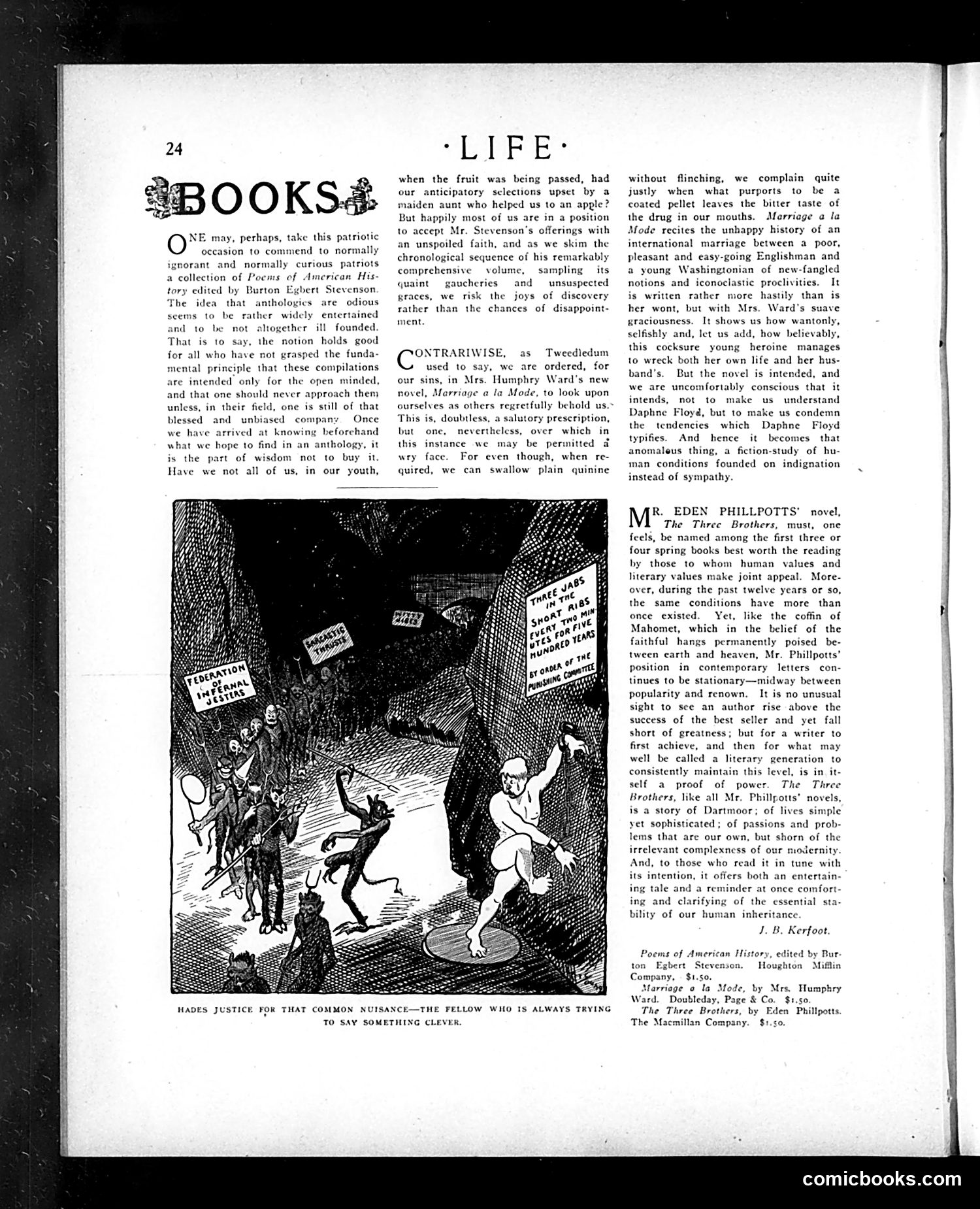
This page contains a **book review section** rather than political cartoons. The central illustration depicts Hades (Greek underworld) administering justice to "the fellow who is always trying to say something clever"—a social satire about people who make constant quips or witty remarks. The reviews discuss three literary works: a poetry anthology edited by Burton Egbert Stevenson; *Marriage à la Mode* by Mrs. Humphry Ward (criticized for being hastily written and condemning its young female protagonist rather than understanding her); and *The Three Brothers* by Eden Phillpotts (praised as worthy literature, though noting Phillpotts maintains a frustratingly middling position between bestseller success and literary greatness). The underlying point seems to be about literary merit versus popular appeal—a common concern in early 20th-century literary criticism. The Hades cartoon serves as light commentary on social pretension, a typical satirical magazine element.
📄 Transcribed text from this page (OCR, searchable)
Machine-transcribed from the original scan — historical spelling and the odd misread are preserved.
OOKS# 2 may, perhaps, take this patriotic occasion to commend to normally and normally curious patriots on of Pocms of American His- Burton Egbert Stevenson hologies are odious widely entertained ther ill founded. That is to say, the notion holds good for all who have not grasped the funda- mental principle that these compilations for the open minded, oS O ? ignorant a collec tory edited by The idea tha seems to be rather and to be not alte are intended only and that one should never approach then unless, in their field, one is still of that blessed and unbi Once we have arrived beforehand what we hope to find in an anthology, it is the part of wisdom not to buy it. Have we not all of us, in our youth, “ee when the fruit was being passed, had our anticipatory selections upset by a maiden aunt who helped us to an apple? But happily most of us are in a position to accept Mr. Stevenson's offerings with an unspoiled faith, and as we skim the chronological sequence of his remarkably comprehensive volume, sampling its gaucheries and unsuspected graces, we risk the joys of discovery rather than the chances of disappoint ment. quaint ONTRARIWISE, as Tweedledum used to say, we are ordered, for our sins, in Mrs. Humphry Ward’s new novel, Marriage a la Mode, to look upon ourselves as others regretfully behold us.> This is, doubtless, a salutory prescription, but one, over which in this instance we may be permitted @ wry face. For even though, when re- quired, we can swallow plain quinine nevertheless, HADES JUSTICE FOR THAT COMMON NUISANCE—THE FELLOW WHO 1S ALWAYS TRYING TO SAY SOMETHING CLEVER. without flinching, we complain quite justly when what purports to be a coated pellet leaves the bitter taste of the drug in our mouths. Marriage a la Mode recites the unhappy history of an international marriage between a poor, pleasant and easy-going Englishman and a young Washingtonian of new-fangled notions and iconoclastic proclivities. It is written rather more hastily than is her wont, but with Mrs, Ward's suave graciousness, It shows us how wantonly, selfishly and, let us add, how believably, young manages to wreck both her own life and her bus- band’s. But the novel is intended, and we are uncomfortably conscious that it intends, not to make us understand Daphne Floyd, but to make us condemn the tendencies which Daphne Floyd typifies. And hence it becomes that anomaleus thing, a fiction-study of hu- man conditions founded on indignation instead of sympathy. Me EDEN PHILLPOTTS’ novel, The Three Brothers, must, one feels, be named among the first three or four spring books best worth the reading by those to whom human values and literary values make joint appeal. More- over, during the past twelve years or so, the same conditions have more than once existed. Yet, like the coffin of Mahomet, which in the belief of the faithful hangs permanently poised be- tween carth and heaven, Mr. Phillpotts’ position in contemporary letters con- tinues to be stationary—midway between popularity and renown. It is no unusual sight to sce an author rise above the success of the best seller and yet fall short of greatness; but for a writer to first achieve, and then for what may well be called a literary generation to consistently maintain this level, is in it- self a proof of power. The Three Brothers, like all Mr. Phillpotts’ novels, is a story of Dartmoor; of lives simple yet sophisticated ; of passions and prob- lems that are our own, but shorn of the irrelevant complexness of our moxernity. And, to those who read it in tune with its intention, it offers both an entertain- ing tale and a reminder at once comfort- this cocksure heroine ing and clarifying of the essential sta- bility of our human inheritance. J. B. Kerfoot. Poems of American History, edited by Bur- ton Egbert Stevenson. Houghton Mifflin Company, $1.50. Marriage 0 la Mode, by Mrs, Humphry Ward. Doubleday, Page & Co. $1.50. The Three Brothers, by Eden Phillpotts The Macmillan Company. $1.50. comicbooks.com