
Life, 1909-07-01 · page 28 of 44
Life — July 1, 1909 — page 28: what you’re looking at
What you’re looking at
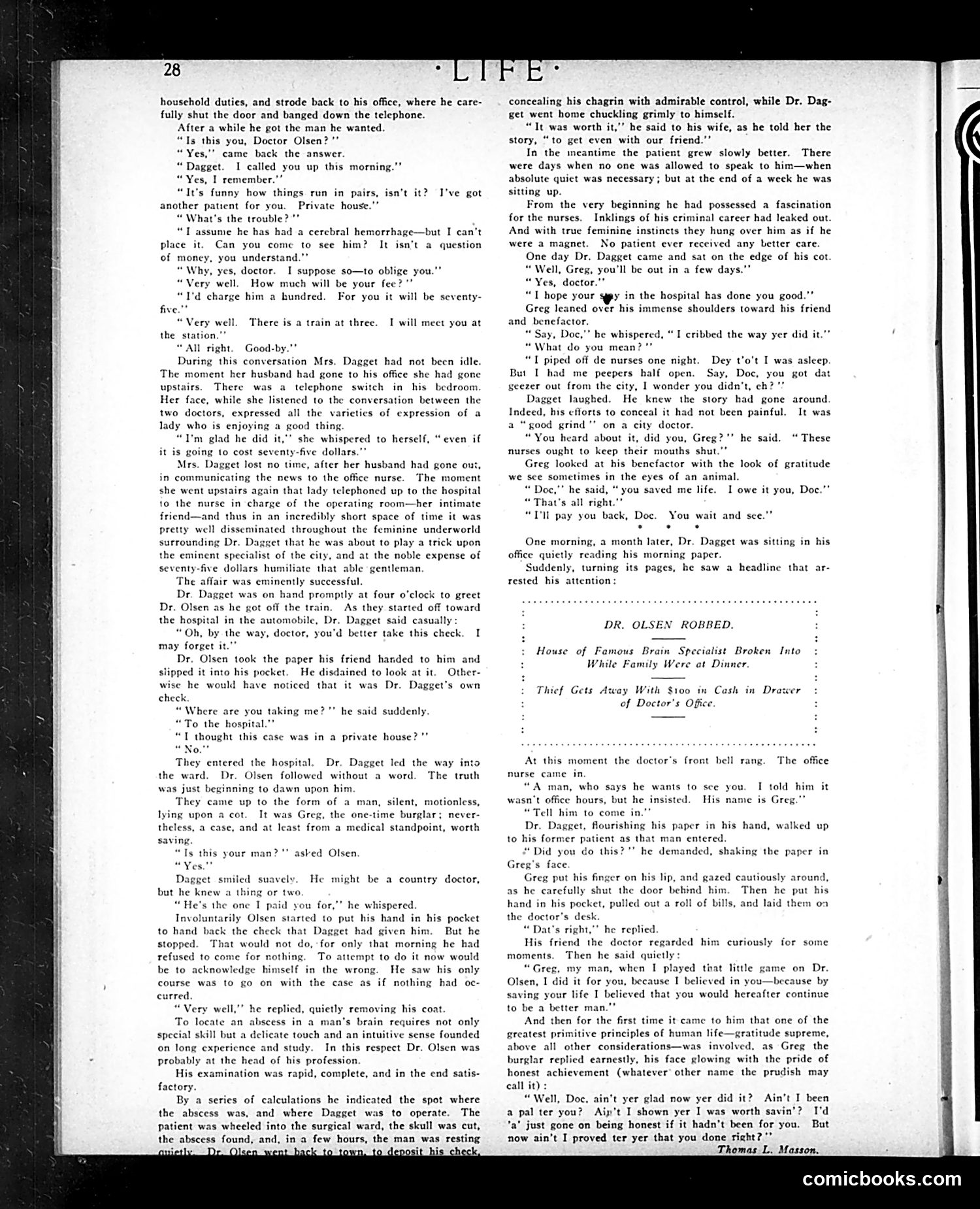
This page presents a narrative story with embedded satire about medical professional ethics and social class. The headline "DR. OLSEN ROBBED" refers not to literal theft, but to a con: Dr. Dagget, a country doctor, tricks the renowned specialist Dr. Olsen into treating a poor burglar (Greg) for a reduced fee by claiming it's a private case requiring seventy-five dollars instead of his usual hundred. The satire targets: 1. **Professional pride**: Olsen refuses to admit he's been duped, paying the check rather than acknowledging he was outwitted 2. **Class pretension**: Dagget humbles the "eminent specialist" using a vagrant as an instrument 3. **Medical ethics**: Despite the deception, Olsen performs excellently—suggesting integrity ultimately prevails The irony is that Dagget's trick succeeds in getting quality care for someone who "deserves" it medically, though socially disposable. The women's gossip network spreading news of the scheme emphasizes gender and power dynamics of the era.
📄 Transcribed text from this page (OCR, searchable)
Machine-transcribed from the original scan — historical spelling and the odd misread are preserved.
28 household duties, and strode back to his office, where he care- fully shut the door and banged down the telephone. After a while he got the man he wanted. “Is this you, Doctor Olsen?’ “Yes,"" came back the answer. “Dagget. I called you up this morning.”” “Yes, I remember.”” “It's funny how things run in pairs, isn’t it? I've got another patient for you. Private house.”” “What's the trouble? "” “Tassume he has had a cerebral hemorrhage—but I can’t place it. Can you come to see him? It isn’t a question of money, you understand.”’ “Why, yes, doctor. I suppose so—to oblige you.”” “Very well. How much will be your fee?” “I'd charge him a hundred. For you it will be seventy- five.” “Very well. There is a train at three. the station.”” “All right. Good-by During this conversation Mrs. Dagget had not been idle. he moment her husband had gone to his office she had gone upstairs. There was a telephone switch in his bedroom. Her face, while she listened to the conversation between the two doctors, expressed all the varictics of expression of a lady who is enjoying a good thing. “I'm glad he did it,’ she whispered to herself, “even if it is going to cost seventy-five dollars, Mrs. Dagget lost no time, after her husband had gone out, in communicating the news to the office nurse. The moment she went upstairs again that lady telephoned up to the hospital to the nurse in charge of the operating room—her intimate I will meet you at fricnd—and thus in an incredibly short space of time it was pretty well disseminated throughout the feminine underworld surrounding Dr. Dagget that he was about to play a trick upon the eminent specialist of the city, and at the noble expense of seventy-five dollars humiliate that able gentleman. The affair was eminently successful. Dr. Dagget was on hand promptly at four o'clock to greet Dr. Olsen as he got off the train. As they started off toward the hospital in the automobile, Dr. Dagget said casually : “Oh, by the way, doctor, you'd better take this check may forget it."” Dr. Olsen took the paper his friend handed to him and pped it into his pocket. He disdained to look at it. Other- wise he would have noticed that it was Dr. Dagget’s own check “Where are you taking me?’ he said suddenly. “To the hospital.”” “T thought this case was in a private house?" “No. They entered the hospital. Dr. Dagget led the way into the ward. Dr. Olsen followed without a word. The truth was just beginning to dawn upon him. They came up to the form of a man, silent, motionless, lying upon a cot. It was Greg, the one-time burglar: neve! theless, a case, and at least from a medical standpoint, worth saving. “Is this your man?" asked Olsen. Dagget smiled suavely. He might be a country doctor, but he knew a thing or two “He's the one I paid you for,” he whispered Involuntarily Olsen started to put his hand in his pocket to hand back the check that Dagget had given him, But he stopped. That would not do, for only that morning he had refused to come for nothing. To attempt to do it now would be to acknowledge himself in the wrong. He saw his only course was to go on with the case as if nothing had oc- curred, “Very well, To locate an a special skill but a delicate touch and an intuitive sense founded on long experience and study. In this respect Dr. Olsen was probably at the head of his profession His examination was rapid, complete, and in the end satis- factory. By a series of calculations he indicated the spot where the abscess was, and where Dagget was to operate. The patient was wheeled into the surgical ward, the skull was cut, the abscess found, and, in a few hours, the man was resting 7 Do . . it his check he replied, quietly removing his coat. scess in a man’s brain requires not only concealing his chagrin with admirable control, while Dr. Dag- get went home chuckling grimly to himself. “It was worth it,”” he said to his wife, as he told her the story, “to get even with our friend.” In the meantime the patient grew slowly better. There were days when no one was allowed to speak to him—when absolute quiet was necessary ; but at the end of a week he was sitting up. From the very beginning he had possessed a fascination for the nurses, Inklings of his criminal career had leaked out. And with true feminine instincts they hung over him as if he were a magnet. No patient ever received any better care. One day Dr. Dagget came and sat on the edge of his cot “Well, Greg, you'll be out in a few days.” Yes, doctor. “T hope your syy in the hospital has done you good.’ Greg leaned over his immense shoulders toward his friend and benefactor. Say, Doc," he whispered, “What do you mean?"’ “T piped off de nurses one night. Dey t’o’t I was asleep. But I had me peepers half open. Say, Doc, you got dat seezer out from the city, I wonder you didn’t, ch? "? Dagget laughed. He knew the story had gone around Indeed, his efforts to conceal it had not been painful. It was a “good grind” on a city doctor. “You heard about it, did you, Greg? nurses ought to keep their mouths shut Greg looked at his benefactor with the look of gratitude we sce sometimes in the eyes of an animal. Doe,”’ he said, “ you saved me life. 1 owe it you, Doc.’ “ That's all right.’’ “TI pay you back, Doc. You wait and see. I cribbed the way yer did it. he said. “ These One morning, a month later, Dr. Dagget was sitting in his office quietly reading his morning paper. Suddenly, turning its pages, he saw a headline that ar- rested his attention: DR. OLSEN ROBBED. House of Famous Brain Specialist Broken Into : While Family Were at Dinner. Thief Gets Away With $100 Cash in Draw of Doctor's Office At this moment the doctor's front bell rang. The office nurse came in “A man, who says he wants to sce you. I told him it n't office hours, but he insisted. “Tell him to come in Dr. Dagget, flourishing his paper in his hand, walked up to his former patient as that man entered. “Did you do this?’ he demanded, shaking the paper in Greg's face Greg put his finger on his lip, and gazed cautiously around, as he carefully shut the door behind him. Then he put his hand in his pocket, pulled out a roll of bills, and laid them oa the doctor's desk “Dat’s right,” His friend the doctor regarded him curiously for some His name is Greg.” he replied. ments. Then he said quietly: Greg, my man, when I played that little game on Dr. Olsen, I did it for you, because I believed in you—because by saving your life I believed that you would hereafter continue to be a better man."" ‘And then for the first time it came to him that one of the greatest primitive principles of human life—gratitude supreme, above all other considerations—was involved, as Greg the burglar replied earnestly, his face glowing with the pride of honest achievement (whatever other name the prudish may call it) : “Well, Doc, ain't yer glad now yer did it? Ain't I been a pal ter you? Ain't I shown yer I was worth savin’? I'd *a’ just gone on being honest if it hadn't been for you. But now ain’t I proved ter yer that you done right?” Thomas L. Masson. comicbooks.com