
A complete issue · 32 pages · 1909
Life — April 22, 1909
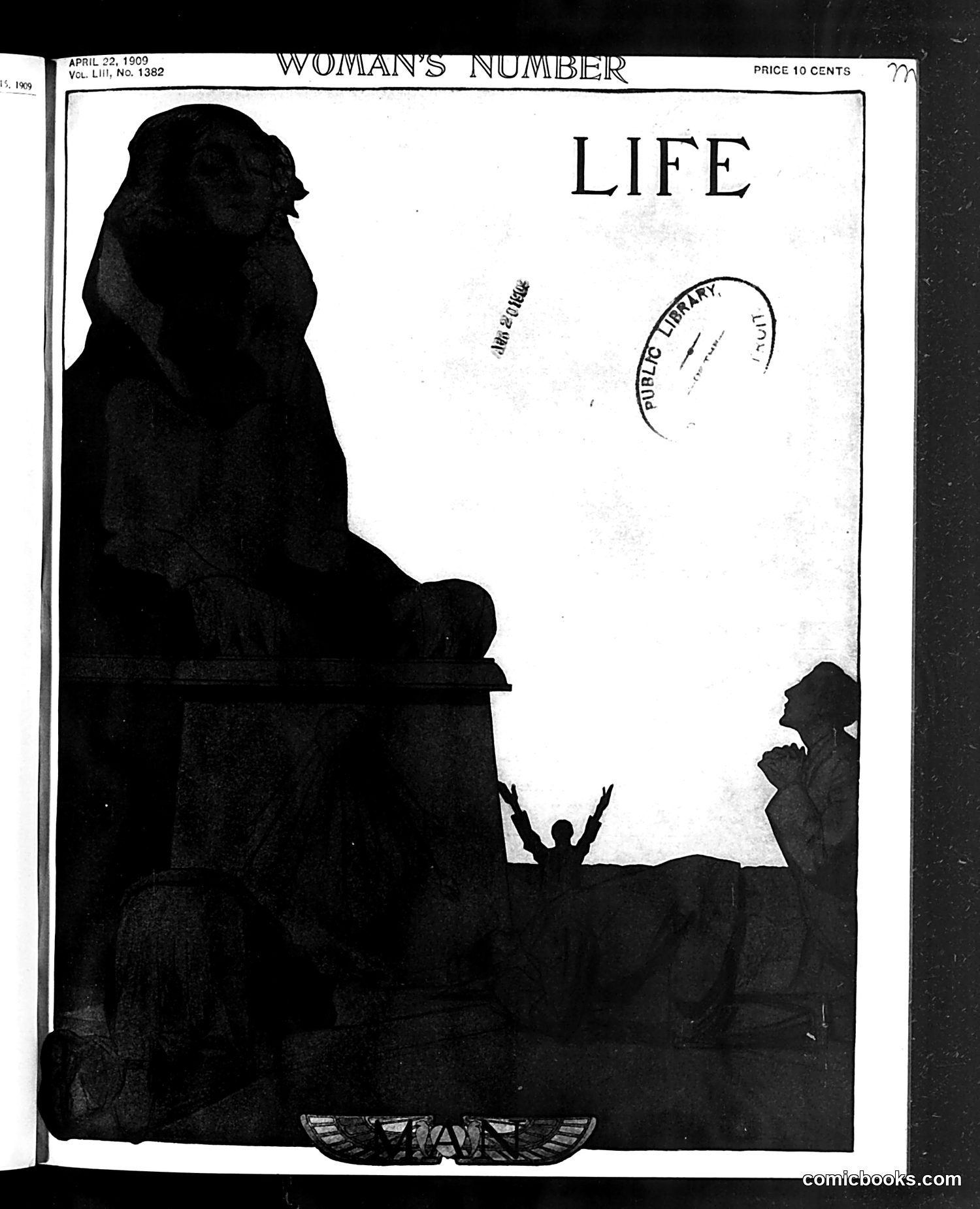
This is the cover of Life magazine's "Woman's Number" issue (price 10 cents). The image is a silhouette composition showing an Egyptian sphinx-like colossal female figure dominating the composition, with small human figures below appearing to worship or revere her. The satire likely comments on the growing women's movement and changing social status of women in early 20th-century America. The sphinx—an ancient, monumental symbol of mystery and power—suggests women as an enigmatic, formidable force reshaping society. The tiny figures below emphasize this shift in power dynamics. This reflects contemporary anxieties and fascination with feminism during the Progressive Era.
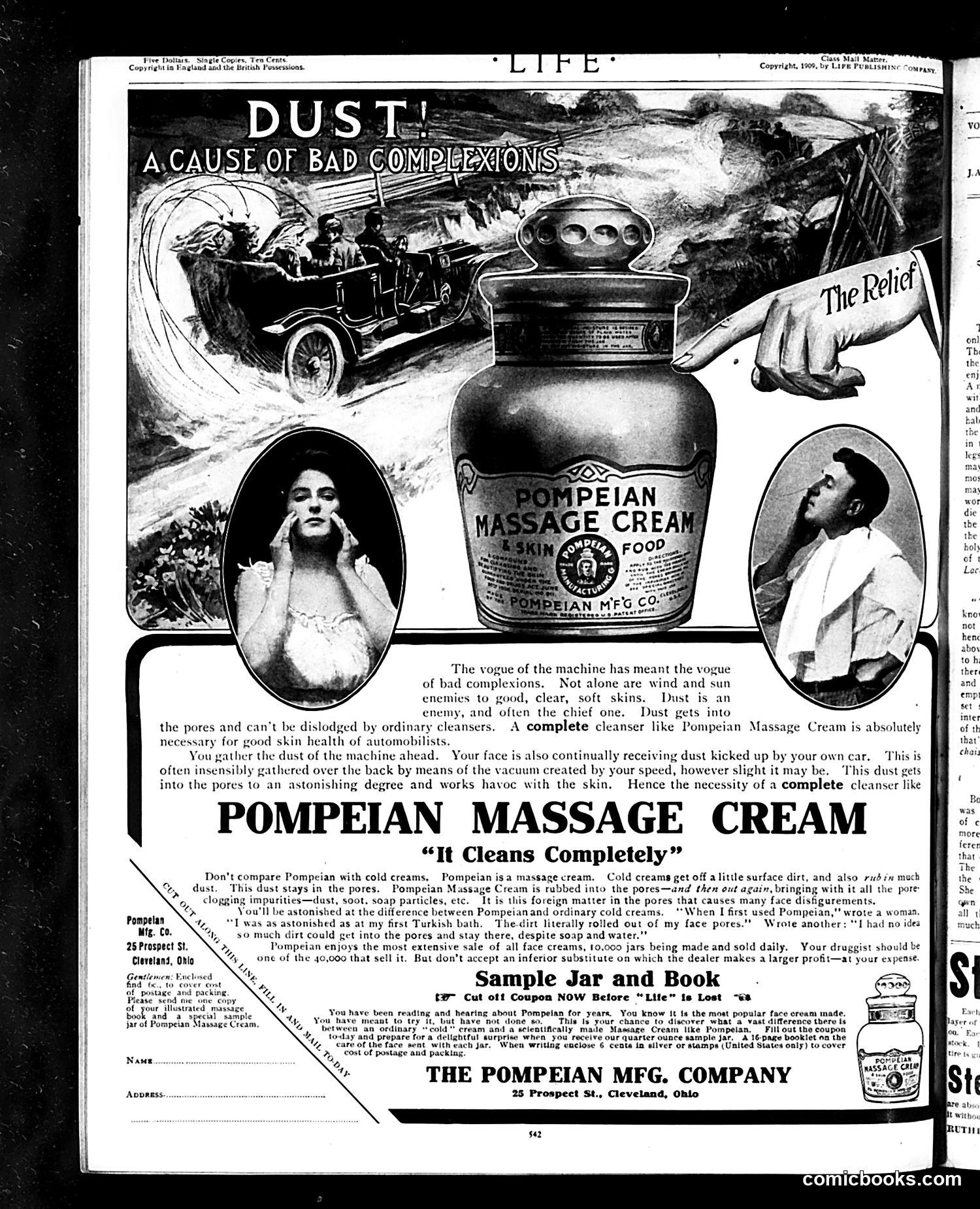
This page is primarily a **product advertisement** for Pompeian Massage Cream, not political satire. The headline "DUST! A CAUSE OF BAD COMPLEXIONS" uses a topical concern—likely referencing dust from early automobile travel or industrial pollution—as a marketing hook. The advertisement argues that dust from cars and machines damages skin by clogging pores. The Pompeian product is positioned as a "complete cleanser" superior to ordinary cold creams. The two portrait photographs show before/after examples of skin problems allegedly caused by dust exposure. The automobile illustration depicts the dusty conditions people faced. This represents typical early-20th-century advertising strategy: identifying a modern anxiety (automobile dust/pollution) and offering a commercial solution. The satirical magazine *Life* ran paid advertisements alongside editorial content.
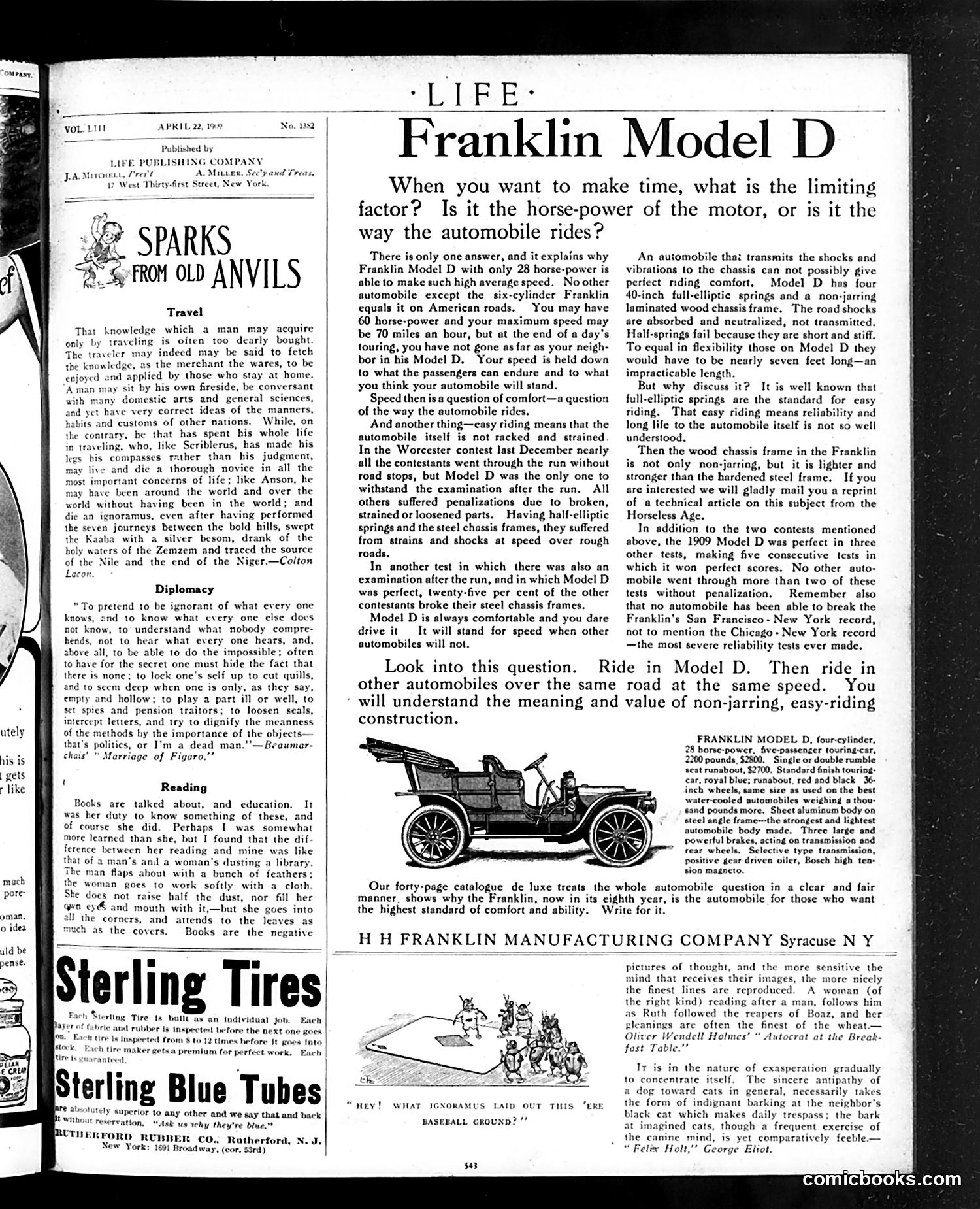
This page is primarily **advertising and editorial content**, not political satire. The main feature is a promotional article for the Franklin Model D automobile, highlighting its comfortable ride and reliable construction. The accompanying illustration shows the car itself—a four-cylinder touring vehicle. The only cartoon element appears at the bottom: a small humorous illustration labeled "HEY! WHAT INONOHAM'S LAID OUT THIS 'ERE BASEBALL GROUND?'" This appears to be a domestic joke about someone's yard being used as a baseball field, unrelated to broader political commentary. The page also advertises Sterling Tires and Sterling Blue Tubes—typical early 20th-century automotive advertisements. The content reflects 1920s consumer culture and automobile marketing rather than satirical commentary.
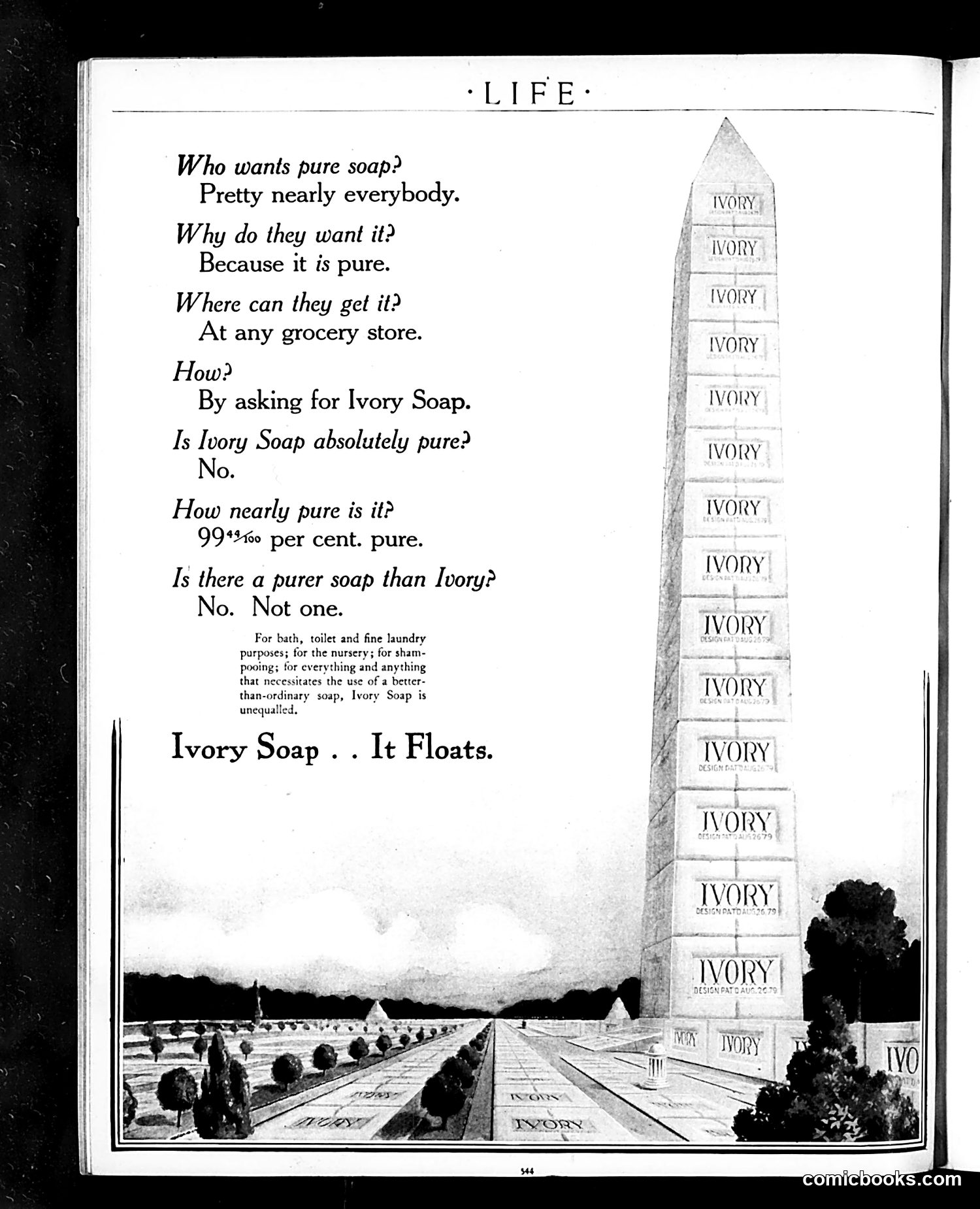
This is a straightforward product advertisement, not satire or political commentary. The page uses a question-and-answer format to promote Ivory Soap's key selling points: its purity (99 44/100% pure), universal availability at grocery stores, and superiority to competitors. The visual shows an impossibly tall tower of stacked Ivory bars dominating a landscape—a common advertising device of the era to convey the product's dominance and ubiquity in the market. The phrase "It Floats" references Ivory's famous characteristic (an accidental result of air whipped into the soap during manufacturing). This represents early-20th-century consumer advertising using aspirational imagery and competitive claims typical of the period.
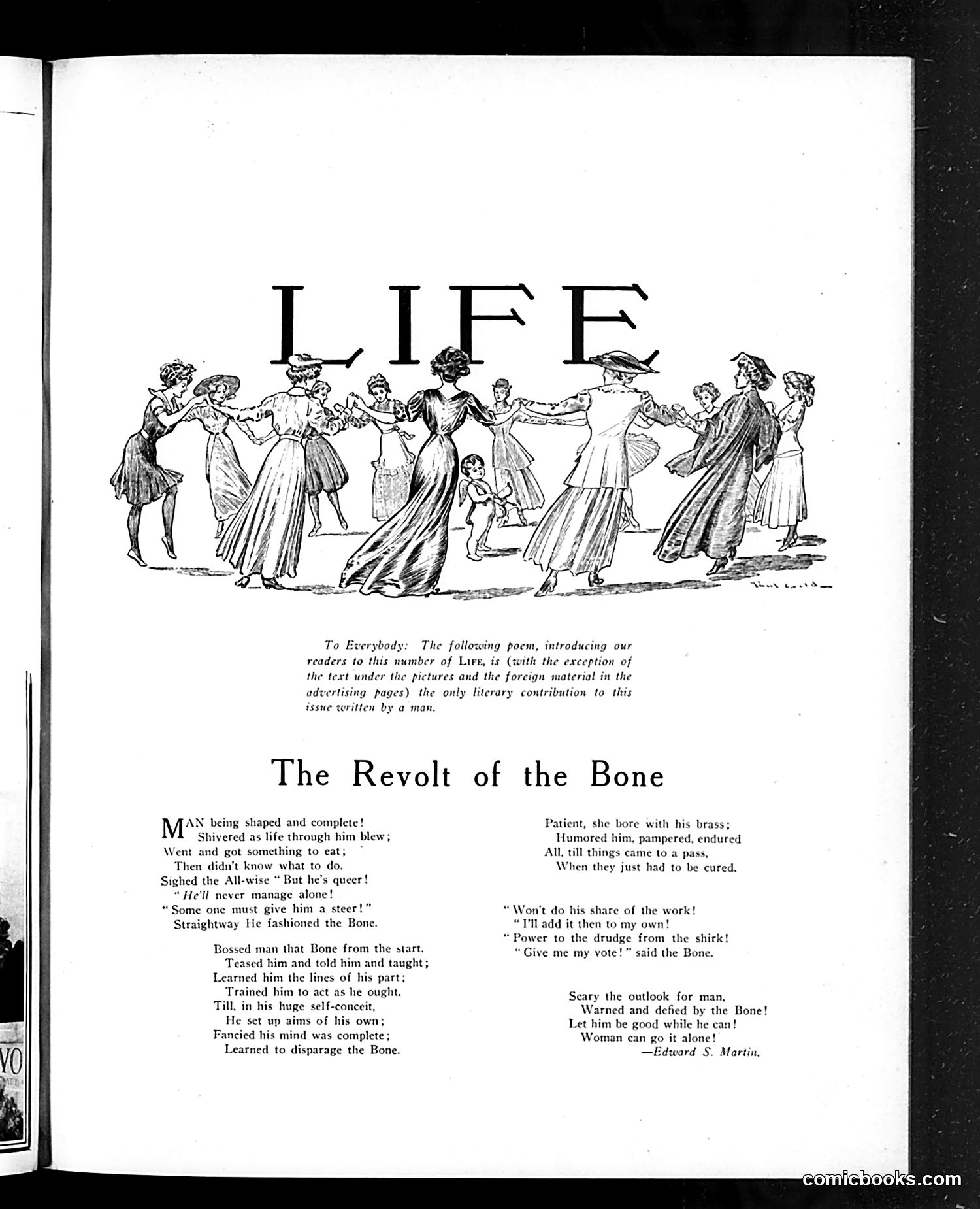
This satirical poem by Edward S. Martin critiques the emerging women's suffrage and independence movements of the early 20th century. "The Bone" appears to be a metaphor for a woman who has been shaped and controlled by men ("shaped and complete"). The poem describes her "revolt"—her demand for voting rights, workplace equality ("Won't do his share of the work!"), and autonomy ("Power to the drudge from the shirt!"). The illustration shows women in a circle, likely representing this collective uprising. The satire mocks male anxiety about women's liberation, warning men should "be good while he can" because "Woman can go it alone!" The piece captures contemporary male resistance to women's rights activism.
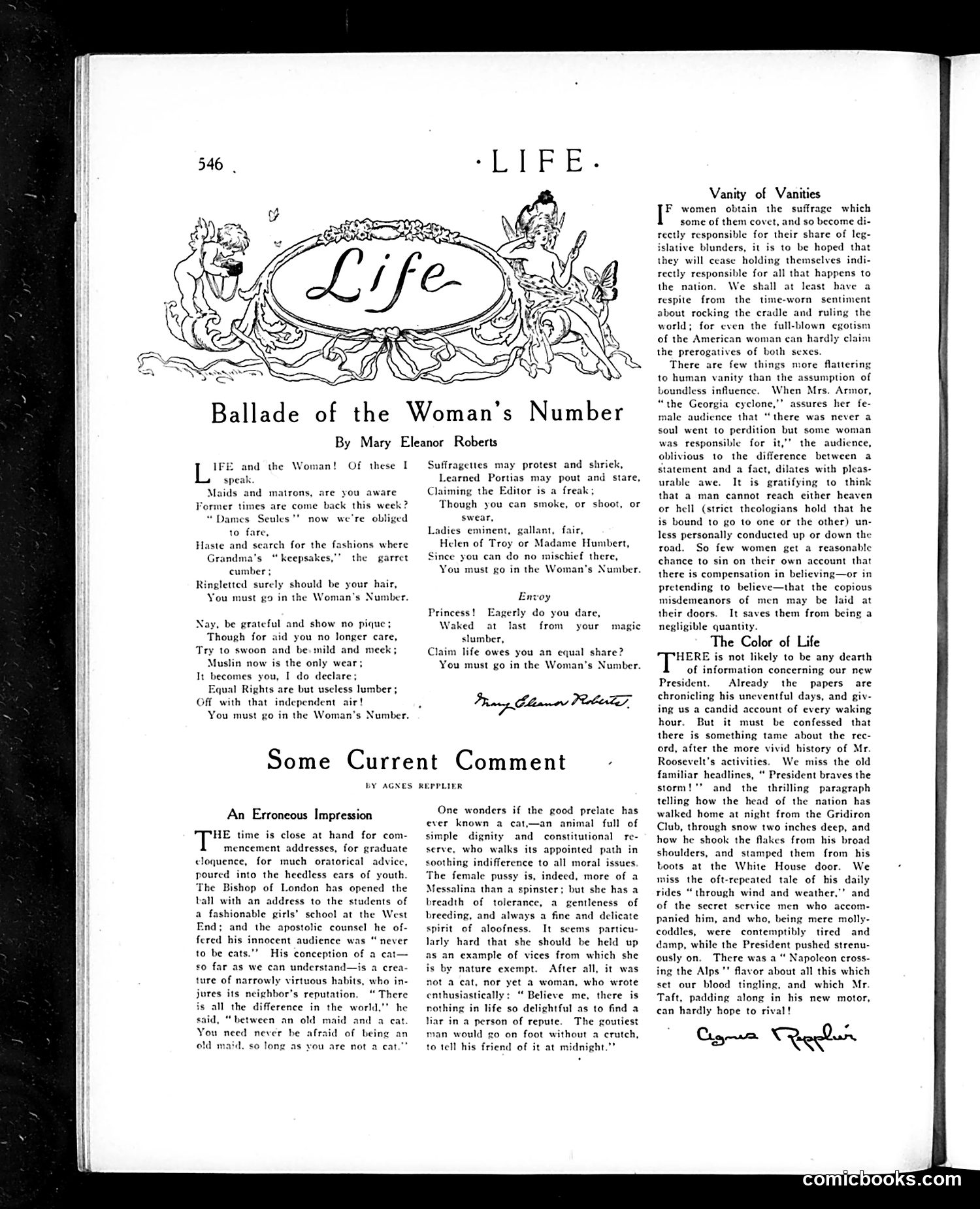
This page contains literary content rather than political cartoons. The main feature is "Ballade of the Woman's Number" by Mary Eleanor Roberts, a poem addressing women's suffrage. The verse argues that women should have equal political rights ("Equal Rights are needless lumber; / Off with that independent air! / You must go in the Woman's Number"). The accompanying commentary sections critique press coverage of President Roosevelt's activities, noting the "tame" quality of recent presidential news compared to earlier, more dramatic headlines. There's also commentary on gender stereotypes, comparing women unfavorably to cats in terms of moral character. The page reflects early 20th-century debates over women's voting rights and contemporary political coverage, presented through satire and social commentary typical of *Life* magazine's editorial approach.
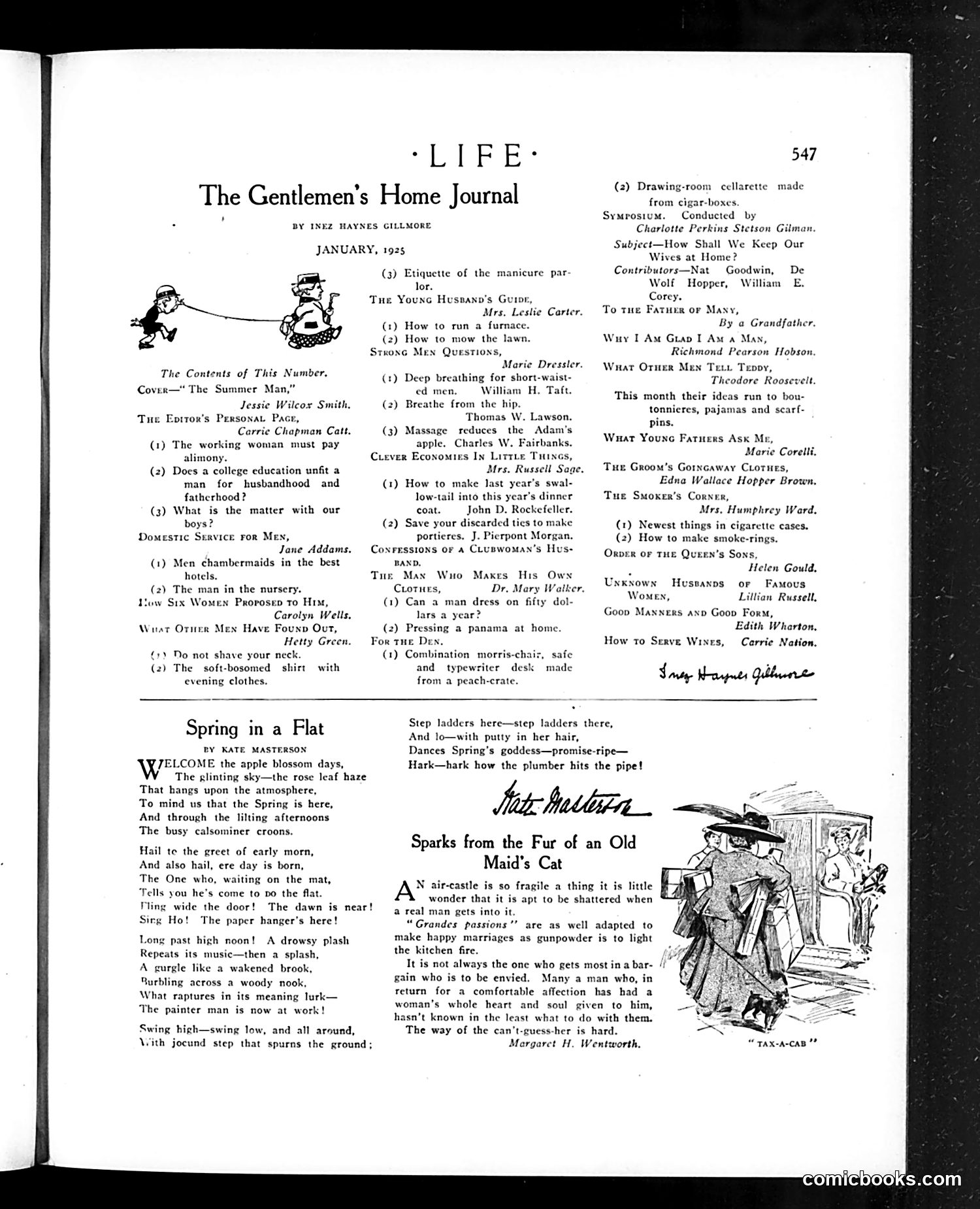
This cartoon by Kate Masterson illustrates a domestic comedy scene about spring cleaning in an apartment ("flat"). The sketch shows a plumber working inside a home while a woman watches, with the caption "TAX-A-CAB." The humor appears to reference the absurdity of spring maintenance tasks—the plumber is actively working on pipes while the domestic space undergoes renovation. The "tax-a-cab" reference likely puns on taxi services, though the exact satirical target is unclear from the image alone. It seems to mock the chaos and expense of urban apartment living during spring renovations, when various tradespeople (plumbers, painters) must be hired, making the season costly for homeowners.
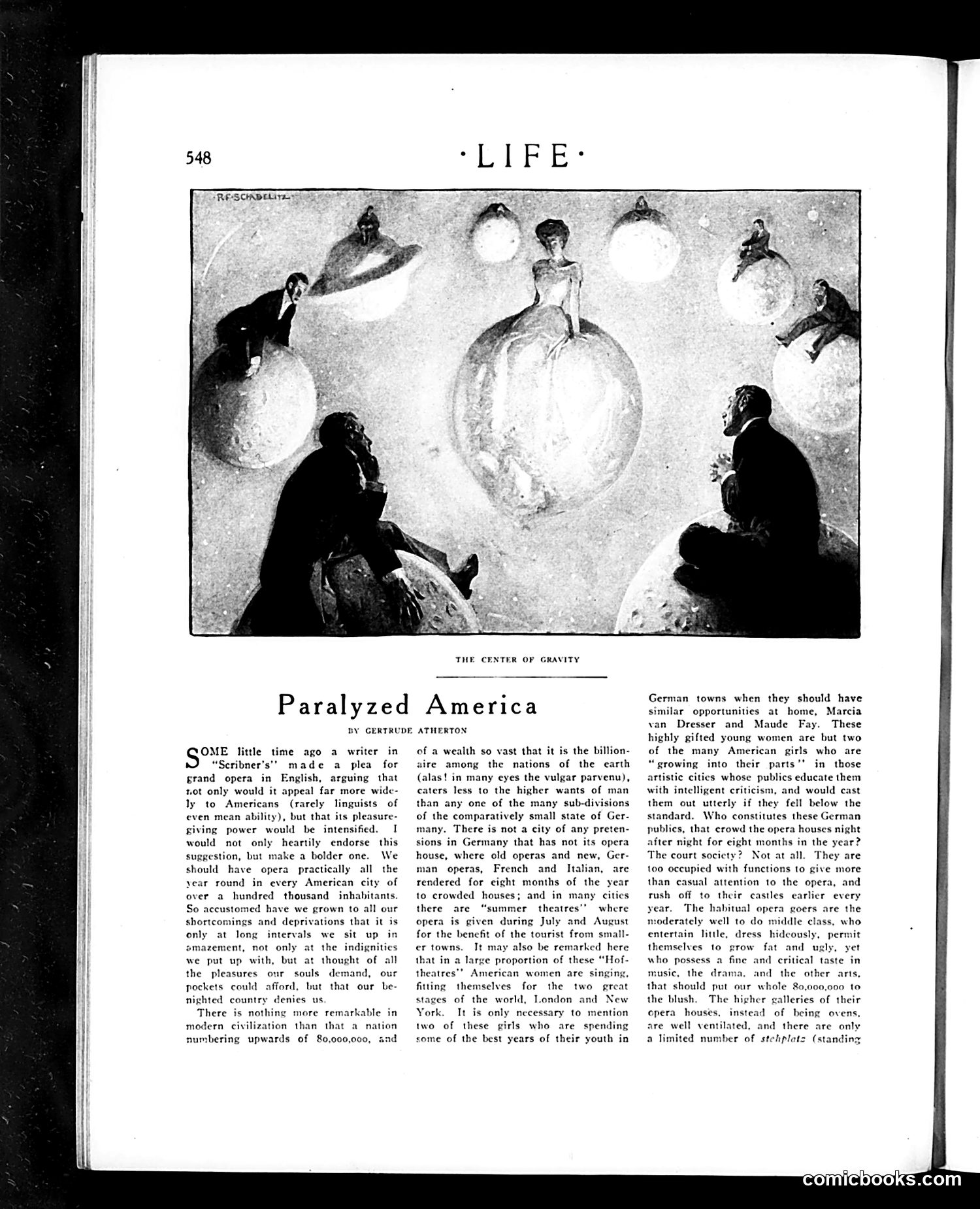
This satirical piece critiques American cultural life as stagnant compared to Germany's vibrant opera and theater scene. The illustration titled "The Center of Gravity" depicts figures floating around large spheres, suggesting America's cultural institutions lack proper grounding or direction. Atherton argues that while Germany supports opera houses year-round across numerous cities, America relies on touring companies and "summer theaters" for tourists. She notes that American opera houses remain closed much of the year, and laments that talented young women seeking artistic careers must pursue them abroad rather than at home. The satire suggests America's high society is culturally "paralyzed"—wealthy but artistically underdeveloped compared to European standards, unable to sustain serious theatrical institutions despite its resources.
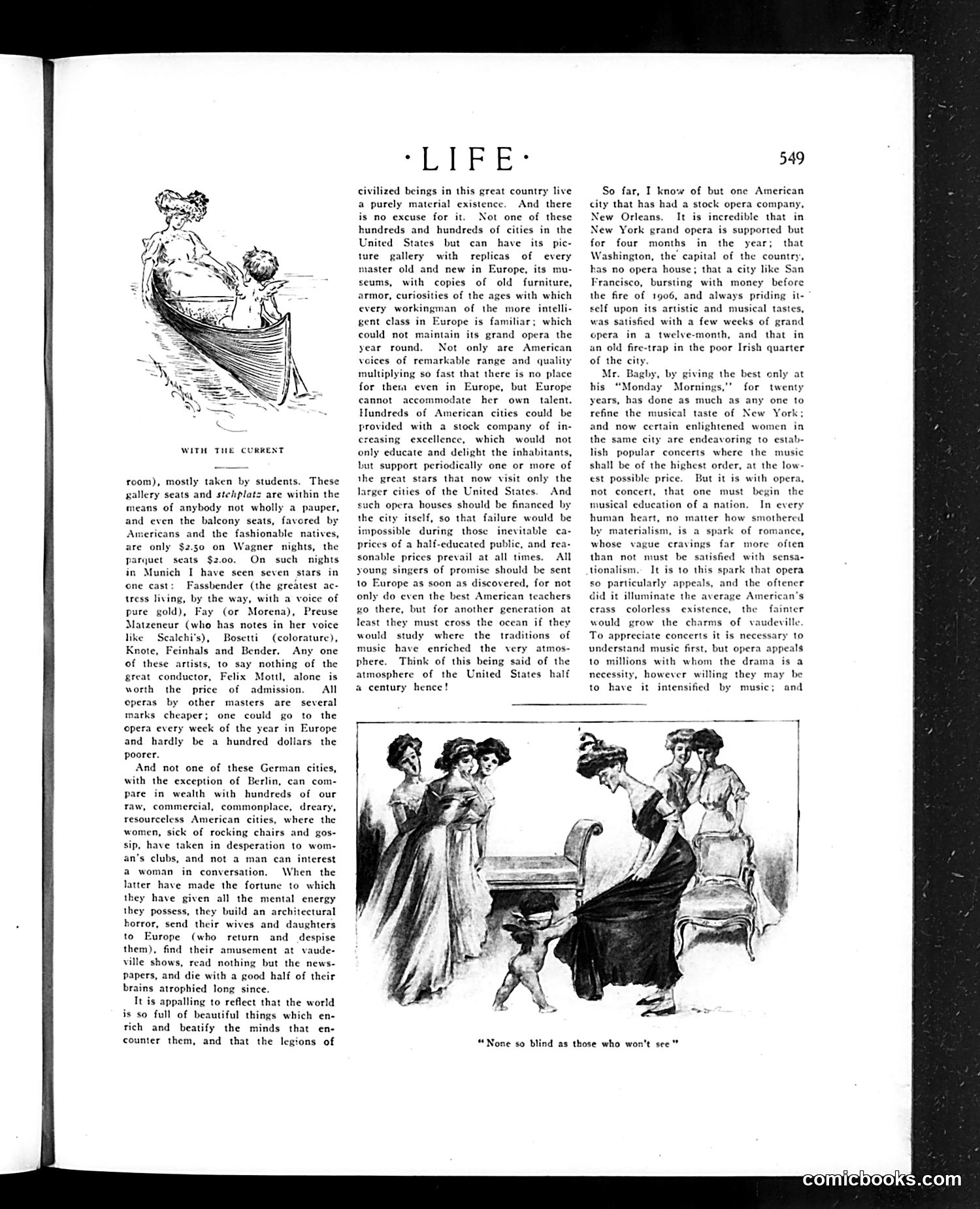
The page discusses American cultural deficiencies, particularly the lack of opera houses and musical institutions in U.S. cities compared to Europe. The text argues that wealthy American industrialists have failed to support the arts despite their fortunes. The cartoon at bottom, captioned **"None so blind as those who won't see,"** depicts well-dressed women gathered around what appears to be a baby carriage or similar object. The satire suggests that wealthy American women—despite their education and resources—deliberately ignore opportunities to patronize or appreciate culture. The broader critique lambastes America's commercial materialism and the wealthy classes' failure to foster artistic institutions, contrasting American cultural poverty unfavorably with European tradition and sophistication.
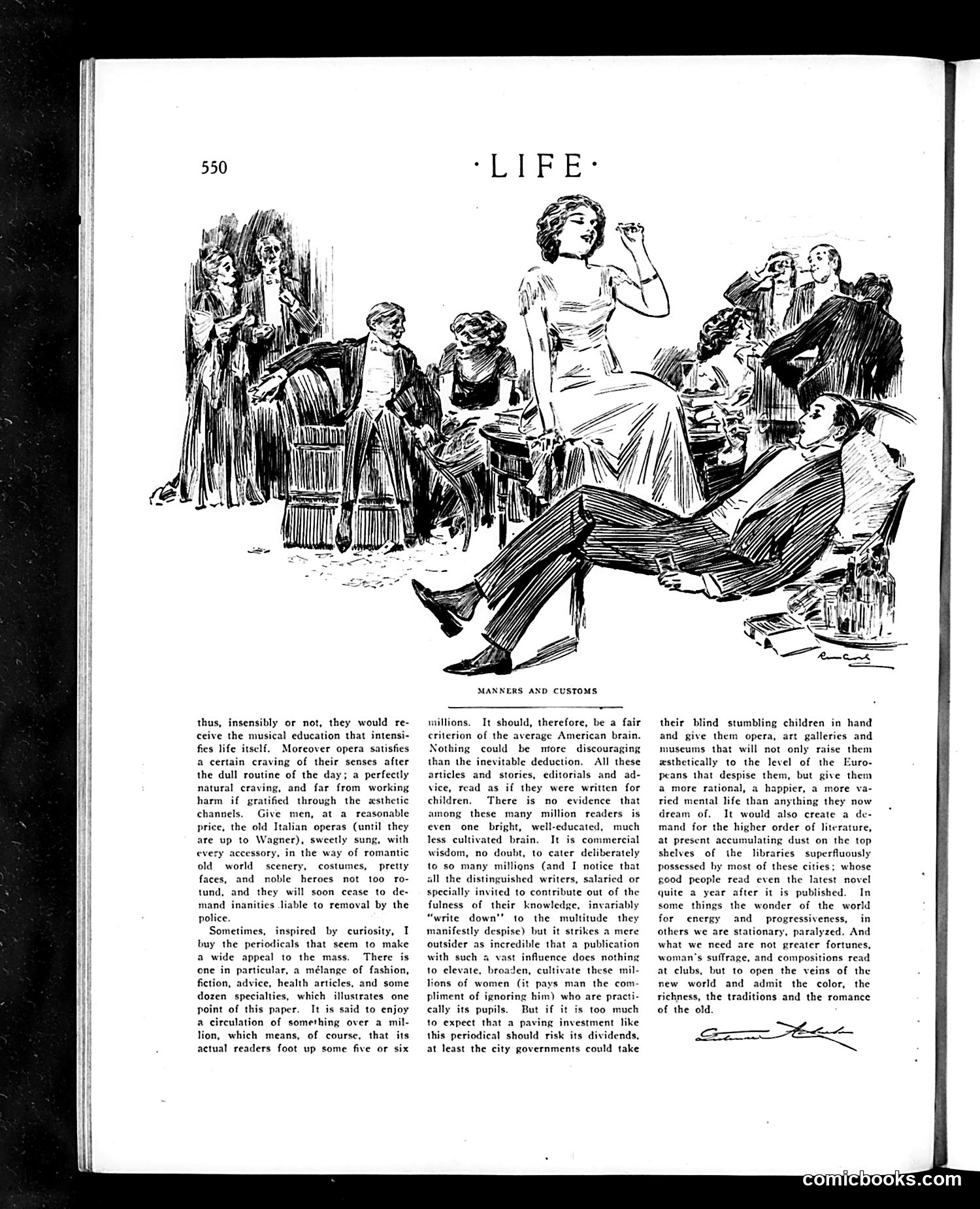
This is a satirical commentary on American cultural taste and publishing, not a political cartoon. The illustration depicts a social gathering where a woman sits centrally while various men attend to her—a scene illustrating upper-class social dynamics. The accompanying text critiques the "musical education" and cultural priorities of American society. It argues that while millions of American readers consume popular periodicals, newspapers, and serialized fiction, they lack refined aesthetic education comparable to Europeans. The author suggests that average Americans receive "commercial wisdom" rather than genuine cultural cultivation, and laments that prestigious publications cater deliberately to mass audiences rather than elevating public taste. The satire targets American anti-intellectualism and the publishing industry's profit-driven compromises with mass culture.
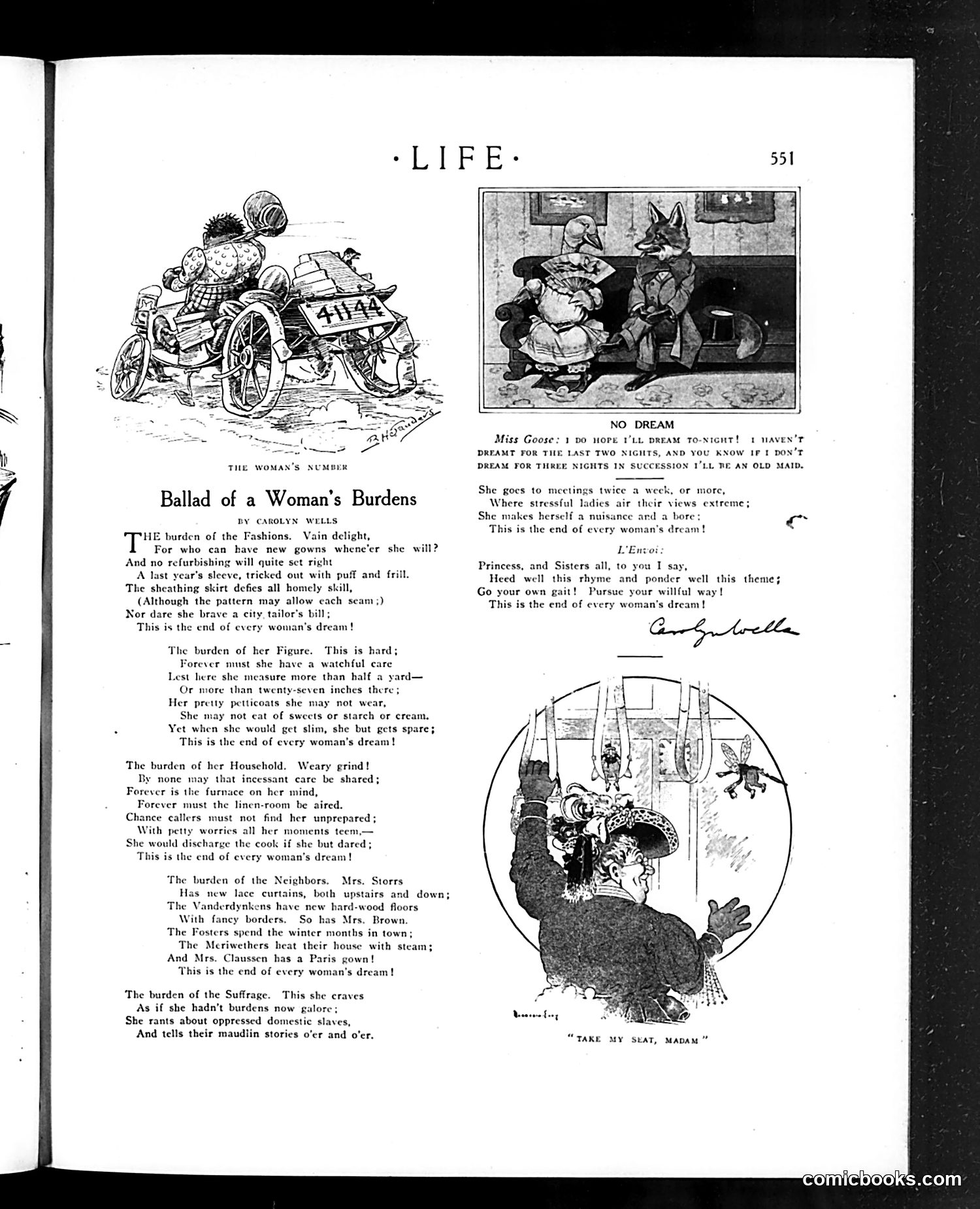
This satirical poem and illustrations critique the relentless domestic demands on women. The text mocks women's supposed "dreams" by cataloging their actual exhausting realities: fashion constraints, household management, childcare, cooking, laundry, and social obligations. The cartoon illustrations reinforce this message visually. "The Woman's Number" shows a chaotic vehicle overloaded with burdens. "No Dream" and "Take My Slat, Madam" depict women overwhelmed by responsibilities and social expectations. The concluding editorial voice sarcastically tells women to "pursue your willful way" while acknowledging this is "the end of every woman's dream"—meaning their dreams die under domestic drudgery. The satire critiques both women's constrained circumstances and society's dismissal of their suffering as inevitable female fate.
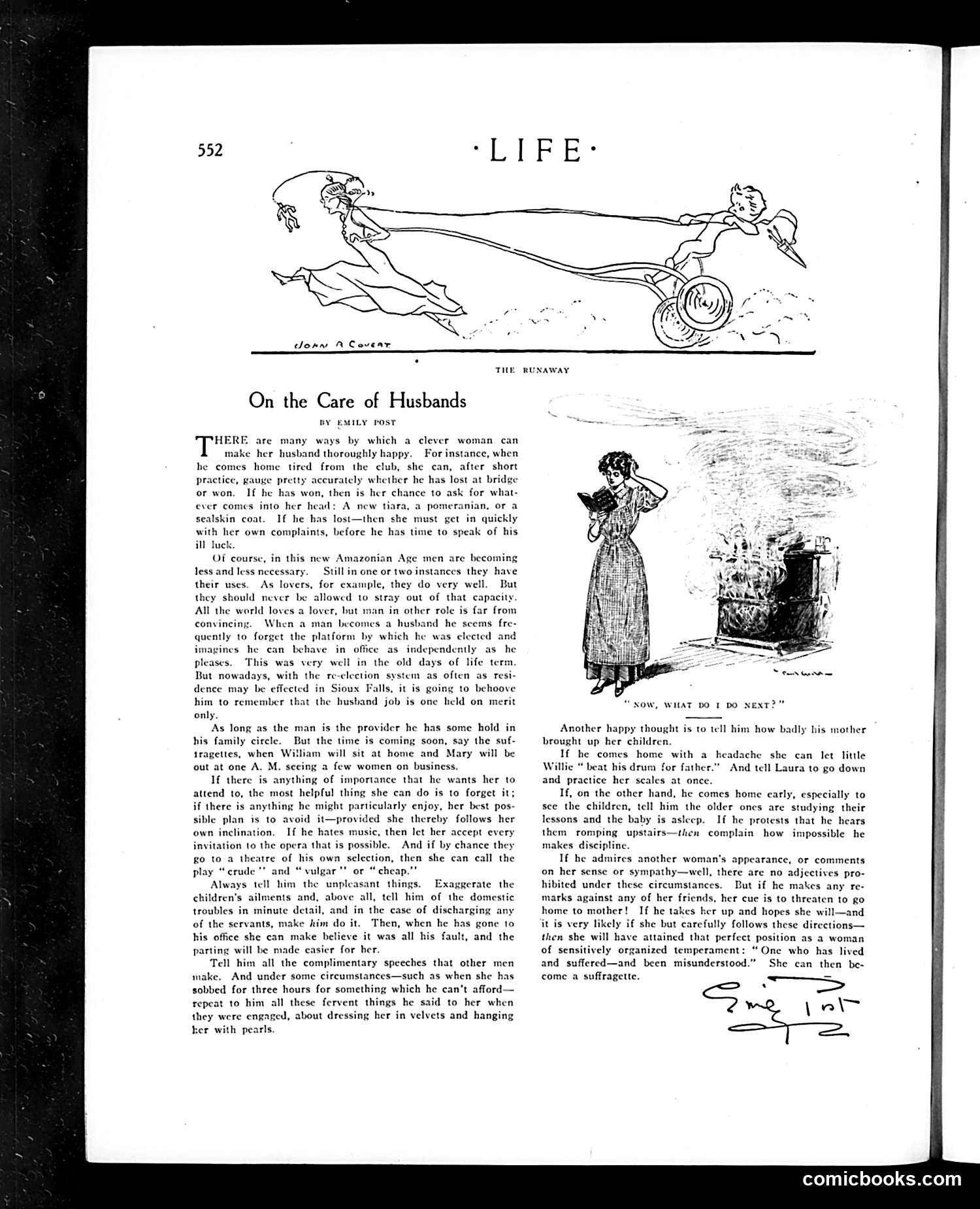
This page presents advice on managing husbands, illustrated by a cartoon titled "The Runaway" showing a woman being dragged by two cherubs in opposite directions—a visual metaphor for the competing demands on a wife's attention. The article, credited to etiquette authority Emily Post, addresses how wives should handle husbands' moods and needs. It advises women to manage household complaints discreetly, avoid public criticism, and maintain their husband's dignity, while also managing children and domestic staff. The cartoon's caption—"Now, what do I do next?"—captures the satirical point: wives must constantly navigate competing obligations and keep husbands satisfied, reflecting early-20th-century gender expectations where women's primary duty was managing their husband's emotional needs and household comfort.
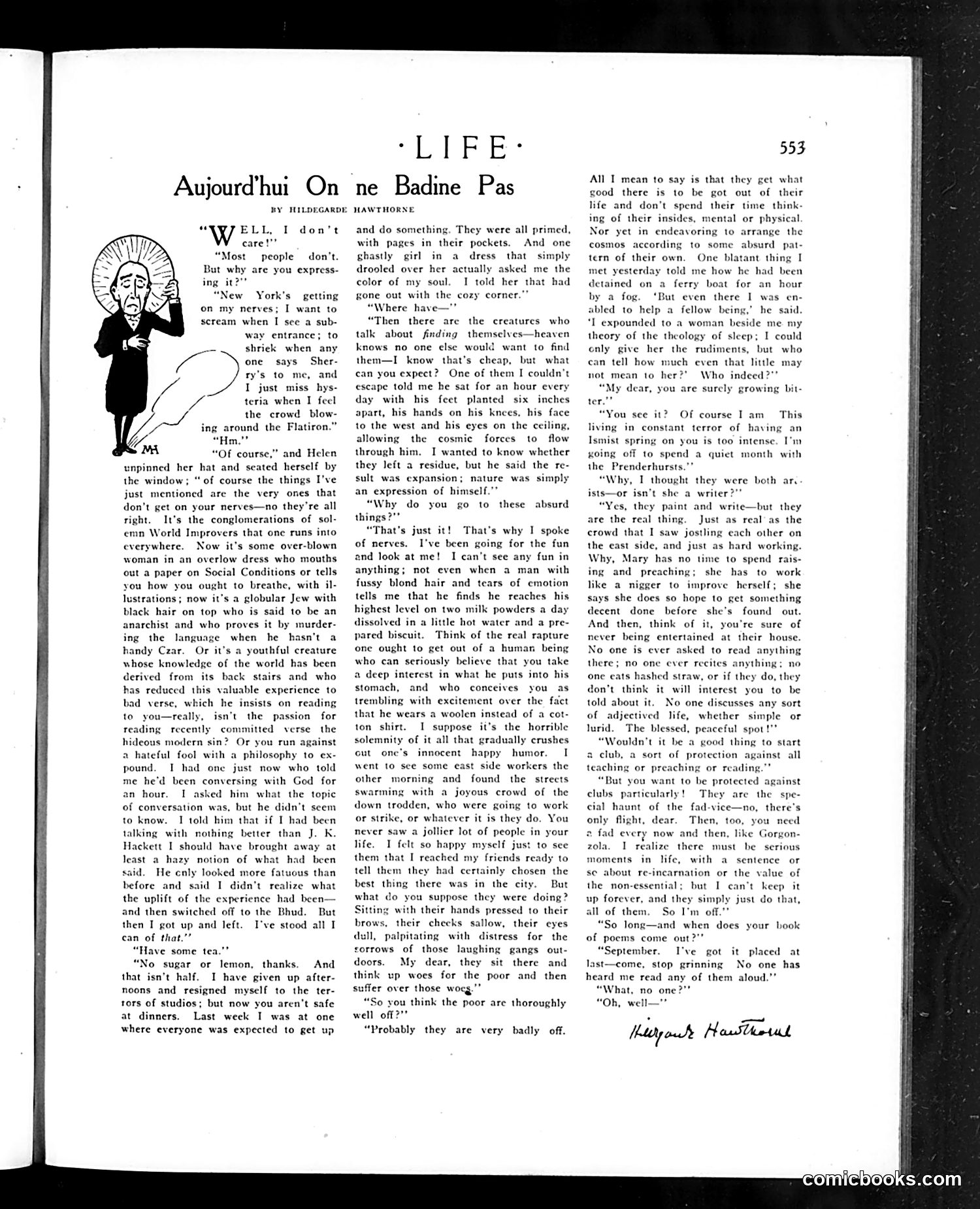
This satirical essay mocks wealthy New Yorkers' pretentious social concerns. The narrator, exhausted by city life and constant socializing, encounters a woman obsessing over whether poor people are "well off." The piece satirizes the disconnect between the affluent and working classes—specifically how the wealthy simultaneously claim concern for laborers' welfare while living in "constant terror" of social disruption. The narrator notes the irony: these same people who worry about the poor refuse to actually engage with them or read literature addressing poverty. The illustration shows a fashionable woman, likely representing this oblivious upper-class perspective. The satire targets 1920s New York society's superficial progressivism and anxiety about social unrest without genuine commitment to change.
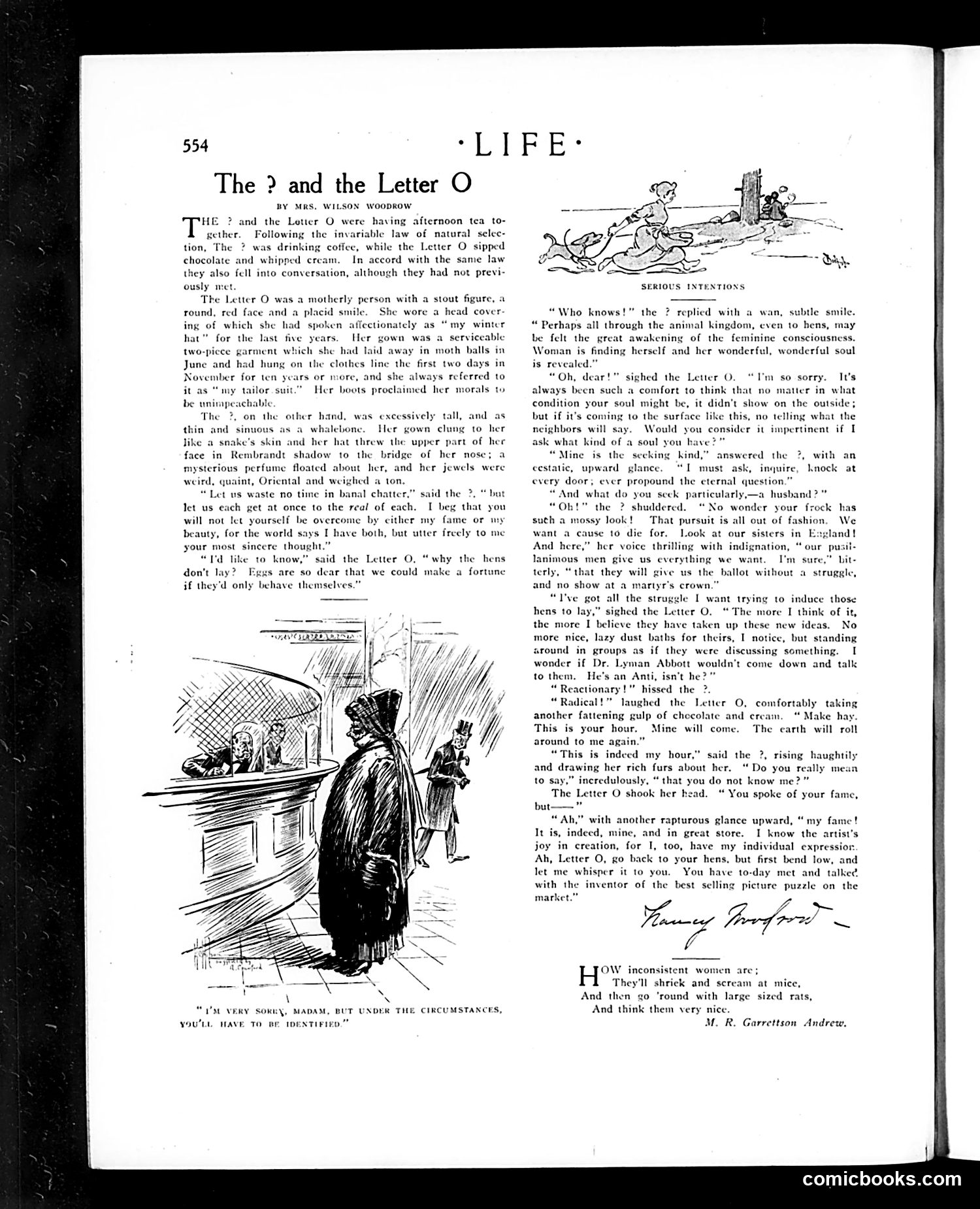
This satirical story by Mrs. Wilson Woodrow uses personified punctuation marks to mock two contrasting female archetypes of the early 1900s. The **Letter O** represents traditional, conservative womanhood: motherly, modest, practical, wearing the same clothes for years, concerned with domestic matters (her hens). The **?** (Question Mark) embodies the "New Woman"—a progressive, intellectual, restless figure who pursues causes and self-discovery, dismisses marriage, and speaks of women's awakening consciousness. She's fashionable, mysterious, and obsessed with eternal questions. The joke satirizes both types: the O for her dull domesticity and moral rigidity; the ? for her pretentious idealism and rejection of practical concerns. Their conversation—where even hens supposedly embrace "new ideas" and stop laying—mocks how thoroughly progressive ideology supposedly pervades society, suggesting the feminist awakening is becoming absurdly pervasive and impractical.
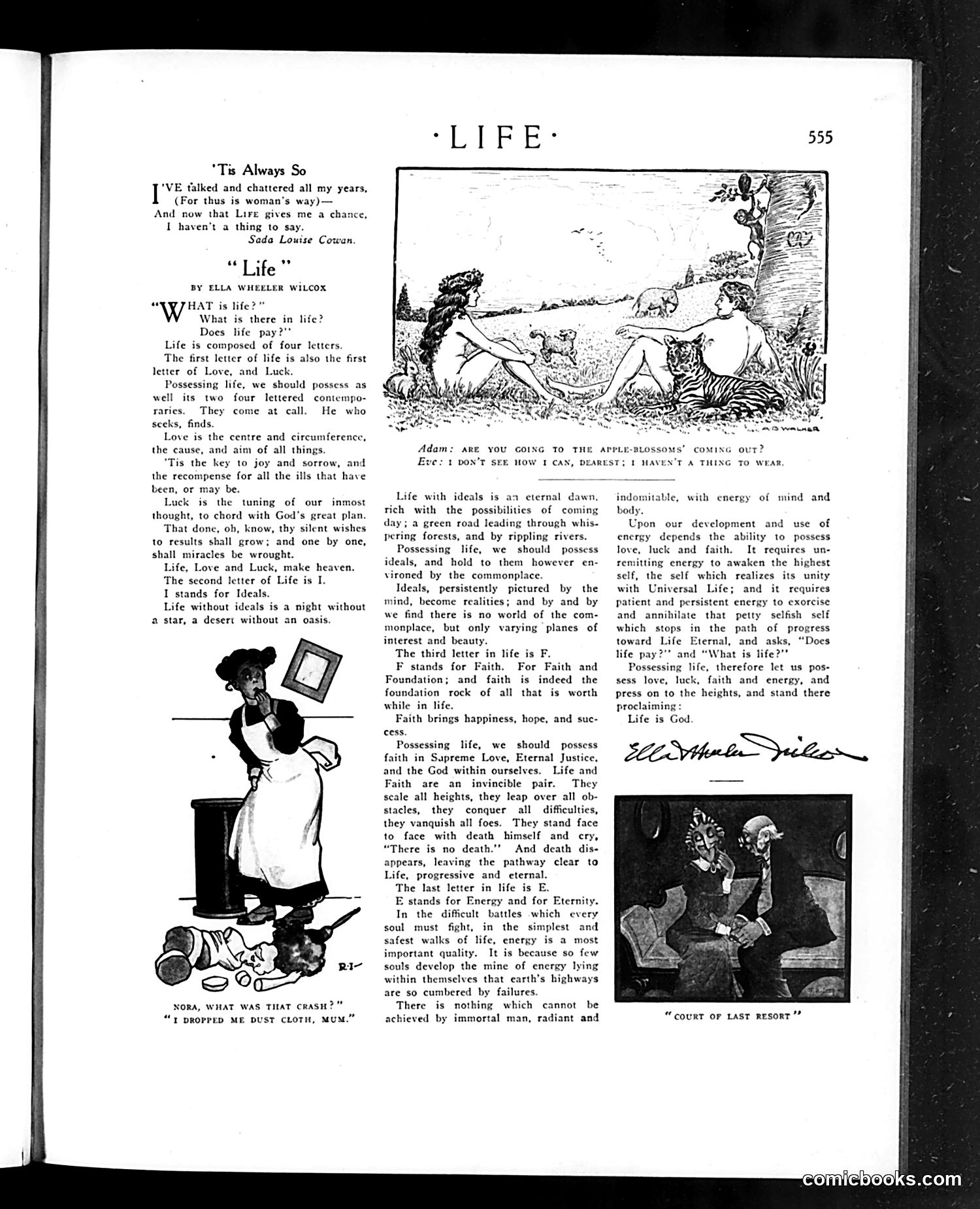
This page presents philosophical and satirical content about the meaning of life, organized around the acronym L-I-F-E. **The Main Satire:** The opening epigraph by Sada Louise Cowan jokes about women's traditionally limited voices—she's "talked and chattered" her whole life, but now that Life magazine gives her a platform, she has "nothing to say." This is gentle social satire about women's intellectual dismissal in the era. **The Cartoons:** - The top illustration shows Adam and Eve with Eve saying she "haven't a thing to wear" to see the apple blossoms—a playful reference to women's eternal fashion concerns, even in paradise. - The lower left shows a maid who dropped a dust cloth, responding to an accident. - "Court of Last Resort" (bottom right) appears to show death-related imagery. **The Essay:** Ella Wheeler Wilcox's philosophical piece breaks "LIFE" into four letters representing Love, Ideals, Faith, and Energy—presenting an earnest, spiritual self-help message typical of early 20th-century magazines. The page mixes genuine philosophy with gentle mockery of both women and human pretension.
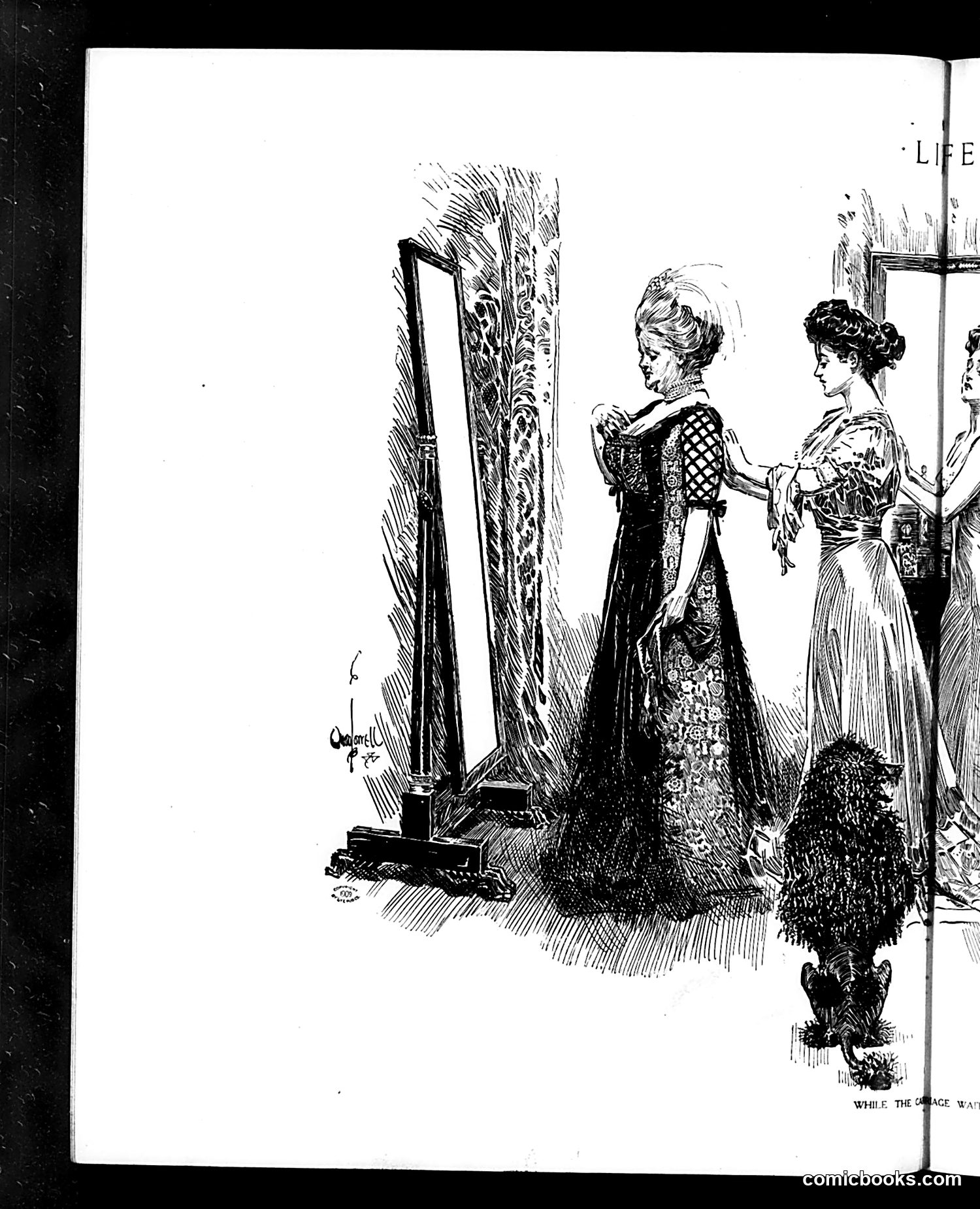
This appears to be a satirical illustration from *Life* magazine showing three elegantly dressed women in early 20th-century fashion examining a mirror. The visible text fragment "WHILE THE" and partial words suggest this is part of a larger caption or joke, though the complete text is cut off at the page edge. The illustration likely satirizes women's vanity, fashion consciousness, or social pretension of the era—common *Life* magazine themes. The detailed cross-hatching and the women's ornate clothing and hairstyles suggest commentary on upper-class or fashionable society. Without the complete caption, the specific satirical point remains unclear, but the mirror and the women's apparent self-regard suggest mockery of feminine preoccupation with appearance.
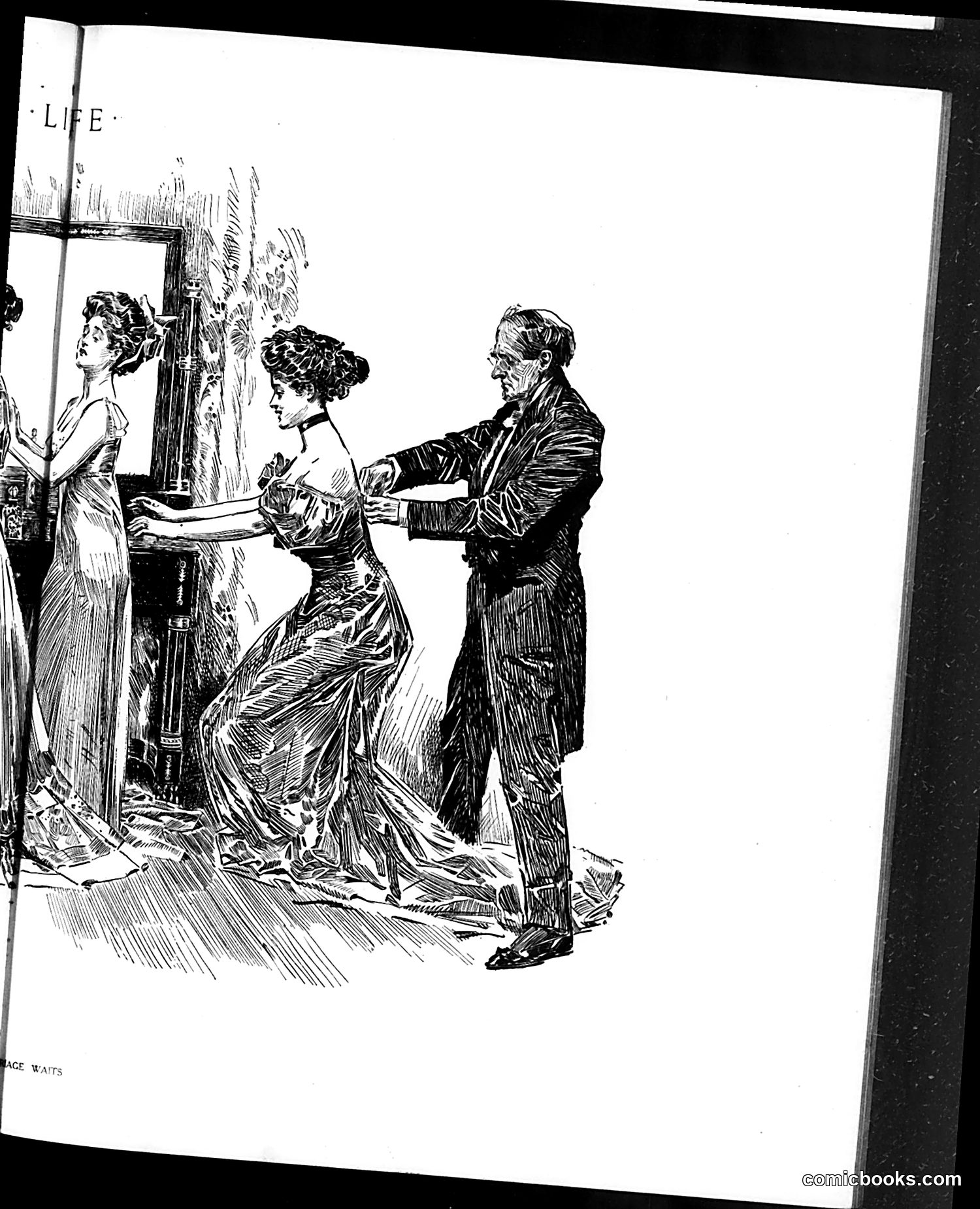
This is a page from *Life* magazine titled simply "LIFE" at the top. The illustration, credited to "PACE WATTS" at the bottom, depicts an indoor social scene with three figures in formal Edwardian-era dress. The cartoon appears to show a social interaction, likely satirizing courtship or romantic dynamics of the period. A man in a dark suit gestures toward or presents a woman in an elaborate gown to another elegantly dressed woman, suggesting some kind of introduction or social maneuvering. Without additional context or caption text visible on the page, the specific satirical point remains unclear—it could address gender roles, social pretension, romantic competition, or marital arrangements typical of *Life* magazine's social satire. The refined line work and formal setting suggest commentary on upper-class behavior or propriety.
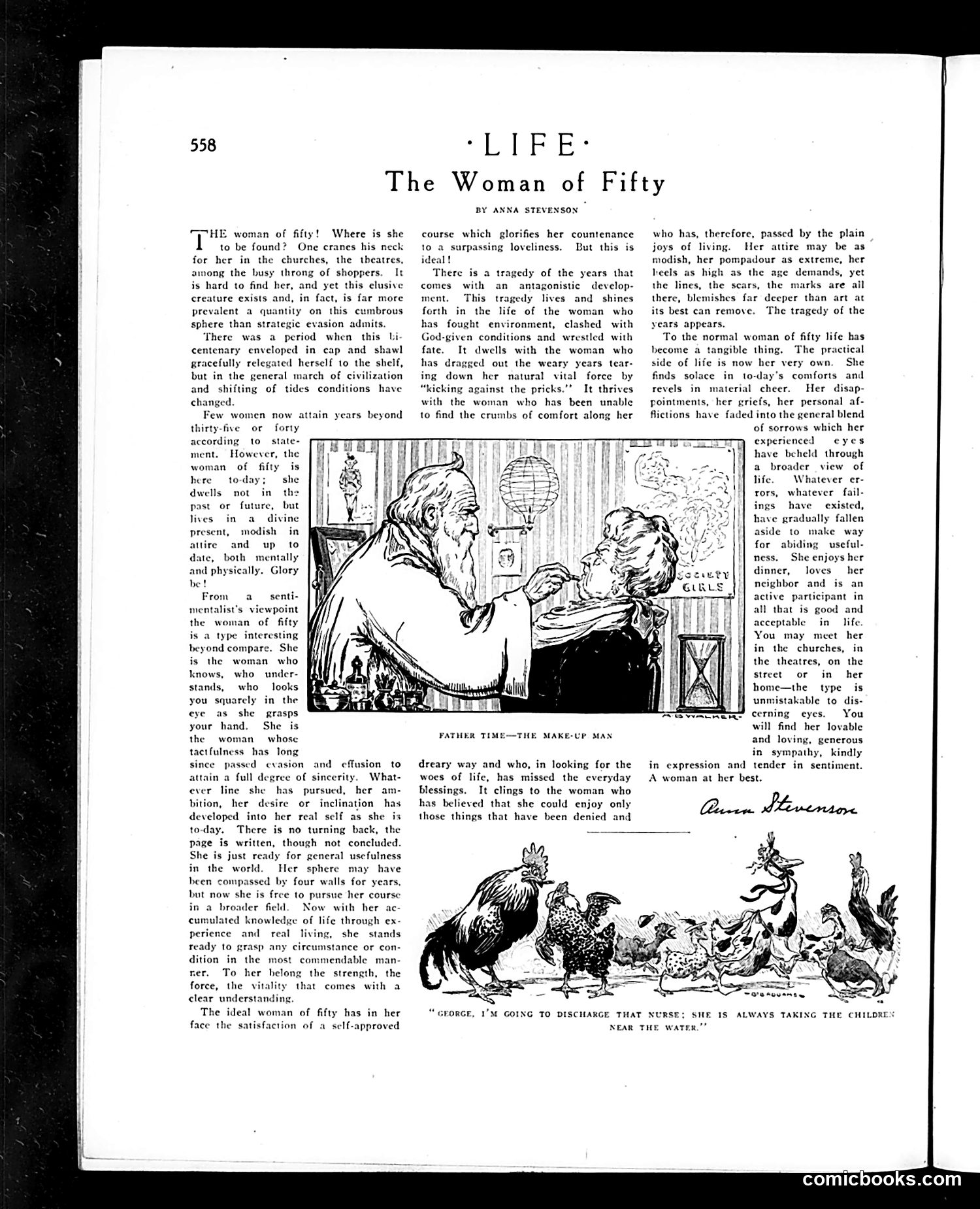
This is a satirical essay about women at age fifty in early 20th-century America. The author contrasts two types: the "ideal" fifty-year-old woman who accepts life's disappointments gracefully and remains engaged and useful, versus the tragic figure who has fought against circumstance, missed everyday joys while pursuing denied things, and now bears visible marks of bitterness—lines, scars, and a hardened appearance despite fashionable dress. The accompanying illustrations—one labeled "Father Time—The Make-Up Man" showing an old man applying cosmetics, and another of a rooster with fowl—appear to mock women's attempts at youthful appearance through makeup and vanity. The piece's satire targets women who deny aging or seek only what's forbidden, contrasting them with those who age with dignity and purpose.
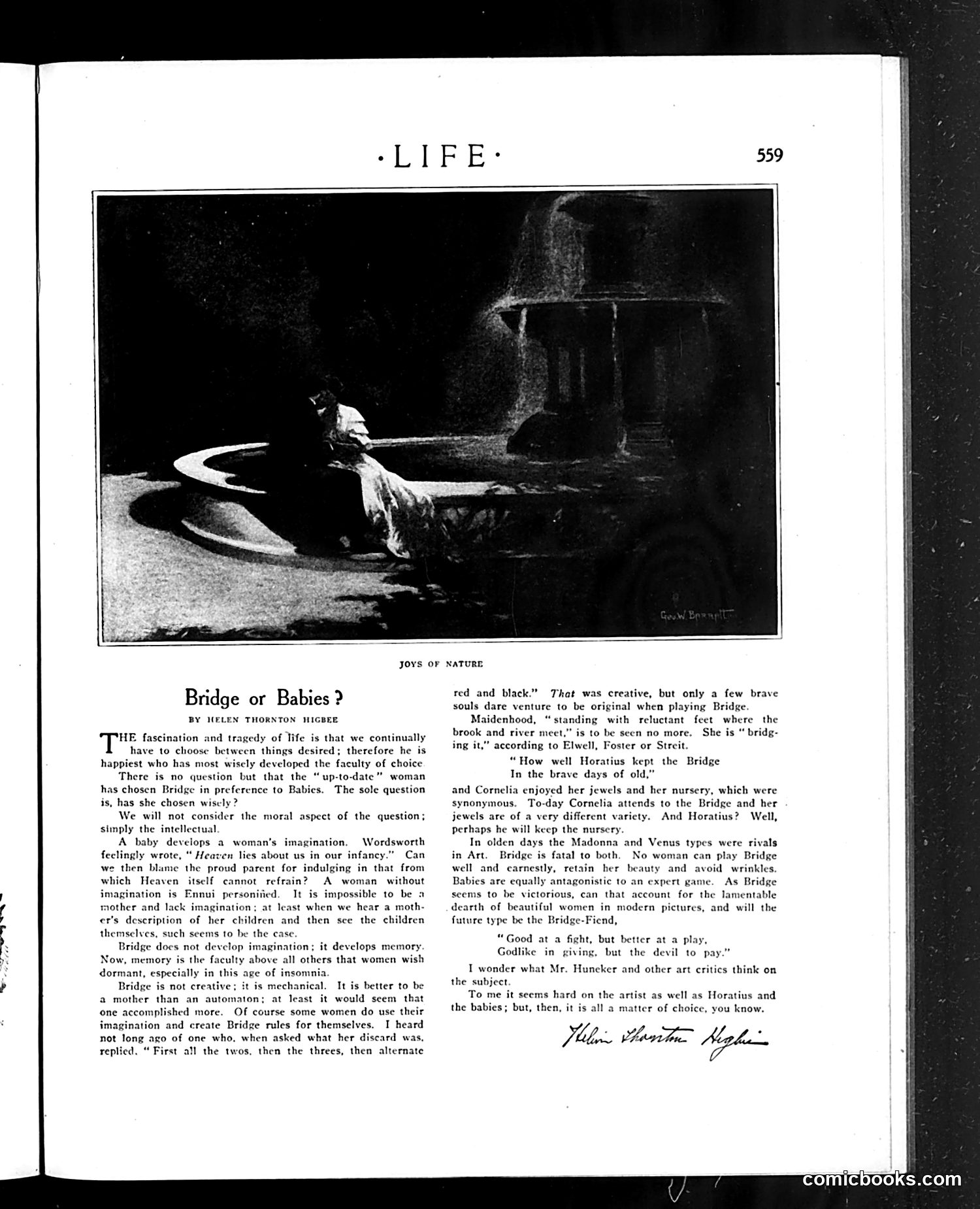
This essay-article satirizes the social conflict of early 20th-century women choosing between marriage/motherhood ("Babies") and leisure activities ("Bridge," a popular card game). The accompanying illustration shows a woman lounging by what appears to be a decorative pool or fountain—a visual representation of idle leisure. The author argues that Bridge-playing, though fashionable among "up-to-date" women, is intellectually inferior to motherhood. Bridge merely develops memory and is mechanical/uncreative, while babies develop imagination. The piece references classical ideals (Horatius, Cornelia) to contrast ancient women's roles with modern women abandoning domesticity for card games. The satire's barb: women choosing Bridge are becoming neither beautiful nor creatively fulfilled—they're becoming "Bridge-Fiends," mechanical and unattractive. The author questions whether this social choice explains the "dearth of beautiful women in modern pictures." The piece reflects anxieties about women's changing roles and leisure habits in the pre-WWI era.
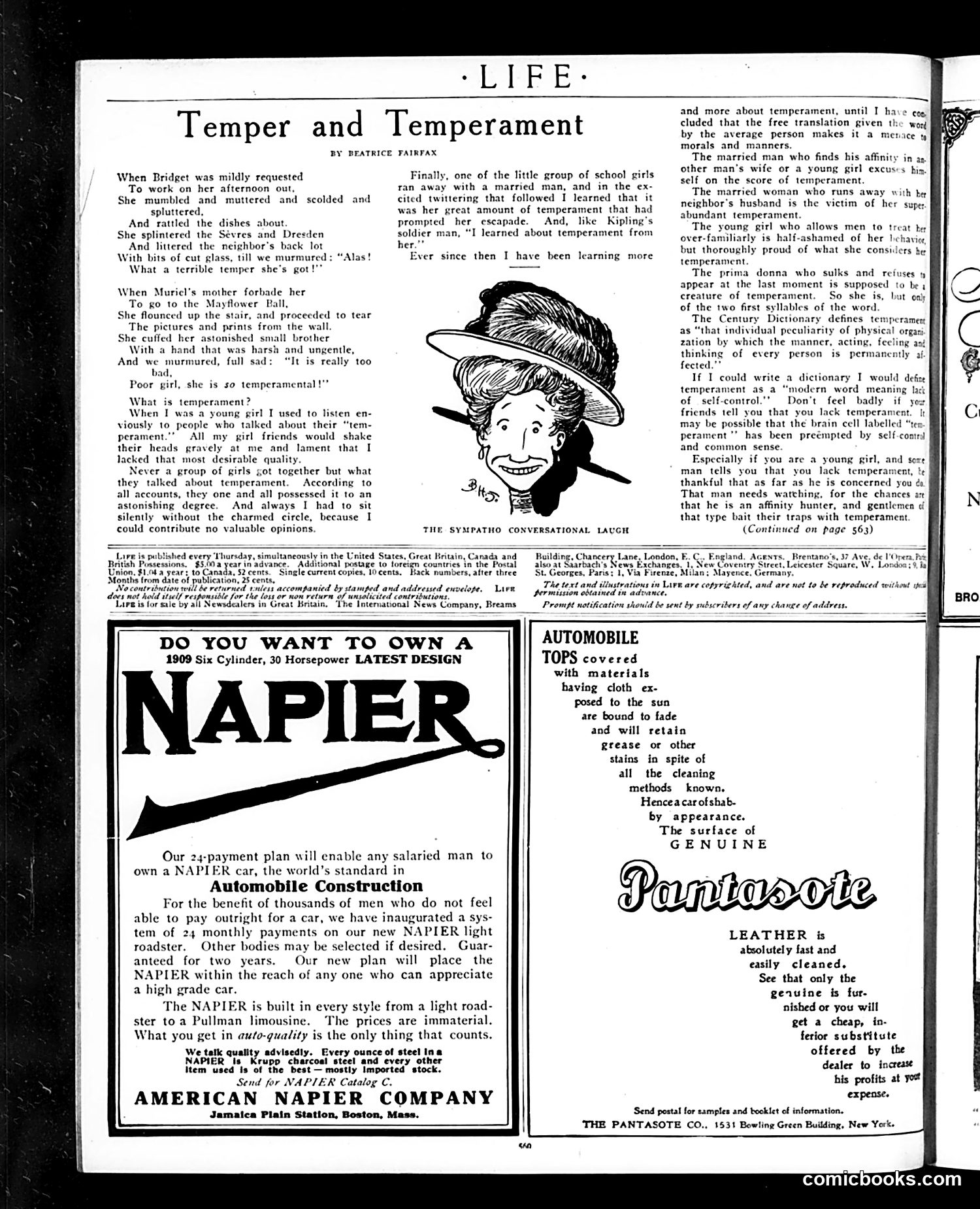
This is an advice column satirizing how young women (and men) misuse the word "temperament" as an excuse for bad behavior. The accompanying cartoon shows a woman's exaggerated facial expression—depicting the theatrical dramatics associated with claiming "temperament." Fairfax argues that "temperament" has become a euphemism for lack of self-control. She catalogs examples: servants breaking dishes, girls destroying furniture when denied outings, married people justifying affairs, opera singers canceling performances. The column warns young women especially: men claiming they "lack temperament" are often predatory ("affinity hunters") using flattery as a trap. The piece reflects early-20th-century anxieties about women's independence and respectability. Fairfax redefines "temperament" sarcastically as merely "a modern word meaning lack of self-control," urging women to recognize when this flattery masks manipulation or genuine character flaw.
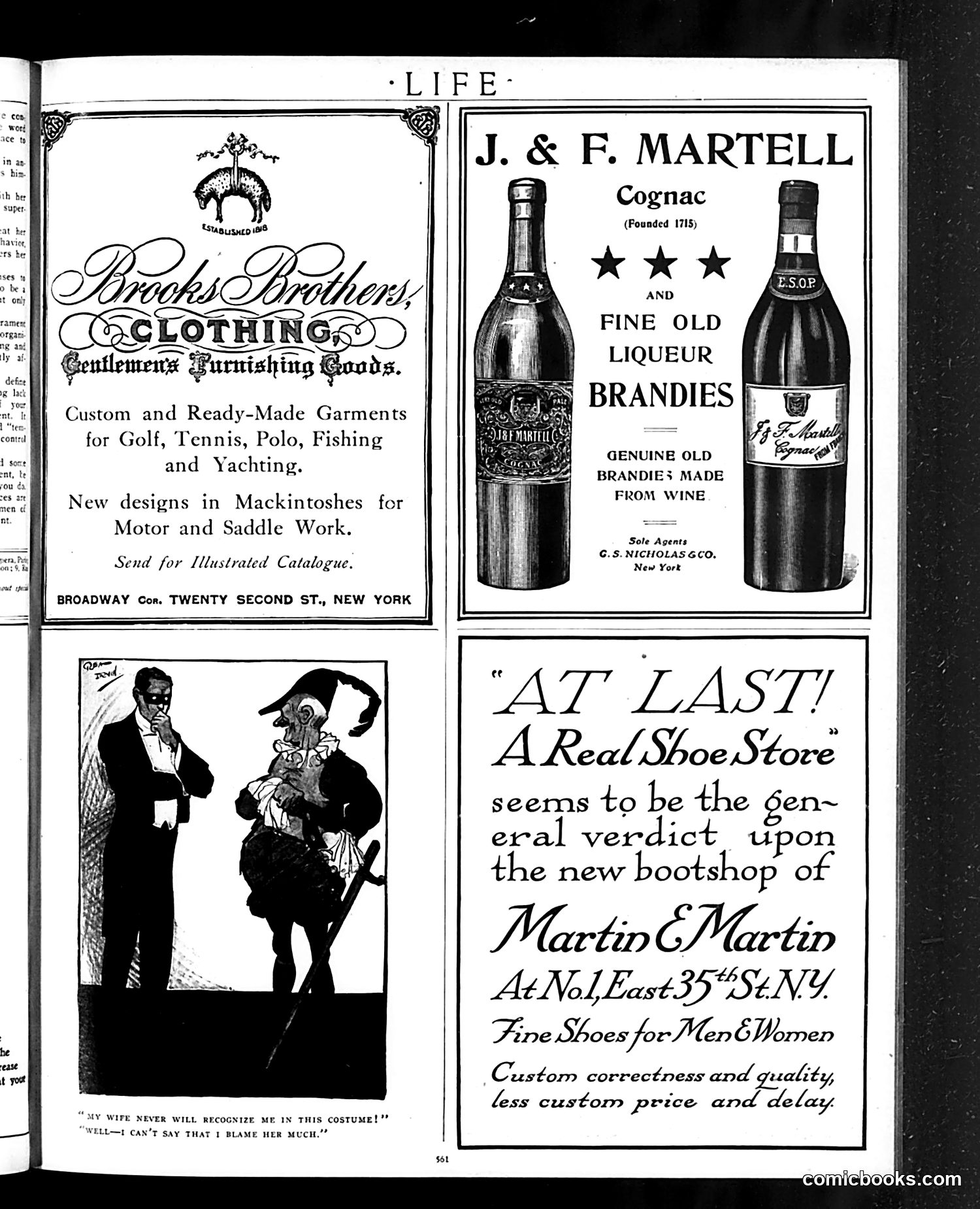
This page is primarily **advertising**, with one small satirical cartoon. The cartoon (lower left) depicts two men in formal attire engaged in conversation. One wears an elaborate, ornate costume—likely a theatrical or masquerade outfit—while the other appears in conventional dress. The caption reads: "My wife never will recognize me in this costume!" / "Well—I can't say that I blame her much." The joke appears to be about **marital discord or infidelity**—the implication being that the man in disguise is unrecognizable, and his companion cynically suggests his wife wouldn't recognize him anyway (meaning their relationship is so distant). This reflects early-20th-century humor about failed marriages, a common satirical theme in Life magazine. The surrounding advertisements promote luxury goods (Brooks Brothers clothing, Martell cognac, and a shoe store), typical of Life's affluent readership during this era.
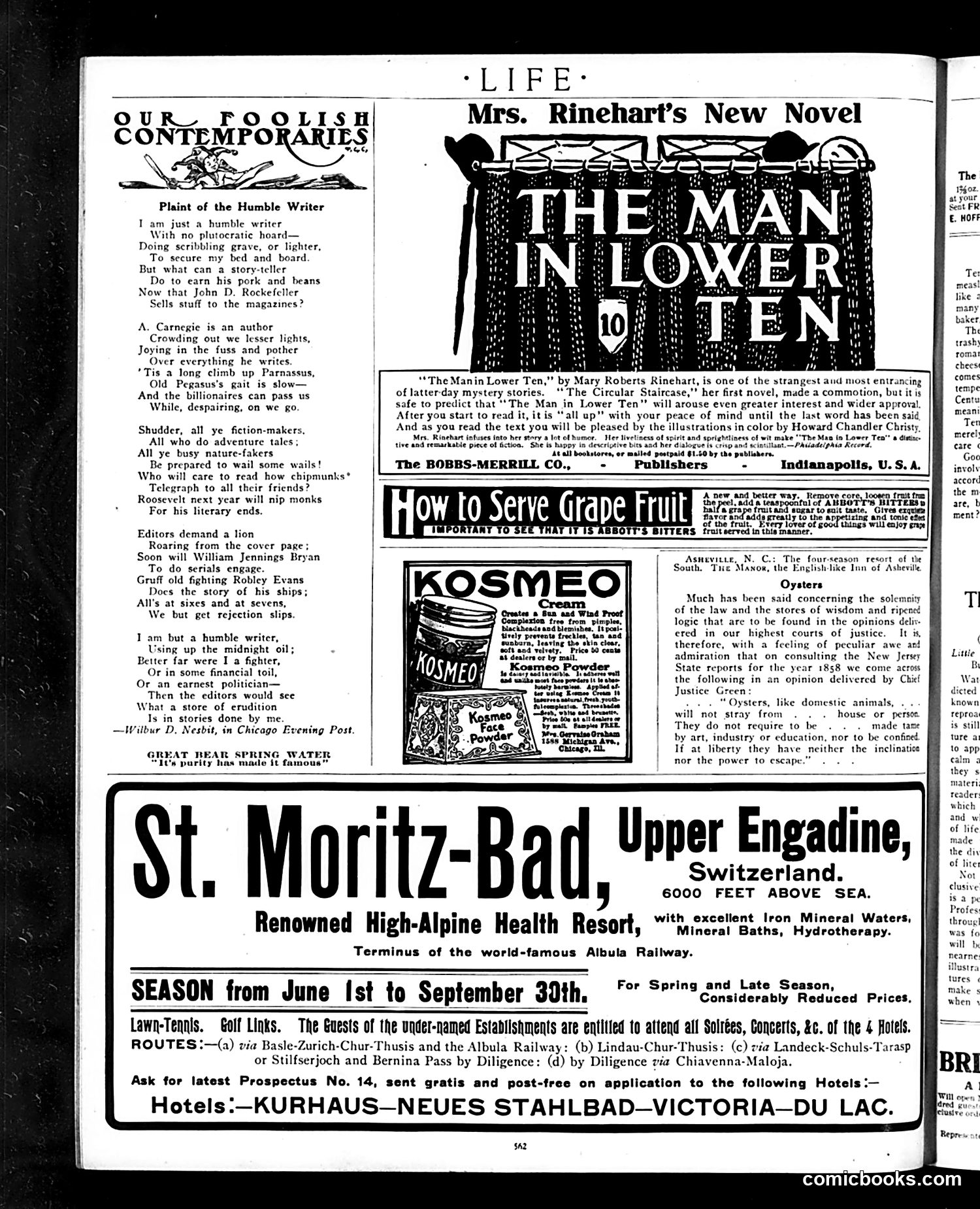
This page primarily features **advertising and literary promotion** rather than political satire. The main content is a poem titled "Plaint of the Humble Writer" that satirizes the publishing industry's unfair competition. The joke: wealthy industrialists like **Carnegie and Rockefeller** are now writing novels and magazine articles, crowding out struggling professional writers who depend on publication fees for survival. The poem lists absurd editorial demands (demanding lion stories, serializing William Jennings Bryan and Admiral Robley Evans) to show how desperate editors have become. The poem represents the *anxiety* of working writers facing competition from wealthy amateurs with resources to promote themselves—a distinctly early 20th-century complaint about democratized publishing. The rest of the page contains **commercial advertisements** for Mrs. Rinehart's new novel "The Man in Lower Ten," Kosmeo cosmetic powder, grape fruit serving instructions, and Swiss health resorts. These are standard period advertisements, not satire.
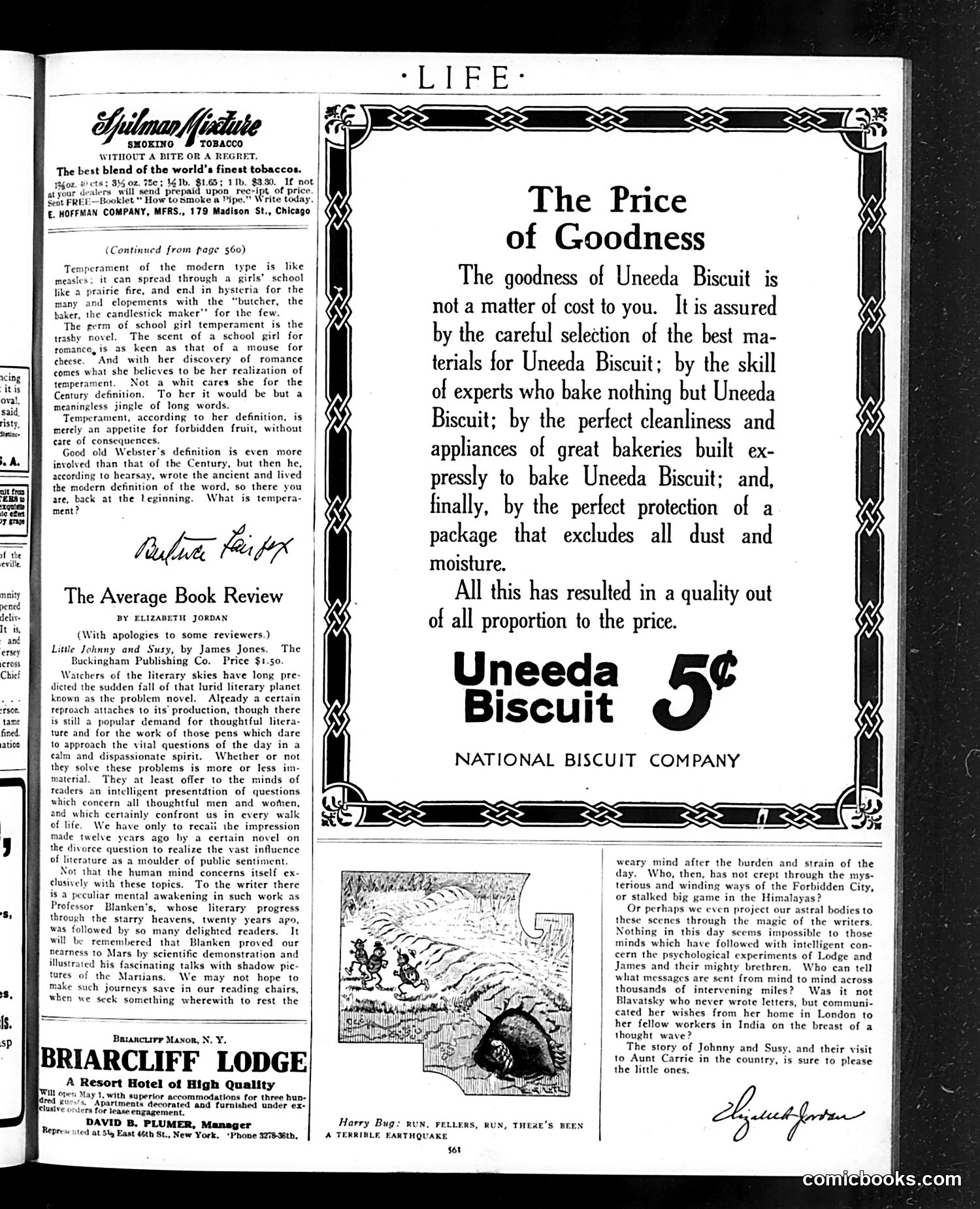
This page is primarily **advertising and book review content**, not political satire. The main elements are: **Advertisements:** The top features Philman Mixture smoking tobacco, and the right side contains a full-page Uneeda Biscuit ad emphasizing quality at a low price (5 cents). Below is a Briarcliff Lodge resort hotel advertisement. **Editorial Content:** "The Average Book Review" by Elizabeth Jordan offers a parody of overwrought literary criticism, gently mocking reviewers who use inflated language to discuss "problem novels" addressing contemporary social issues. The humor lies in the exaggerated, verbose style typical of early 20th-century book reviews. **Small illustration:** A cartoon labeled "Harry Bug: Bum, Fellers, Bum. There's Been a Terrible Earthquake" shows a character amid destruction, likely commenting on casual attitudes toward disaster news. The page reflects Life magazine's typical mixed format of satirical commentary, advertisements, and humor pieces aimed at educated, middle-class readers.
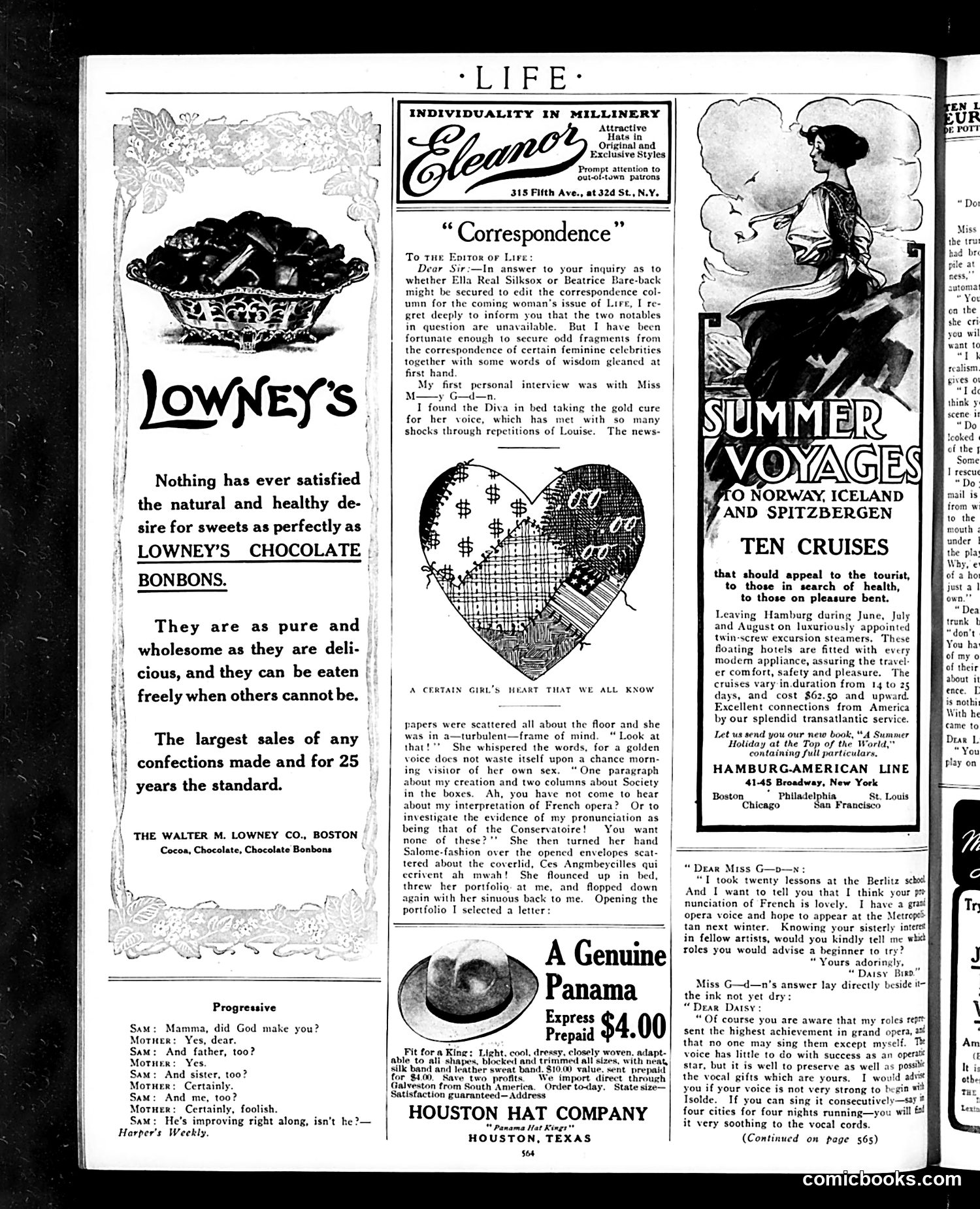
This page is primarily **advertising with some light humor content**, typical of Life magazine's format. The main satirical element is a "Correspondence" column featuring fictional letters supposedly from celebrities. It mocks operatic divas—specifically someone identified as "Miss M—y G—d—n" (likely Mary Garden, a famous opera singer). The satire depicts her as vain and temperamental: she's in bed taking a "gold cure" for her voice, upset about newspaper coverage focusing on society box-seat gossip rather than her operatic genius, and dramatically throwing her portfolio at the correspondent. Below this is a brief "Progressive" joke from Harper's Weekly about a child's theological reasoning—a gentle mockery of childhood logic. The rest of the page consists of **period advertisements**: Lowney's chocolate bonbons (emphasizing wholesomeness), millinery fashions, Panama hats, cruise lines to Norway/Iceland, and the Hamburg-American shipping line. These ads reflect early 20th-century consumer culture and leisure travel for the wealthy. The page contains no significant political commentary—it's entertainment and commerce aimed at affluent readers.
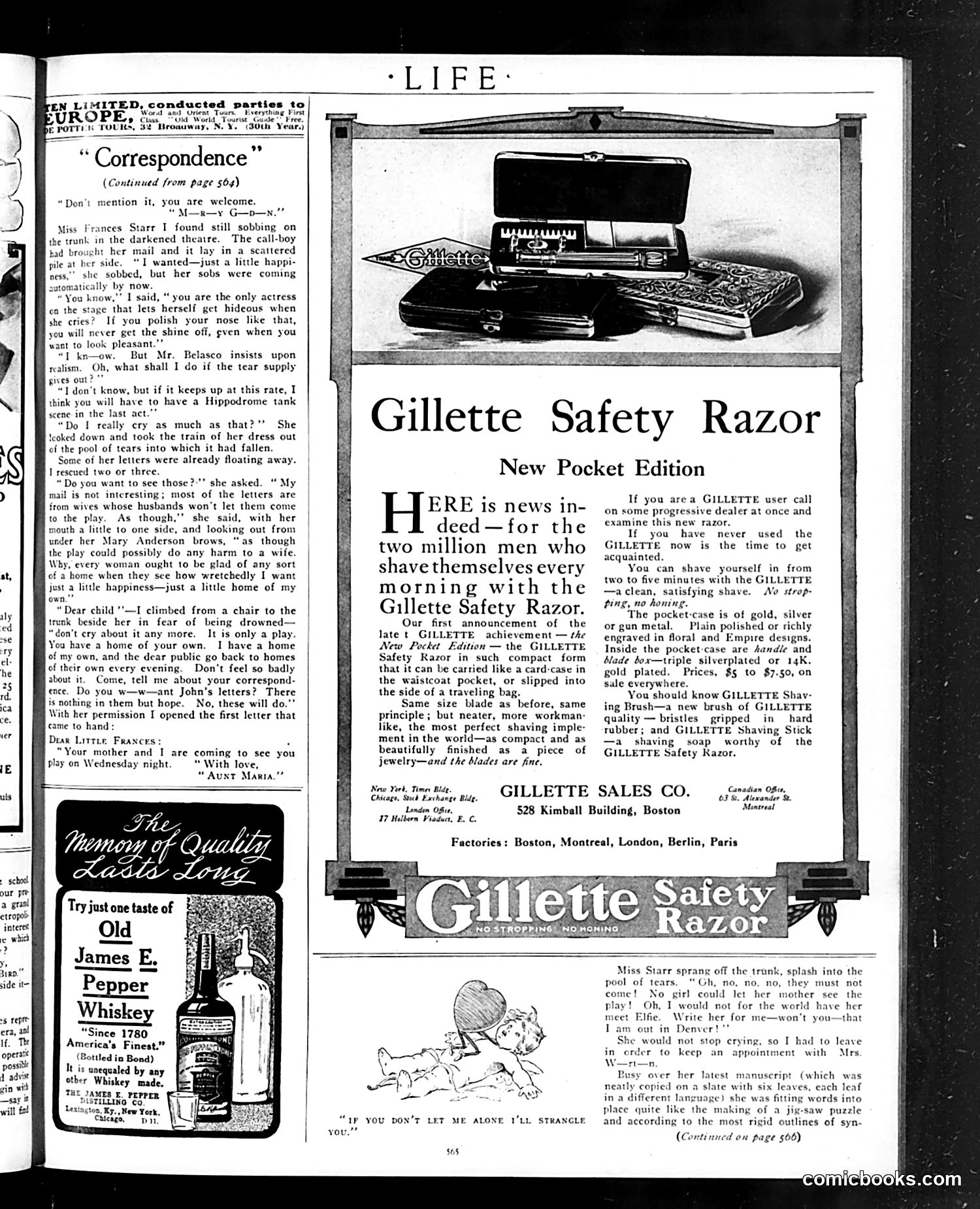
This page consists primarily of **advertising and serialized fiction** rather than political satire. The main content is a continuation of a serialized story titled "Correspondence," featuring a dramatic scene between the narrator and actress Frances Starr in a theater. The narrative depicts Starr emotionally distraught over fan mail, with the narrator attempting to console her. The passage relies on period theatrical conventions and sentimentality for humor—notably, a joke about her crying so much during performances that she might need a "Hippodrome tank scene." The page is dominated by two major **advertisements**: one for Old James E. Pepper Whiskey (emphasizing its quality since 1780) and a substantial spread for the **Gillette Safety Razor's new "Pocket Edition."** The Gillette ad highlights the razor's compact design suitable for travelers, targeting the growing market of men who shave themselves daily. There is **no political cartoon or satirical commentary** visible on this page. It represents typical early-twentieth-century magazine content mixing serialized entertainment with product advertising.
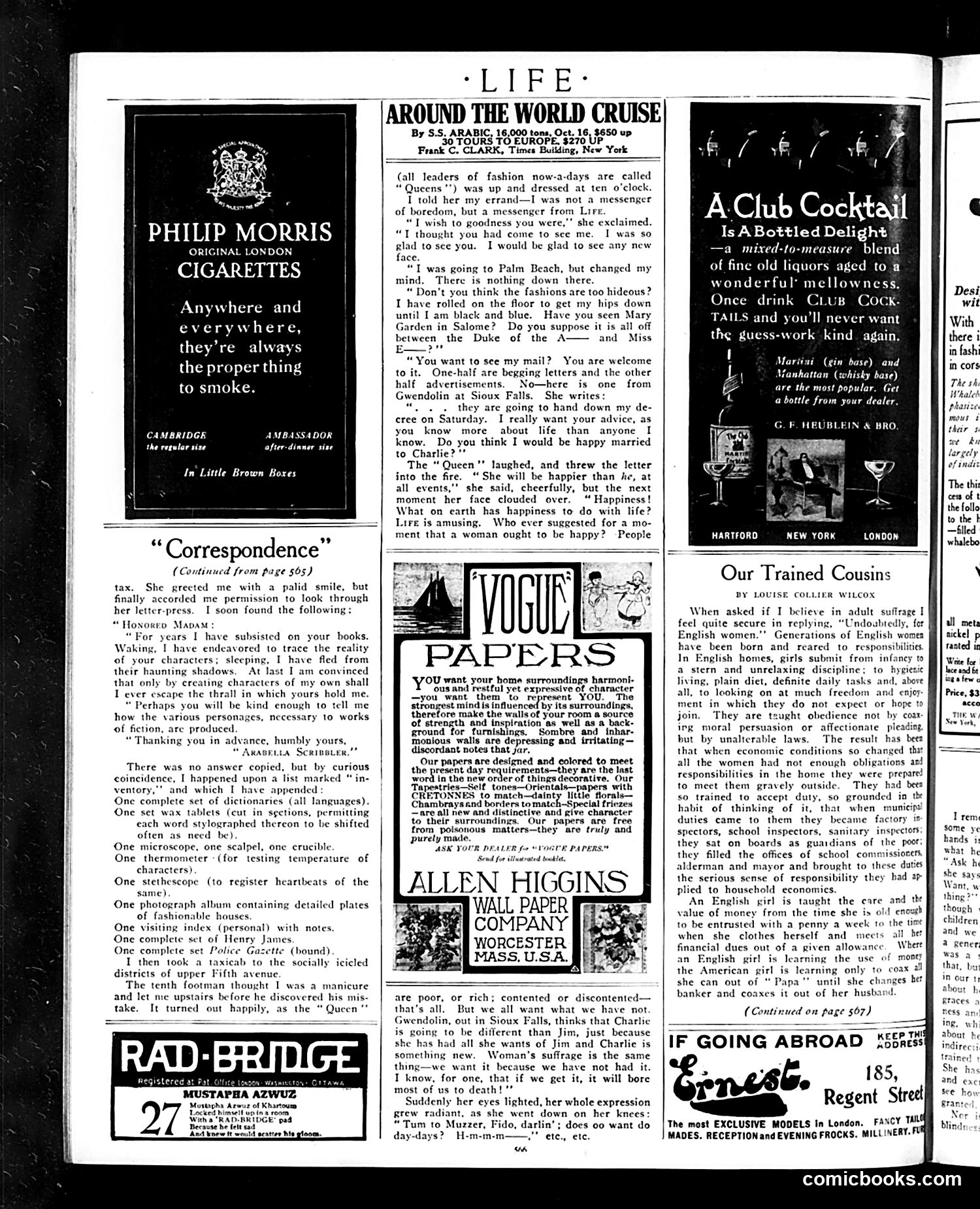
This page is primarily **advertising and light social commentary**, not political satire. The main content is a "Correspondence" column satirizing how fiction writers create characters. A fan writes to an author asking how he invents his vivid characters. The humor comes from the revealed "inventory" of creative tools—dictionaries, wax tablets, microscopes, a stethoscope—treating character creation as pseudo-scientific. The punchline: the narrator visits a wealthy society "Queen" (slang for a fashionable woman) to research her, only to find her shallow and obsessed with fashion and gossip. The satire gently mocks both overly-romantic notions of artistic genius and the vacuity of high society. The "Queen" dismisses happiness as irrelevant to life, caring only about amusement and social drama. The page is otherwise filled with **period advertisements**: Philip Morris cigarettes, cruise ships, Vogue wallpapers, and Club Cocktails—typical of Life magazine's commercial content circa 1910s-1920s.
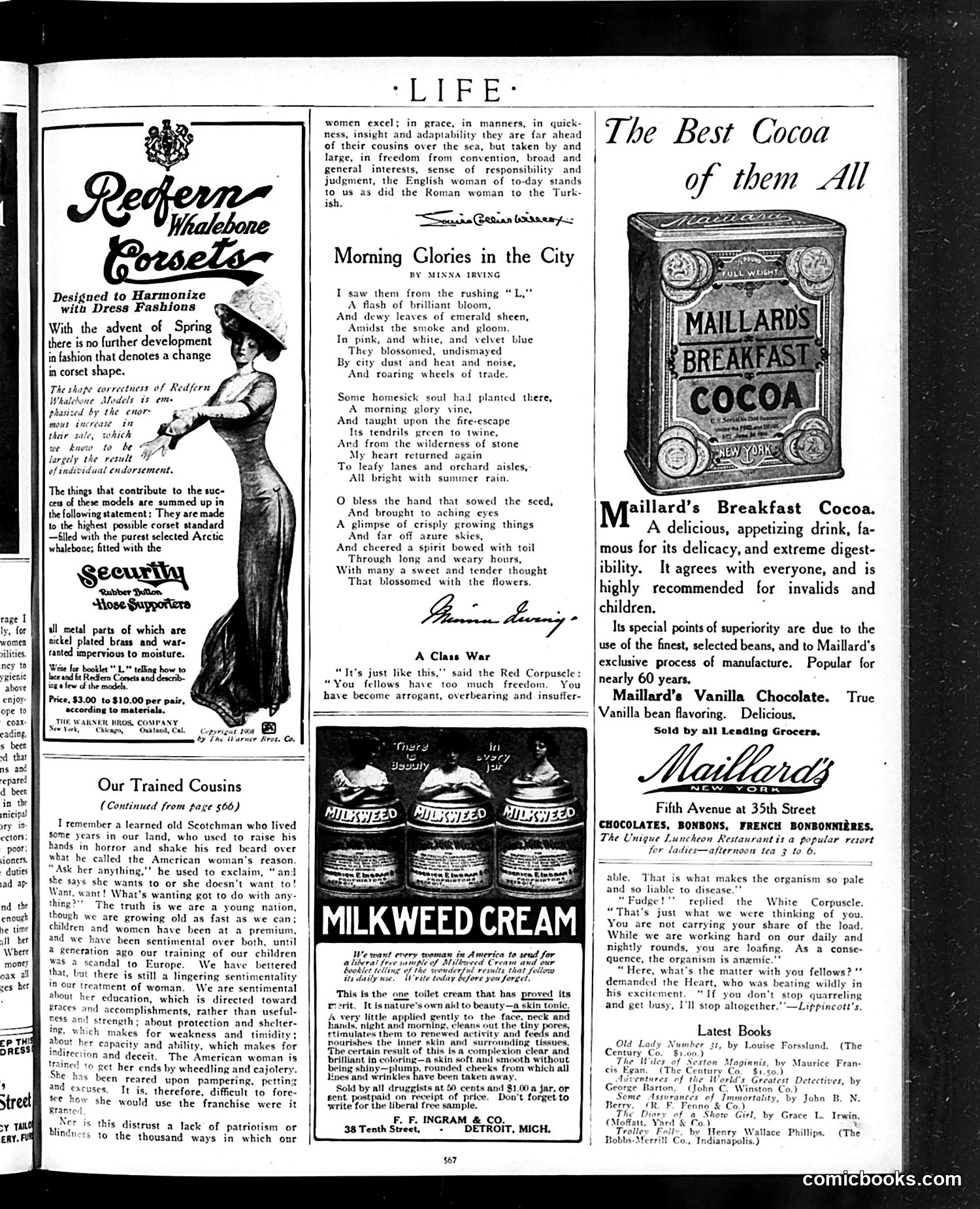
This page combines **fashion advertising** with **literary content** and **social commentary**. The left side advertises **Redfern Whalebone Corsets**, emphasizing that spring fashions require no change in corset shape—these models maintain their form through Arctic whalebone construction. The center features **"Morning Glories in the City"** by Minna Irving, a sentimental poem about morning glories blooming on a fire escape amid urban smoke and noise, offering respite and memories of nature to weary city dwellers. Below that is **"Our Trained Cousins,"** a comparative essay contrasting American and English women. The author argues that while English women excel in restraint and responsibility, American women possess greater freedom but suffer from excessive sentimentality in their upbringing, making them prone to "wheedling and cajolery." The page also contains **"A Class War"** (incomplete), appearing to satirize labor tensions through dialogue between a Red Corpuscle and another figure. The right side advertises **Maillard's Breakfast Cocoa** as a superior digestible product.
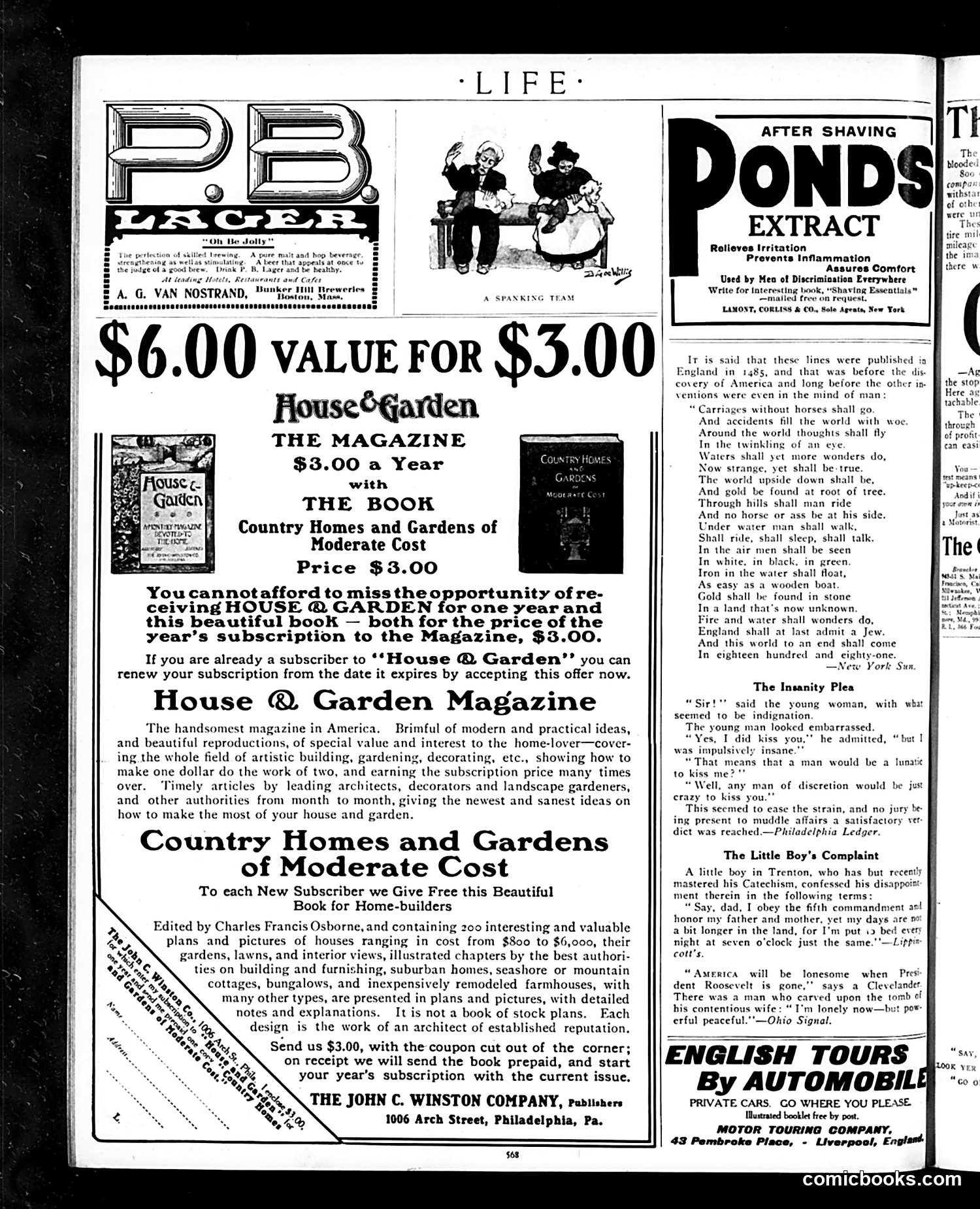
This page is primarily **advertising and promotional content** rather than political satire or comics. The dominant features are: **Main Content:** - Large advertisement for *House & Garden* magazine subscription bundle ($3.00 for magazine plus a book on country homes) - Smaller ads for P.B. Lager beer, Ponds Extract aftershave, and English automobile tours **Cartoon Elements:** - "A Spanking Team" illustration shows two figures (appears to be an adult spanking a child), typical domestic humor of the era - "The Insanity Plea" text excerpt discusses a romantic misunderstanding about kissing—light satirical dialogue common in early 20th-century magazines **Historical Context:** The page reflects early 1900s consumer culture, targeting middle-class home owners interested in domestic improvement and modern conveniences. The "insanity plea" joke plays on period attitudes about courtship propriety. No specific political figures or events are referenced—this is straightforward commercial publishing content.
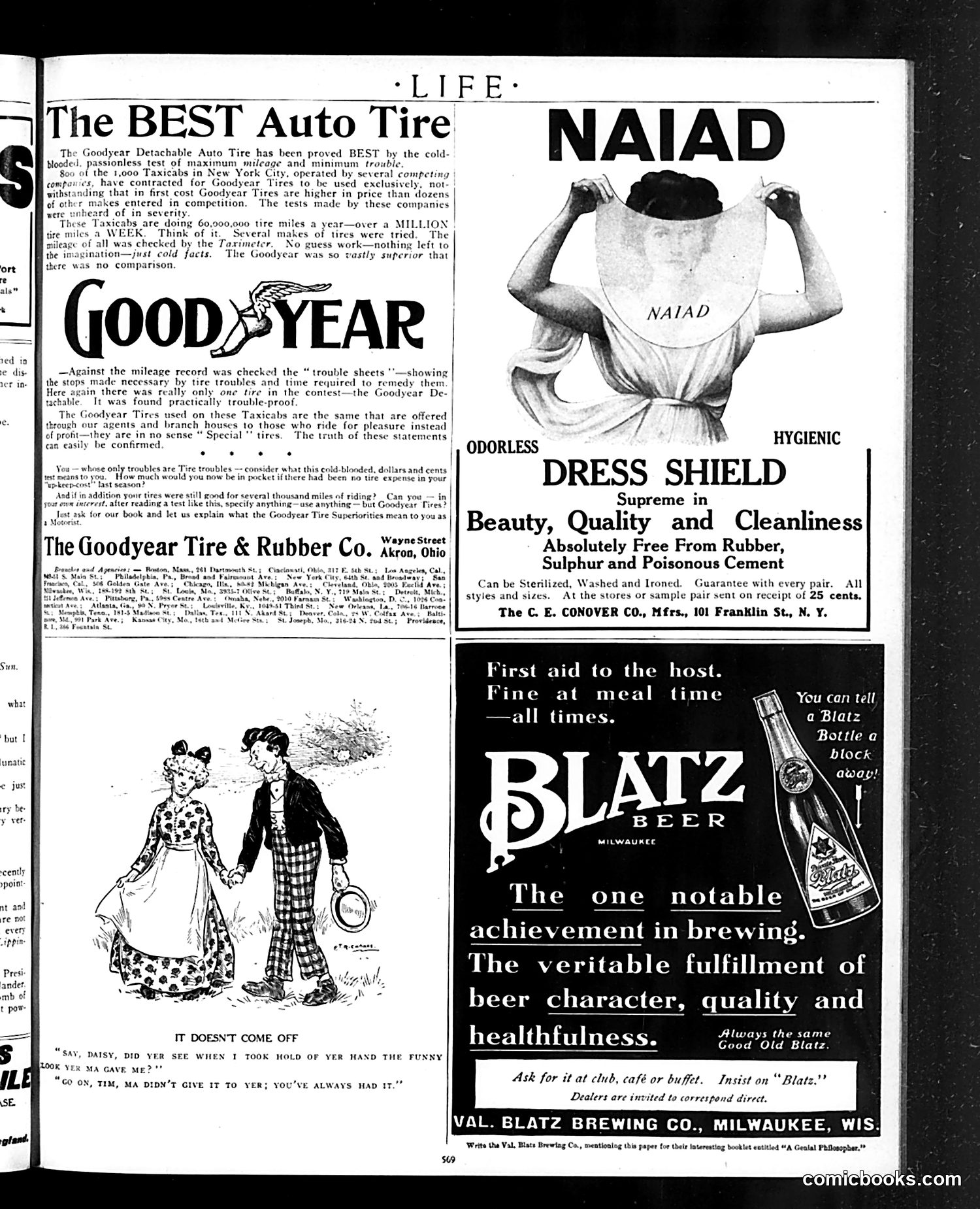
This page is primarily **advertising**, not satirical editorial content. It contains four commercial advertisements typical of early 20th-century magazines. The main items are: 1. **Goodyear Tires** — emphasizing durability through NYC taxicab testing data 2. **Naiad Dress Shields** — underarm protective garments marketed as hygienic and odor-free 3. **A small cartoon** (bottom left) showing a domestic scene where a woman ("Daisy") jokes about her boyfriend's nervous reaction when holding hands — a mild romantic humor piece 4. **Blatz Beer** — promoting Milwaukee beer as reliable and healthful The dress shield ad is notable today as a historical artifact: it addresses a social concern (perspiration stains and odors) that modern deodorants have largely eliminated, revealing period anxieties about body hygiene and social propriety. The cartoon's humor relies on early 20th-century courtship conventions where hand-holding was sufficiently intimate to cause visible nervousness — standards that seem quaint today.
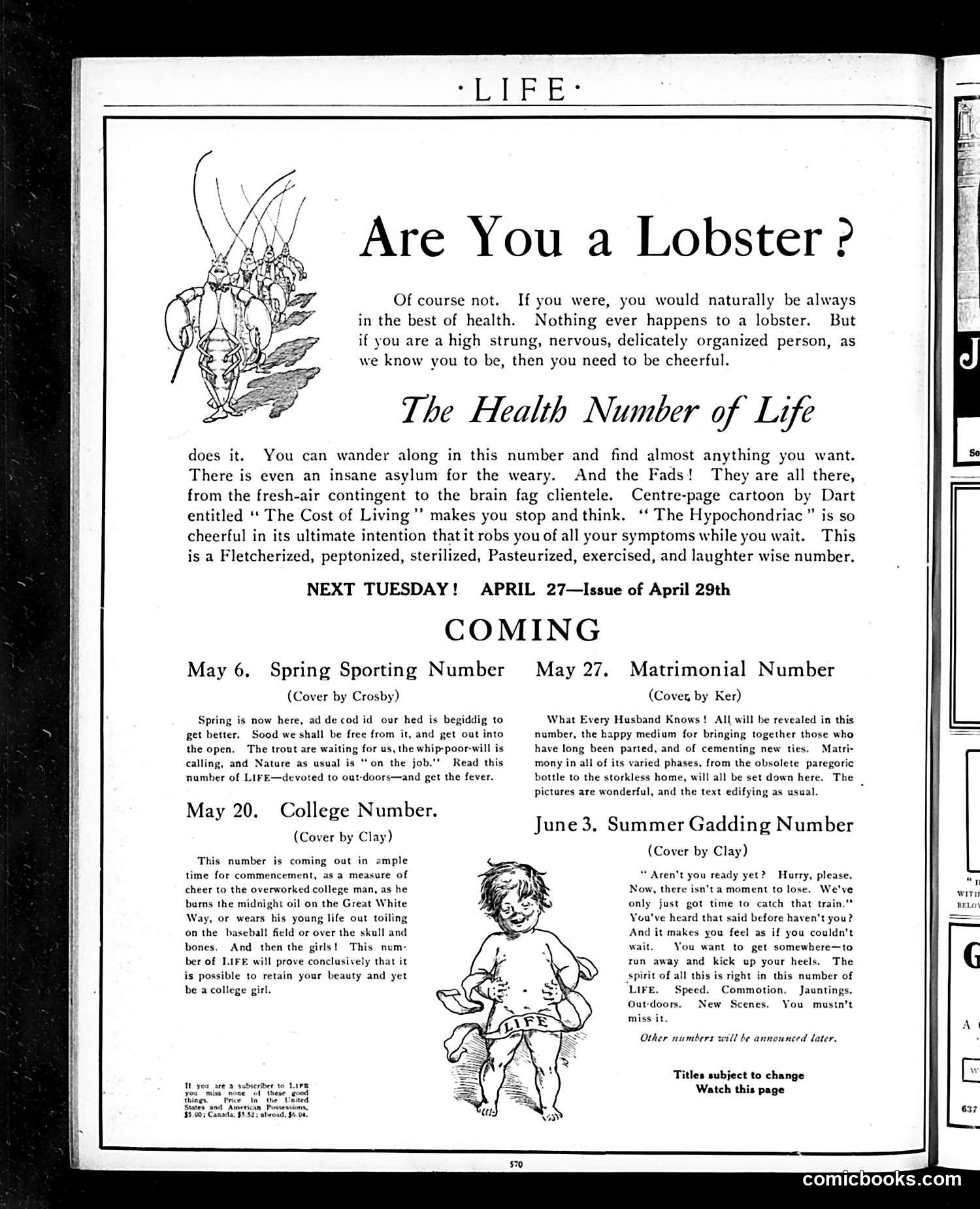
This is a promotional page for *Life* magazine's upcoming issues (circa 1910s). The masthead asks "Are You a Lobster?"—a humorous rhetorical device comparing readers' nervous dispositions to lobsters' imperviousness to illness. The joke suggests that unlike robust lobsters, sensitive, high-strung people need *Life*'s humor to maintain health. The page advertises upcoming special issues: - **Spring Sporting Number** (May 6): outdoor recreation - **College Number** (May 20): celebrating college life and girls - **Matrimonial Number** (May 27): marriage and relationships - **Summer Gadding Number** (June 3): travel and adventure References like "Fletcherized" (a popular digestion method) and mentions of "brain fag" and hypochondriacs reflect early 20th-century health fads and anxieties. The tone is gently satirical—mocking both contemporary wellness trends and readers' neuroses while positioning *Life* as therapeutic entertainment. The illustrations and casual, colloquial writing style are characteristic of *Life*'s satirical approach.
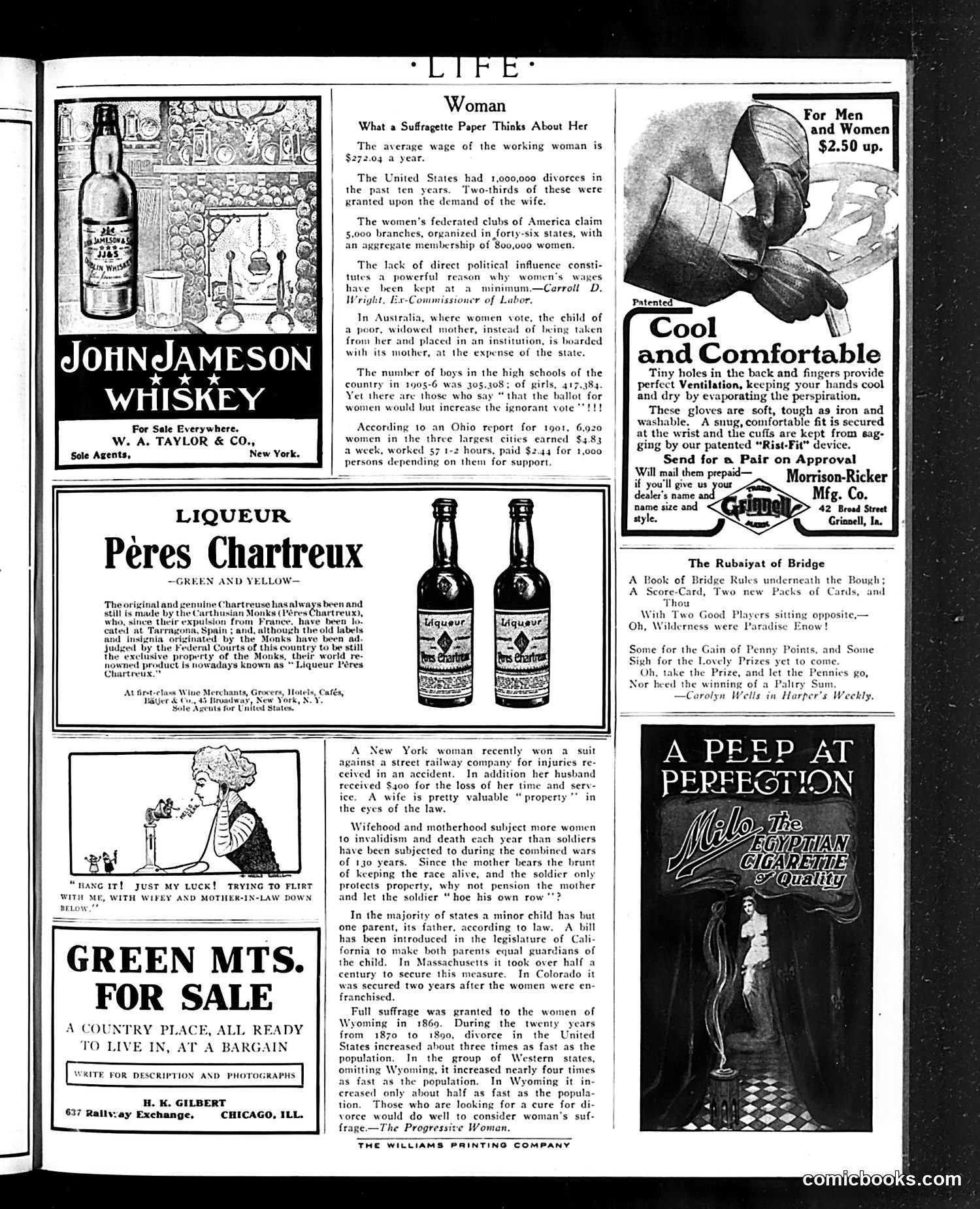
This page mixes advertisements with pro-suffrage advocacy. The central article, "What a Suffragette Paper Thinks About Her," presents statistics supporting women's voting rights—a major political debate of the early 1900s (likely pre-1920, before the 19th Amendment). The argument uses economic data (women earning $4.83/week for 57.5-hour weeks) and legal inequities (women kept as dependents) to justify suffrage. It cites Australia as proof that women voting improves outcomes: poor widows receive state support rather than losing custody of children. The small cartoon at bottom shows a man trying to flirt, blocked by "wifey and mother-in-law"—mocking anti-suffrage fears that voting women would become overbearing. This satirizes the opposition's arguments by treating their concern as trivial compared to genuine economic injustice. The surrounding whiskey, liqueur, and glove advertisements are incidental commercial content typical of Life's revenue model.
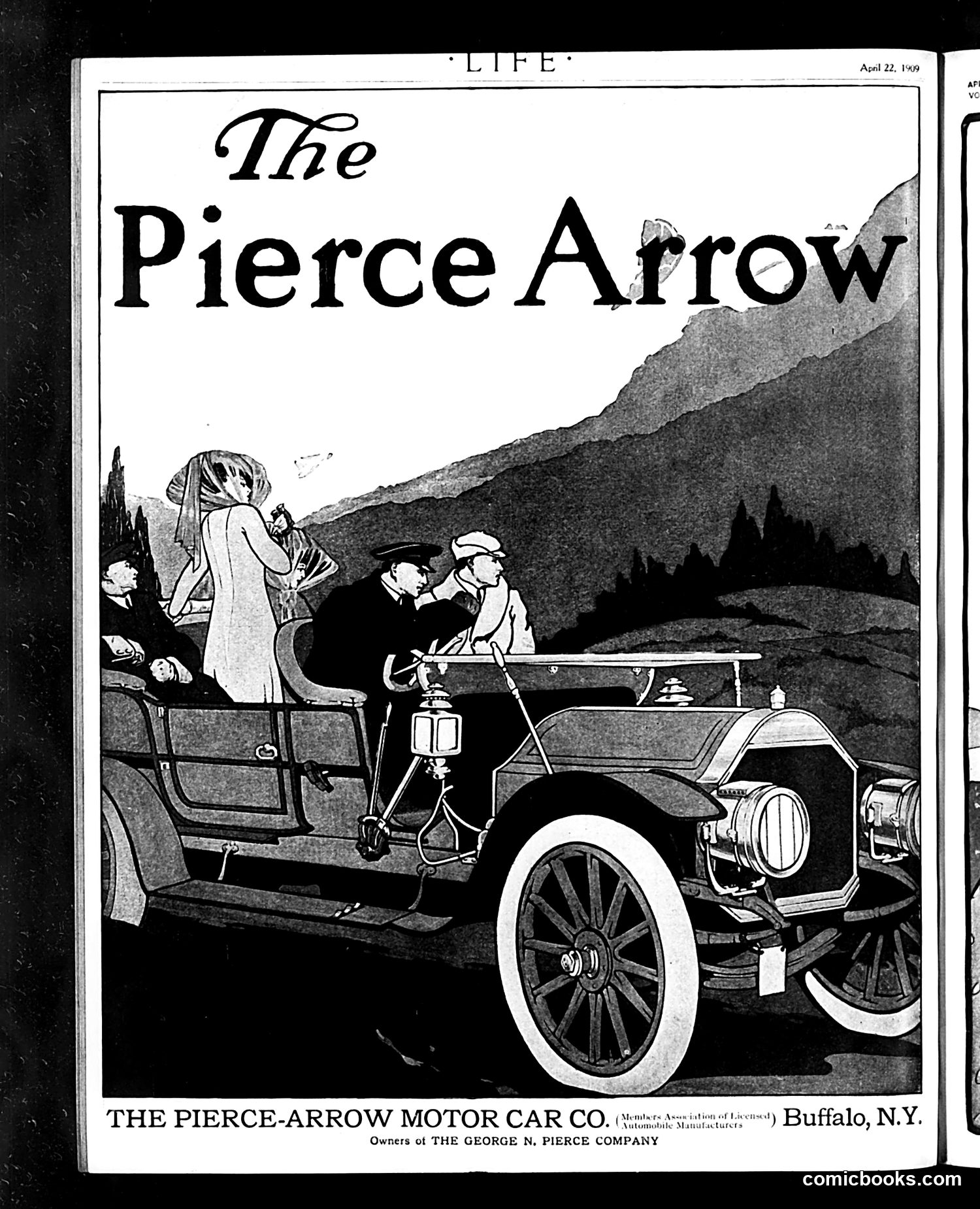
This is a full-page advertisement for the Pierce-Arrow Motor Car Company of Buffalo, New York, not political satire. The illustration depicts an elegant early automobile with well-dressed passengers on a scenic mountain road at dusk or dawn. A woman stands in the car, pointing toward the landscape, while men in suits and caps sit nearby—presenting the vehicle as a luxury item for affluent leisure travel. The ad emphasizes the Pierce-Arrow's sophistication and comfort, positioning it as aspirational transportation for the wealthy. The romantic, picturesque setting and fashionable passengers suggest status and refined taste rather than practical utility. This reflects early 1900s automotive marketing, when cars were luxury goods for the elite.