
Life, 1909-04-22 · page 8 of 32
Life — April 22, 1909 — page 8: what you’re looking at
What you’re looking at
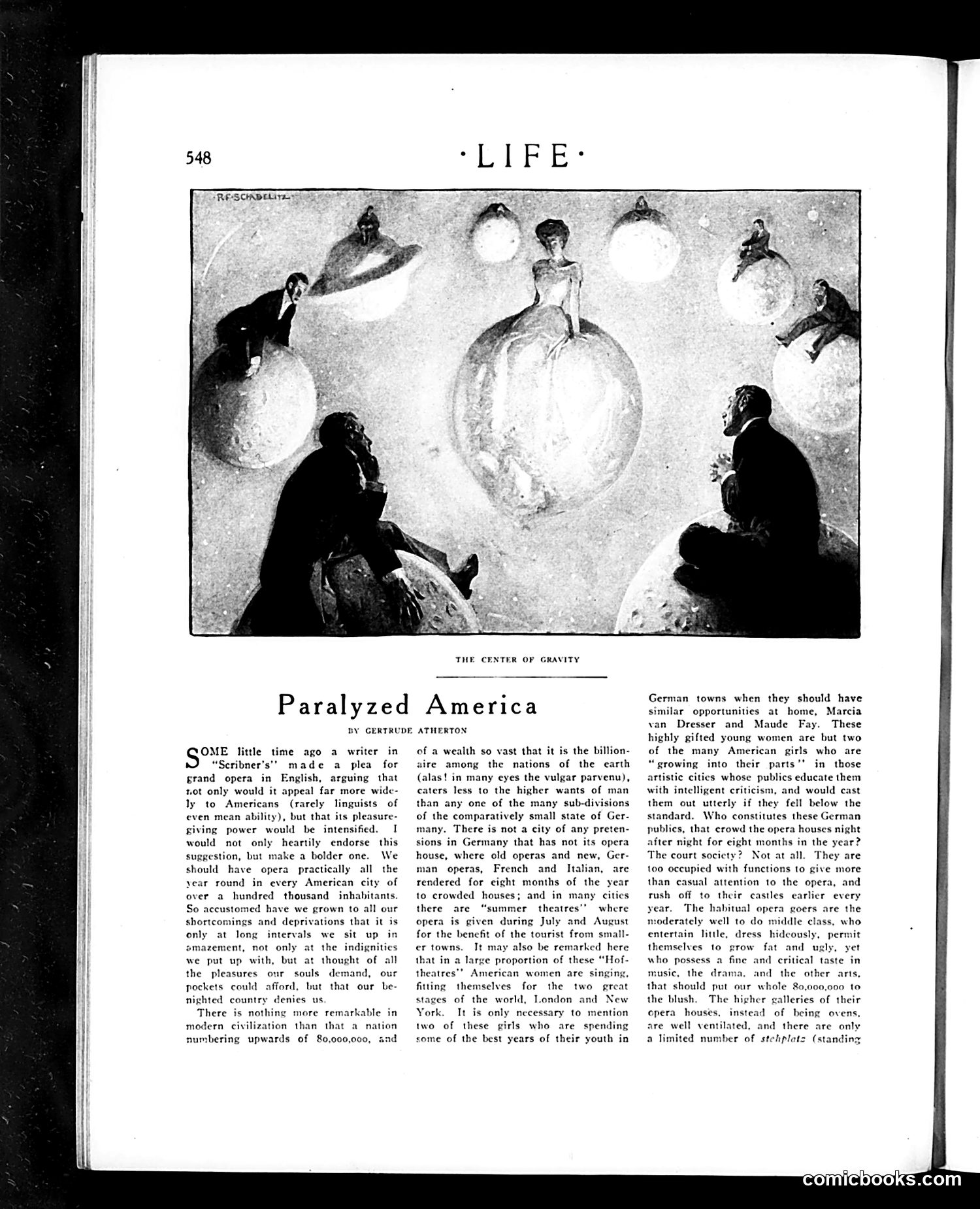
This satirical piece critiques American cultural life as stagnant compared to Germany's vibrant opera and theater scene. The illustration titled "The Center of Gravity" depicts figures floating around large spheres, suggesting America's cultural institutions lack proper grounding or direction. Atherton argues that while Germany supports opera houses year-round across numerous cities, America relies on touring companies and "summer theaters" for tourists. She notes that American opera houses remain closed much of the year, and laments that talented young women seeking artistic careers must pursue them abroad rather than at home. The satire suggests America's high society is culturally "paralyzed"—wealthy but artistically underdeveloped compared to European standards, unable to sustain serious theatrical institutions despite its resources.
📄 Transcribed text from this page (OCR, searchable)
Machine-transcribed from the original scan — historical spelling and the odd misread are preserved.
*RESCADELITA THE CENTER OP GRAVITY Paralyzed America BY GERTRUDE ATHERTON OME little time ago a writer in “Scribner's” made a plea for grand opera in English, arguing that not only would it appeal far more wide- ly to Americans (rarely linguists of even mean ability), but that its pleasure- giving power would be intensified. 1 would not only heartily endorse thi suggestion, but make a bolder one. We should have opera practically all the year round in every American city of hundred thousand inhabitants med have we grown to all our over a So accust shortcomings and deprivations that it is only at long intervals we sit up in mazement, not only at the indignities we put up with, but at thought of all the pleasures our souls demand, our pockets could afford, but that our be- nighted country denies us There is nothing more remarkable in modern civilization than that a numbering upwards of 80,000,000, and nation of a wealth so vast that it is the billion- aire among the nations of the earth (alas! in many eyes the vulgar parvenu), caters less to the higher wants of n than any one of the many sub-divisions of the comparatively small state of Ger- many. There is not a city of any preten- sions in Germany that has not its opera house, where old operas and new, Ger- man operas, French and Italian, are rendered for eight months of the year to crowded houses; and in many cities there are “summer theatres’ where opera is given during July and August for the benefit of the tourist from small- er towns. It may also be remarked here that in a large proportion of these “Hof- theatres"’ American women are singing, fitting themselves for the two great stages of the world, London and New York. It is only necessary to mention two of these girls who are spending some of the best years of their youth in German towns when they should have similar opportunities at home, Marcia van Dresser and Maude Fay. These highly gifted young women are but two of the many American girls who are “growing into their parts’? in those artistic cities whose publics educate them with intelligent criticism, and would cast them out utterly if they fell below the standard. Who constitutes these German publics, that crowd the opera houses night after night for eight months in the year? The court society? Not at all. They are too occupied with functions to give more than casual attention to the opera, and rush off to their castles earlier every year. The habitual opera goers are the moderately well to do middle class, who entertain little, dress hideously, permit themselves to grow fat and ugly, yet who possess a fine and critical taste in music, the drama, and the other that should put our whole 80,000,000 to the blush. The higher galleries of their opera instead of are well ventilated, and there are only a limited number of stehplatz (standing arts, houses, being ovens,