
Life, 1909-04-22 · page 10 of 32
Life — April 22, 1909 — page 10: what you’re looking at
What you’re looking at
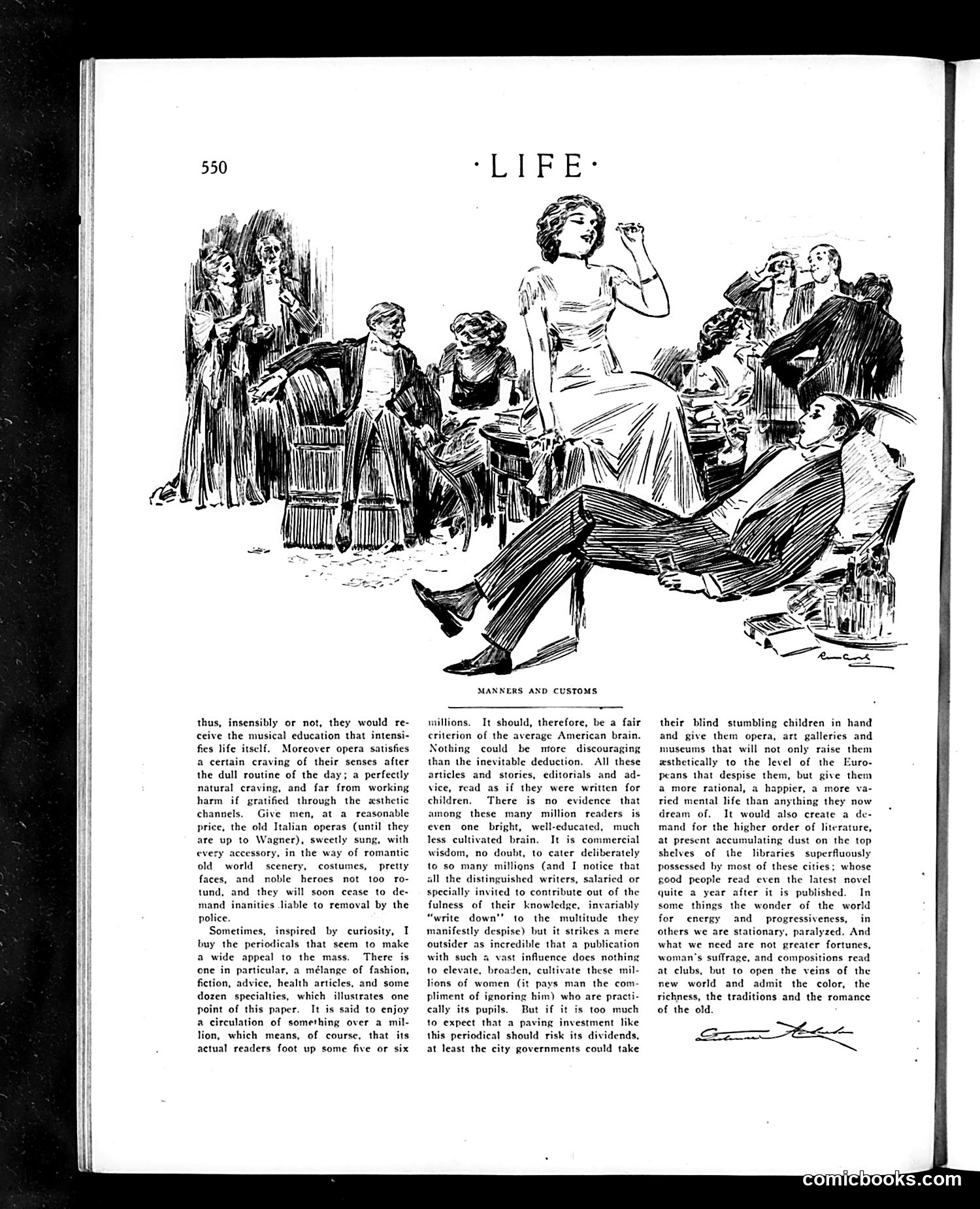
This is a satirical commentary on American cultural taste and publishing, not a political cartoon. The illustration depicts a social gathering where a woman sits centrally while various men attend to her—a scene illustrating upper-class social dynamics. The accompanying text critiques the "musical education" and cultural priorities of American society. It argues that while millions of American readers consume popular periodicals, newspapers, and serialized fiction, they lack refined aesthetic education comparable to Europeans. The author suggests that average Americans receive "commercial wisdom" rather than genuine cultural cultivation, and laments that prestigious publications cater deliberately to mass audiences rather than elevating public taste. The satire targets American anti-intellectualism and the publishing industry's profit-driven compromises with mass culture.
📄 Transcribed text from this page (OCR, searchable)
Machine-transcribed from the original scan — historical spelling and the odd misread are preserved.
thus, insensibly or not, they would re- ceive the musical education that intensi- fies life itself. Moreover opera satisfies a certain craving of their senses after the dull routine of the day; a perfectly natural craving, and far from working harm if gratified through the zxsthetic channels. Give men, at a reasonable price, the old Italian operas (until they are up to Wagner), sweetly sung, with every accessory, in the way of romantic old world scenery, costumes, pretty faces, and noble heroes not too ro- tund, and they will soon cease to de- mand inanities liable to removal by the police. Sometimes, inspired by curiosity, I buy the periodicals that seem to make a wide appeal to the mass. There is one in particular, a mélange of fashion, fiction, advice, health articles, and some dozen specialties, which illustrates one point of this paper. It is said to enjoy a circulation of something over a mil- lion, which means, of course, that its actual readers foot up some five or six MANNERS AND CUSTOMS millions. It should, therefore, be a fair criterion of the average American brain. Nothing could be ntore discouraging than the inevitable deduction. All these articles and stories, editorials and ad- vice, read as if they were written for children. There is no evidence that among these many million readers is even one bright, well-educated, much less cultivated brain. It is commercial wisdom, no doubt, to cater deliberately to so many millions (and I notice that all the distinguished writers, salaried or specially invited to contribute out of the fulness of their knowledge, invariably “write down’? to the multitude they manifestly despise) but it strikes a mere outsider as incredible that a publication with such s vast influence does nothing to elevate, broaden, cultivate these mil- lions of women (it pays man the com pliment of ignoring him) who are practi- cally its pupils. But if it is too much to expect that a paving investment like this periodical should risk its dividends, at least the city governments could take their blind stumbling children in hand and give them opera, art galleries and museums that will not only raise them asthetically to the level of the Euro- peans that despise them, but give them a more rational, a happier, a more va- ried mental life than anything they now dream of. It would also create a de- mand for the higher order of literature, at present accumulating dust on the top shelves of the libraries superfluously possessed hy most of these cities; whose good people read even the latest novel quite a year after it is published. In some things the wonder of the world for energy and progressiveness, in others we are stationary, paralyzed. And what we need are not greater fortunes, woman’s suffrage, and compositions read at clubs, but to open the veins of the new world and admit the color, the richness, the traditions and the romance of the old. aS icbooks.com