
Life, 1909-04-22 · page 12 of 32
Life — April 22, 1909 — page 12: what you’re looking at
What you’re looking at
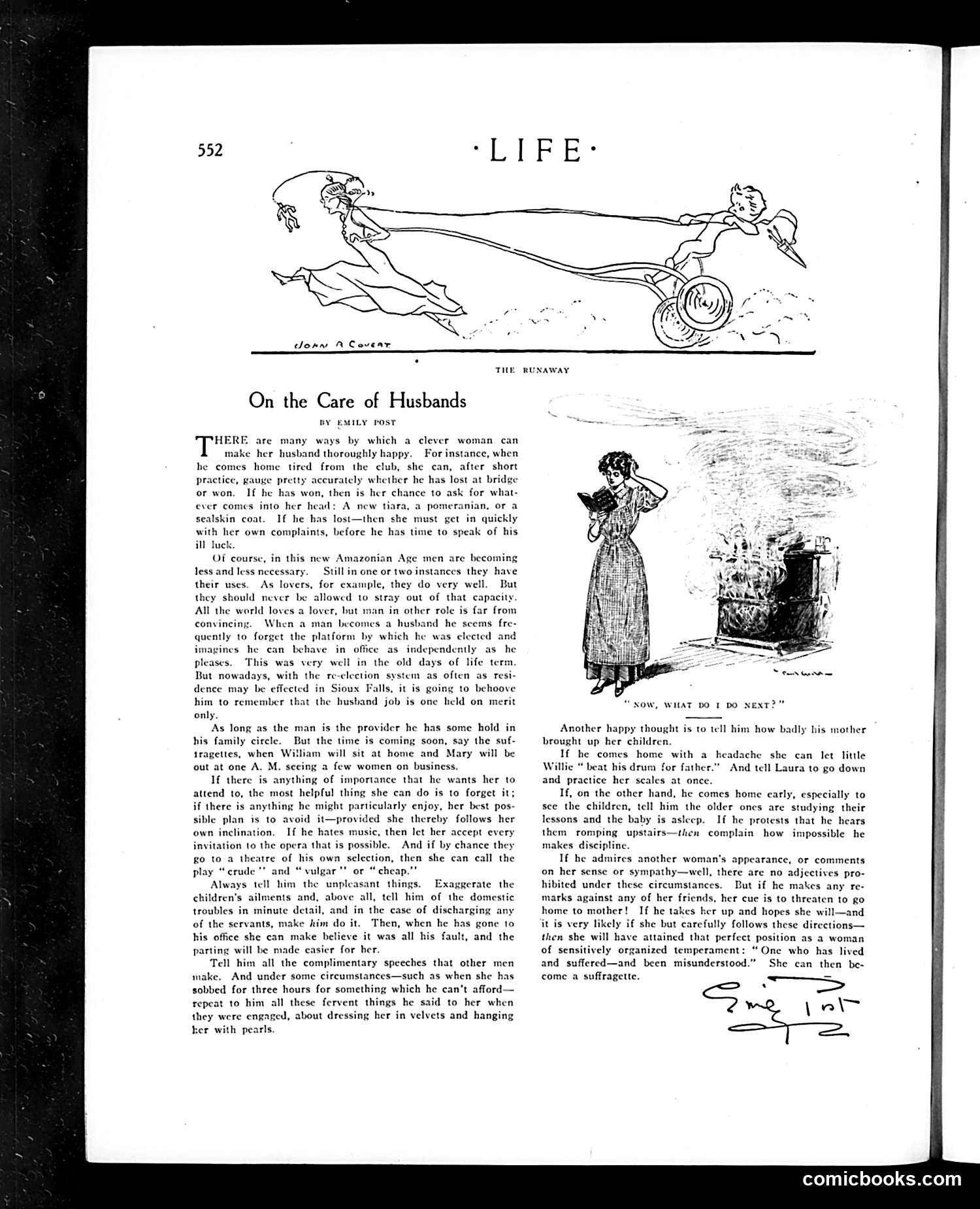
This page presents advice on managing husbands, illustrated by a cartoon titled "The Runaway" showing a woman being dragged by two cherubs in opposite directions—a visual metaphor for the competing demands on a wife's attention. The article, credited to etiquette authority Emily Post, addresses how wives should handle husbands' moods and needs. It advises women to manage household complaints discreetly, avoid public criticism, and maintain their husband's dignity, while also managing children and domestic staff. The cartoon's caption—"Now, what do I do next?"—captures the satirical point: wives must constantly navigate competing obligations and keep husbands satisfied, reflecting early-20th-century gender expectations where women's primary duty was managing their husband's emotional needs and household comfort.
📄 Transcribed text from this page (OCR, searchable)
Machine-transcribed from the original scan — historical spelling and the odd misread are preserved.
orn A Covent THe On the Care of Husbands BY EMILY Post HERE are many ways by which a clever woman can make her husband thoroughly happy. For instance, when he comes home tired from the club, she can, after short practice, gauge pretty accurately whether he has lost at bridge or won. If he has won, then is her chance to ask for what- ever comes into her head: A new tiara, a pomeranian, or a sealskin coat. If he has lost—then she must get in quickly with her own complaints, before he has time to speak of his ill luck. Of course, in this new Amazonian Age men are becoming less and less necessary. Still in one or two instances they have their uses. As lovers, for example, they do very well. But they should never be allowed to stray out of that capacity All the world loves a lover, but man in other role is far from convincing. When a man becomes a husband he scems fre- quently to forget the platform by which he was elected and imagines he can behave in office as independently ashe pleases. This was very well in the old days of life term. But nowadays, with the re-election system as often as resi dence may be effected in Sioux Falls, it is going to behoove him to remember that the husband job is one held on merit only ‘As long as the man is the provider he has some hold in his family circle. But the time is coming soon, say the suf- tragettes, when William will sit at home and Mary will be out at one A. M. seeing a few women on business. If there is anything of importance that he wants her to attend to, the most helpful thing she can do is to forget it; if there is anything he might particularly enjoy, her best pos- sible plan is to avoid it—provided she thereby follows her own inclination. If he hates music, then let her accept every invitation to the opera that is possible. And if by chance they fo to a theatre of his own selection, then she can call the play “crude * and “ vulgar"? or “cheap."* Always tell him the unpleasant things. Exaggerate the children’s ailments and, above all, tell him of the domestic troubles in minute detail, and in the case of discharging any of the servants, make him do it. Then, when he has gone to his office she can make believe it was all his fault, and the parting will be made easier for her. Tell him all the complimentary spceches that other men make. And under some circumstances—such as when she has sobbed for three hours for something which he can’t afford— repeat to him all these fervent things he said to her when they were engaged, about dressing her in velvets and hanging ker with pearls RUNAWAY “Sow, WHAT DO 1 DO NEXT?” Another happy thought is to tell him how badly his mother brought up her children. If he comes home with a headache she can let little Willic “ beat his drum for father.” And tell Laura to go down and practice her scales at once. If, on the other hand, he comes home carly, especially to sce the children, tell him the older ones are studying their lessons and the baby is asleep. If he protests that he hears them romping upstairs—then complain how impossible he makes discipline. If he admires another woman's appearance, or comments on her sense or sympathy—well, there are no adjectives pro- hibited under these circumstances. But if he makes any re- marks against any of her friends, her cue is to threaten to go home to mother! If he takes her up and hopes she will—and it is very likely if she but carefully follows these directions— then she will have attained that perfect position as a woman of sensitively organized temperament: “One who has lived and suffered—and been misunderstood.” She can then be- come a suffragette. — ae \ e\ comicbooks.com