
Life, 1909-04-22 · page 13 of 32
Life — April 22, 1909 — page 13: what you’re looking at
What you’re looking at
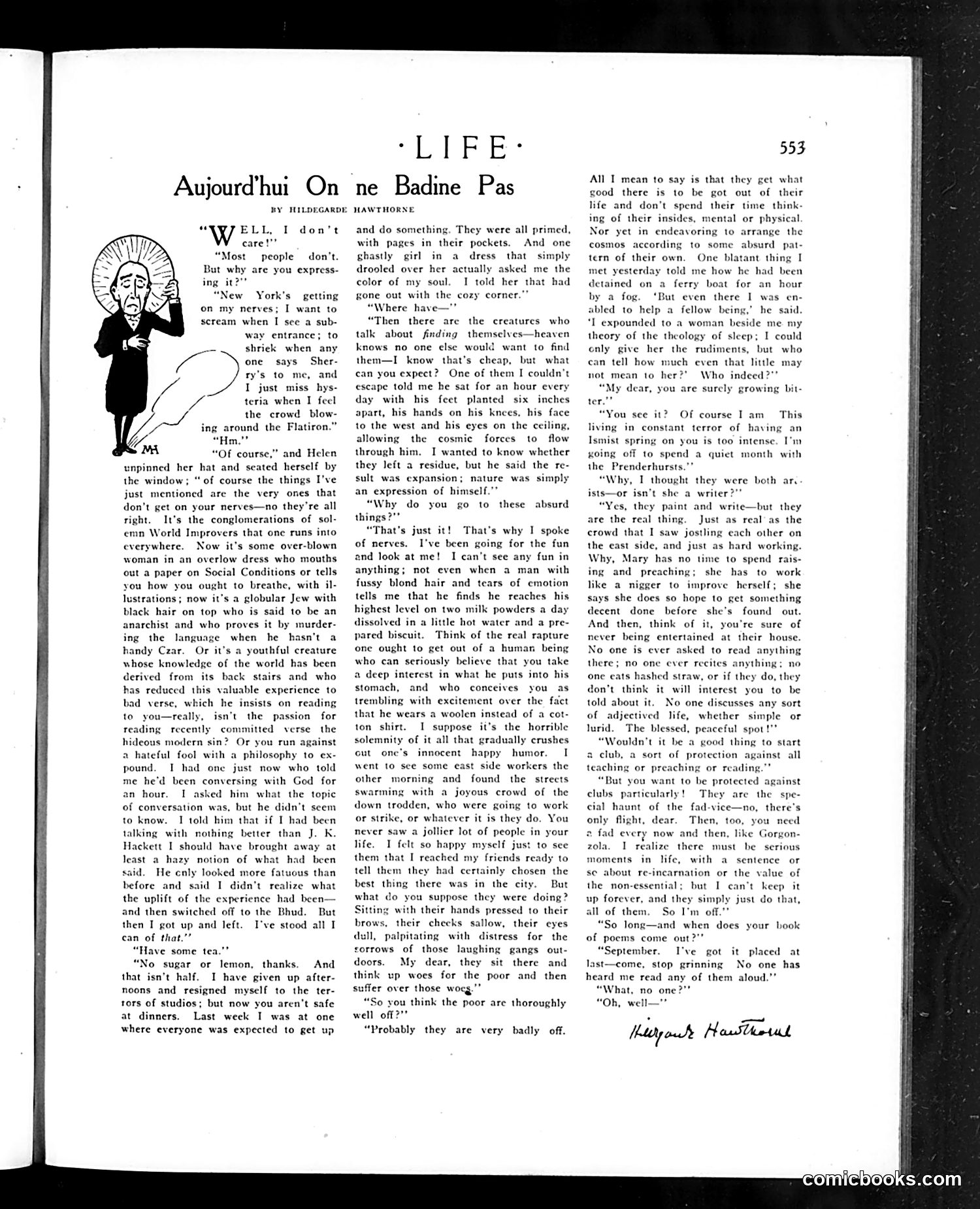
This satirical essay mocks wealthy New Yorkers' pretentious social concerns. The narrator, exhausted by city life and constant socializing, encounters a woman obsessing over whether poor people are "well off." The piece satirizes the disconnect between the affluent and working classes—specifically how the wealthy simultaneously claim concern for laborers' welfare while living in "constant terror" of social disruption. The narrator notes the irony: these same people who worry about the poor refuse to actually engage with them or read literature addressing poverty. The illustration shows a fashionable woman, likely representing this oblivious upper-class perspective. The satire targets 1920s New York society's superficial progressivism and anxiety about social unrest without genuine commitment to change.
📄 Transcribed text from this page (OCR, searchable)
Machine-transcribed from the original scan — historical spelling and the odd misread are preserved.
Aujourd’hui On BY IUILDEGARDE . ELL, I care!"" fost people don But why are you express- ing it?” don't York's getting on my nerves; I want to scream when I see a sub- way entrance; to shriek when any one says Sher- ry’s to me, and I just miss hys- teria when I feel the crowd blow- ing around the Flatiron.” “Of course,” and Helen unpinned her hat and seated herself by the window; “of course the things I've just mentioned are the very ones that don’t get on your nerves—no they're all right. It’s the conglomerations of sol- emn World Improvers that one runs into everywhere. Now it's some over-blown woman in an overlow dress who mouths out a paper on Social Conditions or tells you how you ought to breathe, with il- lustrations; now it’s a globular Jew with black hair on top who is said to be an anarchist and who proves it by murder- ing the language when he hasn't a handy Czar. Or it’s a youthful creature whose knowledge of the world has been derived from its back stairs and who has reduced this valuable experience to bad verse, which he insists on reading to you—really, isn’t the passion for reading recently committed verse the hideous modern sin? Or you run against a hateful fool with a philosophy to ex- pound. I had one just now who told me he'd been conversing with God for I asked him what the topic of conversation was, but he didn’t seem to know. I told him that if I had been talking with nothing better than J. K. Hackett I should have brought away at least a hazy notion of what had been said. He enly looked more fatuous than before and said I didn’t realize what the uplift of the experience had been— and then switched off to the Bhud. But then I got up and left. I've stood all I can of that.’’ “Have some tea.’ No sugar or lemon, thanks. And that isn’t half. I have given up after- noons and resigned myself to the ter- tors of studios; but now you aren't safe at dinners. Last week I was at one where everyone was expected to get up an hour. “LIFE: ne Badine Pas MAWTHORNE and do something. They were all primed, with pages in their pockets. And one ghastly girl in a dress that simply drooled over her actually asked me the color of my soul. I told her that had gone out with the cozy corner.” “Where have—" “Then there are talk about finding knows no one else would to find them—I know that’s cheap, but what can you expect? One of them I couldn't escape told me he sat for an hour every day with his fect planted inches apart, his hands on his knees, his face to the west and his eyes on the ceiling, allowing the cosmic forces to flow through him. I wanted to know whether they left a residue, but he said the re- sult was expansion; nature was simply an expression of himself.”” do you go to the creatures who themselves—heaven want six these absurd Phat's just it! That's why I spoke of nerves. I've been going for the fun and look at me! I can’t see any fun in anything; not even when a man with fussy blond hair and tears of emotion tells me that he finds he reaches his highest level on two milk powders a day dissolved in a little hot water and a pre- pared biscuit. Think of the real rapture one ought to get out of a human being who can seriously believe that you take a deep interest in what he puts into his stomach, and who conceives you as trembling with excitement over the fact that he wears a woolen instead of a cot- ton shirt. I suppose it’s the horrible solemnity of it all that gradually crushes out one’s innocent happy humor. I went to sce some east side workers the other morning and found the strects swarming with a joyous crowd of the down trodden, who were going to work or strike, or whatever it is they do. You never saw a jollier lot of people in your life. I felt so happy myself just to see them that I reached my friends ready to tell them they had certainly chosen the best thing there was in the city. But what do you suppose they were doing? Sitting with their hands pressed to their brows, their checks sallow, their eyes dull, palpitating with distress for the sorrows of those laughing gangs out- doors. My dear, they sit there and think up woes for the poor and then suffer over those wocg.”” ‘0 you think the poor are thoroughly well off?” “Probably they off. are very badly 553 All I mean to say is that they get what good there is to be got out of their life and don't spend their time think- ing of their insides, mental or physical Nor yet in endeavoring to arrange the cosmos according to some absurd pat- tern of their own. One blatant thing I met yesterday told me how he had been detained on a ferry boat for an hour by a fog. ‘But even there I was en- abled to help a fellow being,’ he said. ‘I expounded to a woman beside me my theory of the theology of sleep; I could only give her the rudiments, but who can tell how much even that little may not mean to her?’ Who indeed?’ “My dear, you are surely growing bit- ter.” ¢ Of course 1am This living in constant terror of having an Ismist spring on you is too intense. I'm xoing off to spend a quiet month with the Prenderhursts.”” “Why, I thought they were both ar. ists—or isn’t she a writer? “Yes, they paint and write—but they are the real thing. Just as real as the jostling each other on the east side, d_ working. Why, Mary has no time to spend rais- ing and preaching; to work like a nigger to improve herself; she ays she does so hope to get something decent done before she’s found out. And then, think of it, you're sure of never being entertained at their house. No one is ever asked to read anything there; no one ever recites anything: no one eats hashed straw, or if they do, they don't think it will interest you to be told about it. No one discusses any sort of adjectived life, whether simple or lurid. The blessed, peaceful spot ! You see it? she has “Wouldn't it be a good thing to start a sort of protection against all ‘aching or reading.”* “But you want to be protected against clubs particularly ! cial haunt of the fad-vice—no, there's only flight, dear. = fad every now and then, like Gorgon- zola. I moments in a club, teaching or pr They are the spi Then, too, you need realize there must be life, with a sentence or sc about re-inearnation or the value of the non-essential; but I can't keep it up forever, and they simply just do that, all of them. So I'm off.” “So long—and when does your book of poems come out?" “September. I've got it placed at last—come, stop grinning No one has heard me read any of them aloud.’’ “What, no one? “Oh, well—" serious,