
Life, 1909-04-22 · page 9 of 32
Life — April 22, 1909 — page 9: what you’re looking at
What you’re looking at
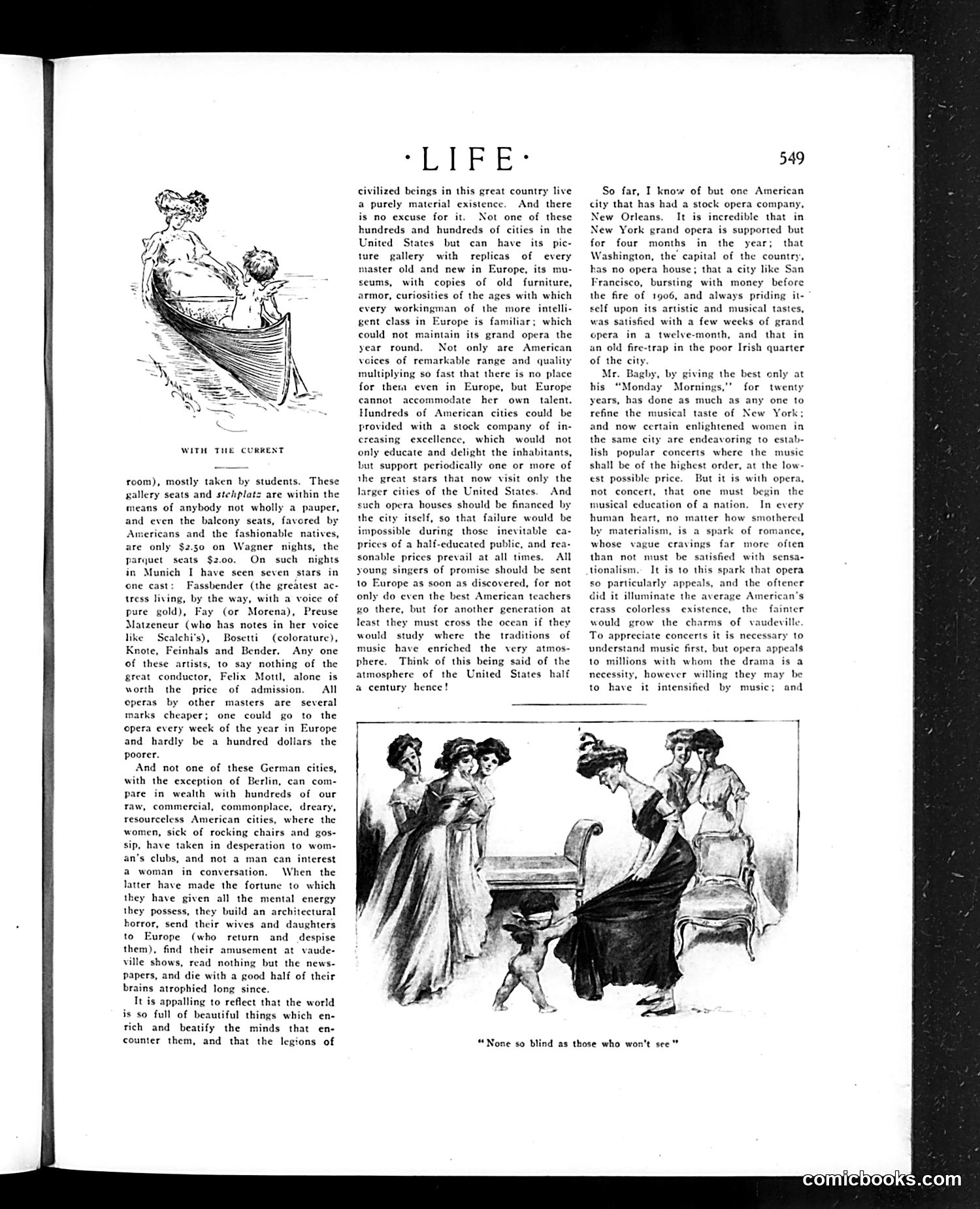
The page discusses American cultural deficiencies, particularly the lack of opera houses and musical institutions in U.S. cities compared to Europe. The text argues that wealthy American industrialists have failed to support the arts despite their fortunes. The cartoon at bottom, captioned **"None so blind as those who won't see,"** depicts well-dressed women gathered around what appears to be a baby carriage or similar object. The satire suggests that wealthy American women—despite their education and resources—deliberately ignore opportunities to patronize or appreciate culture. The broader critique lambastes America's commercial materialism and the wealthy classes' failure to foster artistic institutions, contrasting American cultural poverty unfavorably with European tradition and sophistication.
📄 Transcribed text from this page (OCR, searchable)
Machine-transcribed from the original scan — historical spelling and the odd misread are preserved.
WITH THE CURRENT room), mostly taken by students, These gallery seats and stehplatz are within the means of anybody not wholly a pauper, and even the balcony seats, favored by Americans and the fashionable natives, re only $2.30 on Wagner nights, the arquet seats $2.00. On such nights n Munich I have seen seven stars in one cast: Fassbender (the greatest ac- tress living, by the way, with a voice of pure gold), Fay (or Morena), Preuse Matzeneur (who has notes in her voice like Scalchi’s), Bosetti_ (colorature), Knote, Feinhals and Bender. Any one of these artists, to say nothing of the great conductor, Felix Mottl, alone is worth the price of admission. All operas by other masters are several marks cheaper; one could go to the opera every week of the year in Europe and hardly be a hundred dollars the poorer. And not one of these German cities, with the exception of Berlin, can com- pare in wealth with hundreds of our raw, commercial, commonplace, dreary, resourceless American cities, where the women, sick of rocking chairs and gos- sip, have taken in desperation to wom- an's clubs, and not a man can interest a woman in conversation. When the latter have made the fortune to which they have given all the mental energy they possess, they build an architectural horror, send their wives and daughters to Europe (who return and despise them), find their amusement at vaude- ville shows, read nothing but the news- papers, and die with a good half of their brains atrophied long since. It is appalling to reflect that the world is so full of beautiful things which en- rich and beatify the minds that en- counter them, and that the legions of “LIFE civilized beings in this great country live a purely material existence. And there is no excuse for it. Not one of these hundreds and hundreds of cities in the United States but can have its pic- ture gallery with replicas of every master old and new in Europe, its mu- seums, with copies of old furniture, armor, curiosities of the ages with which every workingman of the more intelli- gent class in Europe is familiar; which could not maintain its grand opera the year round. Not only are American voices of remarkable range and quality multiplying so fast that there is no place for thera even in Europe, but Europe cannot accommodate her own talent. Hundreds of American cities could be provided with a stock company of in- creasing excellence, which would not only educate and delight the inhabitants, Lut support periodically one or more of the great stars that now visit only the rer cities of the United States. And such opera houses should be financed by the city itself, so that failure would be impossible during those inevitable ca- prices of a half-educated public, and r sonable prices prevail at all times, All young singers of promise should be sent to Europe as soon as discovered, for not only do even the best American teachers go there, but for another generation at least they must cross the ocean if they would study where the traditions of music have enriched the very atmos- phere. Think of this being said of the atmosphere of the United States half a century hene; 549 So far, I know of but one American city that has had a stock opera company, New Orleans. It is incredible that in New York grand opera is supported but for four months in the year; that Washington, the capital of the country, has no opera house; that a city like San Francisco, bursting with money before the fire of 1906, and always priding it- elf upon its artistic and musical tastes, was satisfied with a few weeks of grand opera in a twelve-month, and that in an old fire-trap in the poor Irish quarter of the city Mr. Bagby, by giving the best only at his “Monday twenty years, has done as much as any one to refine the musical taste of New York: and now certain enlightened women in the same city are endeavoring to estab- lish popular concerts where the shall be of the highest order, at the low- But it is with opera, not concert, must begin the musical education of a nation. In every human heart, no matter how smothered by materialism, is a spark of romance, whose vague cravings far often than not must be satisfied sensa- tionalism. It is to this spark that opera so particularly appeals, and the oftence did it illuminate the average American's crass colorless fainter would grow the charms of To appreciate concerts it is necessary to Mornings,"’ for sic est possible price. that one more with existence, the vaudeville, understand music first, but opera appeals to millions with whom the drama is a necessity, however willing they may be to have it intensified by music; and “None so blind as those who won't see”