
A complete issue · 28 pages · 1908
Life — October 15, 1908
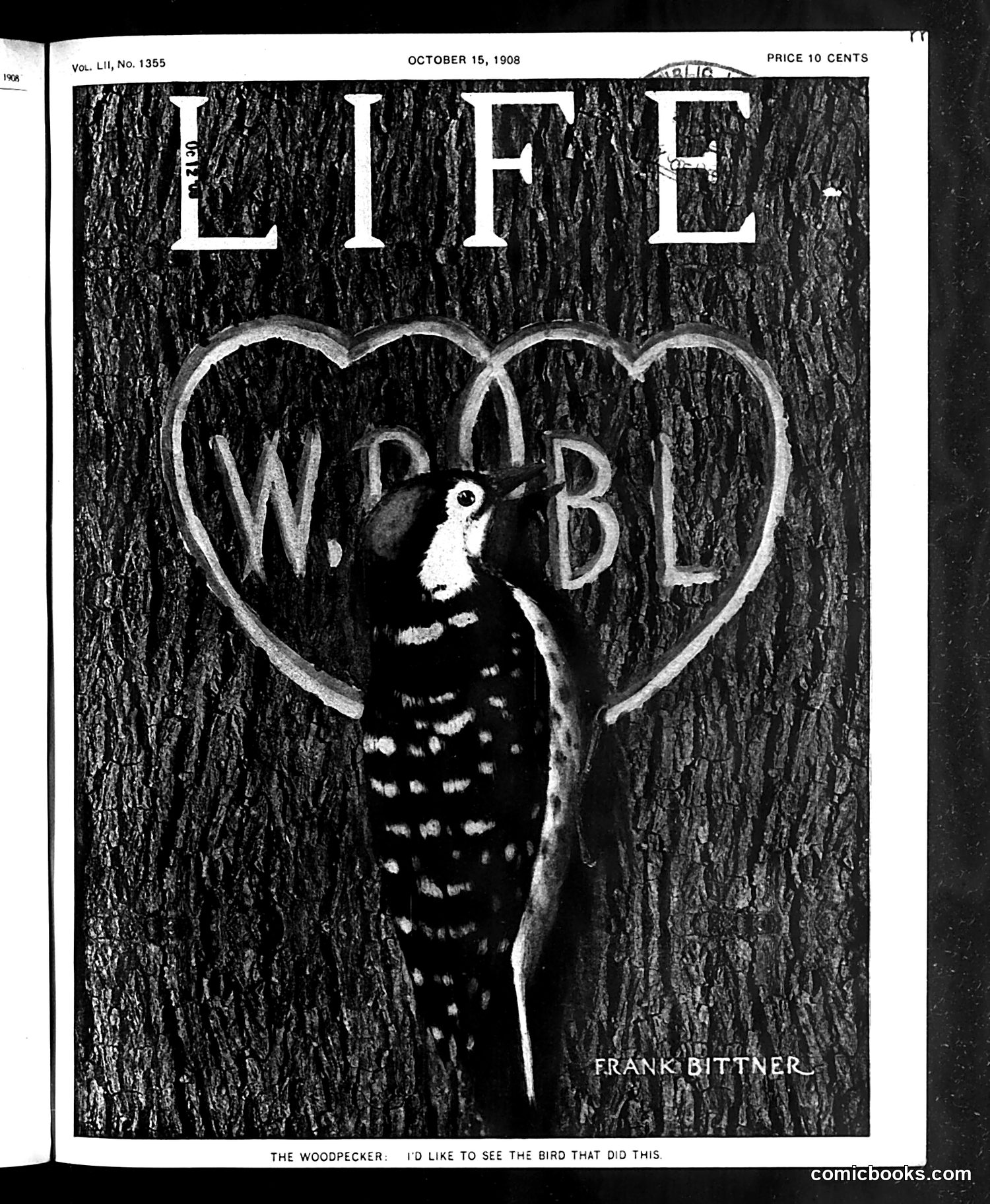
This cover features a woodpecker carving a heart into a tree trunk, with the initials "W.B." inside. The caption reads "THE WOODPECKER: I'D LIKE TO SEE THE BIRD THAT DID THIS." The cartoon is credited to Frank Bittner. The joke appears to be a pun: the woodpecker—a bird famous for pecking wood—is sarcastically claiming he'd like to meet whoever carved such a neat, deliberate heart shape into the tree, suggesting that no bird actually created this romantic symbol. It's likely a commentary on human sentimentality and the contrast between animals' instinctive behaviors and humans' capacity for romantic expression. The specific initials "W.B." remain unclear without additional context.
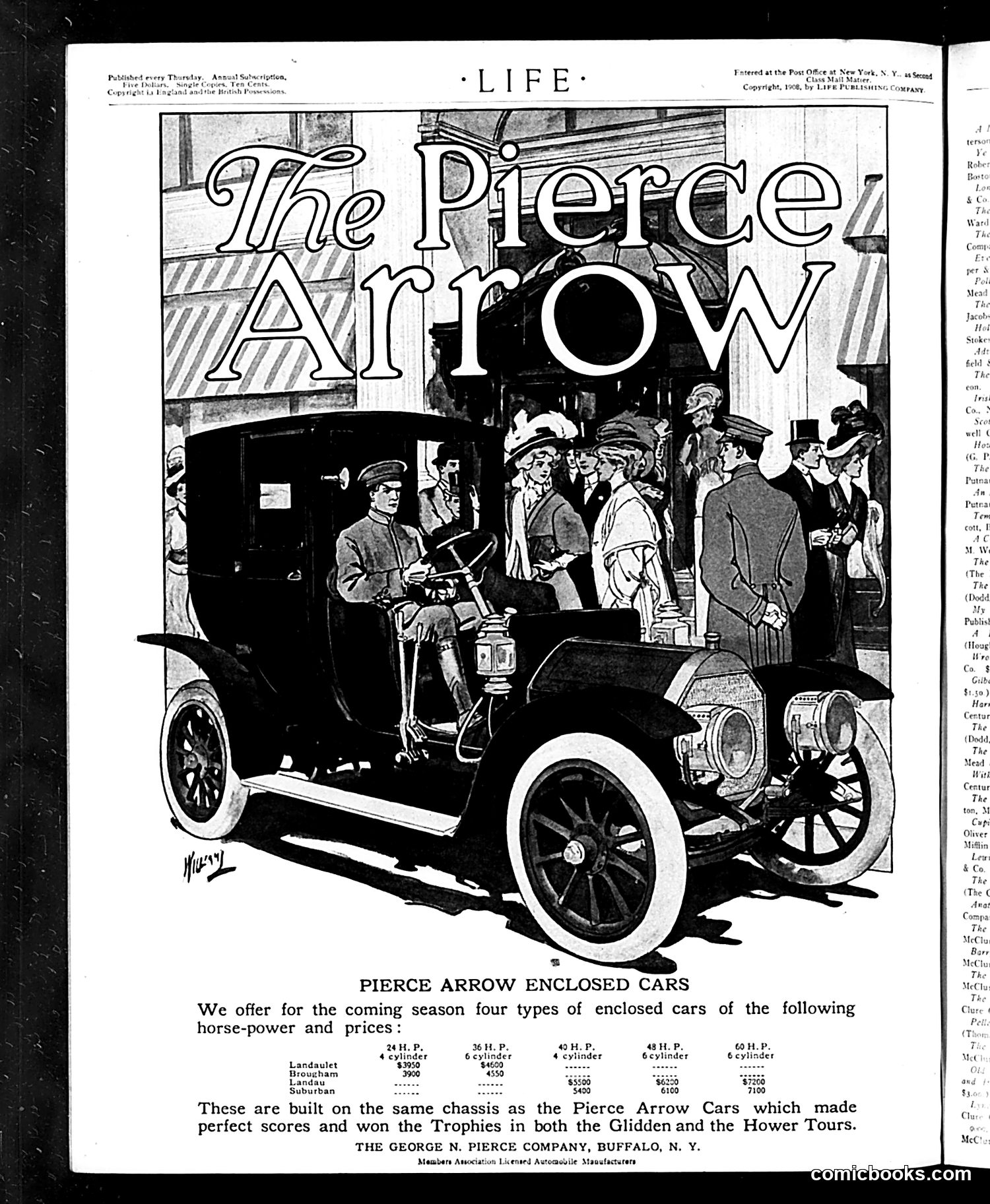
This page is **primarily an advertisement**, not a political cartoon. It promotes Pierce Arrow enclosed automobiles from The George N. Pierce Company in Buffalo, New York. The large illustration shows a stylish early 1900s motorcar surrounded by well-dressed pedestrians and onlookers on an urban street. The image is promotional rather than satirical. The advertisement emphasizes that Pierce Arrow offers "four types of enclosed cars" in various engine sizes (24 H.P. through 60 H.P.) and models (Runabout, Brougham, Landau, Suburban). It claims these vehicles are "built on the same chassis as the Pierce Arrow Cars which made perfect scores and won the Trophies in both the Glidden and the Hower Tours"—referencing contemporary automotive competitions to establish credibility and desirability. This is vintage automobile marketing from approximately 1908.
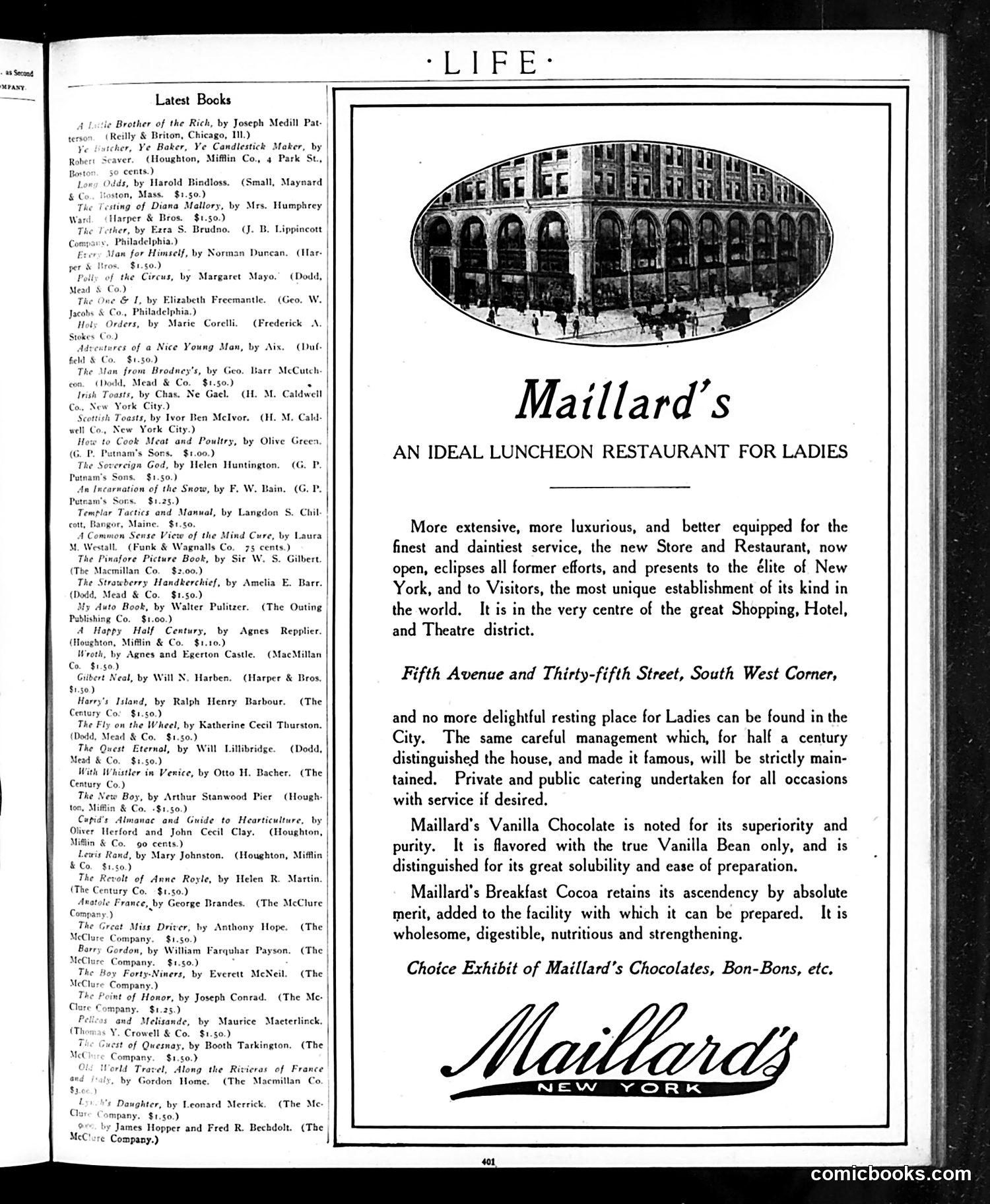
This page is **primarily advertising, not satire or political commentary**. The left column lists "Latest Books" — a standard literary digest feature of the era, promoting new publications from various publishers. The right side contains a full-page advertisement for **Maillard's Restaurant and Chocolate Company** in New York. The ad emphasizes that their new establishment at Fifth Avenue and Thirty-fifth Street is "an ideal luncheon restaurant for ladies," featuring luxurious service, private catering, and quality products like their "Vanilla Chocolate" and "Breakfast Cocoa." This reflects early 20th-century consumer culture and gender expectations — the explicit marketing to women as a refined clientele for upscale dining establishments. There is no political cartoon or satirical content visible on this page.
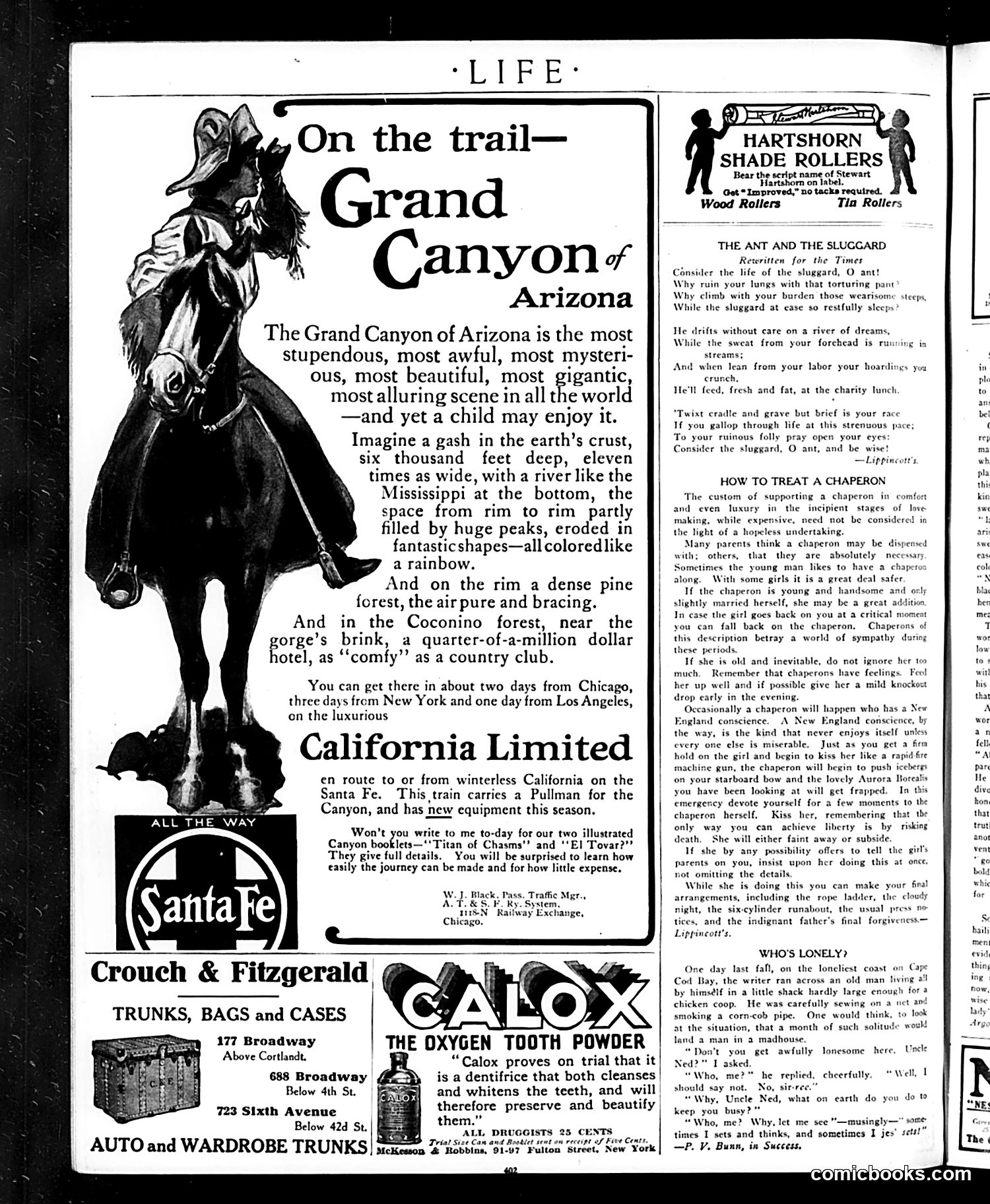
This page is primarily **commercial advertising** rather than political satire. The dominant content includes: **Main Advertisement:** A Santa Fe Railway ad promoting the "California Limited" train to the Grand Canyon, featuring an illustration of a horse and rider. The ad emphasizes luxury travel ("Pullman," "new equipment") accessible from major cities. **Secondary Advertisements:** Crouch & Fitzgerald trunks/luggage and Calox tooth powder. **Advice Columns:** "The Ant and the Sluggard" (moralistic verse) and "How to Treat a Chaperon" and "Who's Lonely?" (social etiquette pieces). **Hartshorn Shade Rollers:** A small product advertisement. The page reflects early 20th-century concerns: travel aspirations, proper social conduct, and consumer goods. There is **no identifiable political cartoon or satire** present—this is a typical Life magazine page mixing advertisements with light lifestyle content.
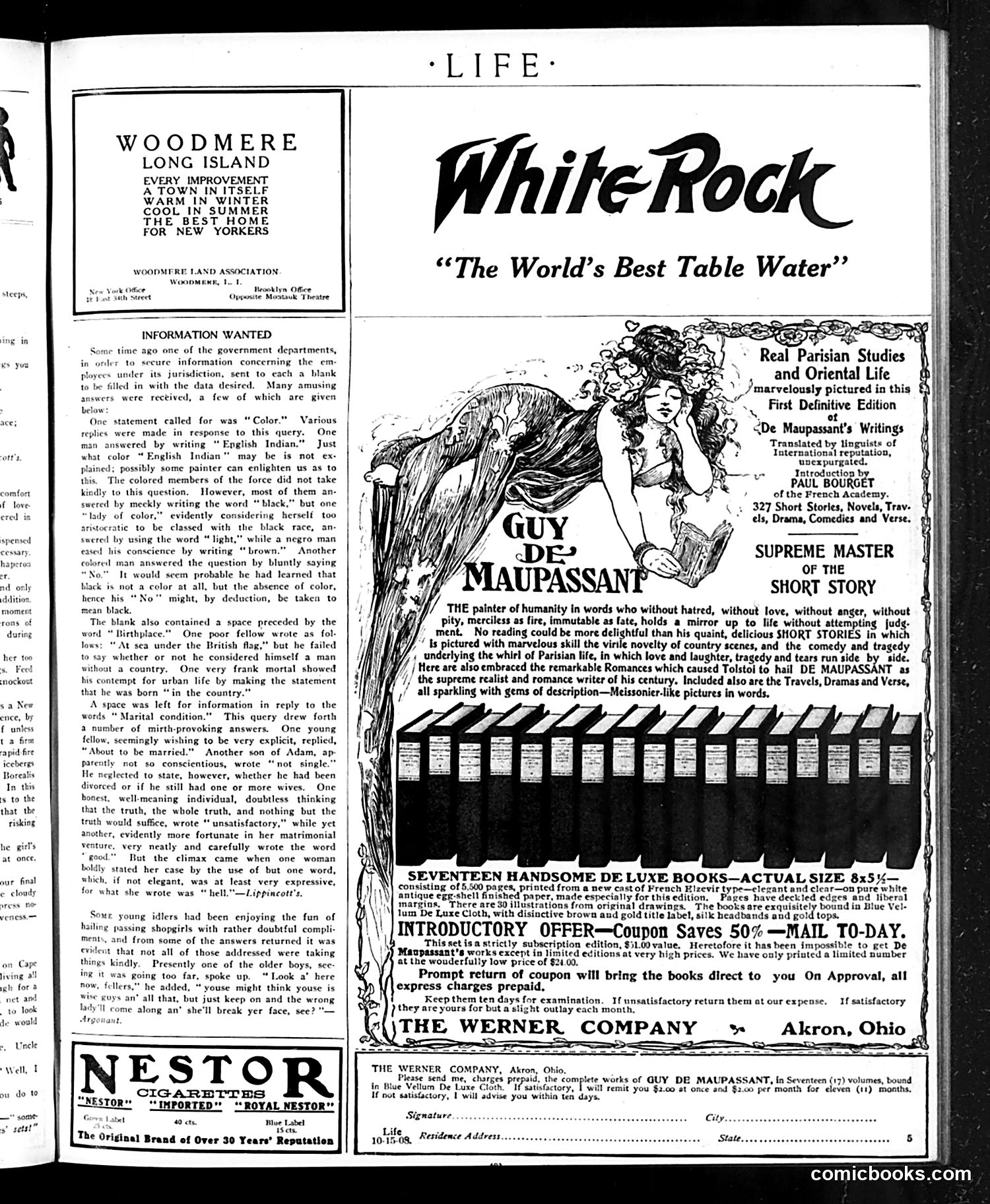
This page is **primarily advertising**, not satire or political commentary. The dominant content is a large advertisement for "White Rock" table water, featuring an illustration of a winged female figure (the brand's iconic logo) and promotional text for books by Guy de Maupassant. The smaller left-hand section contains two minor items: a Woodmere, Long Island real estate advertisement and a brief piece titled "Information Wanted" discussing various government department responses to a survey about color terminology—apparently a lighthearted collection of humorous official replies. The page also includes advertisements for Nestor cigarettes and The Werner Company's mail-order book offer. There is **no political satire or cartoon** on this page in the traditional sense. It represents standard early-20th-century magazine advertising and miscellaneous content.
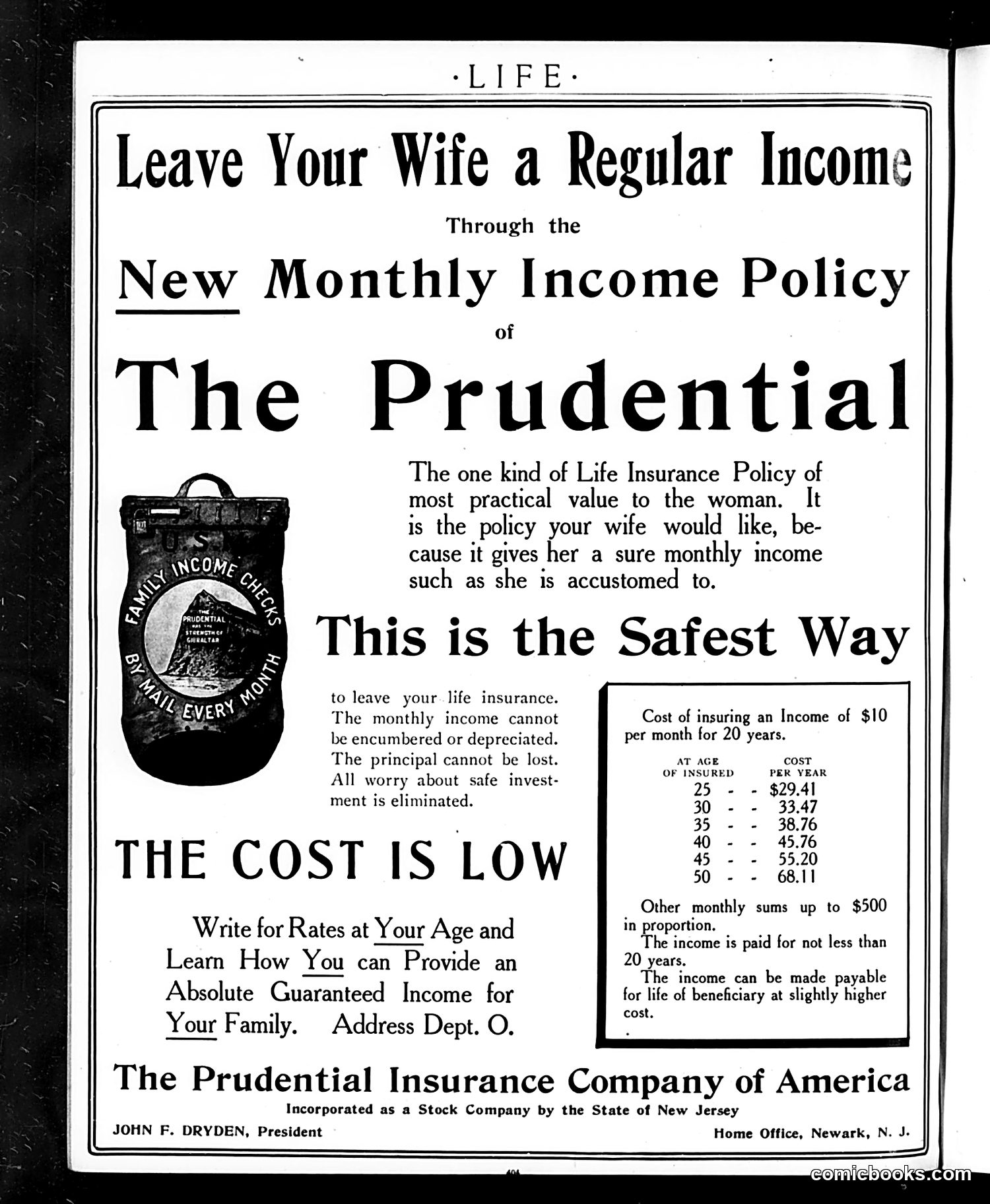
This is **not satire or a cartoon**—it's a straightforward insurance advertisement from *Life* magazine. The page promotes The Prudential Insurance Company's "New Monthly Income Policy" targeted at men concerned about providing for their wives after death. The ad reflects early 20th-century gender assumptions: wives are portrayed as financially dependent and needing guaranteed monthly income rather than lump-sum payouts. The "Family Income Checks" logo emphasizes reliable, predictable payments—appealing to male breadwinners' anxieties about family security. The pricing table shows this was affordable life insurance ($29-68 annually for $10/month income), representing emerging mass-market insurance for middle-class families. The Newark, New Jersey headquarters identifies Prudential as a major American insurer of that era.
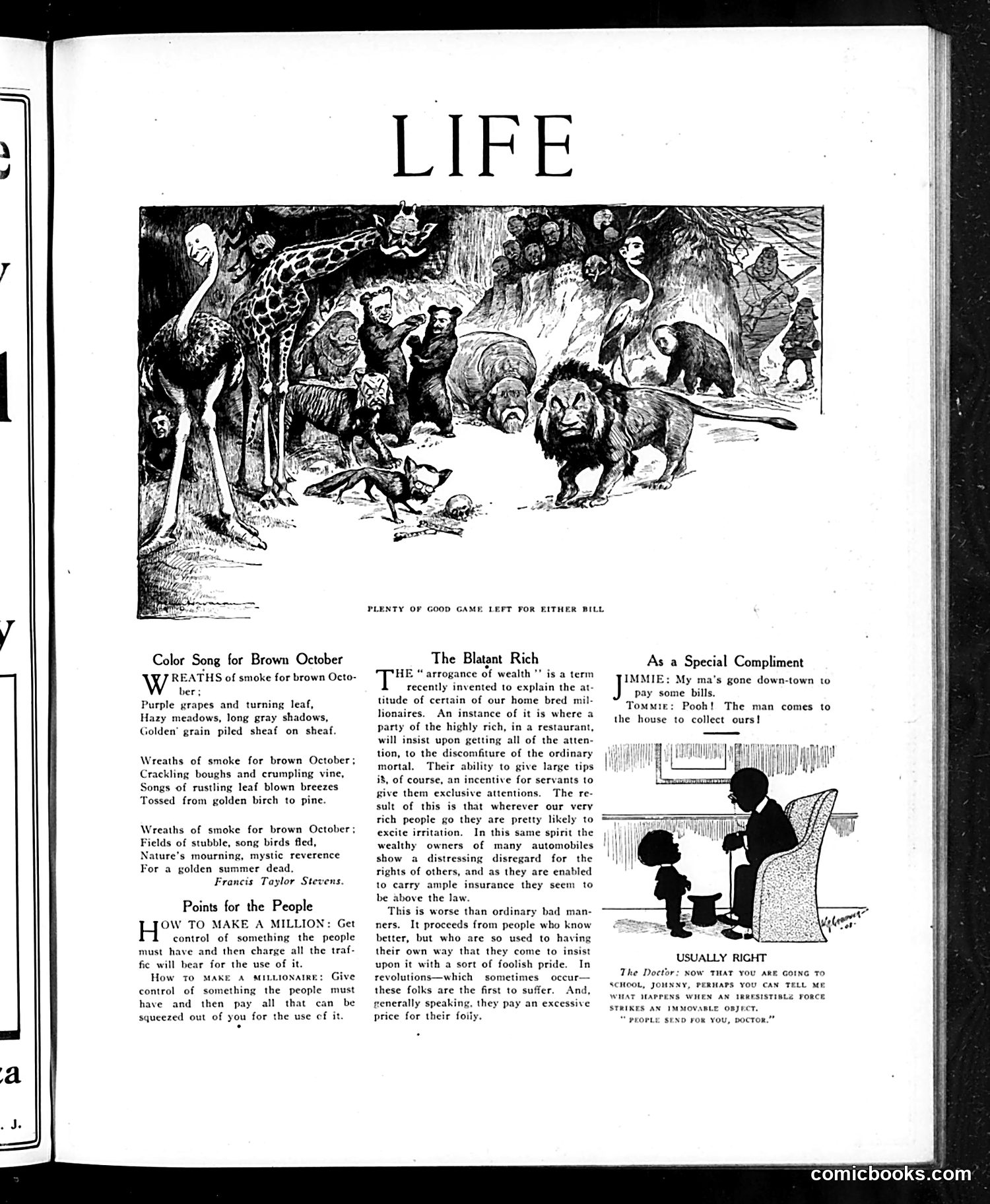
**Top Illustration:** A satirical drawing depicting various animals and caricatured figures in what appears to be a hunting or gathering scene, captioned "Plenty of Good Game Left for Either Bill." The "Bill" reference likely alludes to political figures of the era, though the specific identity is unclear without additional context. **Text Content:** The page contains three distinct pieces: 1. **"Color Song for Brown October"** — Poetry about autumn imagery 2. **"The Blatant Rich"** — Social commentary criticizing wealthy people's arrogance and presumptuous behavior toward servants and the working class 3. **"As a Special Compliment"** — A cartoon dialogue about a doctor and parents regarding school attendance, appearing to mock pretentious or foolish parental behavior The overall theme satirizes social class divisions and the self-important attitudes of the wealthy.
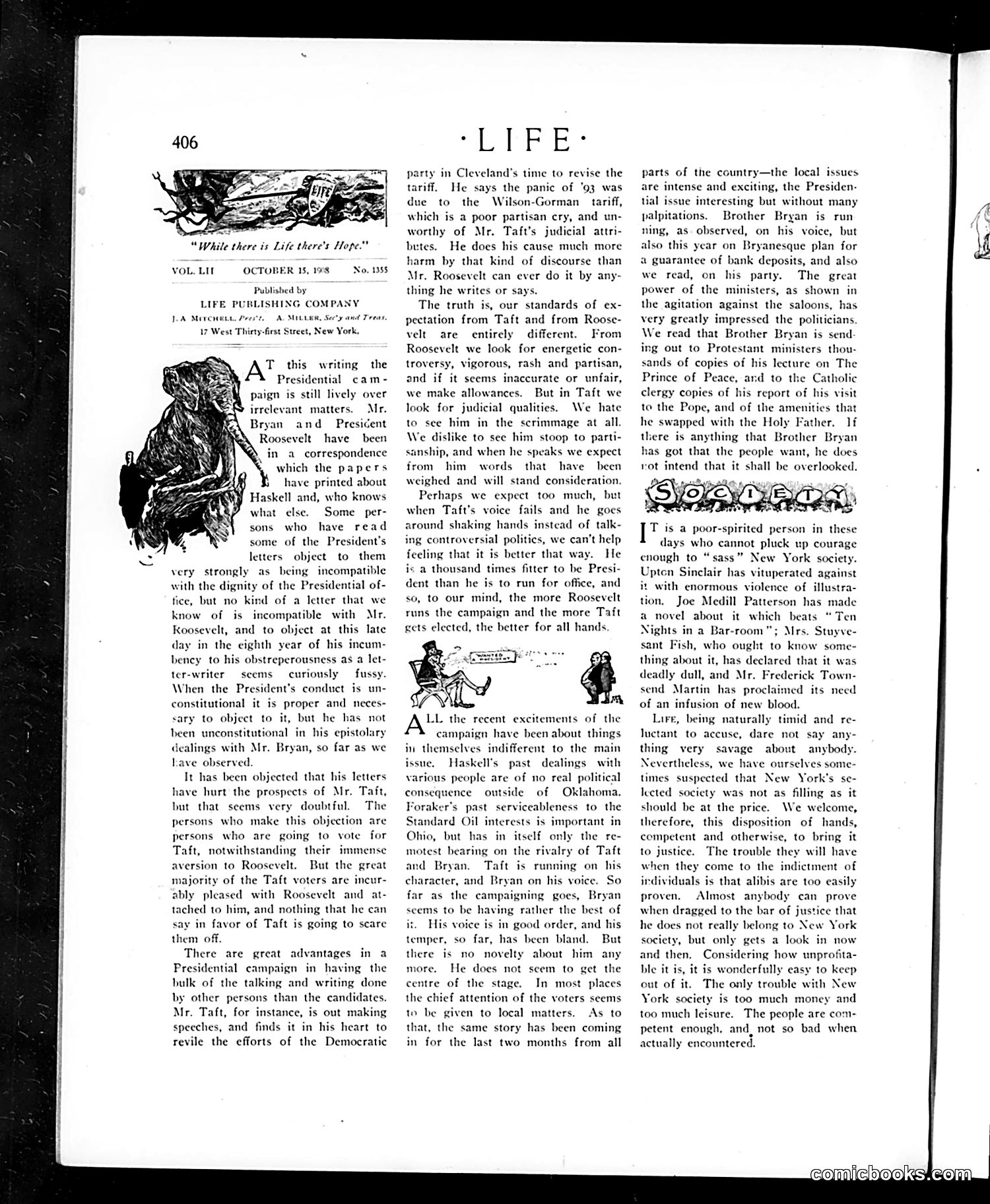
This October 1908 *Life* magazine page critiques the presidential campaign between President Theodore Roosevelt and William Howard Taft (Republican) versus William Jennings Bryan (Democrat). The main illustration shows **Haskel** (appears to be a political figure) being criticized for his past dealings with various political interests. The text argues that while Taft and Roosevelt supporters object to Bryan and Roosevelt, the real issue is that Taft's "judicial qualities" are preferable to Roosevelt's more aggressive, partisan approach. The satire suggests Roosevelt's vigorous campaigning style creates unnecessary controversy, whereas Taft represents a calmer, more measured alternative. The commentary implies voters concerned about presidential dignity should prefer Taft's restraint to Roosevelt's combative rhetoric.
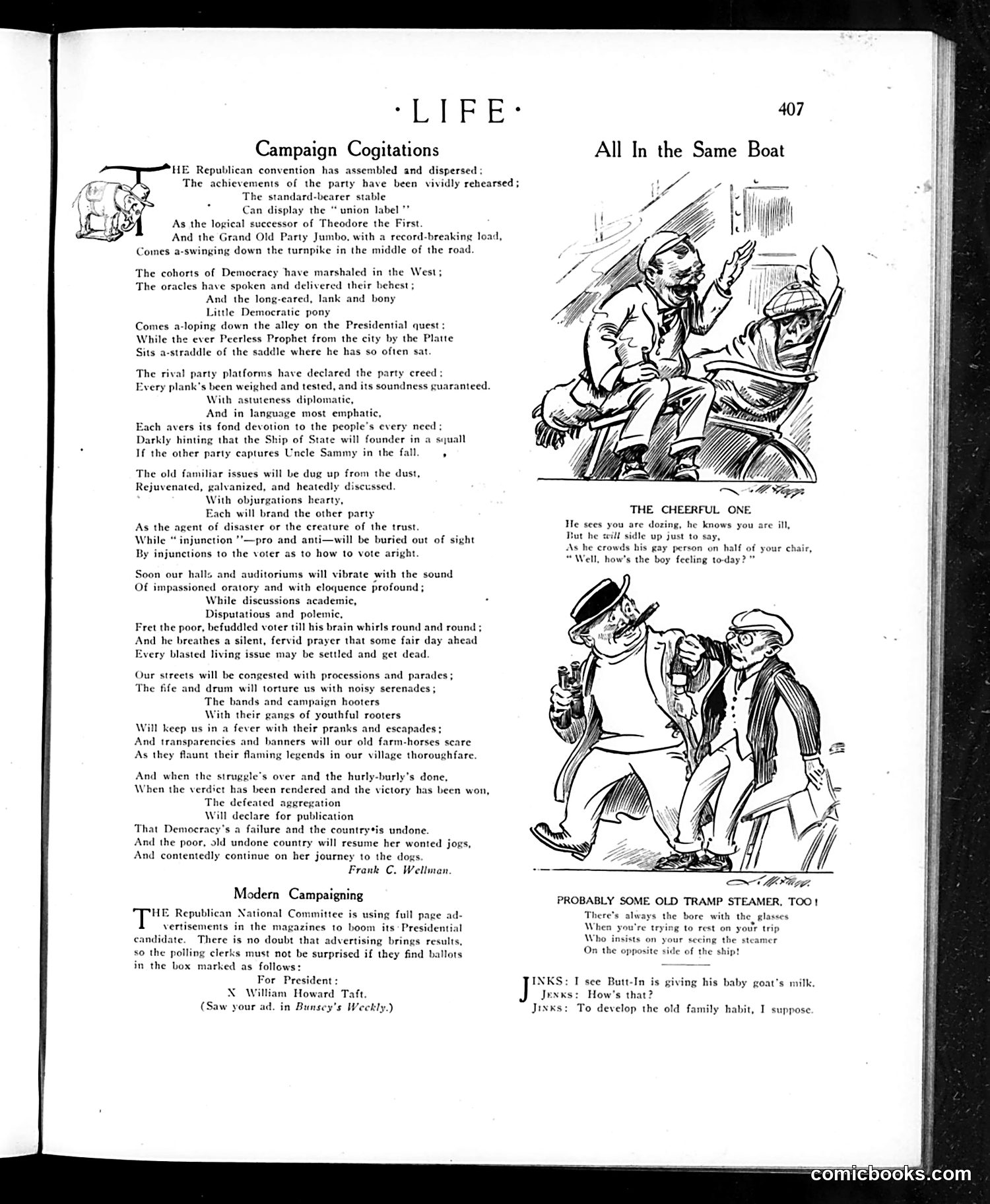
This page satirizes the 1912 presidential campaign through two main sections: **"Campaign Cogitations"** (left): A lengthy poem by Frank C. Wellman mocking Republican and Democratic party platforms, conventions, and campaign promises. It ridicules both parties' rhetoric as empty, their platforms as weightless, and predicts the inevitable parade of political speeches and disappointed voters. **"All in the Same Boat"** (right): A cartoon showing politicians in a rowboat, with accompanying dialogue about a "cheerful one" asking passengers how they're feeling—satirizing how politicians feign concern for constituents while all parties are essentially adrift together with no real solutions. **"Modern Campaigning"** (bottom left): Notes that Republicans are using full-page magazine ads for their presidential candidate, with a mock ballot showing "N. William Howard Taft." The overall message: all political parties make identical hollow promises regardless of differences.
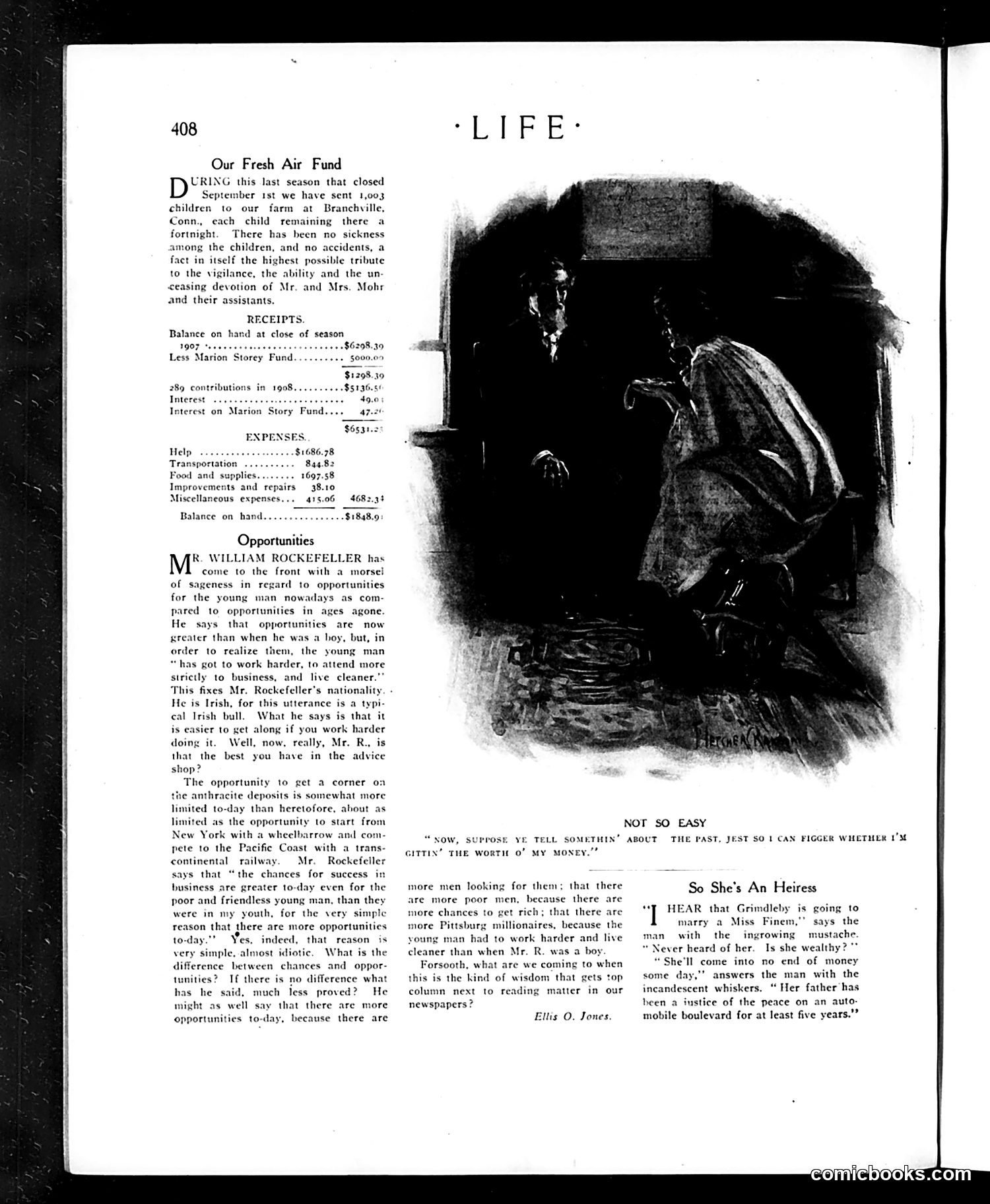
This cartoon depicts a social commentary on wealth and opportunity. The illustration shows what appears to be a wealthy figure (based on the fine clothing visible) speaking with a working-class man. The caption reads: "Now, suppose ye tell somethin' about the past. Jest so I can figger whether I'm gittin' the worth o' my money." The satire targets the gap between rich and poor in early 20th-century America. The wealthy person is questioning a laborer about his past, implying suspicion and class-based judgment. The accompanying article "Opportunities" by William Rockefeller discusses how young men face greater business challenges than previous generations, despite claims of expanded opportunity. The cartoon's title "Not So Easy" ironically undercuts Rockefeller's optimistic message about American economic mobility.
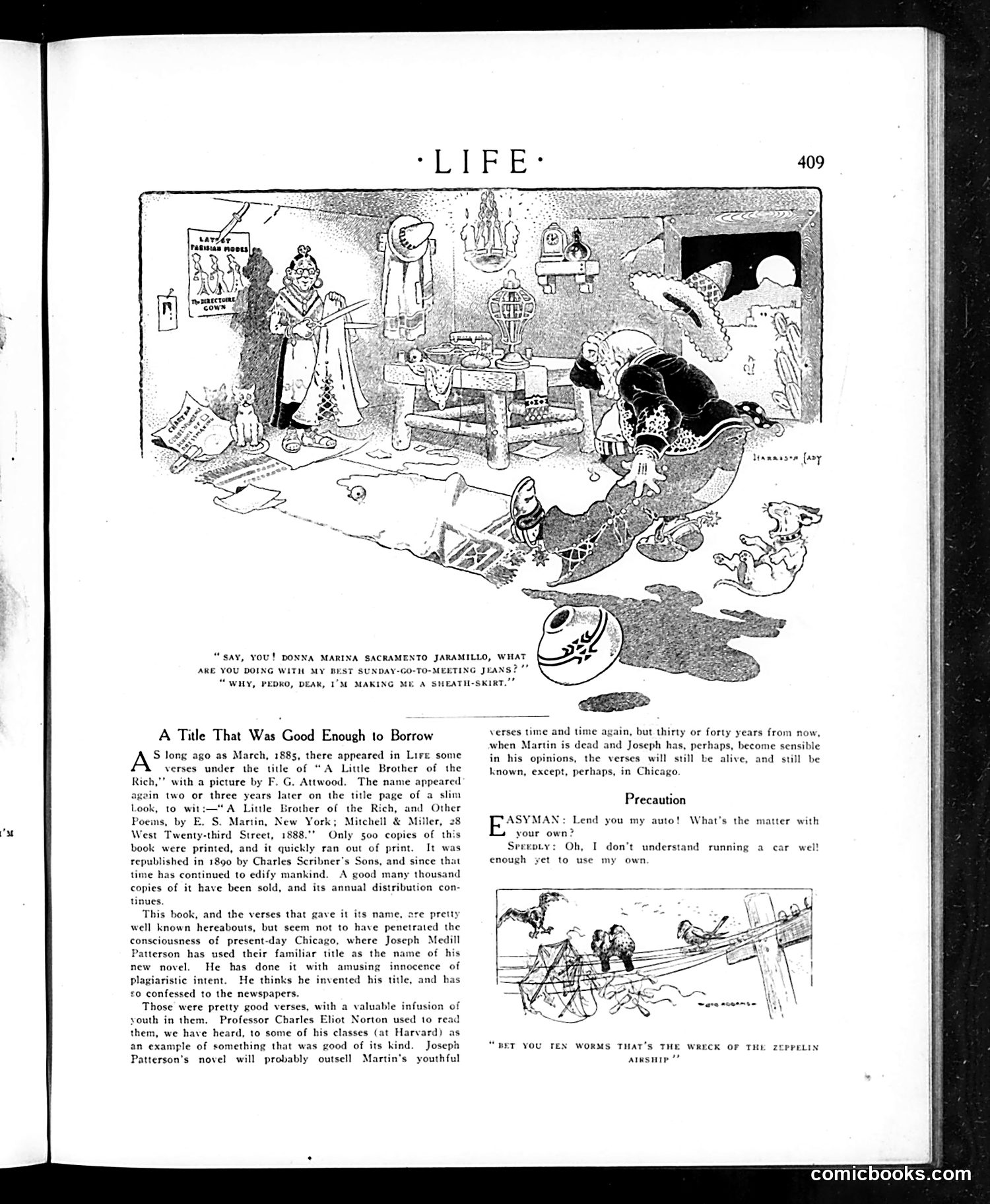
This page from *Life* magazine (page 409) contains two distinct elements: **Top cartoon:** A chaotic domestic scene where someone appears to be sewing or crafting, with various household items scattered about. The dialogue references "Marina Sacramento Jaramillo" and "Sunday-go-to-meeting jeans" versus a "sheath-skirt"—satirizing women's fashion choices and domesticity, likely from the early-to-mid 20th century. **Bottom section:** An article titled "A Title That Was Good Enough to Borrow" discusses an 1885 *Life* poem by E.S. Martin called "A Little Brother of the Rich." The piece explains how Joseph Medill Patterson later borrowed this title for his novel, with the accompanying cartoon showing what appears to be a shipwreck scene with the caption "But you ten worms that's the wreck of the zeppelin airship." The satire critiques literary borrowing and possibly early aviation mishaps.
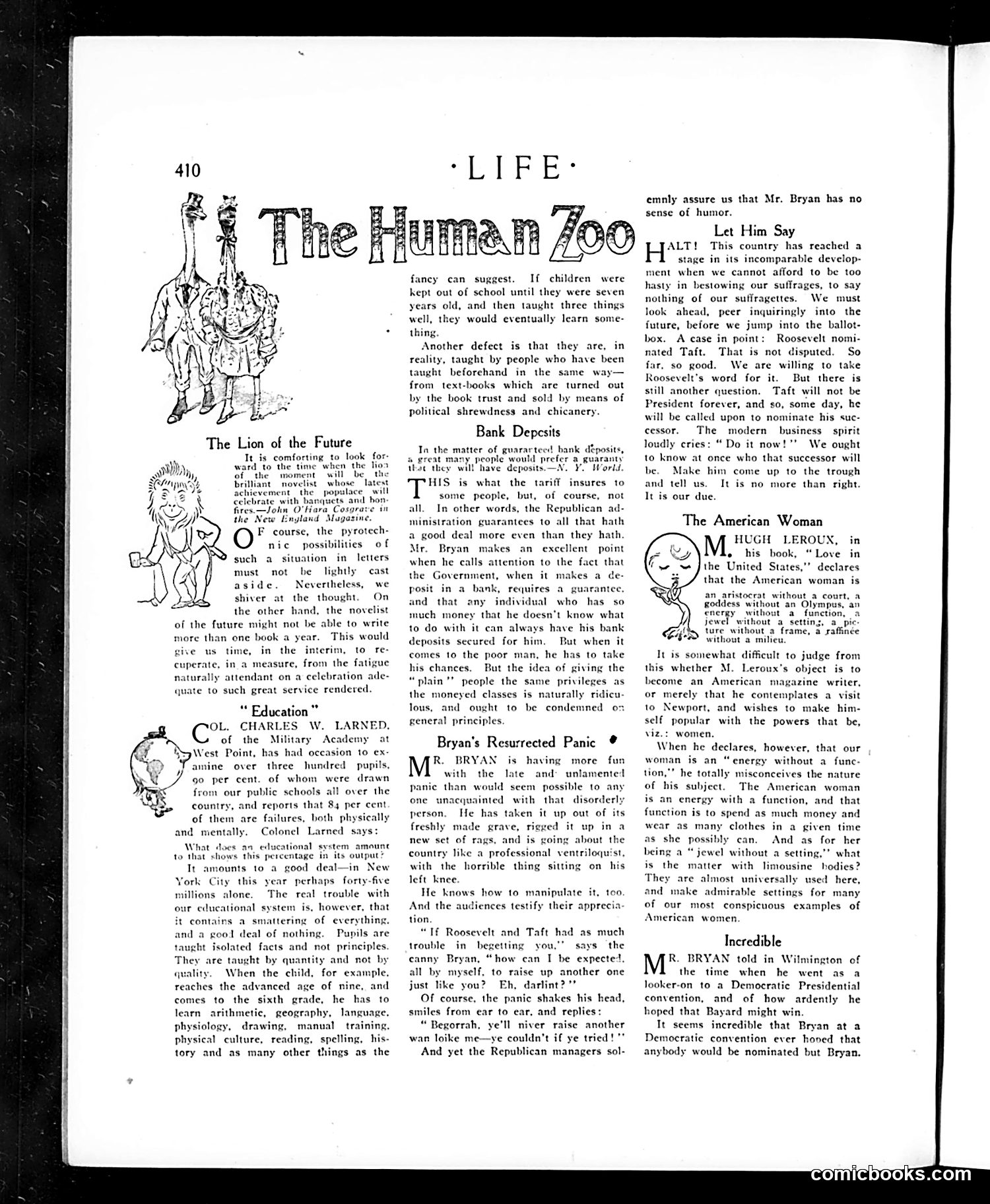
This page satirizes William Jennings Bryan's 1908 presidential campaign through multiple cartoons and articles. The main illustration depicts Bryan as a circus ringmaster parading absurd political positions like a zoo exhibit. The satire criticizes Bryan for: - Inconsistent or ridiculous policy proposals presented as novelties - Changing positions frequently ("the panic shakes his head") - Making campaign promises he cannot deliver ("raise up another one just like you") The accompanying articles mock Republican concerns about Bryan's competence, while defending Roosevelt's record. The cartoons use exaggeration and animal imagery to suggest Bryan treats serious politics as entertainment or spectacle. The satire assumes readers recognize Bryan as a three-time failed presidential candidate whose credibility was questionable.
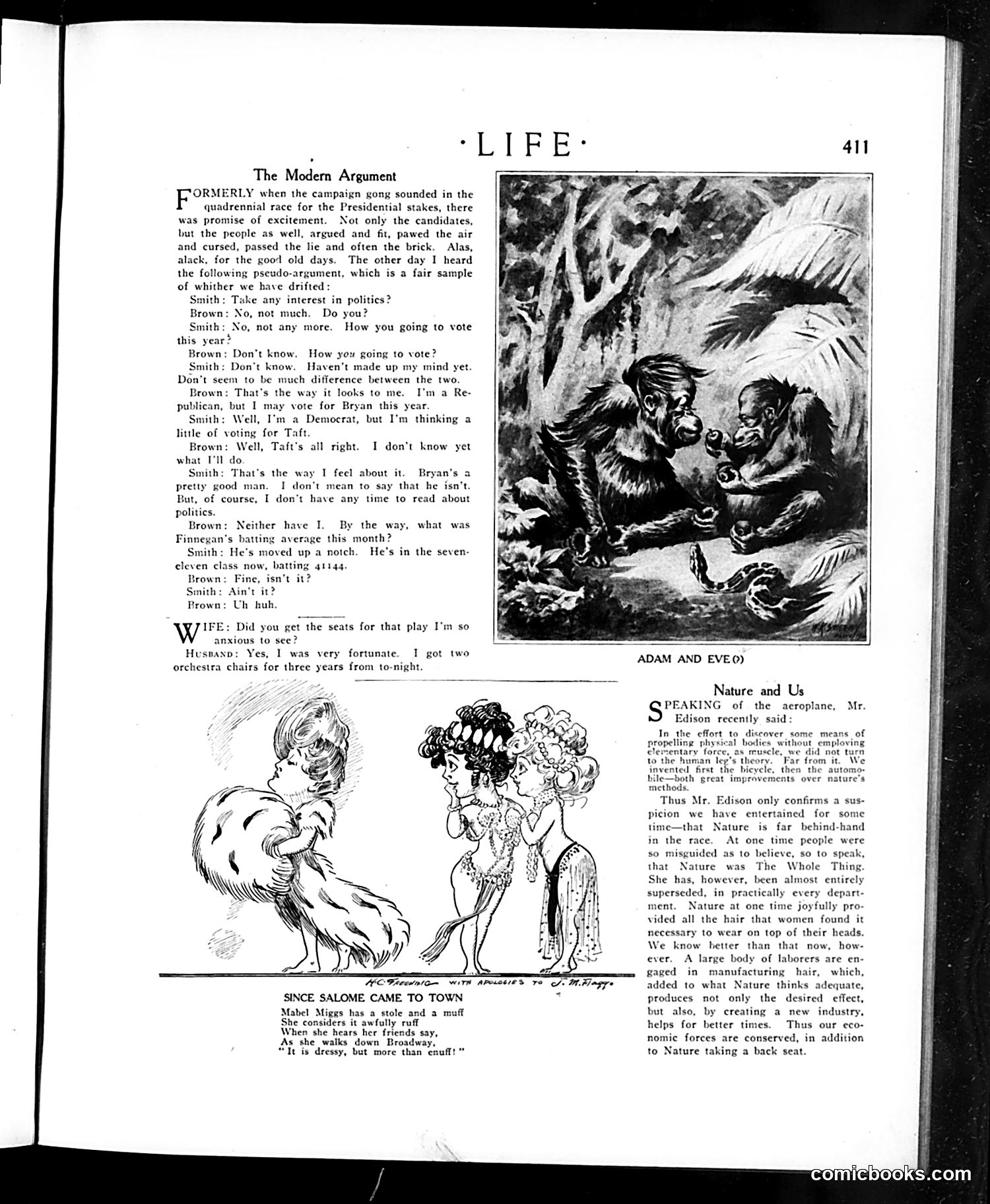
**"The Modern Argument"** satirizes voter apathy and political indifference. Two men (Smith and Brown) discuss the upcoming election, revealing neither follows politics, neither has decided how to vote, and neither knows anything about the candidates. Their exchange mocks the casual, uninformed approach many Americans took to voting, suggesting political engagement had declined from earlier "good old days." **The cartoon below** depicts a woman with exaggerated features and two male admirers, captioned "Since Salome Came to Town," referencing the biblical/theatrical Salome figure. The joke appears to mock fashionable pretension and social climbing in urban culture. **"Nature and Us"** discusses Mr. Edison's aeronautical experiments and hair manufacturing—connecting technological progress to consumer industries, suggesting modern economic forces reshape what "Nature" provides.
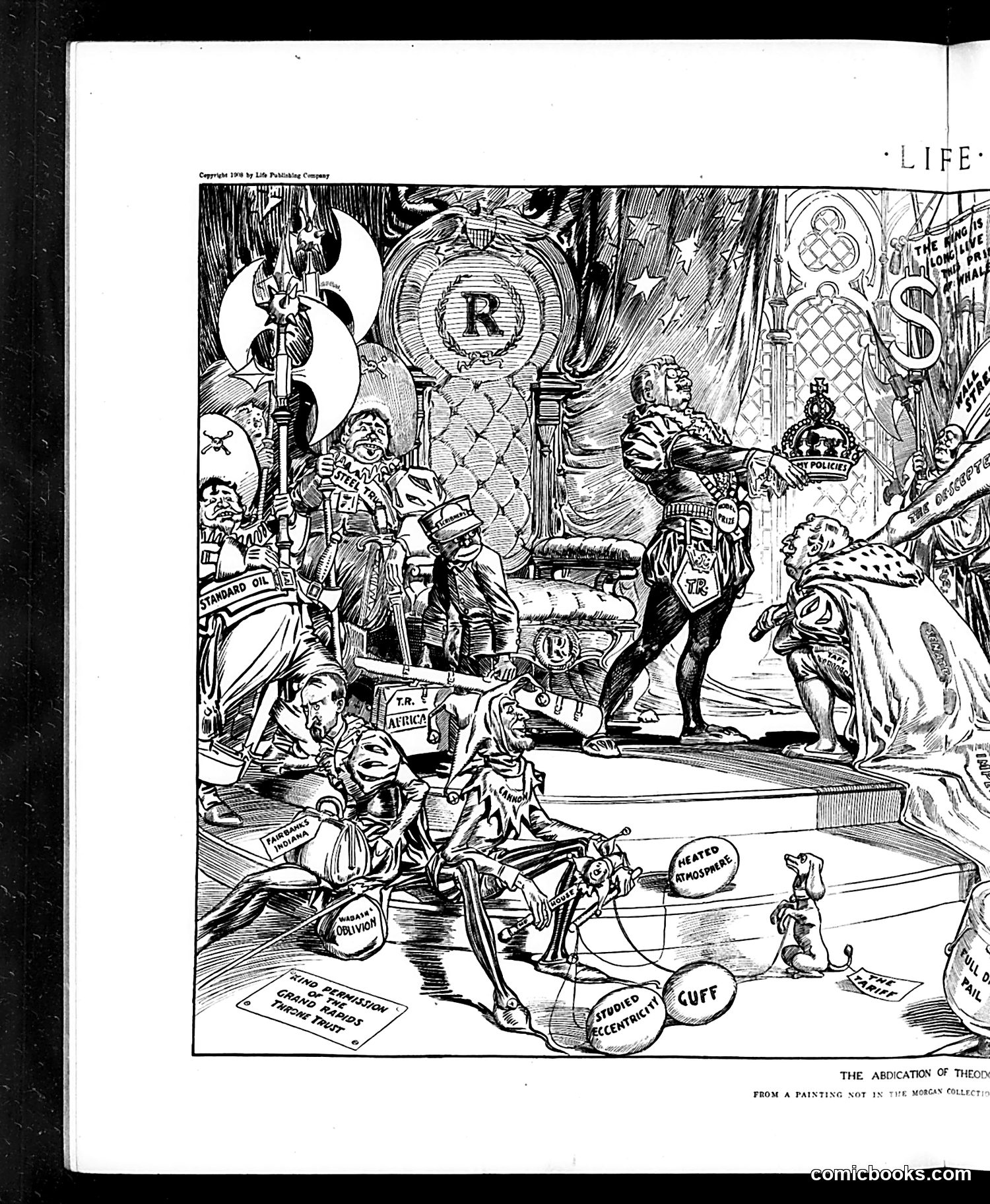
This is a satirical cartoon titled "The Abdication of Theodore" (text partially visible at bottom). It depicts what appears to be a formal court or governmental scene with multiple caricatured figures in period dress, likely referencing Theodore Roosevelt's presidency and political power dynamics of the early 1900s. The cartoon uses allegorical imagery—visible symbols include "Standard Oil," "Heated Atmosphere," "Stuffed Eccentricity," and other labeled elements suggesting critique of monopolistic corporate interests and political favoritism. The ornate throne room setting and formal pageantry appear designed to satirize the grandiosity or pretension of political authority figures. However, without clearer identification of specific individuals or precise historical context, I cannot definitively explain all caricatures or the exact political situation being mocked beyond noting this concerns Roosevelt-era power structures and corporate influence.
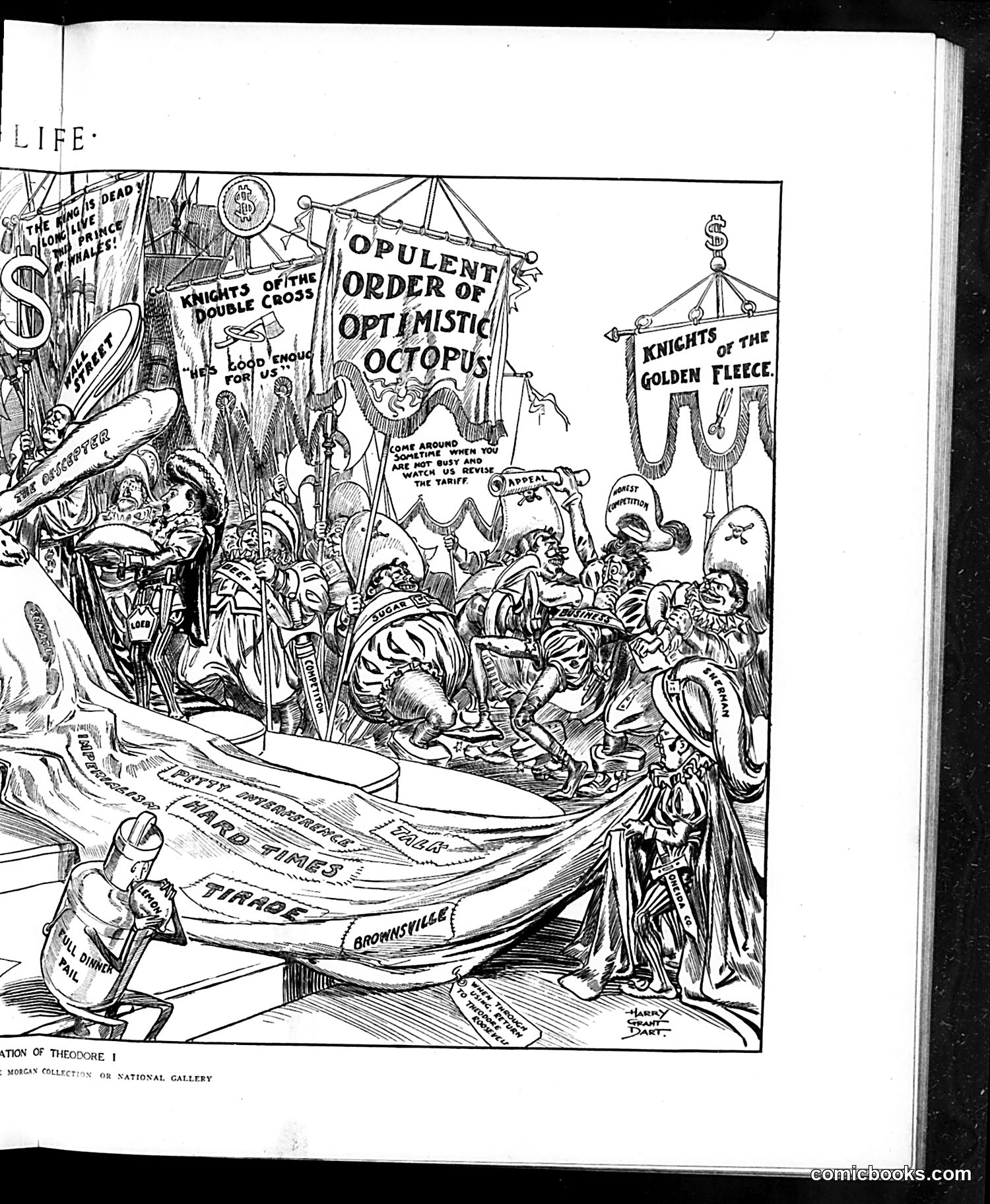
This satirical cartoon depicts various fraternal orders and clubs as absurdist organizations with grandiose titles. Visible banners include the "Popular Order of Optimistic Octopus," "Knights of the Double Cross," and "Knights of the Golden Fleece." The cartoon mocks the proliferation of fraternal societies and their elaborate hierarchies, regalia, and self-important ceremonies that were popular in early 20th-century America. The crowded, chaotic scene with costumed figures and ornate symbols suggests these organizations were more about pomp and pretension than substance. The title reference to "Theodore" likely alludes to Theodore Roosevelt, though the specific connection is unclear from visible text. The satire critiques the American fascination with exclusive clubs and their often-meaningless rituals.
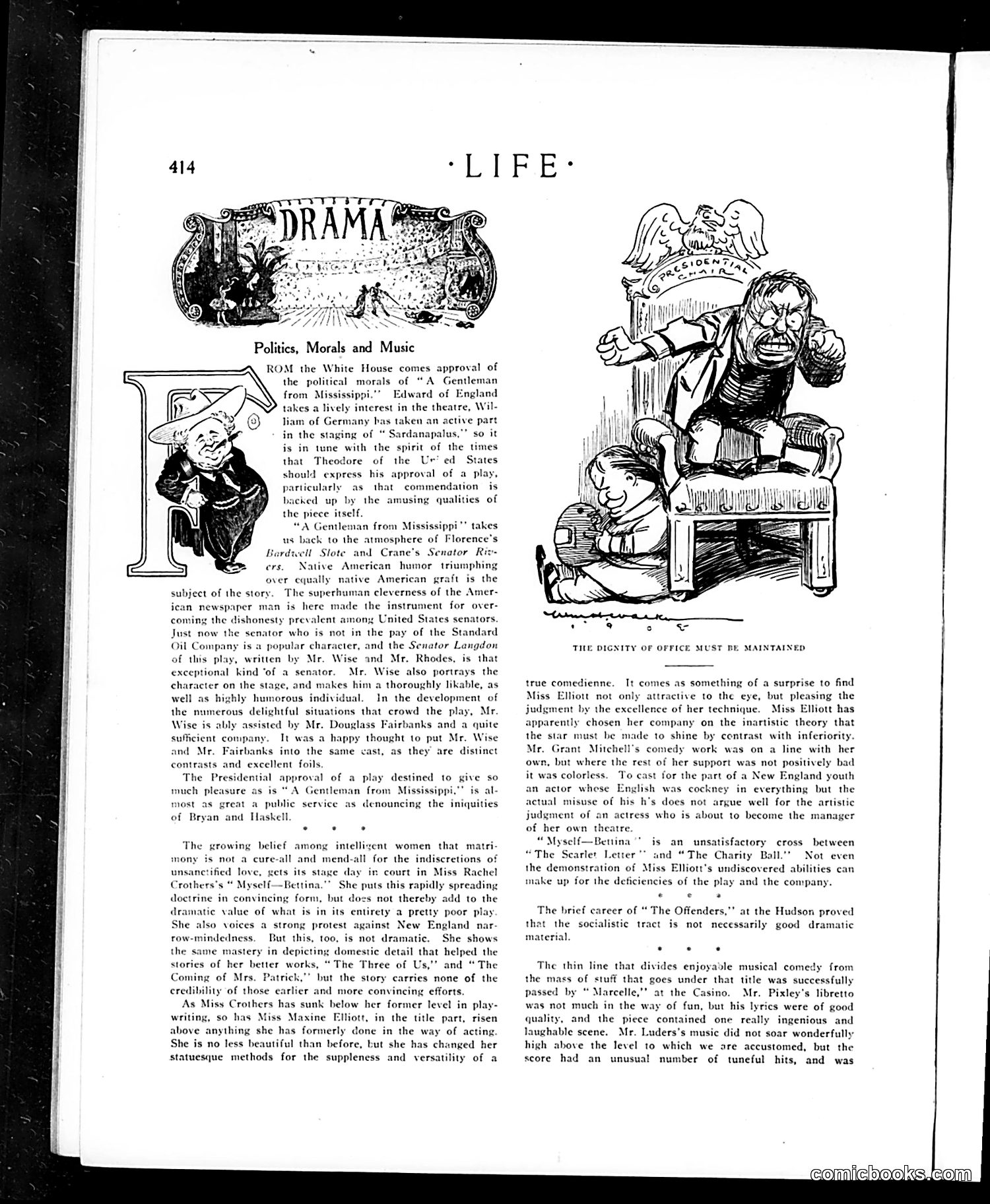
This page reviews contemporary theatrical productions with satirical commentary on their political and moral dimensions. **The Main Cartoon** ("The Dignity of Office Must Be Maintained") depicts a grotesque politician being physically manipulated by shadowy figures, satirizing corruption and loss of autonomy in government. **Key References:** - "A Gentleman from Mississippi" — a play about exposing senatorial corruption, endorsed by President Theodore Roosevelt - The text sarcastically praises Roosevelt's approval, comparing it to European monarchs' theater patronage - The play satirizes dishonest U.S. senators, particularly those corrupted by Standard Oil interests - References to "Bryan and Haskell" appear to target political figures associated with corruption **The Satire's Point:** Life mocks how politicians use theatrical endorsements for respectability while American senators remain notoriously corrupt. The cartoon visualizes this: government officials lose dignity through manipulation by unseen powerful interests—a commentary on corporate influence over American politics in the early 20th century.
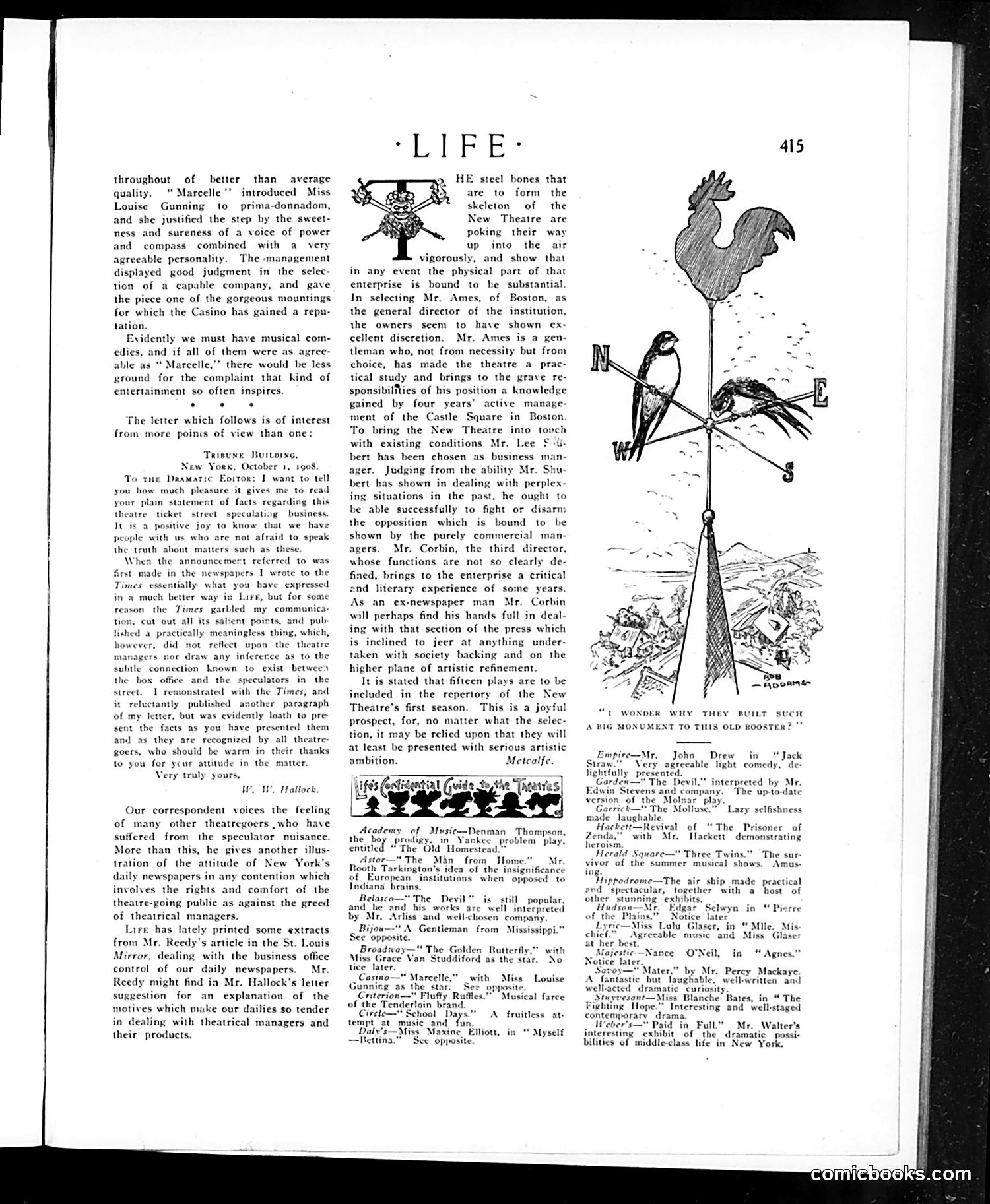
This page contains **theatre criticism and letters** rather than political cartoons. The main content discusses New York's emerging "New Theatre" (a major arts institution under construction). The **cartoon** (top right) is a simple, humorous illustration showing a rooster with the caption "I WONDER WHY THEY BUILT SUCH A BIG MONUMENT TO THIS OLD ROOSTER?" This appears to be a joke about the theatre's ambitious scale—calling it a "monument" to something trivial, likely mocking either the theatre's grandiosity or the theatrical establishment itself. The letters address **ticket scalping**—a persistent public complaint about speculators buying theatre tickets and reselling them at inflated prices. One correspondent praises *Life* magazine for exposing this practice, while criticizing New York newspapers for protecting theatrical managers' financial interests rather than defending theatre-goers' rights. The page reflects early 1900s concerns about **commercialism in theatre** and **media bias** favoring business interests over public welfare.
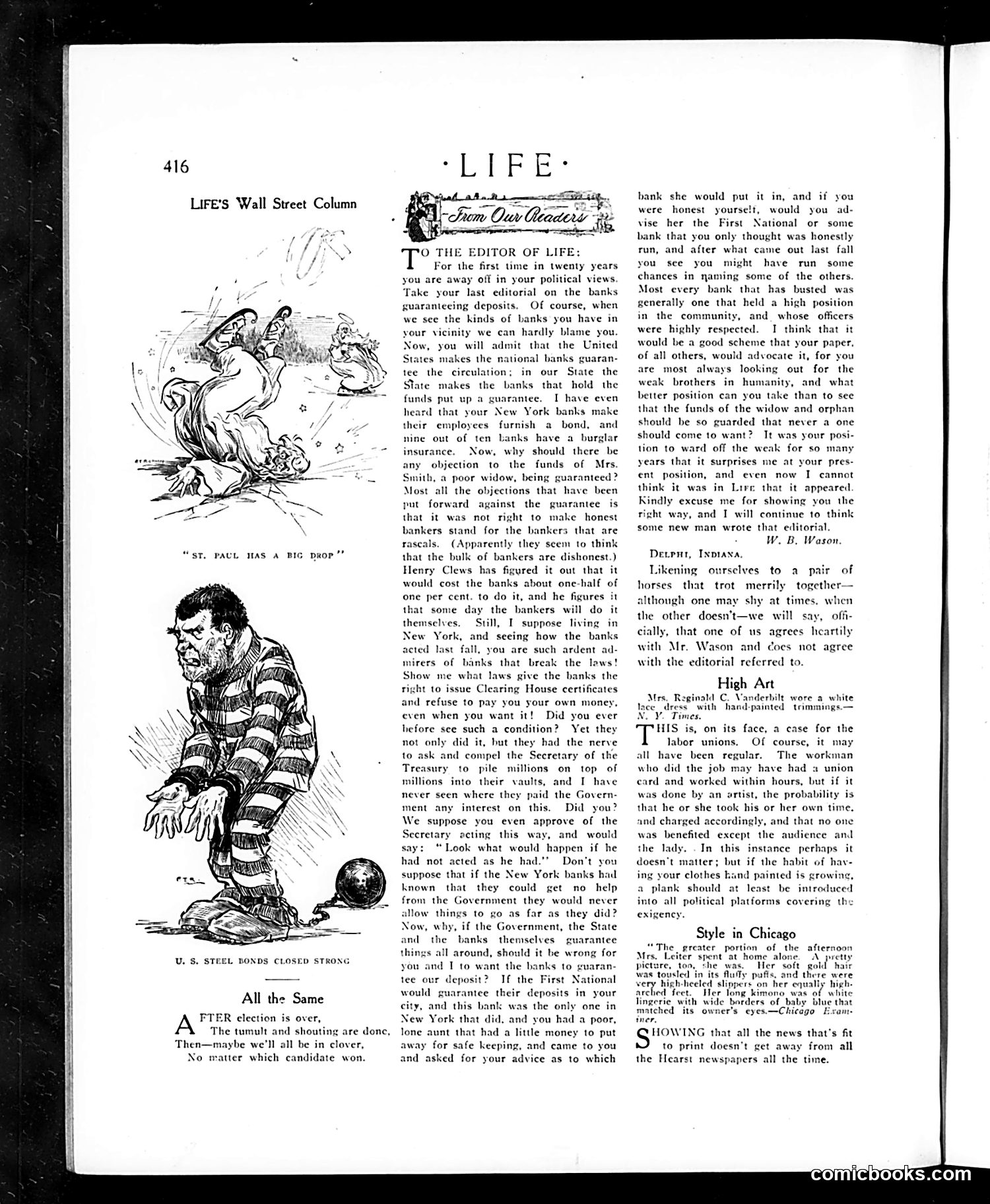
This page contains **editorial cartoons and reader letters about bank regulation**, likely from the post-1907 financial panic era when deposit insurance was debated. The cartoons mock Wall Street and banking practices: - **"St. Paul Has a Big Drop"** depicts a caricatured figure (possibly representing a specific banker or financier) in distress, satirizing stock market volatility or bank failures. - **"U.S. Steel Bonds Closed Strong"** references the steel industry's financial stability, contrasting it with weaker institutions. The reader's letter argues *for* bank deposit guarantees, criticizing Life magazine's editorial opposition. The writer points out that if the government guarantees bank circulation and New York banks require employee bonds, why shouldn't ordinary depositors' funds be protected? He references Henry Clews (a real financial analyst) and the recent banking crisis ("last fall"), arguing that without government safety nets, banks wouldn't have taken excessive risks. The poem "All the Same" cynically suggests post-election politics will disappoint regardless of which candidate wins.
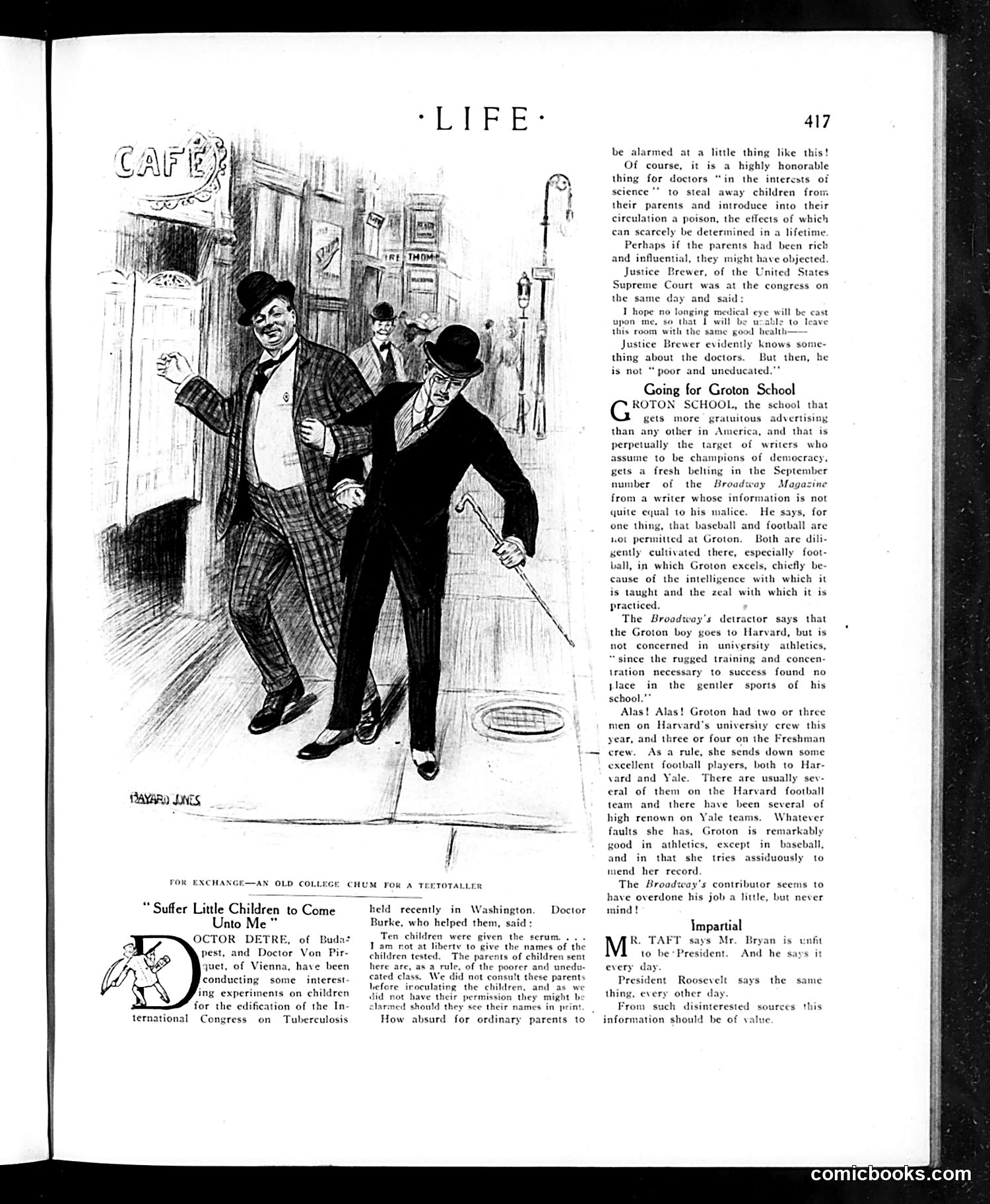
## Main Cartoon: "An Old College Chum for a Teetotaller" The cartoon depicts two well-dressed men evicting a third from a café, satirizing medical ethics violations. The accompanying text references Doctors Detre and Von Pirquet, who conducted tuberculosis serum experiments on poor children in Washington without parental consent. The doctors justified this by noting the subjects were "poorer and uneducated class" whose parents need not be consulted. The satire highlights the hypocrisy: these same doctors would likely object if experiments were performed on *them* or wealthy citizens. Justice Brewer's quote reinforces this—even he recognizes doctors' dangerous attitudes. ## Secondary Article: Groton School Criticism Life defends the exclusive preparatory school Groton against detractors claiming it discourages athletics. The magazine fact-checks a *Broadway Magazine* article alleging Groton prohibits baseball and football, proving instead that Groton students excel at these sports and attend elite universities (Harvard, Yale). **Overall point**: Both pieces mock hypocrisy—medical professionals exploiting the powerless, and writers spreading false claims about institutions.
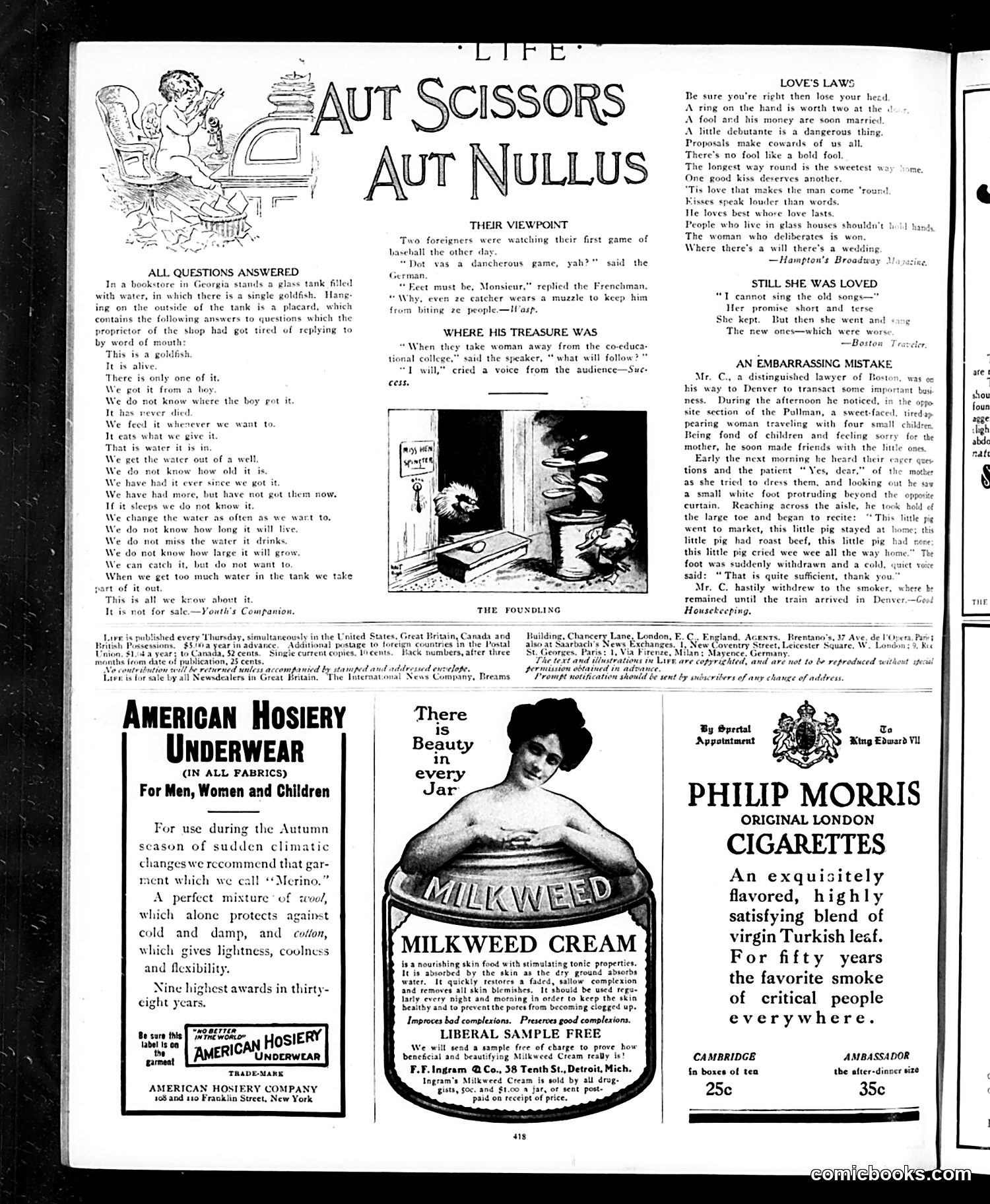
This page presents two separate humor pieces typical of early 20th-century *Life* magazine. **"Aunt Scissors, Aunt Nullus"** satirizes the advice-column format popular in newspapers. Two foreign observers (a German and Frenchman) watch baseball for the first time, misunderstanding its purpose and danger—the joke being their bewildered foreigners' perspective on an American pastime. A separate anecdote mocks what happens when a women's college removes female students: a male voice shouts he'll fill the void, suggesting men's superficiality. The page is primarily **advertising**, featuring products like American Hosiery, Milkweed Cream (a skin treatment), and Philip Morris cigarettes—typical commercial content subsidizing the magazine's humor sections. The sidebar humor pieces ("Love's Laws," "Still She Was Loved," "An Embarrassing Mistake") are brief, sentimental or romantic jokes reflecting period attitudes about courtship and propriety. The overall tone is genteel, family-friendly satire aimed at middle-class American readers.
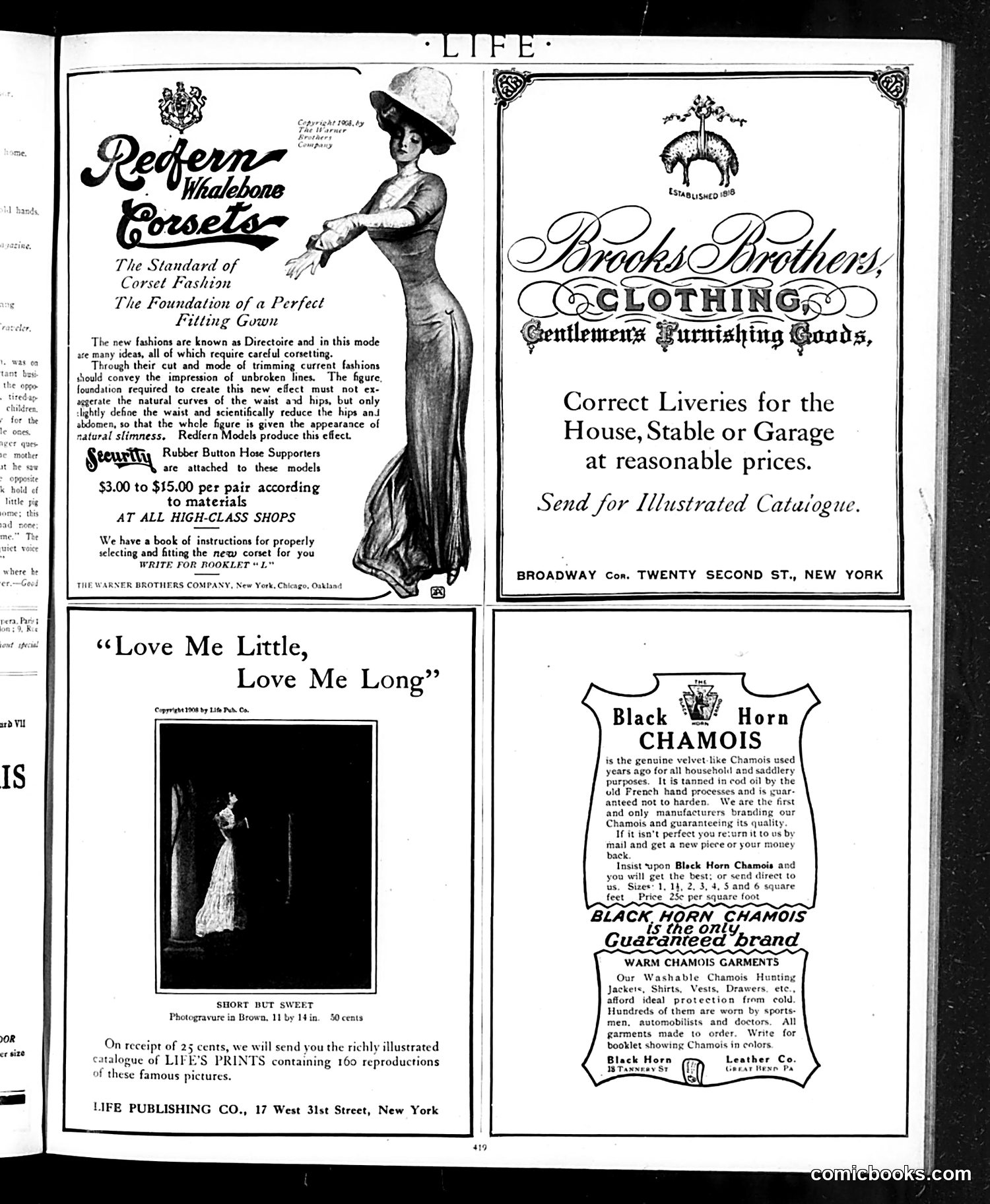
This is primarily an **advertising page**, not a satirical cartoon. It contains four commercial advertisements typical of early 1900s Life magazine: 1. **Redfern Whalebone Corsets** — promoting the "Directoire" fashion style, emphasizing corsets that create a slimmer silhouette with reduced hips and abdomen while maintaining natural lines. 2. **Brooks Brothers** — advertising gentlemen's clothing and livery services for households, stables, and garages. 3. **"Love Me Little, Love Me Long"** — a Life Publishing promotion selling photographic prints and illustrated catalogs of famous pictures. 4. **Black Horn Chamois** — marketing chamois leather garments and fabric, emphasizing quality and durability for sportsmen and motorists. The only potentially satirical element is the small illustration accompanying the Redfern ad showing a woman in fashionable dress, but it functions primarily as product promotion rather than social commentary.
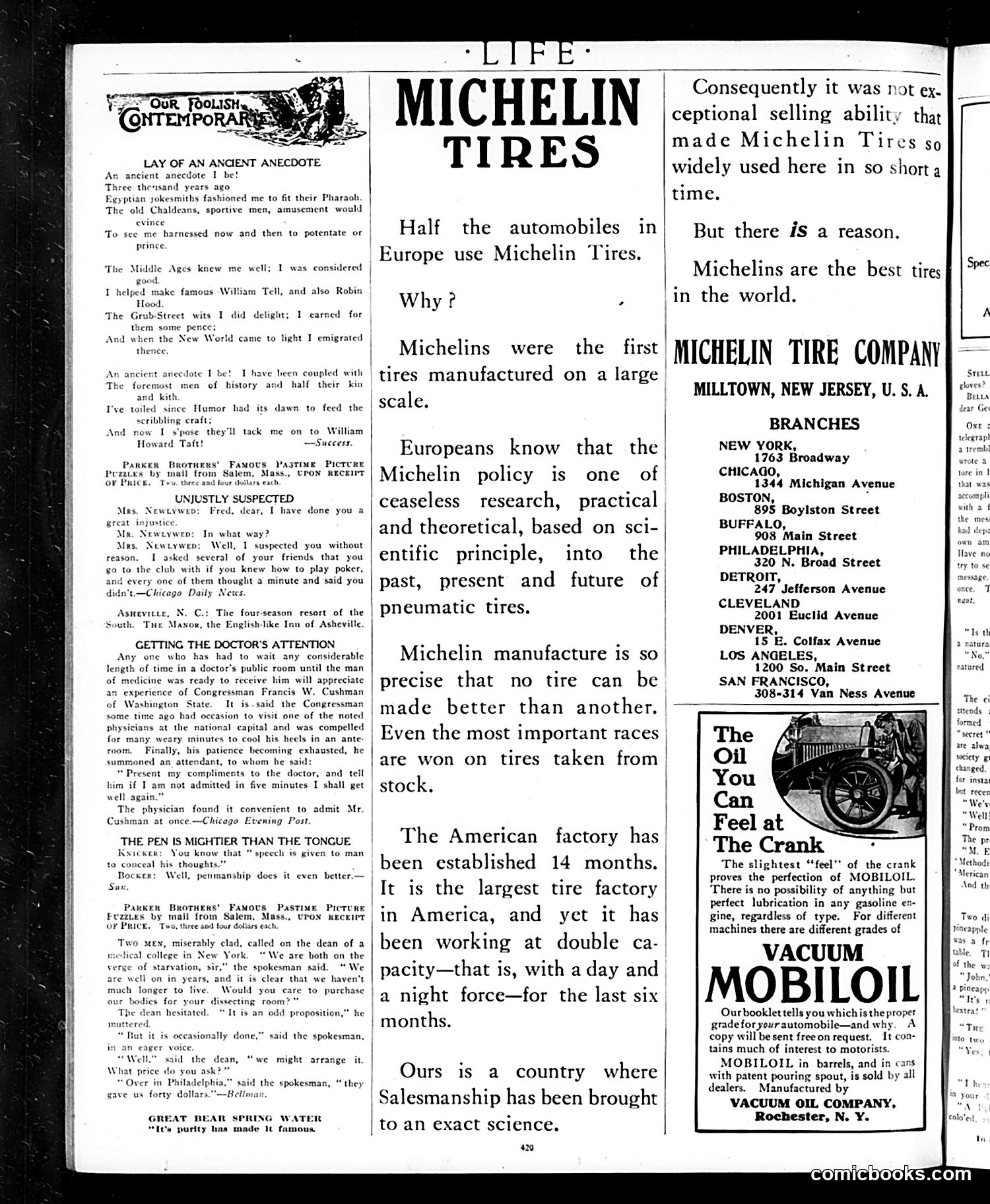
This page is **primarily advertising**, not satire or political cartooning. The left side contains several humor anecdotes (unrelated to Michelin), including a quip about suspecting a congressman couldn't play poker, and a doctor's waiting-room joke. These are standard filler content for the era. **The main content** is a large Michelin Tires advertisement claiming superiority through established manufacturing excellence. The ad argues that Michelin's dominance in Europe (half of European automobiles use them) stems from being "the first tires manufactured on a large scale" and maintaining rigorous scientific standards. The pitch emphasizes that in America specifically—a country where "salesmanship has been brought to an exact science"—Michelin's rapid adoption wasn't exceptional sales technique but rather proof of genuine product quality. The company had opened a New Jersey factory just 14 months prior and was running it at double capacity. **No satirical message is present**—this is straightforward corporate marketing attempting to justify premium pricing through heritage and precision manufacturing claims.
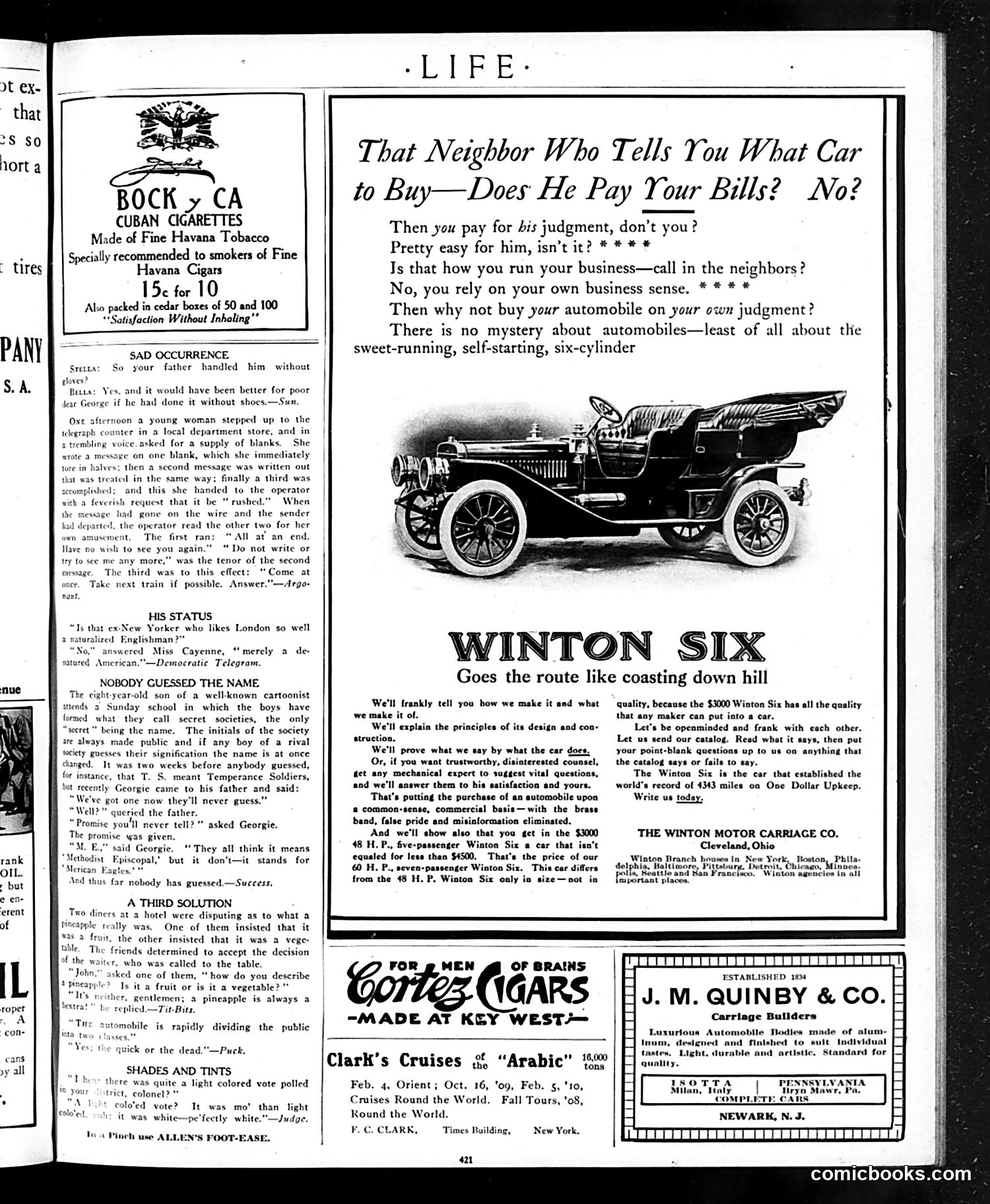
This advertisement-as-satire critiques unsolicited advice in consumer decision-making. The rhetorical argument: if you wouldn't let a neighbor run your business, why accept his automobile recommendation without independent judgment? The piece targets a common early 1900s social dynamic—neighbors offering free opinions on major purchases—and positions the Winton Six as the "smart man's" choice: one based on personal research rather than gossip. The ad emphasizes the car's transparent engineering ("We'll frankly tell you...principles") and invites expert scrutiny. The satire's point: true independence means consulting facts and experts, not neighbors. Ironically, the ad itself *is* persuasion, but frames it as empowering the reader's own judgment. The $3,000 price point and reference to competing $4,500 cars adds credibility through specific comparison—appealing to the rational businessman reader Life magazine targeted.
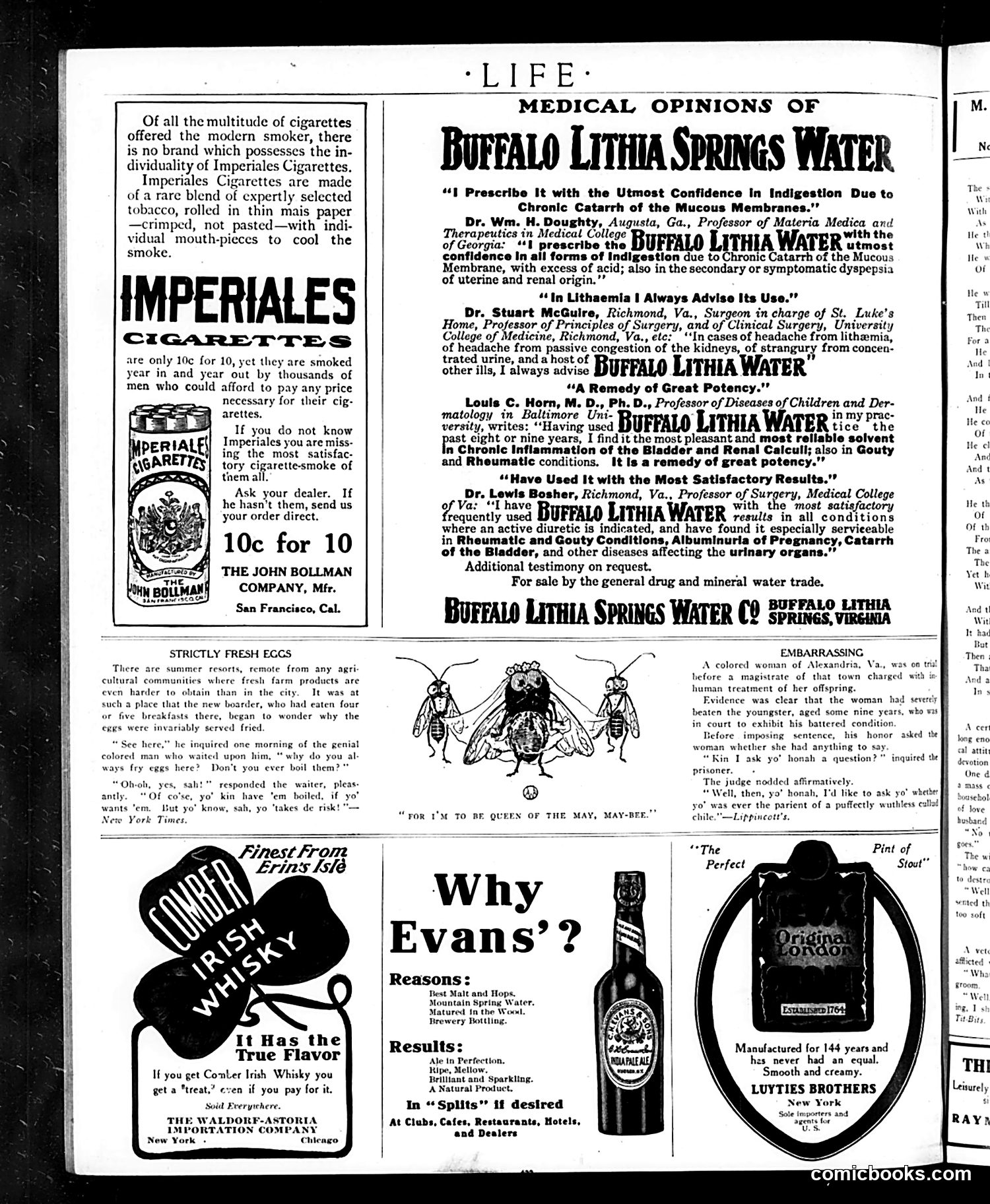
This page is primarily **advertising and filler content**, not political satire. The main elements are: **Medical Testimonials (center):** Fake endorsements for "Buffalo Lithia Springs Water," a patent medicine. Doctors claim it cures indigestion, gout, kidney problems, and various ailments. This reflects the early 1900s era when unregulated medicines made extravagant health claims without evidence. **Cigarette Ad (left):** Imperiales Cigarettes marketed as superior quality, sold individually at 10¢ for 10—typical early advertising. **Humor Sections:** - "Strictly Fresh Eggs" joke about restaurant quality - "For I'm to be Queen of the May" cockroach cartoon - "Embarrassing" anecdote about a Black woman in court—using dialect humor common to the era, presenting her as cleverly deflecting criticism **Bottom Ads:** Irish Whiskey and London Stout beer advertisements. The page reflects period attitudes: patent medicine promotion, racial caricature humor, and casual alcohol/tobacco marketing to general audiences—all pre-regulation.
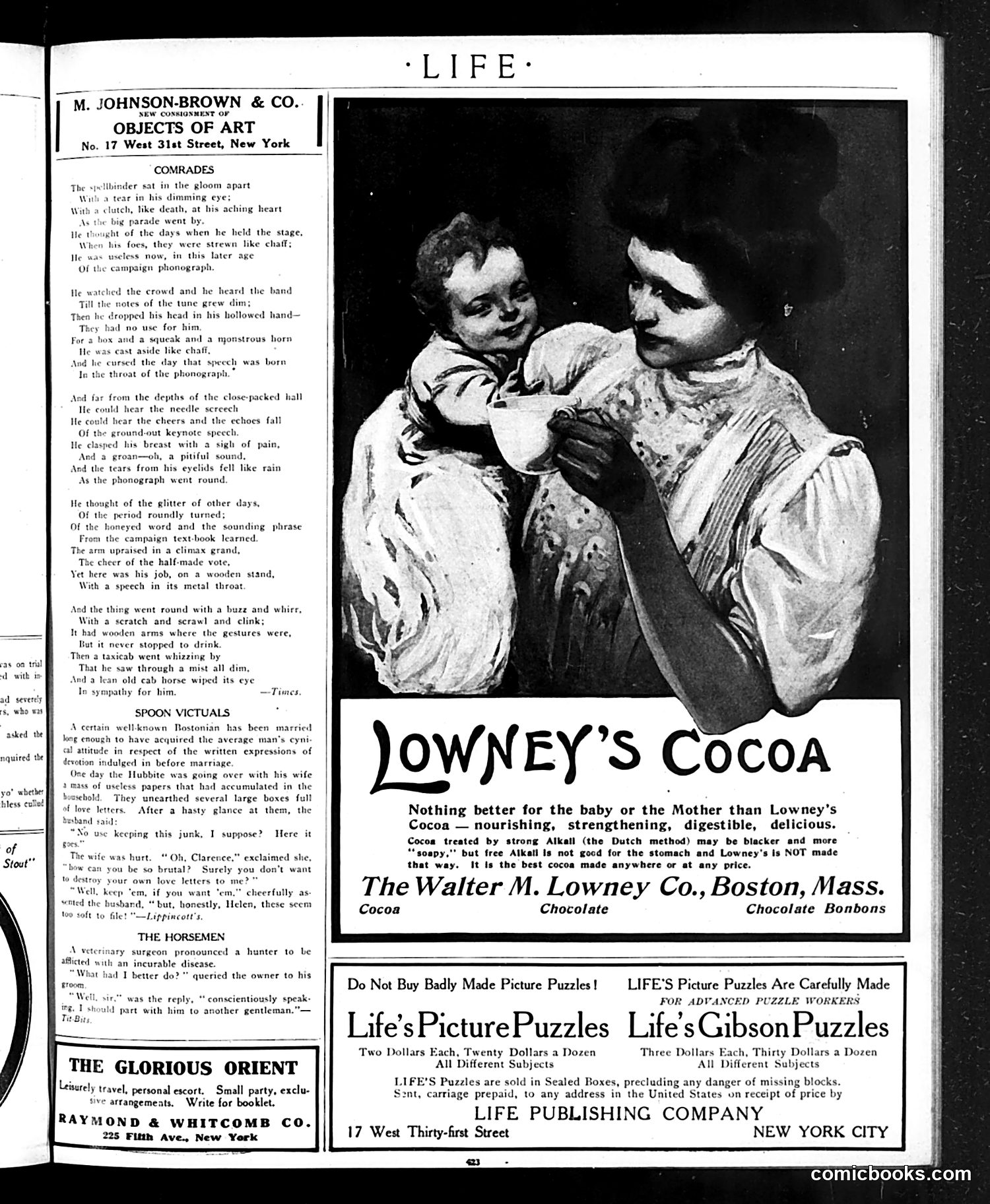
This page is primarily **advertising with one substantial political cartoon**. The main cartoon "Comrades" satirizes the decline of the **political stump speaker** in the early 20th century. The poem depicts an aging orator—a "spellbinder"—who once commanded crowds from the stage. Now obsolete, he watches his replacement: a **phonograph playing recorded campaign speeches**. The cartoon shows this sad figure alongside the mechanical device that has rendered him useless. The satire critiques both technological displacement and the mechanical, inauthentic nature of modern campaigning. Where politicians once performed live with genuine oratory skill ("arm upraised in a climax grand"), campaigns now rely on mass-produced recordings with "wooden arms" and "a speech in its metal throat." This reflects genuine Progressive Era anxieties about technology replacing human labor and authenticity being lost to mechanical reproduction—here applied to political discourse itself, which the cartoonist suggests has become as hollow and repetitive as a phonograph's scratched recording.
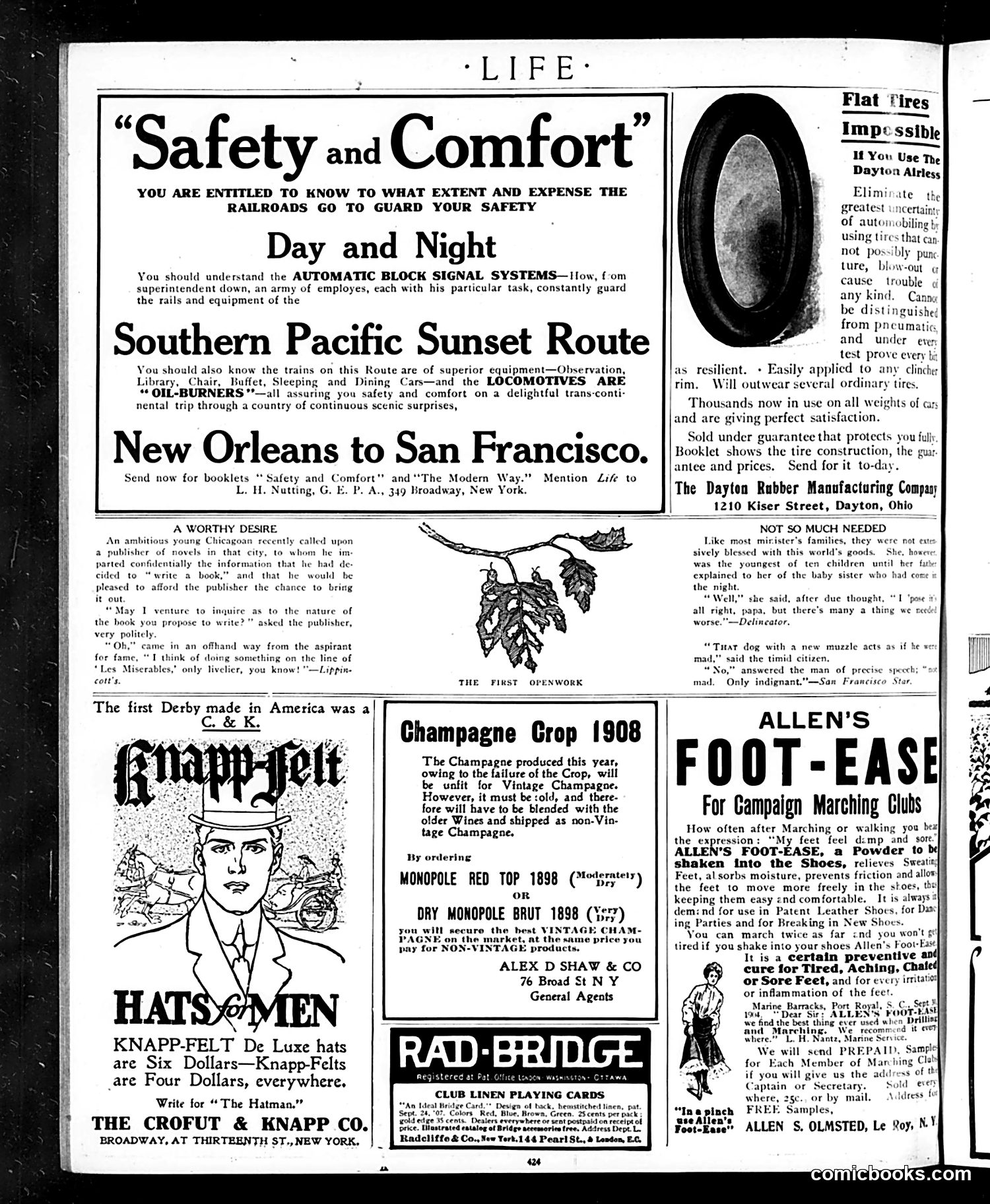
This is primarily an **advertising page** with minimal editorial content, typical of early 1900s magazines. **Notable Elements:** The main satirical content is "A Worthy Desire"—a brief anecdote mocking an aspiring novelist's literary ambitions. A young Chicago writer approaches a publisher claiming he wants to write a book "on the line of 'Les Miserables,' only livelier"—the joke being his presumptuous claim to improve upon Victor Hugo's masterpiece. **Advertisements include:** - Southern Pacific Railroad promoting safety and comfort on its Sunset Route - Dayton Airless tires (claiming puncture-proof reliability) - Knapp-Felt hats - Allen's Foot-Ease powder for marching club members - Monopole champagne (1898 vintage) - Rad-Bridge playing cards The humor throughout reflects early 1900s consumer culture and modest satirical jabs at pretension and product claims rather than political commentary.
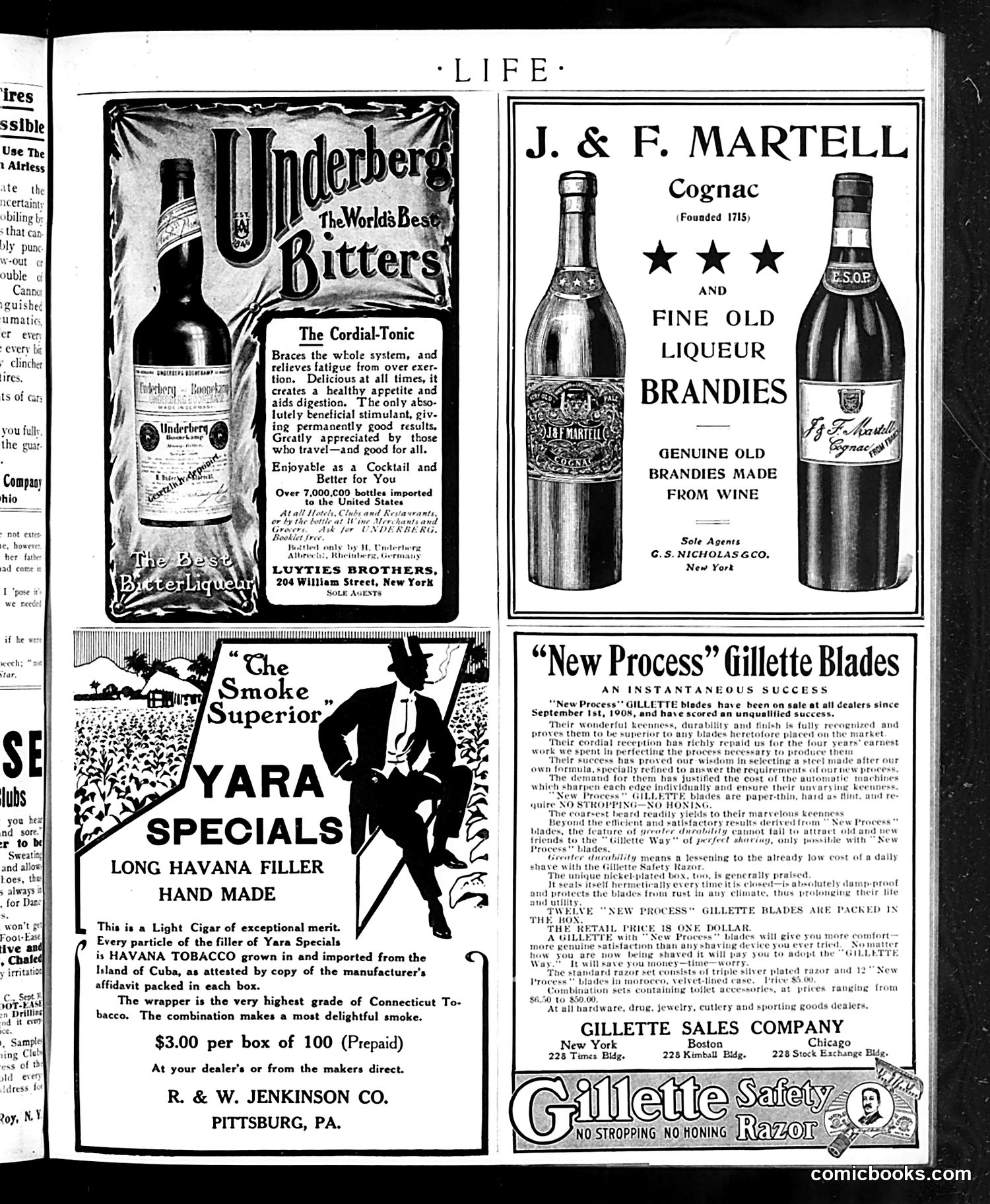
This is primarily an **advertising page** from Life magazine, not a satirical cartoon. It contains four distinct product advertisements typical of early 1900s marketing: 1. **Underberg Bitters** — marketed as a "cordial-tonic" for digestive health and fatigue relief, emphasizing its popularity among travelers 2. **J. & F. Martell Cognac** — premium French brandy (founded 1715) sold through New York agents 3. **Yara Specials cigars** — hand-made long Havana fillers with Connecticut wrapper, priced at $3 per box of 100 4. **Gillette Safety Razor blades** — the "New Process" model advertised as newly successful (September 1908 launch), emphasizing durability and the convenience of daily shaving at one dollar The page reflects early-20th-century consumer culture and product positioning through appeals to quality, health benefits, and modern convenience. No political satire or caricature is present—this is straightforward commercial advertising.
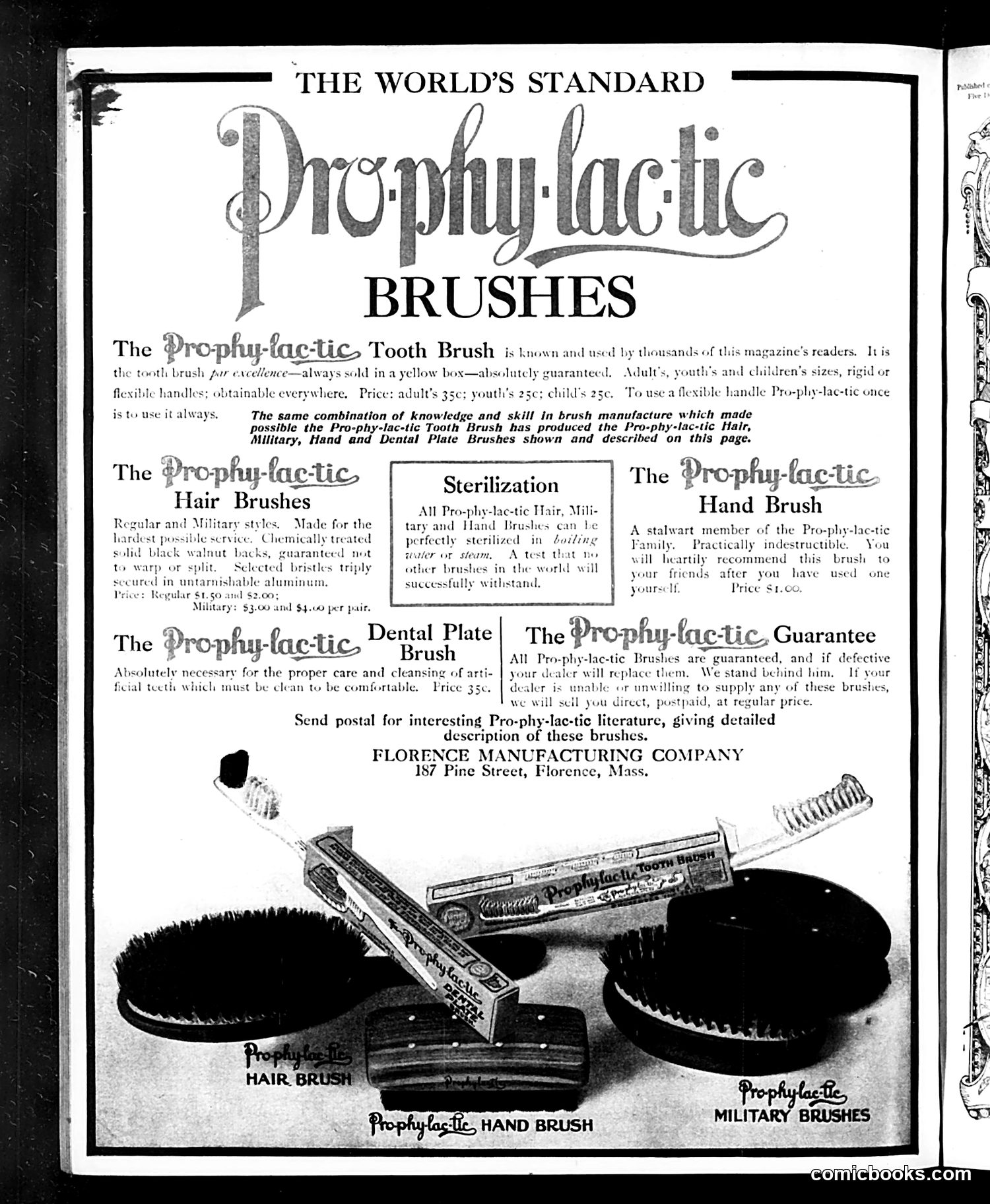
This is a **product advertisement**, not a political cartoon. The page promotes Prophy-lactic brushes—toothbrushes, hairbrushes, dental plate brushes, military brushes, and hand brushes—manufactured by the Florence Manufacturing Company in Massachusetts. The advertisement targets *Life* magazine's readers with claims of quality and reliability. Notably, it emphasizes that hair and military brushes can be "perfectly sterilized in boiling water or steam," suggesting early 20th-century concerns about hygiene and sanitation (possibly wartime-related, given military brush mentions). The pricing structure—offering different sizes and grades, including "military" versions at higher prices—indicates market segmentation. The guarantee promise ("All Pro-phy-lac-tic Brushes are guaranteed") was a significant selling point for the era. No political satire or social commentary is present; this is straightforward commercial messaging typical of *Life*'s advertising content during its early decades.