
Life, 1908-10-15 · page 17 of 28
Life — October 15, 1908 — page 17: what you’re looking at
What you’re looking at
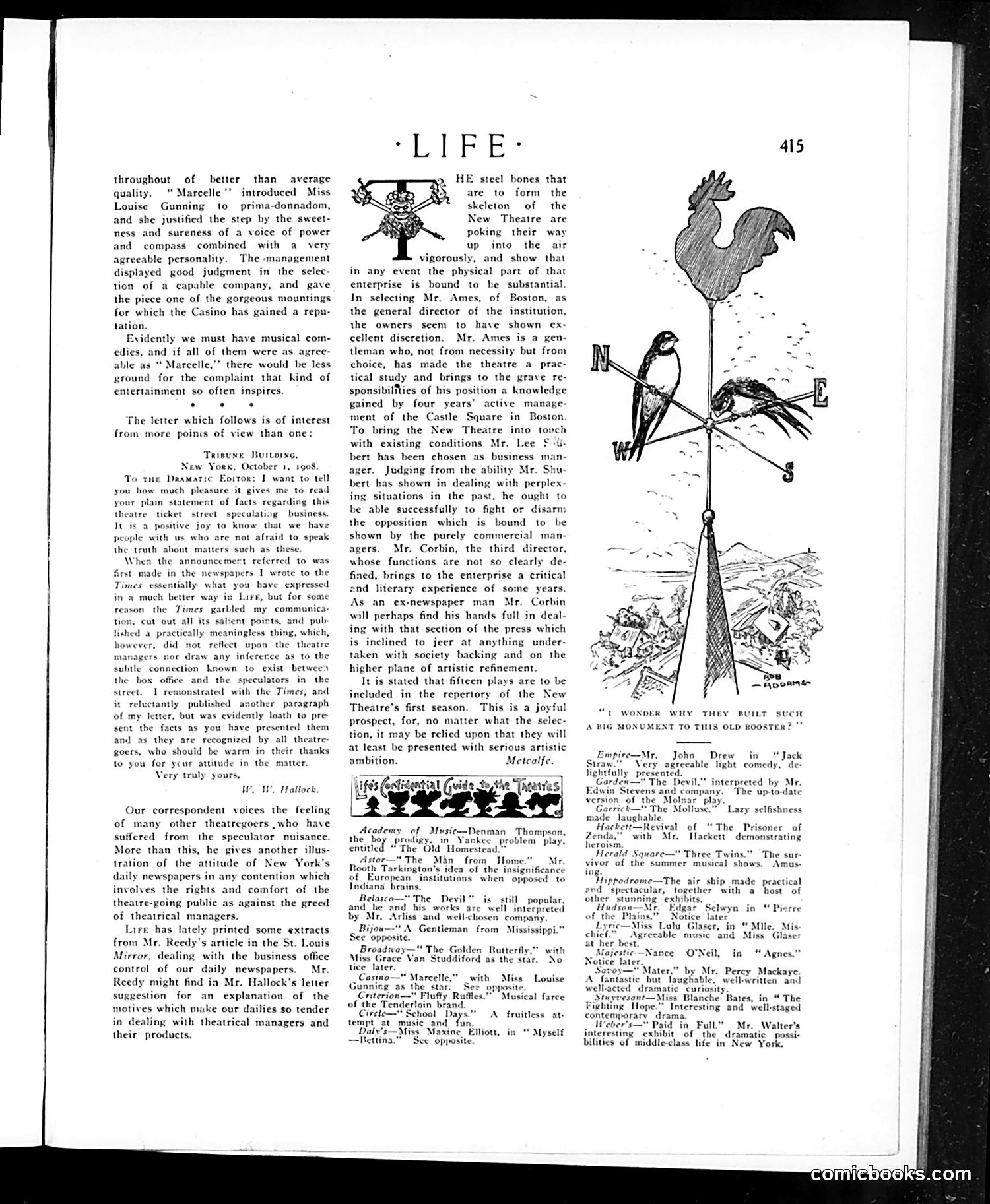
This page contains **theatre criticism and letters** rather than political cartoons. The main content discusses New York's emerging "New Theatre" (a major arts institution under construction). The **cartoon** (top right) is a simple, humorous illustration showing a rooster with the caption "I WONDER WHY THEY BUILT SUCH A BIG MONUMENT TO THIS OLD ROOSTER?" This appears to be a joke about the theatre's ambitious scale—calling it a "monument" to something trivial, likely mocking either the theatre's grandiosity or the theatrical establishment itself. The letters address **ticket scalping**—a persistent public complaint about speculators buying theatre tickets and reselling them at inflated prices. One correspondent praises *Life* magazine for exposing this practice, while criticizing New York newspapers for protecting theatrical managers' financial interests rather than defending theatre-goers' rights. The page reflects early 1900s concerns about **commercialism in theatre** and **media bias** favoring business interests over public welfare.
📄 Transcribed text from this page (OCR, searchable)
Machine-transcribed from the original scan — historical spelling and the odd misread are preserved.
than average introduced Miss throughout of better quality.“ Marcelle” Louise Gunning to prima-donnadom, and she justified the step by the sweet- ness and sureness of a voice of power combined with a very agreeable personality. The ‘management displayed good judgment in the selec- tion of a capable company, and gave the piece one of the gorgeous mountings for which the Casino has gained a repu- tation. Evidently we must have musical com- and if all of them were as agree- able as “ Marcelle,’ there would be less ground for the complaint that kind of entertainment so often inspires. and compass edie: The letter which follows is of interest from more points of view than one: Trimune Muitoixe, New York, October 1, 1908. To tHe Epitor: I want to tell you how much pleasure it gives me to read of facts regarding this speculating y to know that we Dramatic your plain statemer theatre ticket Ii is a positiv le with us who are not afraid to speak business. have street pee the truth about matters such as these When the announcemert referred to was first made in the newspapers I wrote to the Times essentially what you have expressed in a much better way in Lire, but for some reason the Times garbled my communica- tion, cut out all its salient points, and pub lished a practically meaningless thing, which, not theatre managers nor draw any infererce as to the known to exist betweea J the speculators in the street, I remonstrated with the Times, and it reluctantly published another paragraph of my letter, but was evidently loath to pre sent the facts as you have presented them and as they are recognized by all theatre: gocrs, who should be warm in their thanks to you for ycur attitude in the matter, Very truly yours, W. WW. Haltock however, did reflect upon the subtle the box offi Our correspondent voices the feeling of many other theatregoers who have suffered from the speculator nuisance. More than this, he gives another illus- tration of the attitude of New York's daily newspapers in any contention which involves the rights and comfort of the theatre-going public as against the greed of theatrical manager: Lire has lately printed some extracts from Mr. Reedy’s article in the St. Louis Mirror. dealing with the business office control of our daily newspapers. Mr. Reedy might find in Mr. Hallock’s letter suggestion for an explanation of the motives which make our dailies so tender in dealing with theatrical managers and their products. ‘LIFE HE steel bones that are to form the skeleton of the New Theatre are poking their w up into the air vigorously, and show that in any event the physical part of that enterprise is bound to be substantial. In selecting Mr. Ames, of Boston, as the general director of the institution, the owners seem to have shown ex- cellent discretion. Mr. Ames is a gen- tleman who, not from necessity but from choice, has made the theatre a prac- tical study and brings to the grave re- sponsibilfties of his position a knowledge gained by four years’ active manage- ment of the Castle Square in Boston To bring the New Theatre into tovch with existing conditions Mr. Lee £ :li- bert has been chosen as business man- ager. Judging from the ability Mr. Sk bert has shown in dealing with perplex- ing situations in the past, he ought to be able successfully to fight or disarm the opposition which is bound to be shown by the purely commercial man- agers. Mr. Corbin, the third director, whose functions are not so clearly de- fined, brings to the enterprise a critical and literary experience of some years. As an ex-newspaper man Mr. Corbin will perhaps find his hands full in deal- ing with that section of the press which is inclined to jeer at anything under- taken with society backing and on the higher plane of artistic refinement. It is stated that fifteen plays are to be included in the repertory of the New Theatre's first season. This is a joyful prospect, for, no matter what the selec- tion, it may be relied upon that they will at least be presented with serious artistic Metcalf. “Treatves Academy of Musie—Denman Thompson, the boy prodigy. in Yankee problem play, entitled “The Old Homestead. Astor—“The Man from Home." Mr Tooth Tarkington's idea of the insignificance of European institutions when opposed to Indiana brains. Belasco—* The Devil is still popular, and be and his works are well interpreted by Mr. Arliss and well-chosen company ““\\ Gentleman from Mississippi.” osite. Broadway—" The Golden Butterfly,” with Miss Grace Van Studdiford as the star. No tice later. Casino—"* Marcelle, Gunning as the star. See Criterion—" Flufty Ruffles. of the Tenderloin brand. Circle" School Days.” tempt at music and_ fun. Daly's—Miss. Maxine Elliott, in —Hettina.” See opposite. with Miss Pposite. Musical farce Louise A fruitless at- Myself 415 1 WONDER WHY THEY MONUMENT TO THIS OLD ROOSTER?" BUILT suc _Empire=Mr. John Drew in “Jack Straw.” Very agreeable light comedy, de- fully presented. Garden dwin $ interpreted by Mr. ny. The up-to-date Molnar pl Garrick—" The Mollusc laughable. ckett—Revival of |“ The Zenda,” with Mr. Hackett heroism Herald Square—* Three Twins.” yivor of the summer musical shows. ing. Hippodrome—The air ship made practical nd spectacular, together with a host of “Lazy selfishness Prisoner of demonstrating ‘The sur- Amus- other stun Hudson—Me. elwyn in “ Pierre of the Plains.” Notice later Lyric—Miss Lulu Glaser, in“ Mile. Mis chief.” Agreeable music and Miss Glaser at her best _Majestic—Nance O'Neil, in“ Agnes. Notice later. Savoy—" Mater.” by Mr. Percy Mackaye. A fantastic but laughable, well-written and wellacted dramatic curiosity Stuvvesant—Miss Blanche Bates, in “ The hting Hope." Interesting and well-staged pntemporary Weber's— Full" Mr, Walter's interesting the dramatic possi- bilities of middle-class life in New York. Comicboo | i i | a f 4 | ‘S.com