
Life, 1908-10-15 · page 18 of 28
Life — October 15, 1908 — page 18: what you’re looking at
What you’re looking at
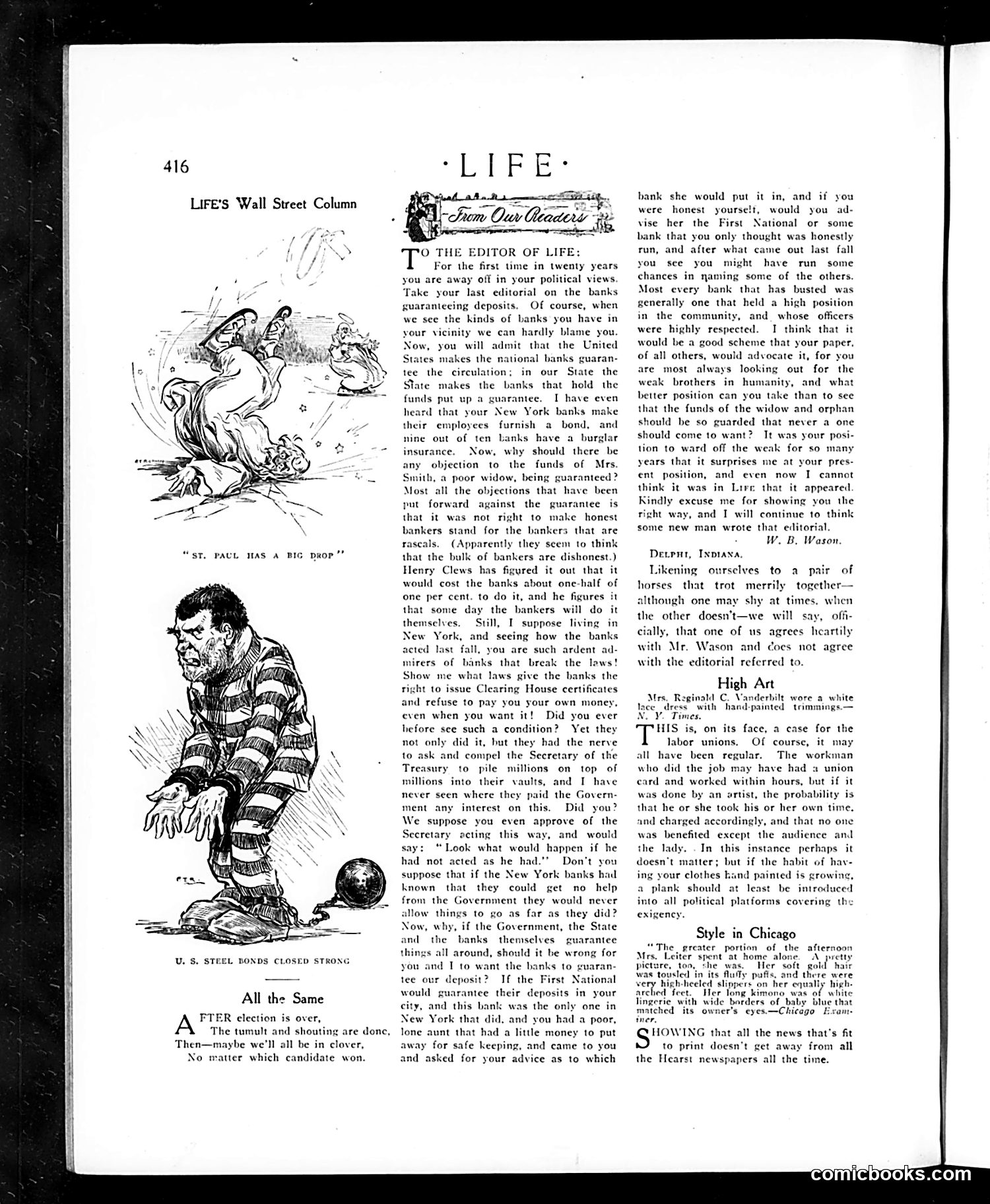
This page contains **editorial cartoons and reader letters about bank regulation**, likely from the post-1907 financial panic era when deposit insurance was debated. The cartoons mock Wall Street and banking practices: - **"St. Paul Has a Big Drop"** depicts a caricatured figure (possibly representing a specific banker or financier) in distress, satirizing stock market volatility or bank failures. - **"U.S. Steel Bonds Closed Strong"** references the steel industry's financial stability, contrasting it with weaker institutions. The reader's letter argues *for* bank deposit guarantees, criticizing Life magazine's editorial opposition. The writer points out that if the government guarantees bank circulation and New York banks require employee bonds, why shouldn't ordinary depositors' funds be protected? He references Henry Clews (a real financial analyst) and the recent banking crisis ("last fall"), arguing that without government safety nets, banks wouldn't have taken excessive risks. The poem "All the Same" cynically suggests post-election politics will disappoint regardless of which candidate wins.
📄 Transcribed text from this page (OCR, searchable)
Machine-transcribed from the original scan — historical spelling and the odd misread are preserved.
3) i) i i | q mr a 416 LIFE’S Wall Street Column ST, PAUL HAS A BIG Drop’? U. S, STEEL BONDS CLOSED STRONG All the Same FTER election is over, The tumult and shouting are donc, Then—maybe we'll all be in clover, No matter which candidate won. ‘LIPE* 0 THE EDITOR OF LIFE: For the first time in twenty years you are away off in your political views Take your last editorial on the banks guaranteeing deposits. Of course, when we see the kinds of banks you have in your vicinity we can hardly blame you. Now, you will admit that the United States makes the national banks guaran- tee the circulation; in our State the State makes the banks that hold the funds put up a guarantee, I have even heard that your New York banks make their employees furnish a bond, and nine out of ten banks have a burg! insurance. Now, why should there be any objection to the funds of Mrs. Smith, a poor widow, being guaranteed? Most all the objections that have been put forward against the guarantee is that it was not right to make honest bankers stand for the bankers that are rascals. (Apparently they scem to think that the bulk of bankers are dishonest.) Henry Clews has figured it out that it would cost the banks about one-half of one per cent. to do it, and he figures it at some day the bankers will do it themselves, Still, I suppose living in New York, and seeing how the banks acted last fall, you are such ardent ad- mirers of banks that break the laws! Show me what laws give the banks the right to issue Clearing House certificates and refuse to pay you your own money, even when you want it! Did you ever liefore see such a condition? Yet they did it, hut they had the nerve k and compel the Secretary of the Treasury to pile millions on top of millions into their v and [have never seen where they paid the Govern- ment any interest on this, Did you We suppose you even approve of the Sceretary acting this way, and would say: “Look what would happen if he had not acted as he had."* Don't you suppose that if the New York banks bad known that they could get no help from the Government they would never low things to go as far as they did? Now, why, if the Government, the State and the banks themselves guarantee things all around, should it be wrong for you and I to want the banks to guaran- tee our deposit? If the First Nationa would guarantee their deposits in your pe city, and this bank was the only one in New York that did, and you had a poor, lone aunt that had a little money to put away for safe keeping, and came to you and asked for your advice as to which bank she would put it in, and if you were honest yourse!t, would you ad- vise her the First National or some bank that you only thought was honestly run, and after what came out last fall you see you might have run some chances in naming some of the others. Most every bank that has busted was generally one that held a high position in the community, and whose officers were highly respected. I think that it would be a good scheme that your paper, of all others, would advocate it, for you are most always looking out for the weak brothers in humanity, and what better position can you take than to see that the funds of the widow and orphan should be so guarded that never a one should come to want? It was your posi- tion to ward off the weak for so many years that it surprises me at your pres- ent position, and even now I cannot think it was in Lire that it appeared Kindly excuse me for showing you the right way, and I will continue to think some new man wrote that editorial. W. B. Wagon. Detpmt, Ixpiana. Likening ourselves to a pair of horses that trot merrily together— although one may shy at times, when the other doesn't—we will say, offi- cially, that one of us agrees heartily with Mr. Wason and coes not agree with the editorial referred to. High Art Mrs, Reginald C. Vanderbilt wore a white lace dress with Tand-painted teimmings.— s. HIS is, on its face, a case for the labor unions. Of course, it may all have been regular. The workman who did the job may have had 2 union card and worked within hours, but if it was done by an artist, the probability is that he or she took his or her own time. and charged accordingly, and that no one was benefited except the audience and the lady, . In this instance perhaps it doesn't matter; but if the habit of hav- ing your clothes kand painted is growing, plank should least be introduced nto all political platforms covering the exigency. Style in Chicago portion of the afternoon : at home alone. A pretty picture, ton, the was. Her soft gold hair Was tousled in its fully pafls, and there were very high-heeled slippers on her equally high- arched fect. Her long kimono. was of white lingerie with wide barders of baby blue that matched its owner's eyes—Chicago Evant- ner. HOWING that all the news that's fit to print doesn’t get away from all the Hearst newspapers all the time.