
Life, 1908-10-15 · page 8 of 28
Life — October 15, 1908 — page 8: what you’re looking at
What you’re looking at
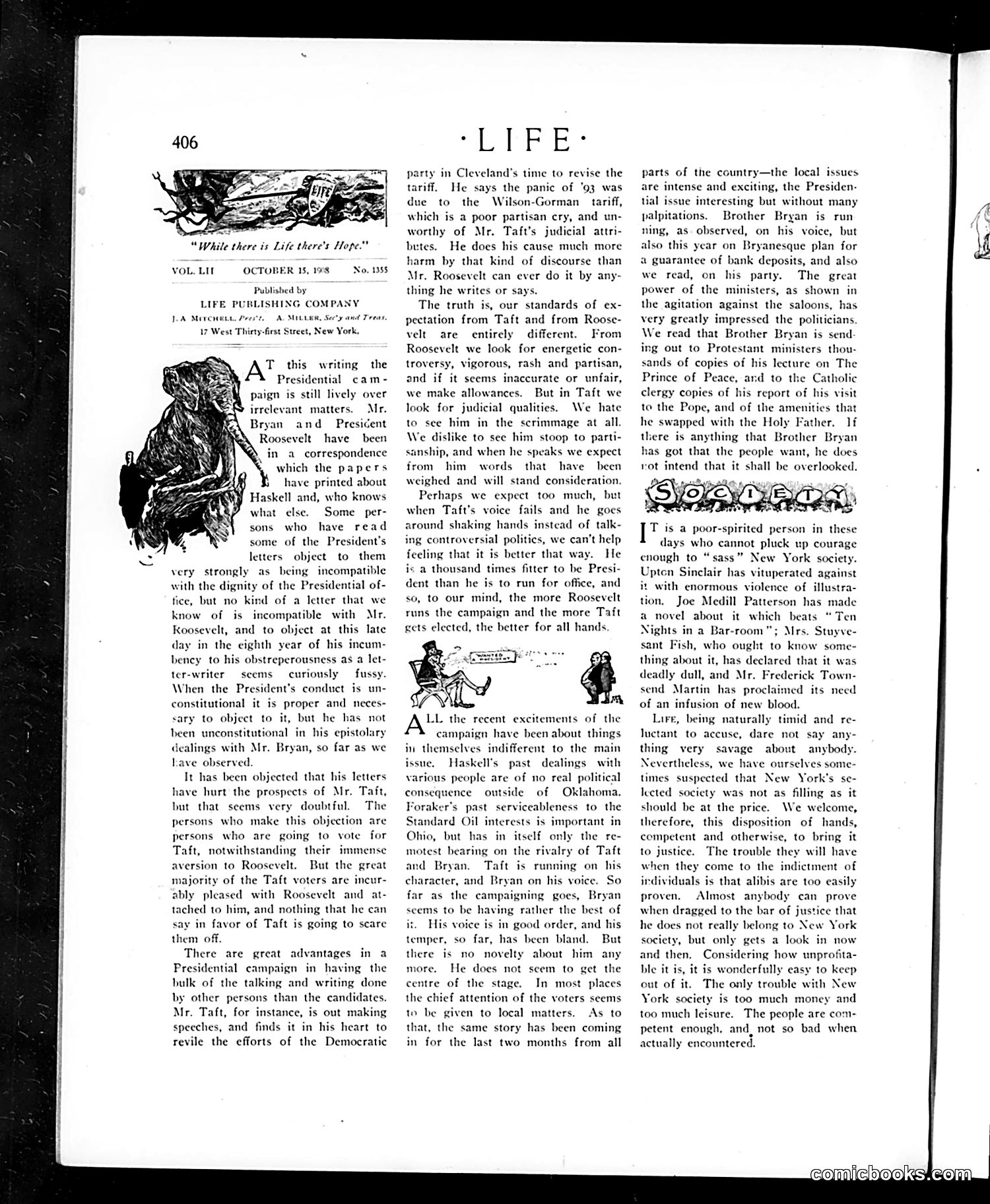
This October 1908 *Life* magazine page critiques the presidential campaign between President Theodore Roosevelt and William Howard Taft (Republican) versus William Jennings Bryan (Democrat). The main illustration shows **Haskel** (appears to be a political figure) being criticized for his past dealings with various political interests. The text argues that while Taft and Roosevelt supporters object to Bryan and Roosevelt, the real issue is that Taft's "judicial qualities" are preferable to Roosevelt's more aggressive, partisan approach. The satire suggests Roosevelt's vigorous campaigning style creates unnecessary controversy, whereas Taft represents a calmer, more measured alternative. The commentary implies voters concerned about presidential dignity should prefer Taft's restraint to Roosevelt's combative rhetoric.
📄 Transcribed text from this page (OCR, searchable)
Machine-transcribed from the original scan — historical spelling and the odd misread are preserved.
“While there is Life there's Hope." VOL. LIT OCTOBER 15, 198 No. 1385 Published by UBLISHING COMPANY AL MILLER, Secty ant Tres LIFE JA Murenena. 2 17 West Thinty-first Street, New York, A’ this writing the , Presidential cam- paign is still lively over irrelevant matters. Mr. Bryan and Presicent Roosevelt have been in a_ correspondence which the papers have printed about Haskell and, who knows what else. Some per- sons who have read some of the President's letters object to them very strongly as being incompatible with the dignity of the Presidential of- tice, but no kind of a letter that we know of is incompatible with Mr. Koosevelt, and to object at this late day in the eighth year of his incum- Dency to his obstreperousness as a let- ter-writer scems curiously fussy. When the President’s conduct is un- constitutional it is proper and neces- sary to object to it, but he has not Deen unconstitutional in his epistolary dealings with Mr. Bryan, so far as we lave observed. It has been objected that his letters have hurt the prospects of Mr. Ta but that seems very doubtful. persons who make this objection are persons who are going to vote for Taft, notwithstanding their immense aversion to Roosevelt. But the great majority of the Taft voters are incur- ably pleased with Roosevelt and at- tached to him, and nothing that he can ay in favor of Taft is going to scare them off. There are great advantages in a Presidential campaign in having the bulk of the talking and writing done by other persons than the candidates. Mr. Taft, for instance, is out making speeches, and finds it in his heart to revile the efforts of the Democratic *LIPE: party in Cleveland's time to revise the tariff. He says the panic of ’93 was due to the Wilson-Gorman tariff, which is a poor partisan cry, and un- worthy of Mr. Taft’s judicial attri- butes. He does his cause much more harm by that kind of discourse than Mr. Roosevelt can ever do it by any- thing he writes or says. The truth is, our standards of ex- pectation from Taft and from Roose- velt are entirely different. From Roosevelt we look for energetic con- troversy, vigorous, rash and. partisan, and if it seems inaccurate or unfair, we make allowances. But in Taft we look for judicial qualities. We hate to sce him in the scrimmage at all. We dislike to see him stoop to parti- sanship, and when he speaks we expect from him words that have been weighed and will stand consideration. Perhaps we expect too much, but when Taft's voice fails and he goes around shaking hands instead of talk- ing controversial politics, we can’t help feeling that it is better that w He is a thousand times fitter to be Presi- dent than he is to run for office, and so, to our mind, the more Roosevelt runs the campaign and the more Taft gets elected, the better for all hands. LL the recent excitements of the campaign have been about things in themselves indifferent to the main Haskell’s past’ dealings with various people are of no real political consequence outside of Oklahoma. Foraker’s past. serviceableness to the Standard Oil interests is important in Ohio, but has in itself only the re- motest bearing on the rivalry of Taft and Bryan. Taft is running on his character, and Bryan on his voice. So far as the campaigning goes, Bryan scems to be having rather the best of it. His voice is in good order, and his temper, so far, has been bland. But there is no novelty about him any more. He does not seem to get the centre of the stage. In most places the chief attention of the voters seems to be given to local matters. As to that, the same story has been coming in for the last two months from all issue. parts of the country—the local issues are intense and exciting, the Presiden- tial issue interesting but without many palpitations. Brother Bryan is run ning, as. observed, on his voice, but also this year on Bryanesque plan for a guarantee of bank deposits, and also we read, on his party. The great power of the ministers, as shown in the agitation against the saloons, has. very greatly impressed the politicians We read that Brother Bryan is send ing out to Protestant ministers thou- sands of copies of his lecture on The Prince of Peace, and to th atholic clergy copies of his report of his visit to the Pope, and of the amenities that he swapped with the Holy Father. 1f there is anything that Brother Bryan has got that the people want, he docs rot intend that it shall be overlooked. I* is a poor-spirited person in these days who cannot pluck up courage cnough to “sass” New York society. Upten Sinclair has vituperated against it with enormous violence of illustra- tion, Joe Medill Patterson has made a novel about it which beats “Ten Nights in a Bar-room”; Mrs. Stuyve- sant Fish, who ought to know some- thing about it, has declared that it was deadly dull, and Mr, Frederick Town- send Martin has proclaimed its need of an infusion of new blood. Lire, being naturally timid and re- luctant to accuse, dare not say any- thing very savage about anybody. Nevertheless, we have ourselves some- times suspected that New York's se- lected society was not as filling as it should be at the price. We welcome, therefore, this disposition of hands, competent and otherwise, to bring it to justice. The trouble they will have when they come to the indictment of individuals is that alibis are too easily proven. Almost anybody can prove when dragged to the bar of justice that he does not really belong to New York society, but only gets a look in now and then. Considering how unprofita- ble it is, it is wonderfully easy to keep out of it. The only trouble with New York society is too much money and too much leisure. The people are com- petent enough, and, not so bad when actually encountered.