
A complete issue · 26 pages · 1908
Life — July 16, 1908
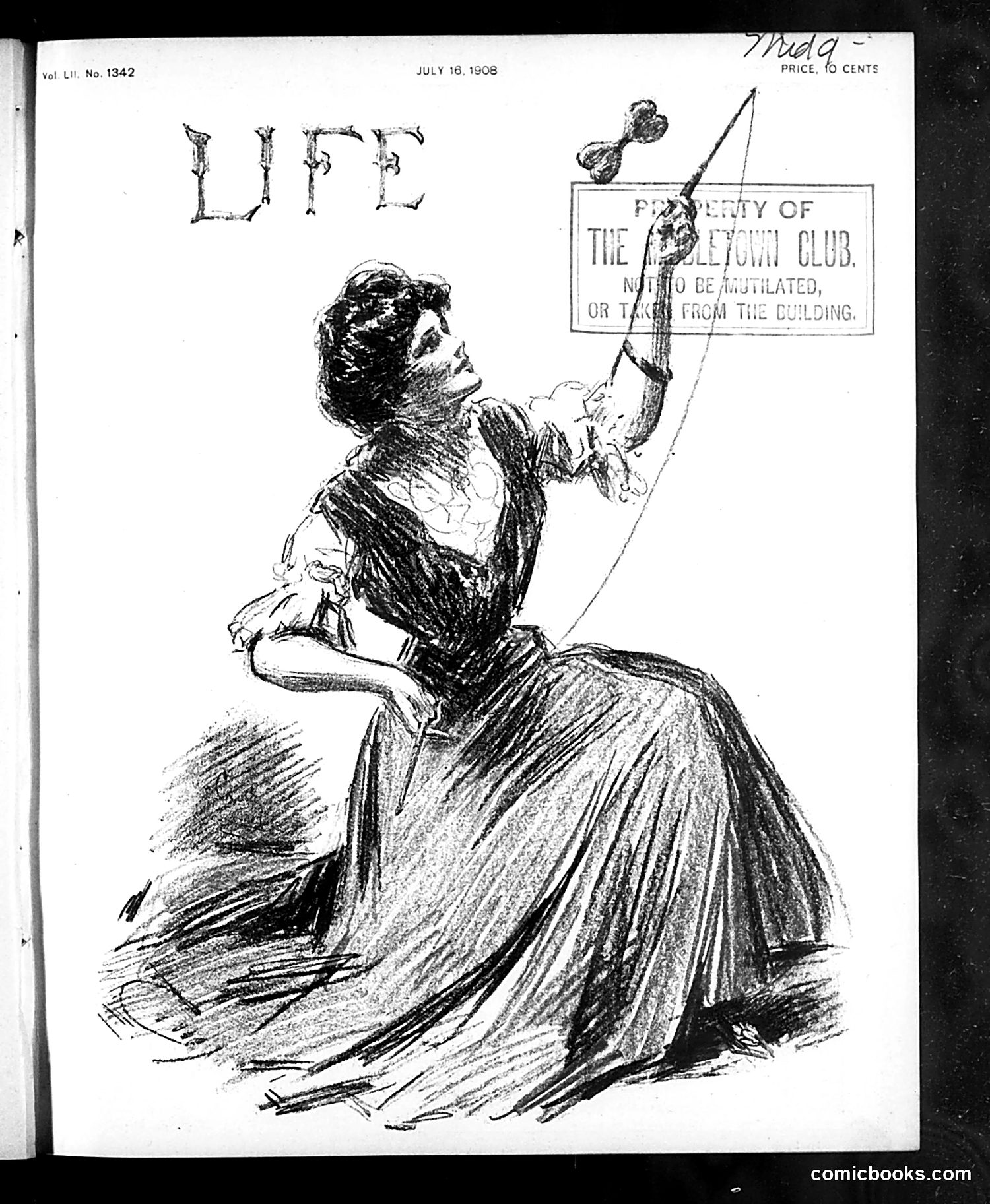
This cover illustration depicts a woman in classical robes wielding a fishing rod, clearly representing "Life" itself as an allegorical figure. She gazes upward at her catch—a caricatured face on a hook—suggesting she has "hooked" or captured some notable person or public figure of 1908. The accompanying notice warns that this image is "Property of The Pagetown Club" and "Must not be investigated or taken from the building," which appears to be satirical commentary about the exclusivity or secretive nature of such clubs. The specific identity of the caught figure remains unclear from the image alone, but the cartoon's central joke mocks someone prominent enough that Life's editors thought their readers would immediately recognize the caricature.
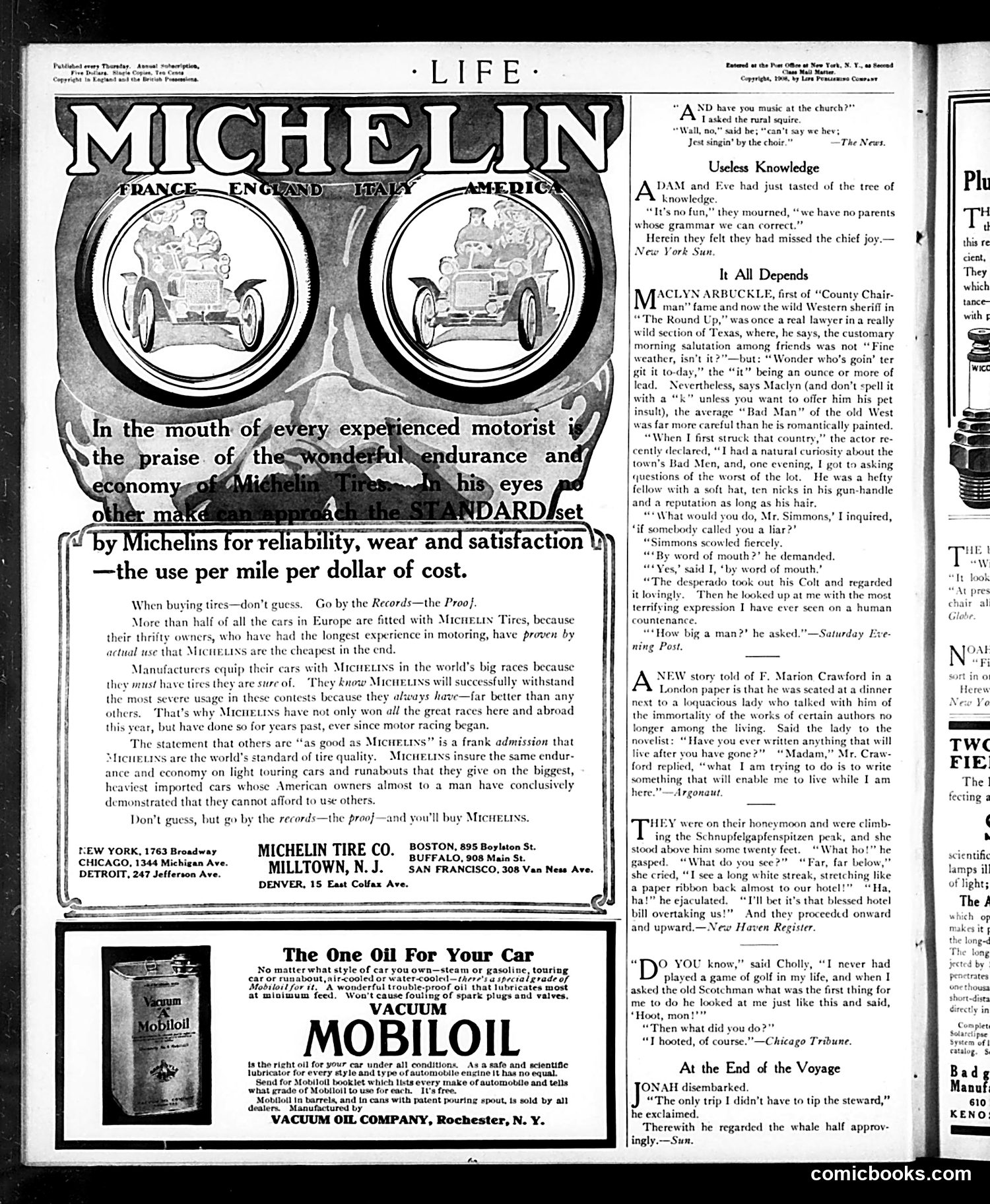
This page is **primarily advertising** rather than satire or political commentary. It features two major car-related ads: 1. **Michelin Tires advertisement** (top, large): Uses comparative illustrations of cars in France, England, Italy, and America to promote tire durability and economy. The ad emphasizes that Michelin tires are the "world's standard" and are used by racing teams and European vehicles. This is straightforward product marketing highlighting reliability and cost-effectiveness. 2. **Mobiloil advertisement** (bottom): Promotes motor oil as "the one oil for your car," emphasizing its universal compatibility with different engine types and its quality. The right-hand column contains brief humorous anecdotes and short stories—typical Life magazine filler content—but contains no political satire or notable caricatures requiring historical context.
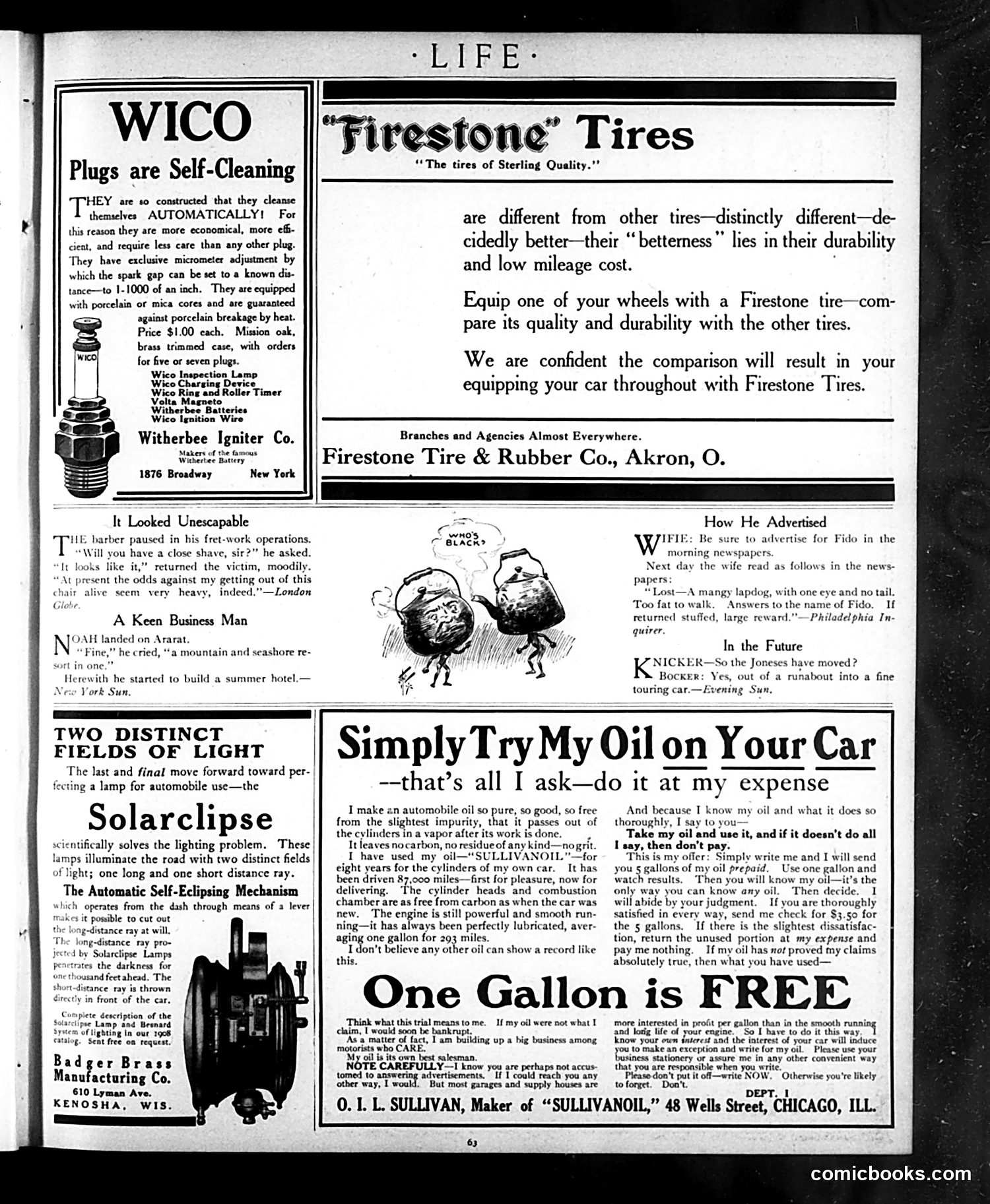
This page is **primarily advertising** with minimal editorial content. The advertisements promote: 1. **Wico spark plugs** (self-cleaning design) 2. **Firestone Tires** (durability and low cost) 3. **Solareclipse automobile lamps** (dual-field lighting) 4. **Sullivanoil** (motor oil with a free-gallon offer) There are three brief humorous items with illustrations: - "It Looked Unescapable" (barber shop anecdote) - "A Keen Business Man" (hotel entrepreneur joke) - "How He Advertised" (domestic humor about lost dog advertisements) These are simple joke items rather than political satire. The page reflects early automotive-era consumer culture (1910s-1920s era based on styling), with manufacturers competing to convince buyers their products were superior. The humor is gentle, domestic, and non-political.
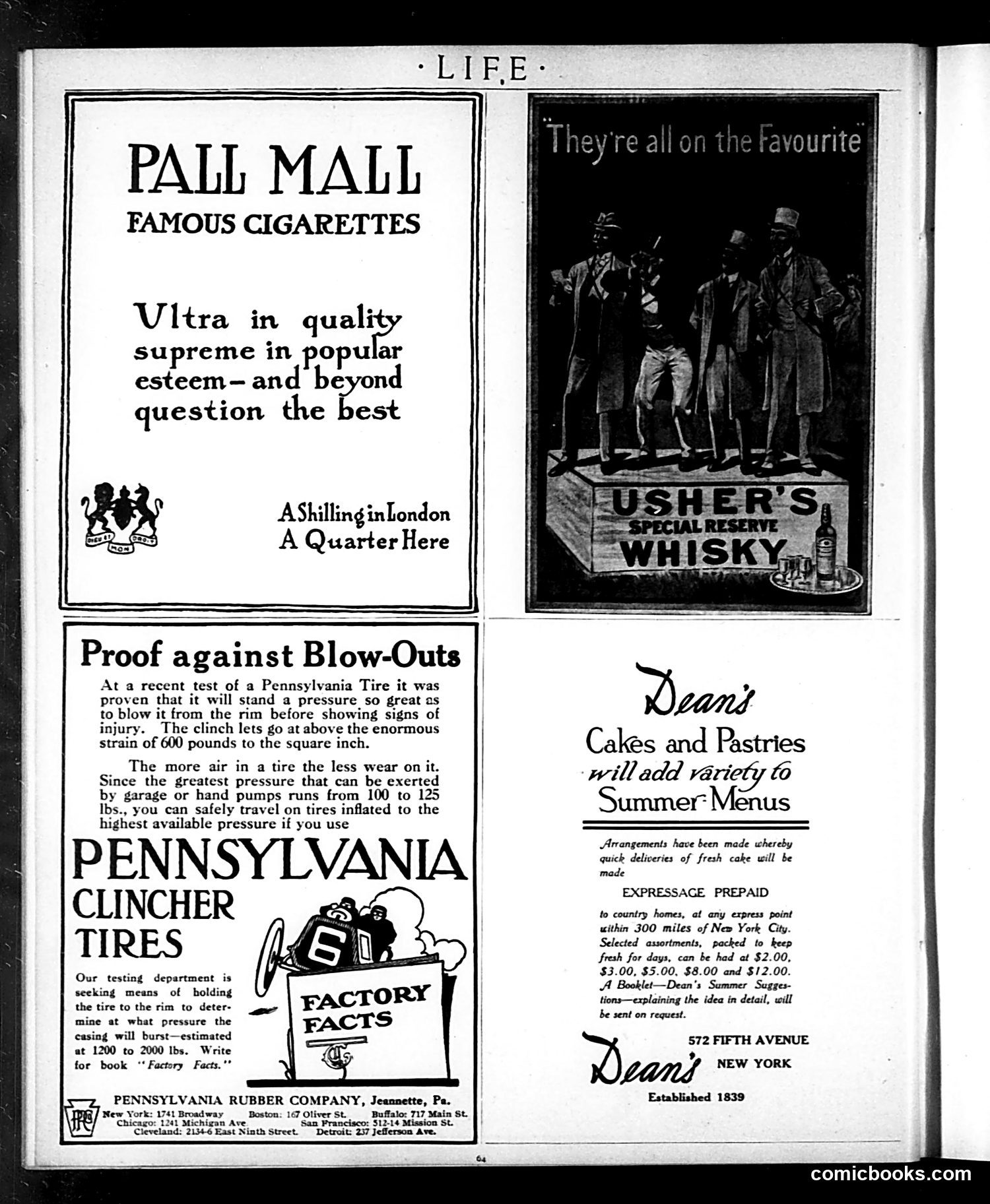
This page consists primarily of **period advertisements** rather than political satire or comics requiring historical context. The **Pall Mall cigarettes ad** uses standard early 20th-century marketing language ("ultra in quality, supreme in popular esteem") with no satirical content. The **Usher's Whisky ad** shows men in formal dress with the caption "They're all on the Favourite"—likely a horse-racing reference suggesting the product's popularity, not satire. The **Pennsylvania Clincher Tires ad** contains technical product information about tire safety testing, with a "Factory Facts" mascot character. The **Dean's Cakes and Pastries ad** advertises mail delivery services. **Bottom line:** This is a standard magazine advertising page with no political cartoons or satirical commentary to decode for modern readers.
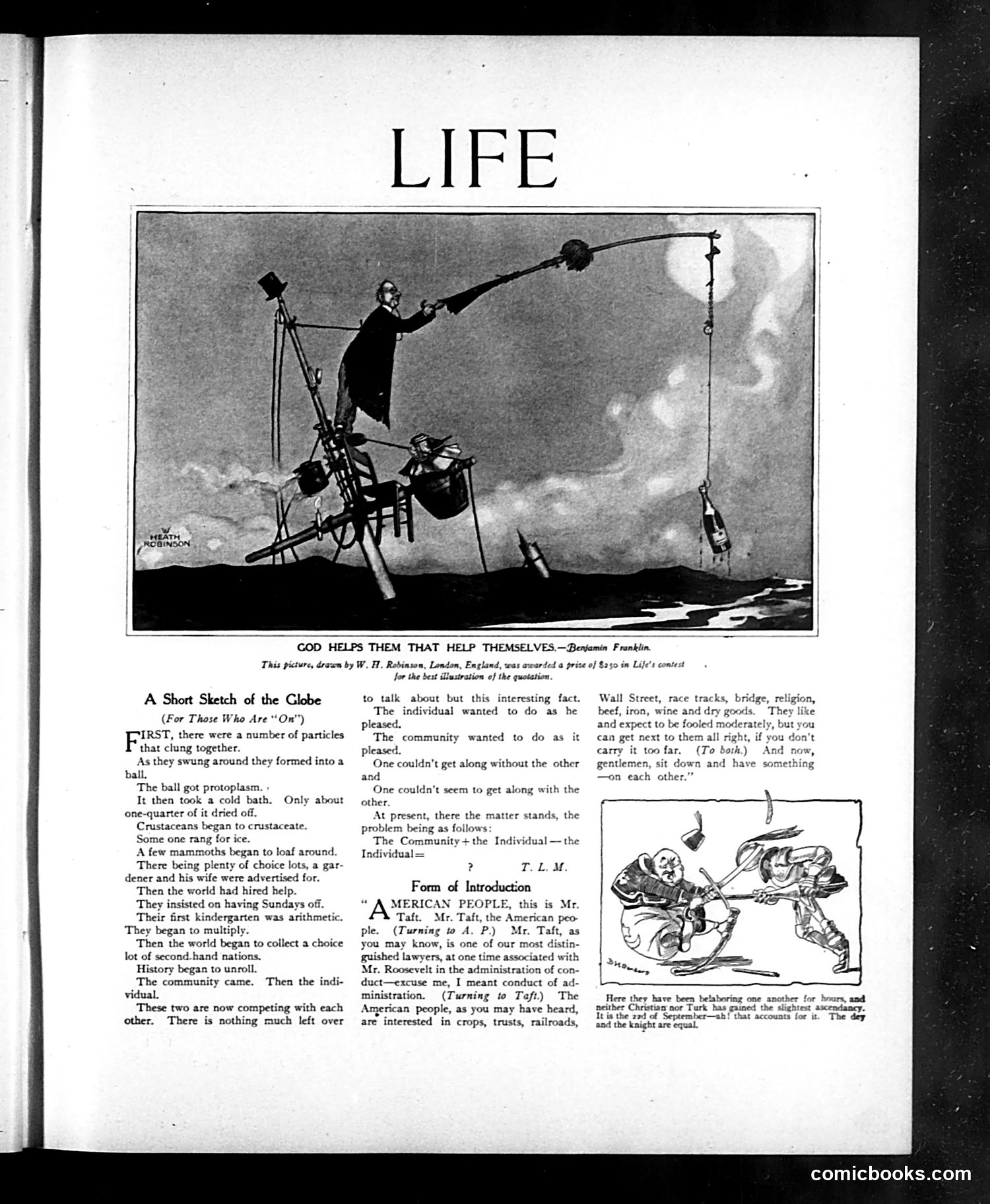
**Main Cartoon (Top):** The illustration by W. H. Robinson depicts a figure in formal dress operating a complex mechanical contraption labeled with pulleys and levers, attempting to manipulate a large sphere (representing "the globe"). The quote "God helps them that help themselves" attributes this to Benjamin Franklin. **Meaning:** This satirizes the tension between individual ambition and collective welfare. The cartoon suggests that self-interested manipulation of systems—even through elaborate mechanical means—may be futile or counterproductive when dealing with matters affecting society broadly. **Text Below:** An article titled "A Short Sketch of the Globe" uses evolutionary language ("particles," "protoplasm," "crustaceans") as metaphor for social development, contrasting community interests with individual desires. A subsequent section on "Form of Introduction" references Mr. Taft, suggesting early 20th-century American political context.
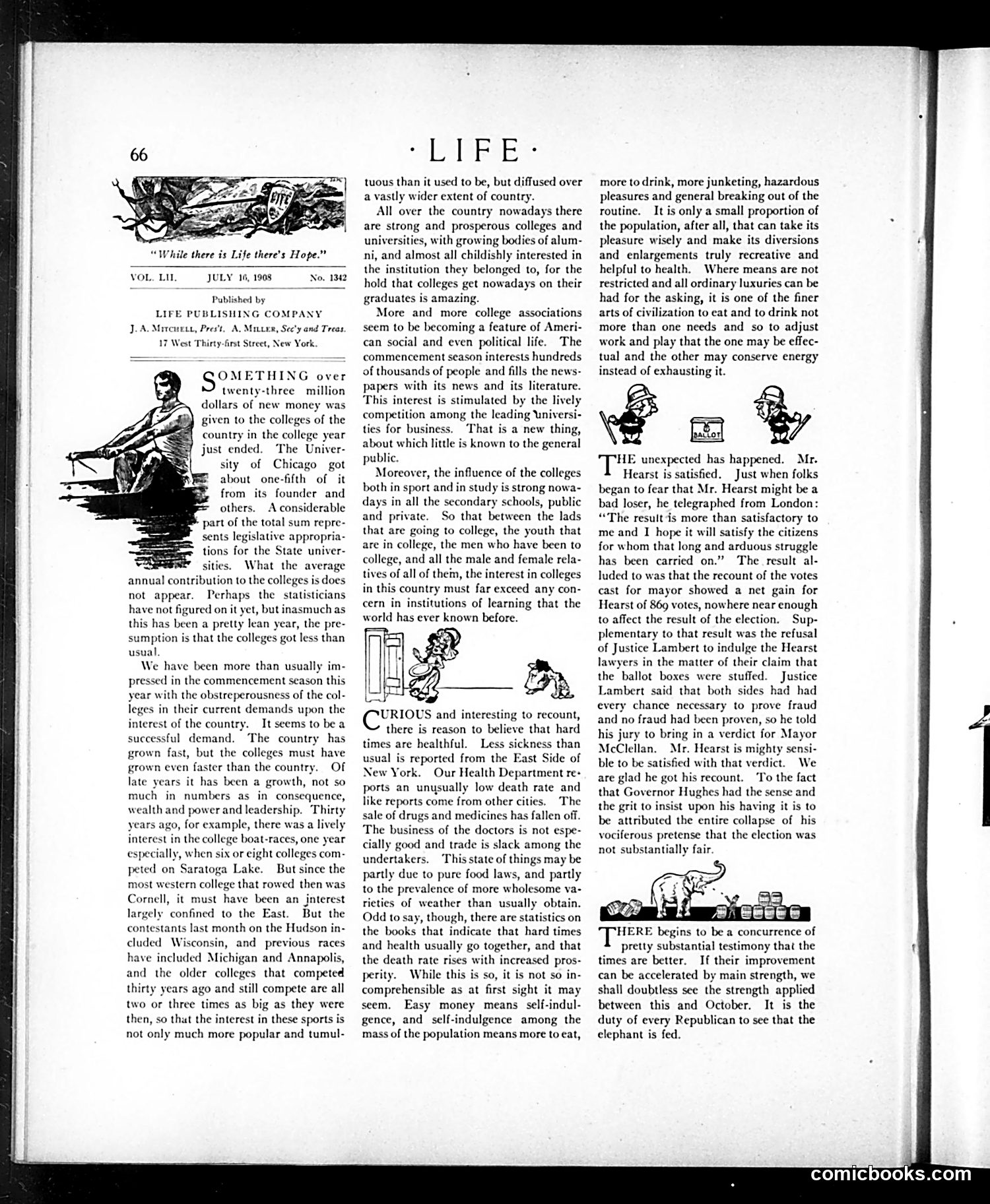
This page discusses college influence on American society and an election result. The text references "Mr. Hearst" receiving disappointing election news from London, with a telegraphed message about vote recounts. A mayoral election result is mentioned, with Justice Lambert involved in ballot-stuffing investigations. The cartoons appear to illustrate themes of money in politics and fraud. One sketch shows a figure at an oar, labeled "While there is Life there's Hope," suggesting perseverance despite setbacks. The page critiques how colleges shape national interests and how major figures like newspaper magnate William Randolph Hearst influence politics. The mention of ballot fraud and Justice Lambert suggests contemporary electoral corruption concerns—likely referencing the 1908 NYC mayoral race and Hearst's political ambitions.
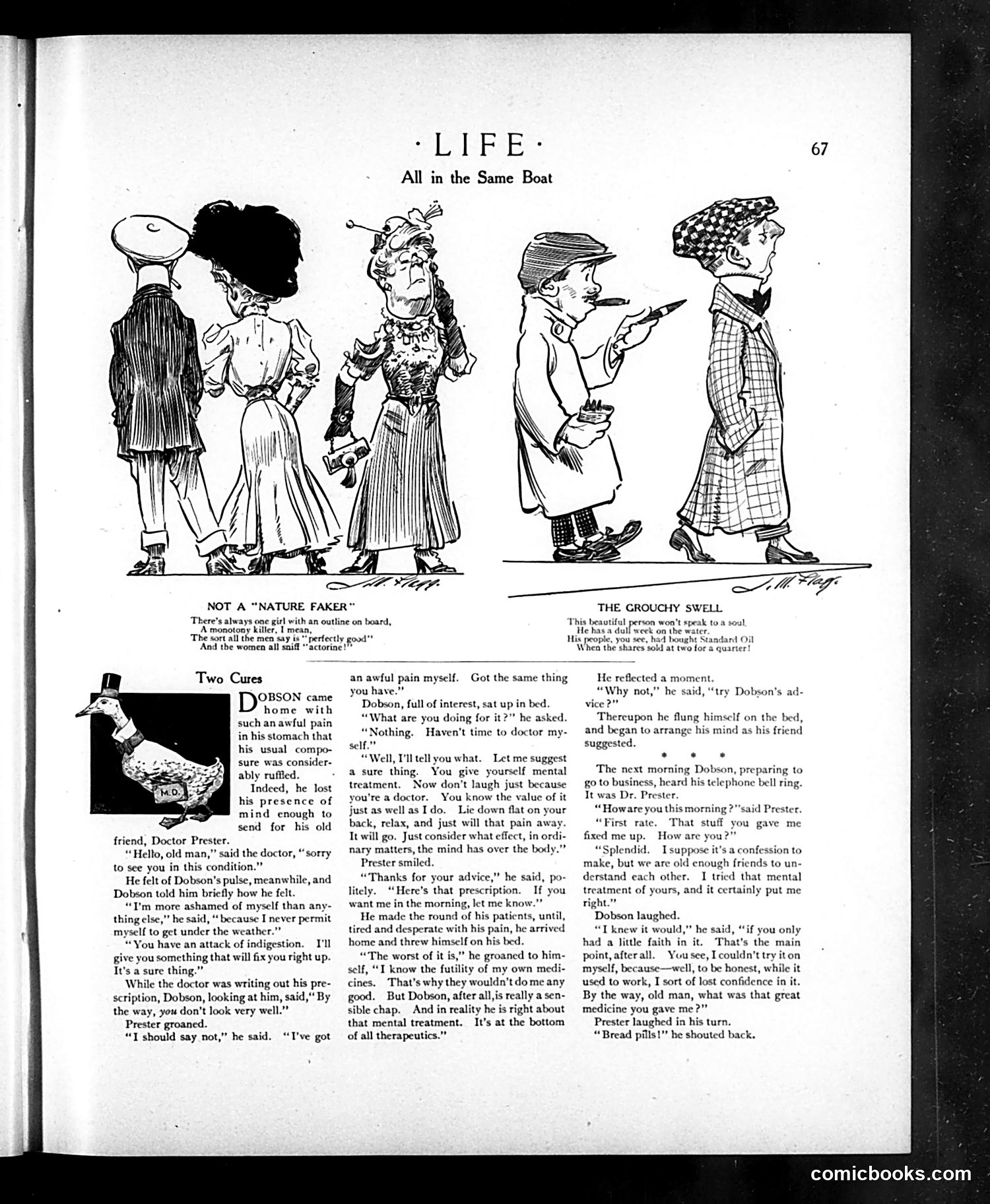
**Top Cartoons:** Two satirical illustrations titled "All in the Same Boat" mock social pretension. "Not a 'Nature Faker'" depicts three fashionably dressed women gossiping about a man with "an outline on board"—likely mocking exaggerated or false social personas. "The Grouchy Swell" shows a wealthy, irritable person, satirizing the wealthy class's bad temperament despite privilege. **Main Story "Two Cures":** This narrative piece describes a patient named Dobson consulting Doctor Prester about stomach pain. The doctor prescribes mental treatment rather than medicine, arguing "the mind has over the body." Dobson initially dismisses this but eventually acknowledges its effectiveness. The piece satirizes emerging psychological medicine and Victorian skepticism toward mental treatment as legitimate healthcare.
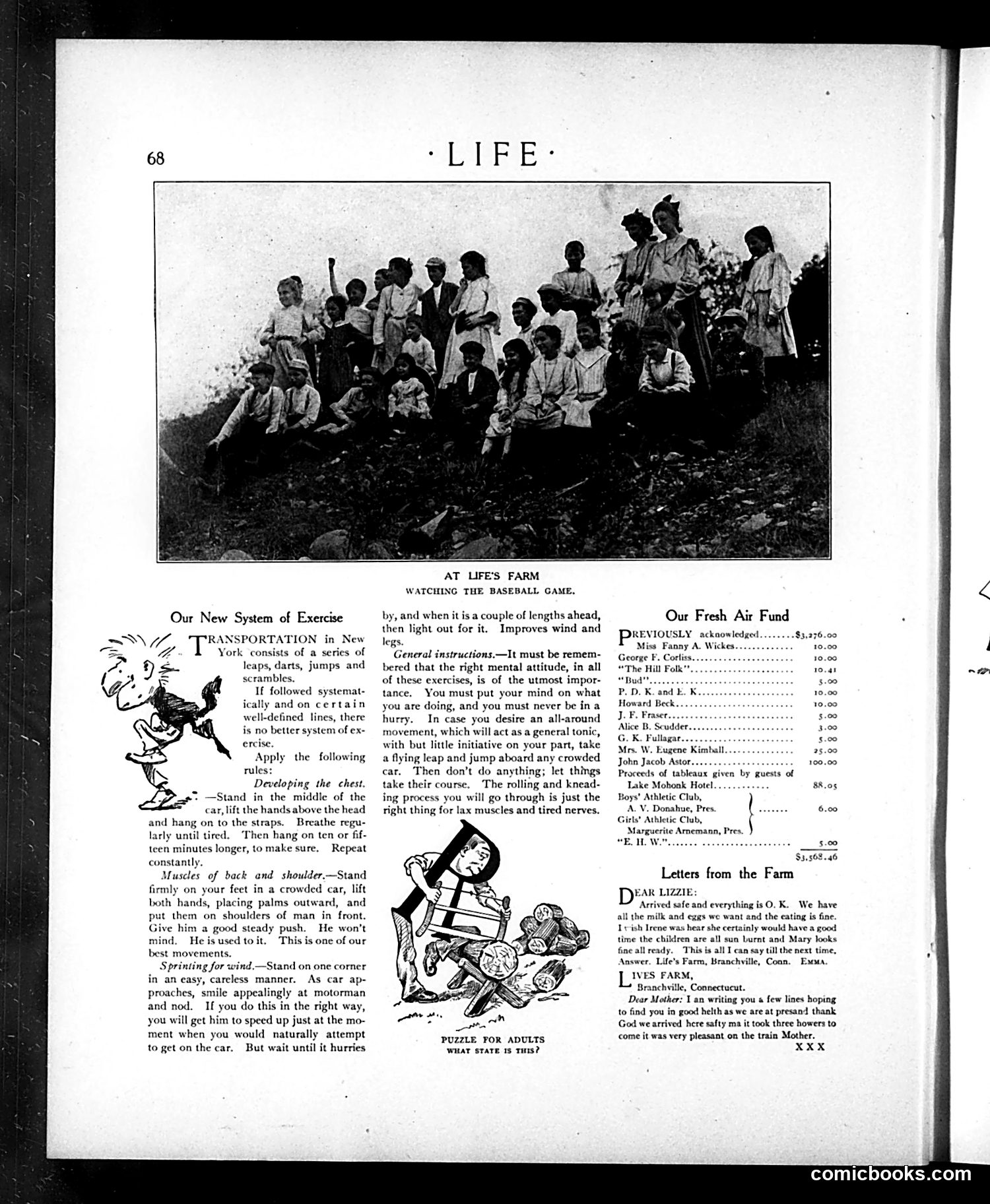
This page from Life magazine contains a photograph of a group at "Life's Farm" watching a baseball game, alongside exercise instructions and letters from readers. The main content is **practical fitness advice** rather than political satire. The "Developing the chest" and "Muscles of back and shoulder" sections offer calisthenic instructions with small cartoon illustrations of proper form. Below is a "Puzzle for Adults" asking "What state is this?" — likely a visual riddle. The "Letters from the Farm" section shows reader correspondence about Life magazine's farm operation, suggesting this was a real venue or retreat. The "Fresh Air Fund" lists donations for a charitable cause, indicating Life's involvement in promoting public health and wellness activities during this era. Overall, this page emphasizes health, exercise, and community engagement rather than political commentary.
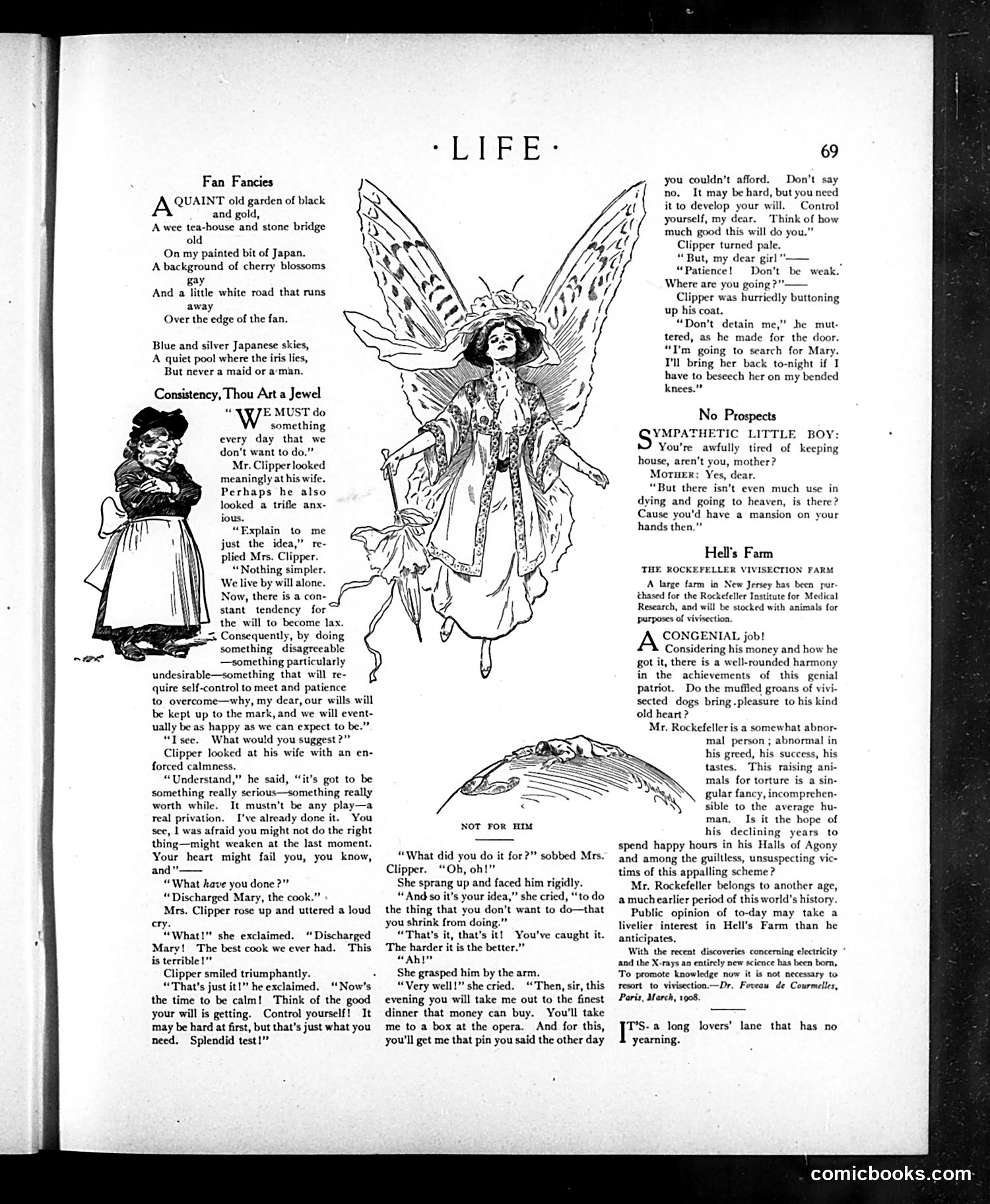
This page contains poetry and prose pieces rather than political cartoons. The main illustrated elements are decorative: **"Fan Fancies"** - A poem accompanied by an illustration of a winged fairy-like figure in elaborate dress, appears whimsical rather than satirical. **The dialogue pieces** ("Consistency, Thou Art a Jewel," "No Prospects," "Hell's Farm") use illustrations of ordinary people in domestic situations to frame humorous conversations about everyday life—a nagging wife, a tired housewife, and commentary on the Rockefeller Institute's animal testing practices. **"Hell's Farm"** section includes social commentary criticizing Mr. Rockefeller's funding of animal vivisection for medical research, suggesting this was a contentious public issue. The text presents both the practice and moral objections to it. The page is primarily literary humor focused on domestic situations and contemporary social debates rather than explicit political satire.
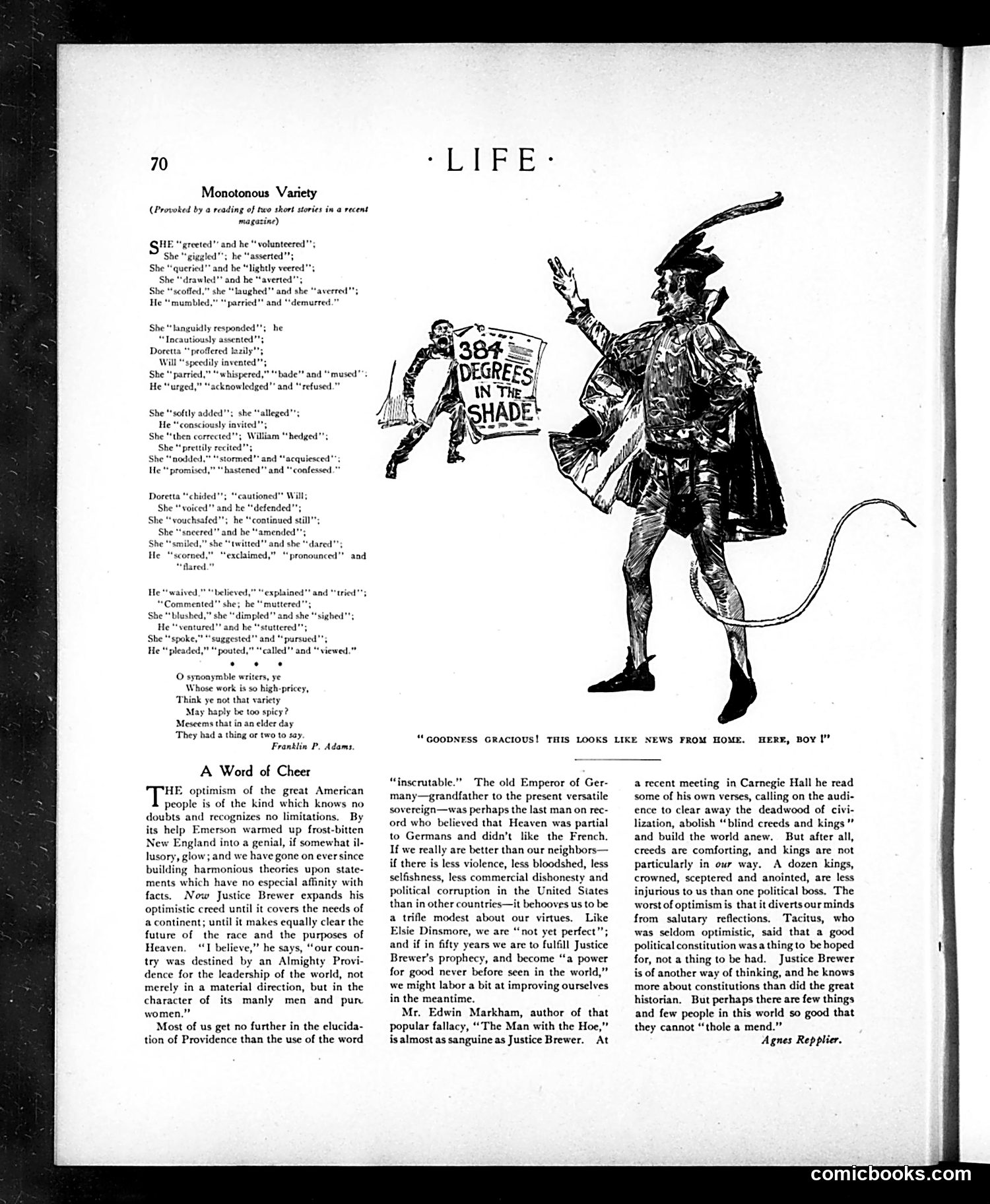
The central illustration depicts a devil-like figure holding a thermometer labeled "384 DEGREES IN THE SHADE," with the caption "GOODNESS GRACIOUS! THIS LOOKS LIKE NEWS FROM HOME. HERE, BOY!" This appears to be **wartime satire**, likely from WWI or WWII, mocking enemy soldiers or an enemy nation. The cartoon suggests that conditions in hell ("home" to the devil) are comparable to extreme heat—384 degrees—implying the enemy faces impossibly harsh, hellish circumstances. The devil's casual reaction ("news from home") sarcastically suggests their suffering amuses him. The accompanying text discusses American optimism and virtue, contrasting with implied enemy moral failings, supporting the propagandistic tone of the cartoon.
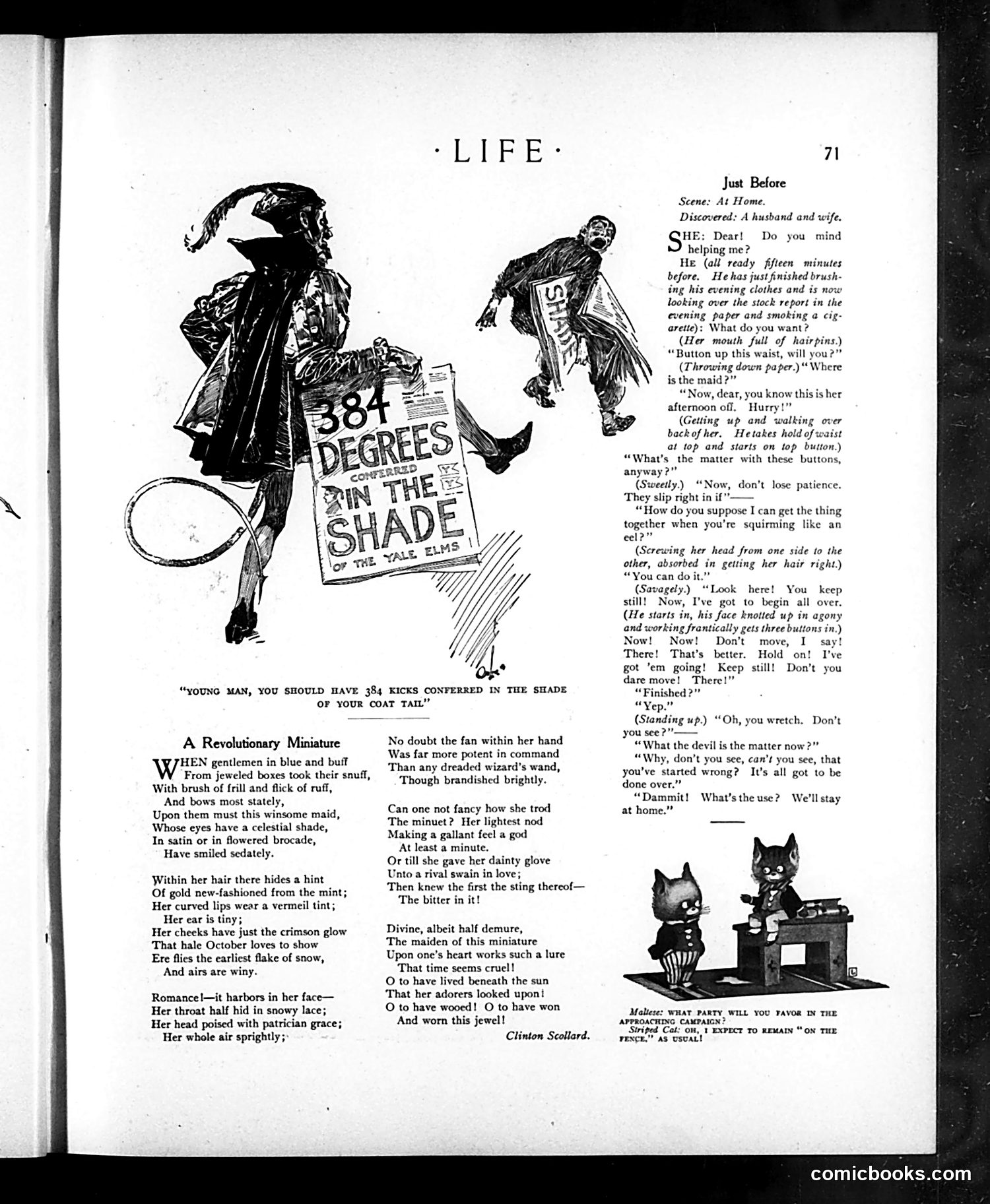
The main cartoon depicts a man in formal evening wear frantically fleeing, carrying a newspaper headlined "384 DEGREES IN THE SHADE OF THE YALE ARMS." The caption reads: "YOUNG MAN, YOU SHOULD HAVE 384 KICKS CONFERRED IN THE SHADE OF YOUR COAT TAIL." This appears to satirize extreme heat and discomfort during summer in New Haven, Connecticut (Yale's location). The exaggerated temperature and the man's panicked flight suggest mockery of how unbearably hot the weather was—so intense it's literally chasing him away. The page also contains a poem titled "A Revolutionary Miniature" by Clinton Scollard about a woman, plus a domestic comedy sketch and an illustration of cats at bottom. The overall theme concerns summer weather and social inconveniences of the era.
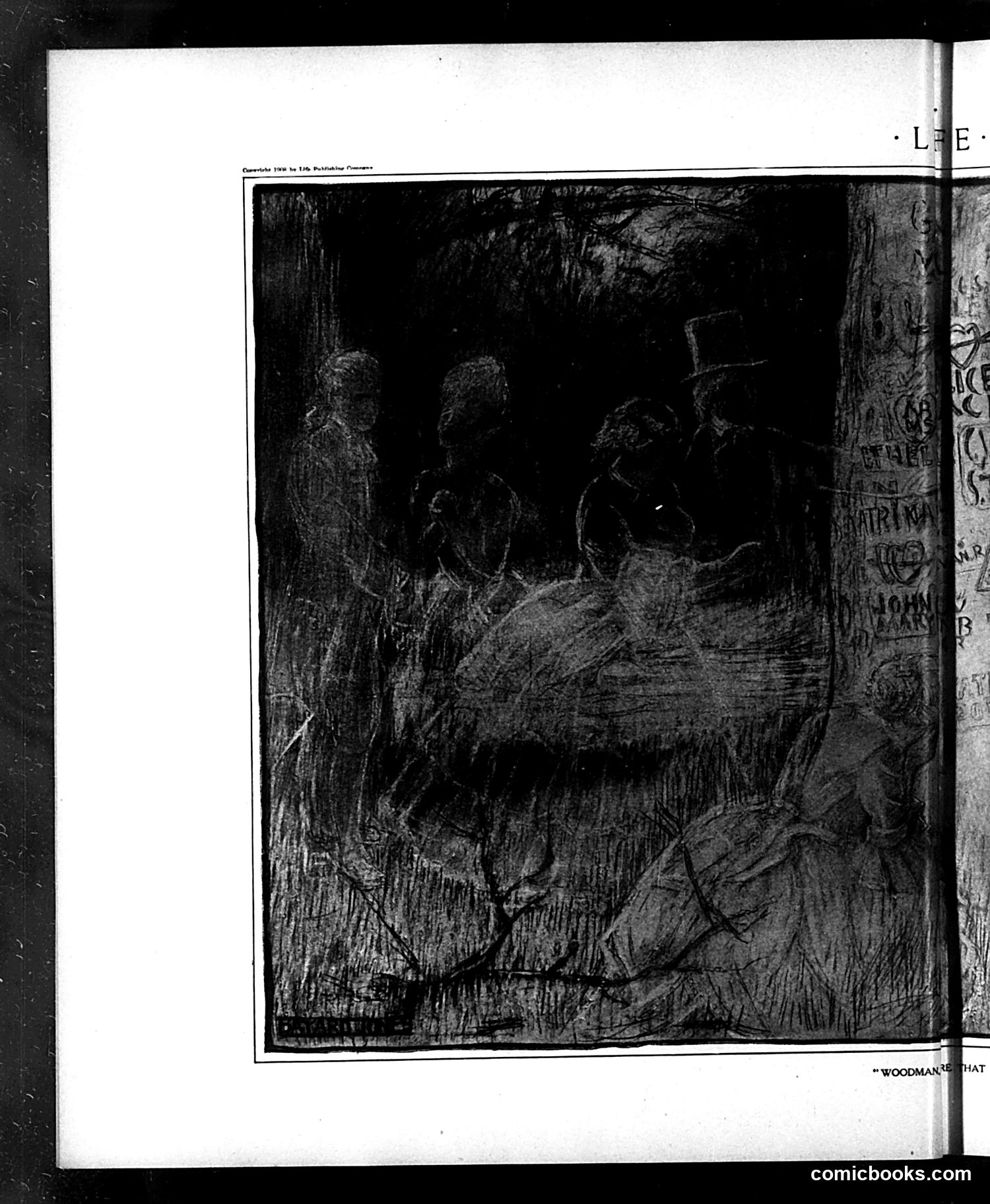
This page appears to be from Life magazine and shows a dark, sketchy illustration titled "Woodman's Hat" (visible at bottom). The image depicts several figures in what appears to be an indoor scene with dramatic shadowing and cross-hatching technique. Due to the poor image quality and heavy darkness of the reproduction, I cannot confidently identify the specific figures or their caricatured features. The composition suggests a social or political scene with multiple characters, but the details are too obscured to determine the satirical subject with certainty. Without clearer visibility of facial features or accompanying caption text beyond the title, I cannot reliably explain what contemporary reference or joke this cartoon makes for a modern reader. The artistic style is consistent with early-20th-century magazine illustration, but specifics remain unclear from this reproduction.
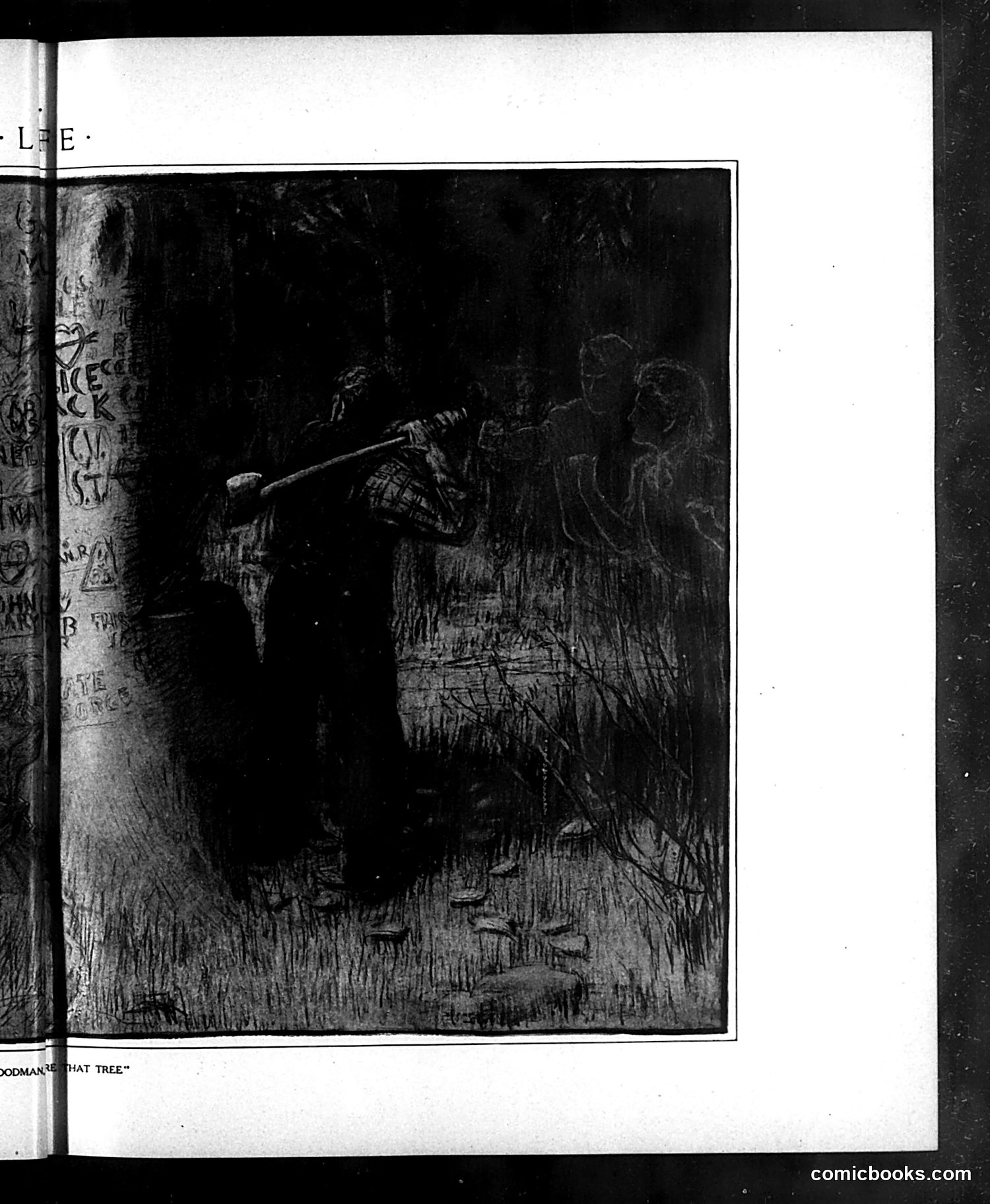
This appears to be a satirical illustration from *Life* magazine titled "That Tree" (visible at bottom left). The image shows a figure using a telescope or spyglass while standing near a tree, with several other figures visible in the background darkness. Without being able to read the full caption or article text clearly, I cannot definitively identify the specific political or social reference this cartoon satirizes. The moonlit, somewhat mysterious scene and the act of surveillance or observation through the telescope suggests commentary on secrecy, spying, or hidden truths—possibly referencing a contemporary scandal or political situation from *Life*'s era of publication. To accurately explain the satire's specific target and meaning, I would need additional visible text or historical context about the publication date.
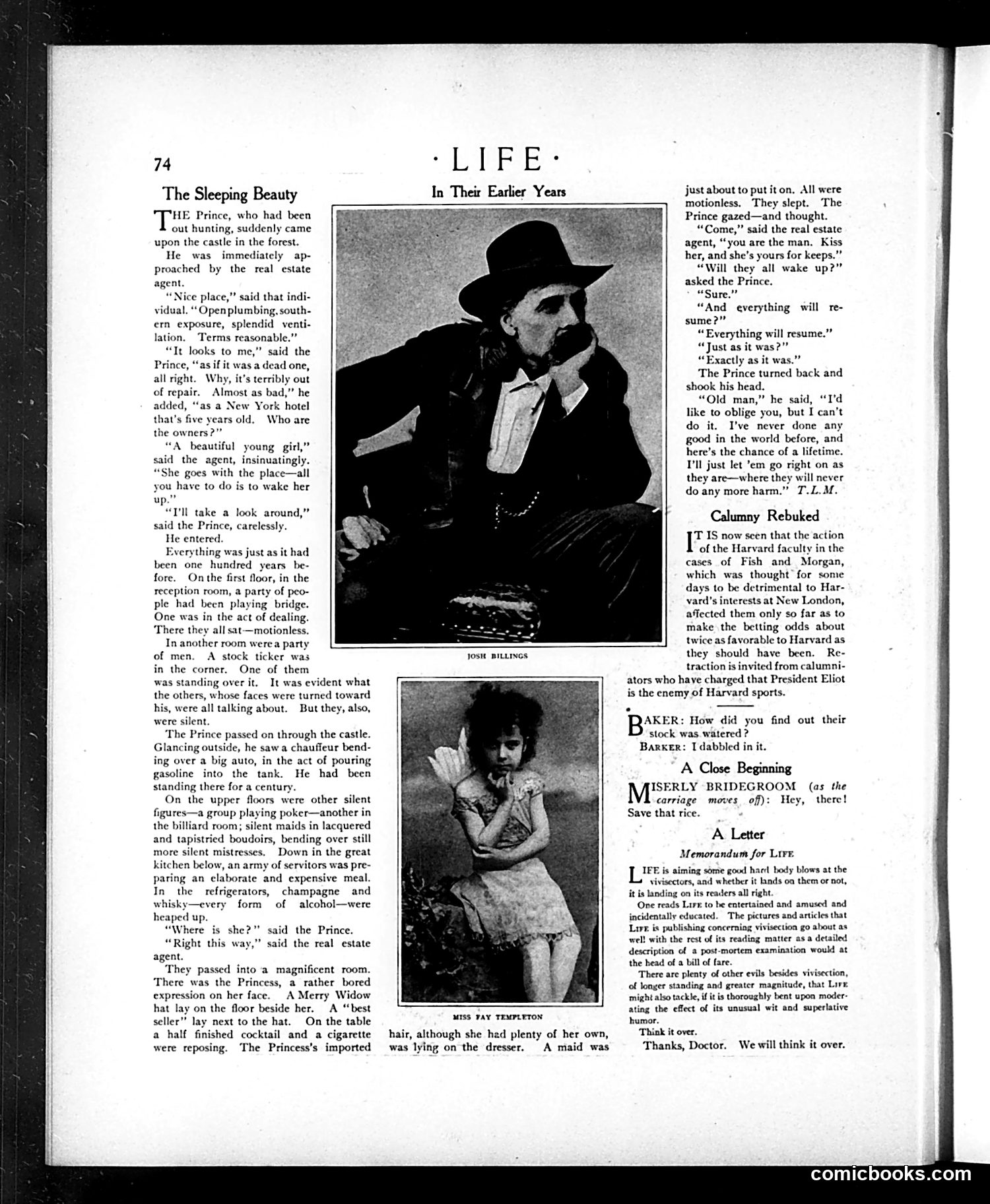
This page adapts the classic fairy tale to satirize early 20th-century American life. A Prince discovers the castle of Sleeping Beauty frozen in time—but rather than awakening everyone with a kiss, he refuses, observing that letting them remain asleep prevents them from doing further harm. The satire targets: 1. **Real estate hustlerism**: The agent cynically markets a decrepit property by including an unconscious woman as part of the "deal" 2. **Modern leisure decay**: The frozen inhabitants represent the idle rich—bridge players, poker players, drinkers—engaged in frivolous, ultimately pointless pursuits 3. **Moral commentary**: The Prince's refusal to restore this world suggests that some societies are better left undisturbed; their resumption would only perpetuate vice and wastefulness The detailed description of the Princess—wearing false hair, smoking, reading "best sellers," drinking cocktails—mocks superficial modernity and artificiality. The satire suggests that 1920s American consumer culture, if given the chance to continue unchanged, would only repeat its moral failings.
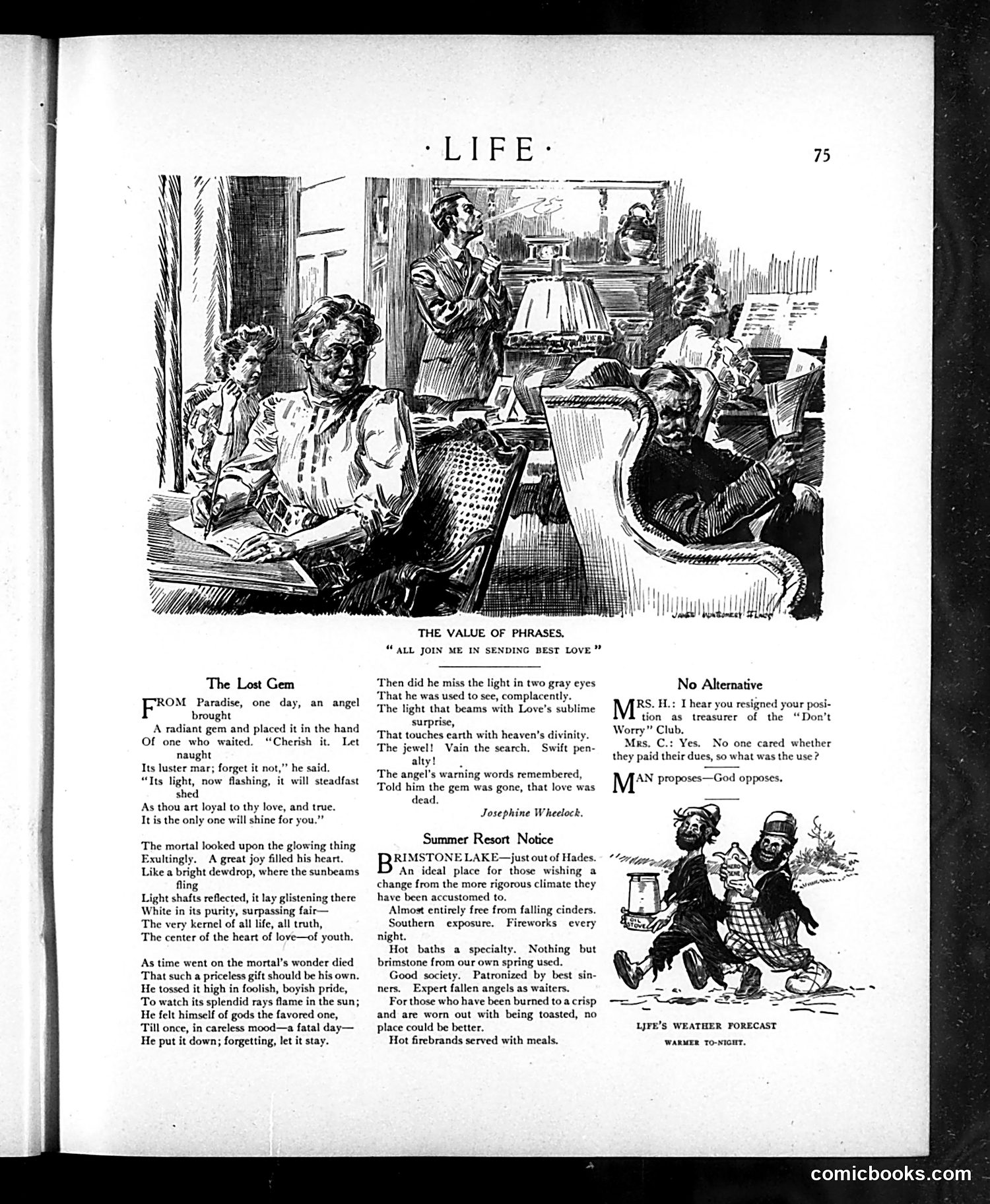
This page contains three distinct pieces of satirical content: **"The Lost Gem"** (poem): A moral allegory about romantic love. An angel gives a man a glowing jewel symbolizing love's light. Initially cherished, the man grows complacent, tosses it carelessly aside, and loses it forever—representing how people neglect relationships through indifference and take love for granted. **"Summer Resort Notice"**: Dark humor satirizing Hell as a vacation destination ("Brimstone Lake—just out of Hades"). The joke mocks both tourist advertising conventions and suggests that Hell's amenities rival earthly resorts, implying society's moral decay. References to "fallen angels as waiters" and those "burned to a crisp" are comedic inversions of luxury resort language. **"No Alternative"** (brief joke): A woman resigned as club treasurer because members didn't pay dues—suggesting the organization was so poorly run, her position was meaningless. The punchline "Man proposes—God opposes" sardonically comments on human futility. The cartoon illustration shows a Victorian-era social gathering, establishing the period's drawing-room setting for these morality-tinged jokes about love, social institutions, and human nature.
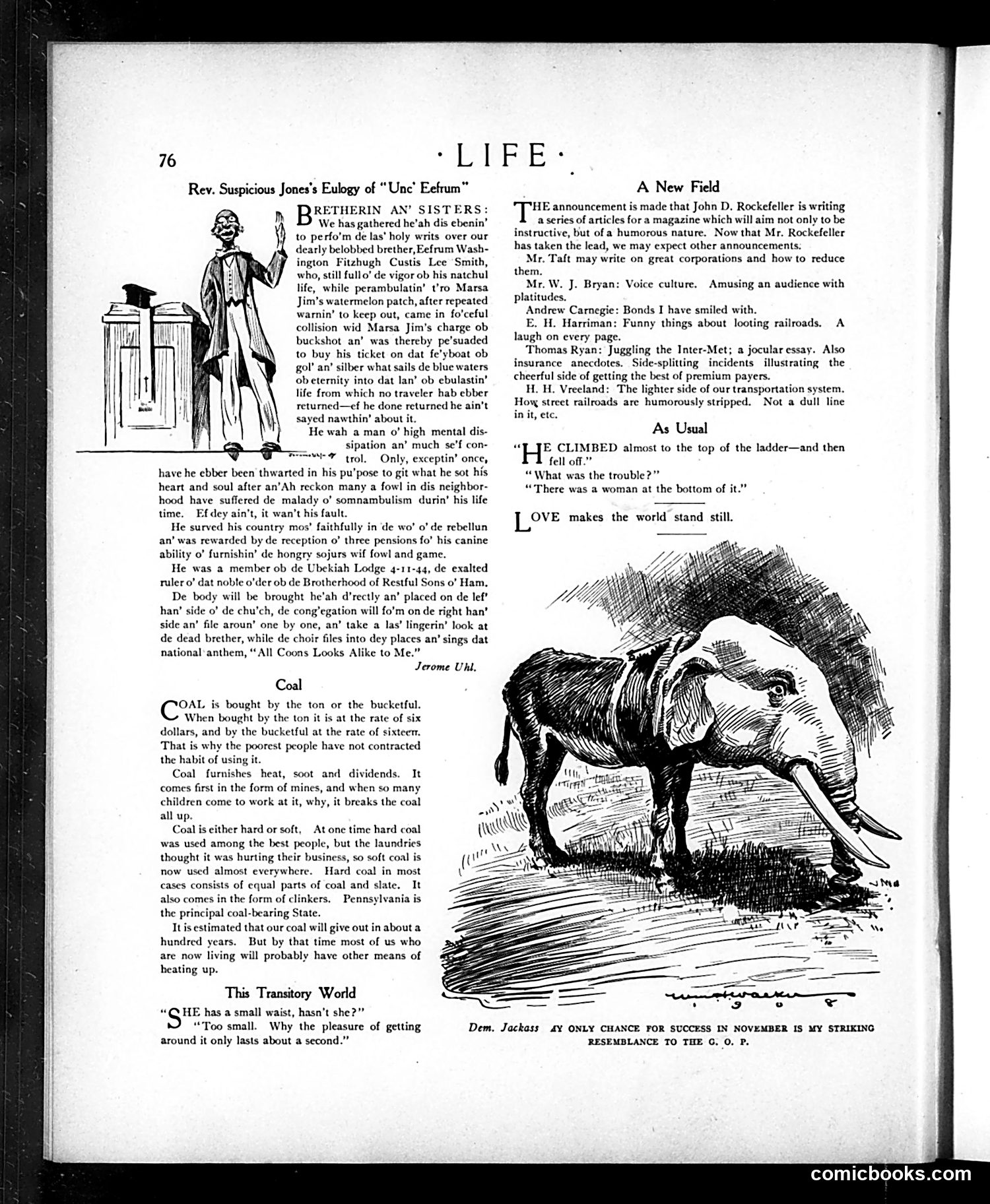
This page contains three distinct pieces of satirical content: **"Rev. Suspicious Jones's Eulogy"** (top): A racist dialect piece mocking African American funeral customs. The funeral oration for "Unc' Eefrum" uses exaggerated dialect and portrays the deceased as a chicken thief who was killed stealing from "Marsa Jim's" watermelon patch—perpetuating degrading stereotypes common in early 20th-century "humor." **"Coal"** (middle): Straightforward satirical commentary on coal economics, noting the poor cannot afford it and that children labor in mines. The ironic closing observes coal will run out in a century, but "most of us who are now living will probably have other means of heating up"—dark humor about mortality. **"A New Field"** (right): Political satire imagining articles by wealthy industrialists (Rockefeller, Taft, Bryan, Carnegie, Harriman, Ryan, Vreeland) on humorous topics. The joke mocks their monopolistic practices by suggesting they'd write comedic pieces—implying their real-world behavior isn't funny at all. The page reflects Life's role as a satirical magazine targeting both racial prejudices and corporate malfeasance.
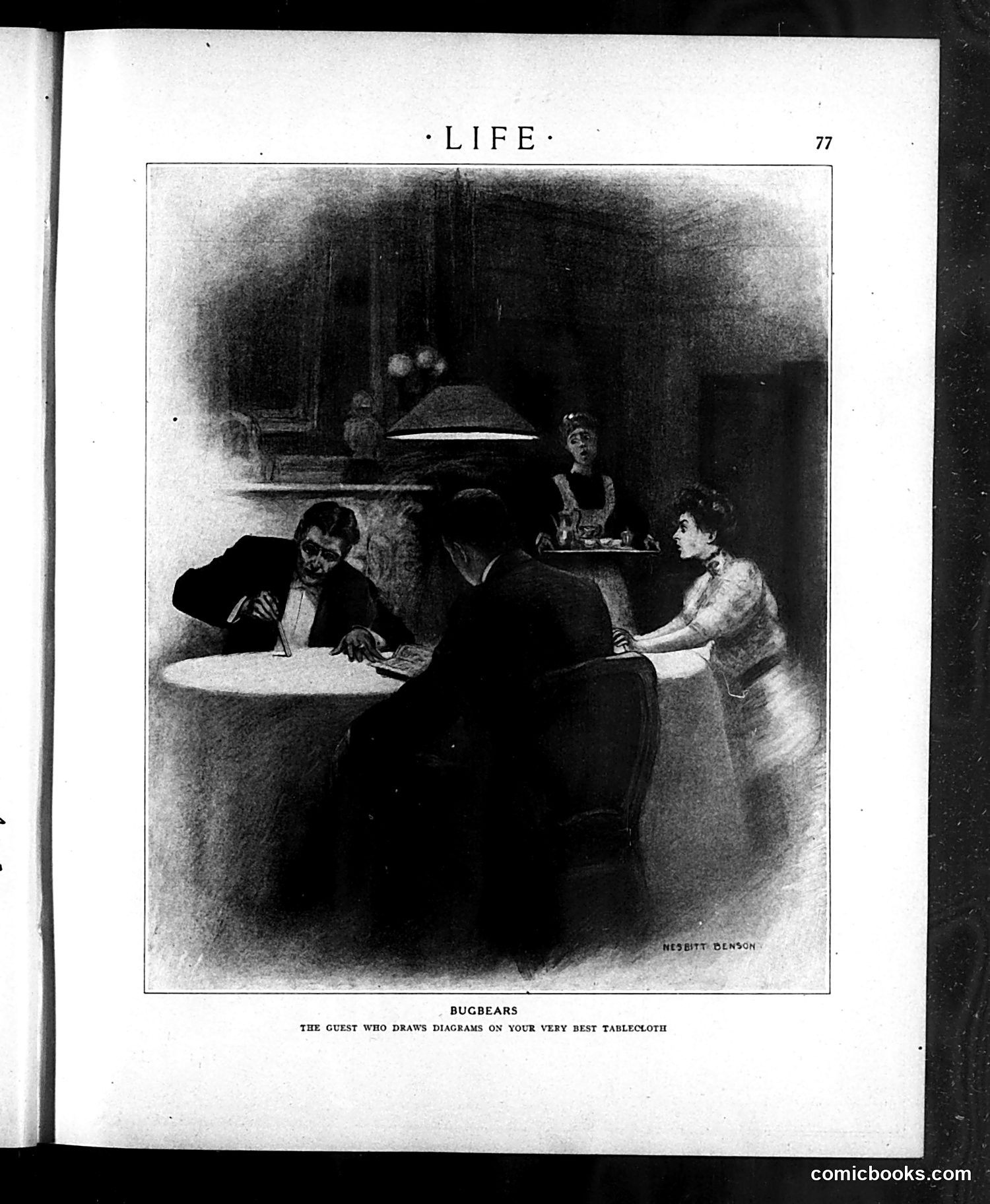
This is a humorous domestic satire from *Life* magazine, illustrated by Hesittt Denson. The cartoon depicts a social annoyance: a dinner guest who, while seated at the table, is drawing diagrams directly on the host's finest tablecloth. The other guests and hosts appear dismayed by this behavior—one woman gestures in protest while others look on in disapproval. The joke satirizes inconsiderate guests and poor manners in polite society. The "bugbear" (a source of anxiety or irritation) is the socially oblivious person who would use expensive table linens as a drawing surface, apparently so absorbed in explaining something through sketches that they've forgotten basic etiquette. It's gentle social commentary on dinner party frustrations.
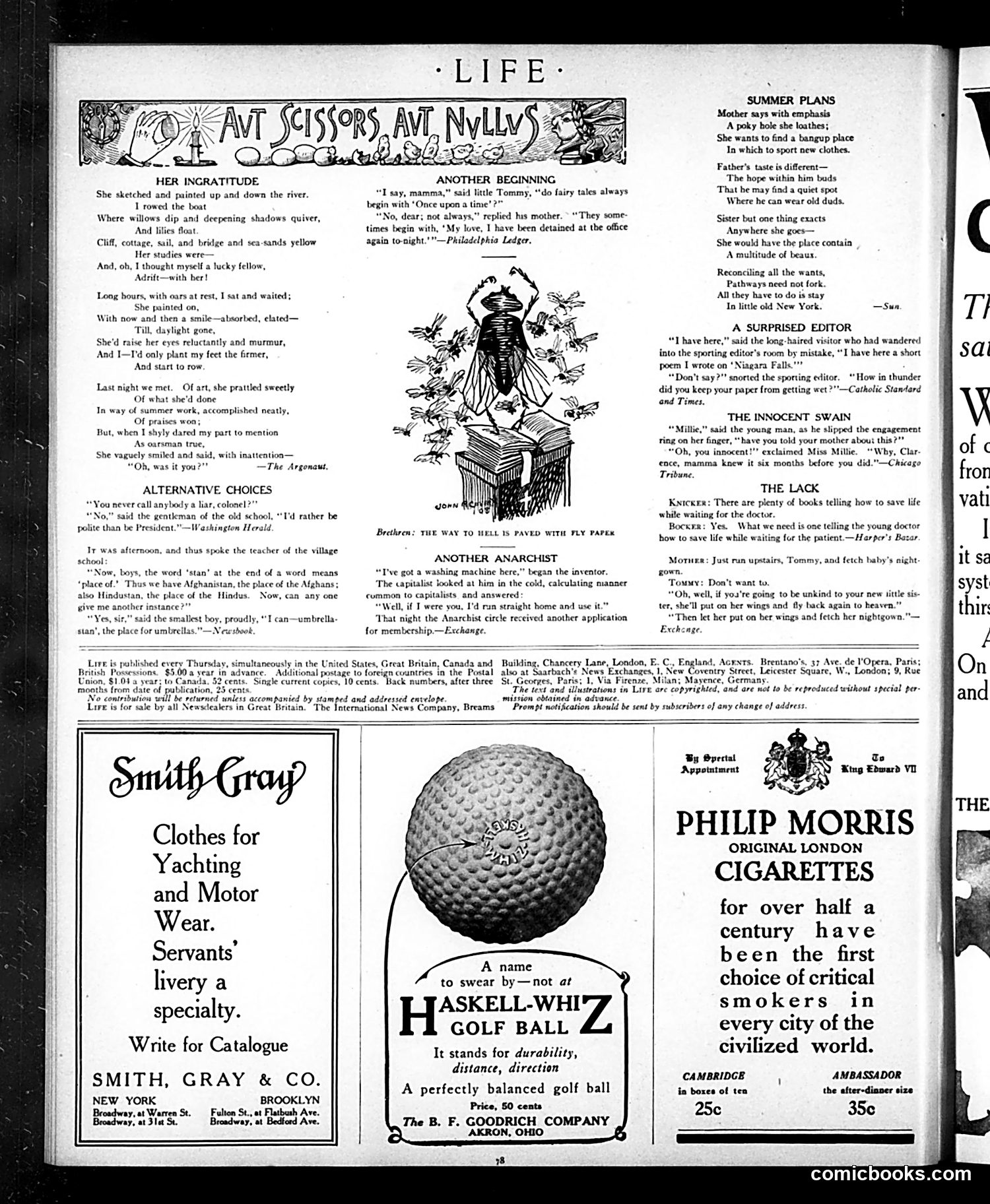
This page contains several humorous short stories and jokes typical of Life magazine's satirical content, rather than political cartoons. The main illustrated piece shows a winged insect (fly) standing on books—accompanying "Brethren: The Way to Hell is Paved with Fly Paper," a pun on the proverb about good intentions. The jokes address everyday social situations: a woman's ingratitude toward her patient suitor, schoolboy wordplay about "-stan" place names, marital domestic life, and professional absurdities (an anarchist's washing machine, an impatient young doctor). "Summer Plans" humorously reconciles conflicting family vacation preferences by suggesting everyone simply stay in New York. The page is primarily filled with period advertisements for yachting clothes, golf balls, and cigarettes. The humor relies on Victorian-era social conventions—romantic entitlement, domestic dynamics, and professional pretension—rather than political satire.
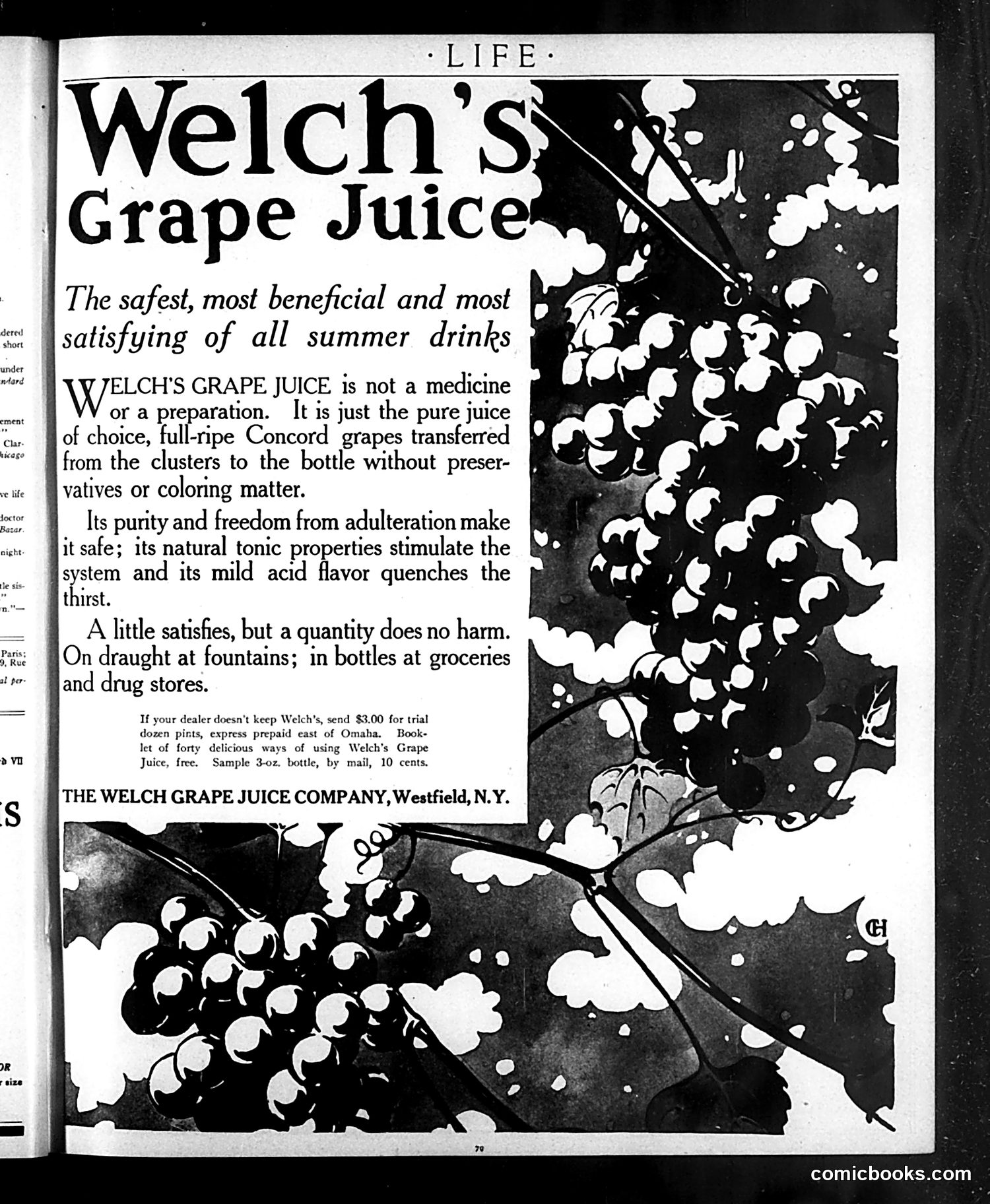
This is a **product advertisement**, not political satire. The page promotes Welch's Grape Juice from Westfield, New York, featuring illustrated grape clusters. The advertisement emphasizes purity and safety—key selling points for the era. The claim that it "is not a medicine or a preparation" is significant: this likely responds to Prohibition-era concerns (early 1900s) about beverages masquerading as medicinal tonics when they were actually alcoholic. By explicitly stating Welch's contains no preservatives or coloring and is "safe," the ad reassures consumers of its legitimacy as a genuine juice product. The copy highlights the product's natural properties and appeals to health-conscious readers. Distribution details (fountains, groceries, drug stores) and the trial-offer pricing ($3.00 for a dozen pints, 10 cents for samples) reflect standard early twentieth-century marketing tactics. The decorative art shows stylized grape bunches, emphasizing the natural product.
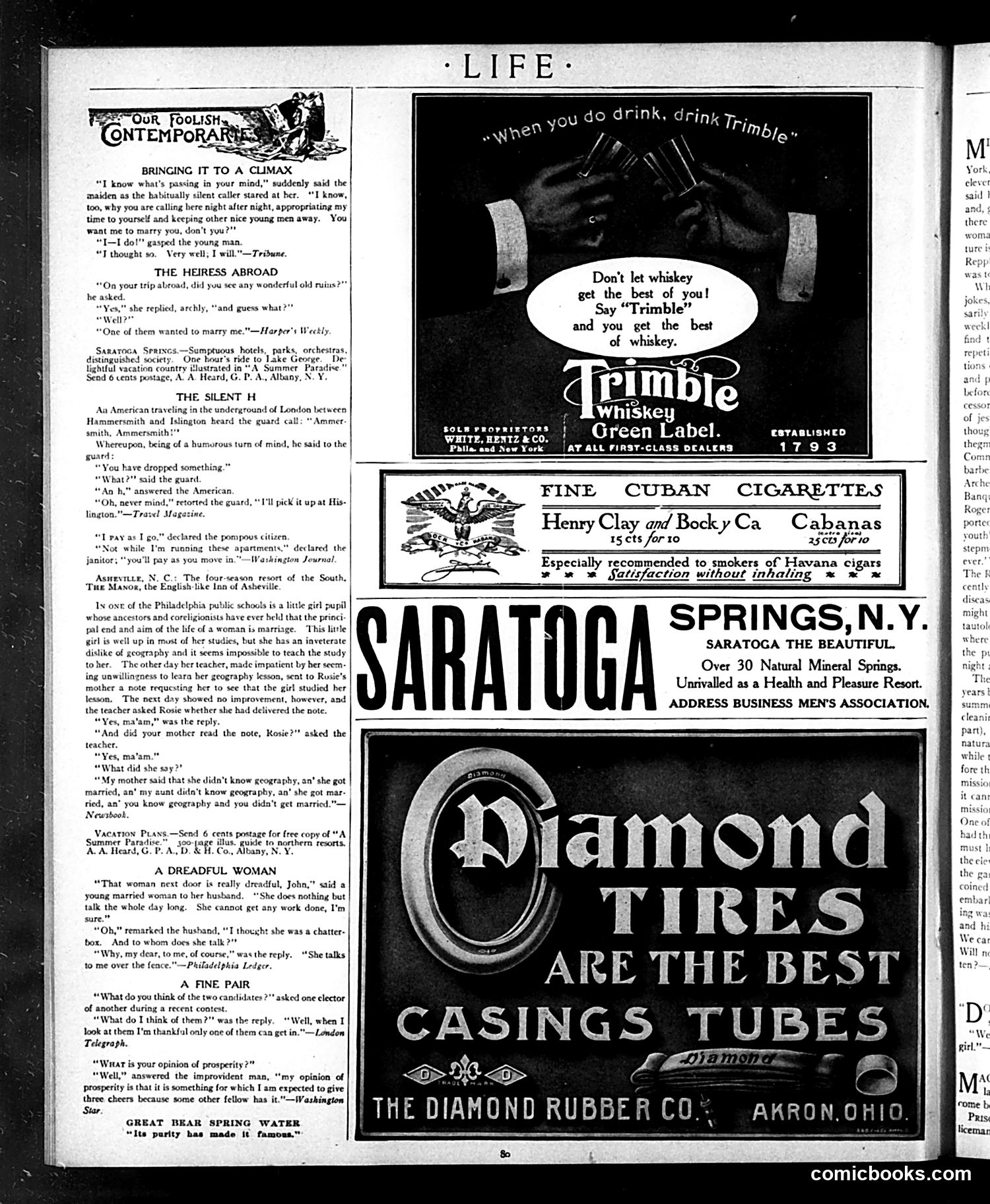
This page from Life magazine consists primarily of **short humorous anecdotes** rather than political cartoons. The jokes satirize early 20th-century social conventions: **"Bringing It to a Climax"**: A young man's silence is interpreted by his romantic interest as a marriage proposal—satirizing courtship rituals and female directness. **"The Heiress Abroad"**: A wealthy woman's jest about ancient ruins proposing to her mocks both tourism and the assumption that wealthy women are marriage targets. **"The Silent H"**: A London guard's dropped "H" in speech is humorous class commentary on working-class accents versus proper pronunciation. **"A Dreadful Woman"**: A wife complains her neighbor talks constantly—the punchline being she herself is the neighbor's sole conversation partner, satirizing gossip and female sociability. The remaining jokes mock political candidates, prosperity claims, and geography education. The page is primarily filled with **period advertisements** for whiskey, cigars, tires, and Saratoga Springs—typical Life magazine content mixing satire with commercial promotion.
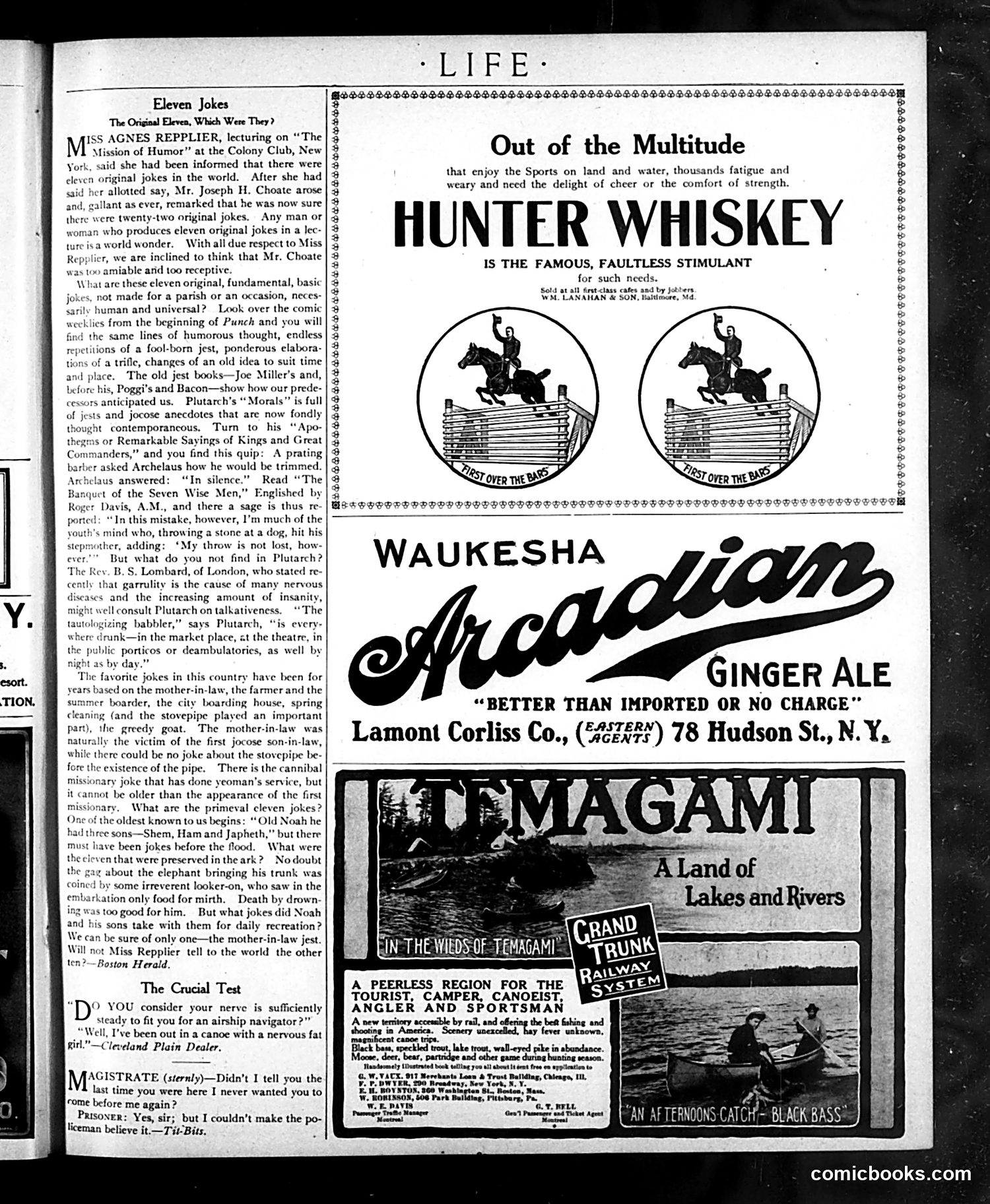
This page mixes editorial content with period advertising. The main article discusses whether truly "original" jokes exist, citing classical sources (Plutarch, Bacon) to argue most humor recycles ancient themes. The author humorously suggests only one genuinely original joke may exist: the mother-in-law joke. Two cartoons appear below: 1. **"The Crucial Test"**: A magistrate questions a prisoner about navigating an airship while nervous. The prisoner claims a policeman wouldn't believe him when he said he'd never return—the joke being the prisoner's obvious dishonesty undermines his credibility on any topic. 2. **Advertisement cartoons** feature Hunter Whiskey and Waukesha Ginger Ale marketed as tonics for tired sportsmen—typical early-20th-century patent medicine advertising claiming restorative powers. The page reflects pre-Prohibition America's casual alcohol advertising alongside humor rooted in class stereotypes (mothers-in-law, farmers, city boarders).
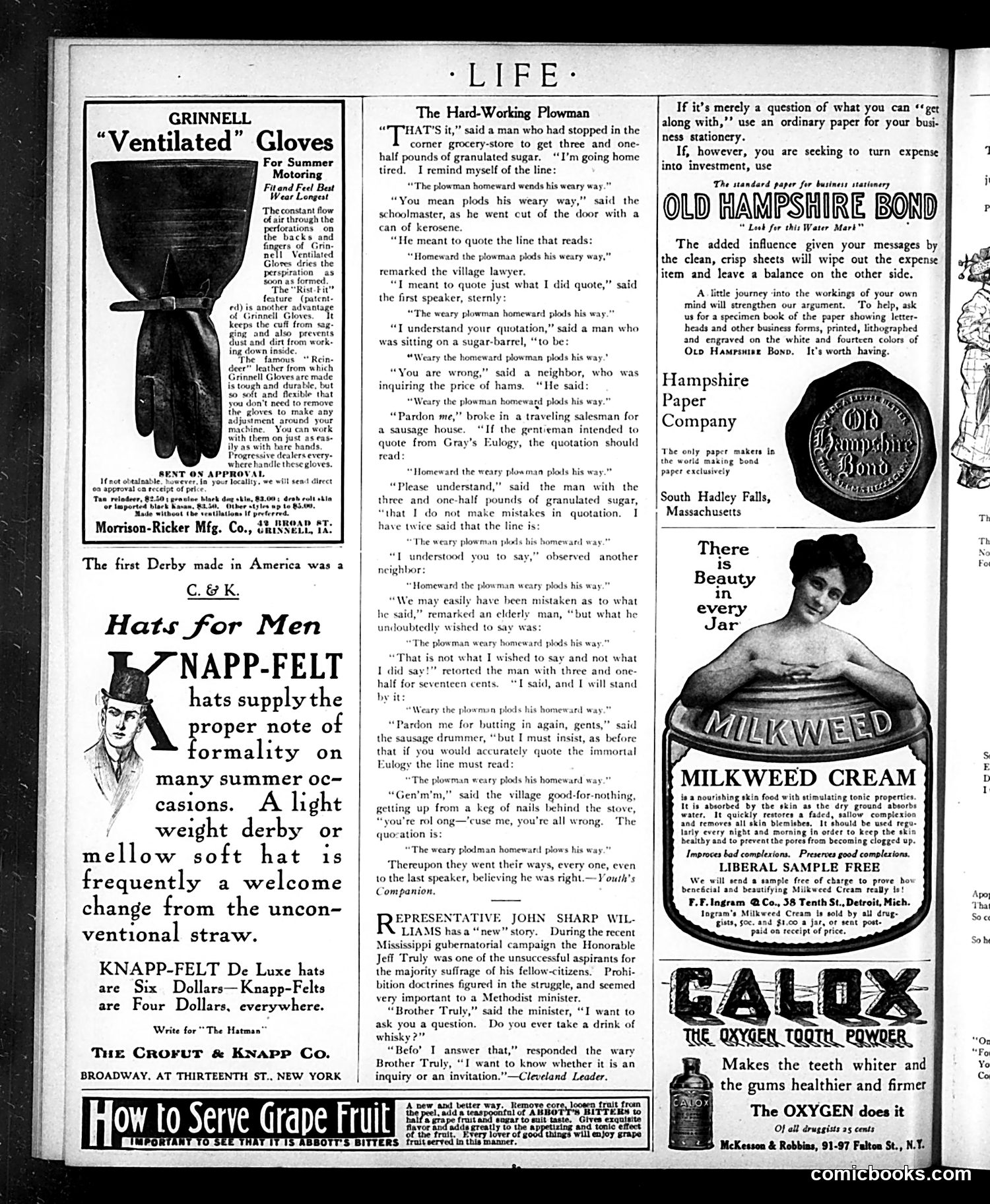
This page is primarily **advertising and humor content**, not political cartoons. The main text feature is "The Hard-Working Plowman," a humorous anecdote about a man trying to quote a line of poetry (apparently from Gray's "Elegy Written in a Country Churchyard") who becomes increasingly frustrated as various townspeople—a schoolmaster, lawyer, traveling salesman, elderly man, and village loafer—each "correct" him with different versions of the same line. **The joke**: The humor lies in the absurdity of multiple people confidently insisting they know the "correct" quotation, each offering a slightly different wording. The original speaker stubbornly maintains his version while everyone else contradicts him, and the passage ends with each person believing they were right despite their disagreement. The page also includes a brief anecdote about Representative John Sharp Williams and a story involving "Jeff Truly" and prohibition, though it's incomplete here. The remainder consists of product advertisements for gloves, hats, paper, and cosmetics—typical of Life magazine's mixed content format.
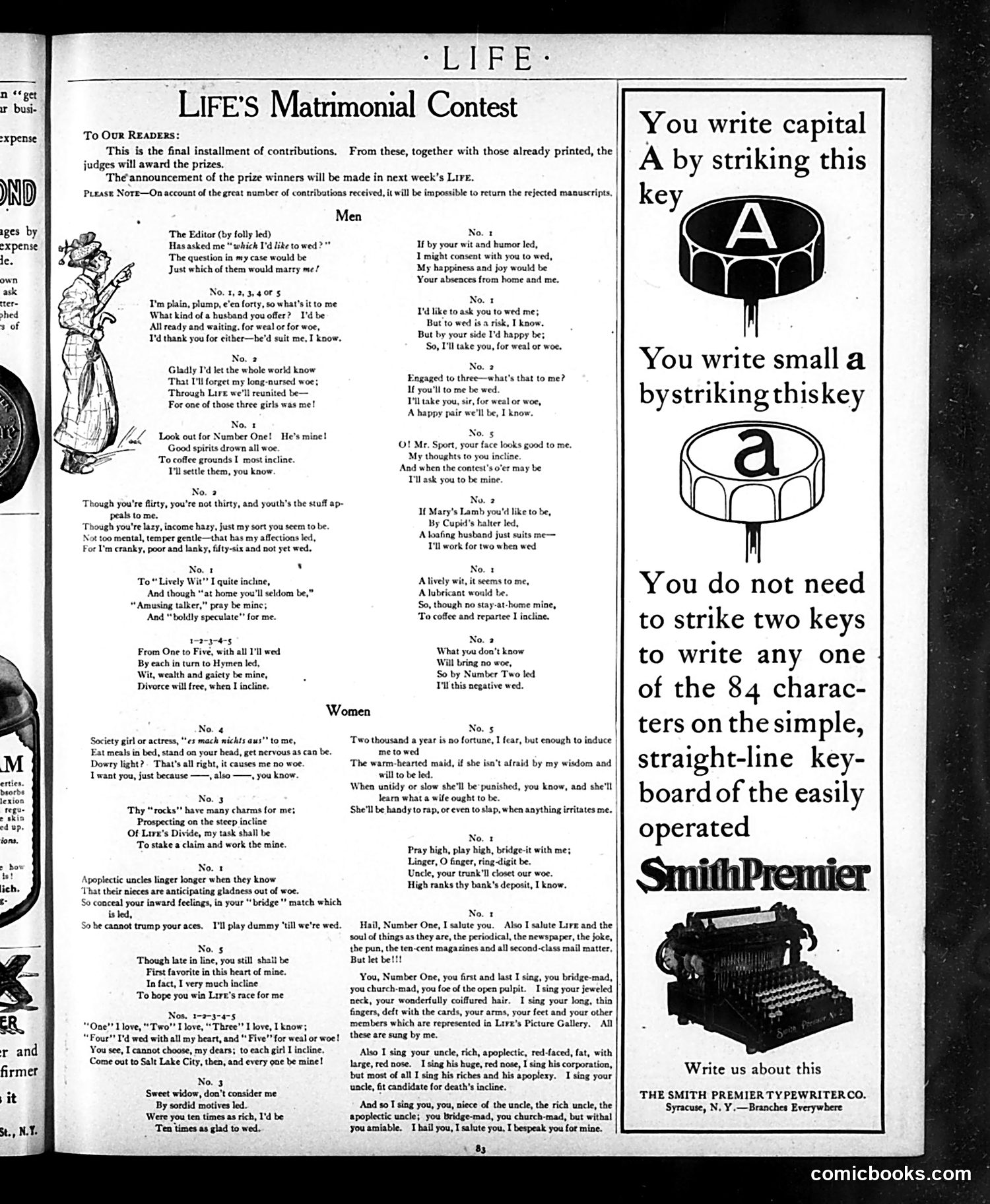
This page presents the final installment of Life's humorous matrimonial contest—readers submitted comic marriage proposals, both from men and women seeking partners. The satire mocks romantic conventions and marital expectations of the era. The submissions reveal period attitudes: men emphasize youth and beauty; women prioritize wealth, wit, or practical security. Notably cynical entries include one man willing to marry "any" of five women for "divorce will free, when I incline," and a woman admitting she'll "conceal your inward feelings" to hide financial scheming. The jokes target both genders' mercenary motives, family fortune-hunting, and the gap between romantic ideals and practical marriage calculations. Life magazine judged the best entries, announcing winners the following week. The right-side advertisement for Smith-Premier typewriters is unrelated to the satirical content.
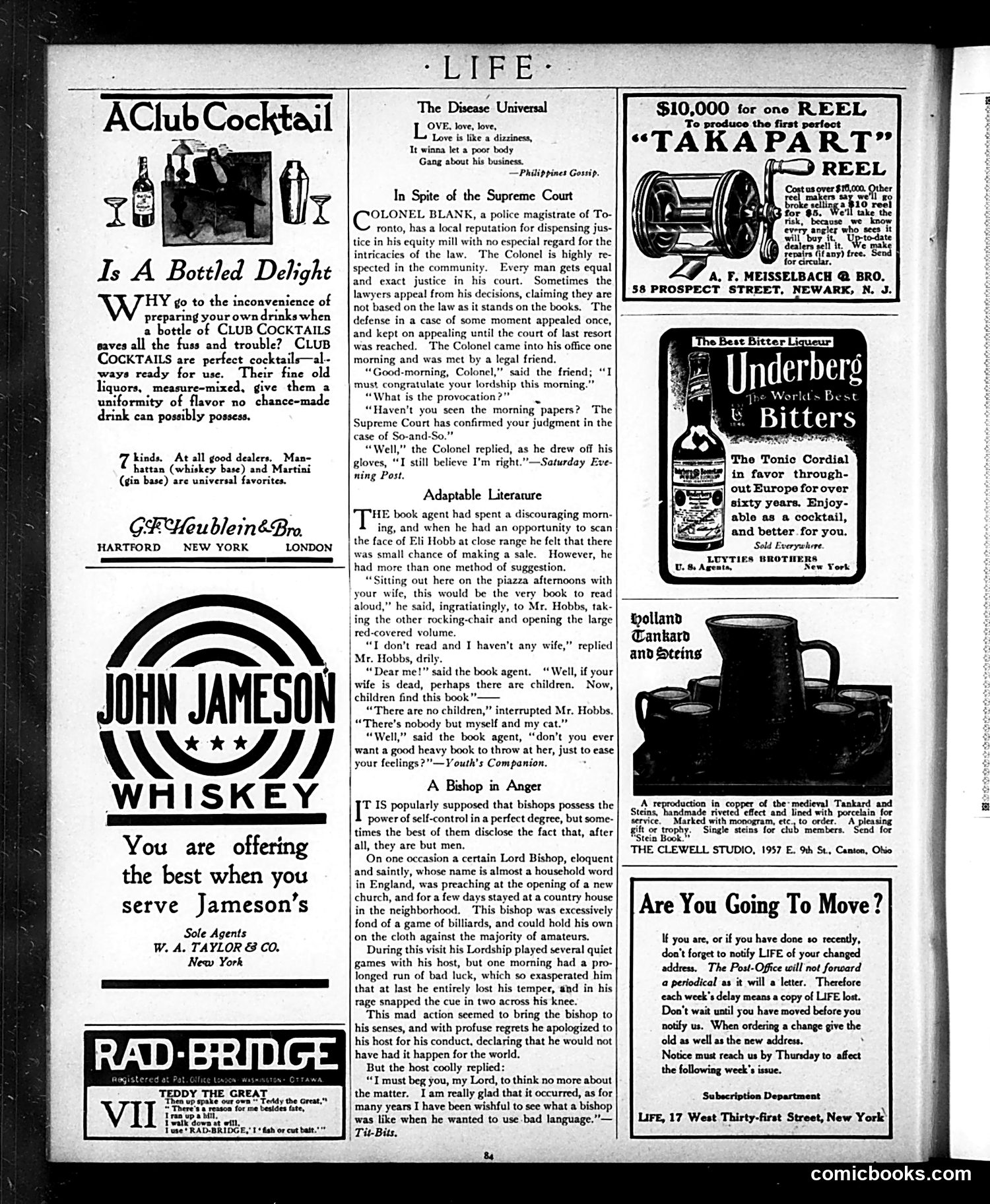
This page is primarily **advertising with three short humorous anecdotes**—not political satire. The advertisements promote alcohol (Club Cocktails, John Jameson Whiskey, Underberg Bitters) typical of the pre-Prohibition or early Prohibition-era magazine. The three brief stories illustrate common themes: 1. **"In Spite of the Supreme Court"**: A Toronto police magistrate named Colonel Blank dispenses justice by personal judgment rather than legal technicality, and the Supreme Court surprisingly upholds his informal ruling. The joke mocks rigid legal systems versus practical justice. 2. **"Adaptable Literature"**: A persistently clever book salesman tries selling to an antisocial man (Eli Hobbs) with no wife or children, finally suggesting the book as a projectile to throw at his cat. 3. **"A Bishop in Anger"**: A dignified bishop loses his temper while playing billiards, snapping his cue in rage—undermining the stereotype of clergy as perfectly self-controlled. These are gentle, class-conscious humor pieces mocking human nature rather than political figures.
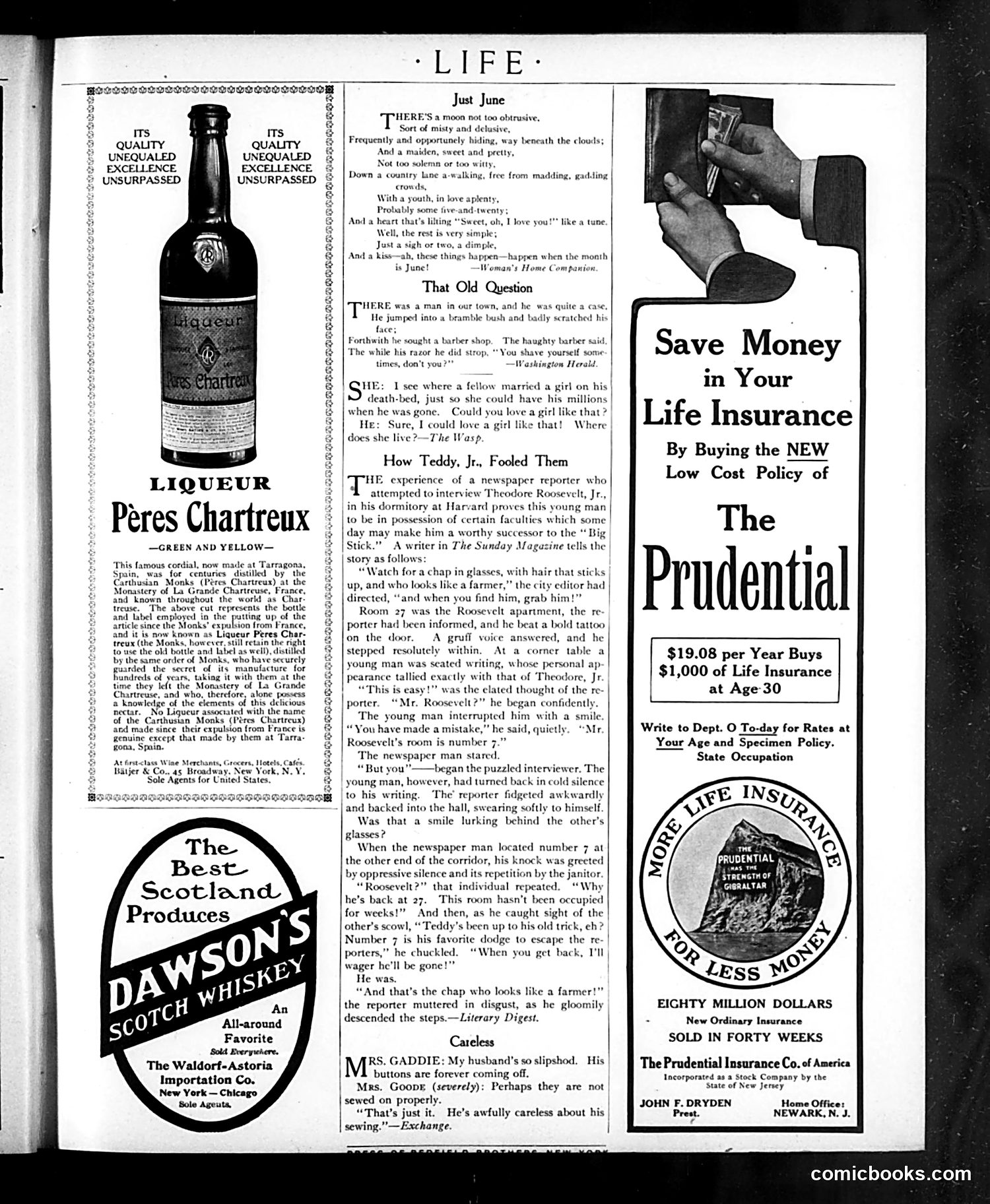
This page from *Life* magazine contains three humorous short pieces typical of early 20th-century American satire: **"That Old Question"** mocks a man who jumped into brambles, then asks a barber if he shaves himself—absurd literalism as comedy. **"How Teddy, Jr, Fooled Them"** satirizes a newspaper reporter attempting to interview Theodore Roosevelt Jr. at Harvard. The young man deliberately impersonates a farm-looking student matching the editor's description, sending the reporter on a wild chase to the wrong room. The joke targets the reporter's gullibility and the superficiality of identifying people by appearance. **Poetry and romance vignettes** fill the center—sentimental verses about June moonlight and young love, typical of the era's magazine content. The page also features period advertisements for Pères Chartreux liqueur and Prudential life insurance, which were standard revenue sources for magazines. The overall tone reflects *Life*'s identity as a satirical weekly aimed at educated, urban readers.
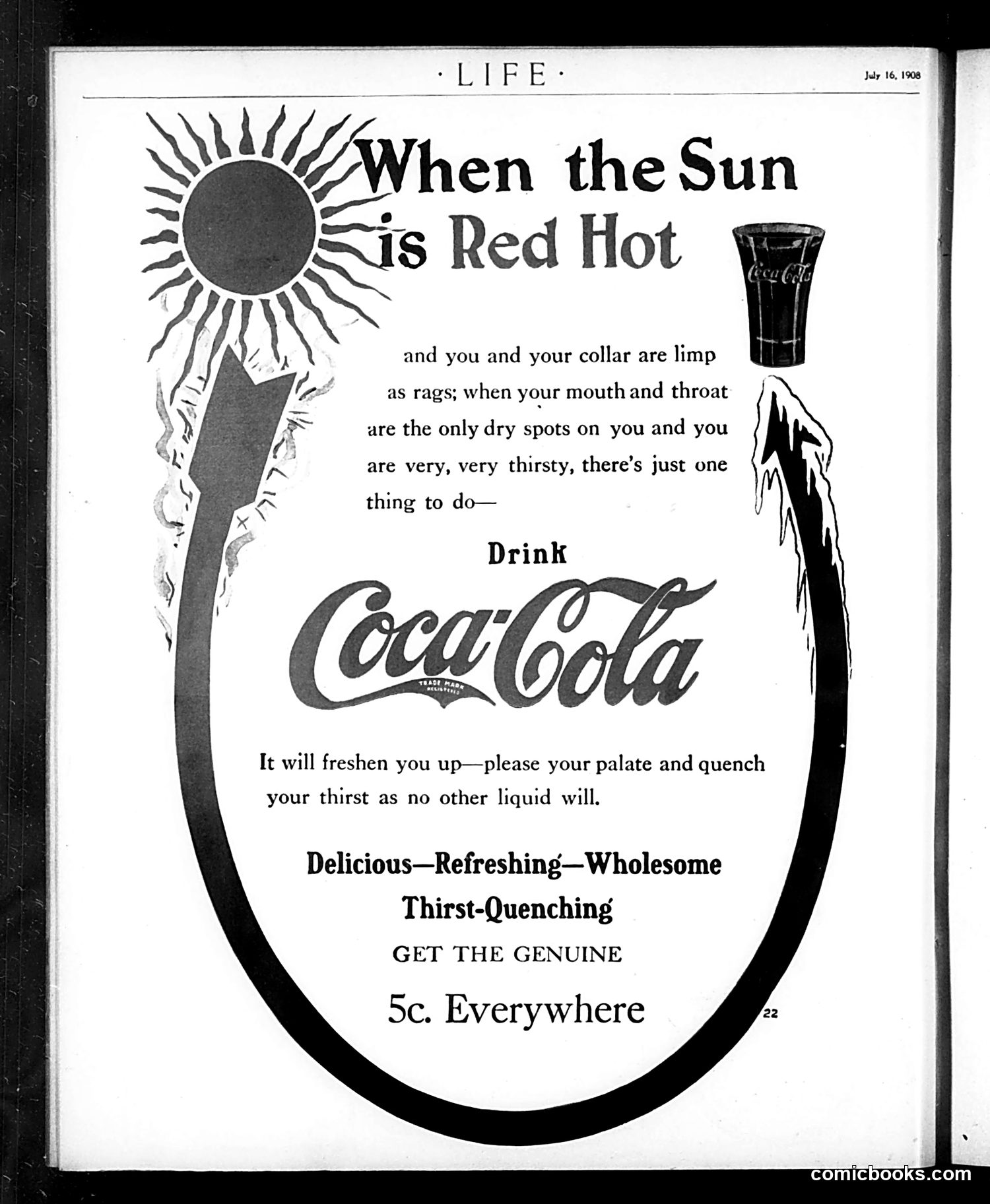
This is a **Coca-Cola advertisement**, not political satire. Dated July 16, 1908, it uses visual humor to sell the product rather than mock any figures or events. The joke is straightforward: a dramatic illustration shows the sun beating down mercilessly, reducing a person to a wilted shadow. The ad promises Coca-Cola as the solution to extreme heat exhaustion—the only remedy that will truly satisfy thirst "as no other liquid will." The messaging emphasizes the drink's refreshing properties through exaggerated imagery (the person's literal collapse) and claims of superiority. At 5 cents, it positioned the product as an affordable luxury for hot summer days. This reflects early 20th-century advertising that emphasized product benefits through humor and hyperbole rather than fact-based claims. No political figures or satirical commentary appear here—it's purely commercial marketing.