
Life, 1908-07-16 · page 10 of 26
Life — July 16, 1908 — page 10: what you’re looking at
What you’re looking at
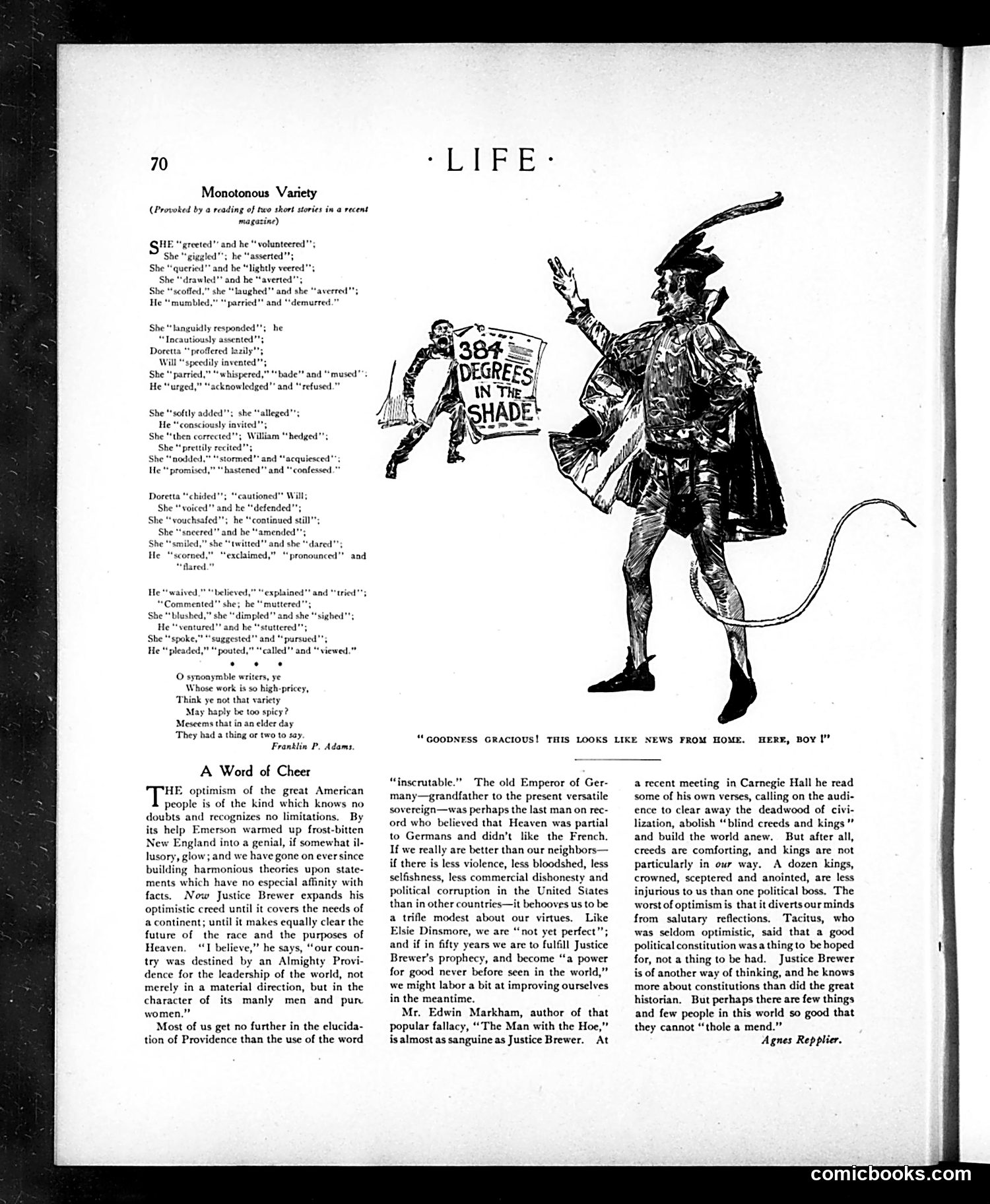
The central illustration depicts a devil-like figure holding a thermometer labeled "384 DEGREES IN THE SHADE," with the caption "GOODNESS GRACIOUS! THIS LOOKS LIKE NEWS FROM HOME. HERE, BOY!" This appears to be **wartime satire**, likely from WWI or WWII, mocking enemy soldiers or an enemy nation. The cartoon suggests that conditions in hell ("home" to the devil) are comparable to extreme heat—384 degrees—implying the enemy faces impossibly harsh, hellish circumstances. The devil's casual reaction ("news from home") sarcastically suggests their suffering amuses him. The accompanying text discusses American optimism and virtue, contrasting with implied enemy moral failings, supporting the propagandistic tone of the cartoon.
📄 Transcribed text from this page (OCR, searchable)
Machine-transcribed from the original scan — historical spelling and the odd misread are preserved.
70 Monotonous Variety (Provoked by a reading of two short stories in a recent magazine) GHE “greeted” and he “volunteered”; She“ gled"’; he “‘asserted""; and be “lightly veered "*; and he “averted""; ¢ laughed" and she “averred"*; parried"* and ‘‘demurred.”” She“ “‘Incautiously assented Doretta “proffered lazil speedily invented’; She “ parried,”* “whispered,” "bade" and “*mused’": He “urged,” “acknowledged” and “refused.” She “softly added"; she “alleged”; “consciously invited"; hen corrected"; William "hedged"; She " pretti She “nodded, He "promised and “acquiesced hastened" and “confessed.” cautioned" Will; defended" "5 he “continued ‘neered* and he “amended twitted"’ and she "dared"; xclaimed,” “pronounced” and xplained"’ and * he “muttered”; impled"” and she "sighed"; tattered suggested" and " pursued called”? and eo 8 tried "5 O synonymble writers, ye Whose work is so high-pricey, ‘Think ye not that variety May haply be too spicy? Mescems that in an elder day ‘They had a thing of two to say. Franklin P. Adams A Word of Cheer HE optimism of the great American people is of the kind which knows no doubts and recognizes no limitations. By its help Emerson warmed up frost-bitten New England into a genial, if somewhat il- lusory, glow; and we have gone on ever since building harmonious theories upon state- ments which have no especial affinity with facts, Now Justice Brewer expands his optimistic creed until it covers the needs of a continent; until it makes equally clear the future of the race and the purposes of Heaven, “I believe,” he says, “our coun- try was destined by an Almighty Provi- dence for the leadership of the world, not merely in a material direction, but in the character of its manly men and pur women.”” Most of us get no further in the elucida- tion of Providence than the use of the word “GOODNESS GRACIOUS! THIS LOOKS LIKE NEWS FROM HOME. “inscrutable.” The old Emperor of Ger- many—grandfather to the present versatile sovercign—was perhaps the last man on rec- ord who believed that Heaven was partial to Germans and didn’t like the French. If we really are better than our neighbors— if there is less violence, less bloodshed, less selfishness, less commercial dishonesty and political corruption in the United States than in other countries—it behooves us to be a trifle modest about our virtues. Like Elsie Dinsmore, we are “not yet perfect” and if in fifty years we are to fulfill Justice Brewer's prophecy, and become “a power for good never before seen in the world,” we might labor a bit at improving ourselves in the meantime. Mr. Edwin Markham, author of that popular fallacy, “The Man with the Hoe,” isalmost as sanguine as Justice Brewer. At HERE, BOY I” a recent meeting in Carnegie Hall he read some of his own verses, calling on the audi- ence to clear away the deadwood of civi- lization, abolish “blind creeds and kings" and build the world anew. But after all, creeds are comforting, and kings are not particularly in our way. A dozen kings, crowned, sceptered and anointed, are less injurious to us than one political boss. The worst of optimism is that it diverts our minds from salutary reflections, Tacitus, who was seldom optimistic, said that a good political constitution was thing to be hoped for, not a thing to be had. Justice Brewer is of another way of thinking, and he knows more about constitutions than did the great historian. But perhaps there are few things and few people in this world so good that they cannot “‘thole a mend.” Agnes Repplier. comicbooks.com