
Life, 1908-07-16 · page 6 of 26
Life — July 16, 1908 — page 6: what you’re looking at
What you’re looking at
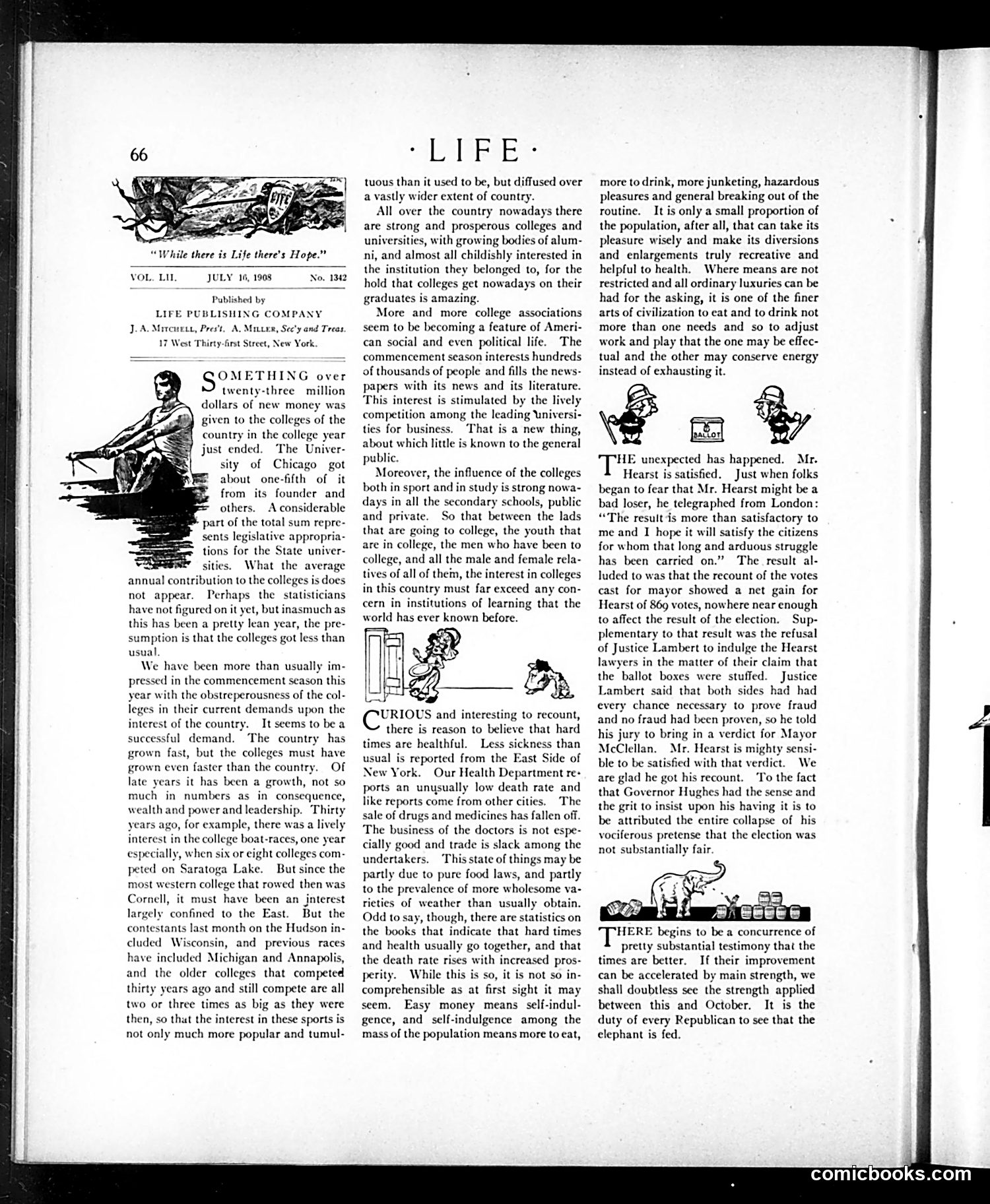
This page discusses college influence on American society and an election result. The text references "Mr. Hearst" receiving disappointing election news from London, with a telegraphed message about vote recounts. A mayoral election result is mentioned, with Justice Lambert involved in ballot-stuffing investigations. The cartoons appear to illustrate themes of money in politics and fraud. One sketch shows a figure at an oar, labeled "While there is Life there's Hope," suggesting perseverance despite setbacks. The page critiques how colleges shape national interests and how major figures like newspaper magnate William Randolph Hearst influence politics. The mention of ballot fraud and Justice Lambert suggests contemporary electoral corruption concerns—likely referencing the 1908 NYC mayoral race and Hearst's political ambitions.
📄 Transcribed text from this page (OCR, searchable)
Machine-transcribed from the original scan — historical spelling and the odd misread are preserved.
“While there is Life there’s Hope.” VOL. LU. 1908 No. 1342 JULY Published by LIFE PUBLISHING COMPANY J.A. Mircuent, Pres't, A. Miture, See'y and Treas Street, New York. OMETHING over twenty-three million dollars of new money was given to the colleges of the country in the college year just ended. The Univer- sity of Chicago got about one-fifth of it from its founder and others. A considerable + part of the total sum repre- sents legislative appropria- tions for the State univer- sities. What the average annual contribution to the colleges is does not appear. Perhaps the statisticians have not figured on it yet, but inasmuch as this has been a pretty lean year, the pre- sumption is that the colleges got less than usual. We have been more than usually im- pressed in the commencement season this year with the obstreperousness of the col- ieges in their current demands upon the interest of the country. It seems to be a successful demand. The country has grown fast, but the colleges must have grown even faster than the country. Of late years it has been a growth, not so much in numbers as in consequence, wealth and power and leadership. Thirty ears ago, for example, there was a lively interest in the college boat-races, one year especially, when six or eight colleges com- peted on Saratoga Lake. But since the most western college that rowed then was Cornell, it must have been an jnterest largely confined to the East. But the contestants last month on the Hudson in- cluded Wisconsin, and previous races have included Michigan and Annapolis, and the older colleges that competed thirty years ago and still compete are all two or three times as big as they were then, so that the interest in these sports is not only much more popular and tumul- “LL ERES tuous than it used to be, but diffused over a vastly wider extent of country. All over the country nowadays there are strong and prosperous colleges and universities, with growing bodies of alum- ni, and almost all childishly interested in the institution they belonged to, for the hold that colleges get nowadays on their graduates is amazing. More and more college associations seem to be becoming a feature of Ameri- can social and even political life. The commencement season interests hundreds of thousands of people and fills the news- papers with its news and its literature. This interest is stimulated by the lively competition among the leading \universi- ties for business. That is a new thing, about which little is known to the general public. Moreover, the influence of the colleges both in sport and in study is strong nowa- days in all the secondary schools, public and private. So that between the lads that are going to college, the youth that are in college, the men who have been to college, and all the male and female re tives of all of them, the interest in colleges in this country must far exceed any con- cern in institutions of learning that the world has ever known before. 'URIOUS and interesting to recount, there is reason to believe that hard times are healthful. Less sickness than usual is reported from the East Side of New York. Our Health Department re+ ports an unusually low death rate and like reports come from other cities. The sale of drugs and medicines has fallen off The business of the doctors is not espe- cially good and trade is slack among the undertakers. This state of things may be partly due to pure food laws, and partly to the prevalence of more wholesome va- rieties of weather than usually obtain. Odd to say, though, there are statistics on the books that indicate that hard times and health usually go together, and that the death rate rises with increased pros- perity. While this is so, it is not so in- comprehensible as at first sight it may seem. Easy money means self-indul- gence, and self-indulgence among the mass of the population means more to eat, more to drink, more junketing, hazardous pleasures and general breaking out of the routine. It is only a small proportion of the population, after all, that can take its pleasure wisely and make its diversions and enlargements truly recreative and helpful to health. Where means are not restricted and all ordinary luxuries can be had for the asking, it is one of the finer arts of civilization to cat and to drink not more than one needs and so to adjust work and play that the one may be effec- tual and the other may conserve energy instead of exhausting it. —— ation} TH unexpected has happened. Mr. Hearst is satisfied. Just when folks began to fear that Mr. Hearst might be a bad loser, he telegraphed from London: “The resultis more than satisfactory to me and I hope it will satisfy the citizens for whom that long and arduous struggle has been carried on.” The result al- luded to was that the recount of the votes cast for mayor showed a net gain for Hearst of 869 votes, nowhere near enough to affect the result of the election. Sup- plementary to that result was the refusal of Justice Lambert to indulge the Hearst lawyers in the matter of their claim that the ballot boxes were stuffed. Justice Lambert said that both sides had had every chance necessary to prove fraud and no fraud had been proven, so he told his jury to bring in a verdict for Mayor McClellan, Mr. Hearst is mighty sensi- ble to be satisfied with that verdict. We are glad he got his recount. ‘To the fact that Governor Hughes had the sense and the grit to insist upon his having it is to be attributed the entire collapse of his vociferous pretense that the election was not substantially fair. HERE begins to be a concurrence of pretty substantial testimony that the times are better. If their improvement can be accelerated by main strength, we shall doubtless see the strength applied between this and October. It is the duty of every Republican to see that the elephant is fed. comicbooks.com