
A complete issue · 28 pages · 1908
Life — June 18, 1908
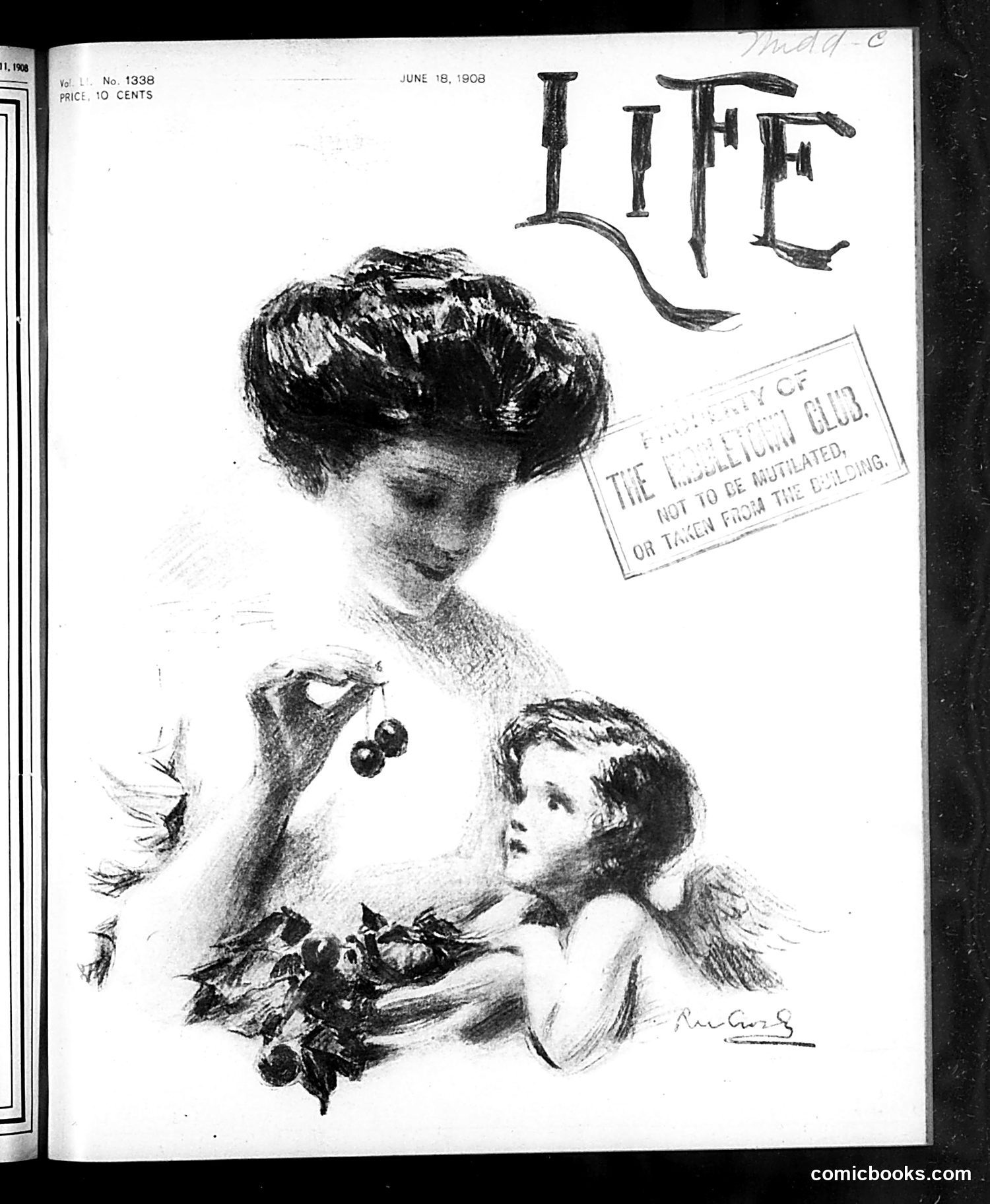
This cover illustration depicts a fashionable woman in Edwardian dress with an elaborate upswept hairstyle, gazing down at a cherub or cupid figure holding what appears to be berries or fruit. The word "LIFE" dominates the upper right. The satirical point appears to address turn-of-the-century gender dynamics and beauty standards. The woman's idealized, refined appearance contrasts with the innocent cherub below, suggesting commentary on adult femininity, romantic idealization, or possibly the commercialization of beauty. The stamp reading "The Immorality Club / Not to be mutilated or taken from the clubhouse" is unclear in its specific reference—it may be ironic commentary on propriety or club culture. The illustration is signed by what appears to be the artist's name in the lower right.
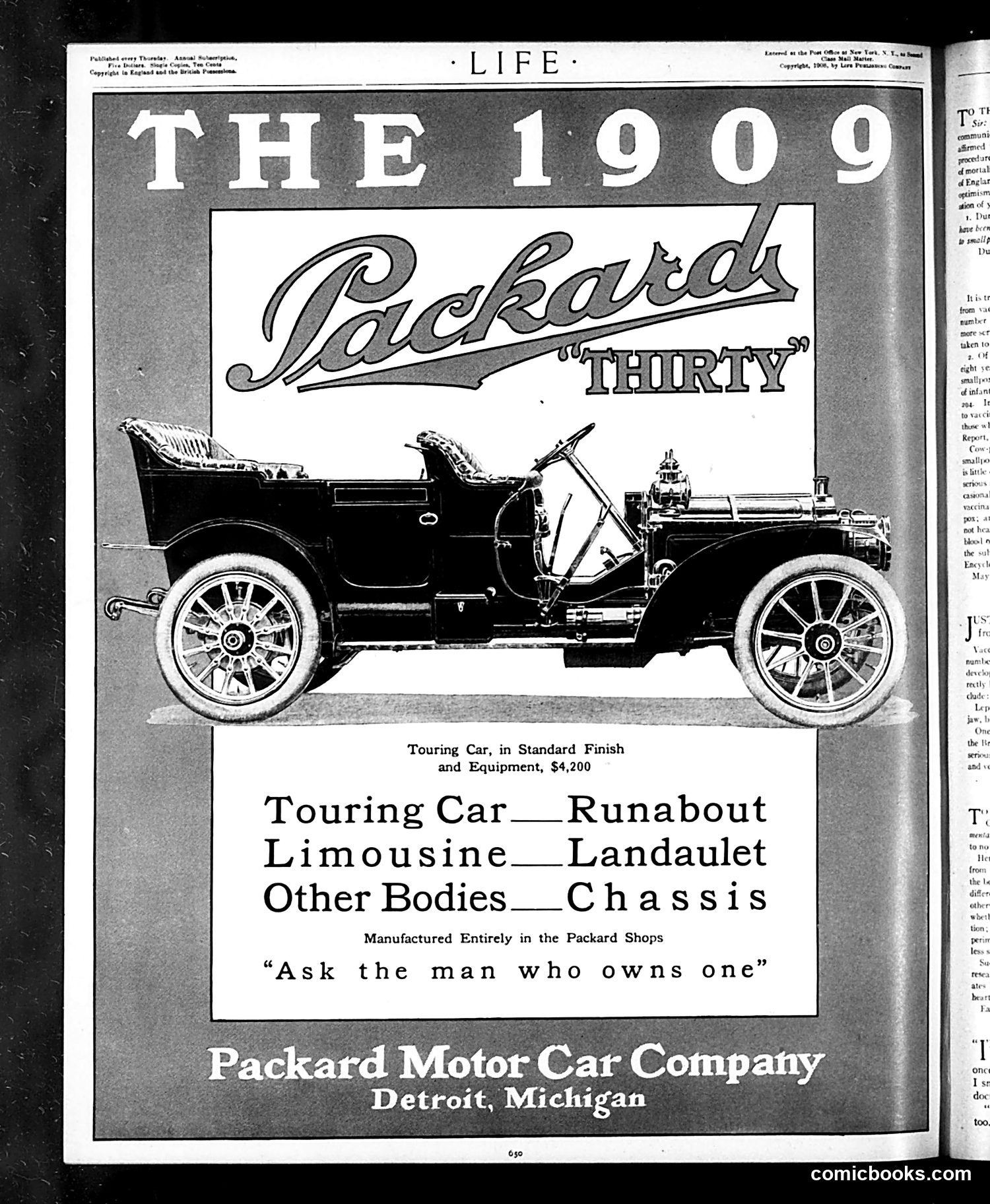
This page is **primarily an advertisement**, not satire or a political cartoon. It promotes the 1909 Packard "Thirty" automobile, featuring a detailed side-view illustration of the touring car model. The ad highlights various body styles available (Touring Car, Runabout, Limousine, Landaulet) and emphasizes that the vehicle is "Manufactured Entirely in the Packard Shops." The price is listed as $4,200 in standard finish. The tagline "Ask the man who owns one" became Packard's famous advertising slogan, positioning the car as a luxury vehicle whose owners could vouch for its quality. This appears in a 1909 *Life* magazine issue, reflecting the early automotive era when cars were expensive luxury goods marketed to wealthy Americans.
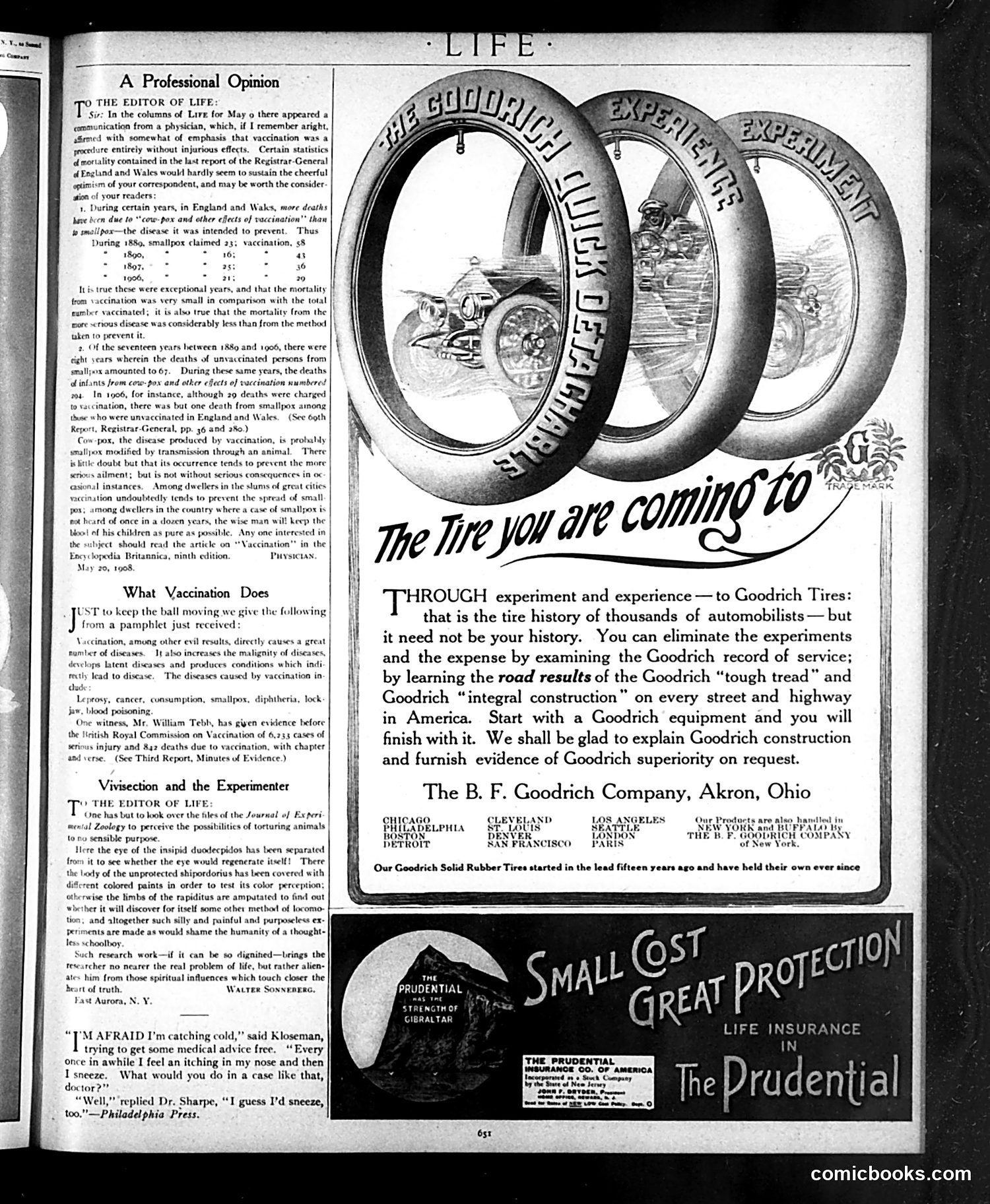
This page is primarily **advertising and medical content** rather than political satire. The left column contains a medical debate about vaccination—"A Professional Opinion" discusses whether vaccination causes deaths, citing statistics from England and Wales. Below that, educational sections explain "What Vaccination Does" and discuss "Vivacection and the Experimenter," debating animal testing ethics. The dominant visual is a large **Goodrich Tires advertisement** featuring a giant tire with an automobile engine inside, promoting their "tough tread" and "integral construction." At the bottom is a **Prudential Life Insurance advertisement** emphasizing "Small Cost, Great Protection." There is **no political cartoon or satire** on this page. It reflects early 20th-century magazine content mixing medical discussion, product advertising, and insurance promotion.
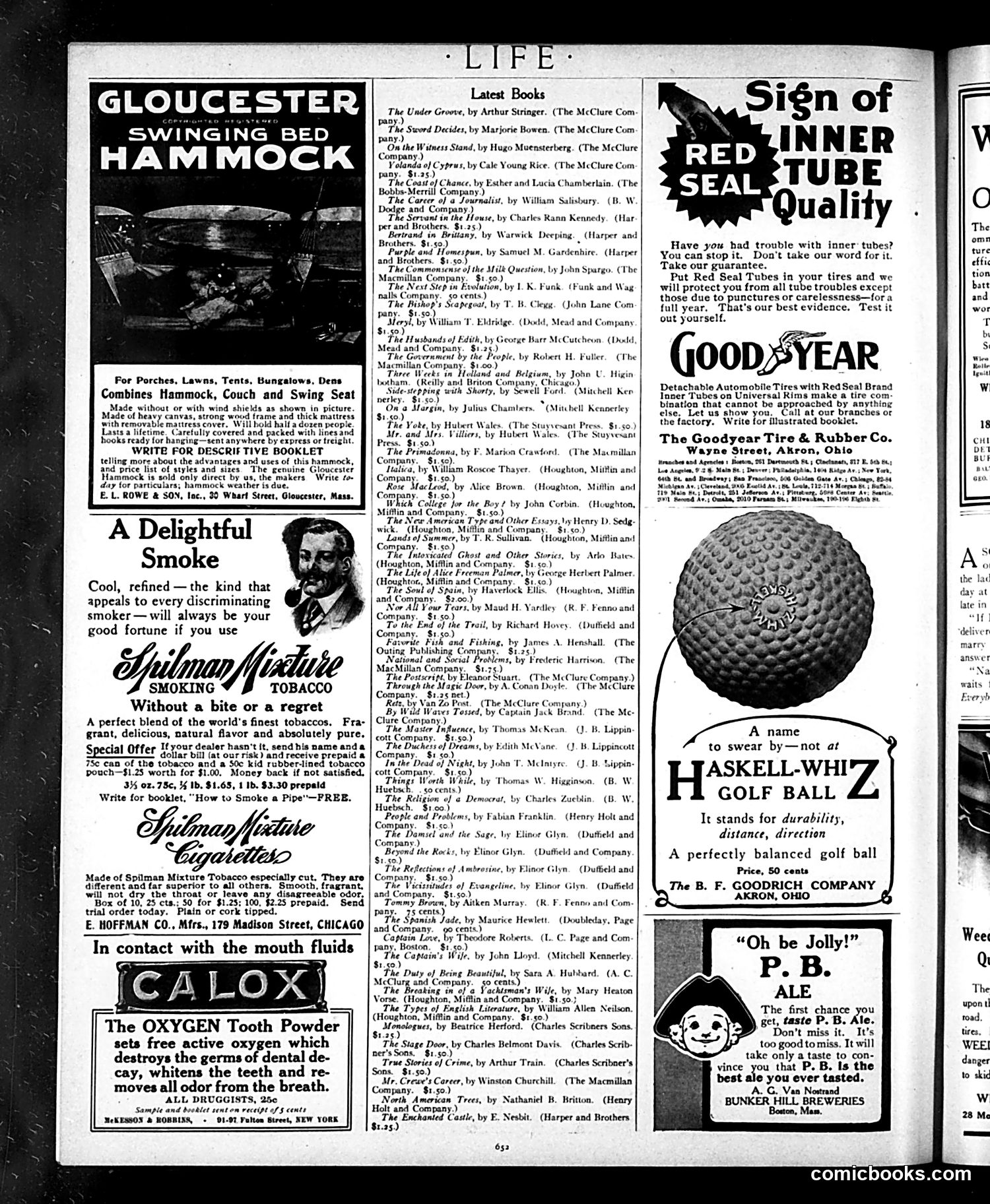
This page is primarily **advertising**, not editorial content or satire. The advertisements include: 1. **Gloucester Swinging Bed Hammock** - furniture advertisement with product image 2. **Spijtman Mixture Smoking Tobacco** - cigarette ad featuring a bearded gentleman, emphasizing "natural flavor" and purity 3. **Calox Oxygen Tooth Powder** - dental hygiene product 4. **Red Seal Inner Tube Quality** - Goodyear tire/tube advertisement 5. **Haskell-Whiz Golf Ball** - sports equipment ad 6. **P.B. Ale** - beer advertisement with a smiling mascot character The page also contains a "Latest Books" section listing contemporary publications. There is no political cartoon or satirical content visible. This appears to be a standard commercial page from Life magazine's advertising section, typical of early-to-mid 20th century publishing.
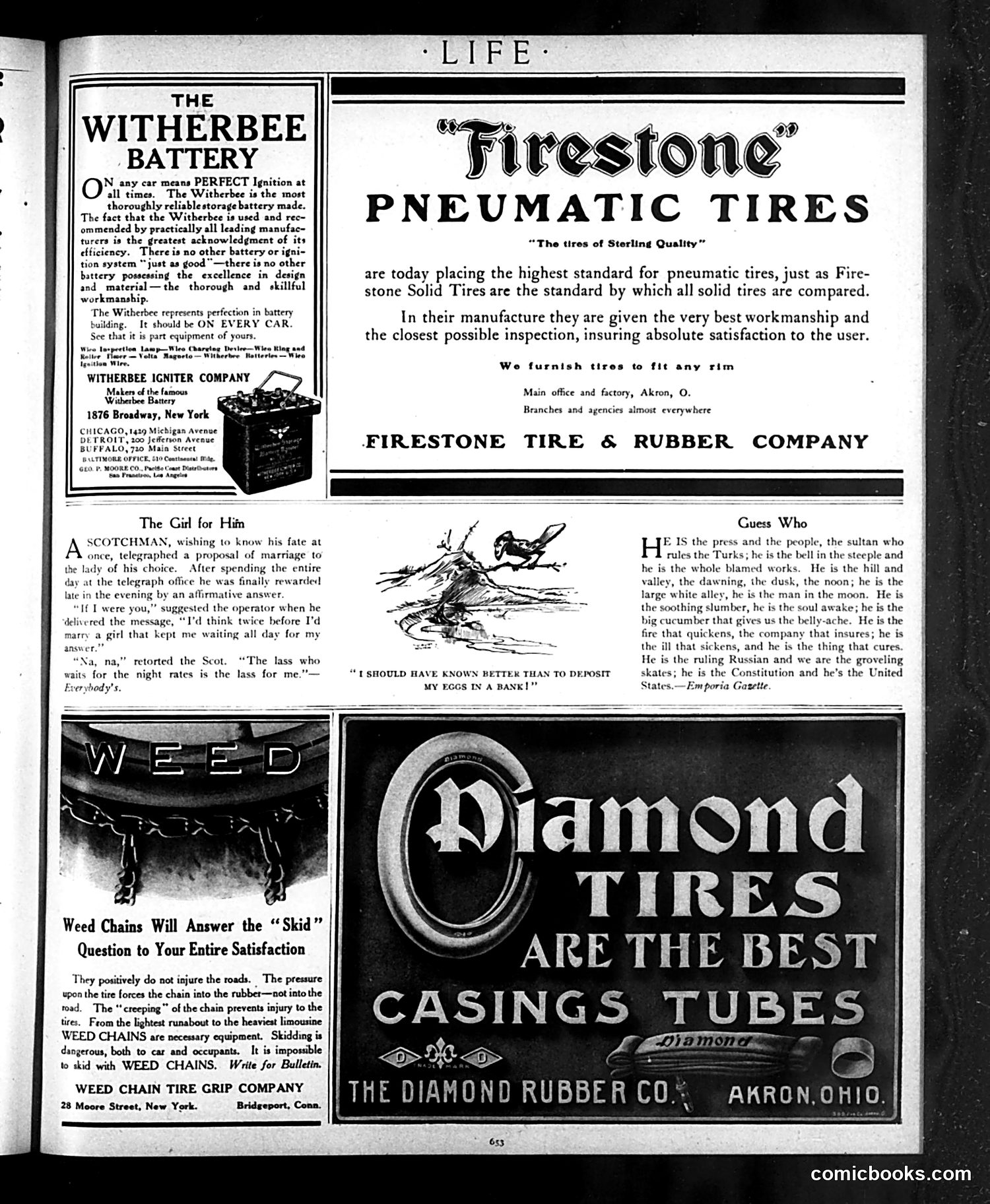
This page is primarily **advertising** rather than editorial content or political satire. It features four separate automobile-related advertisements from the early 20th century: Witherbee Battery, Firestone Pneumatic Tires, Weed Chains, and Diamond Tires. The only satirical content is a small humor piece titled "The Gal for Him," a brief Scottish dialect joke about marriage proposal timing, and a text puzzle titled "Guess Who" that appears to be a contemporary riddle game. The page reflects the era's consumer focus on automotive accessories and innovations—batteries, tires, and tire chains were critical new products for early automobiles. No significant political satire or caricature is present.
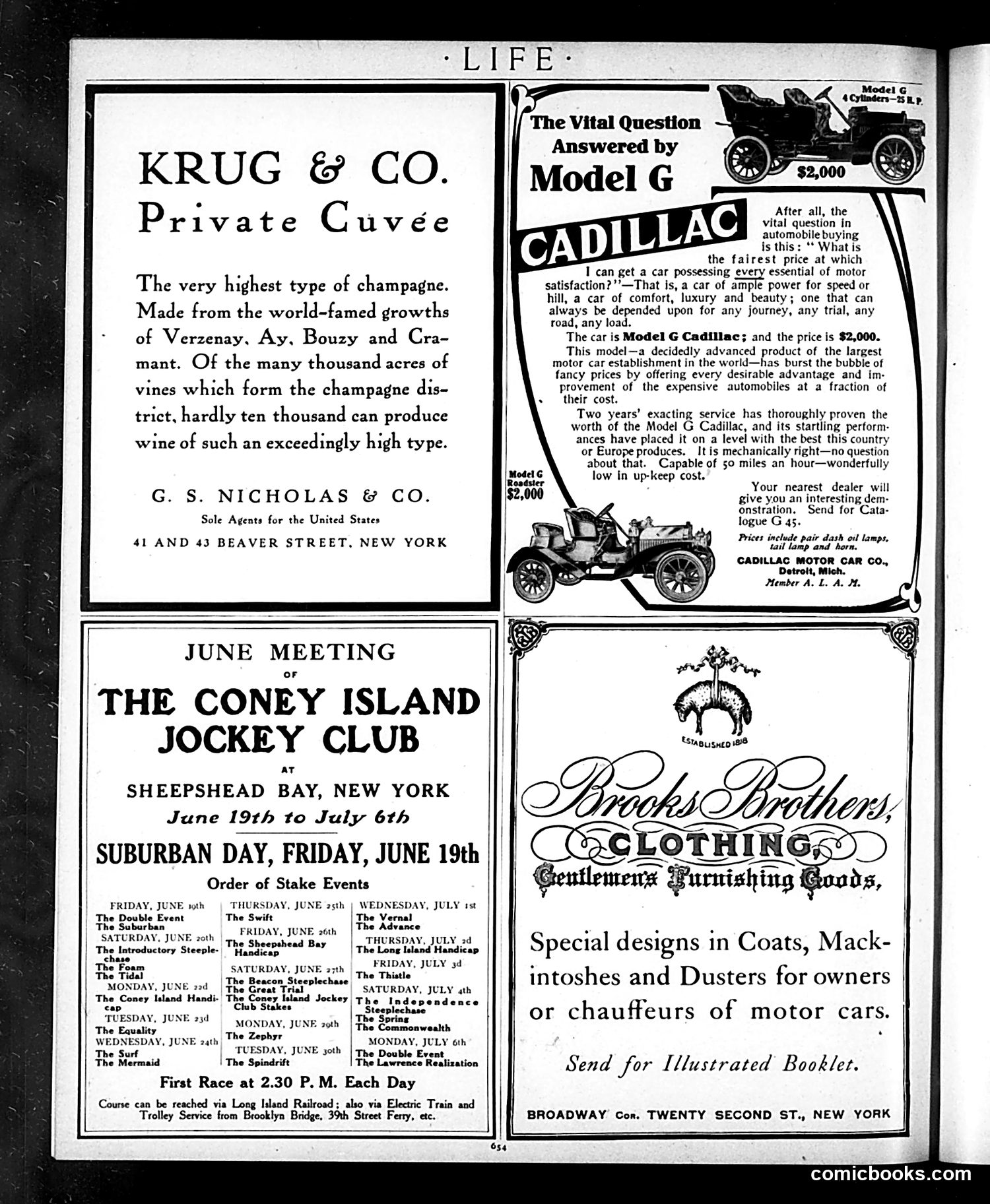
This page contains **no political cartoons or satire**. It consists entirely of period advertisements from approximately 1910. The ads promote: - **Krug & Co. champagne** (luxury goods marketed to wealthy readers) - **Cadillac Model G automobiles** ($2,000, positioned as the answer to "what is the fairest price" for quality cars) - **Coney Island Jockey Club** horse racing events - **Brooks Brothers clothing** for motorcar owners/chauffeurs The content reflects the magazine's affluent readership and early-20th-century consumer culture. The Cadillac ad notably emphasizes reliability and low maintenance costs—a selling point for the era's relatively new automobile technology. There is no satirical commentary present on this particular page.
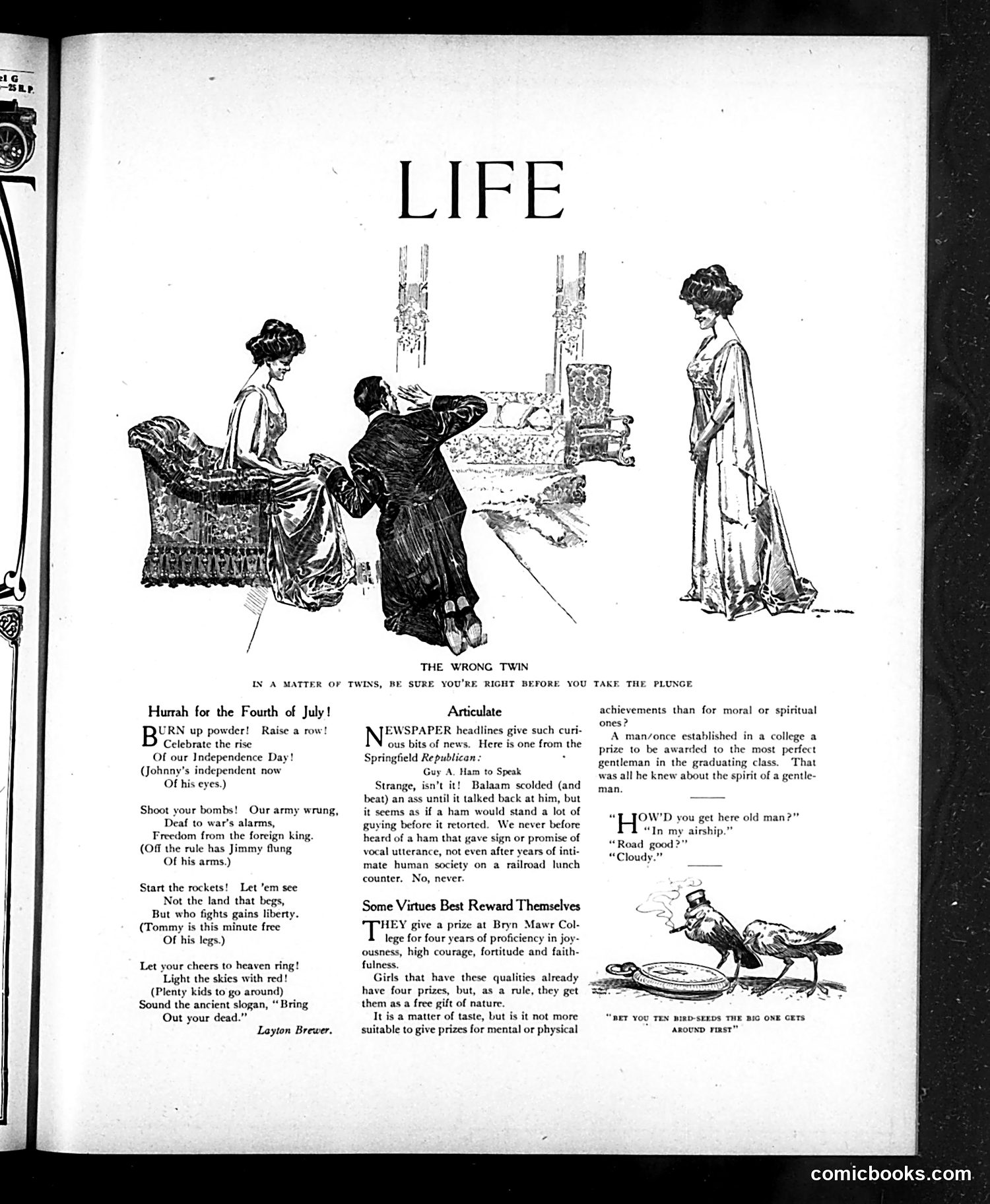
**The Main Cartoon:** The illustration titled "The Wrong Twin" depicts a romantic or social scenario where a man appears to be courting the wrong woman. Two women in elegant Edwardian dress flank the scene, while the man in dark formal wear interacts with one. The caption warns: "IN A MATTER OF TWINS, BE SURE YOU'RE RIGHT BEFORE YOU TAKE THE PLUNGE"—a humorous cautionary tale about mistaking identical twins before making serious romantic commitments. **Context:** This satirizes the popular early-20th-century comedic trope of twin mix-ups in literature and theater. The joke targets the social consequences of romantic entanglement, particularly the embarrassment of pursuing the wrong person. It reflects period anxieties about courtship propriety and the literal consequences of romantic error.
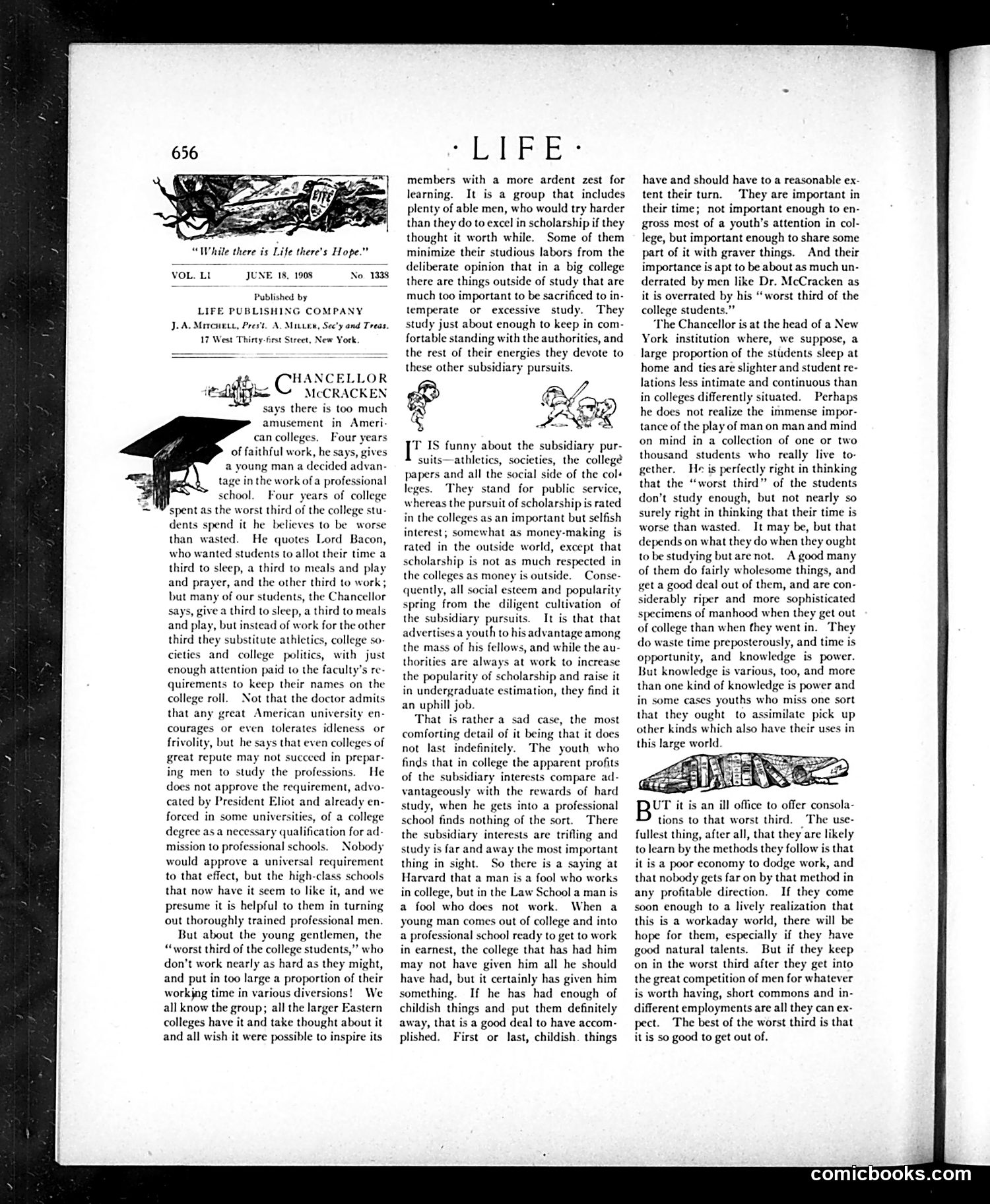
This page features Chancellor McCracken discussing college life. The illustration shows McCracken as a authority figure commenting on student behavior. The satire critiques how colleges emphasize non-academic "subsidiary pursuits"—athletics, societies, social events, and college papers—over actual scholarship. McCracken argues these activities distract students and waste time, yet colleges prioritize them for public service and prestige. The piece mocks a paradox: colleges claim scholarship matters most, but students gain status through social/athletic achievements, not study. McCracken notes the "worst third" of students—those who don't study—actually enjoy college most because they pursue these popular pursuits instead. The cartoon satirizes institutional hypocrisy about educational priorities versus what colleges actually celebrate and encourage among their students.
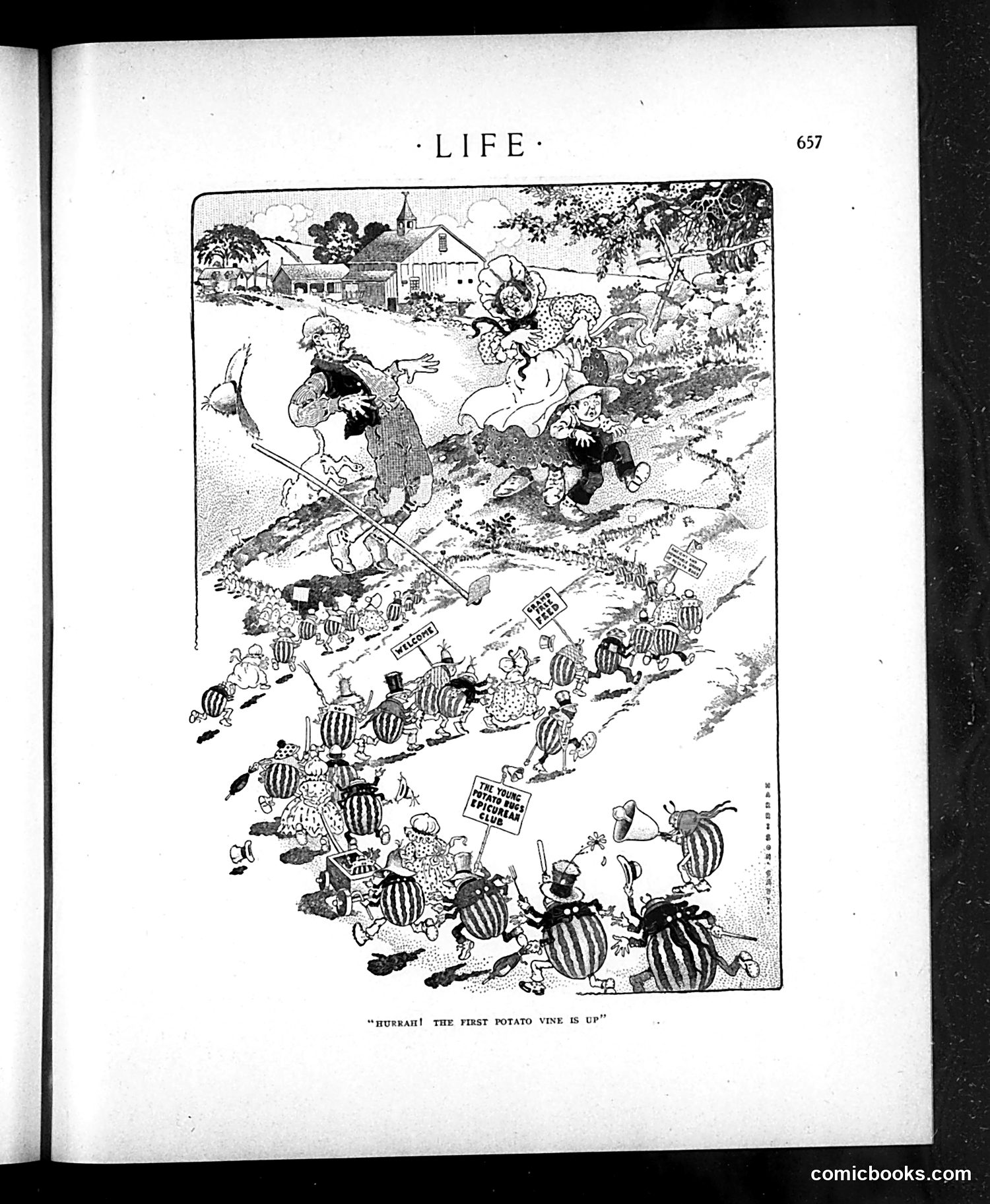
This cartoon satirizes the Colorado Potato Beetle plague that devastated American agriculture in the late 19th century. The image shows a rural farming community celebrating the emergence of their first potato plant, while simultaneously being invaded by masses of striped Colorado beetles marching up from the bottom of the frame. The joke is darkly ironic: the farmers' joy at seeing their crop sprout is immediately threatened by the beetle infestation. Several beetles carry signs reading "THE TOLTEC POTATO BUG CLUB," suggesting organized pest invasion. The cartoon critiques both agricultural vulnerability and the beetles' reputation as an almost organized, unstoppable force of agricultural destruction—a genuine crisis that threatened 19th-century farming communities.
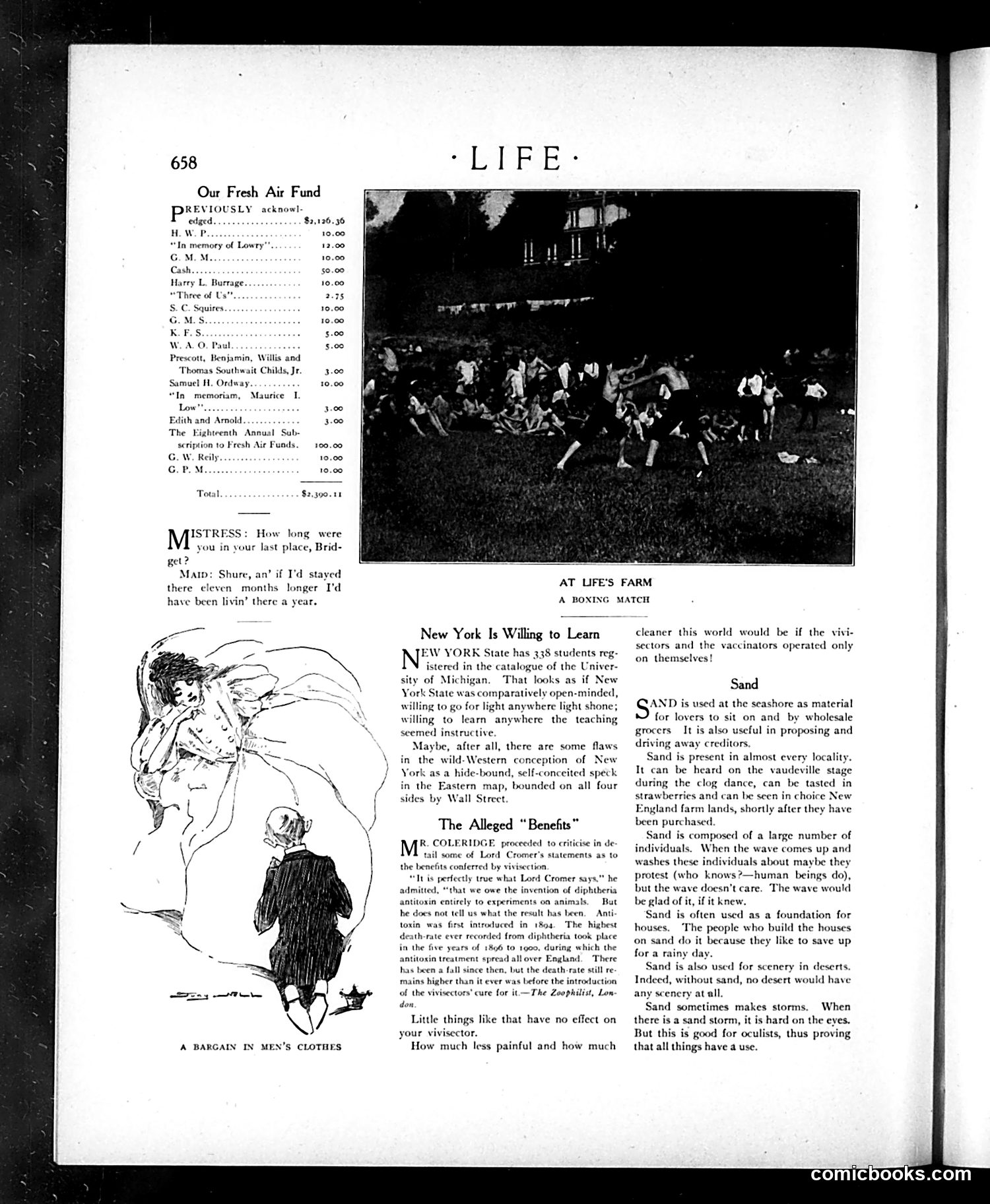
This political cartoon depicts a well-dressed man being fitted into oversized clothing by a tailor. The caption states "A BARGAIN IN MEN'S CLOTHES," suggesting satire about someone acquiring or adopting a position or identity ill-suited to them—literally wearing clothes too large. The cartoon likely comments on an appointment or political figure who appears inadequate for their role. However, **without knowing the specific date or context of this Life magazine issue, I cannot definitively identify the figure or the exact political situation being mocked**. The style and clothing suggest early-to-mid 20th century. The satire hinges on the visual metaphor of someone assuming responsibilities that don't fit them properly.
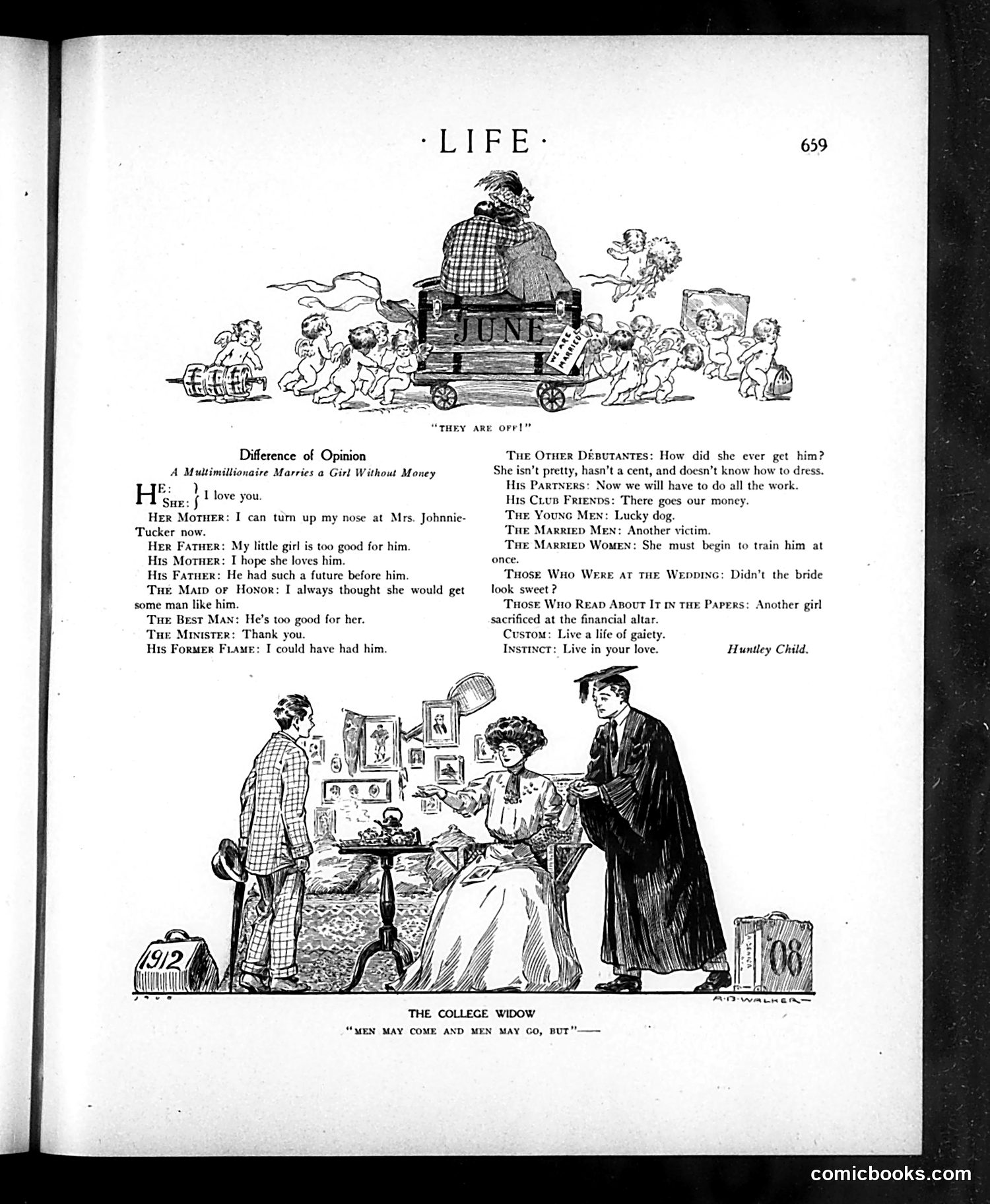
This page contains two satirical pieces about marriage and relationships: **"Difference of Opinion"** presents contrasting views on a couple's marriage. Each character (her mother, father, maid, best man, etc.) offers a different opinion on whether the match is good, with her former flame claiming he could have had her. **"The College Widow"** cartoon below depicts a wealthy widow displaying her collection of suitors' photographs and mementos (dated 1902, 1908), suggesting she serially dates wealthy men. The caption—"Men may come and men may go, but"—implies her romantic interests are transient while she remains constant, likely satirizing women who use marriage for financial gain rather than genuine affection. Both pieces mock marriage mercenary attitudes and social pretension common in early 20th-century American society.
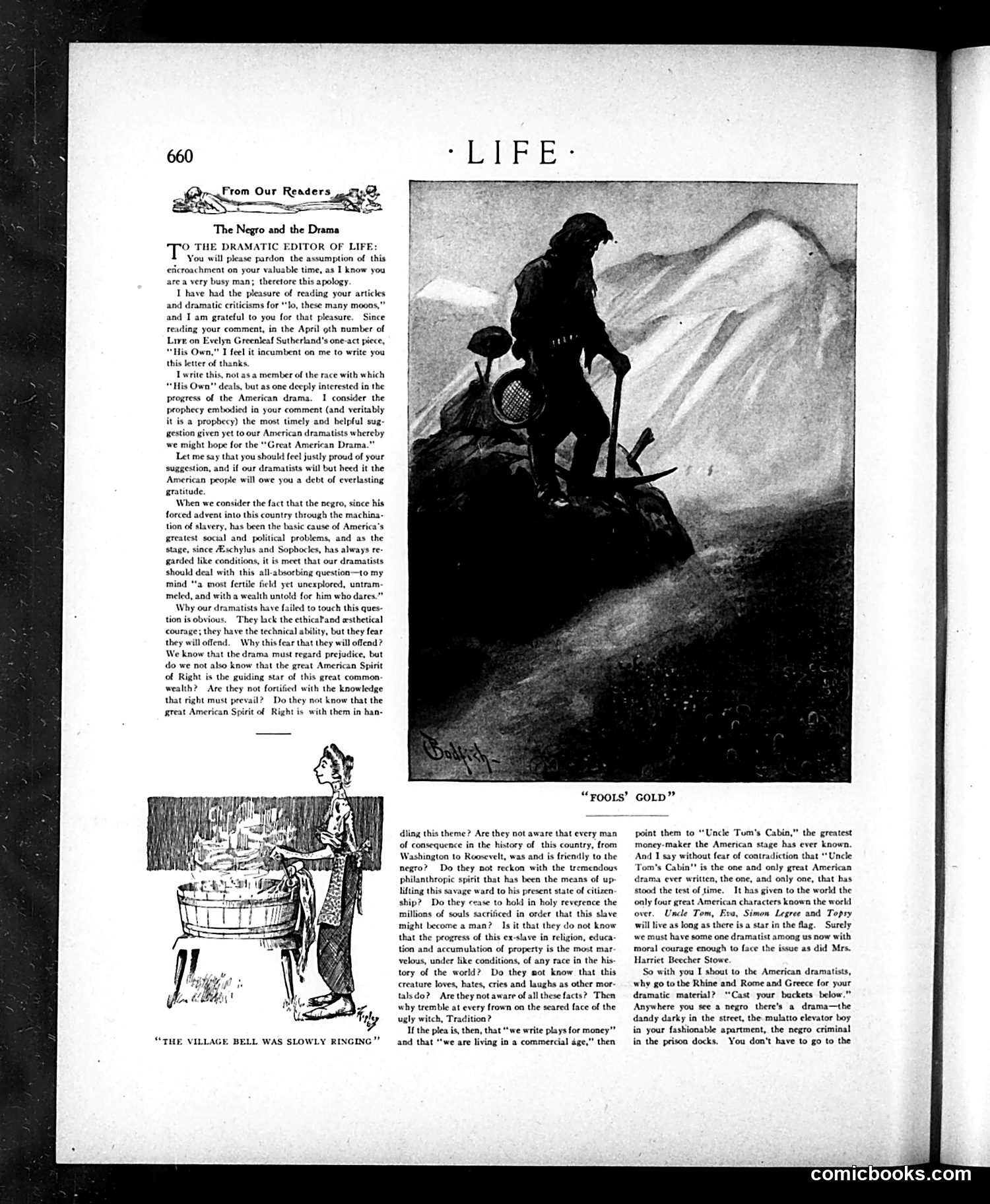
This page from *Life* magazine contains a reader's letter criticizing American dramatists for avoiding the question of race and slavery in their plays. The writer argues that playwrights lack "ethical and aesthetical courage" and fears addressing prejudice, yet insists the American stage must confront this "all-absorbing question." The accompanying illustrations appear to be satirical sketches mocking contemporary theatrical productions. One image is captioned "The Village Bell Was Slowly Singing," and another "Fools' Gold"—likely critiquing lightweight or evasive dramatic works. The letter's references to *Uncle Tom's Cabin* and *Harriet Beecher Stowe* underscore the writer's point: that serious racial drama was possible, yet being avoided by contemporary American playwrights. The satire targets theatrical cowardice regarding America's fundamental social problem.
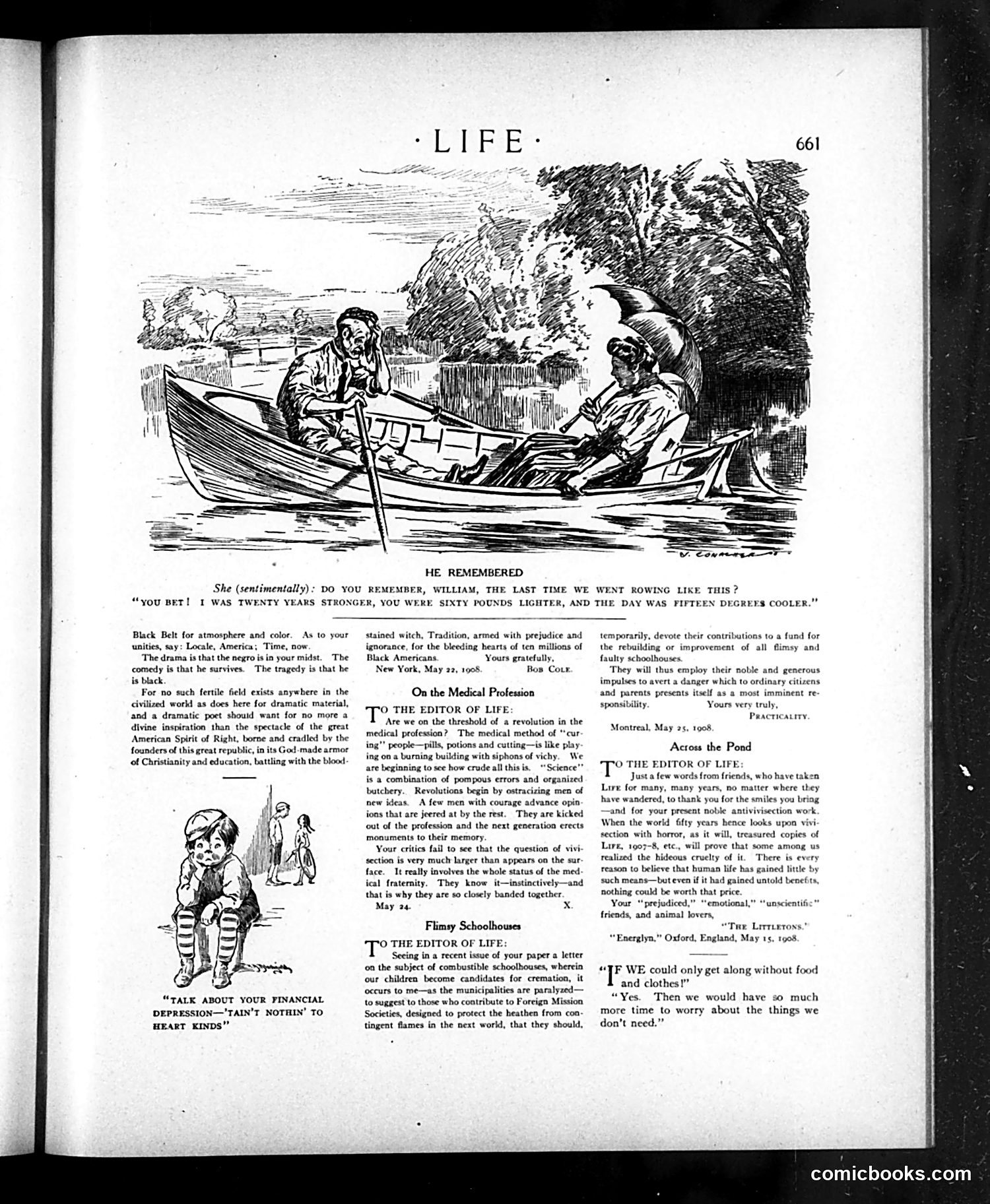
This cartoon depicts two men in a rowboat. The caption quotes one asking the other: "Do you remember, William, the last time we went rowing like this? You were twenty years younger, you were sixty pounds lighter, and the day was fifty degrees cooler." The humor relies on **aging and nostalgia**. The satirical point mocks how people romanticize the past while ignoring present physical decline—William has apparently gained weight and aged significantly. The "fifty degrees cooler" reference suggests either climate change or simply that summer feels hotter with age. This is straightforward social satire about middle-aged regret and the gap between youthful memory and current reality, with no apparent political dimension.
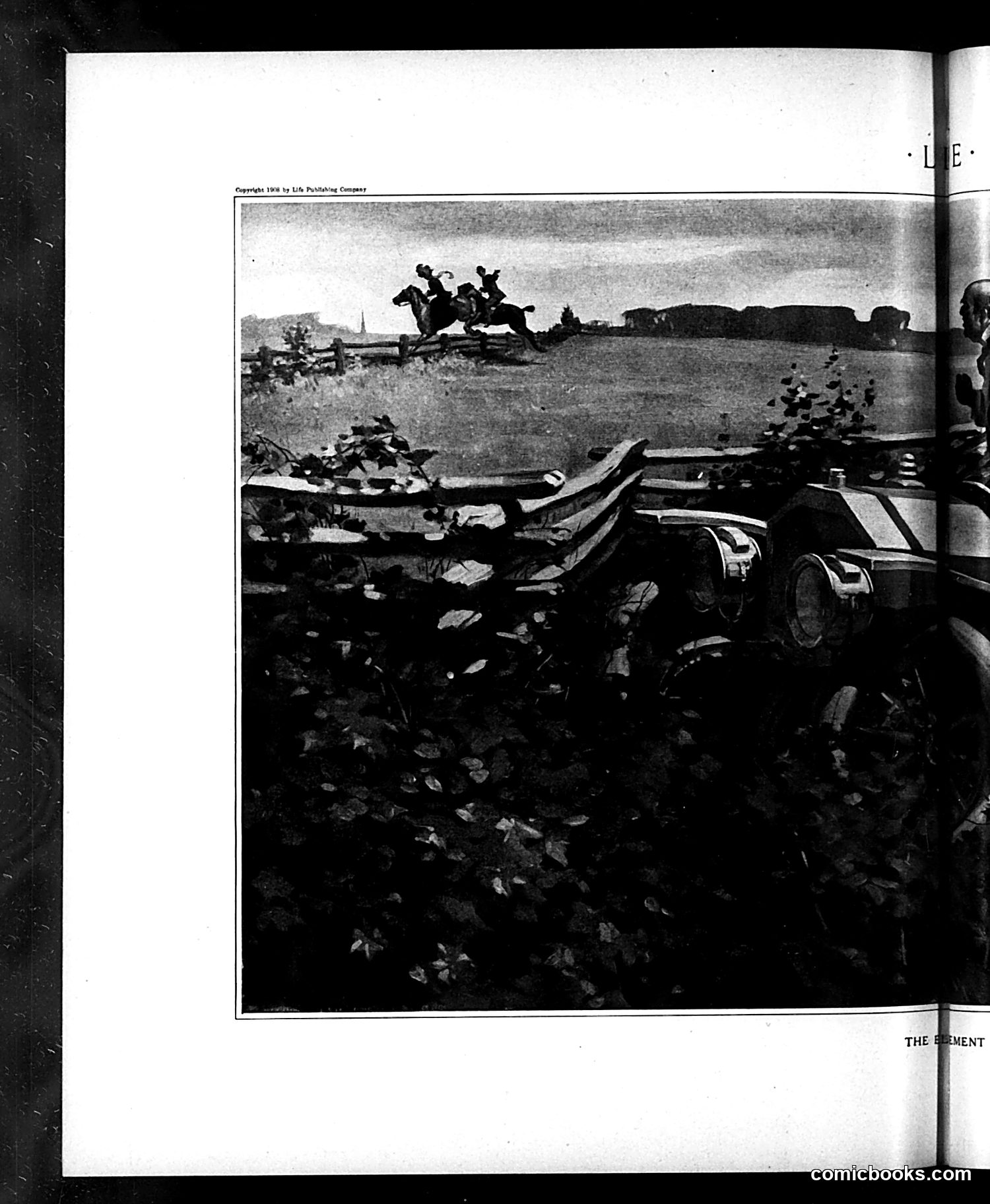
This appears to be a page from *Life* magazine (copyright 1916 by Life Publishing Company). The black-and-white photograph shows a steeplechase or horse-jumping scene, with riders on horseback jumping over fences in the background and farm machinery or agricultural equipment prominently displayed in the foreground. The juxtaposition seems to contrast leisure activities (competitive horseback riding) with agricultural labor and mechanization. However, without clearer text or captions visible on this page, the specific satirical point remains unclear. The page may be commenting on social class distinctions, rural versus urban life, or agricultural modernization during the early 20th century, but I cannot definitively identify the intended message or any specific political figures from the image alone.
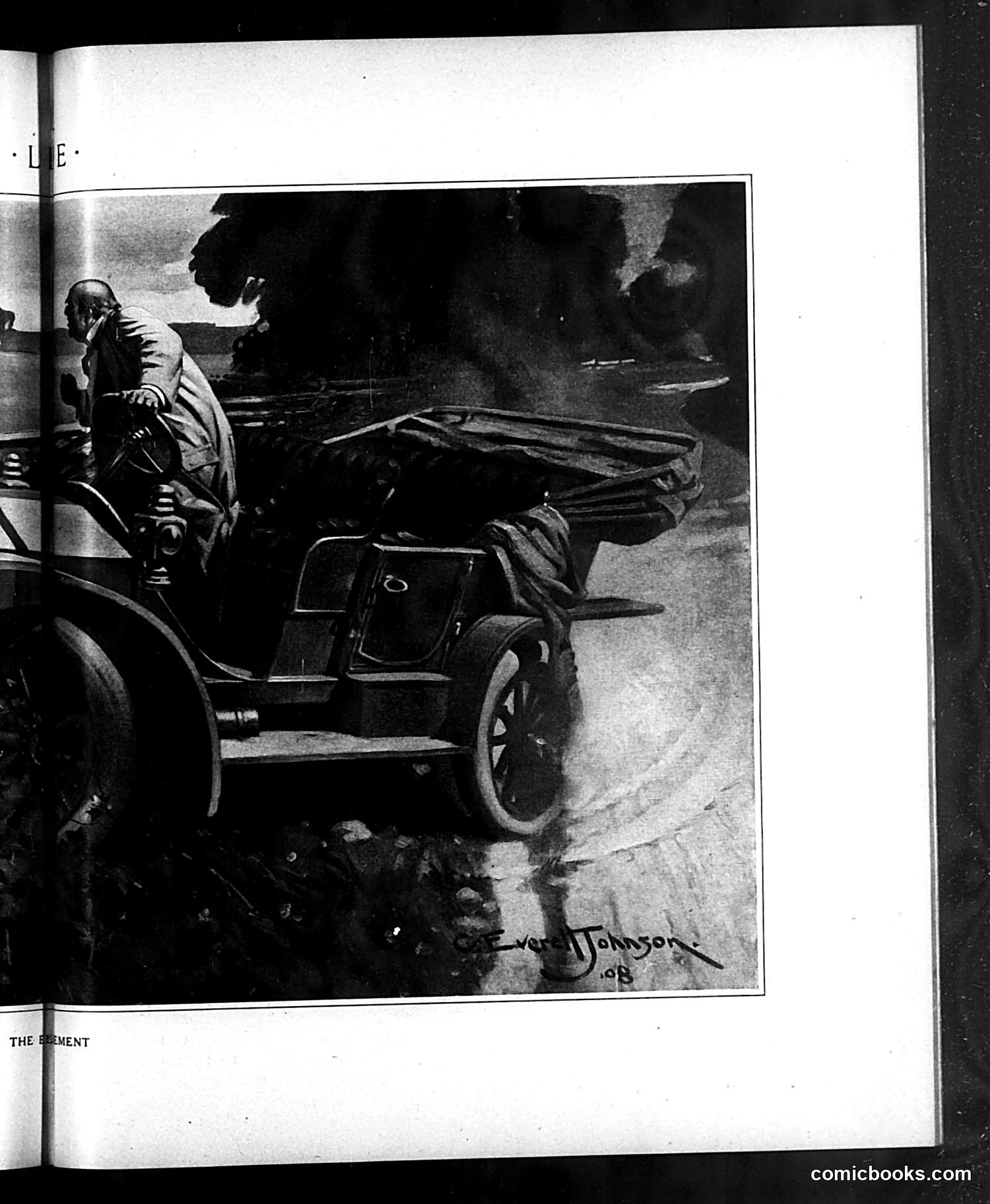
This appears to be a page from Life magazine featuring a black and white illustration signed by Everett Johnson (visible at bottom). The image shows an early automobile with a man in period dress (appearing to be early 1900s) reacting with alarm or distress to the vehicle, which appears to be malfunctioning or smoking heavily. The cartoon likely satirizes early automobiles' notorious unreliability and the social anxiety they provoked. The man's distressed posture suggests the frustration and danger associated with these newfangled machines, which frequently broke down, caught fire, or exploded. This reflects common early-20th-century humor about motoring as an unpredictable, hazardous novelty rather than reliable transportation. The page title reads "THE §" (partially obscured), but context is unclear without additional text.
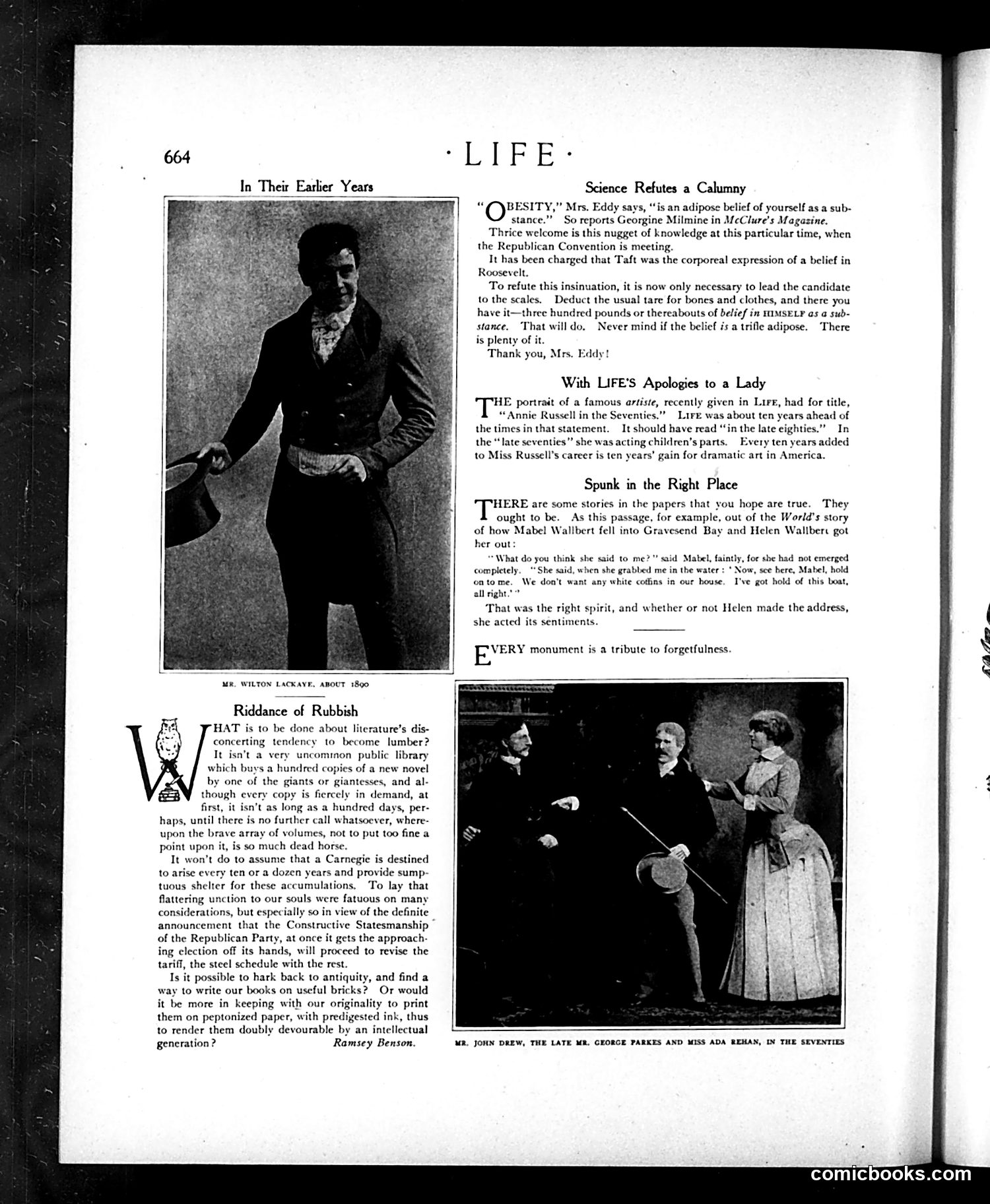
This page contains several distinct satirical pieces: **"Science Refutes a Calumny"** mocks President William Howard Taft using Christian Science doctrine (Mrs. Eddy's teachings). The joke: if obesity is merely a "belief," then Taft's substantial weight proves his self-belief rather than Roosevelt's influence. It's political mockery of Taft during the 1912 Republican Convention, when he faced Theodore Roosevelt's challenge. **"With Life's Apologies to a Lady"** corrects Life's earlier misidentification of actress Annie Russell's age in a portrait—she was in her late eighties, not seventies. It's a humorous admission of error. **"Spunk in the Right Place"** praises a woman (Helen Wallbert) who rescued her sister from drowning with practical, no-nonsense courage rather than hysteria. **"Riddance of Rubbish"** questions what libraries should do with discarded books, sarcastically suggesting printing on digestible peptonized paper for "intellectual generation." It critiques wasteful accumulation of forgotten literature. The page includes period photographs of actors from the 1870s-1890s.
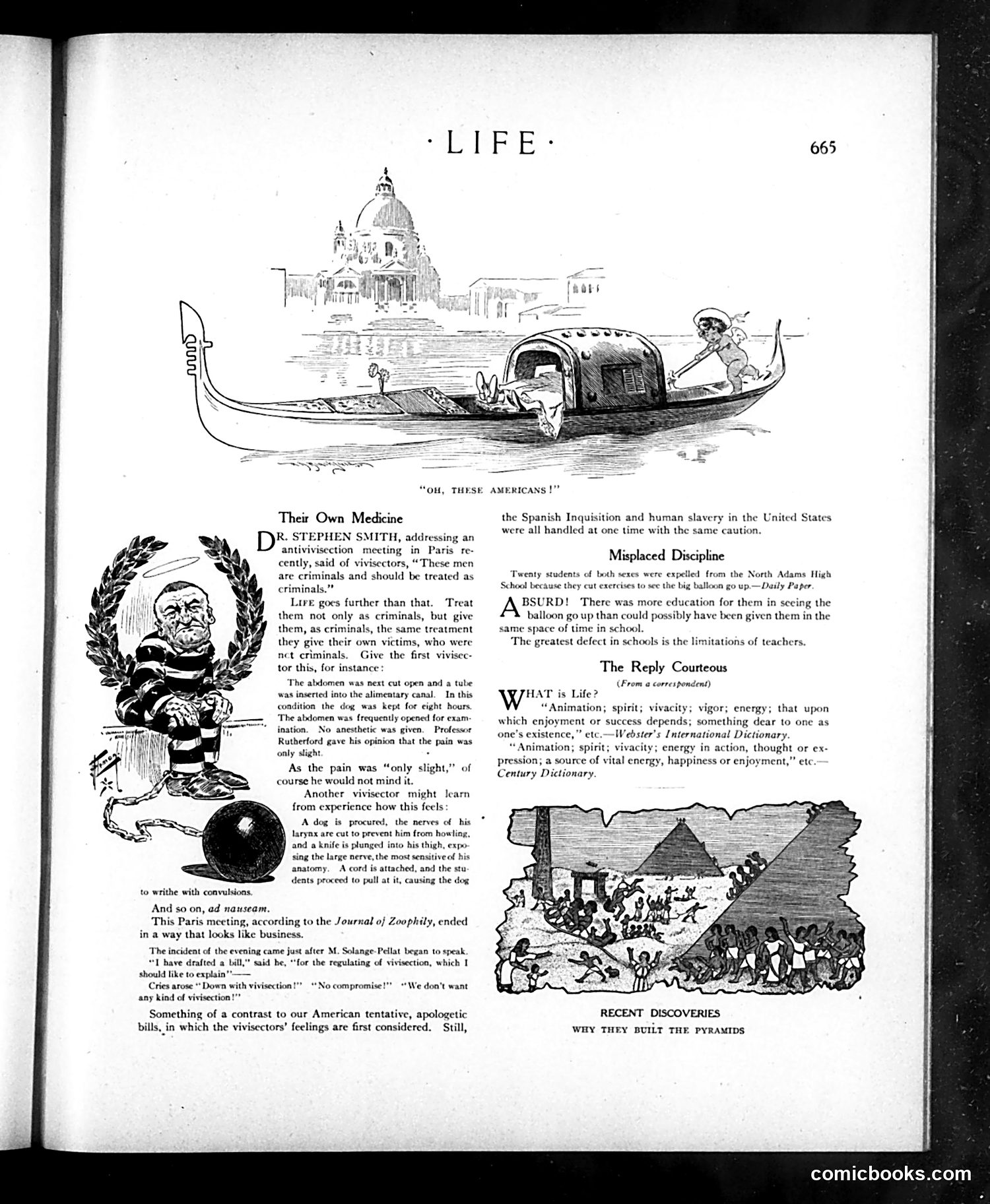
**Main Cartoon: "Their Own Medicine"** This anti-vivisection satire mocks scientists who perform painful experiments on animals without anesthesia. The cartoon depicts a gondola in Venice (with the Basilica di Santa Maria della Salute in background) grotesquely modified as a vivisection apparatus—suggesting vivisectors should experience their own torture methods. The text quotes Dr. Stephen Smith's Paris antivivisection speech, describing graphic animal experiments: dogs with exposed nerves and open abdomens kept conscious for hours. The satire's point: if vivisectors claim such pain is "only slight," they should endure identical procedures themselves. **Political Context:** The piece contrasts European moral outrage ("No compromise!") with American timidity on animal welfare—comparing it dismissively to past tolerance of slavery and the Spanish Inquisition. This reflects genuine early 1900s antivivisection activism, a significant reform movement. **Secondary Items:** A brief note mocks expelling high school students for skipping class to see a hot-air balloon, arguing real education happens outside classrooms.
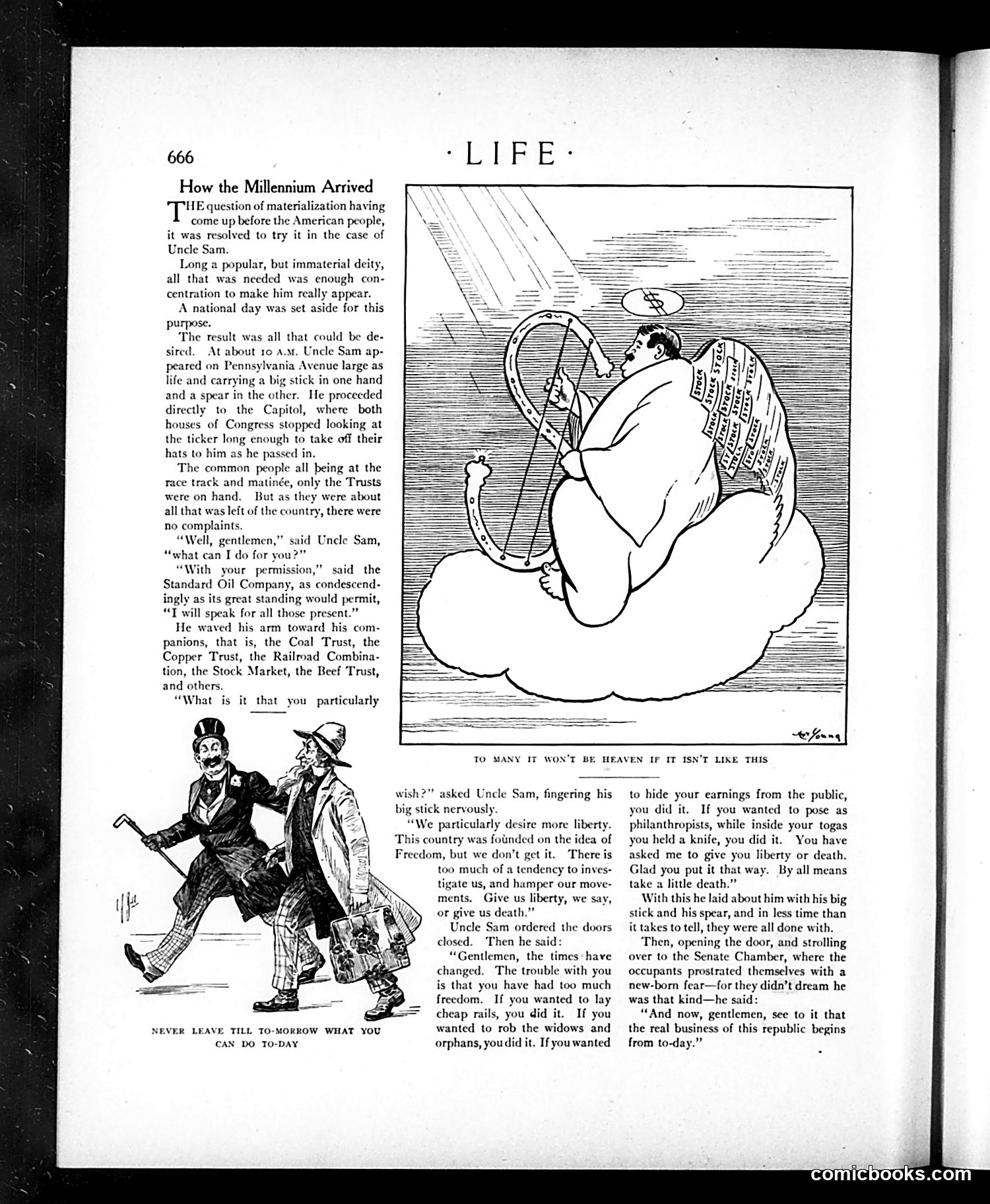
This satirical piece lampoons the monopolistic trusts dominating early 20th-century America. Uncle Sam—materialized through public concentration—confronts the major corporate powers (Standard Oil, Coal Trust, Copper Trust, Railroad, Stock Market, Beef Trust) demanding "more liberty." The satire's bite: these cartels claim government over-regulation oppresses them, echoing their actual arguments against progressive reforms. Uncle Sam's response exposes the hypocrisy—they've exploited freedom to defraud widows, evade taxes, and manipulate markets. His violent "solution" (beating them with stick and spear) represents the author's fantasy of aggressive trust-busting. The accompanying cartoon shows Uncle Sam on a cloud, steering a large wheel—suggesting his control over the nation's direction once he addresses corporate corruption. The satirist argues only harsh intervention can restore genuine republican governance.
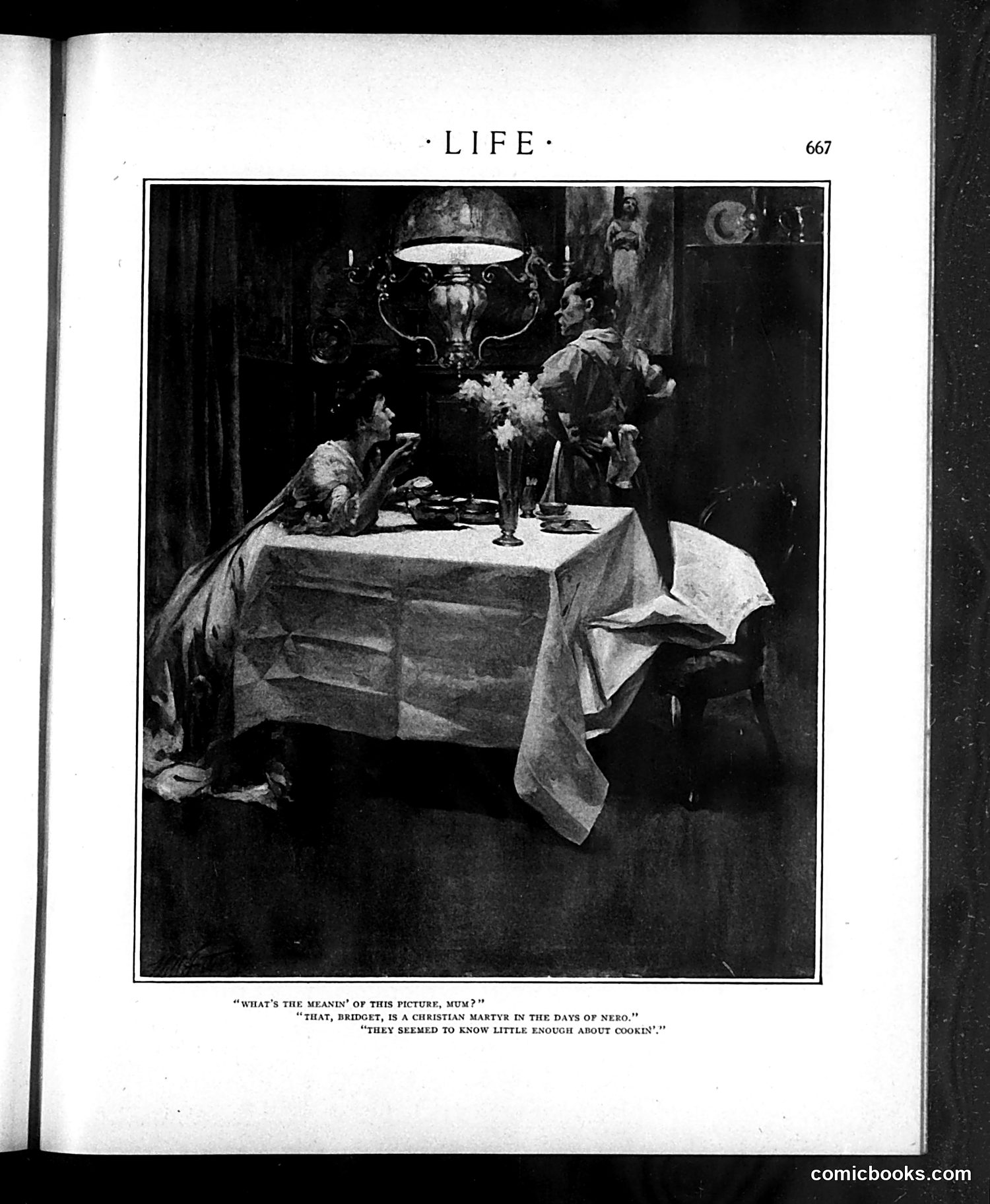
This is a satirical illustration depicting a scene of Roman persecution. The dialogue reveals the joke's target: a character (likely a cook or servant, given the reference to "Cooke") is being asked to explain a picture showing what appears to be a Christian martyr from Nero's era. The humor lies in the ironic response that this person "seemed to know little enough about cooke[s]"—a pun playing on both the historical reference and the contemporary figure or concept of "Cooke." The image shows figures in classical Roman dress examining or discussing an ornate vessel or urn, suggesting the graphic depiction of martyrdom. Without clearer identification of which specific "Cooke" is referenced, the precise political or social target remains unclear, though the satire mocks either ignorance of history or a particular public figure's inadequate knowledge.
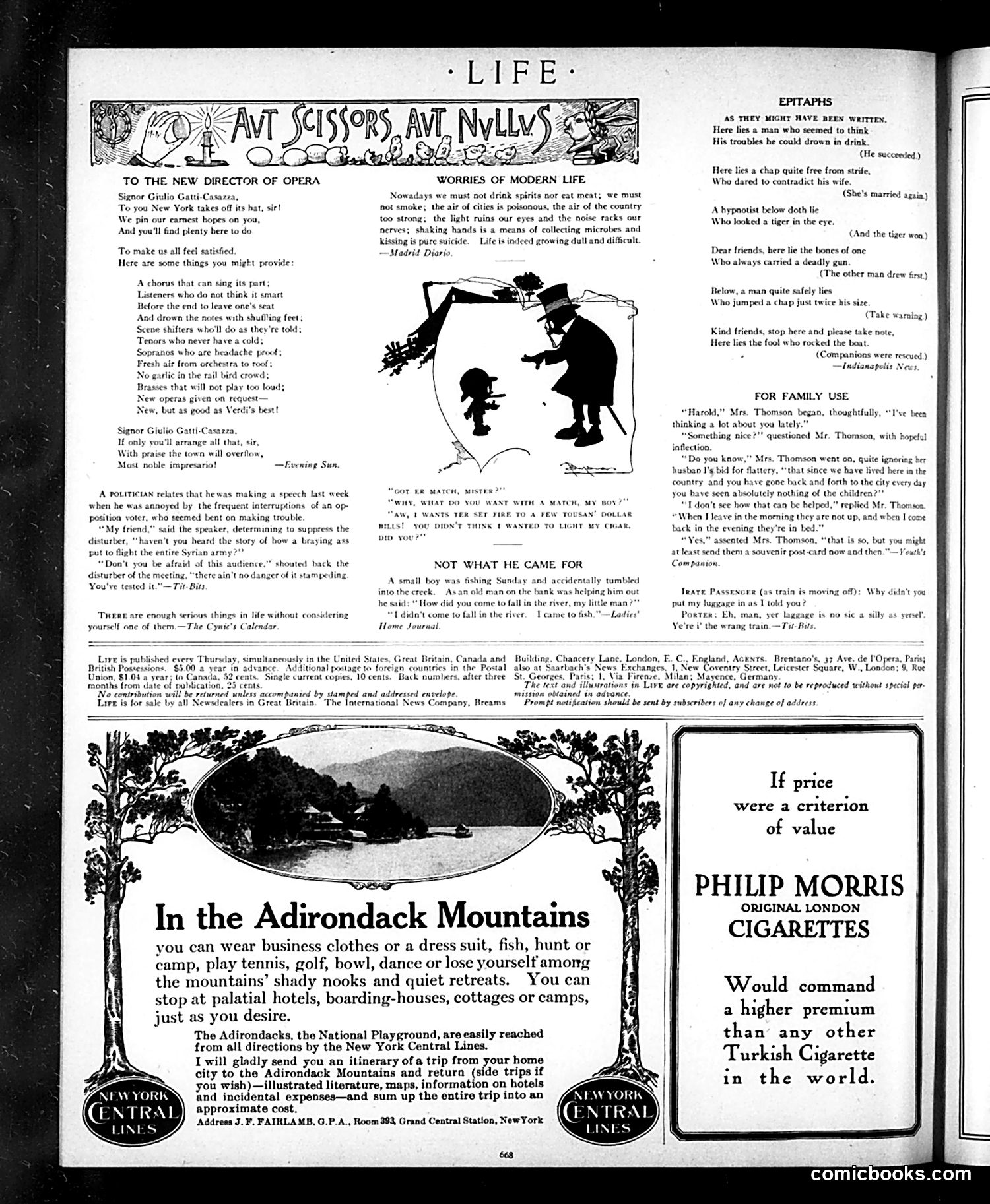
This page from *Life* magazine contains several satirical pieces aimed at early 20th-century American life: **"To the New Director of Opera"** mocks the newly hired opera director Giulio Gatti-Casazza with tongue-in-cheek "suggestions"—a chorus that can actually sing, audiences who don't leave early, tenors without colds, and notably, "no garlic in the rail bird crowd." This jabs at both operatic pretension and ethnic stereotypes about Italian immigrants. **"Worries of Modern Life"** satirizes health-conscious anxieties of the era: fears about alcohol, meat, smoking, city air pollution, artificial light, noise, germs from handshakes. It's gentle mockery of modern neurosis. **"Not What He Came For"** features a cartoon of a boy who fell in a creek; a man mistakes his fishing for accident rescue—simple situational humor. **"Epitaphs"** offers darkly comic fake tombstones about various foolish deaths (drinking, contradicting wives, carrying guns, rocking boats)—Victorian-era cautionary humor. The advertisements promote cigarettes and Adirondack tourism.
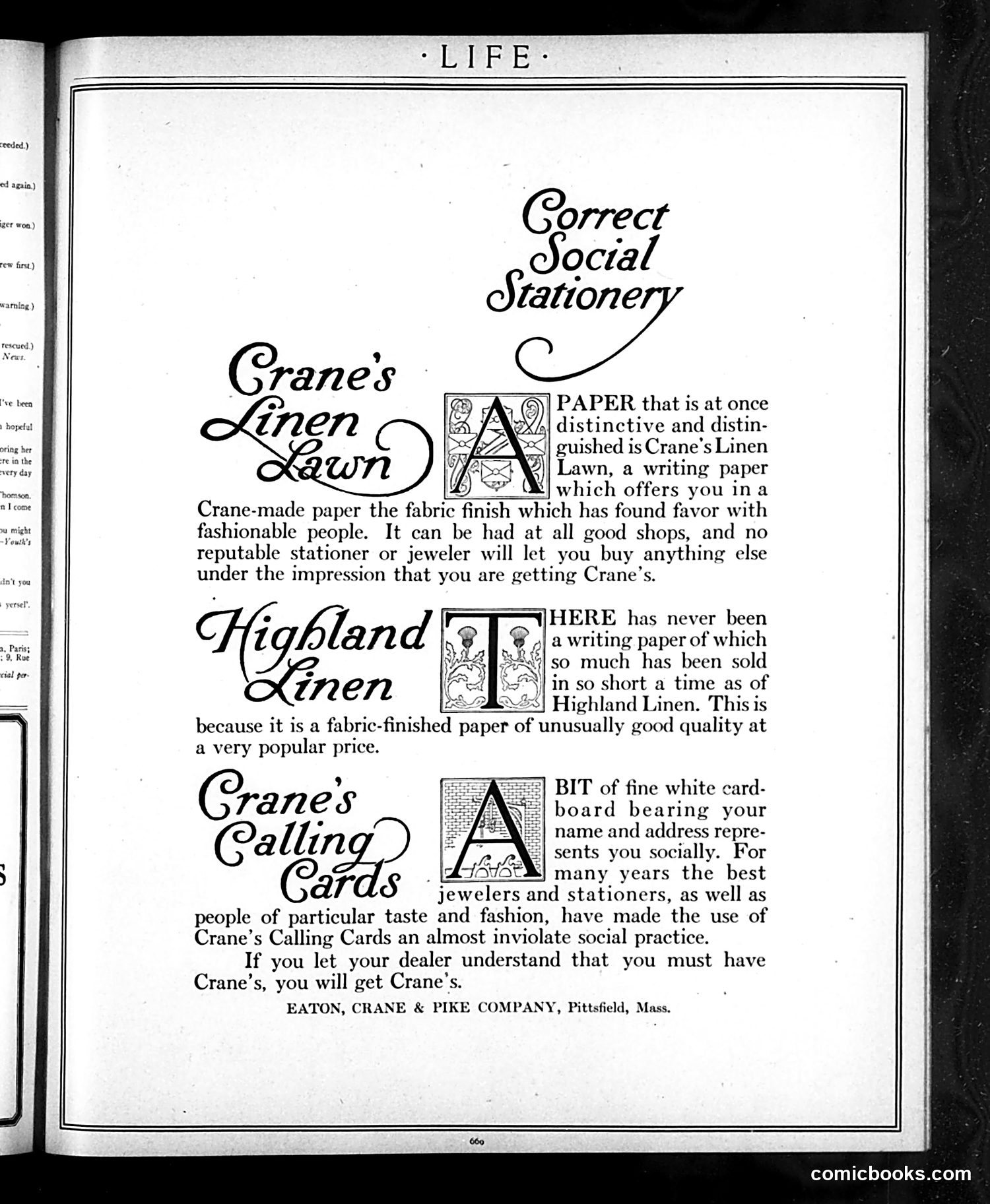
This page is **not a cartoon or satire**—it's a straightforward advertisement for Crane's stationery products, appearing in *Life* magazine. The ad promotes three items: Crane's Linen Lawn writing paper, Highland Linen paper, and Crane's Calling Cards. The copy emphasizes social status and etiquette, targeting upper-class consumers concerned with "correct social stationery." The advertising claims that fashionable people exclusively use these products, that calling cards represent you "socially," and that stationers won't sell inferior substitutes. The tagline "If you let your dealer understand that you must have Crane's, you will get Crane's" suggests brand loyalty and social expectation. This reflects early 20th-century anxieties about proper social conduct—the idea that correct stationery was essential to maintaining one's social standing. The ornamental typography and decorative initials reinforce the product's association with refinement and taste.
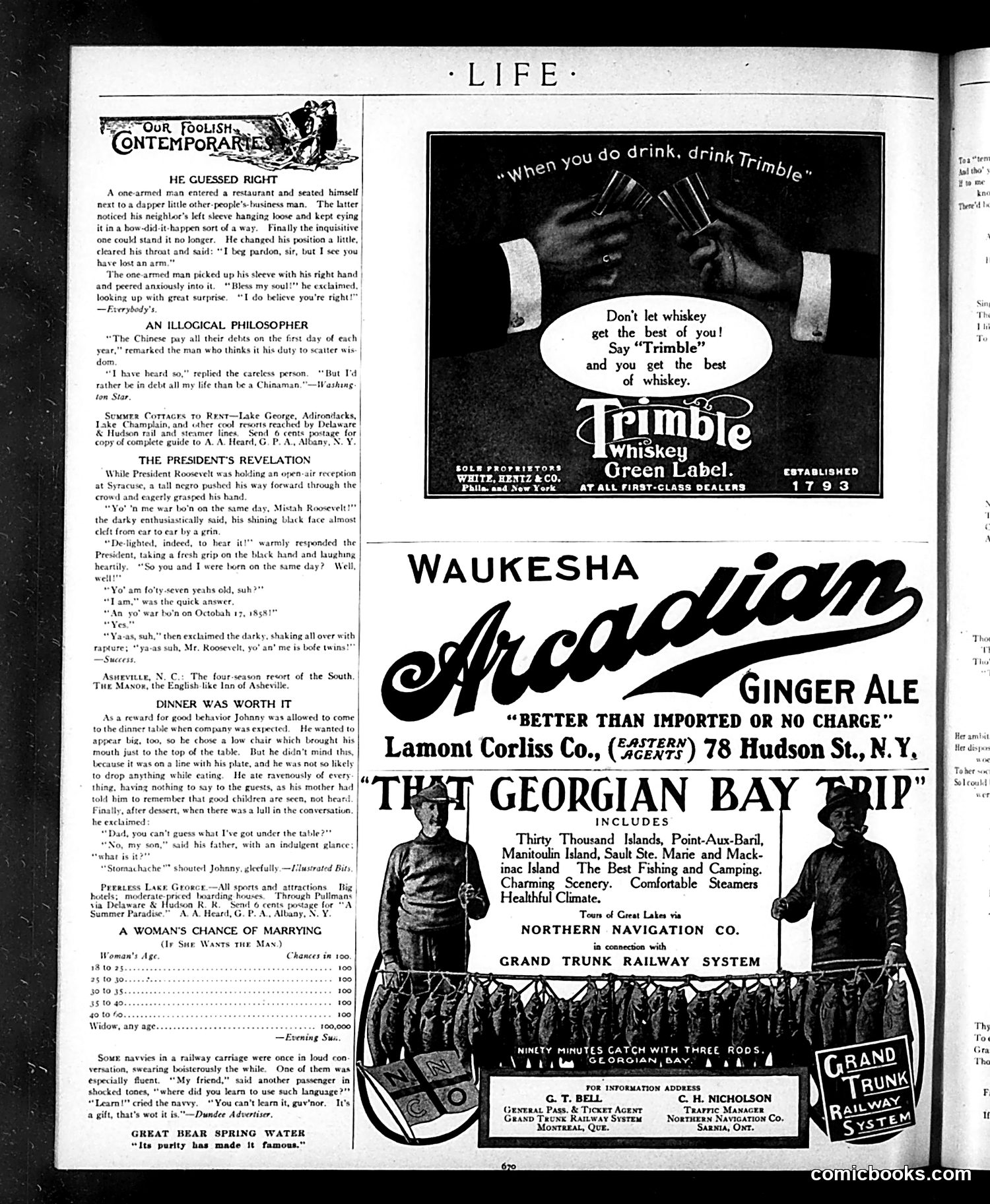
This page from *Life* magazine contains several brief humorous pieces typical of early 20th-century American satirical humor: **"He Guessed Right"** mocks an intrusive busybody who notices a one-armed man's disability and asks about it—only to be outwitted by the amputee, who feigns surprise at discovering his own missing arm. **"An Illogical Philosopher"** presents a quick joke about a careless person preferring lifelong debt to Chinese practices—satirizing casual racial stereotyping of the era. **"The President's Revelation"** depicts President Theodore Roosevelt meeting an African American who claims they share the same birthday. The dialect-heavy dialogue (typical of period humor) plays on the absurdity of the claim that Roosevelt and this man are "bofe twins" despite different ages. The page also includes advertisements for Trimble Whiskey and Arcadian Ginger Ale, plus travel promotions. The humor reflects attitudes common to the time, including casual racial caricature and stereotype-based comedy that would be considered offensive today.
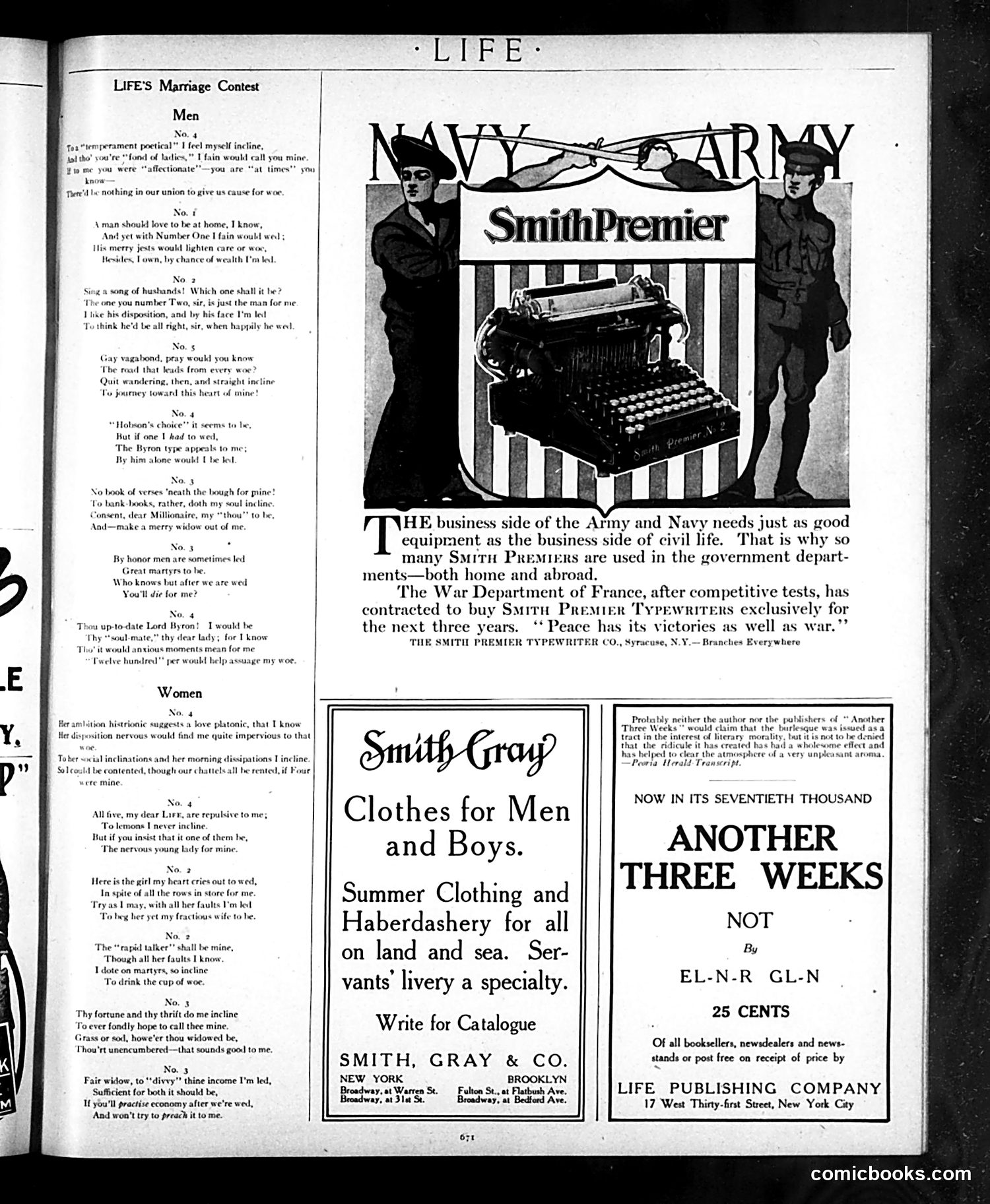
This page features **Life's satirical "Marriage Contest,"** a humorous column where men and women anonymously describe their ideal spouse preferences—revealing period attitudes about marriage and gender roles. The men's entries emphasize practical qualities: financial security, good disposition, and domestic competence. The women's entries, meanwhile, fixate on wealth ("Bank-books, rather, doth my soul incline") and financial security, with several preferring rich widows or financially independent women. The satire targets both genders: men seeking compliant, cheerful companions; women openly prioritizing money over romance. This reflects early 20th-century anxieties about marriage as an economic transaction rather than romantic partnership. The page also contains period advertisements (Smith Premier typewriters, clothing retailers) typical of Life's revenue model. The juxtaposition of cynical marriage commentary with commercial ads ironically reinforces the materialistic themes of the contest itself.
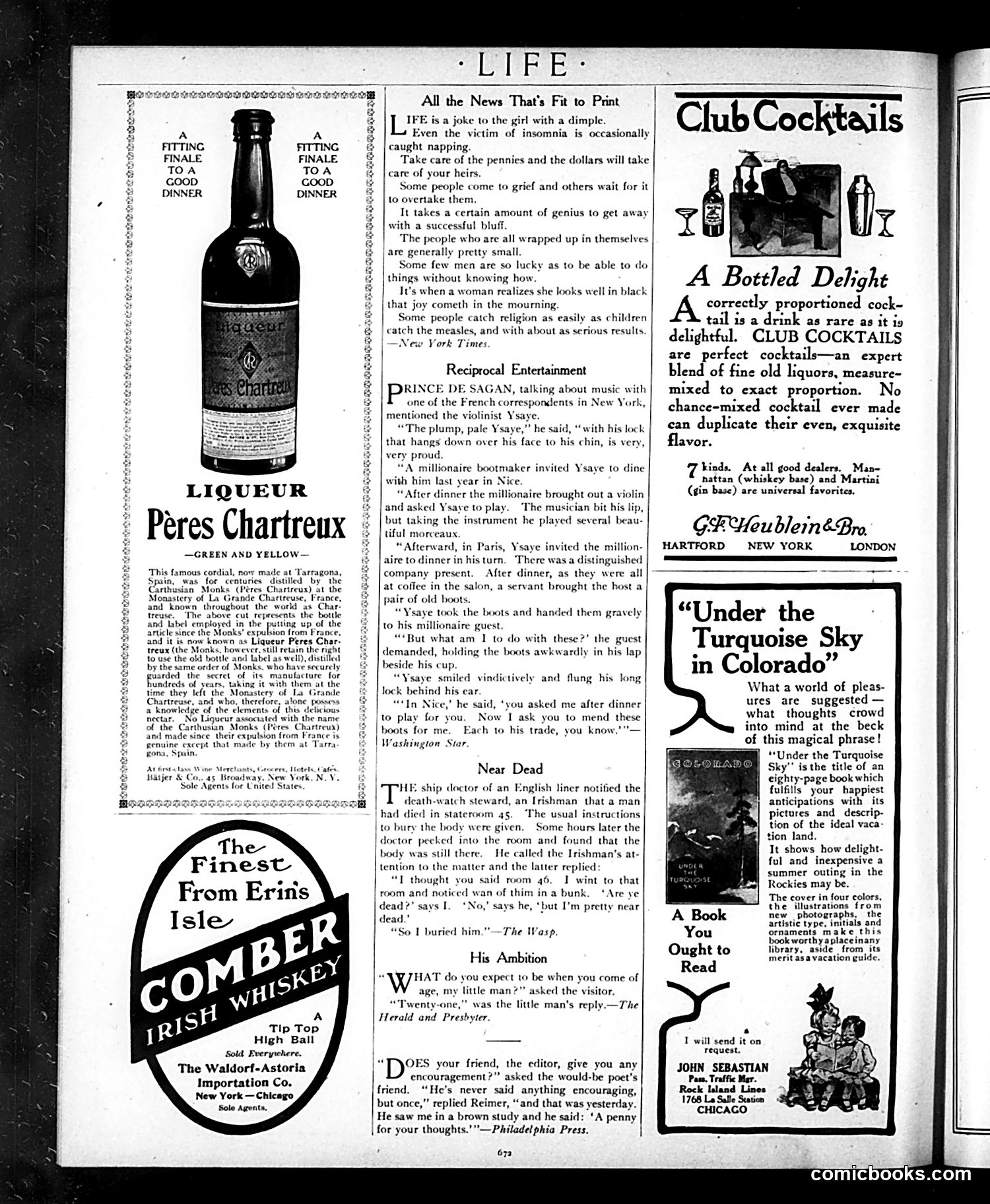
This page is primarily **advertising and light humor**, typical of Life magazine's format in the early 20th century. The main content consists of: 1. **Liqueur Péres Chartreux advertisement** — promoting a French cordial made by Carthusian monks, relocated to Spain after their expulsion from France. The ad emphasizes authenticity and heritage. 2. **Comber Irish Whiskey advertisement** — a competing spirits ad. 3. **Club Cocktails advertisement** — promoting pre-mixed cocktails as a convenience product. 4. **"All the News That's Fit to Print"** — a satirical column of brief, cynical observations about human nature (e.g., "It takes a certain amount of genius to get away with a successful bluff"). 5. **Three humorous anecdotes**: one about violinist Ysaye's revenge (mending boots as payback for being asked to perform), one about an Irish steward burying the wrong person, and one about a poet seeking encouragement. The page reflects **Prohibition-era America** (spirits advertised openly), upper-class humor, and light satire targeting human pretension and folly rather than specific political figures.
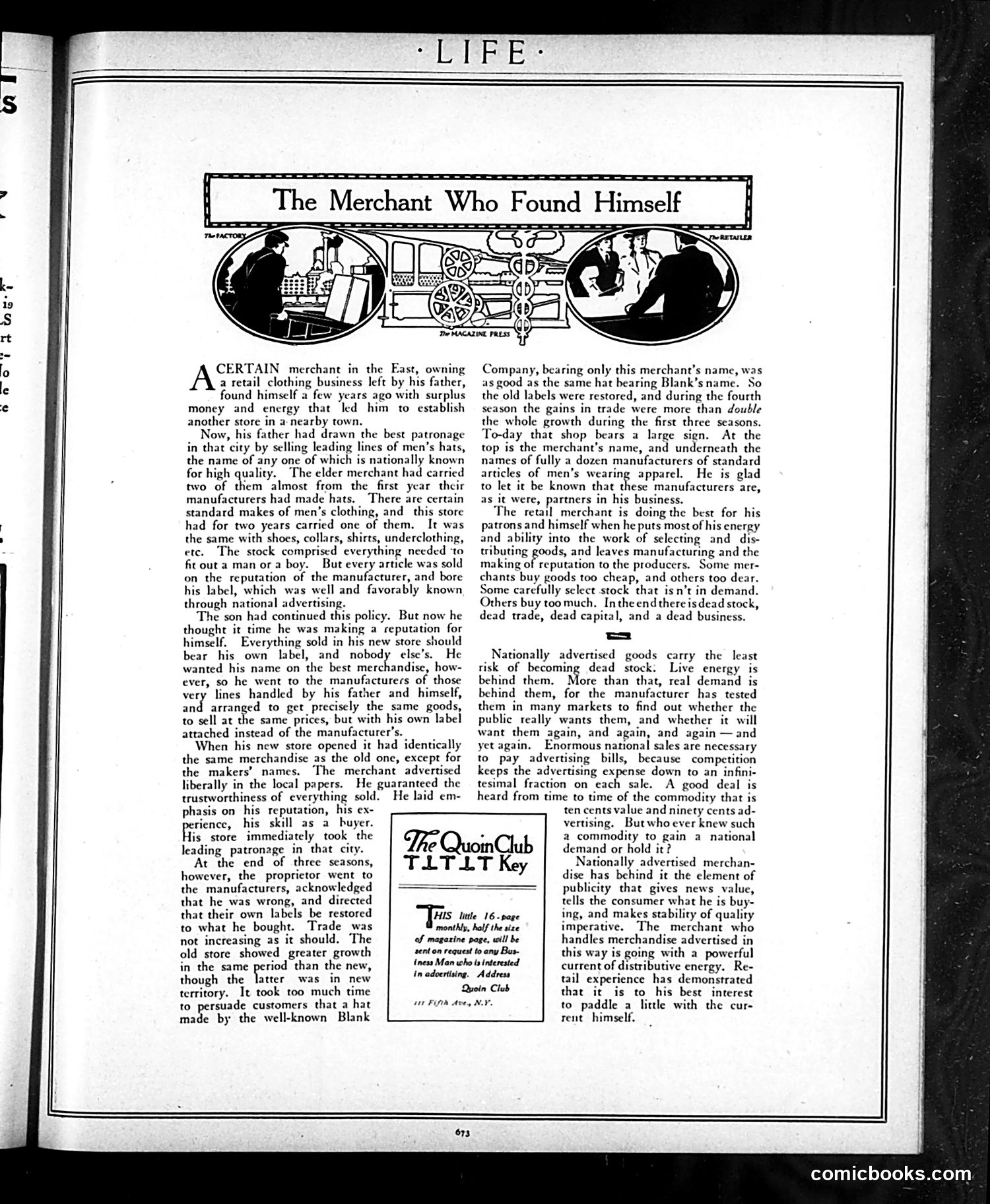
This is a business parable, not political satire. It describes a young merchant who inherits his father's successful clothing store, then opens a second location. Seeking to build personal reputation, he relabels identical merchandise with his own name instead of the established manufacturers' brands—despite selling at the same prices. The story's moral: his new store initially outperforms the old one through aggressive local advertising and personal guarantees. But after three seasons, growth stalls. He realizes customers trust established brand names more than his personal reputation. Restoring the original manufacturer labels—and prominently displaying them alongside his name—dramatically increases sales. The lesson for modern readers: **retail success depends on leveraging manufacturer reputation and national advertising**, not replacing it with personal branding. The merchant succeeds only by positioning himself as a *curator* of quality goods, not their originator.
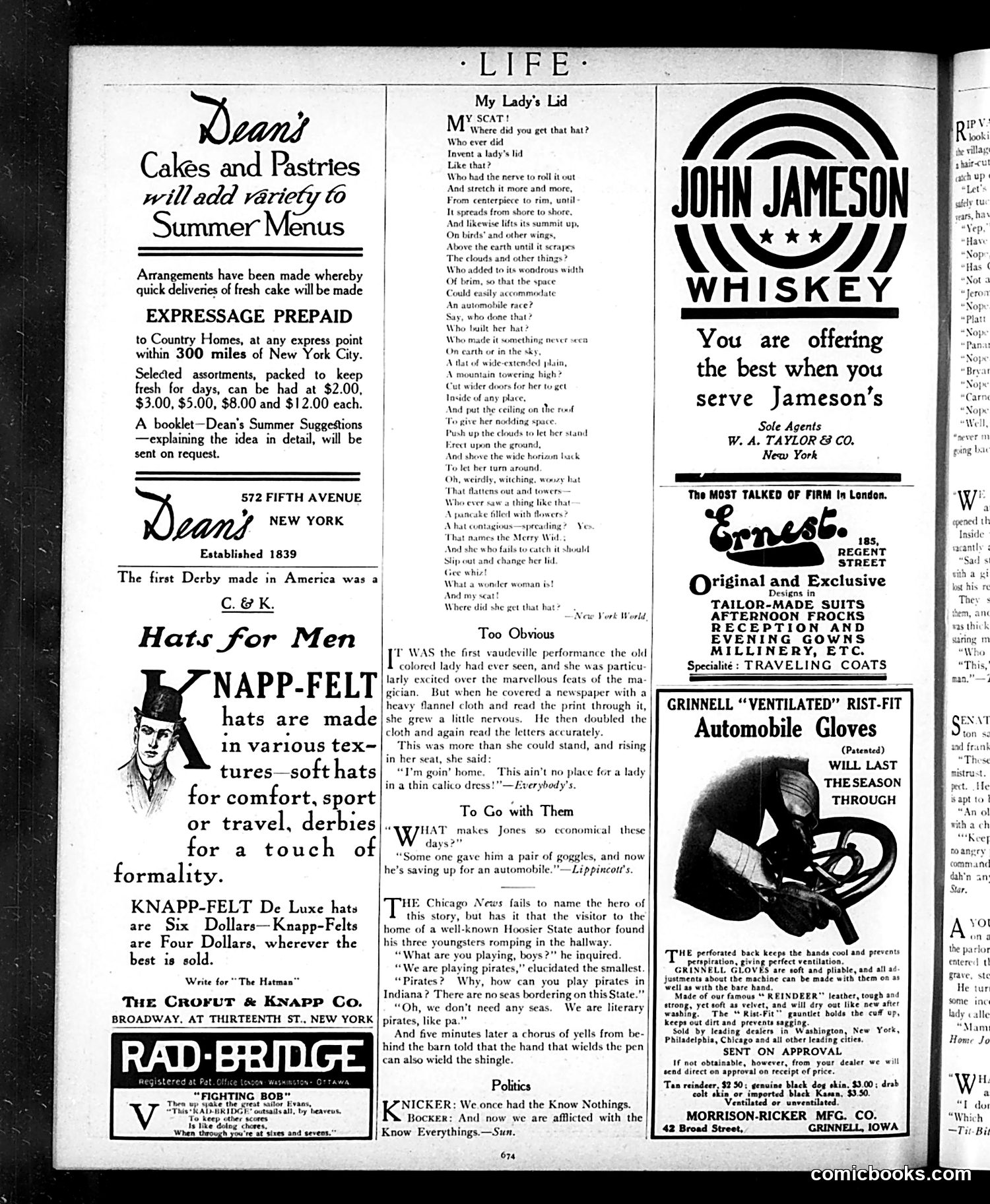
This is primarily an **advertising page** from Life magazine, with decorative comic content and jokes interspersed. The main satirical piece is **"My Lady's Lid"**—a poem mocking the absurdly oversized women's hats fashionable in the early 1900s. The hat's dimensions are exaggerated to ridiculous proportions: spreading "from shore to shore," decorated with "birds' and other wings," so large it could fit "an automobile race." This reflects genuine contemporary fashion excess—women's hats grew enormously during this era, sometimes measuring three feet across, decorated with feathers and ornaments. The remaining content includes three brief humor pieces: a vaudeville joke about a Black woman alarmed by a magician's trick, a quip about someone saving for an automobile, and a "Politics" section contrasting the "Know Nothings" political party with modern know-it-alls. The page's true focus is **advertising**: Dean's cakes, Napp-Felt hats, John Jameson whiskey, Ernest tailoring, and Grinnell automobile gloves dominate the layout, reflecting Life's role as a commercial publication financing its satire through product endorsements.
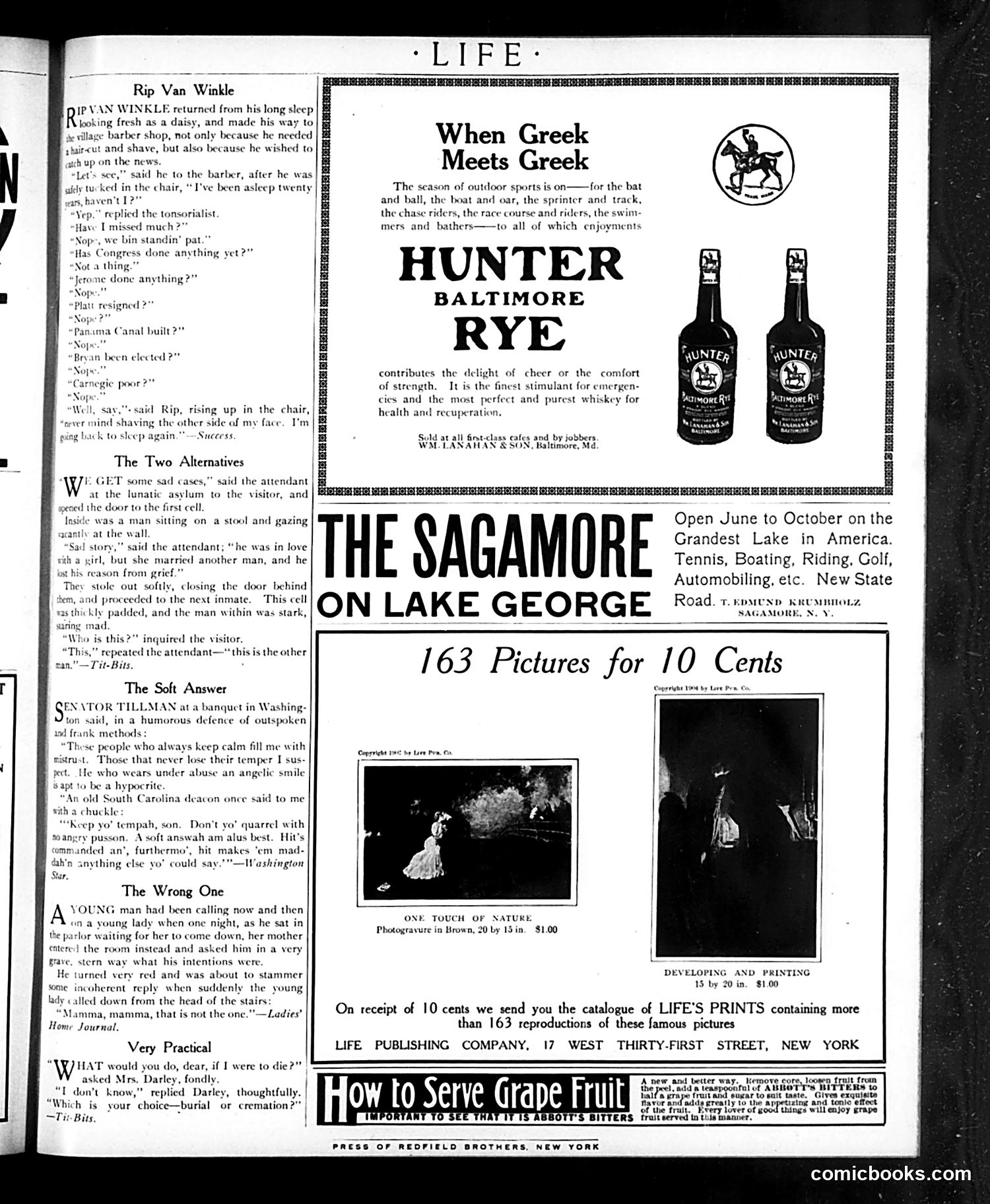
This page contains several brief humorous anecdotes typical of early 20th-century American satire: **"Rip Van Winkle"** riffs on Irving's classic tale: the protagonist awakens after twenty years and asks a barber about major news—Congress, the Panama Canal, Bryan's election—only to hear "we bin standin' pat" (nothing's changed). The joke satirizes political stagnation and legislative inertia. **Other short pieces** mock human nature: a lunatic asylum keeper contrasts a man broken by lost love with one driven mad by rage, suggesting both extremes are foolish; Senator Tillman defends frank anger over false civility; a wife asks her husband what he'd do if she died, receiving his honest but unhappy answer. The page is primarily **advertising**: Hunter Baltimore Rye whiskey, the Sagamore resort on Lake George, and Life Publishing's print catalog dominate. These ads reflect the magazine's target audience—affluent leisure-class readers interested in outdoor sports and fine spirits.
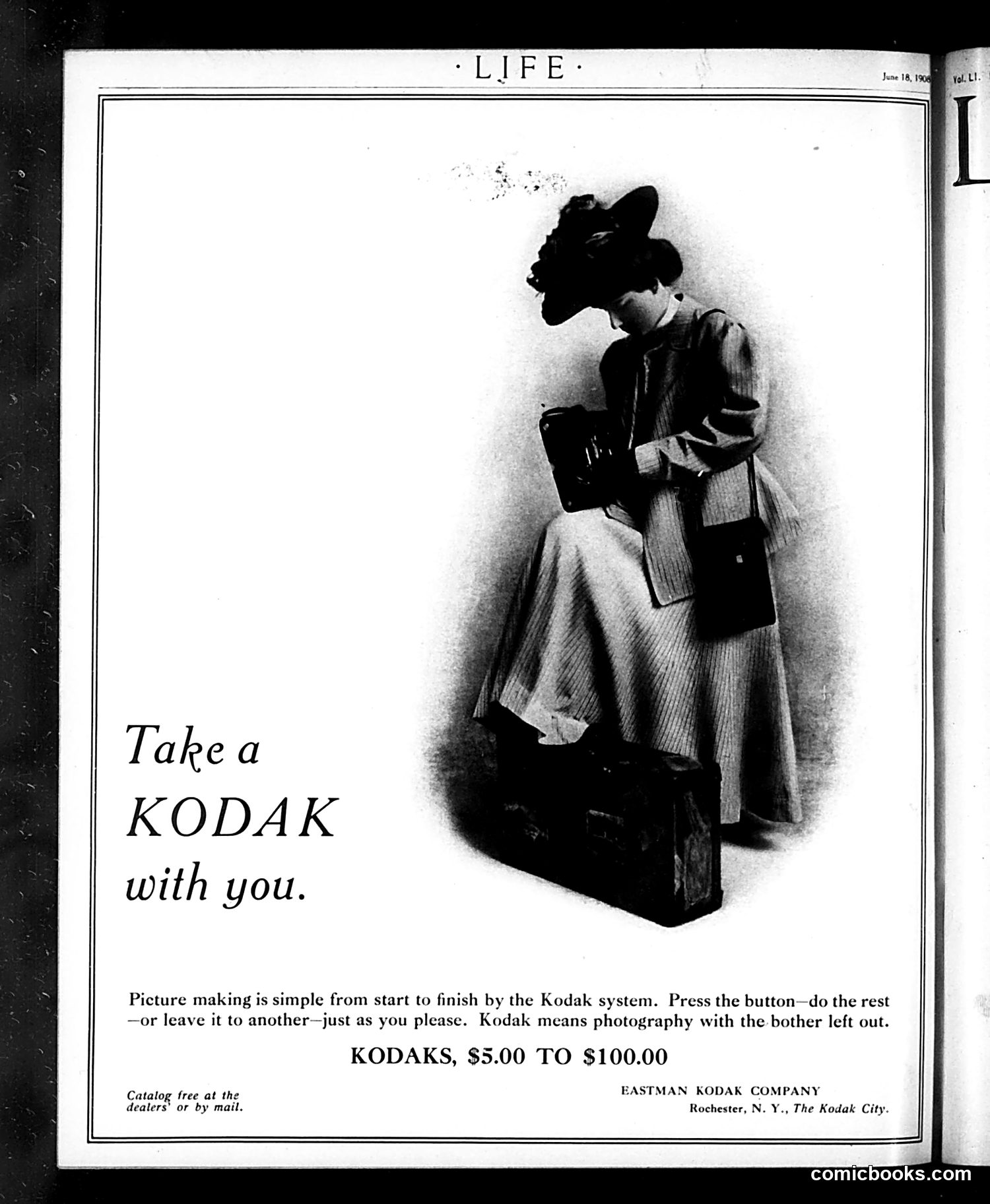
This is primarily **advertising, not satire or political commentary**. It's a Kodak camera advertisement from Life magazine (dated June 18, 1906, visible at top). The image shows a fashionably dressed woman in early 1900s attire—large feathered hat, fitted jacket, long skirt—holding a Kodak camera and suitcase, positioned as if traveling. The advertisement's pitch emphasizes the camera's simplicity: "Press the button—do the rest." This appeals to amateur photographers, particularly women, by eliminating technical complexity. The slogan "Take a Kodak with you" promotes portable photography for leisure travel—a relatively novel concept for the era. Kodak's marketing strategy positioned their cameras as democratizing devices, making photography accessible beyond professional photographers. **For modern readers**: This represents early consumer marketing targeting leisure travelers and women specifically, with messaging emphasizing user-friendly technology.