
Life, 1908-06-18 · page 10 of 28
Life — June 18, 1908 — page 10: what you’re looking at
What you’re looking at
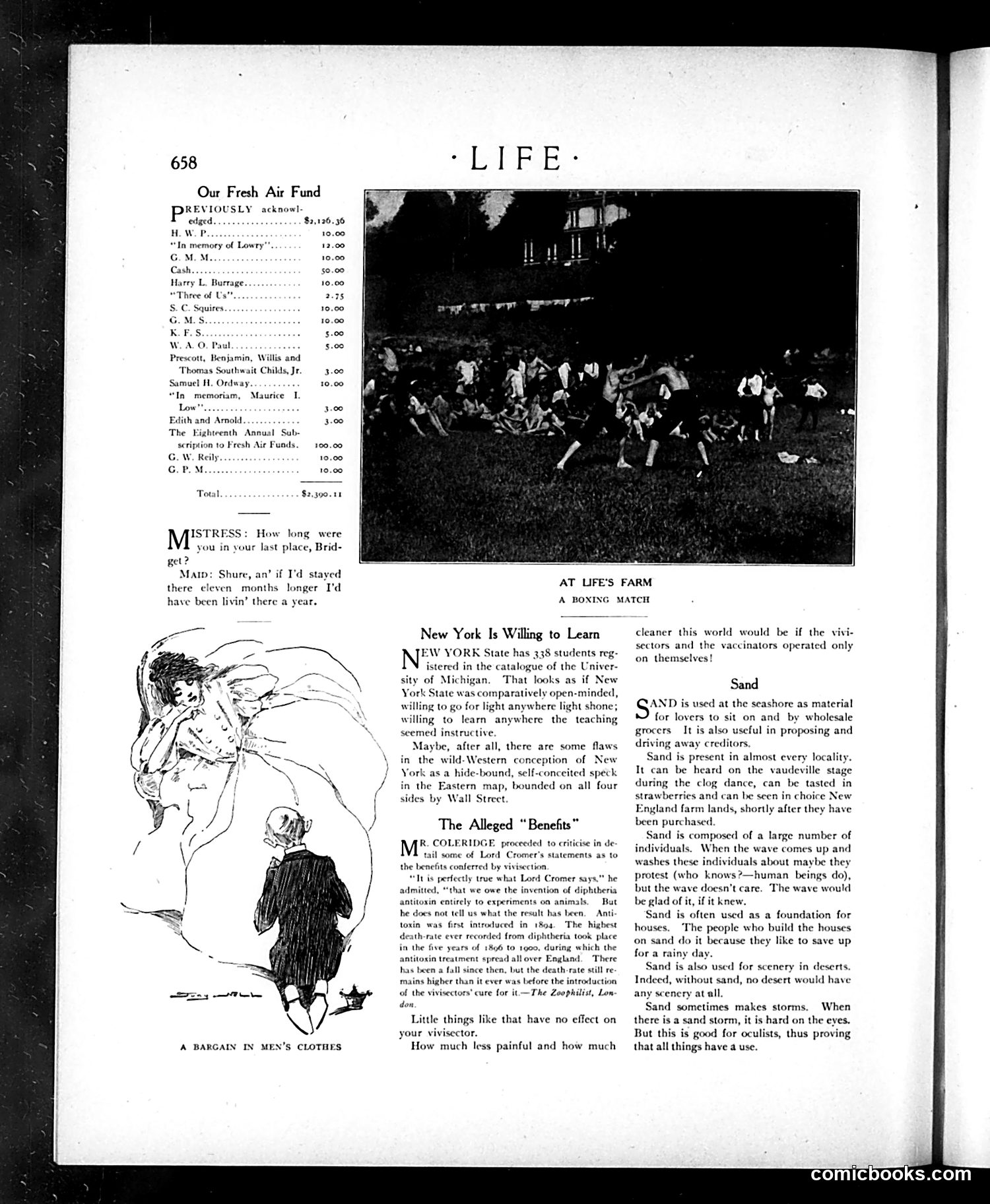
This political cartoon depicts a well-dressed man being fitted into oversized clothing by a tailor. The caption states "A BARGAIN IN MEN'S CLOTHES," suggesting satire about someone acquiring or adopting a position or identity ill-suited to them—literally wearing clothes too large. The cartoon likely comments on an appointment or political figure who appears inadequate for their role. However, **without knowing the specific date or context of this Life magazine issue, I cannot definitively identify the figure or the exact political situation being mocked**. The style and clothing suggest early-to-mid 20th century. The satire hinges on the visual metaphor of someone assuming responsibilities that don't fit them properly.
📄 Transcribed text from this page (OCR, searchable)
Machine-transcribed from the original scan — historical spelling and the odd misread are preserved.
658 Our Fresh Air Fund REVIOUSLY acknow!- edged. HOW. P ja memory of Lowry” M.M. Cash... Harry L. Burrage. “Three of Us" S.C. Squires GMS K.F.S W.A.O, Paul a8 Prescott, Benjamin, Willis and homas Southwait Childs, Jr Samuel H. Ordway : “In memoriam, Maurice I. Low Edith and Arnold ‘The Eighteenth Annual Sub- scription to Fresh Air Funds. G. W. Reily. GP Mo. Total ISTRESS: How lon $2,126. 10. 2 so 10 2 88888 10. 8888 100. 10. 10 $2,390. ng were you in your last place, Brid- get? Matp: Shure, an? if I'd 1 stayed there eleven months longer I'd have been livin’ there a year. A BARGAIN IN. ME: CLOTHES AT UFE'S FARM A BOXING MATCH New York Is Willing to Learn W YORK State has 338 students reg- istered in the catalogue of the Univer- sity of Michigan. That looks as if New York State was comparatively open-minded, willing to go for light anywhere light shone; willing to learn anywhere the teaching seemed instructive. Maybe, after all, there are some flaws in the wild-Western conception of New York asa hide-bound, self-conceited speck in the Eastern map, bounded on all four sides by Wall Street The Alleged “Benefits” R. COLERIDGE. proceeded to criticise in de tail some of Lord the benefits conferred by vivisection “It is perfectly true what Lord Cromer says.” he admitted, “that we owe the invention of di pmer’s statements as to antitoxin entirely to experiments oa animals. he does not tell us what the result has Leen. toxin was first introduced in 1804. The highest death-rate ever recorded from diphtheria took place in the five years of 1806 to 1900, during which the antitoxin treatment spread all over England. There has been a fall since then, but the death-rate still re mains higher than it ever was before the introduction, of the vivisectors' cure for it —The Zoophilist, Lon di Little things like that have no effect on your vivisector. How much less painful and how much cleaner this world would be if the vivi- sectors and the vaccinators operated only on themselves! Sand AND is used at the seashore as material for lovers to sit on and by wholesale grocers It is also useful in proposing and driving away creditors Sand is present in almost every locality. It can be heard on the vaudeville stage during the clog dance, can be tasted in strawberries and can be seen in choice New England farm lands, shortly after they have been purchased. Sand is composed of a large number of individuals. When the wave comes up and washes these individuals about maybe they protest (who knows?—human beings do), but the wave doesn’t care. The wave would be glad of it, if it knew. Sand is often used as a foundation for houses. The people who build the houses on sand do it because they like to save up for a rainy day. Sand is also used for scenery in deserts. Indeed, without sand, no desert would have any scenery at all Sand sometimes makes storms. When there isa sand storm, it is hard on the eyes. But this is good for oculists, thus proving that all things have a use. comicbooks.com