
Life, 1908-06-18 · page 18 of 28
Life — June 18, 1908 — page 18: what you’re looking at
What you’re looking at
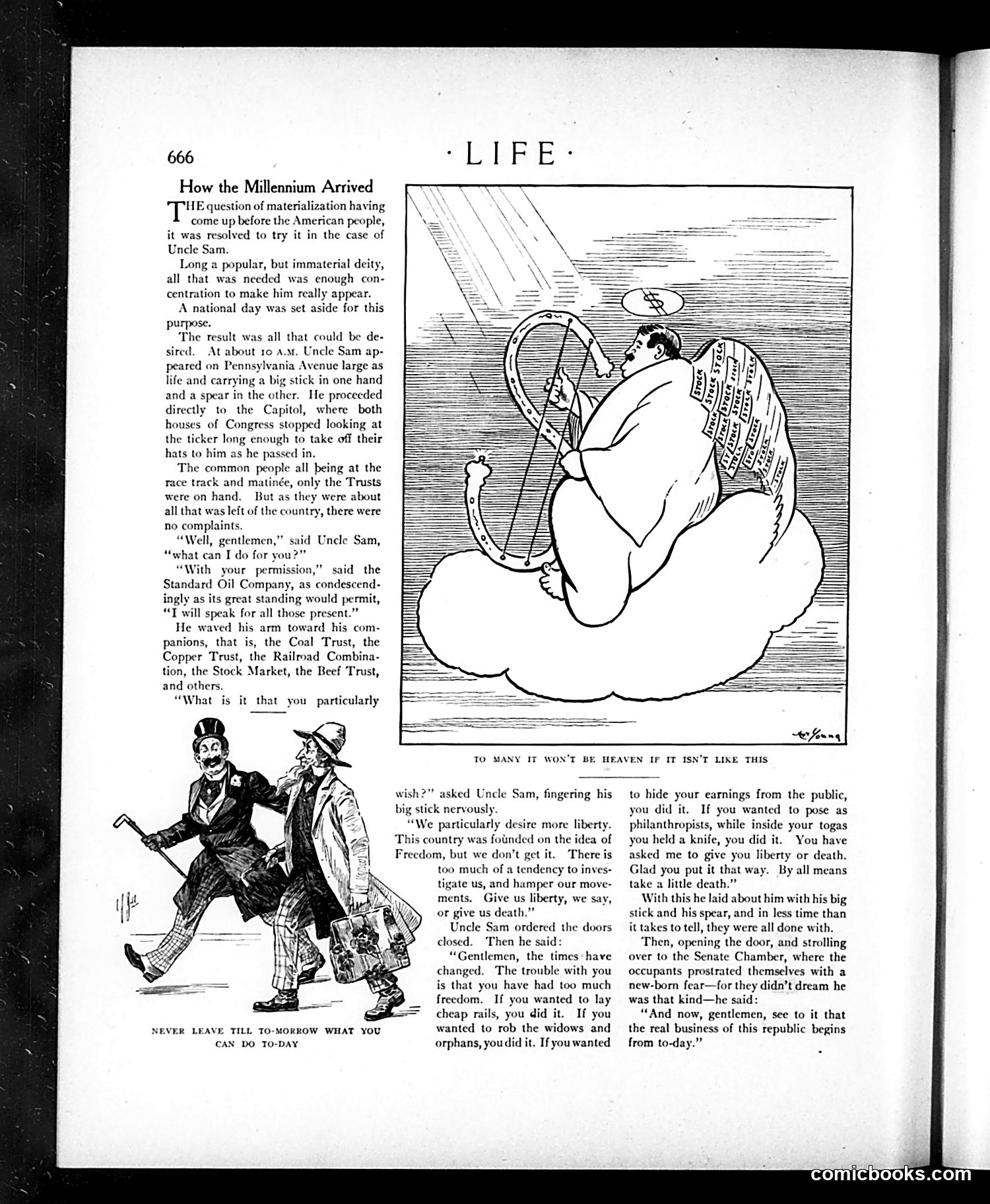
This satirical piece lampoons the monopolistic trusts dominating early 20th-century America. Uncle Sam—materialized through public concentration—confronts the major corporate powers (Standard Oil, Coal Trust, Copper Trust, Railroad, Stock Market, Beef Trust) demanding "more liberty." The satire's bite: these cartels claim government over-regulation oppresses them, echoing their actual arguments against progressive reforms. Uncle Sam's response exposes the hypocrisy—they've exploited freedom to defraud widows, evade taxes, and manipulate markets. His violent "solution" (beating them with stick and spear) represents the author's fantasy of aggressive trust-busting. The accompanying cartoon shows Uncle Sam on a cloud, steering a large wheel—suggesting his control over the nation's direction once he addresses corporate corruption. The satirist argues only harsh intervention can restore genuine republican governance.
📄 Transcribed text from this page (OCR, searchable)
Machine-transcribed from the original scan — historical spelling and the odd misread are preserved.
666 How the Millennium Arrived TLE aiestion of materialization having come up before the American people, it was resolved to try it in the case of Uncle Sam. Long a popular, but immaterial deity, all that was needed was enough con- centration to make him really appear. A national day was set aside for this purpose. The result was all that could be de- sired, At about 10 A.M. Uncle Sam ap- peared on Pennsylvania Avenue large as life and carrying a big stick in one hand and a spear in the other. He proceeded directly to the Capitol, where both of Congress stopped looking at icker long enough to take off their hats to him as he passed in. The common people all being at the race track and matinée, only the Trusts were on hand. But as they were about all that was left of the country, there were no complaints. “Well, gentlemen, “what can I do for y “With your permission,” said the Standard Oil Company, as condescend- 1 Uncle Sam, ingly as its great standing would permit, “T will speak for all those present.” He waved his arm toward his com- panions, that is, the Coal Trust, the Copper Trust, the Railroad Combina- tion, the Stock Market, the Beef Trust, and others. “What is it that you particularly NEVER LEAVE TILL TO-MORROW WHAT YOU CAN DO TO-DAY TO MANY IT WON'T BE HEAVEN IP IT ISN'T LIKE THIS wish?” asked Uncle Sam, fingering his big stick nervously. “We particularly desire more liberty. This country was foinded on the idea of Freedom, but we don’t get it. There is too much of a tendency to in tigate us, and hamper our mov ments. Give us liberty, we say, or give us death.” Uncle Sam ordered the doors closed. Then he said: “Gentlemen, the times have changed. The trouble with you is that you have had too much freedom. If you wanted to lay cheap rails, you did it. If you wanted to rob the widows and orphans, youdid it. If you wanted to hide your earnings from the public, you did it. If you wanted to pose as philanthropists, while inside your togas you held a knife, you did it. You have asked me to give you liberty or death. Glad you put it that way. By all means take a little death.” With this he laid about him with his big stick and his spear, and in less time than it takes to tell, they were all done with. ‘Then, opening the door, and strolling over to the Senate Chamber, where the occupants prostrated themselves with a new-born fear—for they didn’t dream he was that kind—he said: “And now, gentlemen, see to it that the real business of this republic begins from to-day.”