
Life, 1908-06-18 · page 25 of 28
Life — June 18, 1908 — page 25: what you’re looking at
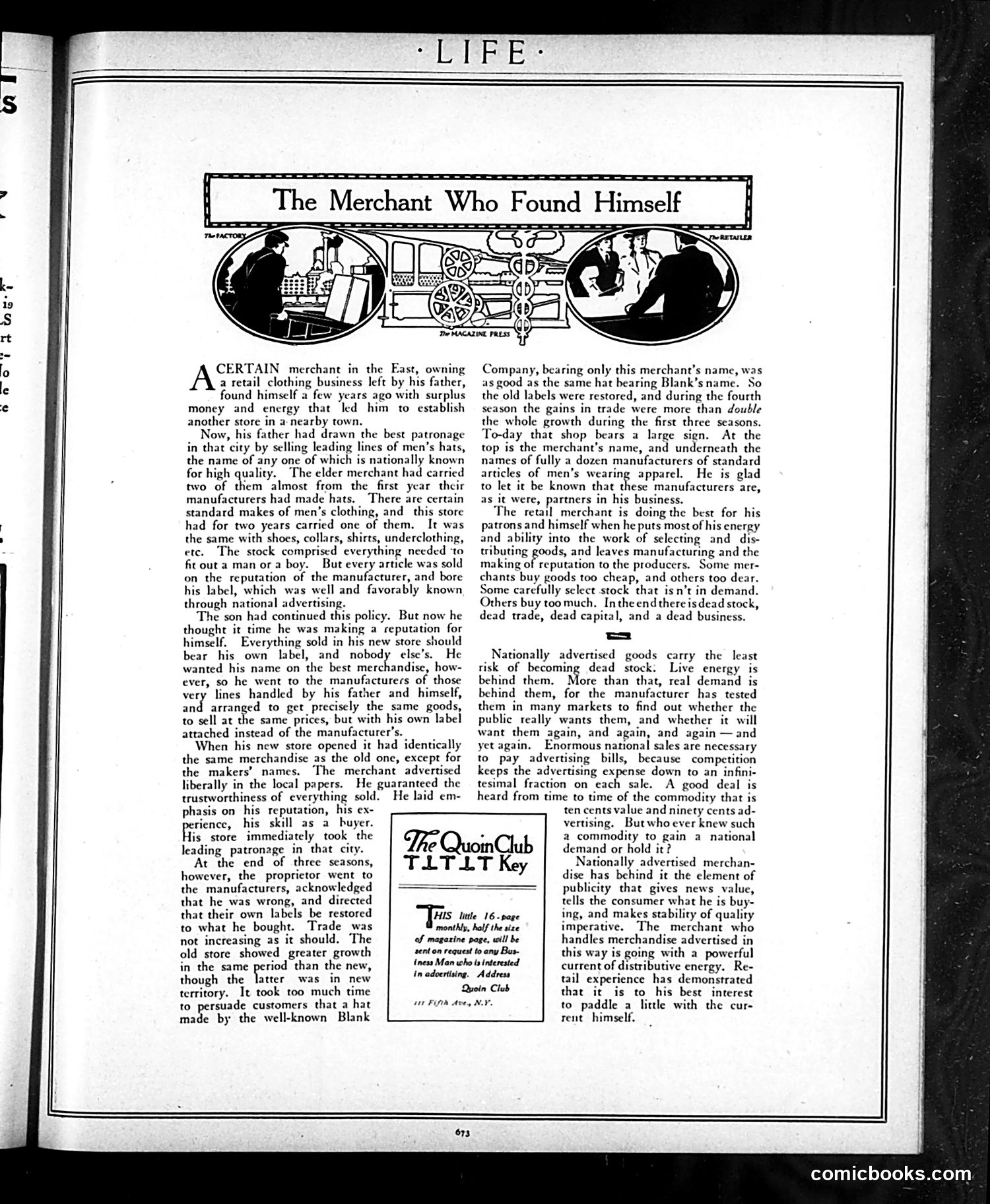
What you’re looking at
This is a business parable, not political satire. It describes a young merchant who inherits his father's successful clothing store, then opens a second location. Seeking to build personal reputation, he relabels identical merchandise with his own name instead of the established manufacturers' brands—despite selling at the same prices. The story's moral: his new store initially outperforms the old one through aggressive local advertising and personal guarantees. But after three seasons, growth stalls. He realizes customers trust established brand names more than his personal reputation. Restoring the original manufacturer labels—and prominently displaying them alongside his name—dramatically increases sales. The lesson for modern readers: **retail success depends on leveraging manufacturer reputation and national advertising**, not replacing it with personal branding. The merchant succeeds only by positioning himself as a *curator* of quality goods, not their originator.
📄 Transcribed text from this page (OCR, searchable)
Machine-transcribed from the original scan — historical spelling and the odd misread are preserved.
CERTAIN merchant in the East, owning a retail clothing business left by his father, found himself a few years ago with surplus money and energy that led him to establish another store in a nearby town. Now, his father had drawn the best patronage in that city by selling leading lines of men’s hats, the name of any one of which is nationally known for high quality. The elder merchant had carried two of them almost from the first year their manufacturers had made hats. There are certain standard makes of men’s clothing, and_ this store had for two years carried one of them. It was the same with shoes, collars, shirts, underclothing, etc. The stock comprised everything needed ‘to fit out a man ora boy. But every article was sold on the reputation of the manufacturer, and bore his label, which was well and favorably known. through national advertising. The son had continued this policy. But now he thought it time he was making a reputation for himself. Everything sold in his new store should bear his own label, and nobody else’s. He wanted his name on the best merchandise, how- ever, so he went to the manufacturers of those very lines handled by his father and himself, and arranged to get precisely the same goods, to sell at the same prices, but with his own label attached instead of the manufacturer’: When his new store opened it had identically the same merchan as the old one, except for the makers’ names. The merchant advertised liberally in the local papers. He guaranteed the trustworthiness of everything sold. He laid em- phasis on his reputation, his ex- rience, his skill as a buyer. is store immediately took the The leading patronage in that city. Ie At the end of three seasons, however, the proprietor went to the manufacturers, acknowledged that he was wrong, and directed that their own labels be restored I to what he bought. Trade was not increasing as it should. The old store showed greater growth in the same period than the new, though the latter was in new territory. It took too much time to persuade customers that a hat made by the well-known Blank i Qin ub HIS little 16-page monthly, half the size of magazine page, will be sent on request to any Bus- {ness Man who is interested in advertising. Address Quoin Club that it is to his best interest Lt FU Ave, MY. Company, bearing only this merchant's name, was as good as the same hat bearing Blank’s name. So the old labels were restored, and during the fourth season the gains in trade were more than double the whole growth during the first three seasons. To-day that shop bears a large sign. At the top is the merchant’s name, and underneath the names of fully a dozen manufacturers of standard articles of men’s wearing apparel. He is glad to let it be known that these manufacturers are, as it were, partners in his business. The retail merchant is doing the best for his patrons and himself when he puts most of his energy and ability into the work of selecting and dis- tributing poods, and leaves manufacturing and the making of reputation to the producers. Some mer- chants buy goods too cheap, and others too dear. Some carefully select stock that isn’t in demand. Others buy toomuch. Intheend there isdead stock, dead trade, dead capital, and a dead business. Nationally advertised goods carry the least risk of becoming dead stock. Live energy is behind them. More than that, real demand is behind them, for the manufacturer has tested them in many markets to find out whether the public really wants them, and whether it will want them again, and again, and again — and yet again. Enormous national sales are necessary to pay advertising bills, because competition keeps the advertising expense down to an infini- tesimal fraction on each sale. A good deal is heard from time to time of the commodity that is ten cents value and ninety cents ad- vertising. But who ever knew such a commodity to gain a national demand or hold it? Nationally advertised merchan- dise has behind it the element of = | publicity that gives news value, tells the consumer what he is buy- ing, and makes stability of quality imperative. The merchant who handles merchandise advertised in this way is going with a powerful current of distributive energy. Re- tail experience has demonstrated to paddle a little with the cur- rent himself. comicbooks.com