
Life, 1908-06-18 · page 8 of 28
Life — June 18, 1908 — page 8: what you’re looking at
What you’re looking at
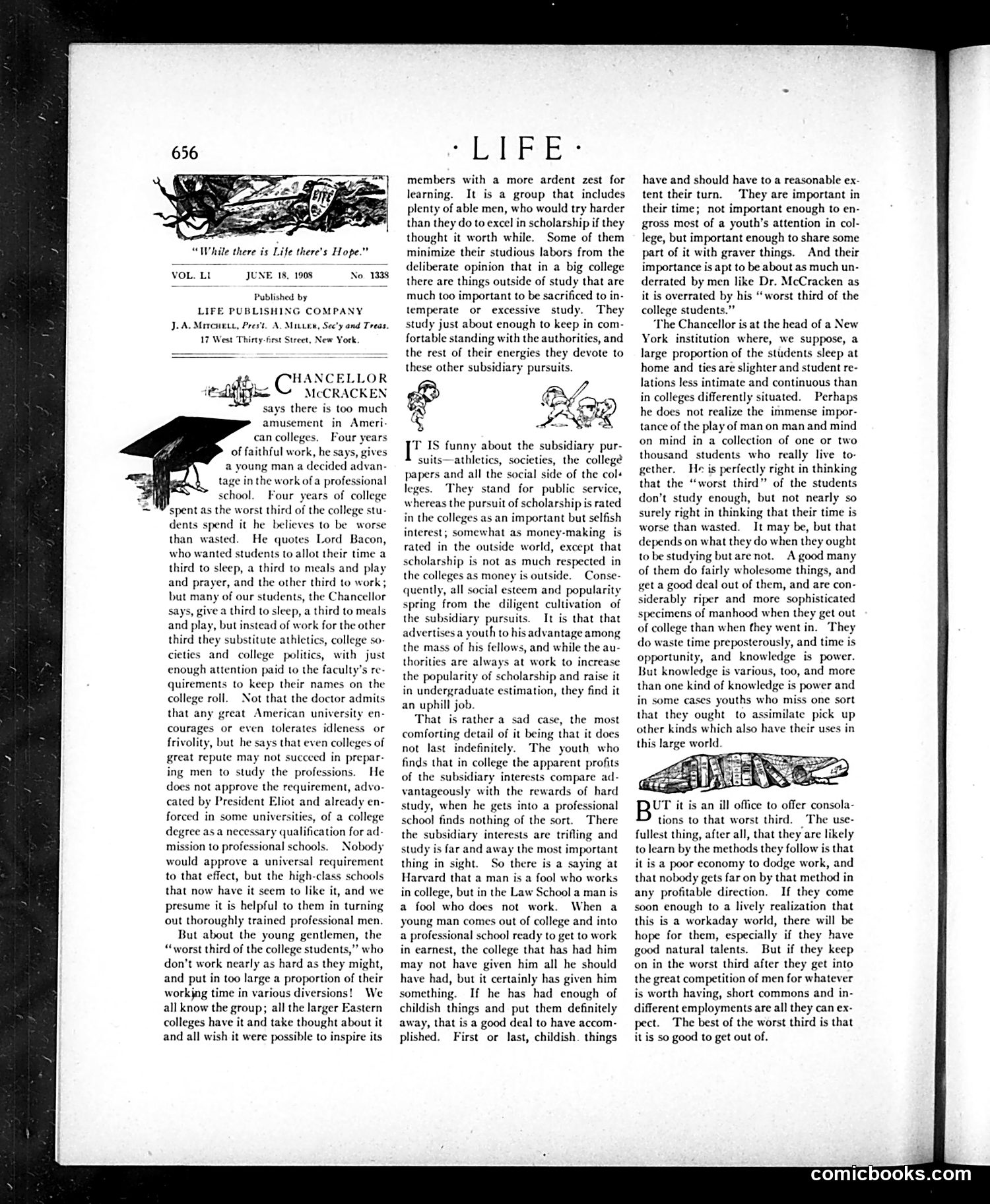
This page features Chancellor McCracken discussing college life. The illustration shows McCracken as a authority figure commenting on student behavior. The satire critiques how colleges emphasize non-academic "subsidiary pursuits"—athletics, societies, social events, and college papers—over actual scholarship. McCracken argues these activities distract students and waste time, yet colleges prioritize them for public service and prestige. The piece mocks a paradox: colleges claim scholarship matters most, but students gain status through social/athletic achievements, not study. McCracken notes the "worst third" of students—those who don't study—actually enjoy college most because they pursue these popular pursuits instead. The cartoon satirizes institutional hypocrisy about educational priorities versus what colleges actually celebrate and encourage among their students.
📄 Transcribed text from this page (OCR, searchable)
Machine-transcribed from the original scan — historical spelling and the odd misread are preserved.
VOL. Li JUNE 18, 1908 Published by LIFE PUBLISHING COMPANY J. A, Mrrcuete, Pres't. A. Mutu, See'y and Treas, 17 West Thirty-first Street, New York. fs, HANCELLOR iff McCRACKEN says there is too much amusement in Ameri can colleges. Four years of faithful work, he says, gives a young man a decided advan- tage in the work of a professional school. Four years of college spent as the worst third of the college stu- dents spend it he believes to be worse than wasted. He quotes Lord Bacon, who wanted students to allot their time a third to sleep, a third to meals and play and prayer, and the other third to work; but many of our students, the Chancellor says, give a third to sleep, a third to meals and play, but instead of work for the other third they substitute athletics, college so- cieties and college politics, with just enough attention paid to the faculty’s re quirements to keep their names on the college roll. Not that the doctor admits that any great American university en- courages or even tolerates idleness or frivolity, but he says that even colleges of great repute may not succced in prepar- ing men to study the professions. He does not approve the requirement, advo- cated by President Eliot and already en- forced in some universities, of a college degree asa necessary qualification for ad- mission to professional schools. Nobody would approve a universal requirement to that effect, but the high-class schools that now have it seem to like it, and we presume it is helpful to them in turning out thoroughly trained professional men. But about the young gentlemen, the “worst third of the college students,” who don’t work nearly as hard as they might, and put in too large a proportion of their workjng time in various diversions!’ We all know the group; all the larger Eastern colleges have it and take thought about it and all wish it were possible to inspire its oa) bed Ri od oe members with a more ardent zest for learning. It is a group that includes plenty of able men, who would try harder than they do to excel in scholarship if they thought it worth while. Some of them minimize their studious labors from the deliberate opinion that in a big college there are things outside of study that are much too important to be sacrificed to in- temperate. or excessive study. They study just about enough to keep in com- fortable standing with the authorities, and the rest of their energies they devote to these other subsidiary pursuits. T IS funny about the subsidiary pur- suits—athletics, societies, the collegé papers and all the social side of the col+ leges. They stand for public service, whereas the pursuit of scholarship is rated in the colleges as an important but selfish interest; somewhat as money-making is rated in the outside world, except that scholarship is not as much re: the colleges as money is outside. quently, all social esteem and popularity spring from the diligent cultivation of the subsidiary pursuits. It is that that advertises a youth to his advantage among the mass of his fellows, and while the au- thorities are always at work to increase the popularity of scholarship and raise it in undergraduate estimation, they find it an uphill job. That is rather a sad case, the most comforting detail of it being that it do not last indefinitely. The youth who finds that in college the apparent profits of the subsidiary interests compare ad- vantageously with the rewards of hard study, when he gets into a professional school finds nothing of the sort. There the subsidiary interests are trifling and study is far and away the most important thing in sight. So there is a saying at Harvard that a man is a fool who works in college, but in the Law School a man is a fool who does not work. When a young man comes out of college and into a professional school ready to get to work in earnest, the college that has had him may not have given him all he should have had, but it certainly has given him something. If he has had enough of childish things and put them definitely away, that is a good deal to have accom- plished. First or last, childish. things have and should have to a reasonable ex- tent their turn. They are important in their time; not important enough to en- gross most of a youth's attention in col- lege, but important enough to share some part of it with graver things. And their importance is apt to be about as much un- derrated by men like Dr. McCracken as it is overrated by his “worst third of the college students. ‘The Chancellor is at the head of a New York institution where, we suppose, a large proportion of the students sleep at home and ties are slighter and student re- lations less intimate and continuous than in colleges differently situated. Perhaps he does not realize the immense impor- tance of the play of man on man and mind on mind in a collection of one or two thousand students who really live to- gether. He is perfectly right in thinking that the “worst third” of the students don’t study enough, but not nearly so surely right in thinking that their time is worse than wasted. It may be, but that depends on what they do when they ought to be studying but are not. A good many of them do fairly wholesome things, and yet a good deal out of them, and are con- siderably riper and more sophisticated specimens of manhood when they get out of college than when fhey went in. They do waste time preposterously, and time is opportunity, and knowledge is power. But knowledge is various, too, and more than one kind of knowledge is power and in some cases youths who miss one sort that they ought to assimilate pick up other kinds which also have their uses in this large world UT it is an ill office to offer consola- tions to that worst third. The use- fullest thing, after all, that they’are likely to learn by the methods they follow is that it is a poor economy to dodge work, and that nobody gets far on by that method in any profitable direction. If they come soon enough to a lively realization that this is a workaday world, there will be hope for them, especially if they have good natural talents. But if they keep on in the worst third after they get into the great competition of men for whatever is worth having, short commons and in- different employments are all they can ex- pect. The best of the worst third is that it is so good to get out of. comicbooks.com