
Life, 1908-06-18 · page 12 of 28
Life — June 18, 1908 — page 12: what you’re looking at
What you’re looking at
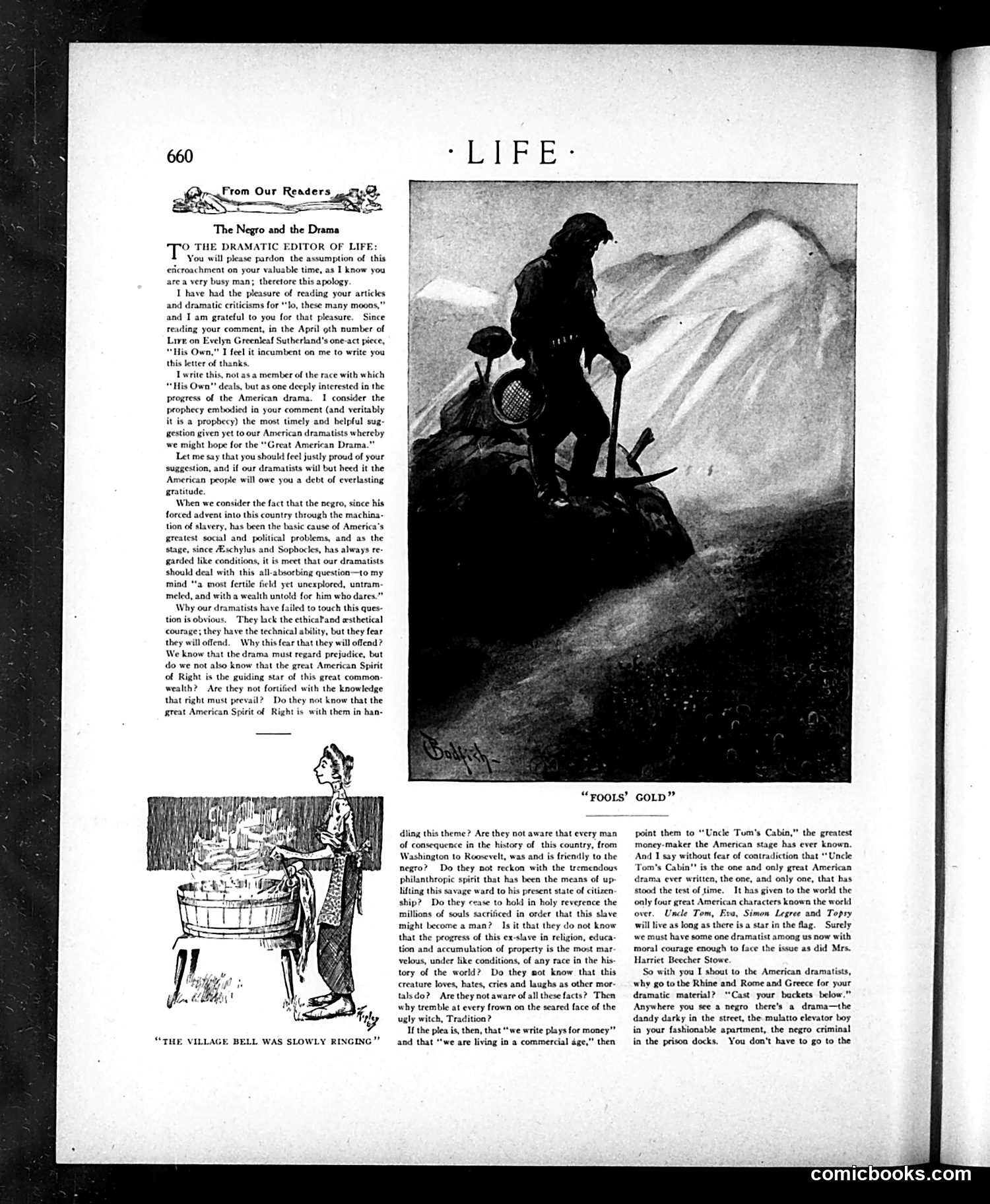
This page from *Life* magazine contains a reader's letter criticizing American dramatists for avoiding the question of race and slavery in their plays. The writer argues that playwrights lack "ethical and aesthetical courage" and fears addressing prejudice, yet insists the American stage must confront this "all-absorbing question." The accompanying illustrations appear to be satirical sketches mocking contemporary theatrical productions. One image is captioned "The Village Bell Was Slowly Singing," and another "Fools' Gold"—likely critiquing lightweight or evasive dramatic works. The letter's references to *Uncle Tom's Cabin* and *Harriet Beecher Stowe* underscore the writer's point: that serious racial drama was possible, yet being avoided by contemporary American playwrights. The satire targets theatrical cowardice regarding America's fundamental social problem.
📄 Transcribed text from this page (OCR, searchable)
Machine-transcribed from the original scan — historical spelling and the odd misread are preserved.
660 From Our Readers 2 2, Se The Negro and the Drama 0 THE DRAMATIC EDITOR OF LIFE: You will please pardon the assumption of this edicroachment on your valuable time, as I know you area very busy man; theretore this apology T have had the pleasure of reading your articles and dramatic criticisms for ‘lo, these many moons,”” and I am grateful to you for that pleasure. Since reading your comment, in the April oth number of Lire on Evelyn Greenleaf Sutherland's one-act piece, “His Own,” I feel it incumbent on me to write you this letter of thanks. I write this, not asa member of the race with which “His Own’ deals, but as one deeply interested in the progress of the American drama. 1 consider the prophecy embodied in your comment (and veritably it is a prophecy) the most timely and helpful sug- gestion given yet to our American dramatists whereby we might hope for the “Great American Drama.” Let me say that you should fee! justly proud of your suggestion, and if our dramatists will but heed it the American people will owe you a debt of everlasting gratitude, When we consider the fact that the negro, since his forced advent into this country through the machina- tion of slavery, has been the basic cause of America’s greatest social and political problems, and as the stage, since Eschylus and Sophocles, has always re- garded like conditions, it is meet that our dramatists should deal with this all-absorbing question—to my mind “a most field yet unexplored, untram: meled, and with a wealth untold for him who dares.” Why our dramatists have failed to touch this ques tion is obvious. “They lack the ethicaPand esthetical courage; they have the technical ability, but they fear they will offend. Why this fear that they will offend ? We know that the drama must regard prejudice, bat do we not also know that the great American Spirit of Right is the guiding star of this great common. wealth? Are they not fortified with the knowledge that right must prevail? Do they not know that the great American Spirit of Right is with them in han- “THE VILLAGE BELL WAS SLOWLY RINGING” “FOOLS’ GOLD” dling this theme? Are they not aware that every man of consequence in the history of this country, from Washington to Roosevelt, was and is friendly to the negro? Do they not reckon with the tremendous philanthropic spirit that has been the means of up- lifting this savage ward to his present state of citizen: ship? Do they cease to hold in holy reverence the millions of souls sacrificed in order that this slave might become a man? Is it that they do not know that the progress of this ex-slave in religion, educa- tion and accumulation of property is the most mar. velous, under like conditions, of any race in the his: tory of the world? Do they mot know that this creature loves, hates, cries and laughs as other mor- talsdo? Are they not aware of all these facts? Then why tremble at every frown on the seared face of the ugly witch, Tradition? If the plea is, then, that “we write plays for money”? and that “we are living in a commercial age,” then point them to “Uncle Tum’s Cabin,” the greatest money-maker the American stage has ever known. And I say without fear of contradiction that “Uncle Tom's Ca is the one and only great American drama ever written, the one, and oaly one, that has stood the test of time. It has given to the world the oaly four great American characters known the world over. Uncle Tom, Eva, Simon Legree and Topsy will live as long as there is a star in the flag. Surely we must have some one dramatist among us now with moral courage enough to face the issue as did Mrs. Harriet Beecher Stowe. So with you I shout to the American dramatists, why go to the Rhine and Rome and Greece for your dramatic material? “Cast your buckets below.” Anywhere you sce a negro there’s a drama—the dandy darky in the street, the mulatto elevator boy your fashionable apartment, the negro criminal in the prison docks. You don’t have to go to the comicbooks.com