
Life, 1908-06-18 · page 13 of 28
Life — June 18, 1908 — page 13: what you’re looking at
What you’re looking at
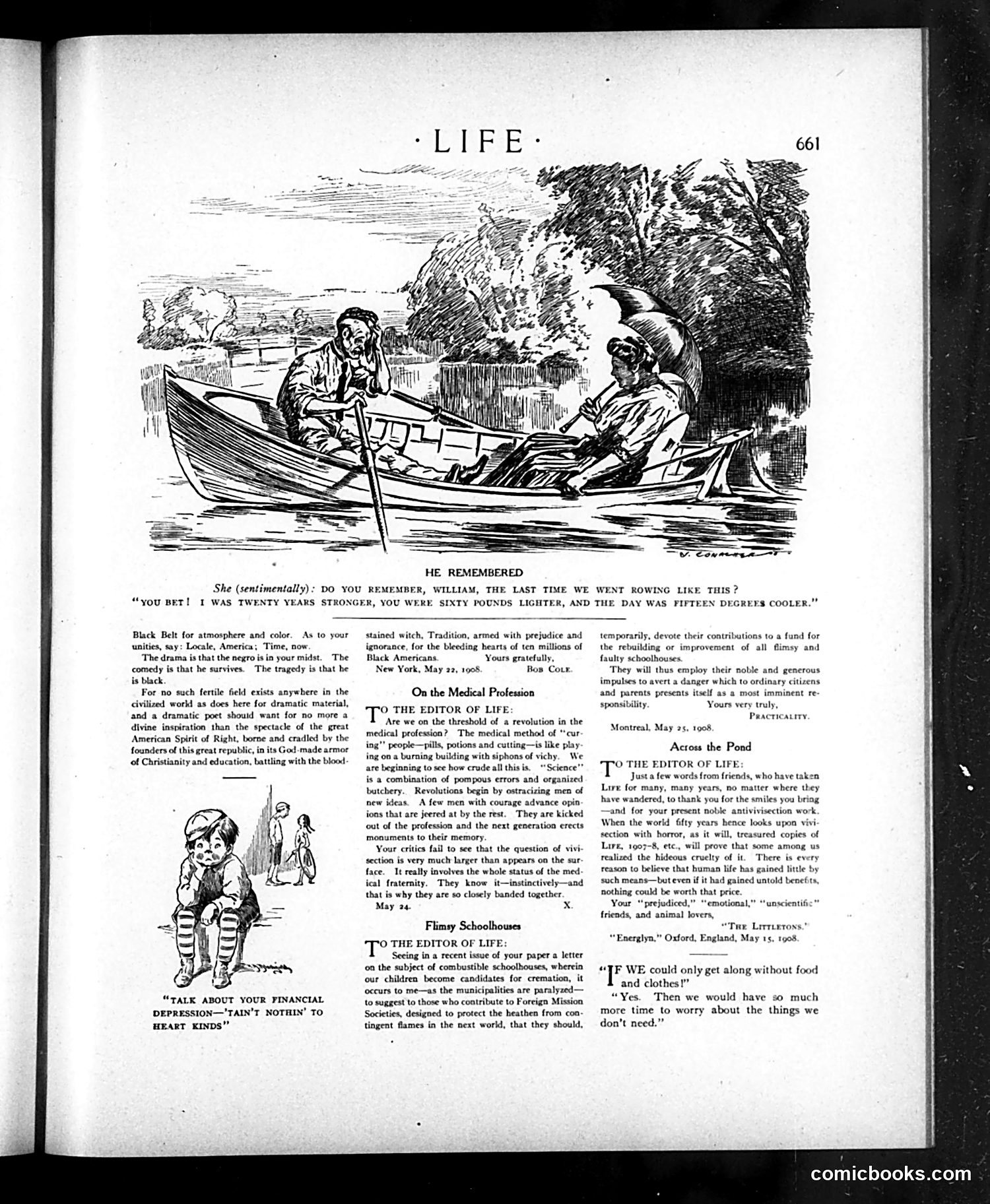
This cartoon depicts two men in a rowboat. The caption quotes one asking the other: "Do you remember, William, the last time we went rowing like this? You were twenty years younger, you were sixty pounds lighter, and the day was fifty degrees cooler." The humor relies on **aging and nostalgia**. The satirical point mocks how people romanticize the past while ignoring present physical decline—William has apparently gained weight and aged significantly. The "fifty degrees cooler" reference suggests either climate change or simply that summer feels hotter with age. This is straightforward social satire about middle-aged regret and the gap between youthful memory and current reality, with no apparent political dimension.
📄 Transcribed text from this page (OCR, searchable)
Machine-transcribed from the original scan — historical spelling and the odd misread are preserved.
HE REMEMBERED She (sentimentally): DO YOU REMEMBER, WILLIAM, THE LAST TIME WE WENT ROWING LIKE THIS? “you Bet! I WAS TWENTY YEARS STRONGER, YOU WERE SIXTY POUNDS LIGHTER, AND THE DAY WAS FIFTEEN DEGREES COOLER.” Black Belt for atmosphere and color. As to your unities, say: Locale, America; Time, now ‘The drama is that the negro is in your midst. The comedy is that he survives. The tragedy is that he is black For no such fertile field exists anywhere in the civilized world as does here for dramatic material, and a dramatic poet should want for no more a divine inspiration than the spectacle of the great American Spirit of Right, borne and cradled by the founders of this great republic, in its God-made armor of Christianity and education, battling with the blood “TALK ABOUT YOUR FINANCIAL DEPRESSION—'TAIN’T NOTHIN’ TO HEART KINDS” stained witch, Tradition, armed with prejudice and ignorance, for the bleeding hearts of ten millions of Black Americans. Yours gratefully, New York, May 22, 1908. Bos Cour On the Medical Profession ‘0 THE EDITOR OF LIFE Are we on the threshold of a revolution in the medical profession? The medical method of “cur ing’’ people—pills, potions and cutting—is like play ing on a burning building with siphons of vichy. We are beginning to see how crude all this is. “Science”? is a combination of pompous errors and organized butchery. Revolutions begin by ostracizing men of new ideas. A few men with courage advance opin ions that are jeered at by the rest. They are kicked out of the profession and the next generation erects monuments to their memory Your critics fail to see that the question of vivi section is very much larger than appears on the sur- face. It really involves the whole status of the med. ical fraternity, They know it—instinctively—and that is why they are so closely banded together. May 24. x Flimsy Schoolhouses THE EDITOR OF LIFE: Seeing in a recent issue of your paper a letter 0a the subject of combustible schoothouses, wherein our children become candidates for cremation, it occurs to me—as the municipalities are paralyzed— to suggest to those who contribute to Foreign Mission Societies, designed to protect the heathen from con- tingent flames in the next world, that they should, temporarily, devote their contributions to a fund for the rebuilding or improvement of all flimsy and faulty schoolhouses. ‘They will thus employ their noble and generous impulses to avert a danger which to ordinary citizens and parents presents itself as a most imminent re- sponsibitity Yours very truly, Practicattry Montreal, May 25, 1908 Across the Pond To THE EDITOR OF LIFE Just a few words from friends, who have taken Lire for many, many years, no matter where they have wandered, to thank you for the smiles you bring —and for your present noble ant When the world fifty years hence looks upon vivi section with horror, as it will, treasured copies of Lire, 1907-8, etc., will prove that some among us realized the hideous cruelty of it. There is every reason to believe that human life has gained little by such means—but even if it had gained untold benefits, nothing could be worth that price Your “prejudiced,” “emotional,” “ unscientifi friends, and animal lovers, “Tne Lrrtrtoxs.” ““Energlyn,” Oxford, England, May 15, 1908 section work. “TF WE could only get along without food and clothes!” “Yes. Then we would have so much more time to worry about the things we don’t need.” comicbooks.com