
A complete issue · 20 pages · 1908
Life — February 27, 1908
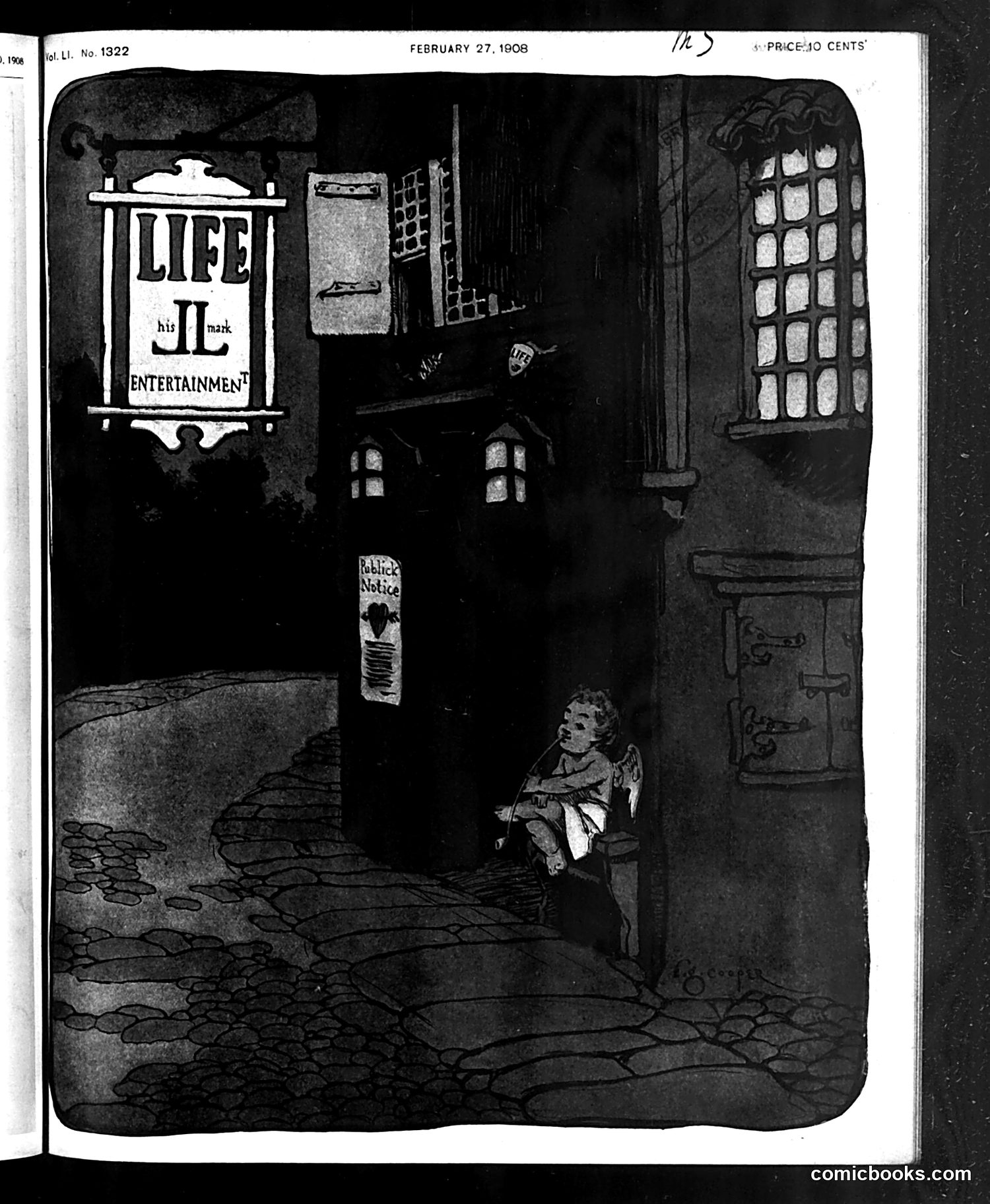
This is a Life Entertainment advertisement featuring the magazine's logo. The cartoon depicts a dark, Gothic-style scene—seemingly a prison or dungeon interior with barred windows and heavy doors. A small child sits alone in the shadowy space, with a "Public Notice" posted on the wall. The LIFE Entertainment mark appears as a hanging sign. The satire likely comments on entertainment venues or theatrical productions of the era, possibly critiquing sensationalist or inappropriate content being marketed. The isolated child in an ominous setting suggests commentary on what types of performances were being promoted to—or accessible to—young audiences. Without additional context from the surrounding page, the specific target of this critique remains unclear, though it appears to be social commentary on entertainment industry practices.
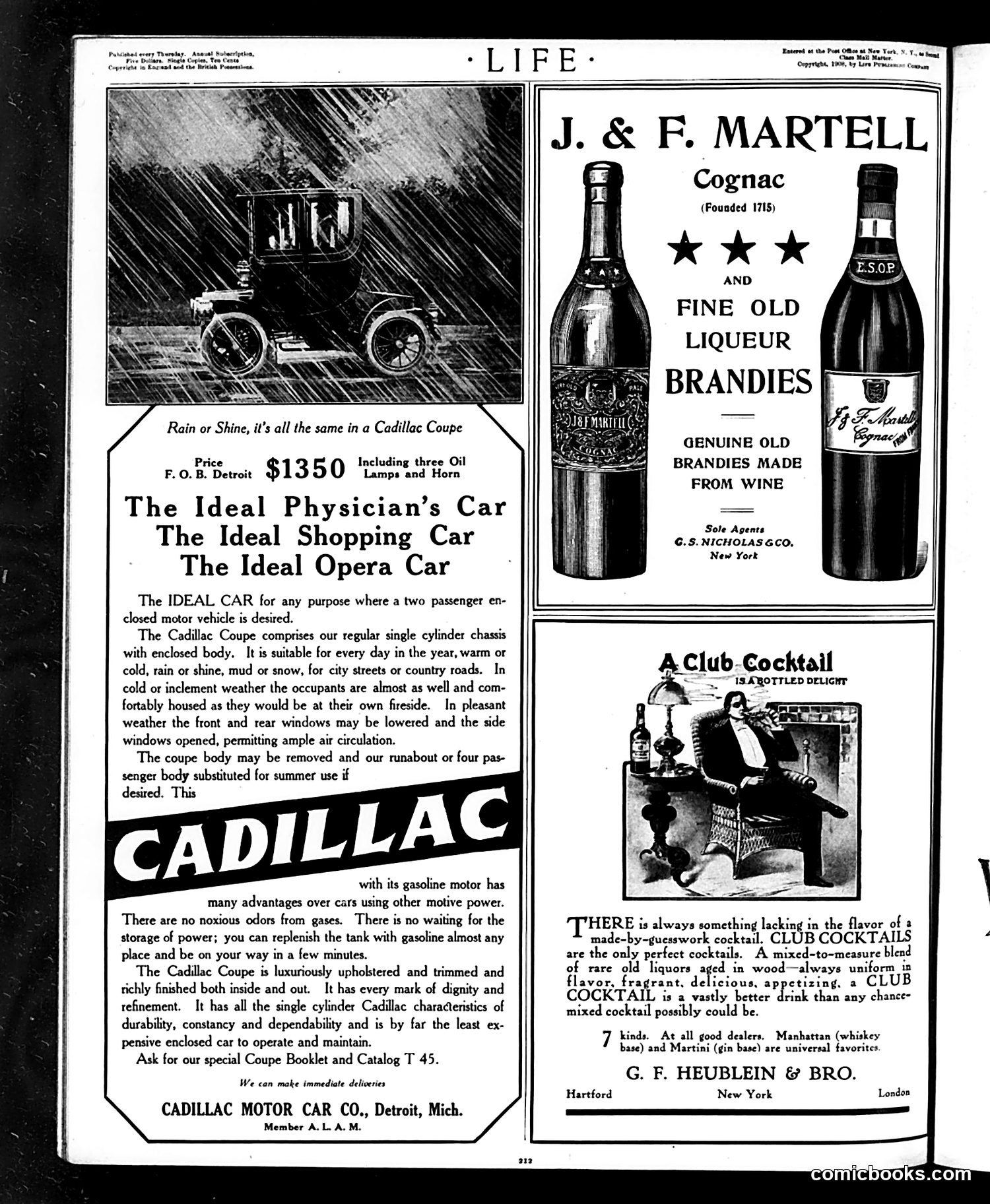
This page is **primarily advertising**, not satire or political commentary. It contains three advertisements: 1. **Cadillac Coupe** (left): Markets an enclosed two-passenger motor car priced at $1,350, emphasizing its suitability for all weather conditions and purposes—positioning it as ideal for physicians, shopping, and opera attendance. 2. **J. & F. Martell Cognac** (top right): Advertises French brandy and liqueurs, highlighting the company's founding in 1715. 3. **Club Cocktail** (bottom right): Promotes a pre-mixed bottled cocktail as a convenient alternative to bar-made drinks. The page reflects early 20th-century consumer culture, with automobiles and alcohol as luxury goods marketed to affluent readers. There is **no apparent political cartoon or satirical commentary**—this is a straightforward advertising section.
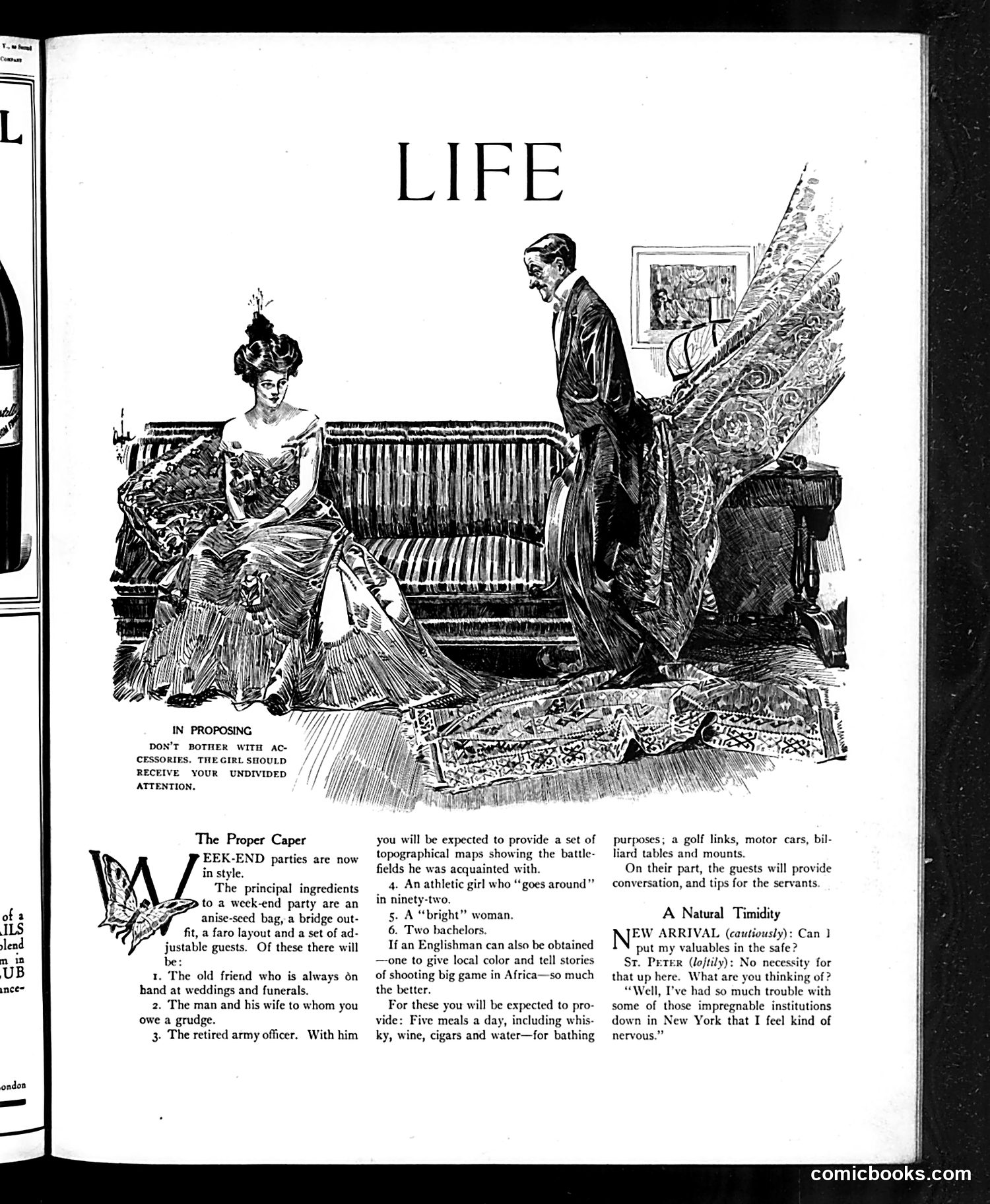
This page satirizes upper-class weekend entertaining practices. The illustration shows a man and woman in an elegant interior, with accompanying text offering tongue-in-cheek advice for hosting a "week-end party." The satire targets wealthy social conventions by listing absurdly specific guest requirements: "the old friend," "the man and his wife to whom you owe a grudge," "the retired army officer," various bachelors, and an "athletic girl." The humor lies in the frank acknowledgment that hosts invited people out of obligation rather than genuine desire—mixing socially required guests with those they actually resented. The proposed five daily meals with "whisky, wine, cigars and water—for bathing" mocks extravagant entertaining practices of the era's leisure class, suggesting such elaborate hospitality was exhausting performance rather than genuine pleasure.
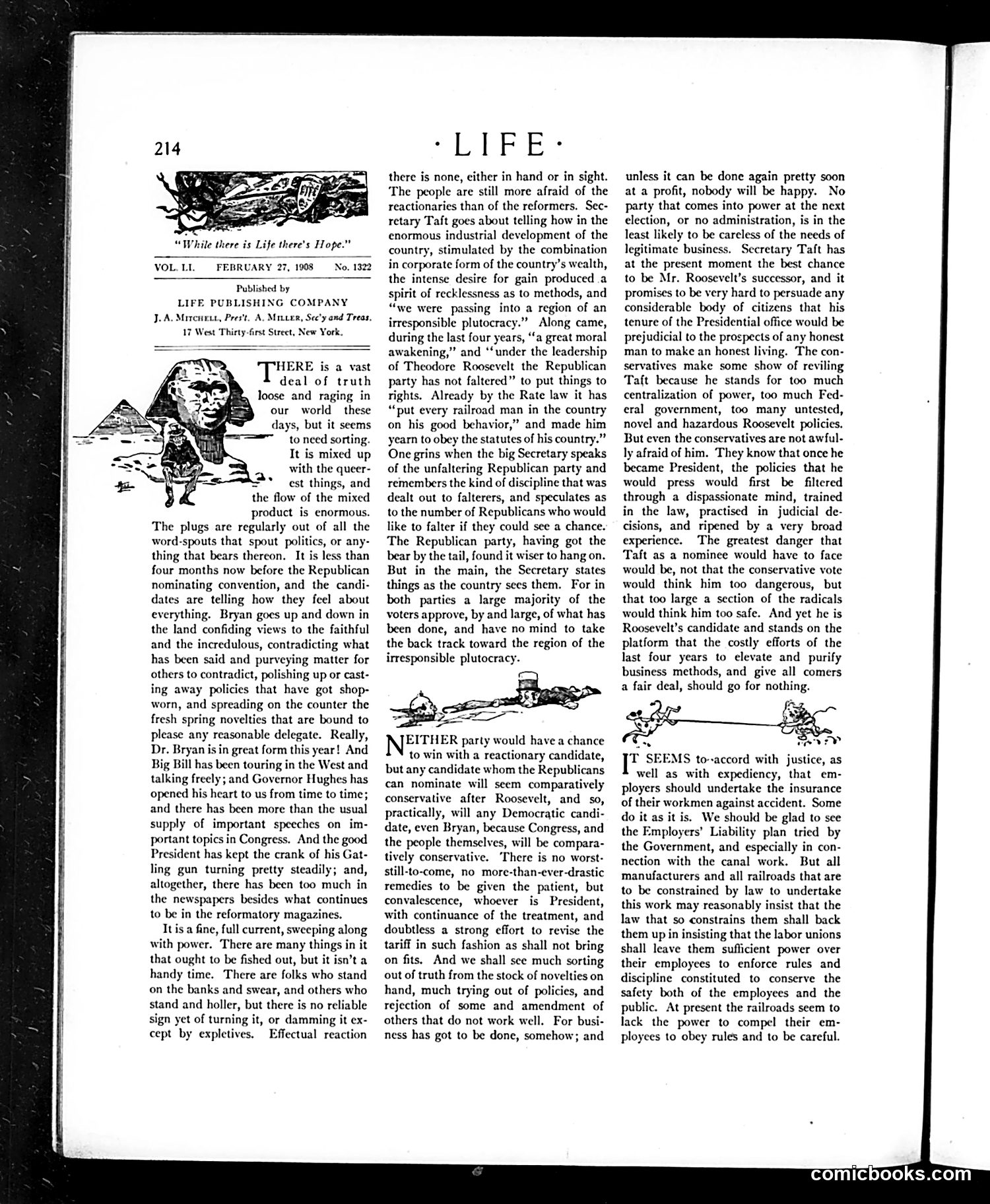
The page contains two political cartoons critiquing the 1908 presidential election cycle. **Left cartoon:** Depicts a figure (likely William Jennings Bryan, referenced in the text) as a raging beast or wild animal, labeled "While there is Life there's Hope." This mocks Bryan's persistent political ambitions despite previous electoral defeats. **Right cartoon:** Shows what appears to be a political figure being trampled or crushed, satirizing the chaotic state of party politics and competing candidates. The accompanying text discusses Republican anxiety about nominating a successor to Roosevelt, debates over conservative versus radical candidacy, and concerns about Bryan's potential return. The satire suggests political instability and the messy nature of succession politics in the 1908 election season.
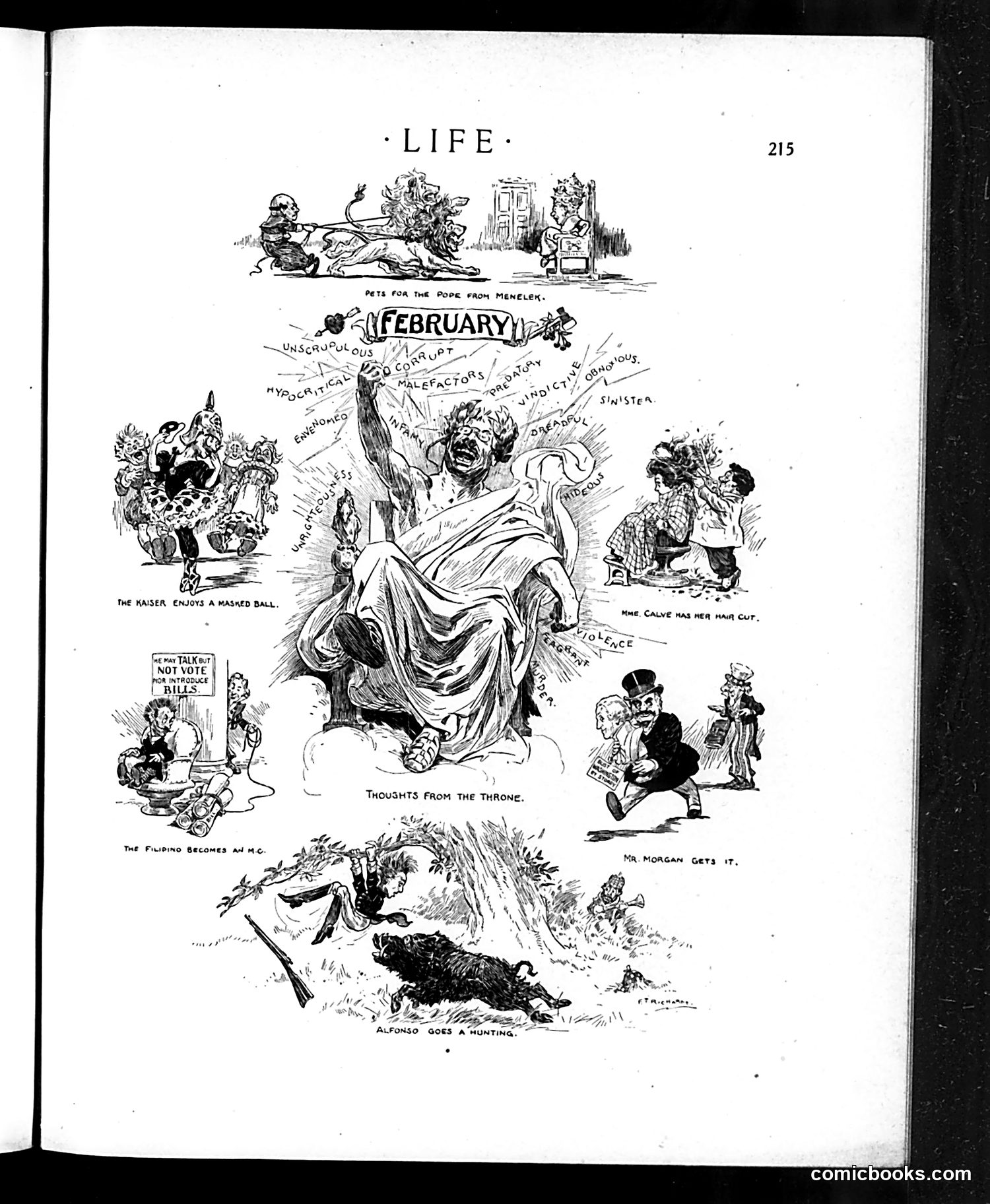
This page presents satirical sketches about February events and personalities. The central allegorical figure labeled "Thoughts from the Throne" appears to represent Kaiser Wilhelm II (suggested by the crown reference), depicting him amid various complaints: "unscrupulous," "hypocrites," "traitors," "malefactors," and other criticisms radiating outward. Surrounding vignettes mock contemporary figures: "The Kaiser Enjoys a Masked Ball," "The Finding Becomes an M.C." (master of ceremonies), "Mr. Morgan Gets It," and "Alfonso Goes A-Hunting." The sketches appear to critique European royalty and American elites during what was likely the pre-WWI period. References to "the Pope from Menelek," "Mrs. Calve," and "Dill" suggest specific (now-obscure) scandals or personalities of the moment. The overall tone is distinctly anti-establishment, mocking power figures through visual caricature and wordplay.
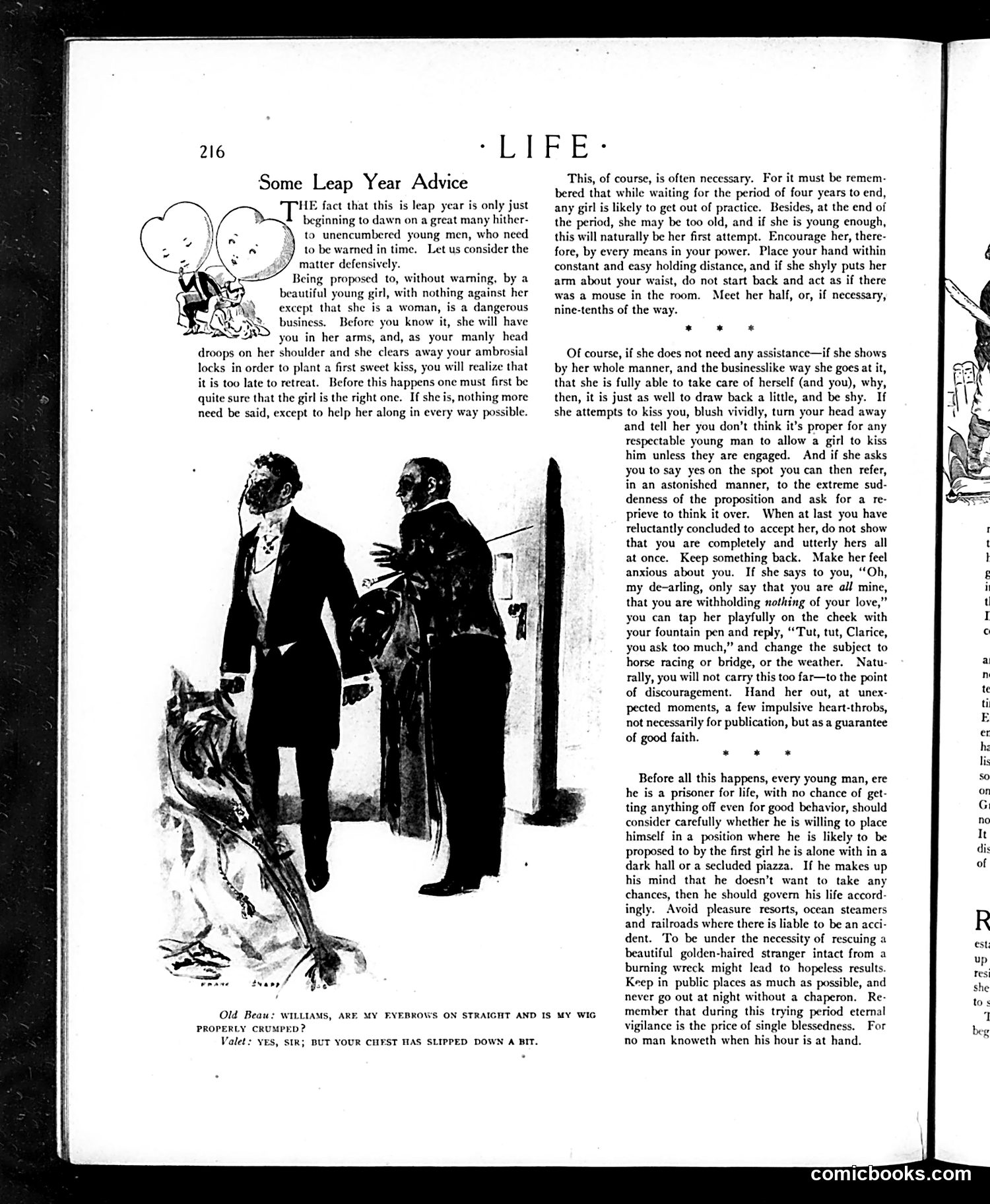
This page addresses leap year dating customs, when tradition permitted women to propose to men. The article offers guidance to young men on proper behavior when approached by a woman seeking marriage. The cartoon below depicts two well-dressed men encountering each other, with dialogue indicating one has disheveled appearance ("your chest has slipped down a bit"). This appears to satirize the awkwardness and social disruption caused by leap year's role-reversal in courtship—the cartoon suggests such encounters leave men flustered and physically unkempt. The article's main advice warns men to maintain composure, avoid secluded settings, keep interactions public, and employ chaperones. The satire mocks both the nervousness this custom provoked in men and the elaborate social protocols required to manage an unconventional situation.
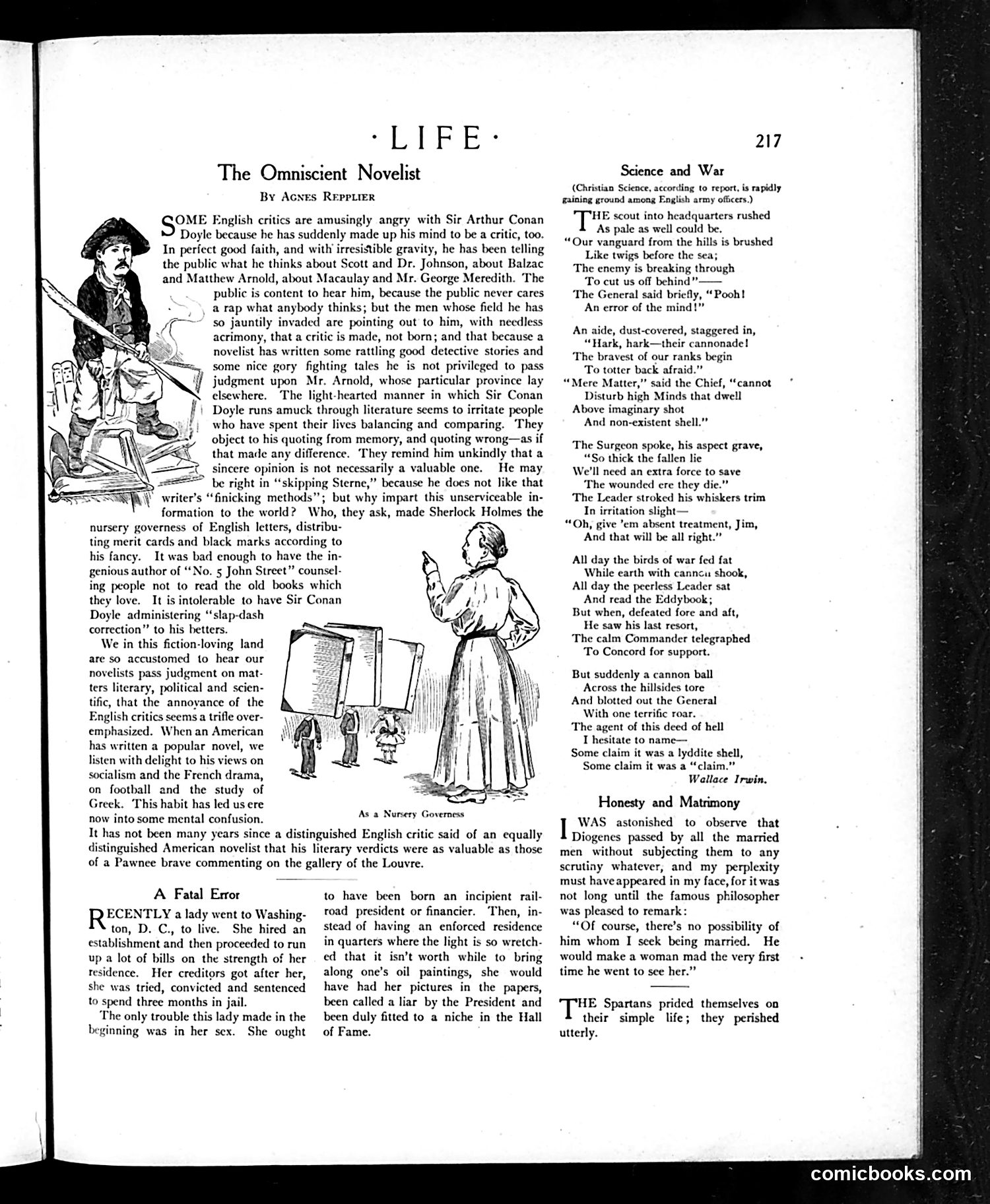
This page satirizes English literary critics who attack Sir Arthur Conan Doyle for becoming a critic himself. The article argues that critics unfairly judge novelists—especially Doyle—for writing detective and war stories, claiming such work disqualifies them from literary judgment. The accompanying illustration depicts a nursery governess overwhelmed by books, labeled "As a Nursery Governess," likely mocking how critics position themselves as authorities on all subjects. The satire's point: English critics are hypocritically arrogant, dismissing working novelists' right to critique literature while the critics themselves lack comparable creative achievements. The piece defends Doyle's intellectual credibility against snobbish literary gatekeeping.
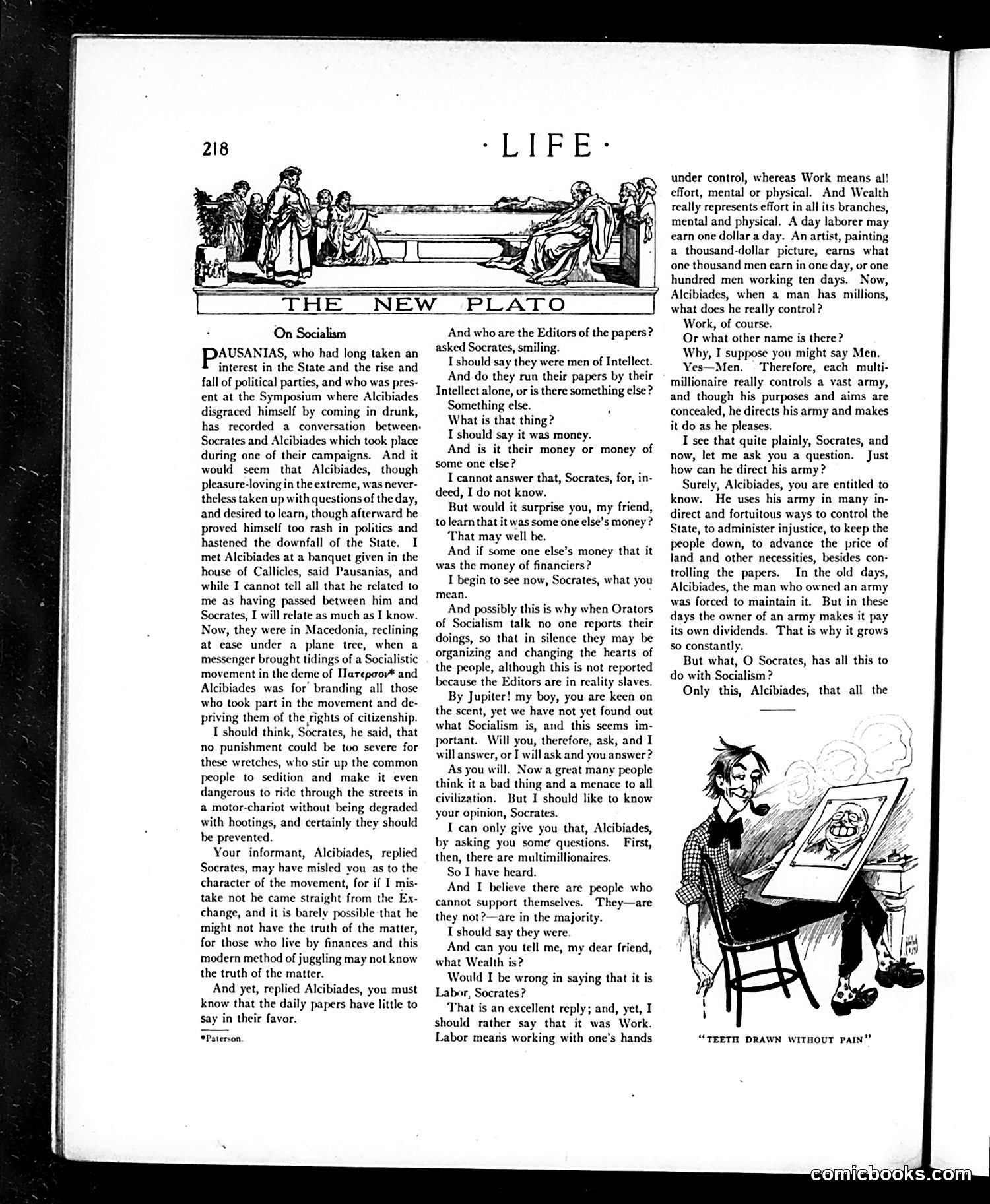
This page presents a Socratic dialogue titled "On Socialism" where Socrates questions Alcibiades about wealth, work, and state control. The satire mocks socialist arguments by having Socrates expose logical contradictions: if multimillionaires can direct armies and resources, why can't they direct the state? The dialogue suggests socialism's idealistic claims about controlling the wealthy ignore practical realities of power and finance. The small cartoon at bottom-right ("Teeth Drawn Without Pain") shows a dentist, likely satirizing socialism as extracting teeth painlessly—implying socialist promises to painlessly redistribute wealth are similarly unrealistic. The classical framing (invoking Plato) elevates the political argument while undercutting it through Socratic questioning that favors capitalism's efficiency over socialist reorganization.
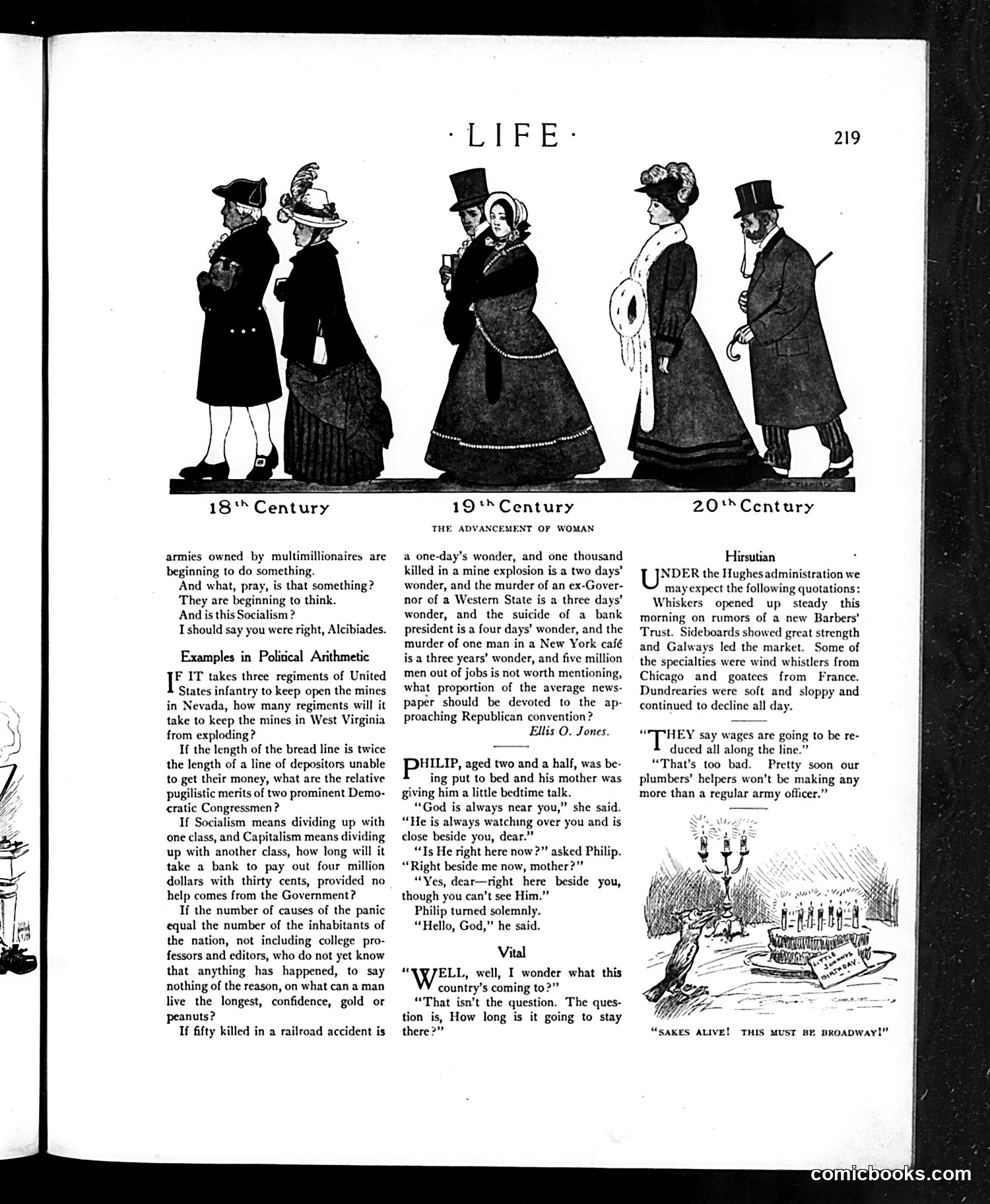
**Top Illustration**: "The Advancement of Woman" contrasts fashion across three centuries. The 18th-century figure wears modest dress; the 19th-century woman sports an elaborate bonnet and full skirt; the 20th-century figures include women in simpler attire and what appears to be a man in formal dress. This satirizes evolving women's fashion and social roles. **Left Column**: "Examples in Political Arithmetic" contains sardonic commentary on contemporary political issues—military spending, socialism, and economic inequality. The tone is caustic, questioning government priorities and the costs of social problems. **Right Section**: A brief domestic scene with a child named Philip and his mother discussing God, followed by a "Vital" section questioning the country's future direction. The illustration shows what appears to be a Broadway theater scene with the caption "SAKES ALIVE! THIS MUST BE BROADWAY!"
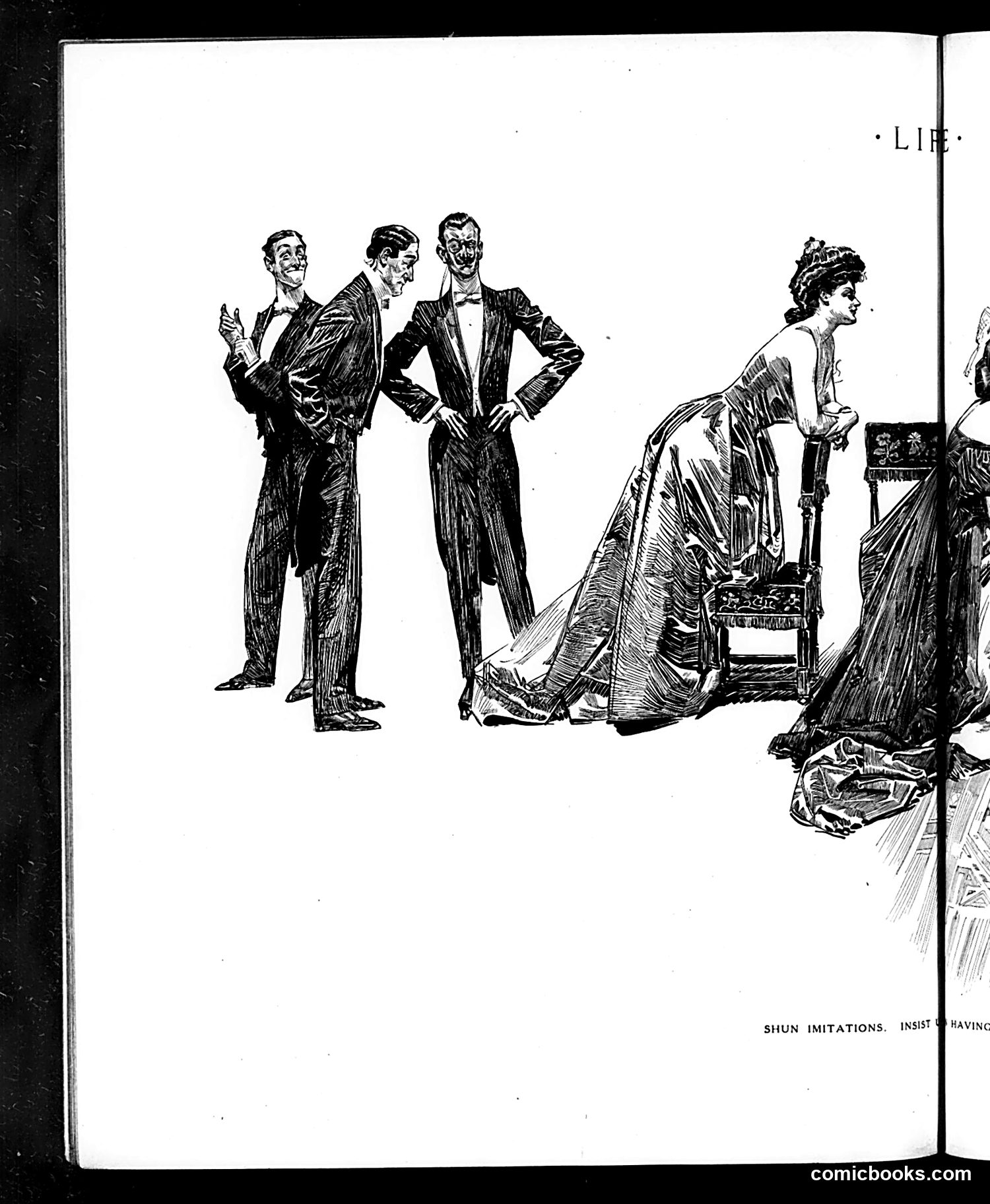
This page from *Life* magazine depicts a social satire titled "Shun Imitations. Insist on Having" (text visible at bottom). The illustration shows three well-dressed men in tuxedos on the left observing a woman on the right in an elaborate gown with a long train, seated in a chair. The satire appears to target fashionable society behavior—likely mocking either: - Men's superficial admiration of women's elaborate fashion - The pretentiousness of high-society imitation and status-seeking - Or commentary on authentic versus counterfeit luxury goods/appearances The "insist on having" text suggests the joke concerns distinguishing genuine from fake versions of something fashionable. The formal evening wear and theatrical poses indicate this targets wealthy social circles and their vanities. The specific target remains unclear without additional context.
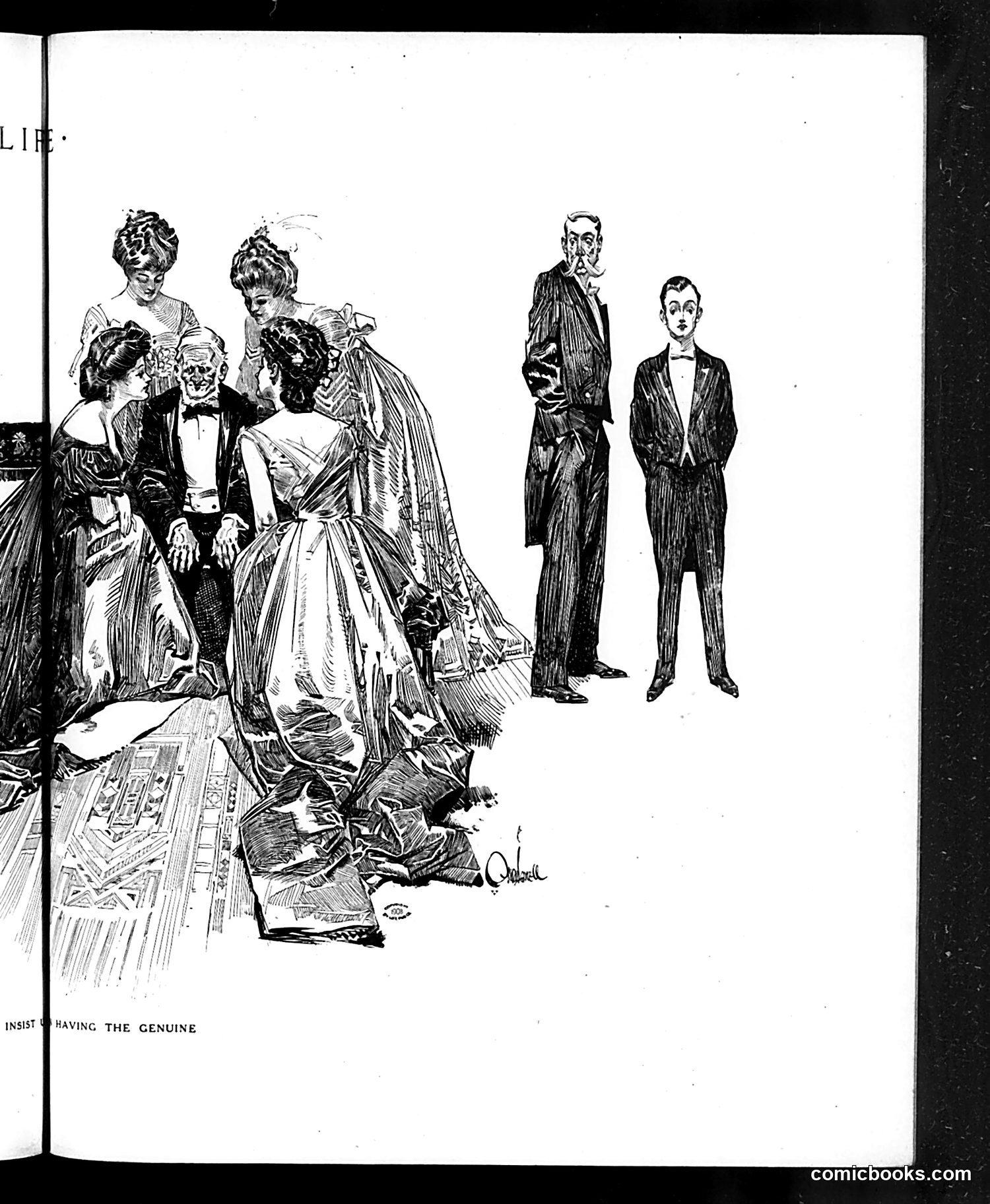
This satirical illustration depicts a social scene where elegantly dressed women and men in formal evening wear gather in what appears to be an upper-class drawing room. The caption "Insist on Having the Genuine" suggests commentary on authenticity and social pretense. The cartoon likely satirizes high society's obsession with "genuine" luxury goods and status symbols during the early 20th century—a period when counterfeits and imitations were becoming widespread concerns among the wealthy. The formal attire and interior setting emphasize the importance placed on appearing refined and authentic. The joke appears to be that despite society's insistence on genuineness, the scene itself may be theatrical or artificial—poking fun at the performative nature of upper-class social gatherings and their preoccupation with maintaining appearances of authenticity and superiority.
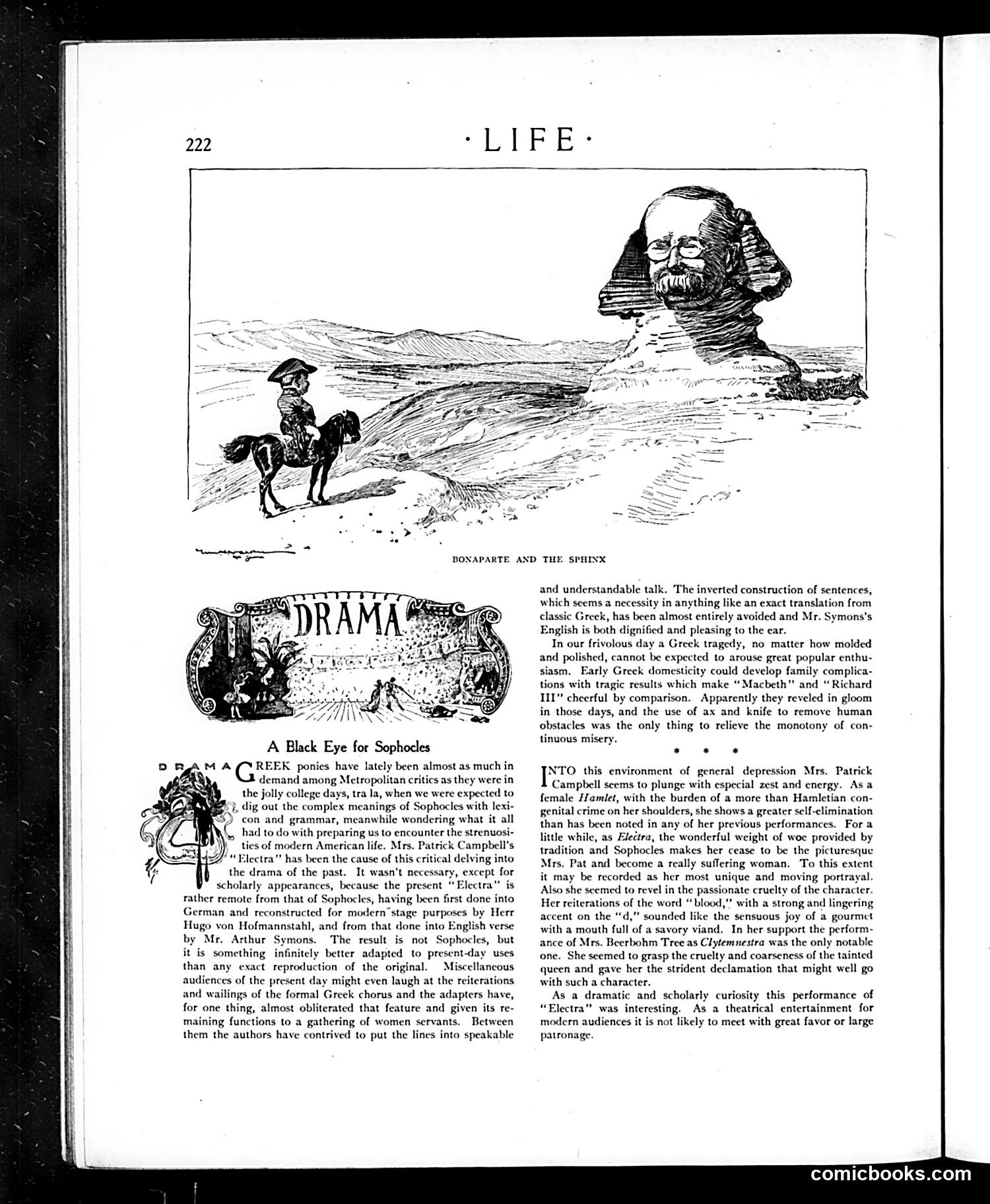
The top illustration depicts a figure with a modern bearded face grafted onto the Great Sphinx of Giza. A small soldier on horseback (representing Napoleon) gazes up at it. This is satirical commentary on Napoleon's Egyptian campaign and his self-aggrandizing legacy. By replacing the Sphinx's ancient face with a contemporary bearded man's portrait, the cartoonist mocks Napoleon's attempt to impose himself on history and align himself with timeless monuments. Below is a drama section discussing a theatrical adaptation of Sophocles' "Electra," praising Mrs. Patrick Campbell's performance. The article notes that translating Greek tragedy into modern English is challenging, and Campbell successfully navigated these difficulties while delivering emotionally powerful characterization.
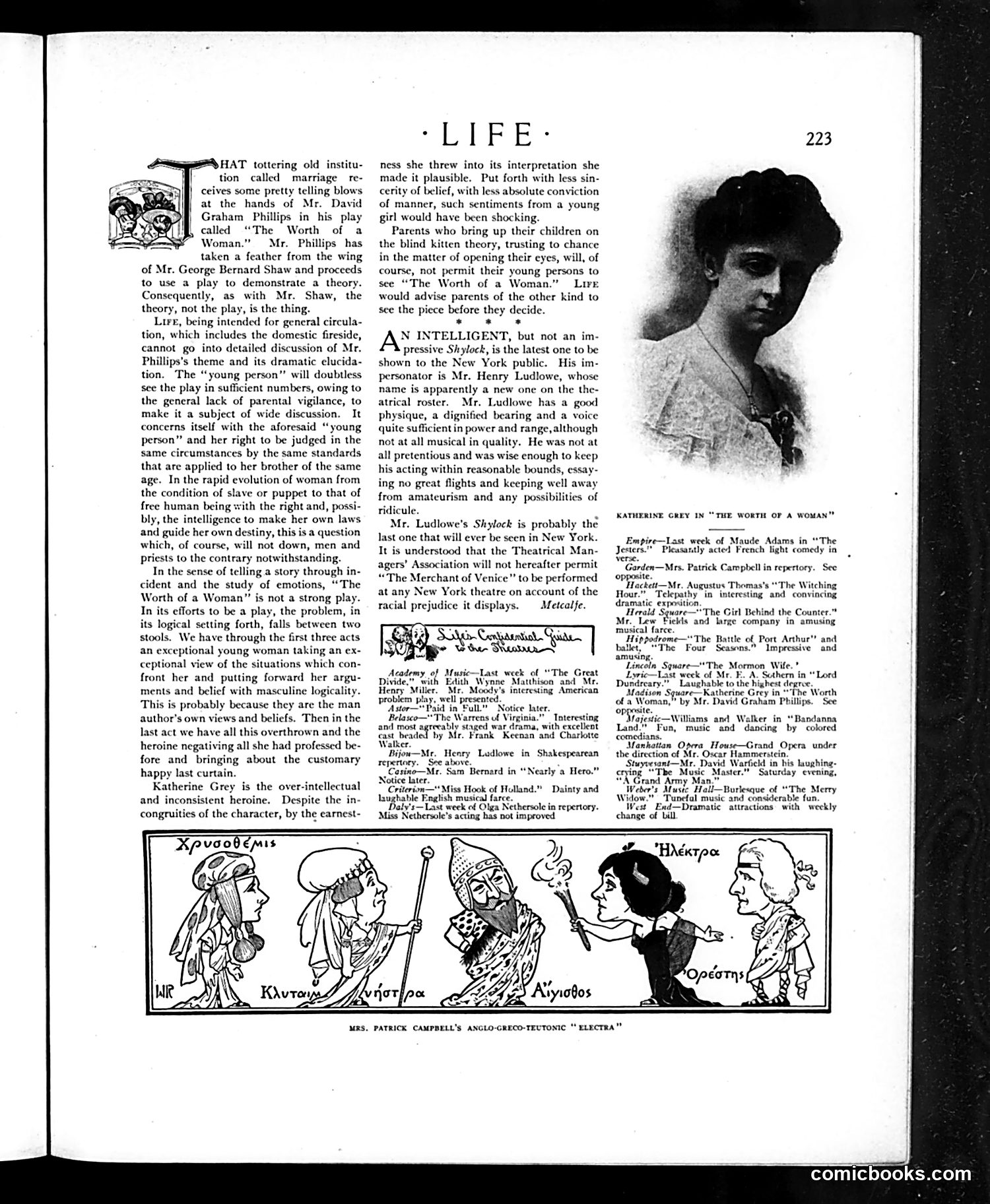
This page from *Life* magazine contains theater reviews. The bottom cartoon illustrates Mrs. Patrick Campbell's production of an Anglo-Greco-Teutonic version of Sophocles' classical tragedy *Electra*. The illustration shows figures labeled in Greek (Chrysothemis, Clytemnestra, Orestes, Electra, and Orestes), depicting characters from the ancient Greek play. The cartoon appears to satirize the theatrical production's ambitious attempt to blend classical Greek drama with contemporary staging. The review text discusses various theatrical performances of the era, including critical commentary on acting and production choices. The overall page focuses on evaluating current New York theatrical productions for the magazine's readership.
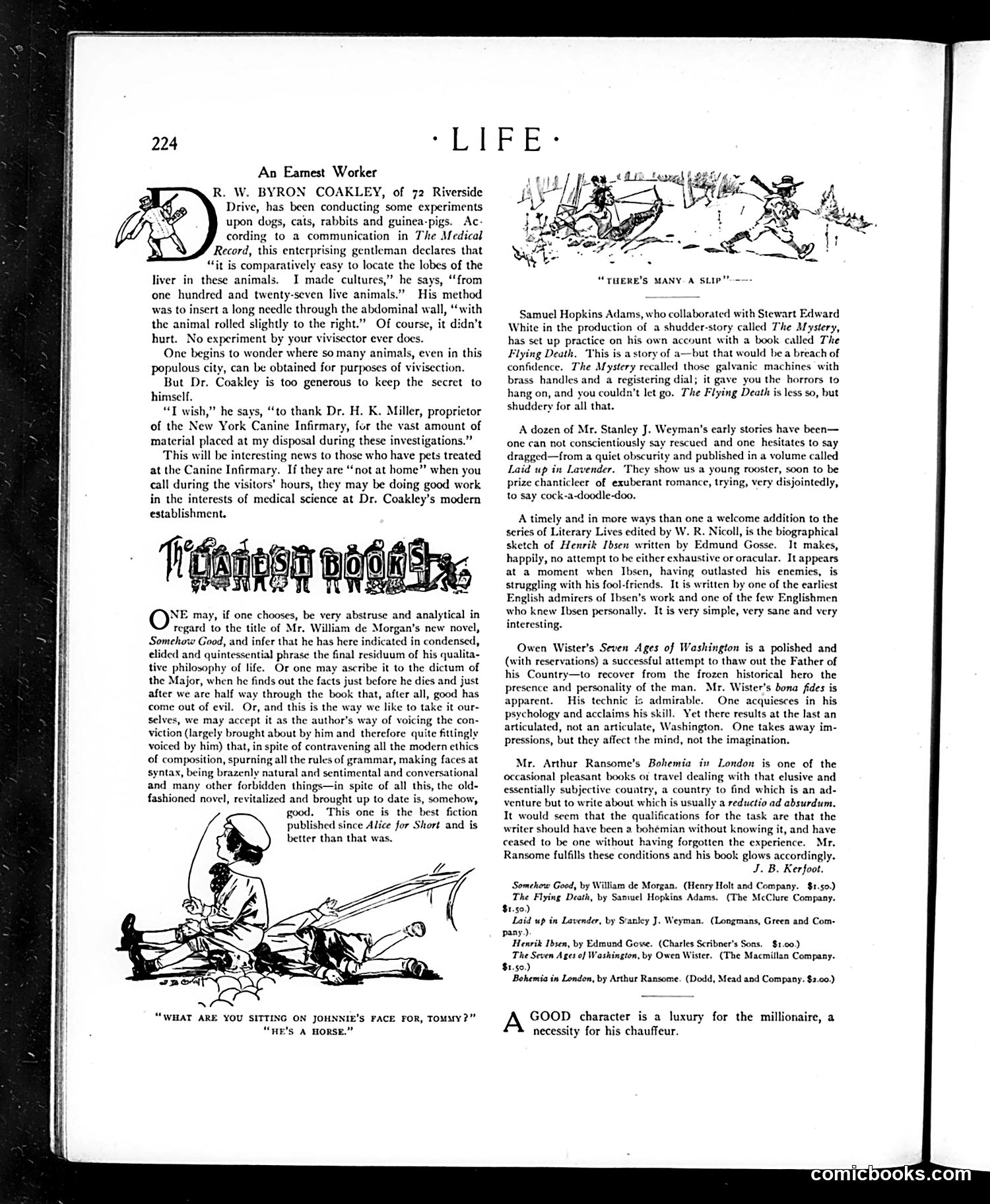
This page critiques **animal experimentation** through satirical reporting. The opening article describes Dr. R. W. Byron Coakley's vivisection research on 127 live animals, inserted with needles to study liver lobes. Life's satire lies in its deadpan tone—Coakley claims experiments "didn't hurt," while the magazine sarcastically notes he sourced animals from the New York Canine Infirmary, implying pet owners' missing animals were being used for research without knowledge. The cartoon below shows a child sitting on another child's face, captioning it "He's a horse"—a visual pun about the absurdity of justifying harm through reframing. The page also reviews literary works, including criticism of William de Morgan's *Somehow Good*, praising old-fashioned novels despite violating modern compositional rules. **Context**: This reflects early 1900s concerns about unregulated vivisection and medical ethics, attacking what Life considered exploitative practices disguised as scientific progress.
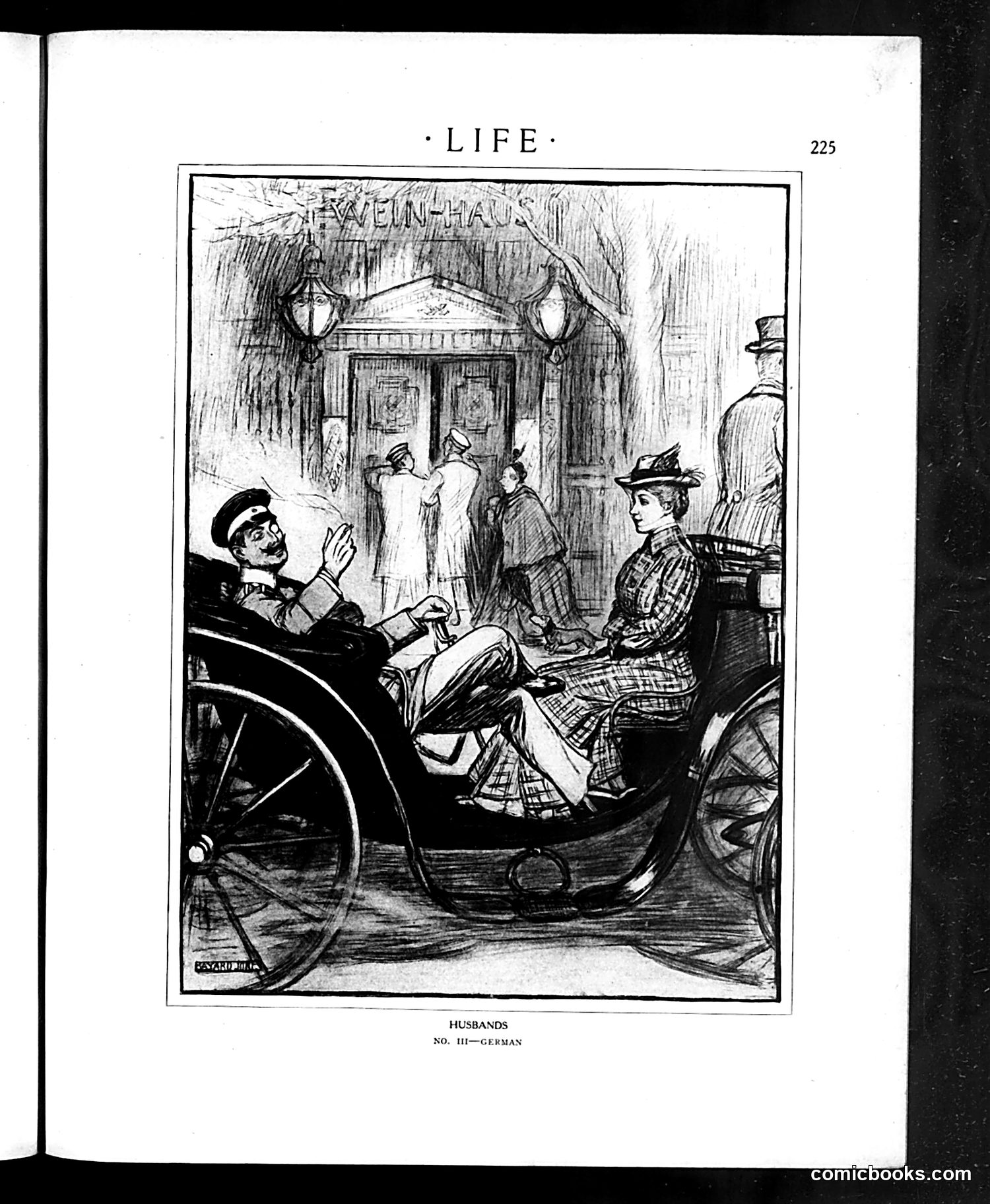
This satirical cartoon depicts German husbands as overly attentive and deferential to their wives. The image shows a well-dressed man in a carriage gazing adoringly at his wife while she sits beside him wearing a fashionable hat. The "Weinhaus" (wine house) establishment visible in the background suggests a leisurely social outing. The satire likely plays on American stereotypes about German marital dynamics—specifically the notion that German husbands were notably solicitous or henpecked compared to other nationalities. The series format ("No. II—German") suggests Life magazine was comparing husband-wife relationships across different cultures, with this entry suggesting German men were particularly devoted or submissive to their wives' wishes and interests.
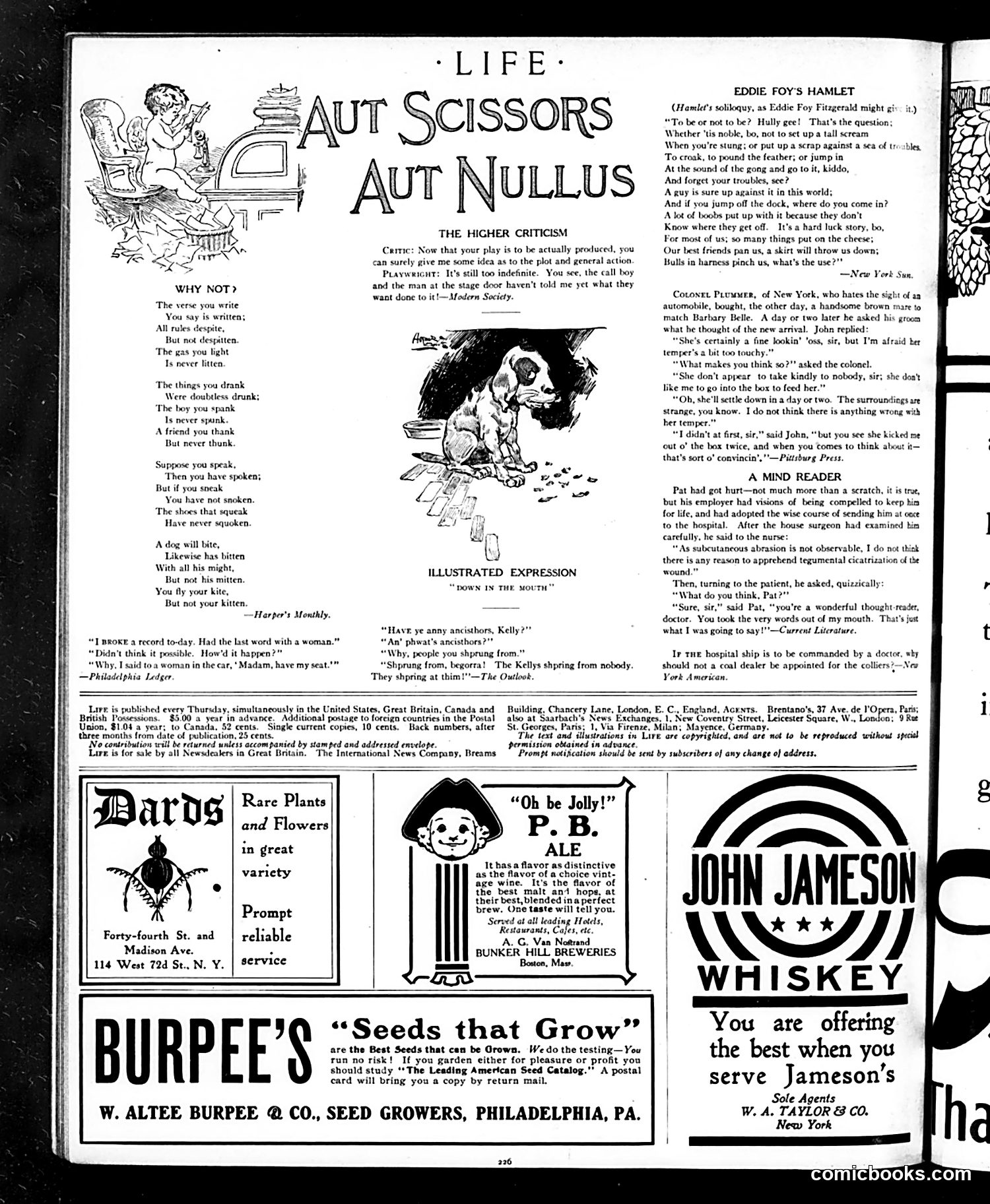
This is a **humor and satire page** from Life magazine's early era, featuring several distinct comedic pieces: **"Aut Scissors / Aut Nullus"** satirizes grammatical inconsistency—the title playfully suggests "either scissors or nothing," mocking English's irregular verb conjugations (we say "write/written" but "speak/spoken," never "snoken"). **"The Higher Criticism"** jokes about theatrical vagueness: a playwright admits his play's plot remains undefined because even the stagehands haven't told him what should happen. **"Illustrated Expression"** presents ethnic dialect humor (common to the era): an Irish character misunderstands "ancestors," thinking Kellys "spring at" rather than "from" people. **"Eddie Foy's Hamlet"** parodies the famous actor's comedic style, reimagining Hamlet's soliloquy in vernacular slang ("Hully gee," "kiddo")—mocking both Shakespeare reverence and vaudeville speech patterns. Additional anecdotes use wordplay and misunderstandings for humor. The **advertisements** for seeds, plants, ale, and whiskey were standard revenue sources. The page reflects **early-1900s Life**: irreverent, pun-heavy, reliant on dialect humor now considered offensive.
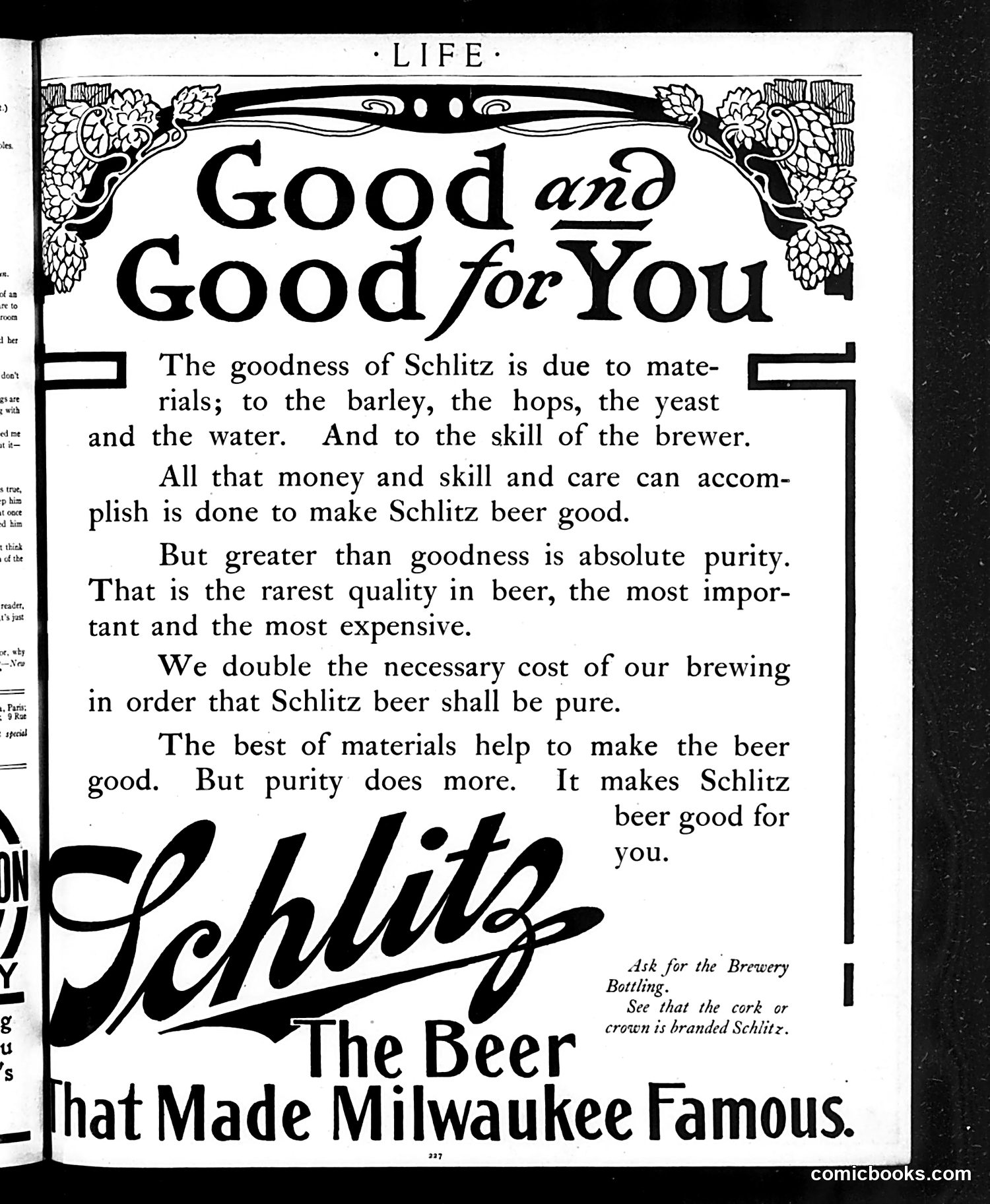
This is a **Schlitz beer advertisement**, not political satire or a cartoon. The page appears from *Life* magazine's advertising section. The ad promotes Schlitz beer—"The Beer that Made Milwaukee Famous"—by emphasizing **purity as a selling point**. The copy argues that while good materials (barley, hops, yeast, water, brewer skill) make beer acceptable, **purity is what truly matters** and justifies premium pricing. The advertisement reflects early 20th-century beer marketing strategy, likely targeting health-conscious consumers. The claim that Schlitz "doubles the necessary cost" to ensure purity was an actual marketing tactic of the era. The instruction to verify the cork or crown is branded Schlitz addresses consumer concerns about counterfeits. No satire or political commentary is present—this is straightforward commercial advertising emphasizing product quality and brand authentication.
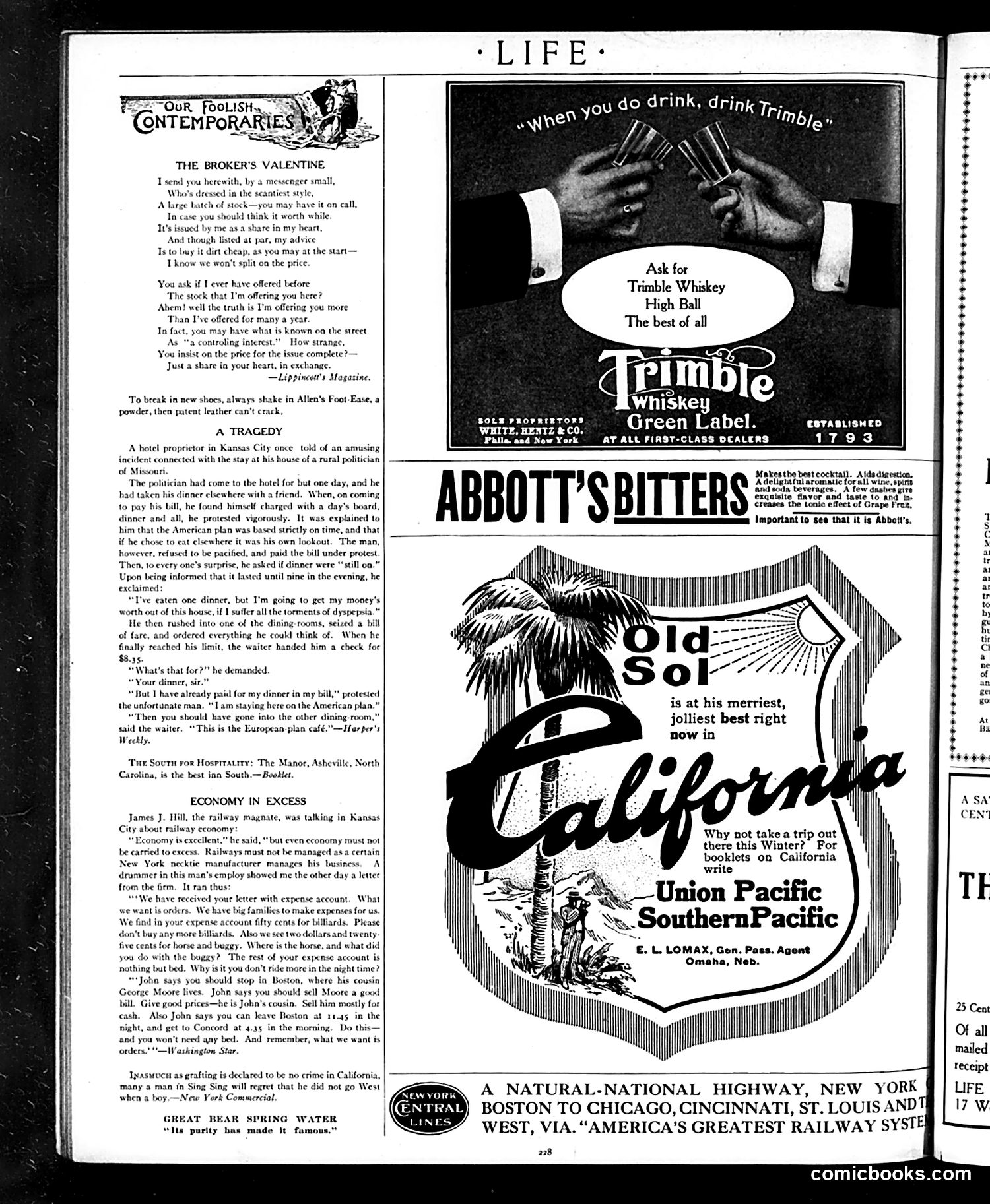
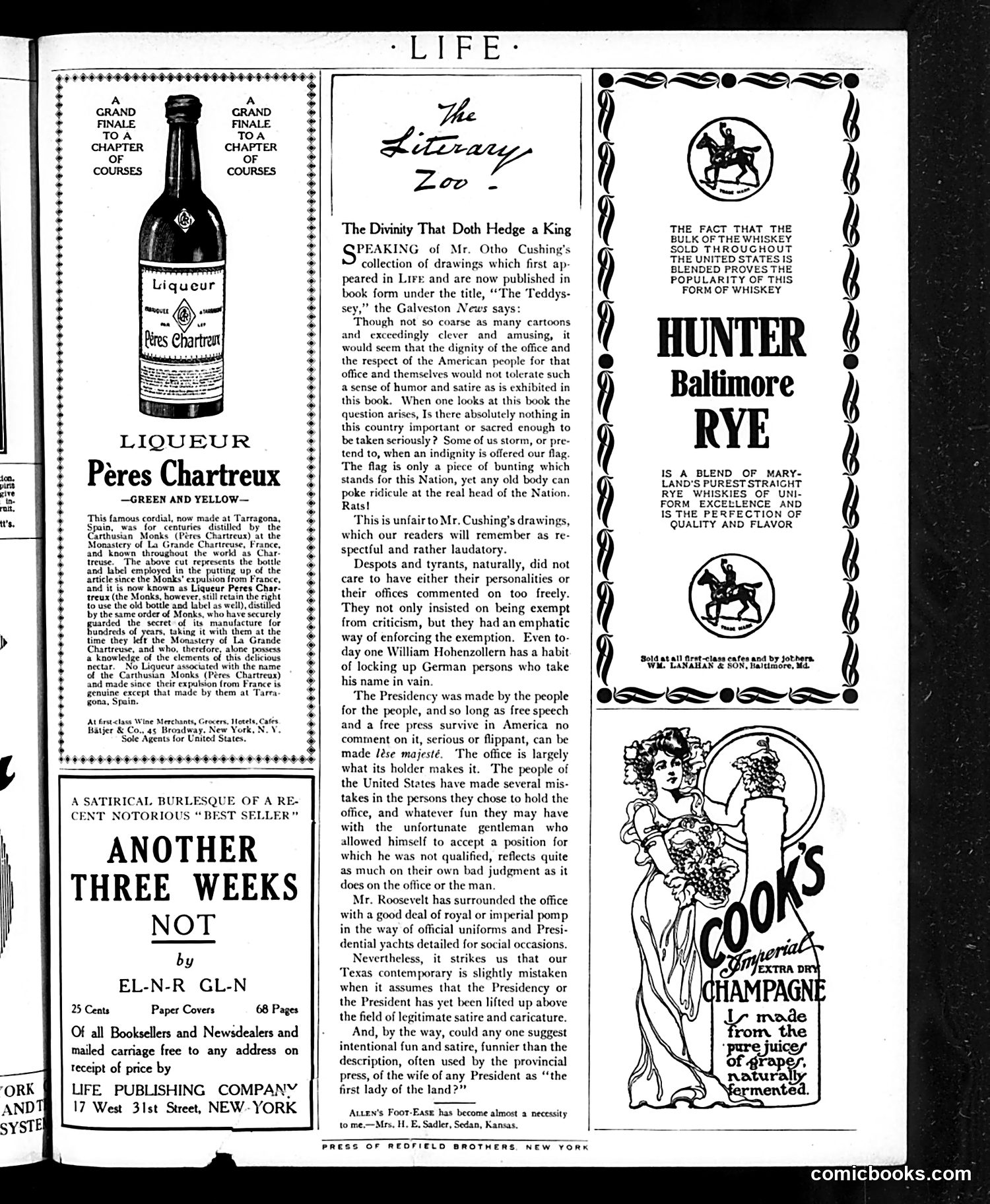
This page primarily contains **advertisements** and a brief **editorial comment** defending political satire. The key content is a response to criticism of cartoonist Otho Cushing's book "The 'Teddysey'" (likely caricaturing President Theodore Roosevelt). A Texas newspaper had objected that satirizing the presidency was disrespectful. Life magazine's editor **forcefully disagrees**, arguing that in a democracy with free speech, the presidency and president are fair targets for satire and humor. The editor explicitly rejects the European concept of "*lèse majesté*" (offense to royal dignity), asserting that American presidents are public servants chosen by the people—not sacred figures beyond criticism. The editor notes that despots like "William Hohenzollern" (Kaiser Wilhelm II) punish dissent, but America should reject such authoritarianism. The rest of the page contains liqueur and whiskey advertisements typical of early-20th-century magazines.
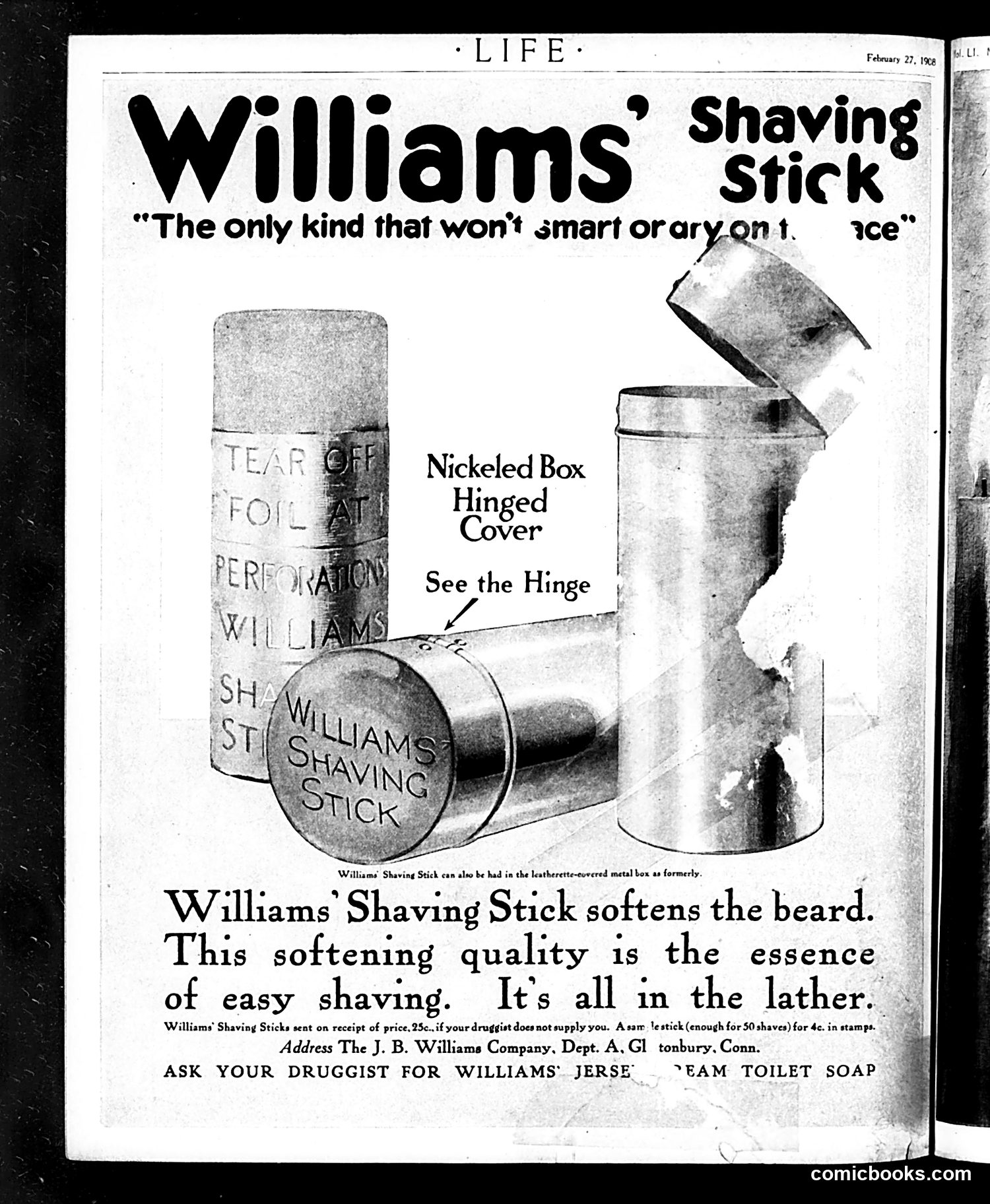
This is a **product advertisement**, not a political cartoon. It promotes Williams' Shaving Stick, a men's grooming product manufactured by The J. B. Williams Company of Glastonbury, Connecticut. The ad showcases the product's packaging—a cylindrical stick in a nickeled box with hinged cover—and emphasizes its key selling point: it softens facial hair to produce better lather, making shaving easier and less irritating (the tagline promises it "won't smart or sting on the face"). The advertisement uses product photography and straightforward copy typical of early 20th-century marketing. There is no satire, political commentary, or hidden meaning—it's a straightforward commercial pitch appearing in *Life* magazine (February 27, 1908). The ad also cross-promotes Williams' Jersey Cream Toilet Soap.