
Life, 1908-02-27 · page 8 of 20
Life — February 27, 1908 — page 8: what you’re looking at
What you’re looking at
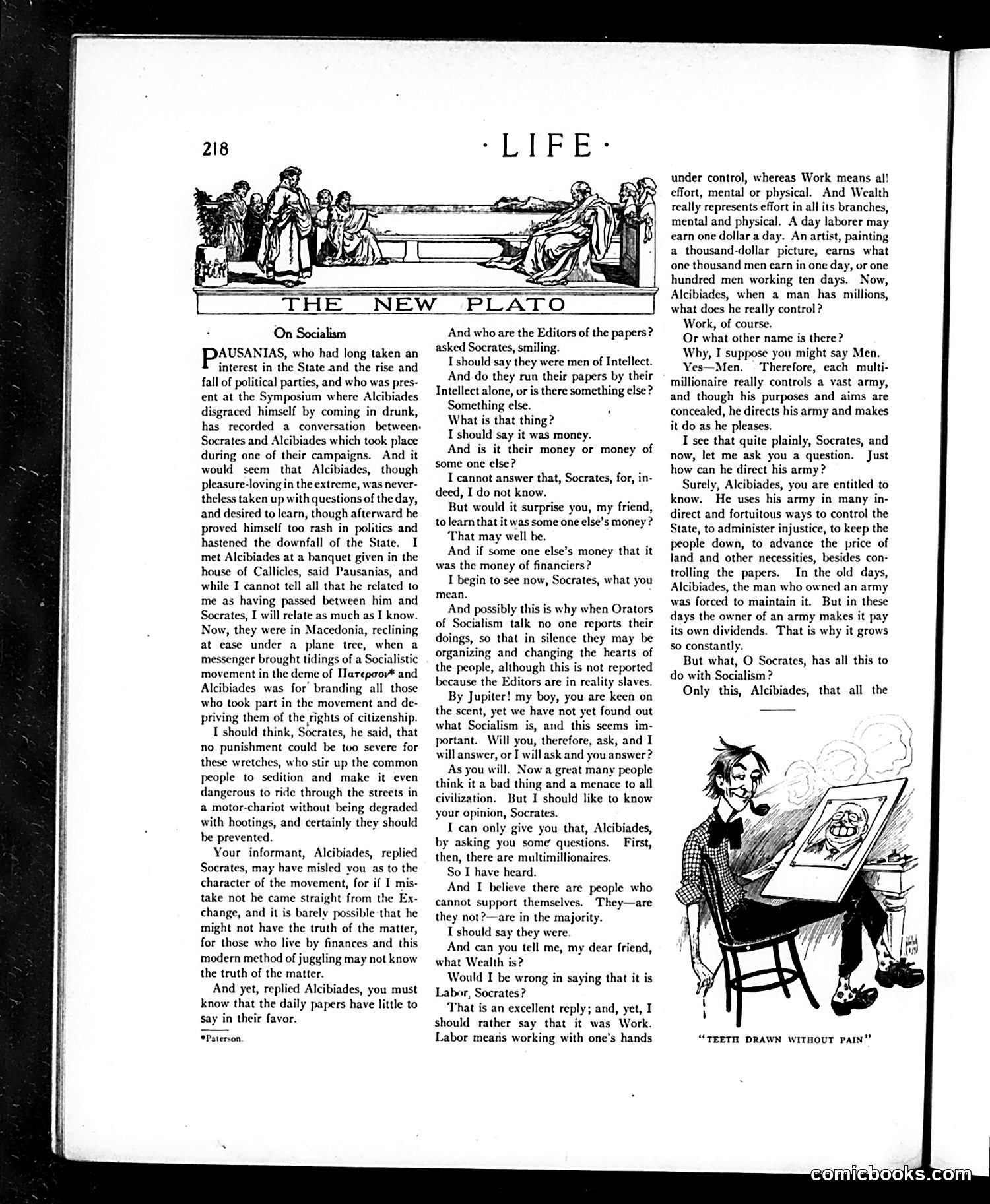
This page presents a Socratic dialogue titled "On Socialism" where Socrates questions Alcibiades about wealth, work, and state control. The satire mocks socialist arguments by having Socrates expose logical contradictions: if multimillionaires can direct armies and resources, why can't they direct the state? The dialogue suggests socialism's idealistic claims about controlling the wealthy ignore practical realities of power and finance. The small cartoon at bottom-right ("Teeth Drawn Without Pain") shows a dentist, likely satirizing socialism as extracting teeth painlessly—implying socialist promises to painlessly redistribute wealth are similarly unrealistic. The classical framing (invoking Plato) elevates the political argument while undercutting it through Socratic questioning that favors capitalism's efficiency over socialist reorganization.
📄 Transcribed text from this page (OCR, searchable)
Machine-transcribed from the original scan — historical spelling and the odd misread are preserved.
“THE NEW PLATO PAvsanns, who had long taken an interest in the State and the rise and fall of political parties, and who was pres- ent at the Symposium where Alcibiades disgraced himself by coming in drunk, has recorded a conversation between Socrates and Alcibiades which took place during one of their campaigns. And it would seem that Alcibiades, though pleasure-loving in the extreme, was never- theless taken up with questions of the day, and desired to learn, though afterward he proved himself too rash in politics and hastened the downfall of the State. I met Alcibiades at a banquet given in the house of Callicles, said Pausanias, and while I cannot tell all that he related to me as having passed between him and Socrates, I will relate as much as I know. Now, they were in Macedonia, reclining at ease under a plane tree, w messenger brought tidings of a Social movement in the deme of Harepoow* and Alcibiades was for’ branding all those who took part in the movement and de- priving them of the rights of citizenship. I should think, Socrates, he said, that no punishment could be too severe for these wretches, who stir up the common. people to sedition and make it even dangerous to ride through the streets in a motor-chariot without being degraded with hootings, and certainly they should be prevented. Your informant, Alcibiades, replied Socrates, may have misled you as to the character of the movement, for if I mis- take not he came straight from the Ex- change, and it is barely possible that he might not have the truth of the matter, for those who live by finances and this modern method of juggling may not know the truth of the matter. And yet, replied Alcibiades, you must know that the daily papers have little to their favor. And who are the Editors of the papers? asked Socrates, smiling. I should say they were men of Intellect. And do they run their papers by their Intellect alone, or is there something else ? Something else. What is that thing? I should say it was money. And is it their money or money of some one else? I cannot answer that, Socrates, for, in- deed, I do not know. But would it surprise you, my friend, to learn that it was some one else’s money? That may well be. And if some one else’s money that it was the money of financiers? I begin to see now, Socrates, what you mean. And possibly this is why when Orators of Socialism talk no one reports their doings, so that in silence they may be organizing and changing the hearts of the people, although this is not reported because the Editors are in reality slaves. By Jupiter! my boy, you are keen on the scent, yet we have not yet found out what Socialism is, and seems im- portant. Will you, therefore, ask, and I will answer, or I will ask and you answer? As you will. Now a great many people think it a bad thing and a menace to all civilization. But I should like to know your opinion, Socrates. I can only give you that, Alcibiades, by asking you some questions. First, then, there are multimillionaires. So I have heard. And I believe there are people who cannot support themselves. They—are they not ?—are in the majority. I should say they were. And can you tell me, my dear friend, what Wealth is? Would I be wrong in saying that it is Labor, Socrates? That is an excellent reply; and, yet, I should rather say that it was Work. Labor means working with one’s hands under control, whereas Work means al! effort, mental or physical. And Wealth really represents effort in all its branches, mental and physical. A day laborer may earn one dollar a day. An artist, painting a thousand-dollar picture, earns what one thousand men earn in one day, or one hundred men working ten days. Now, Alcibiades, when a man has millions, what does he really control ? Work, of course. Or what other name is there? Why, I suppose you might say Men, Yes—Men. Therefore, each multi- millionaire really controls a vast army, and though his purposes and aims are concealed, he directs his army and makes it do as he pleases. I see that quite plainly, Socrates, and now, let me ask you a question. Just how can he direct his army? Surely, Alcibiades, you are entitled to know. He uses his army in many in- direct and fortuitous ways to control the State, to administer injustice, to keep the people down, to advance the price of land and other necessities, besides con- trolling the papers. In the old days, Alcibiades, the man who owned an army was forced to maintain it. But in these days the owner of an army makes it pay its own dividends. That is why it grows so constantly. But what, O Socrates, has all this to do with Socialism ? Only this, Alcibiades, that all the “TEETH DRAWN WITHOUT PAIN”