
Life, 1908-02-27 · page 12 of 20
Life — February 27, 1908 — page 12: what you’re looking at
What you’re looking at
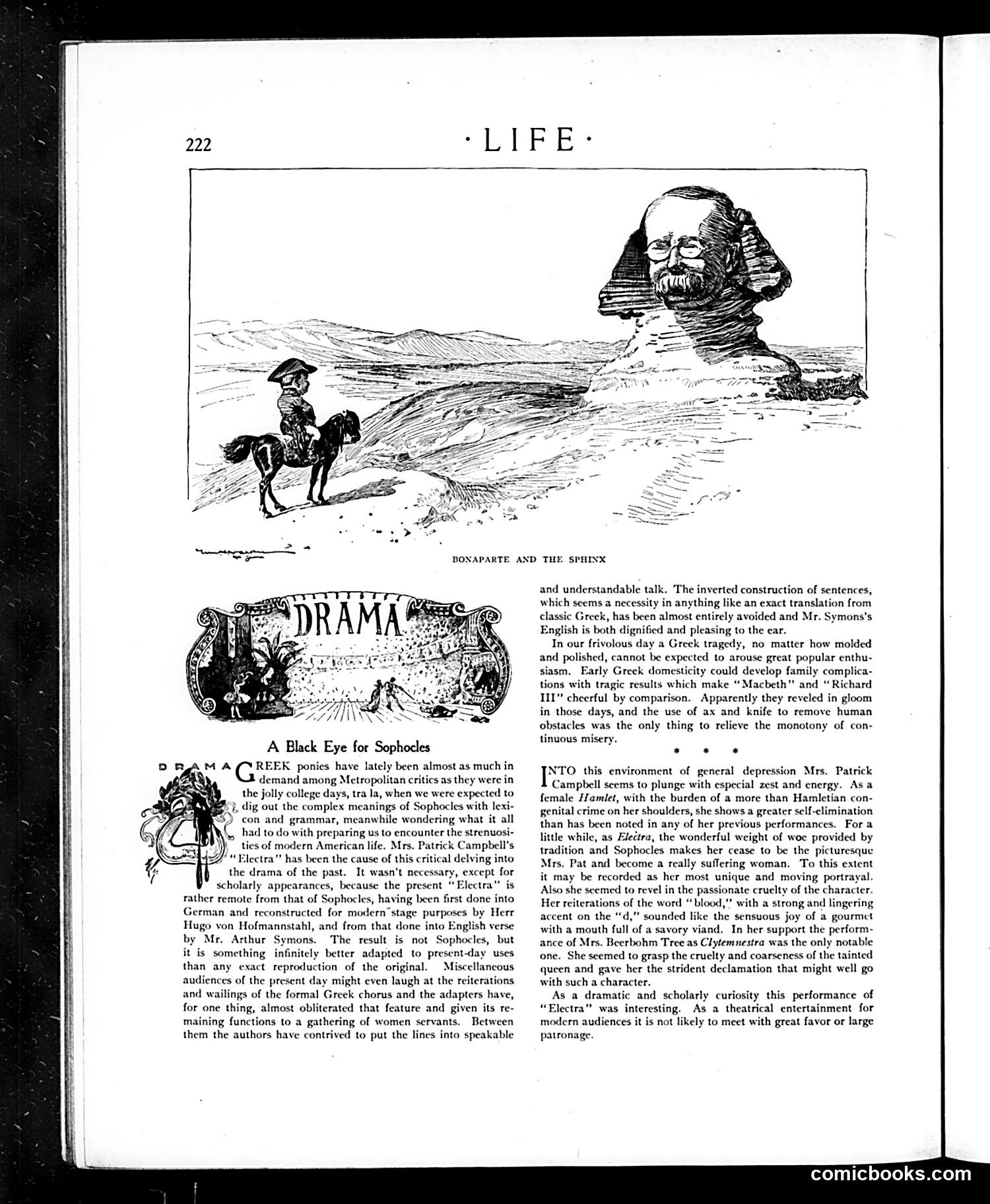
The top illustration depicts a figure with a modern bearded face grafted onto the Great Sphinx of Giza. A small soldier on horseback (representing Napoleon) gazes up at it. This is satirical commentary on Napoleon's Egyptian campaign and his self-aggrandizing legacy. By replacing the Sphinx's ancient face with a contemporary bearded man's portrait, the cartoonist mocks Napoleon's attempt to impose himself on history and align himself with timeless monuments. Below is a drama section discussing a theatrical adaptation of Sophocles' "Electra," praising Mrs. Patrick Campbell's performance. The article notes that translating Greek tragedy into modern English is challenging, and Campbell successfully navigated these difficulties while delivering emotionally powerful characterization.
📄 Transcribed text from this page (OCR, searchable)
Machine-transcribed from the original scan — historical spelling and the odd misread are preserved.
BONAPARTE AND THE SPHINX A Black Eye for Sophocles AM A (YREEK ponies have lately been almost as much in demand among Metropolitan critics as they were in the jolly college days, tra la, when we were expected to dig out the complex meanings of Sophocles with lexi- con and grammar, meanwhile wondering what it all had to do with preparing us to encounter the strenuosi- )” ties of modern American life. Mrs. Patrick Campbell's Z' “Flectra” has been the cause of this critical delving into the drama of the past. It wasn’t necessary, except for scholarly appearances, because the present Electra” is rather remote from that of Sophocles, having been first done into German and reconstructed for modern”stage purposes by Herr Hugo von Hofmannstabl, and from that done into English verse by Mr. Arthur Symons. The result is not Sophocles, but it is something infinitely better adapted to present-day uses than any exact reproduction of the original. Miscellancous audiences of the present day might even laugh at the reiterations and wailings of the formal Greek chorus and the adapters have, for one thing, almost obliterated that feature and given its re- maining functions to a gathering of women servants. Between them the authors have contrived to put the lines into speakable and understandable talk. The inverted construction of sentences, which seems a necessity in anything like an exact translation from classic Greek, has been almost entirely avoided and Mr. Symons’s. English is both dignified and pleasing to the ear. In our frivolous day a Greek tragedy, no matter how molded and polished, cannot be expected to arouse great popular enthu- siasm. Early Greek domesticity could develop family complica- tions with tragic results which make “ Macbeth” and “Richard III” cheerful by comparison. Apparently they reveled in gloom in those days, and the use of ax and knife to remove human obstacles was the only thing to relieve the monotony of con- tinuous misery. s 8 8 NTO this environment of general depression Mrs. Patrick Campbell seems to plunge with especial zest and energy. As a female Hamlet, with the burden of a more than Hamletian con- genital crime on her shoulders, she shows a greater self-climination than has been noted in any of her previous performances. For a little while, as Flectra, the wonderful weight of woe provided by tradition and Sophocles makes her cease to be the picturesque Mrs. Pat and become a really suffering woman. To this extent it may be recorded as her most unique and moving portrayal. Also she seemed to revel in the passionate cruelty of the character. Her reiterations of the word “blood,” with a strong and lingering accent on the ‘d,” sounded like the sensuous joy of a gourmet with a mouth full of a savory viand. In her support the perform- ance of Mrs. Beerbohm Tree as Clytemnestra was the only notable ‘one. She seemed to grasp the cruelty and coarseness of the tainted queen and gave her the strident declamation that might well go with such a character. ‘As a dramatic and scholarly curiosity this performance of “Electra” was interesting. As a theatrical entertainment for modern audiences it is not likely to meet with great favor or large patronage. comicbooks.com