
Life, 1908-02-27 · page 13 of 20
Life — February 27, 1908 — page 13: what you’re looking at
What you’re looking at
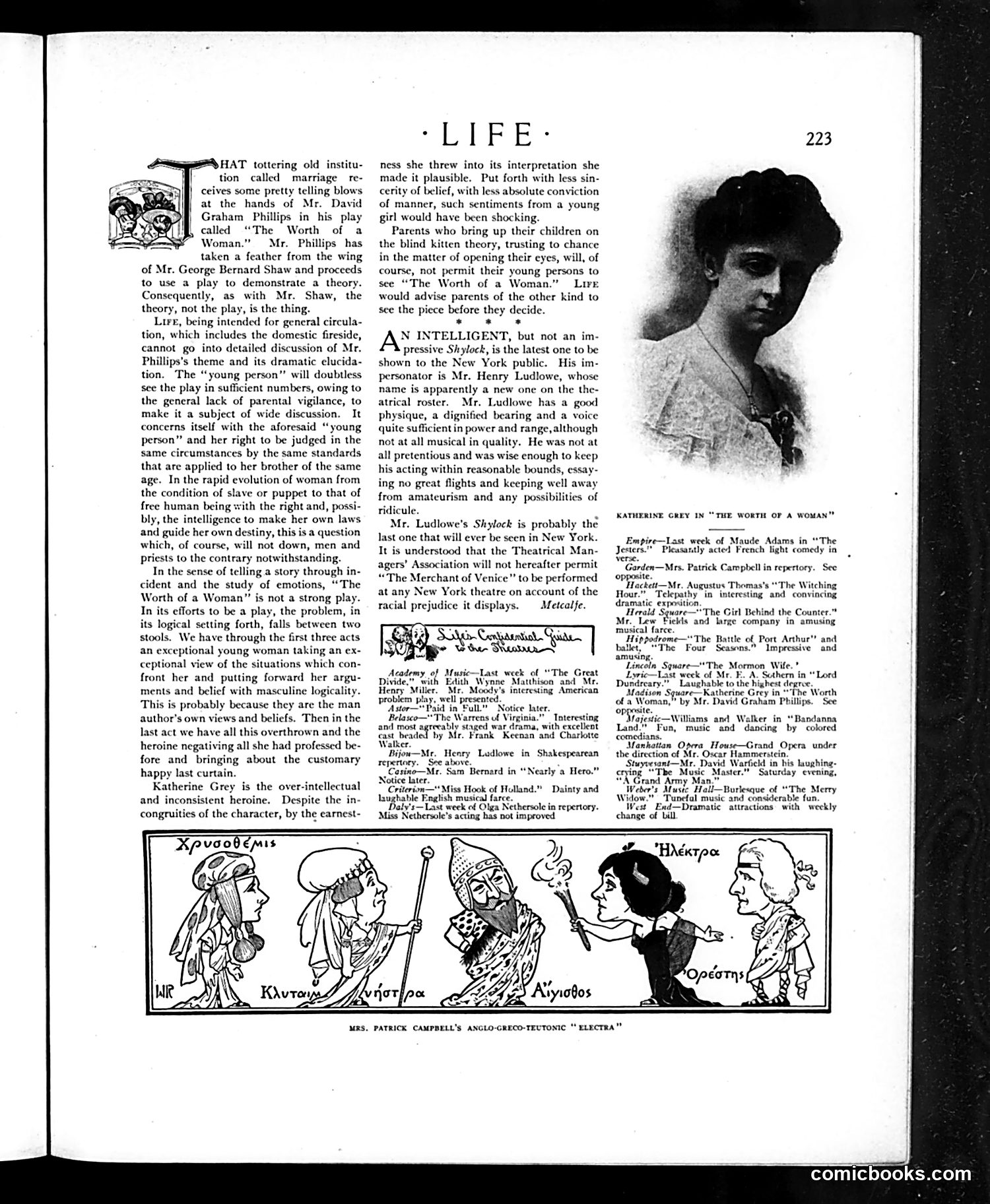
This page from *Life* magazine contains theater reviews. The bottom cartoon illustrates Mrs. Patrick Campbell's production of an Anglo-Greco-Teutonic version of Sophocles' classical tragedy *Electra*. The illustration shows figures labeled in Greek (Chrysothemis, Clytemnestra, Orestes, Electra, and Orestes), depicting characters from the ancient Greek play. The cartoon appears to satirize the theatrical production's ambitious attempt to blend classical Greek drama with contemporary staging. The review text discusses various theatrical performances of the era, including critical commentary on acting and production choices. The overall page focuses on evaluating current New York theatrical productions for the magazine's readership.
📄 Transcribed text from this page (OCR, searchable)
Machine-transcribed from the original scan — historical spelling and the odd misread are preserved.
HAT tottering old institu- tion called marriage re- ceives some pretty telling blows at the hands of Mr. David Graham Phillips in his play called “The Worth of a Woman.” Mr. Phillips has taken a feather from the wing of Mr. George Bernard Shaw and proceeds to use a play to demonstrate a theory. Consequently, as with Mr. Shaw, the theory, not the play, is the thing. Live, being intended for general circula- tion, which includes the domestic fireside, cannot go into detailed discussion of Mr. Phillips’s theme and its dramatic elucida- tion. The “young person” will doubtless sce the play in sufficient numbers, owing to the general lack of parental vigilance, to make it a subject of wide discussion. It concerns itself with the aforesaid “young person” and her right to be judged in the same circumstances by the same standards that are applied to her brother of the same age. In the rapid evolution of woman from the condition of slave or puppet to that of free human being with the right and, possi- bly, the intelligence to make her own laws and guide her own destiny, this is a question which, of course, will not down, men and priests to the contrary notwithstanding. In the sense of telling a story through in- cident and the study of emotions, ‘The Worth of a Woman” is not a strong play. In its efforts to be a play, the problem, in its logical setting forth, falls between two stools. We have through the first three acts. an exceptional young woman taking an ex- ceptional view of the situations which con- front her and putting forward her argu- ments and belief with masculine logicality This is probably because they are the man author's own views and beliefs. Then in the last act we have all this overthrown and the heroine negativing all she had professed be- fore and bringing about the customary happy last curtain. Katherine Grey is the over-intellectual and inconsistent heroine. Despite the in- congruities of the character, by the earnest- “LIFE: ness she threw into its interpretation she made it plausible. Put forth with less sin- cerity of belief, with less absolute conviction of manner, such sentiments from a young girl would have been shocking. Parents who bring up their children on the blind kitten theory, trusting to chance in the matter of opening their eyes, will, of course, not permit their young persons to see “The Worth of a Woman.” Lire would advise parents of the other kind to sce the piece before they decide. * 8 * N INTELLIGENT, but not an im- pressive Shylock, is the latest one to be shown to the New York public. His im- personator is Mr. Henry Ludlowe, whose name is apparently a new one on the the- atrical roster. Mr. Ludlowe has a good physique, a dignified bearing and a voice quite sufficient in power and range, although not at all musical in quality. He was not at all pretentious and was wise enough to keep his acting within reasonable bounds, essay- ing no great flights and keeping well away from amateurism and any possibi of ridicule. Mr. Ludlowe’s Shylock is probably the last one that will ever be seen in New York. It is understood that the Theatrical Man- agers’ Association will not hereafter permit “The Merchant of Venice” to be performed at any New York theatre on account of the racial prejudice it displays. Metcalfe. Academy of Music—Last week of “The Great Divide," with Edith Wynne Mathison and Mr. Henry’ Miller. sting American in Full.” Notice later. . Warrens uf Virginia.” Interesting and most agreeably staged war drama, with excellent fast beaded by Mr. Frank ‘Keenan’and Charlotte Walker. Bijon—Mr. Henry Ladlowe in Shakespearean repertory. See above Casino—Mr. Sam Bernard in “Nearly a Hero.” Notice later. Criterion—" Miss Hook of Holland.” Dainty and laughable English musical farce. Daly's—Last week of Olga Nethersole in repertory. ‘Miss Nethersole’s acting has not improved INE GREY IN “THE WORTH OF A WOMAN" Empire—Last week of Maude Adams in “The Jesters.” Pleasantly acted French light comedy in vere. Garden—Mrs. Patrick Carmpbell in repertory. See opposite. ‘The Girl Behind the Counter.” Lew Fiekls and large company in amusing Hippodrome—"The Battle of Port Arthur"? and kt, “The Four Seasons.” Impressive and amusing. Lincoln Square—""The Mormon Wile.” Lyric—Last week of Mr. E. A. Sothern in “Lord Dundreary.” Laughable to the highest degre. Madison Sguare— Katherine Grey in ‘The Worth of a Woman,” by Mr. David Graham Phillips. See oppesite. Majestic—Williams and Walker in “Bandanna Land." Fun, music and dancing by colored comedians. Manhattan Opera House—Grand Opera under the direction of Mr. Oscar Hammerstein. Stuyvesant—Mr. David Warfield in his laughing- crying “The Music Master.” Saturday evening, “A Grand Army Man.” Weber's Muste Hall—Burlesque of “The Merry Widow.” ‘Tuncfal music and considerable fun. West Exd—Dramatic attractions with weekly change of bill MRS. PATRICK CAMPBELL'S ANGLO-GRECO-TEUTONIC “* ELECTRA" comicbooks.com