
Life, 1908-02-27 · page 14 of 20
Life — February 27, 1908 — page 14: what you’re looking at
What you’re looking at
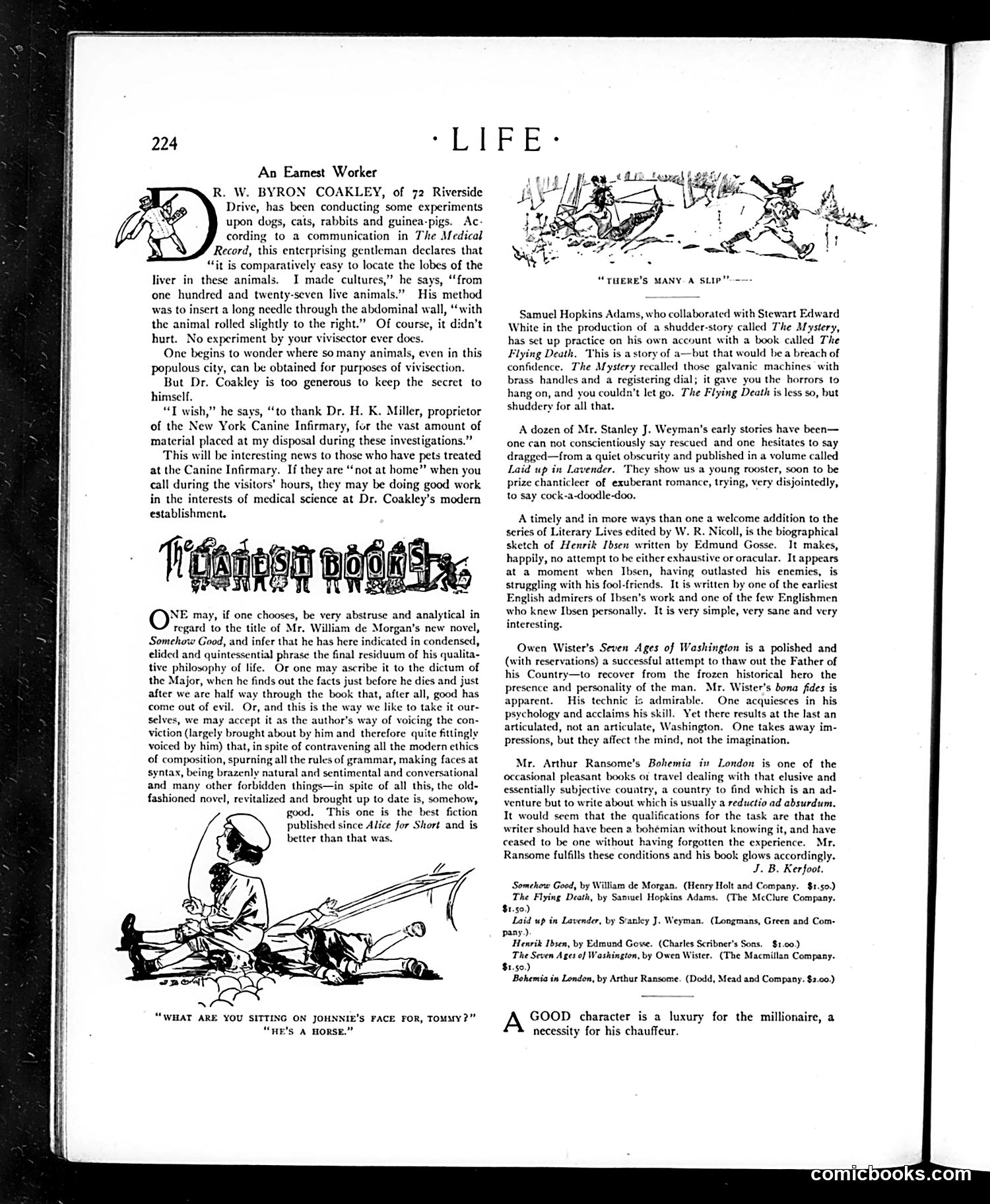
This page critiques **animal experimentation** through satirical reporting. The opening article describes Dr. R. W. Byron Coakley's vivisection research on 127 live animals, inserted with needles to study liver lobes. Life's satire lies in its deadpan tone—Coakley claims experiments "didn't hurt," while the magazine sarcastically notes he sourced animals from the New York Canine Infirmary, implying pet owners' missing animals were being used for research without knowledge. The cartoon below shows a child sitting on another child's face, captioning it "He's a horse"—a visual pun about the absurdity of justifying harm through reframing. The page also reviews literary works, including criticism of William de Morgan's *Somehow Good*, praising old-fashioned novels despite violating modern compositional rules. **Context**: This reflects early 1900s concerns about unregulated vivisection and medical ethics, attacking what Life considered exploitative practices disguised as scientific progress.
📄 Transcribed text from this page (OCR, searchable)
Machine-transcribed from the original scan — historical spelling and the odd misread are preserved.
“LIFE: An Eamest Worker R. W. BYRON COAKLEY, of 72 Riverside Drive, has been conducting some experiments upon dogs, cats, rabbits and guinea-pigs. Ac- cording to a communication in The Medical Record, this enterprising gentleman declares that “it is comparatively easy to locate the lobes of the liver in these animals. I made cultures,” he says, “from one hundred and twenty-seven live animals.” His method was to insert a long needle through the abdominal wall, “with the animal rolled slightly to the right.” Of course, it didn’t hurt. No experiment by your vivisector ever docs. One begins to wonder where so many animals, even in this populous city, can be obtained for purposes of vivisection. But Dr. Coakley is too generous to keep the secret to himself. “T wish,” he says, “to thank Dr. H. K. Miller, proprietor of the New York Canine Infirmary, for the vast amount of material placed at my disposal during these investigations.” This will be interesting news to those who have pets treated at the Canine Infirmary. If they are “not at home” when you call during the visitors’ hours, they may be doing good work in the interests of medical science at Dr. Coakley’s modern establishment. CDSE mays if one chooses, be very abstruse and analytical in regard to the title of Mr. William de Morgan’s new novel, Somehow Good, and infer that he has here indicated in condensed, elided and quintessential phrase the final residuum of his qualita- tive philosophy of life. Or one may ascribe it to the dictum of the Major, when he finds out the facts just before he dies and just after we are half way through the book that, after all, good has come out of evil. Or, and this is the way we like to take it our- selves, we may accept it as the author's way of voicing the con- viction (largely brought about by him and therefore quite fittingly voiced by him) that, in spite of contravening all the modern ethics of composition, spurning all the rules of grammar, making faces at syntax, being brazenly natural and sentimental and conversational and many other forbidden things—in spite of all this, the old- fashioned novel, revitalized and brought up to date is, somehow, good. This one is the best fiction published since Alice for Short and is better than that was. “WHAT ARE YOU SITTING ON JOHNNIE’S PACE FOR, TOMMY?” “HE'S A HORSE.” “THERE'S MANY. A SLIP” -—- Samuel Hopkins Adams, who collaborated with Stew: White in the production of a shudder-story called The Mystery, has set up practice on his own account with a book called The Flying Death. This is a story of a—but that would bea breach of confidence. The Mystery recalled those galvanic machines with brass handles and a registering dial; it gave you the horrors to hang on, and you couldn't let go. The Flying Death is less so, but shuddery for all that. A dozen of Mr. Stanley J. Weyman’s early storics have been— one can not conscientiously rescued and one hesitates to say dragged—from a quiet obscurity and published in a volume called y show us a young rooster, soon to be prize chanticleer of exuberant romance, trying, very disjointedly, to say cock-a-doodle-doo. A timely and in more ways than one a welcome addition to the scries of Literary Lives edited by W. R. Nicoll, is the biographical sketch of Henrik Ibsen written by Edmund Gosse. It makes, happily, no attempt to be cither exhaustive or oracular. It appears ata moment when Ibsen, having outlasted his enemies, is struggling with his fool-friends. It is written by one of the earliest English admirers of Ibsen’s work and one of the few Englishmen who knew Ibsen personally. It is very simple, very sane and very interesting. Owen Wister’s Seven Ages of Washington is a polished and (with reservations) a successful attempt to thaw out the Father of his Country—to recover from the frozen historical hero the presence and personality of the man. Mr. Wister’s bona fides is apparent. His technic i One acquiesces in his psychology and acclaims his skill. Yet there results at the last an articulated, not an articulate, Washington. One takes away im- pressions, but they affect the mind, not the imagination. Mr. Arthur Ransome’s Bohemia in London is one of the occasional pleasant books ot travel dealing with that elusive and essentially subjective country, a country to find which is an ad- venture but to write about which is usually a reductio ad absurdum. It would secm that the qualifications for the task are that the writer should have been a boh¢mian without knowing it, and have ceased to be one without having forgotten the experience. Mr. Ransome fulfills these conditions and his book glows accordingly. J.B. Kerfoot. Somehow Good, by William de Morgan. (Henry Holt and Company. $1.50.) The Flying Death, by Samuel Hopkins Adams. (The McClure Company. $1.50.) Laid up in Lavender, by Stankey J. Weyman. (Longmans, Green and Com- pany.) Henrik Ibsen, by Edmund Gowe. (Charles Scribner's Sons. $1.00.) The Seven Ages of Washington, by Owen Wister. (The Macmillan Company. $1.50.) Bohemia in London, by Arthur Ransome. (Dodd, Mead and Company. $2.00.) A GOOD character is a luxury for the millionaire, a necessity for his chauffeur. comicbooks.com