
Life, 1908-02-27 · page 7 of 20
Life — February 27, 1908 — page 7: what you’re looking at
What you’re looking at
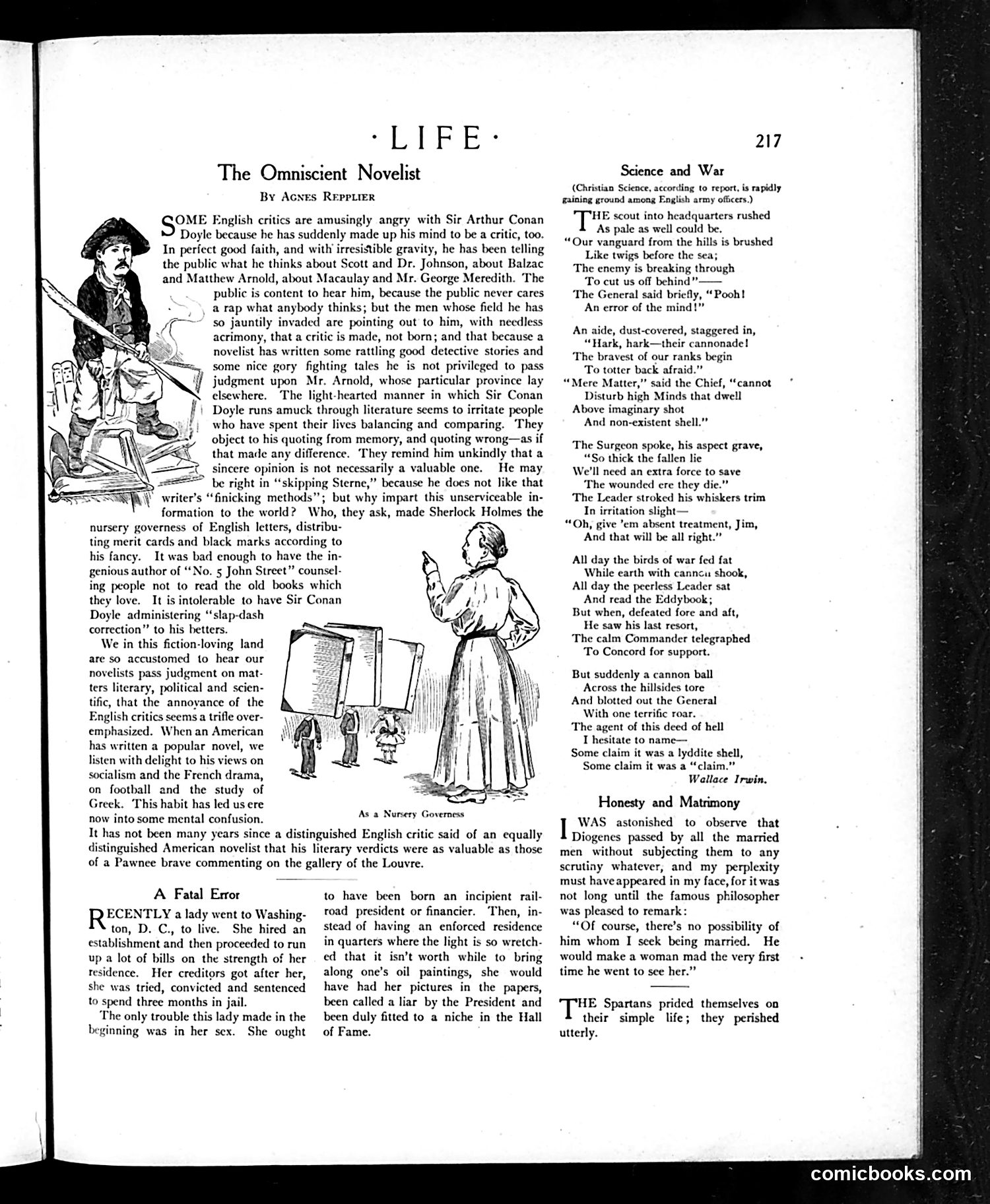
This page satirizes English literary critics who attack Sir Arthur Conan Doyle for becoming a critic himself. The article argues that critics unfairly judge novelists—especially Doyle—for writing detective and war stories, claiming such work disqualifies them from literary judgment. The accompanying illustration depicts a nursery governess overwhelmed by books, labeled "As a Nursery Governess," likely mocking how critics position themselves as authorities on all subjects. The satire's point: English critics are hypocritically arrogant, dismissing working novelists' right to critique literature while the critics themselves lack comparable creative achievements. The piece defends Doyle's intellectual credibility against snobbish literary gatekeeping.
📄 Transcribed text from this page (OCR, searchable)
Machine-transcribed from the original scan — historical spelling and the odd misread are preserved.
“LIFE The Omniscient Novelist By Acnes REPPLIER gly angry with Sir Arthur Conan Doyle because he has suddenly made up his mind to be a critic, too. In perfect good faith, and with irresistible gravity, he has been telling the public what he thinks about Scott and Dr. Johnson, about Balzac and Matthew Arnold, about Macaulay and Mr. George Meredith. The public is content to hear him, because the public never cares a rap what anybody thinks; but the men whose field he has so jauntily invaded are pointing out to him, with needless acrimony, that a critic is made, not born; and that because a novelist has written some rattling good detective stories and some nice gory fighting tales he is not privileged to pass judgment upon Mr. Arnold, whose particular province lay elsewhere. The light-hearted manner in which Sir Conan Doyle runs amuck through literature seems to irritate people who have spent their lives balancing and comparing. They object to his quoting from memory, and quoting wrong—as if that made any difference. They remind him unkindly that a sincere opinion is not necessarily a valuable one. He may be right in “skipping Sterne,” because he does not like that iter’s “finicking methods”; but why impart this unserviceable in- formation to the world? Who, they ask, made Sherlock Holmes the nursery governess of English letters, distribu- ting merit cards and black marks according to his fancy. It was bad enough to have the in- genious author of “No. 5 John Street” counsel- ing people not to read the old books which they love. It is intolerable to have Sir Conan Doyle administering “‘slap-dash correction” to his betters. We in this fiction-loving land are so accustomed to hear our novelists pass judgment on mat- ters literary, political and scien- tific, that the annoyance of the English critics seems a trifle over- emphasized. When an American has written a popular novel, we listen with delight to his views on socialism and the French drama, on football and the study of This habit has led us ere into some mental confusion. It has not been many years since a distinguished English critic said of an equally distinguished American novelist that his literary verdicts were as valuable as those of a Pawnee brave commenting on the gallery of the Louvre. OME English critics are amu: As a Nursery Governess A Fatal Error RECENTLY a lady went to Washing- ton, D. C., to live. She hired an establishment and then proceeded to run up a lot of bills on the strength of her residence. Her creditors got after her, she was tried, convicted and sentenced to spend three months in jail. The only trouble this lady made in the beginning was in her scx. She ought to have been born an incipient rail- road president or financier. Then, in- stead of having an enforced residence in quarters where the light is so wretch- ed that it isn’t worth while to bring along one’s oil paintings, she would have had her pictures in the papers, been called a liar by the President and been duly fitted to a niche in the Hall of Fame. 217 Science and War (Christian Science, according to report, is rapidly gaining ground among English army officers.) HE scout into headquarters rushed As pale as well could be. “Our vanguard from the hills is brushed Like twigs before the sea; The enemy is breaking through ‘To cut us off behind” — ‘The General said briefly, “Pooh! An error of the mind!” An aide, dust-covered, staggered in, “Hark, hark—their cannonade! ‘The bravest of our ranks begin To totter back afraid.” “Mere Matter,” said the Chief, “cannot Disturb high Minds that dwell Above imaginary shot And non-existent shell.” The Surgeon spoke, his aspect grave, “So thick the fallen lie We'll need an extra force to save ‘The wounded ere they die.” The Leader stroked his whiskers trim In irritation slight— “Oh, give ’em absent treatment, Jim, And that will be all right.” All day the birds of war fed fat While earth with canncu shook, All day the peerless Leader sat And read the Eddybook; But when, defeated fore and aft, He saw his last resort, The calm Commander telegraphed To Concord for support. But suddenly a cannon ball Across the hillsides tore And blotted out the General With one terrific roar. The agent of this deed of hell T hesitate to name— Some claim it was a lyddite shell, Some claim it was a “claim.” Wallace Irwin. Honesty and Matrimony I WAS astonished to observe that Diogenes passed by all the married men without subjecting them to any scrutiny whatever, and my perplexity must have appeared in my face, for it was not long until the famous philosopher was pleased to remark: “Of course, there’s no possibility of him whom I seek being married. He would make a woman mad the very first time he went to see her.”” "THE Spartans prided themselves on their simple life; they perished utterly. comicbooks.com